
Setting up a company in a Dubai free zone is a game-changing move for entrepreneurs around the world. It gives you a direct path to 100% foreign ownership, zero personal income tax, and the freedom to repatriate all your profits. This model means you can build your business in one of the world's most dynamic economic hubs without needing a local partner—a powerful and straightforward way to enter the market.
Why a Dubai Free Zone Is Your Strategic Business Advantage

Choosing a Dubai free zone isn't just a logistical step; it’s a foundational business decision that gives you a serious competitive edge. These specialised economic areas are specifically designed to pull in foreign investment by cutting through the usual red tape you'd find elsewhere. For entrepreneurs and established companies, this means more control, better profits, and total operational freedom.
The single biggest draw? The ability to own your business outright. Unlike setting up on the mainland, which often requires a local partner, free zones let you keep 100% control over your company’s direction, decisions, and equity. That kind of autonomy is invaluable for startups, SMEs, and even multinationals looking to roll out their global strategies without local interference.
Unlocking Financial Freedom and Growth
Beyond ownership, the financial perks are what really get businesses excited. Imagine a setup where you can reinvest every single dirham of profit back into your company’s growth, with no deductions for personal income tax. That’s the reality in a Dubai free zone. You can also send 100% of your capital and profits back to your home country whenever you want, giving you complete financial flexibility.
These benefits are central to Dubai's economic strategy. The city's 2025 Economic Vision is counting on free zones to attract over 10,000 new companies, powered by these exact incentives. For small and medium-sized enterprises (SMEs)—which already make up nearly 40% of Dubai's GDP—the deal is even sweeter. This includes a minimal 9% corporate tax that only applies to profits over AED 375,000 and exemptions on customs duties that slash import costs.
This pro-business climate creates a powerful engine for growth. When you combine tax efficiency with unrestricted profit movement, you simply have more cash on hand to scale up, innovate, or break into new markets.
To give you a clearer picture, here’s a quick rundown of the major perks.
Key Benefits of Dubai Free Zone Company Formation at a Glance
| Benefit | Impact on Your Business |
|---|---|
| 100% Foreign Ownership | You maintain full control over your business decisions, strategy, and equity without needing a local partner. |
| Zero Personal Income Tax | Maximise your personal earnings and reinvest more capital back into your business. |
| 100% Profit Repatriation | Freely transfer all your capital and profits back to your home country at any time, ensuring total financial flexibility. |
| Corporate Tax Advantages | Benefit from a low 9% corporate tax rate, which only applies to profits exceeding AED 375,000. |
| Customs Duty Exemption | Reduce your operational costs by importing goods and materials into the free zone without paying customs duties. |
| World-Class Infrastructure | Access modern offices, warehousing, and top-tier connectivity designed to support global business operations. |
These advantages work together to create an environment where international businesses don't just survive—they thrive.
The Power of a Purpose-Built Ecosystem
Each free zone operates like a self-contained business community, often built around specific industries like technology, media, or commodities. This clustering creates amazing networking opportunities and gives you direct access to a pool of skilled talent. A tech startup in Dubai Internet City, for instance, is right in the middle of industry giants and fellow innovators, which naturally sparks collaboration and growth.
A Dubai free zone is not just a location; it's an integrated platform for international business. It combines world-class infrastructure, simplified regulations, and strategic financial benefits to create an environment where global companies can thrive.
Of course, navigating this landscape requires some local know-how. The process involves specific documents, approvals, and sticking to the rules of your chosen free zone. This is where partnering with a specialist like Smart Classic Business Hub can turn a complicated journey into a clear, manageable process. We make sure your company formation is smooth and compliant from day one. You can read more about the numerous benefits of setting up a business in Dubai to fully grasp the opportunities waiting for you. Getting this strategic support right from the start lets you focus on what really matters—building your business.
Choosing the Right Free Zone for Your Business
Picking the right free zone for your company setup in Dubai is probably the single most important decision you'll make. It’s so much more than getting a postcode for your trade license; it's about plugging into a purpose-built ecosystem designed to help your specific industry win. A common mistake I see entrepreneurs make is treating this as a simple cost comparison, which can seriously limit your growth before you even start.
The right choice aligns your business goals with a community, infrastructure, and regulatory framework that actually supports them. For example, a fintech startup would feel instantly at home in Dubai International Financial Centre (DIFC), surrounded by VCs and top-tier financial institutions. A global commodities trader, on the other hand, would naturally gravitate towards the Dubai Multi Commodities Centre (DMCC) for its specialised trading platforms and powerful industry network.
This alignment is everything. It's the difference between just operating in Dubai and truly thriving here.
Matching Your Business Activity to a Specialised Zone
Your very first filter should always be your business activity. Dubai’s free zones aren't a one-size-fits-all solution; they are highly specialised hubs. Trying to set up a media production company in a logistics-focused zone, for instance, would be a nightmare of inefficiency and unnecessary red tape.
To make a smart choice, you have to dig into what each zone actually offers.
- For Tech and Innovation: Look at zones like Dubai Internet City (DIC) and Dubai Silicon Oasis (DSO). They provide an environment packed with tech talent, networking events, and the digital infrastructure you need.
- For Trading and Logistics: Jebel Ali Free Zone (JAFZA) is the global titan here, offering unmatched connectivity to one of the world's busiest ports. It's the undisputed champion for import, export, and manufacturing.
- For Professional Services and Consulting: Newer, more agile zones like the International Free Zone Authority (IFZA) are perfect for consultants, service providers, and global entrepreneurs. They offer cost-effective, rapid setups with maximum flexibility.
This specialisation is a cornerstone of Dubai’s economic strategy. The city's 30 active free zones (as of June 2025, with another on the way) are the bedrock of its business-friendly reputation, part of over 40 multi-sector zones across the UAE. For instance, Dubai Internet City (DIC), founded way back in 1999, was the region's first tech hub and now hosts IT giants alongside disruptive startups. In contrast, IFZA, launched in 2018, is built for SMEs and entrepreneurs who need fast, turnkey services. You can discover more insights about the complete list of Dubai free zones on Smart Indexes.
Beyond the Obvious: Location and Costs
While your business activity will narrow down the list, other critical factors come into play. A cheap license might look good on paper, but hidden costs or a poor location could hamstring your business in the long run.
Think about these crucial elements:
- Physical Location and Accessibility: Do you need to be close to an airport, seaport, or a specific city centre for your clients or logistics? A free zone in a remote area might be cheaper, but you could end up paying more in transport and time.
- Available Facilities: What do you really need? A prestigious corporate office, a simple flexi-desk, or a massive warehouse? Each zone has different real estate options with very different price tags.
- Reputation and Credibility: A well-established name like DMCC or DIFC adds a layer of credibility that is invaluable, especially when you're opening corporate bank accounts or trying to impress international partners.
- Scalability: Does the free zone have a clear path for growth? How easily can you upgrade from a flexi-desk to a physical office and add more visas as your team expands?
Choosing a free zone is like choosing a business partner. You need one that understands your industry, supports your vision, and provides the resources you need to succeed—not just a landlord who rents you a desk.
Let's run through a quick scenario. An international marketing consultant wants a quick, affordable setup with zero fuss. They don't need a big office but absolutely require a credible license and an easy visa process. For them, IFZA is a perfect match. Its streamlined procedures and competitive pricing for service-based businesses make it a no-brainer.
Making the Final Decision with Expert Guidance
Trying to weigh all these factors can feel completely overwhelming, especially if you're new to the local market. Every free zone has its own unique rulebook, documentation requirements, and fee structures. This complexity is exactly why partnering with a business setup consultant like Smart Classic Business Hub makes such a difference.
We do a lot more than just fill out forms; we provide strategic advice. We take the time to understand your business model, target market, and long-term ambitions. From there, we can recommend the one or two free zones that are genuinely the best fit for you. This kind of guidance saves you time, prevents expensive mistakes, and ensures your company is built on a solid foundation.
If you're still weighing your options, you might find our detailed comparison of mainland vs free zone company setup in Dubai helpful.
Your Blueprint for Company Registration and Licensing
Once you’ve locked in the perfect free zone, it’s time to dive into the actual registration and licensing process. This is where your business idea officially transforms from a plan on paper into a legal, operational entity. Think of it as a structured journey with specific milestones. Getting each one right is the key to a smooth and speedy setup.
The whole process for company formation in a Dubai free zone is built for efficiency, but it demands absolute precision. A tiny mistake in your application or a poorly chosen trade name can lead to frustrating delays and costs you didn't budget for. This blueprint will walk you through each stage, from pinning down your business activities to finally getting that all-important licence in hand.
Defining Your Business Activities and Trade Name
The very first practical step is to clearly define every single business activity you plan on doing. Free zone authorities are incredibly specific about this—your licence will only permit you to operate within the activities you list. Be thorough and think ahead. Adding activities later can be a real hassle.
For example, if you're a marketing agency, don't just put "Marketing." That’s too vague and will get your application rejected. Instead, list specifics like "Digital Marketing Services," "Social Media Management," and "Content Creation."
Next up is your trade name. This isn't just about branding; it has to follow strict UAE naming conventions. Your chosen name can't be offensive, linked to any religion, or use names of famous existing companies. Trying to use words like "Global" or "International" often requires extra justification and higher fees.
Insider Tip: Always come prepared with three to five trade name options, listed in order of preference. Your first choice is often already taken, and having backups ready prevents your application from stalling right at the start.
The Application and Initial Approval Phase
With your activities and trade name sorted, you can get started on the formal application. This is where you’ll submit your core documents to the free zone authority you've chosen. While the specific requirements can differ slightly between zones, the foundational documents are pretty much standard across the board.
You will almost always need to provide:
- A completed application form specific to that free zone.
- Passport copies for all shareholders and the appointed manager.
- A concise but solid business plan that outlines your goals, services, and target market.
- Passport-sized photographs with a white background for everyone involved.
The free zone authority reviews this package to make sure everything lines up with their regulations. If it's all in order, they’ll issue an Initial Approval. This is a major milestone. It confirms that the authorities have no objection to your proposed business and gives you the green light to move on to the next legal steps.
This visual shows the main stages, from your first evaluation to the final setup.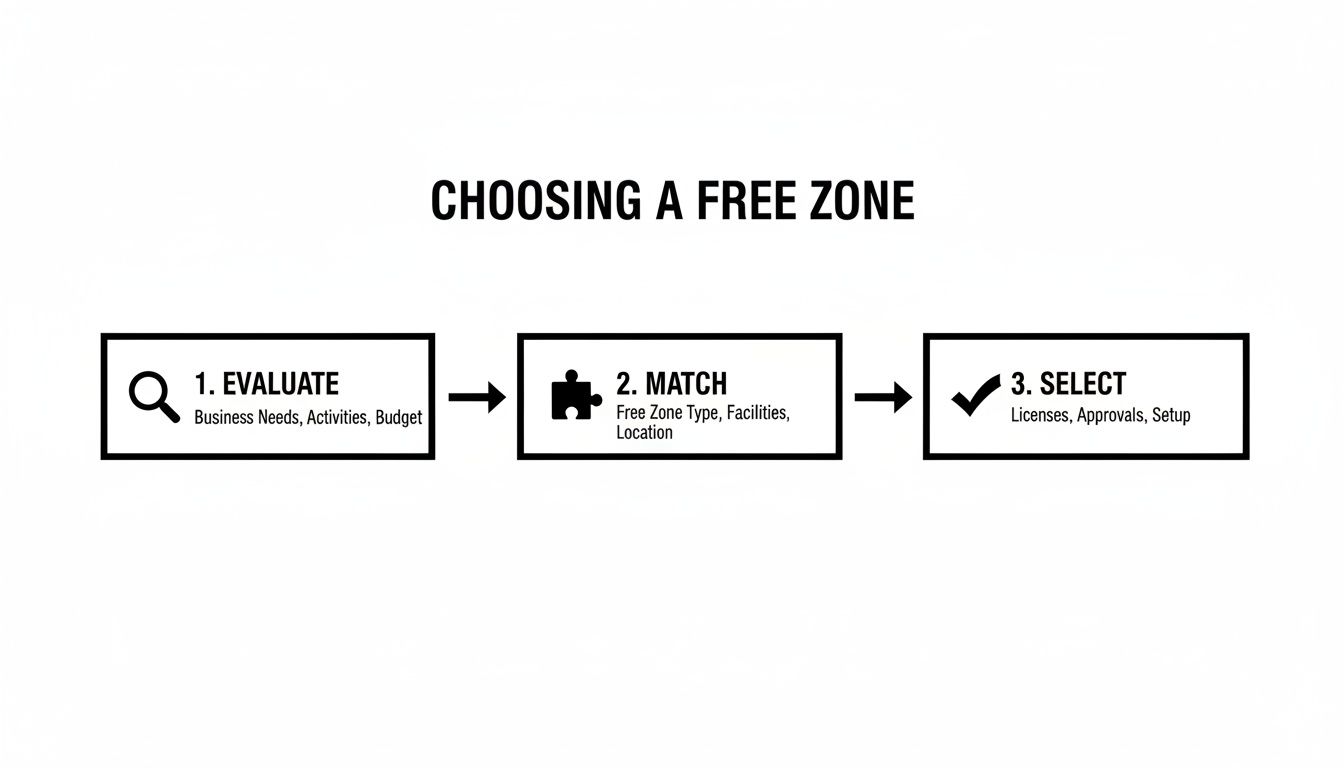
The infographic breaks the journey down simply, showing that success really comes down to carefully evaluating your needs, matching them to a zone’s specialty, and then making a smart, informed choice.
Finalising Legal Documents and Payments
After getting your initial approval, the next stage is all about signing the legal paperwork that officially forms your company. This usually includes the Memorandum of Association (MOA) and Articles of Association (AOA), which spell out the company's structure, shareholding, and operational rules.
For a single-shareholder company, this is usually quite straightforward. But for a company with multiple shareholders (an FZCO), all partners might need to be there in person to sign, unless they've appointed someone with a legal Power of Attorney.
Once the legal documents are signed and submitted, you'll get an invoice for the registration and licence fees. It's critical to pay this quickly to keep things moving. These fees typically cover:
- The company registration fee
- The first year's trade licence fee
- Costs for your office or flexi-desk lease
- The establishment card fee
Paying these fees is the very last hurdle before the free zone authority issues your official business licence.
Receiving Your Business Licence and Establishment Card
This is the moment you’ve been working towards. Once your payment is confirmed and all legal documents are processed, the free zone authority will issue your trade licence. This is your official permission to operate your business within that free zone. For a complete rundown of what's involved, you can learn more about the Dubai trade license process in our dedicated guide.
Along with your licence, you’ll also get other vital company documents:
- Certificate of Incorporation
- Share Certificates for each owner
- The Lease Agreement for your office or flexi-desk
Finally, you’ll receive your Establishment Card. This small but powerful card is basically your company’s ID file with the immigration authorities. You absolutely need it to start applying for residency visas for yourself and your employees, which is the next big step on your journey.
Getting through this multi-stage process requires a sharp eye for detail. Working with a PRO services team like Smart Classic Business Hub ensures every document is prepared and submitted correctly, avoiding the common errors that cause delays. Our experience in company formation in a Dubai free zone means we handle the entire administrative load, freeing you up to focus on what really matters—launching your business.
Securing Visas and Corporate Bank Accounts
With your trade licence and establishment card in hand, your business officially exists on paper. Congratulations. But the journey isn't over yet. The next phase is about bringing your company to life—getting people on the ground and money in the bank.
This means tackling two crucial, and often surprisingly tricky, processes: securing residency visas for yourself and your team, and opening a UAE corporate bank account.
Many entrepreneurs get caught out here. A tiny mistake on a visa application or an unprepared meeting with a banker can stall your progress for weeks, even months. Getting these final steps right is what separates a smooth launch from a frustrating one, and it's essential for anyone serious about company formation in a Dubai free zone.
The UAE Residency Visa Process
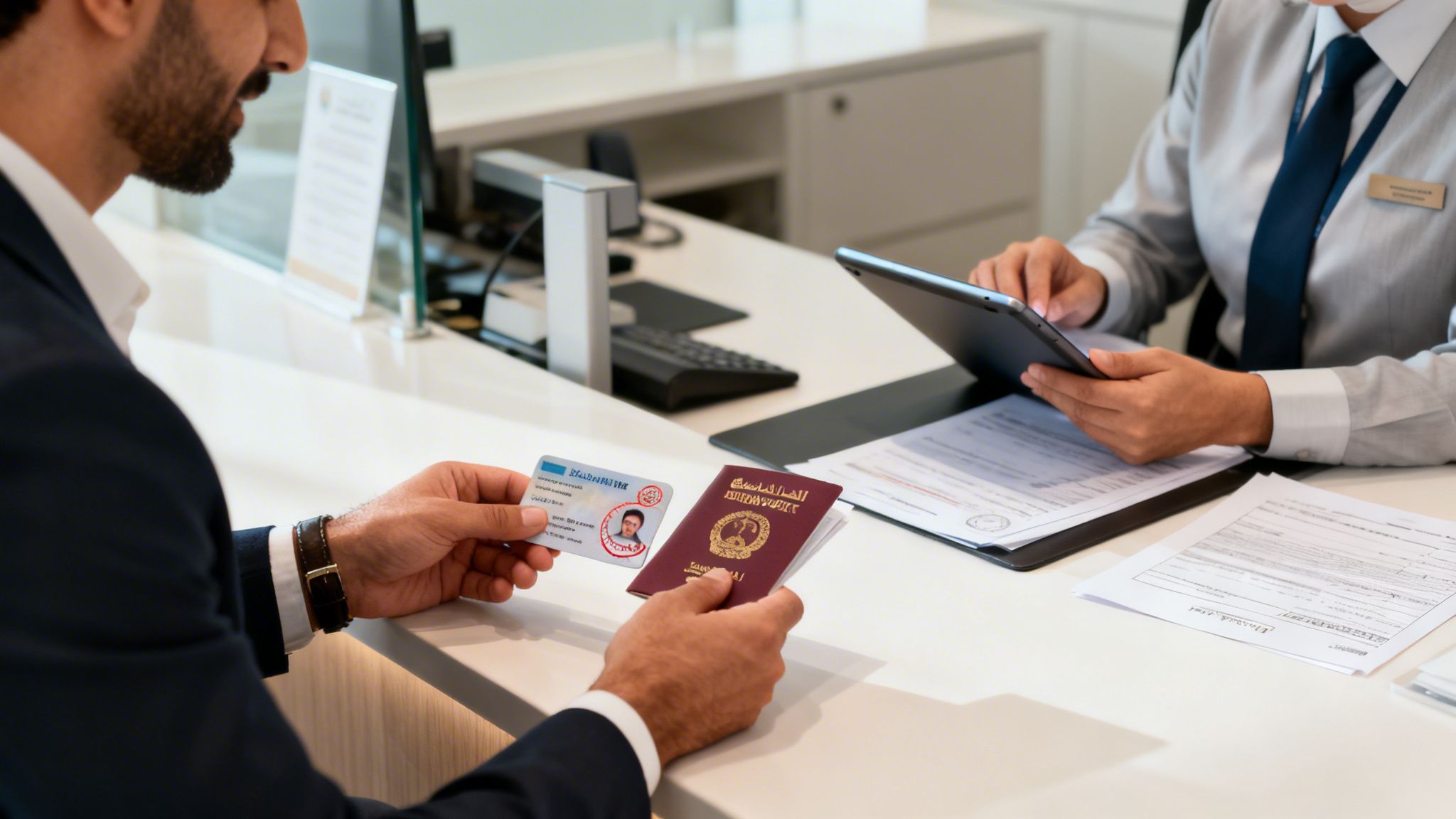
Think of your establishment card as the key that unlocks the entire visa system. It registers your new company with the immigration authorities, granting you the power to sponsor visas for shareholders, employees, and even their families. The process itself is a series of non-negotiable steps that must be followed in the correct order.
It all starts with applying for an entry permit. This is the document that allows you to enter the UAE specifically to complete your residency. Once you're in the country on this permit, the clock starts ticking.
Next up is the mandatory medical fitness test, which involves a standard blood test and chest X-ray to screen for certain communicable diseases. After that, you'll need to register your biometrics—fingerprints and a photo—at an official centre to get your Emirates ID application underway.
The final leg of the journey involves:
- Submitting all your paperwork: This includes the medical results, Emirates ID application, and your original passport.
- Getting your visa stamp: A residency visa sticker is placed inside your passport, making you an official UAE resident.
- Collecting your Emirates ID: This is your official identification card in the UAE, and you'll need it for almost everything, from renting a flat to signing up for a phone plan.
Every one of these steps has to be done in person. While the path is clear, it demands careful coordination and flawless paperwork.
Opening Your Corporate Bank Account
Be warned: opening a corporate bank account in the UAE is not the simple formality it once was. Banks are under immense pressure to comply with strict international anti-money laundering (AML) and know-your-customer (KYC) regulations. A trade licence alone just doesn't cut it anymore.
Banks need to see a real, legitimate business with a clear path to profitability. They’re looking for solid proof that your company will be active, not just a shell entity. A vague or poorly thought-out business plan is one of the fastest routes to rejection.
To give yourself the best shot, you need to build a compelling story around your business. You should be ready to hand over:
- A detailed and professional business plan.
- The CVs of all shareholders, showcasing their relevant experience.
- Details about your target customers and key suppliers.
- Any proof of business activity you might have, like initial contracts or invoices.
Banks in the UAE aren't just opening an account; they are starting a business relationship. They need to be convinced that your company is a credible, low-risk partner with a genuine reason for banking here.
A face-to-face meeting with a bank representative is almost always part of the process. You'll need to confidently explain your business model, who you'll be trading with, and what your expected transaction volumes look like.
One of the biggest hurdles for new setups is the minimum balance requirement. Many banks insist on a significant average monthly balance, and if you dip below it, you could be hit with steep fees or even have your account closed.
This is where having the right connections can completely change the game. At Smart Classic Business Hub, we use our long-standing relationships with numerous UAE banks to your advantage. We help you build a bulletproof application and introduce you to bankers who actually understand the challenges new businesses face, turning a potential headache into a straightforward step.
Staying Compliant: Your Financial and Legal Duties
Getting your trade licence is a huge milestone, but it’s really just the beginning of your journey. To build a business that lasts, you need to get a handle on your ongoing financial and legal responsibilities right from the start. This isn't just about ticking boxes; it's about good governance that protects your company and sets it up for long-term success.
Think of it this way: understanding your obligations early on saves you from last-minute headaches and nasty surprises like fines. The big three you need to master are corporate tax, Value Added Tax (VAT), and your annual renewals. Nail these, and you'll be running a smooth, compliant, and stress-free operation in the UAE.
Getting to Grips with UAE Corporate Tax
One of the biggest recent changes in the UAE's business world has been the introduction of a federal corporate tax. While Dubai's free zones are legendary for their tax benefits, "tax-free" doesn't mean you can ignore your obligations anymore. The new system is still incredibly competitive, but it brings the UAE in line with global standards.
The headline rate is a very low 9%. But here’s the key part for startups and small businesses: there's a AED 375,000 tax-free threshold. This means you only pay corporate tax on profits above that amount. If your annual profit is less than AED 375,000, you pay zero tax. Simple as that. However, you still have to register for corporate tax and file your returns, even if you don't owe anything.
When to Register for VAT
Value Added Tax, or VAT, is another core financial duty. It’s a tax on most goods and services, but it only kicks in for your business once you reach a certain revenue level. You are legally required to register for VAT once your taxable sales and imports top AED 375,000 within any 12-month period.
Imagine you're running a marketing consultancy from a Dubai free zone. Your client base is growing steadily. The moment your total revenue over the past 12 months hits AED 375,001, the clock starts ticking. You have 30 days to register for VAT with the Federal Tax Authority (FTA). Missing that deadline can lead to some hefty penalties, so it's something you need to monitor closely.
Your financial obligations aren’t just chores; they’re a live dashboard of your business's health and integrity. Solid bookkeeping and timely filings build a rock-solid foundation of trust with authorities, banks, and future investors.
Annual Renewals and Audits: Keeping Your Licence Active
Every single company in a Dubai free zone has to renew its trade licence every year. This is non-negotiable. The process usually involves submitting a few updated documents and paying the renewal fees to your free zone authority. It's the essential step to keeping your company legally operational.
On top of that, many free zones require you to prepare and submit an audited financial statement each year. This isn't just paperwork; it’s a professional check-up on your company's financial health, conducted by a licensed external auditor. It gives you, and the authorities, a clear, verified picture of your business performance.
The appeal of this well-regulated environment is clear. Just look at the Dubai Multi Commodities Centre (DMCC) Free Zone, which welcomed over 1,100 new businesses in the first half of 2025 alone, bringing its total to nearly 26,000 companies. You can see the full story on DMCC's impressive growth on Mitchell's Commercial Realty.
At Smart Classic Business Hub, we take the pain out of these ongoing tasks. From VAT-compliant accounting to managing your annual licence renewal, we make sure you're always compliant, leaving you free to focus on what you do best: growing your business.
Your Questions About Dubai Free Zone Setup, Answered
When you're looking at setting up a company in a Dubai free zone, a lot of questions come to mind. It’s only natural. Getting straight answers is key to moving forward with confidence and avoiding those classic, costly mistakes.
Here, we tackle the most common queries we get from entrepreneurs who are exactly where you are right now. No jargon, no fluff—just practical answers to help you on your way.
What’s the Real Cost to Set Up a Company in a Dubai Free Zone?
This is always the first question, and the honest answer is: there's no one-size-fits-all price. The total investment for your company formation in a Dubai free zone depends entirely on your specific needs. A lean, one-visa setup could start from around AED 12,000, but that figure can easily go up.
The final cost comes down to a few key things:
- Which free zone you pick: A prestigious zone like DMCC will have a higher price point than a more SME-focused one like IFZA.
- Your business activity: Specialised fields, like finance or high-level consulting, often need extra approvals, which adds to the licence fee.
- How many visas you need: Each visa comes with its own government fees for the entry permit, medical tests, and Emirates ID processing.
- Your office setup: A flexi-desk is the most budget-friendly choice. A dedicated physical office, on the other hand, will significantly raise your initial outlay and ongoing costs.
A critical piece of advice: always insist on a fully itemised quote. It should break down every single government fee and service charge. This is the only way to budget properly and avoid nasty surprises. Any reputable partner will provide this level of transparency from the start.
Can I Run My Free Zone Company from Outside the UAE?
Absolutely. You can own and manage your Dubai free zone company from anywhere in the world. This is a huge draw for international business owners who want a UAE footprint without having to relocate.
However, it's not a completely hands-off process. A few key steps require you to be physically in the UAE—and you can't send someone else to do them. You’ll need to be here to complete your residency visa process, which includes the medical fitness test and biometrics for your Emirates ID.
Opening a corporate bank account also nearly always requires an in-person meeting. This is where we step in for our clients. We plan their trips meticulously, lining up all appointments to get every in-person task done in one efficient visit. It saves a ton of time and travel expenses.
Do I Really Need a Physical Office to Get Started?
Not necessarily. The old idea that every company needs a traditional office is long gone. Today, most free zones offer flexible, cost-effective solutions that are perfect for startups, consultants, and solo entrepreneurs.
Flexi-desks and co-working memberships are incredibly popular. They fulfil the legal requirement of having a registered business address without the headache of a long-term lease, utility bills, and fit-out costs. The type of facility you choose often determines how many visas you're eligible for. A basic package might get you one or two visas; if you need more, you'll likely have to upgrade to a larger space. We can help you find the sweet spot between what you need and what’s most economical.
What’s the Main Difference Between a Free Zone and a Mainland Company?
This is a big strategic decision, and it boils down to two main points: ownership and market access.
Ownership: A free zone company gives you 100% foreign ownership. You are in complete control. With a mainland company, most activities still require you to have a UAE national as a majority shareholder or a local service agent.
Market Access: A free zone company is licensed to do business within its zone and internationally. To sell directly to customers in the wider UAE market (outside of other free zones), you generally need a local distributor. A mainland company, however, can trade anywhere in the UAE without any restrictions.
While both setups are now subject to the 9% corporate tax, free zone companies often benefit from an exemption on customs duties for imports and exports—a massive advantage if you're in the trading business.
Ready to get the details of your company formation in a Dubai free zone sorted with an expert who knows the ropes? The team at Smart Classic Business Hub provides clear, straightforward guidance at every turn, making sure your setup is smooth, compliant, and perfectly aligned with your vision. Start your journey with a free consultation today.