
You're probably in the same position as most new investors entering the UAE. You've identified the market, narrowed your activity, maybe even shortlisted Dubai, Abu Dhabi, or a specific free zone. Then the friction starts. Mainland or free zone. One visa or several. Shared desk or private office. Trading, consultancy, e-commerce, holding, or industrial. Every answer affects the next one.
That's why the first serious decision isn't the licence application. It's choosing the right adviser. Among company formation consultants in UAE, the difference between a transactional agent and a strategic partner shows up fast in cost control, setup speed, banking readiness, and how smoothly the business operates after the licence is issued.
Why You Need a Company Formation Consultant in the UAE
A founder agrees to a low-cost setup package, signs the application, and gets the licence issued quickly. Two weeks later, the problems start. The approved activity does not match the sales model, the visa allocation is too tight, the bank asks questions the file cannot answer well, and the business ends up paying to restructure a setup that looked cheap on day one.
That is why a company formation consultant matters in the UAE. The job is not just filing documents. The first consultant you choose shapes jurisdiction, licence scope, visa planning, banking readiness, office commitments, and the compliance workload that follows. In practice, that choice affects cost, speed, and how easy the company is to operate after incorporation.
The consultant's strategic role
A good consultant starts with how the business will earn money.
They need to understand what you sell, where your customers are, whether you need direct UAE market access, how many people you plan to hire, whether inventory or warehousing is involved, and how much flexibility you need for future growth. Those answers drive the setup. Paperwork comes after.
Practical rule: The lowest setup quote is rarely the lowest-cost decision. The right structure saves money by avoiding amendments, extra approvals, and operational limits later.
This is also why experienced investors compare setup routes early, before choosing a package. If you are still weighing the operating model, this guide to mainland vs free zone in Dubai helps clarify which route fits your revenue plan and market access needs.
What a strong adviser helps you avoid
The common setup mistakes are rarely random. They usually come from making one early decision without testing the commercial impact.
- Wrong jurisdiction choice: A business is formed in a free zone because the entry cost looks attractive, then finds its core revenue depends on direct onshore trade.
- Licence and activity mismatch: The approved activity is too narrow, too broad, or poorly aligned with what the company will invoice for in practice.
- Weak planning after licence issuance: Visas, establishment card steps, bank compliance questions, VAT records, renewals, and tenancy requirements were never mapped properly.
- No single owner of the process: One provider handles incorporation, another handles immigration, another handles accounting, and no one checks whether the full structure still makes sense.
A seasoned consultant works as a project lead. They sequence decisions in the right order so one shortcut does not create three extra problems later.
What works in practice
The cleanest setups come from treating incorporation as a business design decision, not an admin purchase.
Founders who set the target market, staffing plan, budget range, and operating footprint first usually get faster approvals and fewer corrections later. They also end up with a company that is easier to renew, easier to explain to banks, and easier to scale once the first phase of trading begins.
Mainland Free Zone or Offshore Choosing Your Path
A founder picks a low-cost free zone package on Monday, signs a client in Dubai on Wednesday, and by Friday learns the company structure does not match how revenue will be earned. That is why this decision sits at the center of the setup process. The right consultant does more than file documents. They test the business model against the legal route before money is spent.
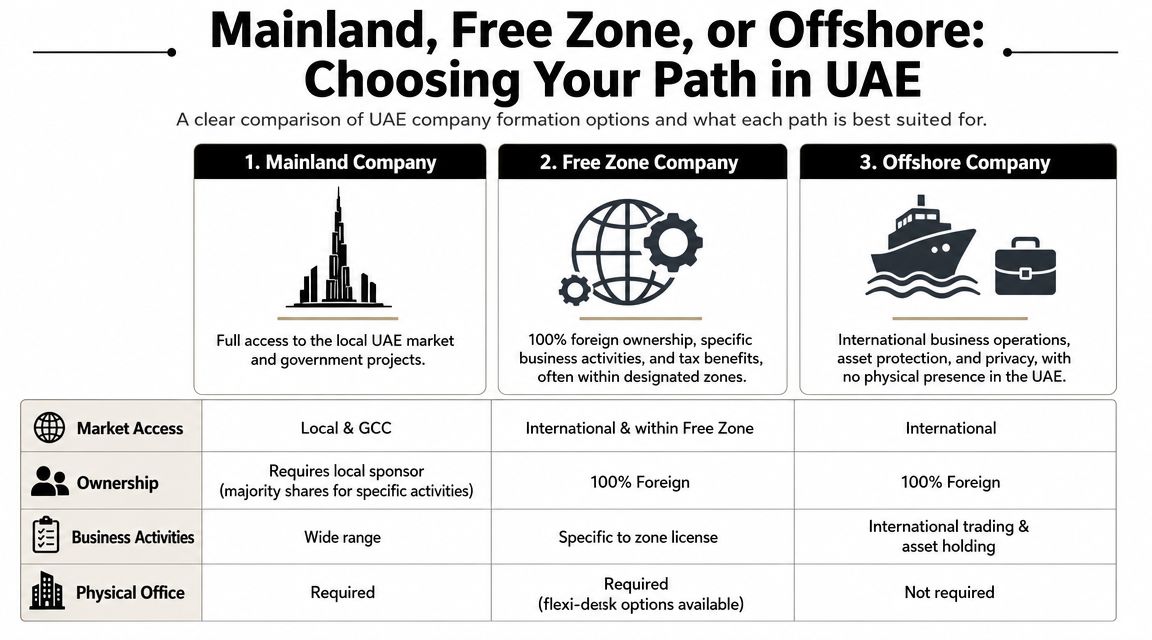
Choose mainland when the UAE market is your operating base
Mainland usually fits companies that plan to sell inside the UAE, meet clients locally, bid for onshore work, or build a broader physical presence over time. Service businesses, retail operations, technical trades, and firms expecting staff growth often start here because the structure gives them more room to operate in the local market.
The trade-off is straightforward. Mainland can involve more approvals, more attention to office requirements, and tighter review of regulated activities. A good consultant should test those points early, especially if your model includes professional services, contracting, healthcare, education, food, or any activity that may need external authority approval.
The right question is not which option sounds simpler. It is where the company will trade, hire, deliver, and invoice.
If you are weighing the two most common operating routes, this guide on mainland vs free zone in Dubai gives a useful side-by-side view.
Choose free zone when the business needs efficiency and a narrower scope
Free zone setups work well for founders who want foreign ownership, a cleaner launch process, and a structure aligned with consulting, digital services, trading, e-commerce, and export-focused models. They can be cost-effective and fast when the activity, visa plan, and customer base are clear from the start.
The mistake is treating any free zone as interchangeable with another. They are not. Eligibility rules, facility requirements, banking perception, visa allocation, and approved activities vary from one authority to the next. A consultant acting as a strategic adviser will compare those differences against your actual first-year plan, not just send a package list.
That matters even more if the company documents need careful drafting. For example, drafting your UAE MoA should reflect the intended activity set, ownership position, and operating scope properly from the beginning.
Choose offshore for holding and structuring, not day-to-day UAE operations
Offshore companies serve a different purpose. They are generally used for holding assets, owning shares, and managing international structures where a UAE trading presence is not required.
They are a poor fit for founders who need visas, a physical office, local staffing, or an active operating company inside the UAE. I regularly see offshore misunderstood as a cheaper version of free zone or mainland. It is not. Used correctly, it is useful. Used for the wrong objective, it creates delays and forces a restructure later.
A practical comparison
| Structure | Usually fits | Watch-outs |
|---|---|---|
| Mainland | Local trading, broader UAE operations, client-facing businesses | Activity approvals, office requirements, and onshore compliance need early review |
| Free zone | Consulting, digital services, international trade, lean launches | Zone rules vary, and market access must match how revenue will be earned |
| Offshore | Holding structures, international ownership, asset protection goals | Not suitable for founders needing visas, premises, or an active UAE operating business |
What experienced consultants test before they recommend a route
Headline price is the weakest basis for this decision. The better test is commercial reality.
A serious adviser will ask where your customers are, how contracts will be signed, whether stock will move through the UAE, how many visas are planned, whether a real office is needed, and what the bank will expect to see. Those answers shape jurisdiction choice more than marketing language ever will.
That is why the consultant selection matters so early. The structure chosen here affects cost, speed, licensing accuracy, banking readiness, and how easy the company will be to renew and grow.
The End to End Company Formation Process and Timeline
A founder approves the setup, expects a licence within days, then loses a week because the activity wording does not match the application, the trade name needs revision, or a signature was placed on the wrong page. That is the primary timeline risk in the UAE. Delay usually comes from preventable errors, not from the authorities working slowly.
The process runs well when the consultant is doing more than collecting documents. A good consultant controls the sequence, checks the file before submission, and tells the founder which decisions affect timing, cost, and later compliance.
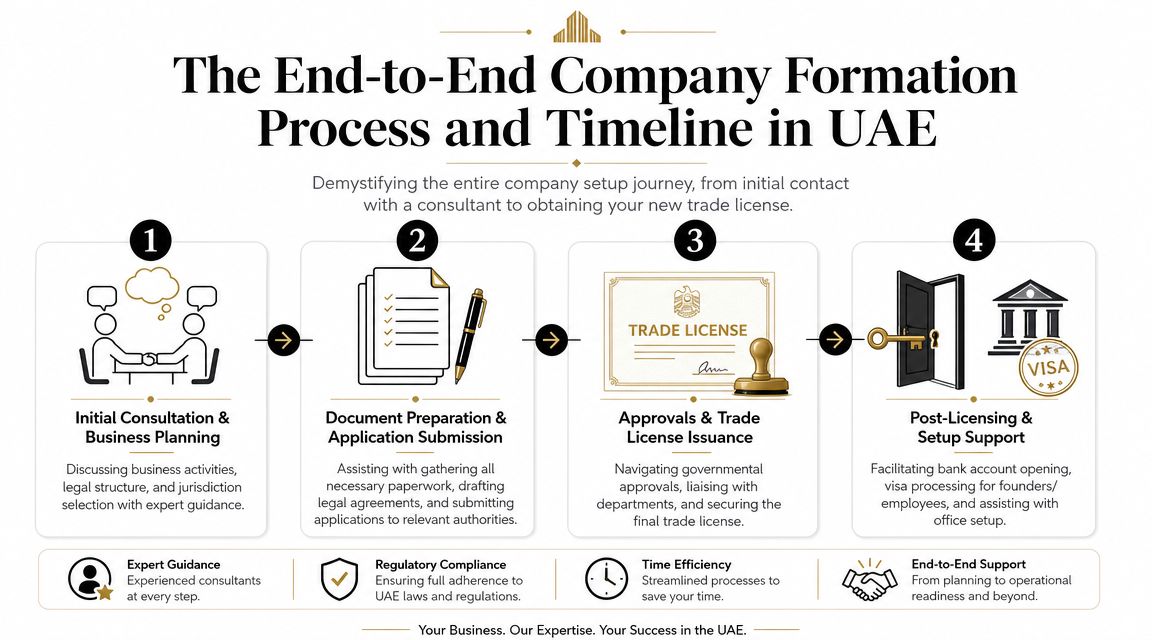
Some setups move quickly. Others take longer because the activity needs extra approvals, the jurisdiction has stricter document rules, or the shareholder structure is more complex. The useful question is not "What is the fastest case?" It is "What could slow my case down, and has my consultant addressed it early?"
Strategy and structuring
The first stage is a working review of the business model. Activity, legal form, jurisdiction, shareholder mix, visa plan, and office requirement all need to line up before anyone starts submitting forms.
Weak advisers create expensive problems. They ask for passport copies and push a package before confirming whether the proposed licence fits the way the company will operate.
A serious consultant reviews the constitutional documents with the same care as the licence application. If the structure requires closer attention, especially around shareholder rights and business activities, a practical guide to drafting your UAE MoA is worth reviewing before signature.
Documentation and approvals
Once the setup path is confirmed, document preparation starts. That usually covers trade name reservation, application forms, identity documents, shareholder resolutions where needed, and any sector-specific approvals.
Accuracy decides speed here. A minor mismatch between the activity description, licence category, and supporting paperwork can stop the file. So can an unsuitable trade name, an incomplete signature set, or documents prepared in the wrong format for the chosen authority.
A consultant earns their fee by controlling these details:
- Trade name screening: reduce rejection risk before submission
- Application consistency: keep the activity, legal form, and supporting documents aligned
- Authority handling: follow the exact process required by the mainland authority or free zone
- Founder guidance: get signatures, attestations, and document copies in the right order
Fast processing usually comes from a clean file with fewer corrections.
Licensing and registration
After approvals are in place, the company moves to licence issuance and formal registration. Founders often treat this as the finish line. In practice, it is the midpoint.
The consultant should explain what has been issued, what still needs to be completed, and what the licence allows in day-to-day terms. If the package includes a flexi-desk, office lease, establishment card, or quota-related limits, those points should be clear before payment is finalised. Here, a strategic partner protects the client from assumptions that become expensive later.
Post-setup action items
The final stage is operational readiness. Many low-fee agents go quiet here, even though at this point the business starts functioning.
Post-licensing support often includes:
- Visa processing for investors, employees, and dependants where applicable
- Banking preparation with realistic guidance on documents, business profile, and compliance expectations
- Record-keeping setup so renewals, tax documentation, and corporate records are not treated as an afterthought
- Office coordination if the company needs physical premises beyond the initial licence package
A competent consultant shortens the setup timeline by reducing rework. A strategic consultant does more than that. They make sure the company is formed in a way the founder can use, bank, renew, and grow.
Essential Services Beyond the Initial Setup
The licence is the start of your obligations, not the end of them. Founders who understand this early tend to avoid the most frustrating problems.

A consultant becomes useful after incorporation when they can support the day-to-day administrative and compliance load that follows. That includes government liaison, accounting discipline, tax-related documentation, and, when the business changes direction, restructuring or closure support.
PRO support and government coordination
PRO services matter because so many operational steps depend on correct dealings with government portals, immigration processes, labour-related formalities, and document submissions. A founder can learn these systems over time, but that's rarely the best use of their time.
When PRO support is weak, the business starts missing renewals, delaying visa actions, or making avoidable visits to resolve documentation issues.
Accounting and compliance discipline
VAT-compliant bookkeeping isn't a premium extra. It is part of running a company properly. Businesses that leave accounting until a filing deadline usually discover missing invoices, poor record-keeping, and incomplete expense support.
That problem gets worse when banking, tax, and ownership documentation are all handled by different people. A better model is one partner who understands the formation background and can maintain continuity.
For founders who want a broader practical read on record checks and verification workflows, this piece on compliance for small businesses is helpful context.
The strongest setup advisers think beyond formation. They organise the business so later compliance is easier.
Tax residency, finance support, and lifecycle services
As the company matures, needs become more strategic. Some businesses need help with tax residency documentation. Others need budgeting, feasibility work, financial management, or support preparing for expansion.
A different category of need appears when the business has to pause, restructure, or close. Liquidation support matters because a poor exit process can leave unresolved obligations behind.
Here's what separates a long-term consultancy from a setup-only shop:
- Tax residency certificate support: Useful where the founder or company needs structured documentation and process guidance.
- Corporate finance advisory: Relevant for firms assessing expansion, cash planning, or investment decisions.
- Liquidation assistance: Important when a business must close cleanly and formally.
- Recruitment and workspace coordination: Helpful when operations start growing beyond a single founder.
Some firms provide that full lifecycle support under one roof. Smart Classic Business Hub is one example of a Dubai-based consultancy offering company formation, PRO services, VAT-compliant accounting, tax residency certificate support, audit, liquidation, and advisory services for businesses operating in the UAE.
Understanding Costs and Spotting Red Flags
Price matters. It just shouldn't be the first filter.
When founders compare proposals, they often look at the top-line package fee and assume they are comparing like for like. Usually they aren't. One quote may include only the licence filing. Another may account for office obligations, visa-related cost drivers, or post-licence administrative steps.
What drives the real cost
A useful benchmark exists in Abu Dhabi, where company formation costs typically start at AED 15,000, with the final setup price varying materially based on the number of visas, licence type, and office-space requirements, as outlined in this Abu Dhabi company formation cost guide.
That benchmark matters because those same drivers shape costs across the wider UAE setup environment too. Even when the jurisdiction changes, the logic stays familiar.
A proposal becomes more expensive when:
- Visa demand increases: More visas usually mean more associated processing and operational commitments.
- Licence complexity rises: Some activities involve more approvals or narrower compliance requirements.
- Office commitments expand: Physical space can affect both initial and recurring cost.
If you're trying to compare broad setup budgets across scenarios, this breakdown of the cost of starting a business in Dubai helps frame the common variables.
Red flags that cost more later
The warning signs are usually easy to spot if you know what to look for.
Warning sign: If a consultant can't explain what is included, what is excluded, and what depends on your activity, the low quote is probably not real.
Look carefully at these issues:
- Guaranteed bank account promises: No credible adviser should present banking as guaranteed. They can prepare the file and guide the process.
- Vague all-inclusive packages: If the proposal avoids detail, expect add-ons later.
- No proper business address or visible office presence: That doesn't automatically mean fraud, but it does raise due diligence concerns.
- Poor response quality: Slow, unclear communication during the sales stage usually gets worse after payment.
- No discussion of post-licence obligations: If the consultant acts as though the licence is the finish line, they are selling a partial service.
What works better than chasing the lowest quote
Ask for a line-by-line scope. Ask what changes the price. Ask which items are statutory, which are consultant fees, and which depend on visas or premises. If they avoid those answers, move on.
In this market, the cheapest quote often becomes the most expensive setup once corrections, delays, and add-on costs start appearing.
How to Choose Your UAE Company Formation Consultant
A founder often loses time and money before the company even starts trading. The mistake usually happens at the consultant stage. A weak adviser takes instructions, files forms, and leaves the investor to deal with the consequences. A strong one challenges the setup, flags constraints early, and helps you choose a structure that still works six or twelve months later.
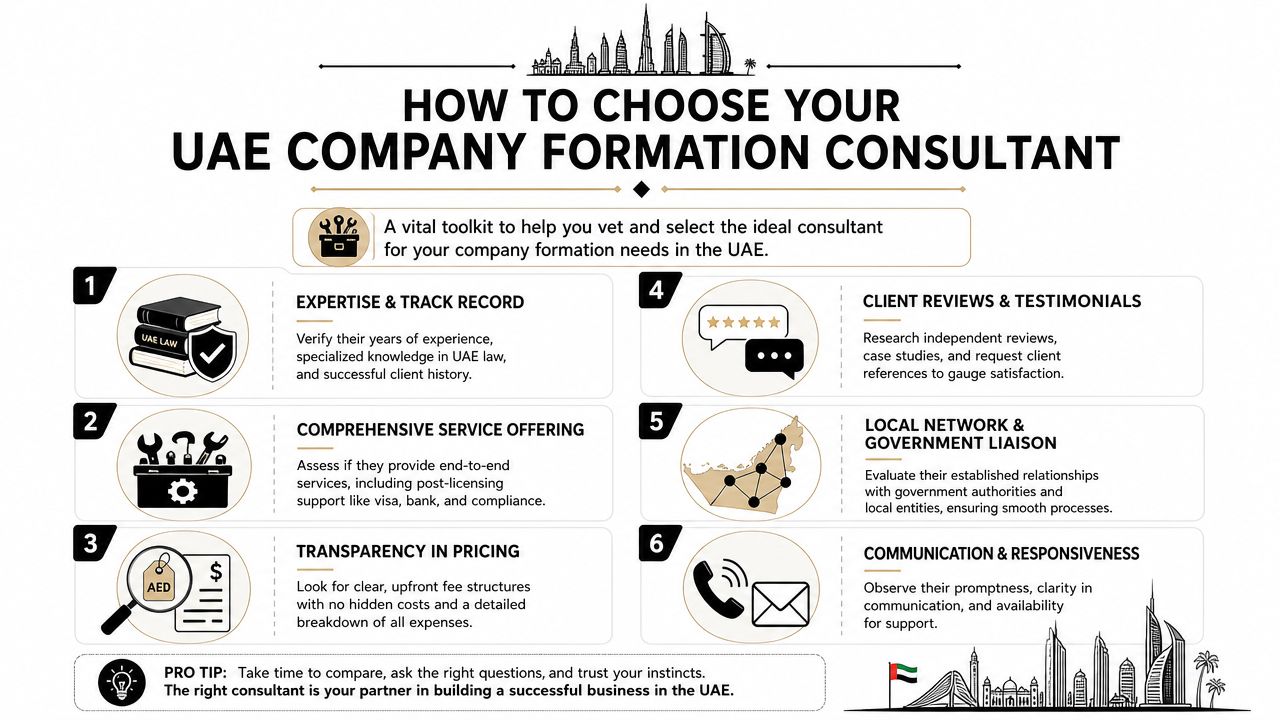
The right consultant is your first strategic hire, even if they are not joining your payroll. Their advice affects jurisdiction, licence scope, visa planning, banking readiness, office commitments, and how easily the business can expand. If they get the early decisions wrong, you spend more later fixing a structure that never matched the business.
What to test before you shortlist anyone
Use the first call to see whether the consultant is diagnosing or just selling.
- Relevant case experience: Ask which business activities they set up regularly, and where they have practical depth rather than general sales knowledge.
- Structure judgment: Ask which option they would reject for your case and why. Good advisers rule out poor-fit routes quickly.
- Execution ownership: Confirm who handles approvals, document follow-up, and government coordination after payment.
- Post-setup support: Check whether they can stay involved with visas, renewals, accounting coordination, and compliance tasks.
- Commercial clarity: A proper proposal should separate government charges, third-party costs, and consultant fees.
- Practical communication: Clear, direct answers in the sales stage usually reflect an organised team.
If you want a broader framework for screening advisers, the Founder Connects consultant guide is a useful starting point. Then apply those questions to UAE-specific issues such as activity restrictions, visa eligibility, office rules, and banking file quality.
Questions that expose real capability
Polished presentations do not tell you much. Specific questions do.
| Ask this | What a good answer sounds like |
|---|---|
| Which structure would you rule out for my business, and why? | They explain the commercial and compliance trade-offs, not just the cheapest package |
| What could delay my setup in practice? | They identify approval risks, document issues, activity-specific checks, or shareholder complications |
| How do you handle banking support without overpromising? | They explain preparation, positioning, and documentation. They do not promise approval |
| What changes after the licence is issued? | They talk through visas, establishment card steps, renewals, accounting discipline, and tax-related admin |
| What costs depend on my decisions later? | They separate fixed setup costs from variables such as visas, premises, and business activity changes |
The firms worth taking seriously
The better consultants do more than process paperwork. They pressure-test the model before incorporation, explain where the plan may break, and stay useful once the licence is live.
That matters because company formation is tied to wider operating decisions. A founder choosing a provider with broader business advisory support in Dubai usually gets better guidance on issues that surface after setup, especially around finance, compliance, and growth planning.
Shortlist the firm that improves your decisions, not the one that talks fastest.
Your Strategic Partner How Smart Classic Business Hub Delivers
By this point, the pattern is clear. A consultant affects more than incorporation. They influence structure, cost control, speed, compliance readiness, and how much friction the business faces once it starts operating.
That's why the right partner should be evaluated across the whole lifecycle. They need to help you choose between mainland, free zone, and offshore based on business reality. They need to manage the setup file carefully. They should also stay involved when the work shifts to visas, accounting discipline, tax-related documentation, renewals, and operational growth.
Smart Classic Business Hub fits that strategic-partner model in practical terms. The firm provides UAE company formation support across mainland, free zone, and offshore routes, along with PRO services, VAT-compliant accounting, audit, tax residency certificate support, liquidation assistance, and broader advisory work tied to business planning and financial management.
That combination matters because most founders don't need a licence seller. They need one team that can connect formation decisions to the day-to-day requirements that follow. When those services sit too far apart, the founder becomes the coordinator. That's inefficient and risky.
A sensible first conversation with any consultant should focus on fit, not sales language. Discuss the activity, customer base, hiring plan, office expectations, and whether the business needs speed, flexibility, or broader local access. The right structure usually becomes obvious once those facts are clear.
If you want practical guidance on setting up and running a business in the UAE, Smart Classic Business Hub can help you assess the right structure, understand the actual cost drivers, and manage both formation and ongoing compliance with a clear scope from the start.