
You're probably seeing the same pattern everywhere. One ad says you can start a UAE company for a very low entry price. Another promises a “complete package” that looks only slightly higher. A third consultant gives you a quote that is double both of them, but insists it's more realistic.
That confusion is normal. In UAE company formation, the cheapest number on the advert often isn't the cheapest decision for your business.
What matters is total cost of ownership. That means the setup fee, yes, but also whether the package works for your activity, whether it supports visas, whether banks are comfortable with the jurisdiction, what office requirement sits behind the licence, and what the second-year renewal will feel like. Founders who ignore those points often save money at the start and spend more fixing the structure later.
The right question isn't “What is the lowest possible licence price?” It's “What setup gives me the lowest practical cost for the way I'll operate?”
Your Guide to Affordable UAE Company Formation
A founder usually starts with one simple goal. Get legal fast, keep costs low, and avoid paying for features they don't need.
Then the market gets noisy. One package looks cheap because it excludes a visa. Another looks cheap because it assumes a minimal office arrangement. Another looks cheap because it covers only a narrow set of activities. By the time you compare three or four quotes, you're no longer comparing like for like.
Many founders searching for the cheapest company formation in UAE don't need the absolute lowest advertised package. They need the lowest-cost structure that lets them invoice clients, open a bank account, apply for the right visa path, and renew without surprises. That's a different decision.
If you're still deciding where to begin, this practical guide on how to start a business in the UAE is a useful companion. It helps frame the setup process before you compare jurisdictions.
The cheapest setup on day one can become the most expensive setup by month three if you need changes, extra approvals, or a different licence activity.
Keep that principle in mind as you review offers. A low starting price can be valid. It can also be incomplete. The difference usually shows up in the details nobody puts in the headline.
Mainland vs Free Zone vs Offshore Explained
A founder selling to UAE clients, needing a residence visa, and planning to open a business bank account should not choose a company structure on setup price alone. The right question is simpler. Which structure stays affordable after licence issuance, visa processing, renewals, and day-to-day use?
In the UAE, that usually means choosing between mainland, free zone, and offshore.
| Structure | Typical use case | Cost profile | Main strength | Main limitation |
|---|---|---|---|---|
| Mainland | Businesses serving the UAE local market directly | Often higher over the full first year | Broad operational flexibility inside the UAE | Office, approvals, and renewals can push up total cost |
| Free Zone | Consultants, service firms, startups, online businesses, international trading | Usually the strongest low-cost option | Lower entry cost and a faster setup process | Banking, visa allocation, and activity fit vary by zone |
| Offshore | Holding structures and international-only use cases | Can be cost-efficient for narrow purposes | Useful for specific international structures | Not suitable for normal UAE operating activity |
Mainland
Mainland makes sense when the business needs direct access to the UAE market without structural workarounds. Retail, restaurants, contracting, local trading, and many regulated activities usually belong here. If that is your business model, trying to force a free zone setup to save money often creates more cost later.
The headline mainland licence fee can look low. The full operating cost usually does not. A Dubai setup cost guide from Engel & Völkers notes that base mainland licence costs can appear modest, while total first-year spend rises once office requirements, approvals, and related fees are added. This is the core mainland trade-off. You get wider UAE operating freedom, but you need to budget for the structure that supports it.
For founders with UAE-facing operations, mainland can still be the cheaper long-term choice if it avoids nominee arrangements, distribution workarounds, or later restructuring.
Free zone
Free zones are usually the first place I tell cost-sensitive founders to look, especially for consulting, digital services, e-commerce support, and international trading structures. The entry price is often lower, ownership is straightforward, and the paperwork is usually lighter than mainland.
But free zone value depends on what happens after incorporation. A cheap package with no visa allocation, weak banking acceptance, or an activity mismatch is only cheap on paper. The better question is whether the zone fits your actual operating plan for the next 12 months.
Some free zones work well for solo service businesses. Others are stronger for founders who want a Dubai address, easier client perception, or better odds when presenting to banks. If you are weighing those trade-offs in more detail, this guide to mainland vs free zone in Dubai is a useful reference.
Practical rule: If the business can operate legally and commercially from a free zone, that option often gives the lowest total startup cost. If the business needs unrestricted local UAE trade, mainland usually becomes the more practical answer despite the higher first-year spend.
Offshore
Offshore is often misunderstood by first-time founders. It is not the low-budget version of a normal UAE operating company.
It suits specific cases such as holding assets, owning shares, or certain international structures where no UAE residence visa, local office use, or day-to-day UAE trading is required. For a founder who wants to live in the UAE, invoice local clients, hire staff, and run operations here, offshore is usually the wrong tool.
That is why offshore should be assessed by function, not price. It can be cost-effective for the right holding structure. It is usually expensive once a founder discovers it cannot do what an operating business needs.
Comparing the UAEs Cheapest Free Zones
A founder sees a licence from AED 5,555 and assumes the decision is done. Then additional costs emerge. Visa eligibility, establishment card charges, medical and Emirates ID costs, bank compliance questions, and renewal pricing decide whether that cheap start stays cheap in month six.
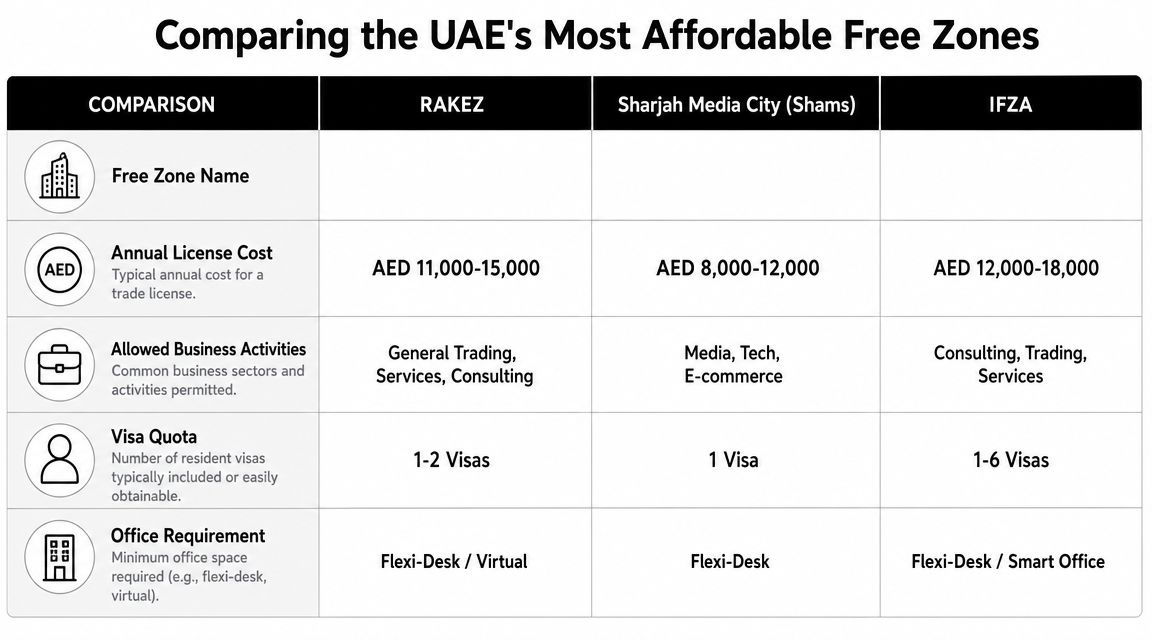
That is why free zones should be compared on total cost of ownership, not only the entry package. The lowest advertised number often belongs to a zero-visa setup. Many founders need a residence visa, usable licence wording, and a jurisdiction that does not create extra friction when opening a bank account. If you want a fuller view of how these quotes are usually structured, this guide to Dubai free zone company setup cost is a useful reference.
A useful benchmark comes from Safe Ledger's review of low-cost free zones, which reports Ajman Free Zone at about AED 5,555 for a zero-visa package and notes that Meydan Free Zone starts from AED 12,500, with Dubai South commonly cited around AED 12,000. Those figures are useful, but only if you compare them against the operating reality of your business.
| Free Zone | Advertised Starting Price (AED) | Realistic 1-Visa Package (AED, Approx.) | Ideal For | Bank Account Difficulty |
|---|---|---|---|---|
| Ajman Free Zone | 5,555 | Higher than the zero-visa headline once visa-related needs are added | Cost-first founders, simple service setups | Can require more careful preparation |
| SHAMS | 5,750 | Usually higher than the entry offer once practical operating needs are included | Media, creative, solo founders, light digital activity | Depends heavily on activity and profile |
| Meydan Free Zone | 12,500 | Closer to a practical operating package than ultra-low headline offers | Consultants, founders who want Dubai signalling | Often easier to position commercially |
| Dubai South | 12,000 | Often considered by founders wanting Dubai positioning with leaner setup | Trading, logistics-adjacent, service firms | Depends on profile and documentation quality |
Ajman Free Zone
Ajman Free Zone stays on nearly every low-budget shortlist for one reason. The entry point is very low.
That works well for a founder who already has UAE residency, does not need a visa now, and wants to start issuing invoices with minimum first-year cash outlay. I usually see it fit lean service businesses, basic trading structures, and early-stage founders who care more about cost control than location perception.
The trade-off is straightforward. Once you add a visa and start dealing with banking, the savings can narrow. If the business depends on a stronger Dubai-facing image or frequent bank review of the business model, Ajman can still work, but the founder needs cleaner documentation and more patience.
SHAMS
SHAMS is usually considered by solo founders in creative, digital, and media-linked activities. It often suits founders selling services online, content work, design, marketing support, or small agency models.
The advantage is access at a low entry level. The risk is buying a package before checking the exact activity wording, visa allocation, and whether the bank will easily understand the business. A vague or overly broad activity list can create problems later, especially for founders applying for payment gateways or business accounts.
SHAMS makes sense when the activity matches cleanly and the founder is keeping the setup simple.
Meydan Free Zone
Meydan costs more at the start, but it often performs better in real operating conditions for consultants, agencies, and service firms that want a Dubai licence from day one. The higher first-year spend can buy a smoother commercial story. That matters when clients review your documents or when a bank asks where the company is licensed.
I often describe Meydan as a zone that is cheaper than many founders expect once they price the full picture properly. The licence is not the lowest. The business may still cost less overall if the jurisdiction saves time on bank account opening, supports the right activities clearly, and avoids an early move to a different licence later.
Dubai South
Dubai South appeals to founders who want a Dubai registration without stepping straight into the higher cost profile of some larger free zones. It is commonly considered for trading, logistics-linked activities, and practical operating businesses that still care about a Dubai address.
The key question is not whether Dubai South starts slightly above or below another option. The question is whether the activity, office requirement, visa plan, and renewal terms fit the business for the next one to two years. A founder who expects to add staff, import goods, or build supplier relationships may find that a slightly higher setup cost is still the cheaper decision overall.
What usually works and what usually goes wrong
What tends to work well
- Zero-visa packages for testing a business model: Best for founders who already hold residency and want to keep first-year spend low.
- Meydan or Dubai South for client-facing service firms: Higher setup cost, but often easier to present commercially.
- A zone that matches the activity exactly: Clear licence wording usually helps with banking, compliance, and renewals.
What often goes wrong
- Choosing only by the advertised package: A low headline fee can become expensive once visa and immigration costs are added.
- Ignoring bankability: Saving a few thousand dirhams on setup is a poor result if the company then struggles to open an account.
- Skipping the renewal check: Some founders buy the cheapest first-year package without pricing year two, when discounts disappear and add-ons start to matter.
A Line-Item Breakdown of Formation Costs
A founder sees a quote for a cheap UAE setup and assumes the decision is easy. Then the second quote arrives with different inclusions, different visa assumptions, and a different office requirement. The only useful way to compare them is line by line.
The headline package rarely reflects the total cost of ownership. What matters is the full first-year spend, then the renewal position after that. A company that starts cheaply can become expensive to maintain if the visa file, workspace, banking support, or licence amendments sit outside the advertised fee.
A Dubai free-zone cost guide from DMCC sets out how these costs are commonly split. It lists items such as a registration fee, annual licence fee, office fee, and, in some cases, a refundable share capital requirement. That structure is why two quotes with similar licence prices can still end up far apart in actual cost.
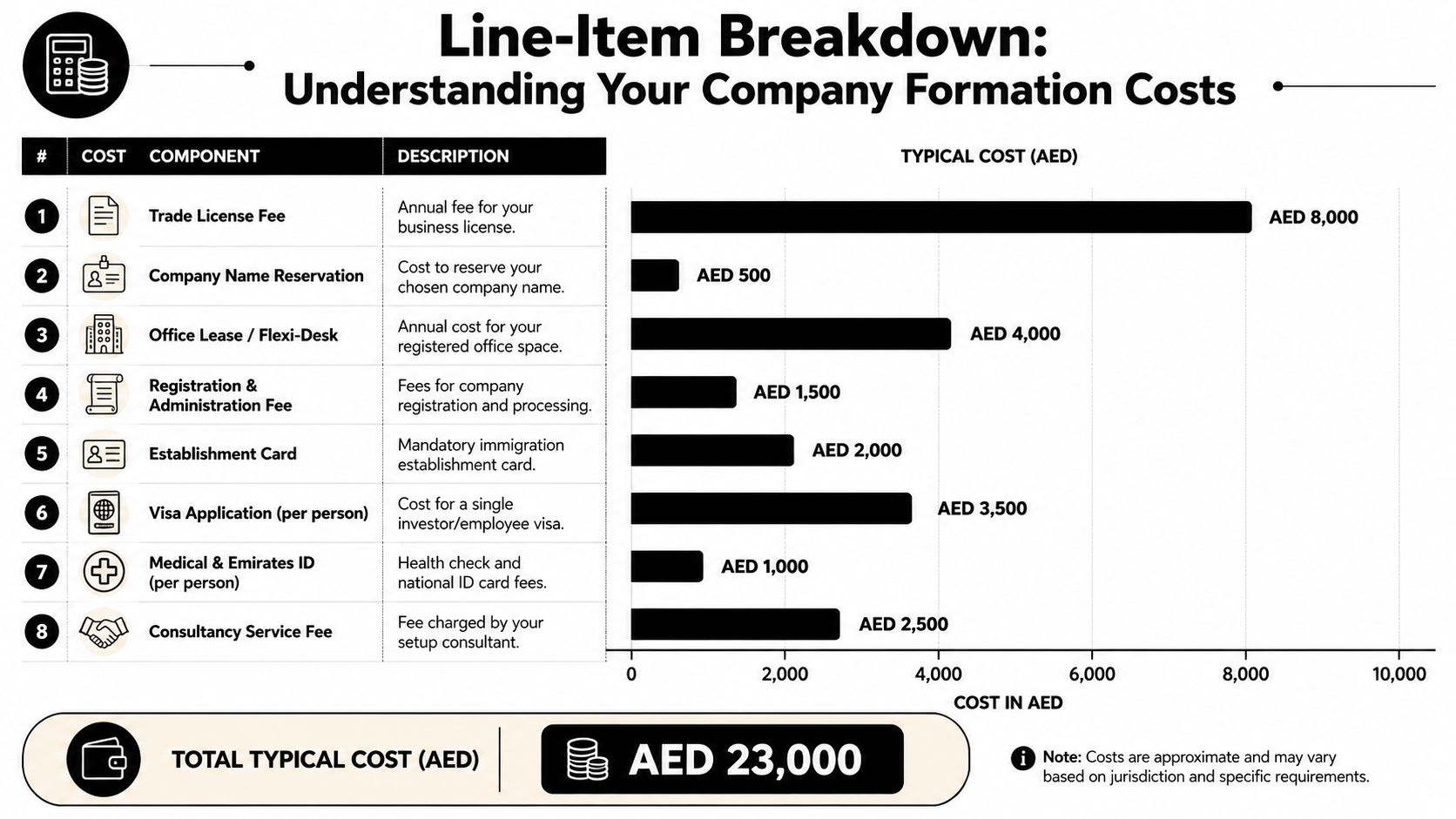
For a more practical quote comparison, this guide to Dubai free zone company setup cost helps show how providers usually group these charges.
The core line items to check
Licence fee
This covers the approved business activity. It is the figure used in most ads, but it does not tell you the actual setup cost on its own.Registration or incorporation fee
Usually charged once at formation. If you do not see it in the quote, ask whether it has been included, waived, or left out.Office or desk requirement
This might be a flexi-desk, shared workstation, or private office. It affects cost, visa allocation, and sometimes how the company is viewed by banks and clients.Share capital requirement
Some jurisdictions require no paid-up capital. Others require capital to be stated or deposited as part of the formation process, even if it is not a permanent business expense.
The add-ons that change the real cost
Here, many low-cost quotes stop being low-cost.
A zero-visa package can be a sensible choice for a founder who already has UAE residency and only needs a licence. It is the wrong structure for someone who plans to apply for residency within a few months. Rebuilding the setup later usually costs more than choosing the right package at the start.
Check these items separately:
Establishment card or immigration file
Required if the company will sponsor visas.Visa processing charges
Often excluded from the entry-level package and priced only after the sale.Medical, Emirates ID, and status change costs
These are part of the overall visa budget, even when the quote only mentions "visa eligibility."PRO or submission support
Some founders handle the paperwork themselves. Others pay for support to avoid delays and repeat visits.Document drafting, translations, and amendments
Small changes to the activity or company documents can create extra cost if they are made after submission.Bank account support
Not always charged as a formal line item, but it has a cost if the jurisdiction, activity wording, or office setup creates banking friction.
A quote is only comparable when every excluded item is visible. The missing line item is usually where the "cheap" setup becomes ordinary or expensive.
How to read a quote properly
Ask every provider to answer the same questions in writing. One page is enough.
- What is included in the first-year fee
- What is excluded but commonly needed
- What repeats at renewal
- What changes if I add one or more visas
- What office arrangement is attached to this package
- What costs apply if the activity or licence wording needs to be revised
That last question saves money. If the activity is too broad, too narrow, or poorly matched to what the business does, the issue often shows up later during banking, invoicing, or renewal. A cheap setup works only when the licence, visa plan, and operating model fit from day one.
Avoiding Hidden Fees and Common Cost Traps
A founder sees a low advertised setup fee, pays quickly, then spends the next few months adding visa costs, office upgrades, amendment fees, and extra banking support. The company was cheap to start. It was not cheap to run.
That is the trap.
The ultimate test is total cost of ownership across the first year and first renewal. A package only deserves to be called affordable if it still makes sense after visas, compliance, banking, renewals, and day-to-day operating needs are added.
Trap one: buying a licence that fits the budget, not the business
A low-cost licence can still be the wrong commercial choice. I see this with founders who pick the cheapest free zone first, then realise their clients expect a Dubai presence, their activity wording creates questions at the bank, or their structure limits how they plan to invoice and grow.
Fixing a bad fit later usually costs more than choosing properly at the start. That cost shows up as amendments, lost time, or a full restructure.
Trap two: underestimating the first real operating year
The setup fee is only one number. The business has to function after incorporation.
Check the recurring and practical costs attached to the package:
- Renewal fees, including any mandatory establishment card or related admin charges
- Office or desk renewal terms, especially if the first-year package used a promotional workspace model
- Visa-linked costs, if you add residency later for yourself or staff
- Banking support costs, if the provider charges separately for help after incorporation
- Amendment fees, if you need to revise the activity, shareholding, or licence details
A cheap first invoice can hide an expensive second invoice.
Trap three: treating banking as an afterthought
Banking friction is one of the most expensive mistakes in UAE setup. If the licence activity is vague, the jurisdiction is a poor fit for the actual business, or the founder cannot present a credible operating model, account opening can drag on.
That delay has a cost. Payments stall. Contracts wait. Some founders pay for extra support. Others abandon the structure and set up again in a better-fit jurisdiction.
I usually advise founders to rank decisions in this order: business activity, banking fit, visa plan, then setup price. That order saves money more often than chasing the lowest licence fee.
Trap four: accepting bundled services you do not need
Some packages look competitive because they bundle services that sound useful at the start but add little value in practice. That may include office features you will not use, generic admin support, or multi-year commitments that reduce flexibility.
Founders should ask one hard question: if this item were removed from the package, would the company still operate properly?
If the answer is yes, price it separately and compare.
Trap five: ignoring the exit cost of a bad decision
The most expensive low-budget setup is the one that has to be replaced. A founder who starts with the wrong jurisdiction may later pay for licence amendments, a new visa path, extra documentation, and in some cases a second company.
That is why the cheapest company formation in UAE is not always the lowest entry price. It is the structure for the business you run, opens a workable banking path, and stays affordable at renewal.
The Cheapest Setup for Your Business Type
There isn't one universal answer to the cheapest company formation in UAE question. The right answer changes with the business model.
Freelance consultant or solo service provider
If you're a coach, marketing consultant, designer, or independent adviser, a low-cost free zone with a service-oriented activity usually makes the most sense. Keep the structure lean. Don't overbuy office space. Don't pay for multiple visas if you'll stay solo for now.
A Dubai-based free zone can make sense if client perception matters. A lower-cost emirate can make sense if your clients are remote and price discipline matters more than address signalling.
E-commerce founder
E-commerce founders often make the mistake of choosing the cheapest licence before checking how they'll handle fulfilment, payment relationships, and local operating needs. A free zone can be cost-effective, but only if the activity and sales model match.
If you plan to test online demand first, a lean free zone route can work well. If local distribution becomes central, reassess early rather than forcing a structure that was only designed for a light launch.
International trader
For trading businesses, cheap isn't the same as useful. Documentation, credibility, and banking tend to matter more than shaving the setup cost to the floor. A slightly higher-cost free zone can be the smarter route if it better supports how counterparties and banks will review the company.
Small agency or growing startup
Agencies and early-stage teams usually need flexibility. Today it's one founder. Soon it may be staff, a visa expansion, or a more formal office arrangement. In that case, choose the structure with the cleanest upgrade path, not merely the smallest opening invoice.
If you want help comparing routes in a practical way, Smart Classic Business Hub provides company formation support across mainland, free zone, and offshore structures, which is useful when the issue isn't filing paperwork but choosing the right setup model in the first place.
Your Step-by-Step UAE Setup Checklist
Low-cost setup works best when you make decisions in the right order. Most expensive mistakes happen because founders choose the jurisdiction first and verify the business model second.
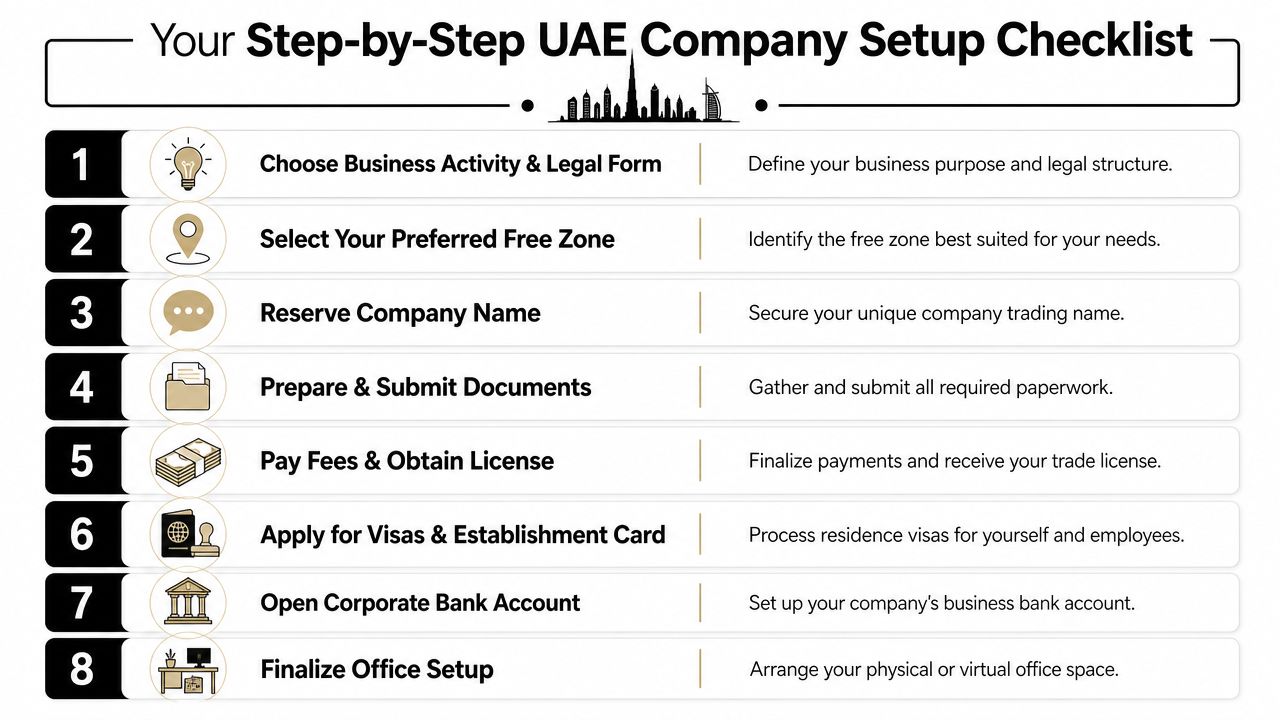
The practical checklist
Define your actual business activity
Write what you will really sell, not the broadest description you think sounds impressive.Set a real first-year budget
Include setup, operations, likely visa needs, and a buffer for adjustments.Choose the jurisdiction based on use, not advertising
Mainland, free zone, and offshore solve different problems.Review the package inclusions line by line
Confirm what is part of the quote and what is outside it.Check the office model
Make sure the workspace requirement matches how you'll operate.Verify visa compatibility early
Don't assume a low-cost package can be expanded smoothly later.Prepare for banking from the start
Keep your activity description, business explanation, and documents consistent.Ask about renewal before paying year one
A sustainable setup beats a flashy entry offer.
Start lean, but don't start blind. The cheapest valid structure is the one that keeps working after incorporation.
Frequently Asked Questions About UAE Setup Costs
Can I get a residence visa with the absolute cheapest packages?
Sometimes, but not always in the way founders expect. The lowest advertised packages are often built around zero-visa assumptions. If residency is essential, you should treat visa support as part of the original setup decision, not as a small later upgrade.
Is a Dubai free zone always better than a cheaper emirate?
No. A Dubai free zone can be worth the extra cost when client perception, meetings, or commercial signalling matter. It's not automatically better for every founder. If your business is remote, lean, and price-sensitive, a lower-cost emirate may produce a better overall result.
Do I really need physical office space?
That depends on the jurisdiction, the licence package, and how the company will operate. Many low-cost setups rely on flexi-desk or minimal workspace models. That can be enough for a solo founder. It may be a weak fit if you need regular in-person operations or stronger commercial presentation.
What should I focus on when comparing two quotes?
Look at four things first: activity fit, visa inclusion, office requirement, and renewal logic. If one quote is cheaper only because it strips out something you'll need later, it isn't the cheaper quote.
What if I'm not sure which setup fits my business?
That's common, especially for first-time founders. The safest move is to compare two or three routes against how you'll invoice, bank, hire, and renew, rather than choosing by headline price alone.
If you want a specific view of what your setup is likely to cost in practice, Smart Classic Business Hub can help you compare mainland, free zone, and offshore options based on your activity, visa needs, and first-year operating plan before you commit to a package.