
You're probably in the same position as many new founders in Dubai. You've chosen a business activity, shortlisted a jurisdiction, maybe even spoken to a bank or a potential client, and then someone asks for your certificate of incorporation. That's where the confusion starts.
Some people tell you it's the document that proves your company exists. Others say your trade licence is enough. Both statements can be true in the UAE, depending on where your company is registered. That's the part most guides blur, and it's the reason founders lose time chasing the wrong document.
The practical question isn't “What is a certificate of incorporation?” in the abstract. The key question is this: does your UAE company get one, and when do you need it? If you understand that distinction early, you avoid delays with banking, compliance, and registration.
Your Company's Birth Certificate Explained
A Certificate of Incorporation is the formal document that confirms a company has been legally created. In plain language, it works like the company's birth certificate. It records that the entity exists as a recognised legal person, separate from the individual founder.
That matters because businesses don't operate on intention. They operate on legal identity. Before a company can sign in its own name, hold rights, or present itself to banks and government authorities, there has to be a document trail showing that the entity exists properly.
What the document actually proves
When founders first start a UAE setup, they usually hear several terms at once: trade licence, Commercial Registry, Memorandum of Association, Articles of Association, shareholder resolution. The certificate of incorporation often gets mixed into that stack as if it's just another paper in the file.
It isn't just another paper.
It is the document that confirms formation itself. In jurisdictions that issue it, it answers the most basic legal question: Has this company been incorporated and recognised by the relevant authority?
Practical rule: If a bank, investor, supplier, or compliance team asks for proof that the company legally exists, they're asking for the core formation document used in that jurisdiction.
A separate but related document is the Memorandum of Association. Founders often confuse the two. The MOA sets out the company's structure and internal arrangement. The certificate of incorporation confirms that the entity has been formally created.
Why UAE founders get confused
The confusion isn't because entrepreneurs are careless. It happens because the UAE uses different documentary logic across jurisdictions.
Most online explanations leave out one key point. Mainland UAE companies do not receive a separate Certificate of Incorporation in the same way free zone and offshore entities do. That's why many founders keep waiting for a document that will never be issued in that form. As noted by Movingo's explanation of UAE certificate of incorporation rules, only Free Zone and offshore entities receive a formal COI, while mainland businesses rely on their licence as registration proof.
That single distinction clears up a lot of downstream confusion. If you don't know it, you can end up asking the wrong authority for the wrong document, or sending incomplete paperwork to a bank that expects a different corporate pack.
The Critical UAE Rule Certificate vs Trade License
A founder sets up in a free zone, receives the trade licence, and assumes the file is complete. Then the bank asks for the Certificate of Incorporation. Another founder sets up on the mainland and keeps waiting for that same certificate, even though the authority will not issue it as a separate document. This is one of the most common UAE incorporation mistakes, and it starts with using one label for two different document systems.
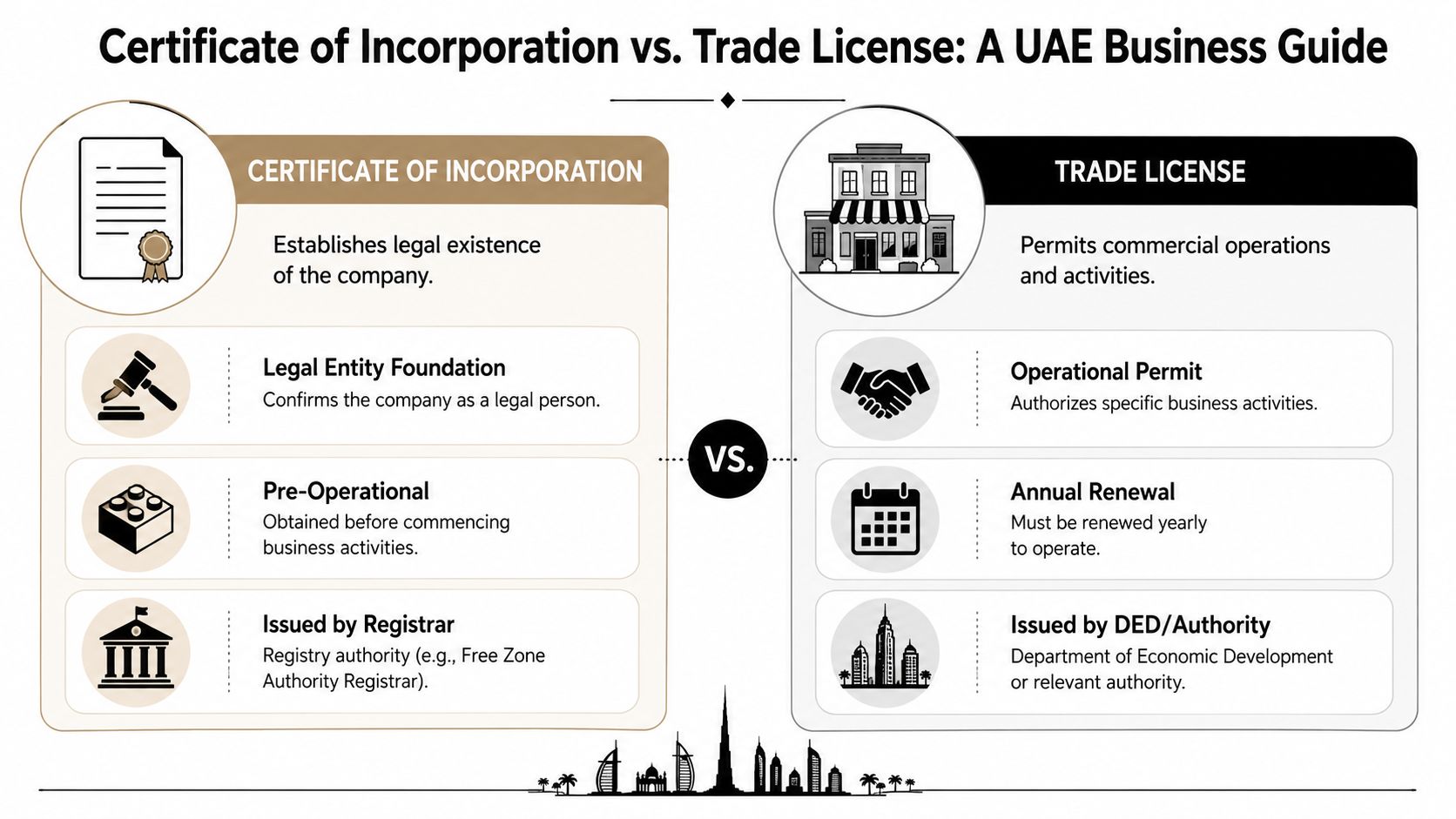
In the UAE, a trade licence and a certificate of incorporation do different jobs. The trade licence authorises business activity. The Certificate of Incorporation confirms that the company has been legally formed. Whether you receive both depends on where you incorporate.
Mainland and free zone work differently
For mainland companies, the corporate file is usually built around the trade licence, commercial registration record, and constitutional documents such as the MOA. For free zone companies, the authority typically issues a Certificate of Incorporation as a separate formation document alongside the trade licence. That difference sounds technical. In practice, it affects what you submit to banks, investors, counterparties, and compliance teams.
For founders comparing structures, it helps to understand how a UAE business licence fits into the wider formation process before choosing mainland or free zone. The same basic logic appears in other jurisdictions too. The steps to form a Florida business also separate formation documents from operating approvals, even though the UAE applies that distinction differently across jurisdictions.
A simple comparison
| Jurisdiction | Core proof of legal existence | Separate certificate of incorporation |
|---|---|---|
| Mainland | Trade License, Commercial Registry, MOA | No |
| Free Zone | Certificate of Incorporation plus Trade License | Yes |
| Offshore | Jurisdiction-specific corporate documents including formal COI | Yes |
What works and what doesn't
What works is sending the document set that matches the jurisdiction.
A mainland company should not keep asking for a standalone COI that does not exist in the same format. A free zone company should not send only the trade licence if the reviewer expects the incorporation certificate as part of the corporate pack. That is usually where account opening, compliance review, or investor due diligence slows down.
For a free zone company, the Certificate of Incorporation is often the document that confirms legal existence. For a mainland company, that role is handled through the licence and related registration records.
Treat the documents accordingly. If you are setting up in a free zone, plan for the COI to be part of your standard file. If you are setting up on the mainland, make sure your licence, registry extract, and constitutional documents are properly aligned and current.
Securing Your Certificate of Incorporation Step by Step
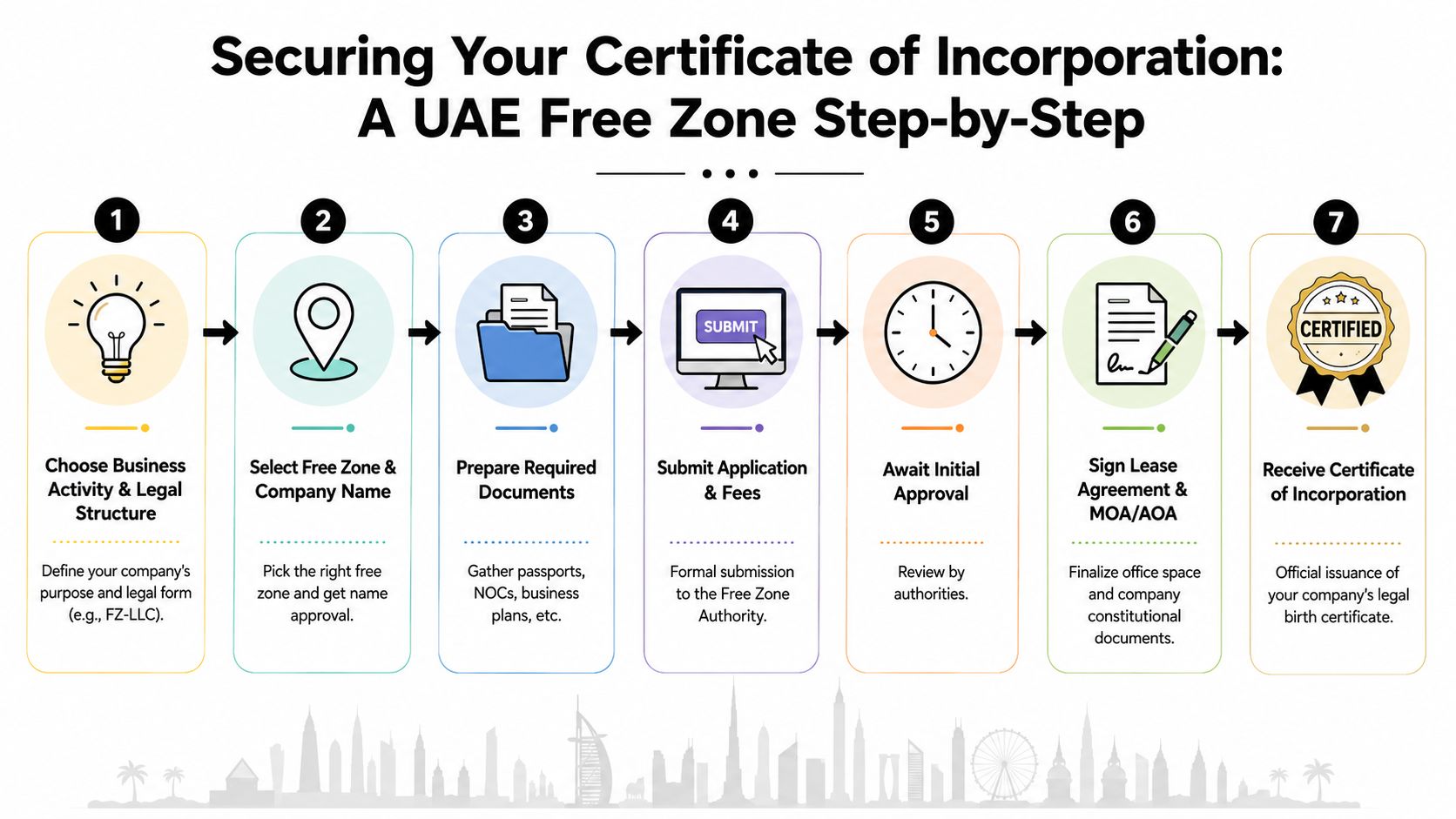
For a free zone company, getting the certificate of incorporation is a process, not a single filing. Founders who move smoothly through it usually do one thing well: they prepare the full sequence in advance instead of reacting to each authority request one by one.
The workflow is familiar if you've ever reviewed company formation in other jurisdictions. For example, the steps to form a Florida business follow the same broad logic of choosing a structure, clearing the name, filing the right documents, and waiting for approval. The UAE free zone process has its own local compliance layers, but the discipline is the same.
The sequence that usually works best
If you want a smoother application, use a structured order instead of collecting documents randomly.
Choose the activity first
The authority needs to know what the company will do. Your selected activity affects the licence category, required approvals, and often the free zone itself.Select the legal form
Founders often decide too late whether they're setting up as a single-shareholder entity, multi-shareholder entity, branch, or another permitted structure. That decision affects the documents you'll need.Pick the right free zone
Don't choose based only on headline package pricing. Choose based on your business activity, visa needs, banking practicality, office requirement, and who your customers are.Reserve the trade name
If the name doesn't comply or conflicts with naming rules, the file stalls early.Submit the initial application
Upon submission, the authority begins checking the proposed structure, shareholders, and activity.Prepare and sign the constitutional documents
MOA and AOA details need to match the application. Inconsistencies create avoidable back-and-forth.Complete lease and final authority formalities
Many founders treat office paperwork as a formality. In practice, it can be decisive.Receive the incorporation documents and trade licence
Once approved, the authority issues the corporate documents for that jurisdiction, including the certificate of incorporation where applicable.
For entrepreneurs who want hands-on support through that process, many use specialist Dubai company formation services to avoid mismatches between the application, constitutional documents, and final issuance.
Why founders get delayed
The free zone process is usually straightforward when the activity, structure, and compliance profile align. Delays happen when founders choose a jurisdiction first and only later realise it doesn't fit their banking plan, staffing model, or document position.
A few practical examples:
- A consultant picks the cheapest free zone package and later discovers the intended activity needs additional approvals.
- A shareholder submits a name application too early before agreeing the legal structure, so the company documents need revision later.
- An overseas founder assumes remote setup means no office commitment, then learns that tenancy documentation is built into the final issuance requirements.
“Fast setup” only happens when the file is clean. Speed doesn't come from rushing. It comes from submitting the right pack the first time.
A practical way to think about the process
Treat the certificate of incorporation as the end result of a compliance chain. It isn't something you request casually after the licence. The authority issues it when the corporate file, identity documents, constitutional documents, and operational prerequisites line up.
That mindset changes how you prepare. Instead of asking, “How quickly can I get the certificate?” ask, “Is my file complete enough for the authority to issue it without queries?”
Your Document Checklist and Common Mistakes to Avoid
A free zone incorporation file is won or lost on document quality. Most rejections don't happen because the business idea is weak. They happen because the paperwork doesn't support the legal structure the founder is trying to create.
The required pack can vary by authority, but the core items are broadly consistent. According to AEDBS on UAE Certificate of Incorporation requirements, free zone issuance requires evidentiary documents including notarised MOA/AOA, board resolutions, proof of minimum share capital, and a valid residence visa for the owner or owners. The same source notes that UBO declaration, proof of address, and a physical office tenancy agreement are mandatory compliance elements.
Core documents to prepare properly
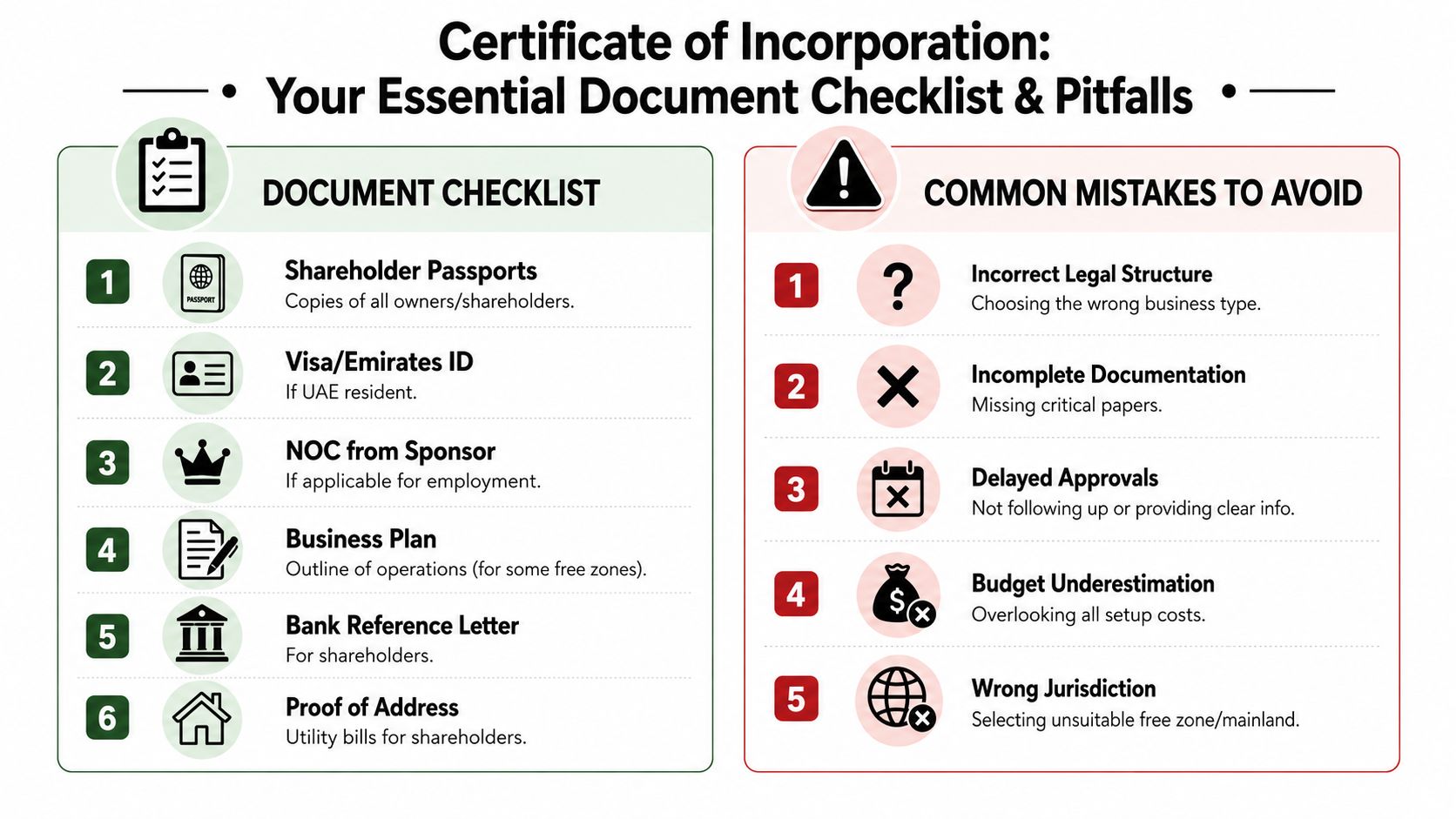
Use this as a practical checklist:
- Identity documents for shareholders and managers. Passport copies are standard, and residency-related documents may also be needed depending on status.
- Proof of address that satisfies the authority's compliance review.
- Notarised MOA and AOA where the structure requires them.
- Board resolution if a corporate shareholder is involved or the authority requires formal authorisation.
- Share capital evidence if the jurisdiction or structure calls for it.
- UBO declaration with consistent ownership details.
- Tenancy or office documentation showing the required physical presence.
- Supporting file items such as business plans, NOCs, or reference documents where the authority asks for them.
If you're assembling a large filing pack from different shareholders in different countries, a utility tool like Merge PDF can help you combine documents into one review-ready submission before sending them to the authority or consultant.
The mistakes that keep files stuck
Some errors look minor but create disproportionate delays.
Incomplete UBO information
If the beneficial ownership trail isn't clear, the authority may reject the file outright.Improper notarisation
A signed document isn't always an acceptable document. If the authority expects notarisation or attestation, a simple signature won't cure the issue.Mismatched names and spellings
A passport spelling, resolution spelling, and application spelling must align. Small differences create compliance questions.Weak proof of address
Founders often submit documents that don't meet the authority's format or recency expectations.Treating office space as optional
For certificate issuance, the physical office tenancy requirement is not optional where the authority mandates it.
Common trap: Founders focus on the licence category and forget that the authority is also testing whether the ownership, location, and supporting documentation make the entity compliant on day one.
The best applications are boring. Every document matches. Every signer is authorised. Every supporting paper confirms the same legal story.
Putting Your Certificate to Work for Your Business
Once the certificate of incorporation is issued, most founders put it in a folder and move on. That's a mistake. For a free zone company, this document starts working the moment you begin dealing with third parties.
The first real test is usually banking. A bank's compliance team wants to know who the entity is, whether it has been legally formed, and whether the corporate pack is internally consistent. If your company is in a free zone, the certificate is often one of the first documents reviewed alongside the licence, shareholder papers, and supporting incorporation records.
Where the certificate becomes useful immediately
A few common situations come up fast:
Opening a corporate bank account
The bank uses the incorporation documents to verify the company's legal identity.VAT registration and tax-related procedures
The entity needs formation evidence that fits the jurisdiction and corporate file.Signing supplier and client contracts
Larger counterparties often ask for the company's registration documents before onboarding.Leasing, service agreements, and corporate onboarding
Landlords, payment providers, and B2B clients may all request incorporation evidence as part of due diligence.
Why this matters commercially
The certificate does more than satisfy bureaucracy. It supports credibility.
A new founder often thinks clients care only about pricing and delivery. In practice, procurement teams and finance departments care about counterparty legitimacy. If they can't verify your company cleanly, they slow the process or stop it entirely.
A certificate of incorporation is rarely the document that wins the deal. It is the document that prevents the deal from stalling in legal and compliance review.
For mainland businesses, the equivalent practical role is performed through their own registration set. For free zone entities, the COI is part of the business's working identity. That's why it should be easy to retrieve, properly stored, and consistent with the rest of the corporate pack you present to banks, tax agents, landlords, and commercial partners.
Navigating UAE Company Formation with Expert Guidance
UAE company formation looks simple from the outside. Fill forms, submit passports, get licence, start trading. In practice, the risk sits in the details. A founder can choose the wrong jurisdiction, prepare the wrong constitutional documents, misunderstand what banking teams expect, or assume one authority's rules apply everywhere.
That's where experienced guidance changes the result. A consultant doesn't just push papers. They pressure-test the setup before filing starts. They ask whether the business should be mainland or free zone, whether the activity fits the chosen authority, whether the shareholder profile will create bank friction, and whether the required supporting documents match the proposed structure.
Why outside help often saves time
Founders usually underestimate three things:
- Jurisdiction nuance because mainland and free zone documents aren't interchangeable.
- Compliance sequencing because UBO, address proof, tenancy, and incorporation papers need to line up.
- Commercial consequences because one missing document can delay banking, contracts, or tax registration.
If you're comparing the UAE with broader cross-border expansion options, this overview of setting up a foreign company is a useful reference point. It helps put the UAE process in the wider context of international incorporation and operational readiness.
The right advisory support gives you fewer surprises. That is its true value. You spend less time correcting preventable mistakes and more time building the business.
Certificate of Incorporation FAQs
How long does it take to get a certificate of incorporation in the UAE
There is no single UAE timeline that applies to every company. In practice, free zone incorporations are often issued faster because the same authority handles the corporate registration pack, while mainland setups can take longer because the proof of legal existence is tied to licence issuance and supporting approvals.
The specific answer depends on your activity, shareholder documents, name approval, and whether the authority asks for clarifications. I advise founders to treat timing and cost as case-specific estimates, not fixed promises.
Do mainland companies get a separate certificate of incorporation
Usually, no. This is the point that causes the most confusion.
A free zone company commonly receives a standalone Certificate of Incorporation or Certificate of Formation as part of its corporate documents. A mainland company usually proves legal existence through its trade licence, commercial registration record, and formation documents issued by the relevant authority. If a bank, supplier, or foreign counterparty asks for a "certificate of incorporation" for a mainland company, the practical fix is to show the mainland corporate pack and explain that the UAE does not always issue the same document format across jurisdictions.
Is the certificate the same as the trade licence
No. They do different jobs.
The certificate records that the company has been incorporated in a jurisdiction that issues that document. The trade licence gives the company permission to carry out its approved business activities. For free zone companies, you may have both. For mainland companies, founders often have the licence and registration documents instead of a separate COI.
Can I open a bank account without it
For a free zone company, banks often expect the Certificate of Incorporation as part of the KYC file. If it is missing, the application usually stalls until the full corporate set is ready.
For a mainland company, the bank will usually review the trade licence, MoA, shareholder documents, commercial registration details, and UBO records. The bank's concern is not the label on the document. It is whether your legal existence, ownership, and business activity are clear and consistent across the file.
What if I lose the original document
Request a reissue or certified copy from the authority that issued it. Do not assume an old scan will satisfy a bank or government body, especially if they ask for a recently certified document.
Does it need renewal
The certificate itself is usually not renewed each year. Your licence, establishment record, and wider compliance position still need to stay valid.
That distinction matters. A founder may still hold an old incorporation certificate, but if the licence has expired, the company can face problems with banking, visa processing, contract onboarding, and tax administration.
If you want clear answers on whether your business should be mainland, free zone, or offshore, and which documents your setup will require, Smart Classic Business Hub can help you structure the process properly from day one. Their Dubai-based team supports company formation, PRO services, VAT-compliant accounting, tax residency matters, and ongoing compliance, so you can move from incorporation to operations without chasing the wrong paperwork.