
You're probably in one of two positions right now. Either you run a media, marketing, content, production, or creator-led business and want a UAE base that clients recognise immediately. Or you've already looked at three different free zones, seen the usual “fast setup” promises, and realised none of those guides explain the decisions that affect cost, visas, banking, and compliance.
That's where business setup in dubai media city gets more nuanced than most articles admit. The core decision isn't just whether you can get a licence. It's whether Dubai Media City fits the way your business operates in 2026, especially if you sell digital services, use AI tools, work with remote teams, or combine media work with consulting and tech-enabled delivery.
A founder can get the paperwork right and still make a bad setup decision. The usual causes are predictable: choosing the wrong activity, picking an office model that limits visa flexibility, or budgeting only for the licence and ignoring the ongoing operating structure. Those mistakes don't always show up on day one. They show up at renewal, at bank onboarding, or when the company needs to hire.
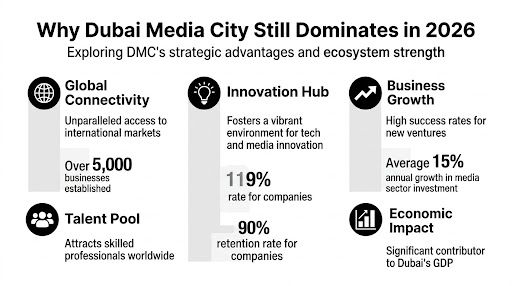
Why Dubai Media City Still Dominates in 2026
Dubai Media City still matters because it wasn't built as a generic licensing zone. It was launched in 2001 as the region's first dedicated media free zone, and the UAE Ministry of Economy & Tourism description of Dubai Media City makes clear that it was designed as a media hub with integrated facilities and support services. That maturity matters when you're setting up. A zone that has supported media businesses for years usually creates less friction than a jurisdiction trying to serve every sector at once.
That early design is also why DMC became a cluster rather than just an address. Media, advertising, publishing, online media, production, and broadcasting businesses weren't placed there by accident. They were drawn into a working environment built around their needs.
Why the ecosystem still gives founders an edge
A mature cluster helps in ways that setup checklists rarely explain. It affects who you meet, how quickly vendors understand your business, and how easily your team can operate once the licence is live.
Three practical advantages stand out:
- Sector relevance: DMC suits businesses that want to be surrounded by agencies, production teams, publishers, broadcasters, and brand-side decision makers.
- Operational familiarity: Banks, landlords, service providers, and candidates are already used to seeing media companies based there.
- Growth visibility: A recognised media address can help when you're pitching regional clients, recruiting specialists, or opening conversations with partners.
If your business is client-facing and reputation-sensitive, location signals matter. They matter even more when your service line sits between media and consulting.
The cluster is still expanding, not just surviving
The strongest argument for DMC in 2026 is that it has scale now, not just legacy. In January 2026, Dubai Media City marked its 25th anniversary and was reported to have attracted 971 cultural and creative sector projects in the preceding year, with AED 18.86 billion in foreign direct investment capital inflows. The wider Media Cluster serves more than 40,000 professionals and hosts over 60% of Fortune 500 companies in the media sector, according to the January 2026 public report on Dubai Media City's 25-year milestone.
Practical rule: If your revenue depends on access to media buyers, agency networks, production ecosystems, or experienced creative talent, DMC is usually a strategic operating choice, not just a registration choice.
That doesn't mean it's right for every founder. If you're comparing flexible working models, this broader look at coworking options in Dubai can help frame whether DMC's ecosystem value justifies its workspace structure for your specific business.
Choosing Your Licence Legal Structure and Activities
Most setup problems in DMC start before the application is submitted. Founders often begin by asking, “Which licence is cheapest?” The better question is, “Which activity and legal form match how the business earns money?”
That sequence matters. For a Dubai Media City setup, a common failure point is mismatching the business activity with the legal entity. The compliant workflow is to choose the activity first, then the legal vehicle, because that affects registration, banking, and visa eligibility, as noted in this Dubai Media City setup workflow guide.
Start with the business model, not the paperwork
If you're a solo consultant, a freelancer permit may fit. If you're building a team, signing client contracts under a standalone company, and planning to scale, an FZ-LLC is often more practical. If you already operate an overseas or UAE company and want a DMC presence, a branch may make more sense.
What doesn't work is forcing a legal structure onto an activity it doesn't support well.
Use this simple filter:
- Freelancer permit suits individual professionals selling their own expertise.
- FZ-LLC suits founders creating an independent business with its own liabilities, contracts, and hiring plans.
- Branch office suits an existing company that wants market entry without creating a separate commercial identity in the same way as a new standalone entity.
Dubai Media City Legal Structures at a Glance
| Feature | Freelancer Permit | Free Zone LLC (FZ-LLC) | Branch of a Company |
|---|---|---|---|
| Best for | Individual professionals | New independent businesses | Existing UAE or foreign companies |
| Legal identity | Individual-led working model | Separate company structure | Extension of parent company |
| Scaling suitability | Limited for team growth | Better for hiring and structured expansion | Useful for established groups entering DMC |
| Contracting style | Often linked closely to the individual | Company contracts under its own setup | Operates through parent-company connection |
| Typical fit | Creators, consultants, specialists | Agencies, studios, media firms, hybrid service businesses | Corporate expansion or regional presence |
The activity list has to reflect reality
The activity selection needs to match what you invoice for. Modern digital businesses often encounter difficulties here. A founder says “media company” but provides a mix of strategy, content production, marketing support, platform management, and advisory work.
That can still work, but the activity mix has to be planned carefully. If the application says one thing and the commercial reality says another, the issues usually appear later:
Choose activities based on revenue, not branding. A business can market itself broadly, but its licence needs to match the services it actually provides.
A few examples make this clearer:
- Content studio: Needs activities aligned with production and creative delivery, not only generic consultancy.
- Marketing agency: Should think beyond naming and include the services that clients will contract and pay for.
- Solo creator using AI tools: Needs a structure that reflects whether the business is personal freelance work or a company selling broader media services.
- Hybrid media-tech consultancy: Needs especially careful scoping, because its services may sit across media, advisory, and digital operations.
If you need to compare DMC against other UAE structures before committing, this guide to free zone company setup in the UAE is a useful reference point.
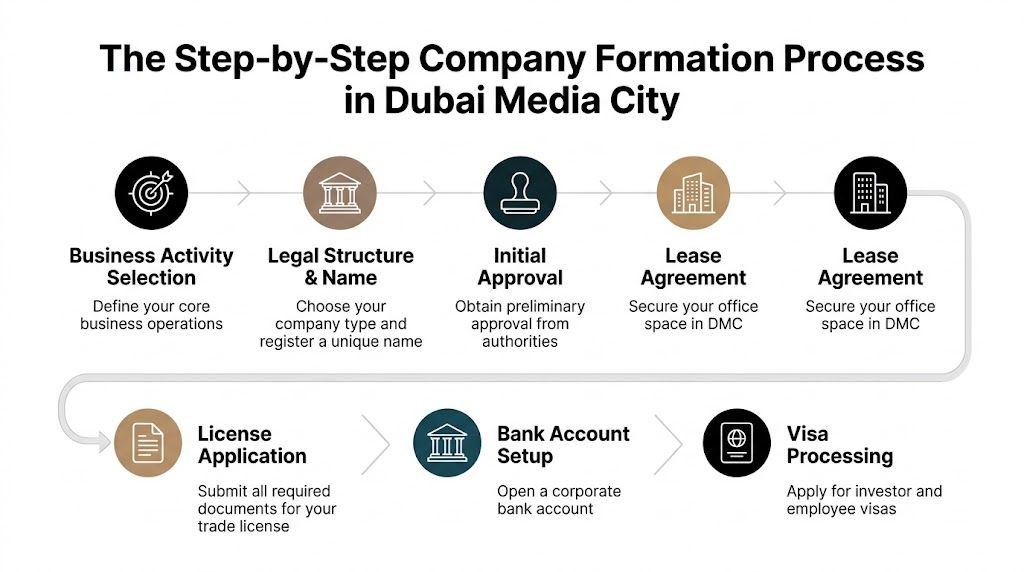
The Step-by-Step Company Formation Process
The DMC formation process is straightforward when the file is clean. It becomes slow when founders submit incomplete documents, vague business descriptions, or an office choice that doesn't fit the intended visa plan.
Dubai Media City's long-established ecosystem is one reason the process can feel more organised than newer jurisdictions. The UAE Ministry of Economy & Tourism overview of Dubai Media City notes that the zone's established environment attracted over 1,300 companies relatively early, which helps explain why setup workflows are already well understood by the market.
What the application journey usually looks like
The shortest compliant path follows a practical sequence:
Define the business activity
This is the foundation. It affects legal form, application review, and later compliance.
Confirm the legal vehicle
Once the activity is clear, the entity choice becomes easier. The founder then decides between freelance, FZ-LLC, or branch.
Prepare the application package
Typical documents include a passport copy, business plan, and where required, financial evidence such as bank statements.
Submit for incorporation and licensing
A clean application is of paramount importance. Missing details tend to delay decisions.
Obtain company documents
Once approved, the licence and incorporation records are issued.
Open the establishment route for visas
The company card or establishment card is needed before visa sponsorship can move properly.
Process immigration formalities
Entry permit, medical, Emirates ID biometrics, and final visa issuance follow in sequence.
Where delays usually happen
Founders often assume delay comes from the authority. In practice, delay usually comes from the file.
The most common weak points are:
- Activity mismatch: The description doesn't reflect the actual business.
- Incomplete documents: The business plan is too vague, or supporting documents are missing.
- Name and structure confusion: The trade name, activity, and legal form don't align well.
- Premature banking expectations: The company is formed, but the founder hasn't prepared for bank due diligence.
A clean file moves quickly. A messy file creates second-round questions, and second-round questions are what stretch timelines.
Regional setup guidance consistently reports that compliant applications can be processed in only a few days, and one guide notes that DMC evaluates applications in about five days after submission. That's useful as an expectation marker, but only if the application is complete and accurate.
What founders should prepare before submission
A good pre-submission review saves more time than any “express” package later. Before filing, confirm:
- The service scope: What exactly will the company sell?
- The ownership map: Who owns the entity, and are any corporate shareholders involved?
- The office plan: What physical setup is needed now, and what will be needed at renewal?
- The visa plan: How many people need sponsorship in the first operating period?
- The banking story: Can the company clearly explain clients, revenues, and transaction flows?
When these points are settled early, the formation process becomes administrative rather than confusing.
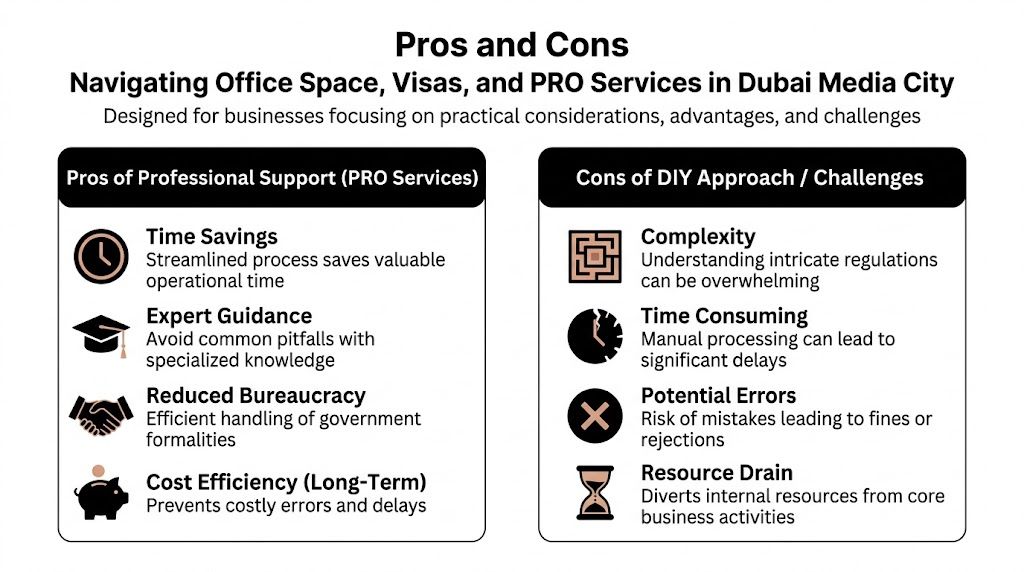
Navigating Office Space Visas and PRO Services
This is the part many founders underestimate. They focus on the licence, then discover that the actual operating structure depends on space, visa planning, and admin execution.
In Dubai Media City, the choice between a serviced office, co-working desk, or dedicated unit directly affects visa eligibility, renewal risk, and total cost, and DMC itself presents workspace options such as commercial offices, co-working spaces, and studios in its business setup offerings for Dubai Media City. That makes workspace a core setup decision, not a box to tick after approval.
Office choice changes more than your rent
A founder who needs one visa and a recognised business address may be fine with a lighter office model. A founder planning to hire, host clients, or build production capability usually needs a more robust setup.
The wrong way to choose office space is to look only at entry cost. The right way is to assess four things together:
Visa capacity
Your office model can affect how much sponsorship flexibility you have.
Commercial credibility
Some client-facing businesses need a stronger physical presence for meetings, tenders, and onboarding.
Renewal resilience
A setup that feels cheap in year one can become restrictive when the company grows or needs additional staff.
Operating practicality
A content team, recording setup, or collaborative creative workflow may need privacy, storage, or studio access that hot-desking doesn't provide.
What tends to work for different business types
Not every media business needs the same premises.
A rough guide looks like this:
Solo specialist or freelancer
A co-working or lighter office model may work if client delivery is remote and headcount stays limited.
Boutique agency
A serviced office often gives the best balance of presentation, flexibility, and controlled overhead.
Content production business
Dedicated or studio-oriented space becomes more relevant because the work itself needs infrastructure.
Regional branch
Office choice often depends on client-facing expectations and internal governance standards from the parent company.
Cheap space can become expensive if it blocks hiring, causes renewal issues, or forces a move too early.
If you're trying to estimate practical layout needs before signing a lease, this office space requirements guide is useful for understanding how headcount and function affect space planning.
Visa processing is where founders lose time
The visa side is procedural, but it isn't trivial. After the company is formed, the establishment route, entry permit, medical testing, Emirates ID biometrics, and final visa issuance need to happen in the correct order. Founders who try to manage every step themselves often lose time chasing appointments, document formatting, and status checks.
That's why PRO support becomes operationally valuable, not just convenient.
A practical PRO partner helps with:
- Application sequencing: Making sure the company and immigration steps happen in the right order.
- Document handling: Avoiding avoidable rejections caused by inconsistency or missing records.
- Government follow-up: Tracking the file rather than waiting passively.
- Internal time protection: Letting the founder focus on clients, recruitment, and launch tasks.
For companies that want bundled help with physical setup and admin support, office solutions in Dubai can be useful as part of the broader planning process.
When DIY works and when it doesn't
DIY can work if the structure is simple. One founder, one straightforward activity, limited visa needs, and a clear office model. Once the setup includes multiple shareholders, a branch, staff visas, or mixed service lines, errors become more expensive.
A good rule is simple. If a delay would cost you client work, payroll planning, or relocation timing, professional handling is usually justified.
Understanding the Full Cost and Financial Obligations
Most founders ask for the licence fee first. That's understandable, but it's the wrong budgeting lens. The actual cost of business setup in dubai media city is the total cost of ownership, not the first invoice.
That total cost includes formation, office occupancy, immigration processing, renewals, accounting discipline, and tax compliance planning. For modern digital-first businesses, the wrong structure often looks affordable at the start and expensive later.

The budget items founders often miss
Founders usually plan for the obvious line items and ignore the operational ones. The cost picture is broader than many setup pages suggest.
Look at your DMC budget in two layers.
Initial and recurring setup costs
- Licence and registration costs: The legal right to operate.
- Office occupancy costs: Driven by whether you choose co-working, serviced office, or dedicated space.
- Visa-related costs: Owner visas, employee visas, and the admin tied to processing.
- Renewal exposure: What the business must maintain to renew without disruption.
Ongoing financial obligations
- Bookkeeping and records: Especially important if the business has multiple revenue streams.
- Tax registration assessment: Whether corporate tax registration applies, and when.
- VAT planning: Important for businesses with mixed services, cross-border work, or evolving turnover.
- Audit or reporting support where required: Depending on structure and obligations.
Hybrid media businesses need more careful planning
2026 setup decisions differ from older media-company playbooks. Many guides still treat DMC as if every applicant is a traditional broadcaster, publisher, or agency. That's no longer how a large share of founders operate.
Many guides on DMC setup fail to address whether the zone fits businesses that are digital-first, AI-assisted, and built around hybrid service lines. The actual problem is whether DMC's licensing scope fits a company blending content, consulting, and tech, especially with UAE corporate tax and VAT now part of the planning picture, as discussed in this Dubai Media City suitability overview for modern business models.
Your licence is only one part of compliance. The way you invoice, classify services, and organise records can matter just as much.
A few examples show why:
- Agency plus consulting model: Needs clarity on what services are licensed and how invoices are described.
- Creator business with remote clients: Needs discipline around income streams and documentation.
- Production company using AI tools: Needs its commercial scope defined in a way that still fits the licensed activity.
- Media business with software or platform support: Needs sharper tax and classification review than a traditional single-service firm.
What a realistic founder should do before launch
Before you commit, build a plain-language financial plan that answers these questions:
- What are the one-off setup costs?
- What has to be paid annually to keep the structure compliant?
- How many visas are needed in the first period?
- What office model still works if the team grows?
- Will the accounting and tax setup support the service mix from day one?
This is where advisory support matters. Firms such as Smart Classic Business Hub handle company formation, PRO coordination, VAT-compliant accounting, audit support, and related compliance services, which can help founders connect the setup decision to the actual financial operating model instead of treating them as separate issues.
Avoiding Pitfalls and Partnering for Success
The expensive mistakes in DMC are rarely dramatic. They're ordinary decisions made too quickly. A founder chooses an activity that sounds close enough. Another picks the cheapest office option without checking how it affects sponsorship. Another gets incorporated, then realises the tax and bookkeeping side was never properly mapped.
Those mistakes are avoidable if you treat setup as an operating design decision, not an admin purchase.
What works
The founders who usually move cleanly through DMC tend to do a few things right:
- They define revenue clearly: They know what services they sell and choose activities accordingly.
- They plan visas early: They don't assume office and sponsorship capacity can be fixed later without cost.
- They budget beyond incorporation: They include renewal, occupancy, records, and tax readiness in the plan.
- They document the business properly: Their business plan, ownership documents, and commercial rationale are consistent.
What usually goes wrong
The recurring problems are easy to recognise:
- Licence-first thinking: Buying a licence before deciding how the business will operate.
- Under-scoped activities: Licensing only part of what the company will invoice for.
- Weak office strategy: Choosing flexibility today and discovering constraints at renewal or hiring stage.
- DIY overload: Trying to manage company formation, banking prep, immigration, and compliance alone while also launching the business.
The best setup is not the one with the lowest entry cost. It's the one you can operate, renew, bank, and scale without having to rebuild it.
If your company is a straightforward solo operation, a light structure may be enough. If you're building a serious regional business, the setup should be designed for year two, not just week one.
If you want a practical review of your options before committing, Smart Classic Business Hub can help you assess whether Dubai Media City fits your activity mix, office needs, visa plan, and compliance obligations, then support the setup and post-setup process with formation, PRO, accounting, and related UAE business services.