
A founder in Dubai can spend months building a business, managing VAT filings, and preparing for a licence renewal, only to discover that the company's audit obligation was triggered by a rule nobody checked. The surprise usually comes from an assumption that the free zone, revenue level, or foreign parent company removes the need for a UAE audit. It often doesn't.
The practical question is not whether your company needs an audit. It's which audit trigger applies, which authority governs the filing, and whether more than one obligation applies at the same time. Mainland companies, free-zone entities, and Qualifying Free Zone Persons can face different requirements, while corporate tax rules create an additional compliance layer.
Why Audit Compliance Matters More Than Ever in Dubai
A company can pass its year-end, tax, and licence deadlines while still missing an audit obligation created by its structure. That happens when founders check only revenue, or assume a free-zone licence removes the need for statutory reporting.
Dubai businesses must identify three possible triggers: the mainland or free-zone authority's rules, the corporate tax framework, and any sector-specific regulator. These obligations can overlap. Treating them as separate checklists is how finance teams miss a filing, appoint the wrong auditor, or prepare records too late.
At the federal level, Federal Decree-Law No. 41 of 2023 governs the accounting and auditing profession. Statutory audits may only be performed by auditors and firms licensed by the UAE Ministry of Economy, as outlined in this guide to auditing companies in Dubai.
An accountant's year-end accounts do not replace an audit opinion from an authorised auditor. That distinction affects licence renewals, tax records, free-zone submissions, and financial statements supplied to banks or investors. Before appointing a low-cost provider, confirm that the auditor is authorised for the specific work and authority involved.
The overlapping trigger founders miss
Use a decision tree. First, check whether the mainland or free-zone authority requires audited financial statements. Next, determine whether the company is a taxable person above the corporate tax threshold. A standalone taxable person with revenue above AED 50 million in a tax period must prepare audited financial statements. Every Qualifying Free Zone Person, regardless of revenue, must also meet the relevant audited-statement requirement under the corporate tax framework described in the Dubai audit compliance guide.
The result may be one obligation or several. Confirm the governing authority, reporting period, auditor eligibility, and submission route before the financial year closes. A missed licence or filing requirement can affect tax compliance, regulatory standing, and the company's ability to prove reliable records.
Practical rule: Put audit planning in the monthly finance calendar, with responsibility assigned before year-end.
DIFC shows how closely audit quality is monitored in Dubai's financial sector. Its oversight process reviews both financial statement work and regulatory reporting, so firms operating under DIFC rules must plan for regulator-specific documentation and review standards. The latest monitoring findings, summarised in this DIFC audit monitoring report summary, reinforce the need to assess auditor quality before the appointment deadline.
Types of Audit Services Businesses Need in Dubai
Businesses often use the word “audit” to describe several different services. That creates confusion. A statutory audit, a VAT review, and an internal audit have different purposes, evidence requirements, and consequences.

Statutory audits
A statutory audit is the formal independent examination of financial statements required by applicable company, free-zone, tax, or regulator rules. UAE financial reporting is technically anchored in IFRS-based reporting, and statutory annual audits apply to mainland LLCs and many free-zone entities. The audit opinion must come from a UAE-licensed auditor, rather than relying only on accounts prepared for a foreign group, as explained in this UAE annual audit overview.
The auditor tests the financial statements and supporting records, including revenue, expenses, assets, liabilities, bank balances, related-party transactions, and selected controls. The result is an audit report that management can use for the relevant authority, shareholders, lenders, or other stakeholders.
A statutory audit is mandatory when a legal trigger applies. It isn't made optional because the business is privately held or because the parent company already has consolidated accounts abroad.
VAT audits and reviews
A VAT audit or VAT compliance review focuses on tax records rather than providing the same opinion as a statutory financial statement audit. The work typically examines VAT returns, tax invoices, input tax claims, output tax treatment, credit notes, reconciliations, and the connection between the VAT ledger and the underlying accounting records.
The Federal Tax Authority may scrutinise records during a review, particularly where documentation is incomplete or the accounting treatment is inconsistent. A business can therefore meet its statutory audit obligation and still have weaknesses in VAT evidence. Finance teams should reconcile VAT filings to the general ledger and preserve the documents supporting each material claim.
Internal audits
An internal audit is a governance tool. It reviews how the business controls payments, purchasing, payroll, inventory, access rights, approvals, and financial reporting. Unlike a statutory audit, it may be commissioned voluntarily by management, shareholders, investors, or a board.
For a growing SME, an internal review can identify weaknesses before they become external-audit findings. It can also test whether employees follow the procedures documented by management. The scope should be practical, such as reviewing procurement approvals or customer-credit controls, rather than producing a broad report that nobody acts on.
Decision point: Statutory audits answer whether the financial statements meet the applicable reporting and audit requirements. Internal audits answer whether the business's processes are controlling risk effectively.
Which Audit Rules Apply to Your Company
Start with the company's legal home, then test the corporate tax position. Don't start with revenue alone. The same revenue level can produce different obligations depending on whether the entity is mainland, in a particular free zone, or claiming the Qualifying Free Zone Person regime.
The decision tree
Use this order:
- Identify the authority. Confirm whether the company is mainland, in DMCC, DIFC, or another free zone, and check the authority's current auditor and filing rules.
- Check the zone trigger. DMCC requires annual audited financial statements for all licensed entities, while DIFC requires annual audits for all entities. Other zones may apply exemptions or revenue thresholds, as described in this free-zone audit compliance guidance.
- Test corporate tax triggers. A business with revenue above AED 50 million in a tax period must prepare audited financial statements. A Qualifying Free Zone Person claiming the 0% regime must also prepare audited financial statements, regardless of revenue, according to the same guidance.
- Record every applicable trigger. If the zone and tax rules both apply, follow the stricter combined obligation rather than selecting the easier interpretation.
Comparison of the main triggers
| Jurisdiction | Audit Trigger | Revenue Threshold | Filing Basis |
|---|---|---|---|
| Mainland | Applicable statutory and corporate tax requirements | Audited statements required above AED 50 million under the corporate tax trigger | UAE-licensed auditor and relevant authority or tax records |
| DMCC | Annual audited financial statements for all licensed entities | No revenue threshold for the stated zone requirement | DMCC filing requirements |
| DIFC | Annual audit for all entities | No revenue threshold for the stated zone requirement | DIFC and applicable financial reporting requirements |
| Other free zones | Zone-specific exemptions or thresholds may apply | Depends on the free zone's rules | Relevant free-zone authority |
| Qualifying Free Zone Person | Audited financial statements required when claiming the 0% regime | Applies regardless of revenue | UAE corporate tax requirements |
| Taxable person above the corporate tax threshold | Audited financial statements | Above AED 50 million in a tax period | UAE corporate tax requirements |
What happens when triggers overlap
Suppose a company operates in a free zone with a universal annual audit rule and also qualifies for a corporate tax trigger. It doesn't have two separate financial statements to prepare. It has one audit engagement that must be scoped to satisfy the applicable requirements and filing formats.
The mistake is assuming that a foreign group audit, management accounts, or a bookkeeping package replaces the UAE statutory opinion. Local deadlines and regulator-specific formats still matter. Your auditor should know which authority will receive the report and what schedules that authority expects.
Keep a written trigger assessment in the finance file. It should identify the company's licence jurisdiction, tax status, revenue position, applicable filing deadlines, approved-auditor requirements, and the person responsible for submission.
The Audit Process From Engagement to Signed Report
A clean audit begins before the auditor starts testing transactions. The engagement letter should define the reporting framework, period under review, expected deliverables, responsibilities, fee basis, and filing support. If those points remain vague, management may discover too late that financial statement preparation, tax work, or regulator-specific reporting sits outside the agreed scope.
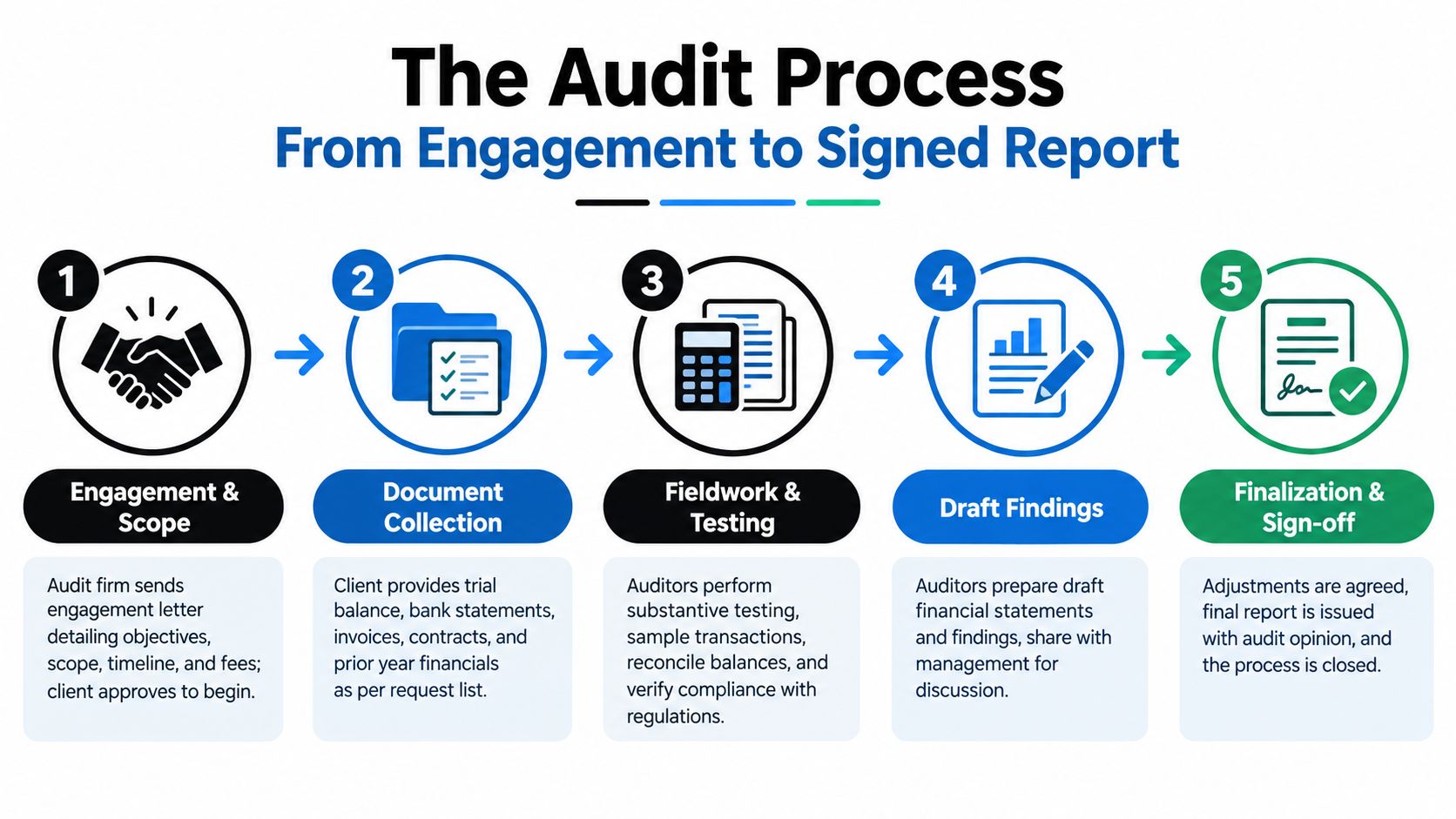
1. Engagement and scope
Give the auditor the trade licence, constitutional documents, ownership information, prior financial statements, and a clear description of operations. Disclose unusual transactions early, including related-party balances, new financing, asset purchases, revenue arrangements, or changes in business activity.
The auditor uses this information to assess risk and plan the work. Your team should ask which free-zone or mainland filing rules apply and whether the report must follow a particular format.
2. Document collection
Expect a request list covering the trial balance, general ledger, bank statements, reconciliations, invoices, contracts, payroll records, fixed-asset schedules, VAT returns, corporate tax information, and related-party disclosures. The exact list varies by business, but incomplete evidence almost always creates avoidable queries.
Assign one finance owner to control the document room. Use consistent file names and provide reconciliations that tie back to the trial balance.
3. Fieldwork and testing
During fieldwork, auditors sample transactions, inspect supporting documents, confirm balances, review cut-off, test revenue and expenses, and examine selected controls. They may ask why a balance changed, whether an invoice relates to the correct period, or how management calculated an estimate.
Your job isn't to defend every figure reflexively. It's to provide clear evidence and explain the accounting judgement behind difficult balances.
4. Findings and adjustments
The auditor discusses proposed adjustments, control observations, and unresolved evidence requests with management. Finance leaders should distinguish between an error in the financial statements, a documentation gap, and a process weakness. Each requires a different response.
Resolve issues before signing where possible. Repeated late adjustments usually indicate that the monthly close process isn't producing reliable schedules.
5. Representation and sign-off
Management may need to provide written representations confirming responsibility for the financial statements and the information supplied. After the final review, the licensed auditor issues the signed report and audit opinion.
Closing discipline: Build working papers around local filing dates and regulator formats, not only around a foreign parent's consolidation timetable.
Keep an audit-ready folder throughout the year. Monthly bank reconciliations, VAT reconciliations, approval records, contract registers, and related-party schedules are far more useful than a rushed document collection exercise at year-end.
The Independence Problem Most Businesses Overlook
Many SMEs want one provider to handle bookkeeping, VAT, corporate tax support, and the audit. It appears efficient, but it can create a serious independence issue when the same firm audits records it prepared.
Updated 2024–2025 Ministry of Economy expectations tightened auditor-independence standards. The concern is a self-review threat, where the auditor may be required to evaluate accounting entries, classifications, reconciliations, or financial statements produced by its own bookkeeping team. The relevant warning is set out in this UAE statutory audit independence guidance.
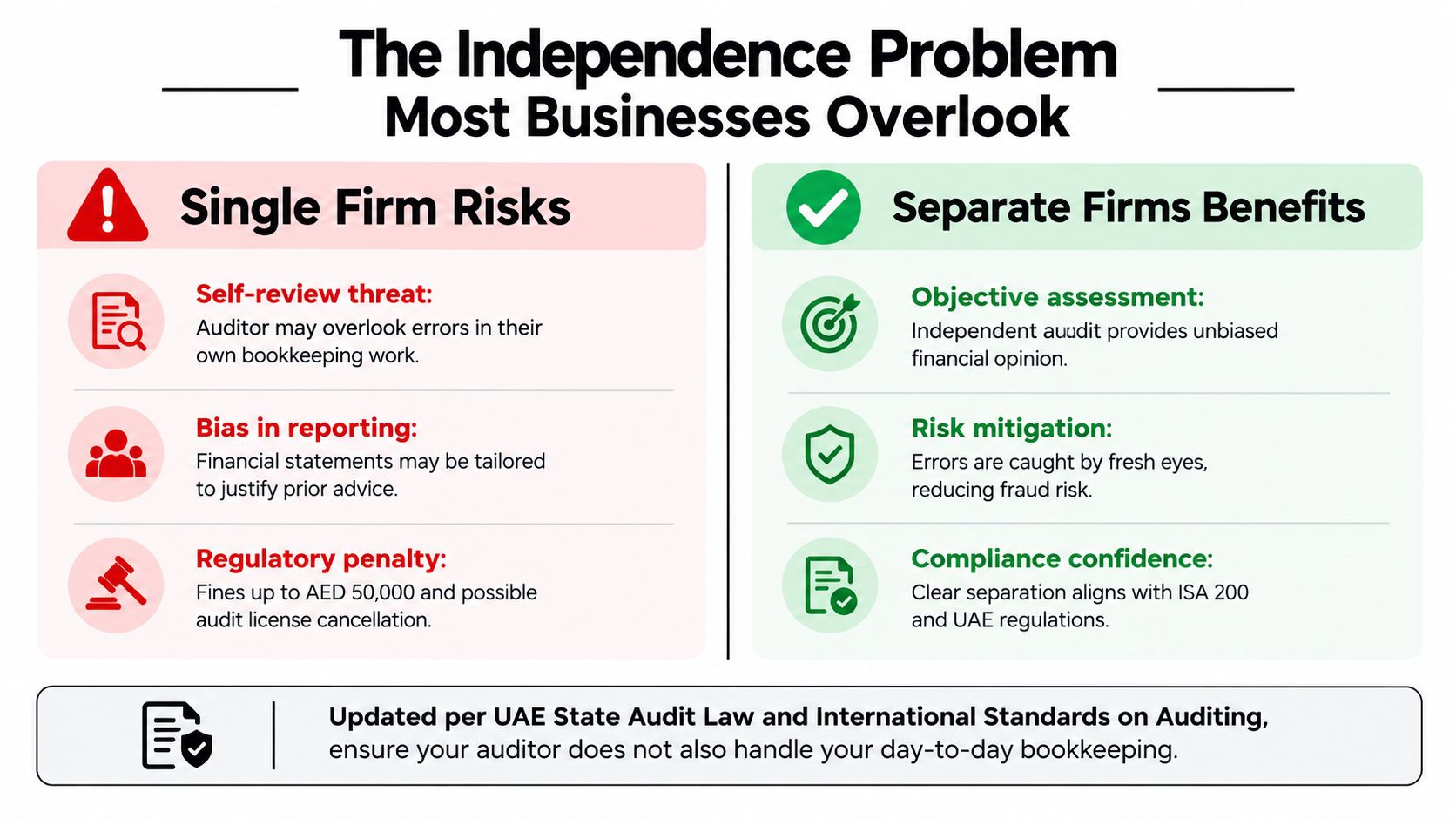
Why the arrangement creates risk
If the bookkeeping provider posts an entry and the audit team later approves the same treatment, the audit file may not demonstrate sufficient objectivity. The issue isn't limited to deliberate misconduct. Familiarity with the client, pressure to defend prior work, and poor separation of responsibilities can all weaken professional scepticism.
That weakness becomes more uncomfortable during a tax review, investor due diligence, bank request, or regulator inspection. Management may have a signed report, but the supporting process can be harder to defend.
How to structure the relationship
Separate the responsibilities wherever the bookkeeping creates a self-review threat. One provider can maintain the books and prepare VAT records, while an independent licensed auditor examines the financial statements. If a firm offers both services, ask how it identifies, evaluates, and safeguards independence risks before accepting the engagement.
Use these questions before signing:
- Who prepares the ledgers? Identify the people responsible for postings, reconciliations, and financial statement preparation.
- Who performs the audit? Confirm the audit team's independence from the bookkeeping team.
- What safeguards apply? Ask whether separate personnel, review procedures, or an independent quality review will address conflicts.
- What is excluded? Read the engagement letter for bookkeeping, tax, and financial statement preparation responsibilities.
The cheapest bundled arrangement can become expensive if the auditor must withdraw, reperform work, or explain an avoidable independence concern.
How to Choose the Right Auditor for Your Business
A low audit fee can become expensive if the firm lacks the licence, free-zone recognition, or sector experience your company requires. Start by checking whether the proposed auditor is licensed by the UAE Ministry of Economy and approved for the work involved. General accounting experience does not automatically qualify a firm for a free-zone filing, regulated activity, or specific reporting format.
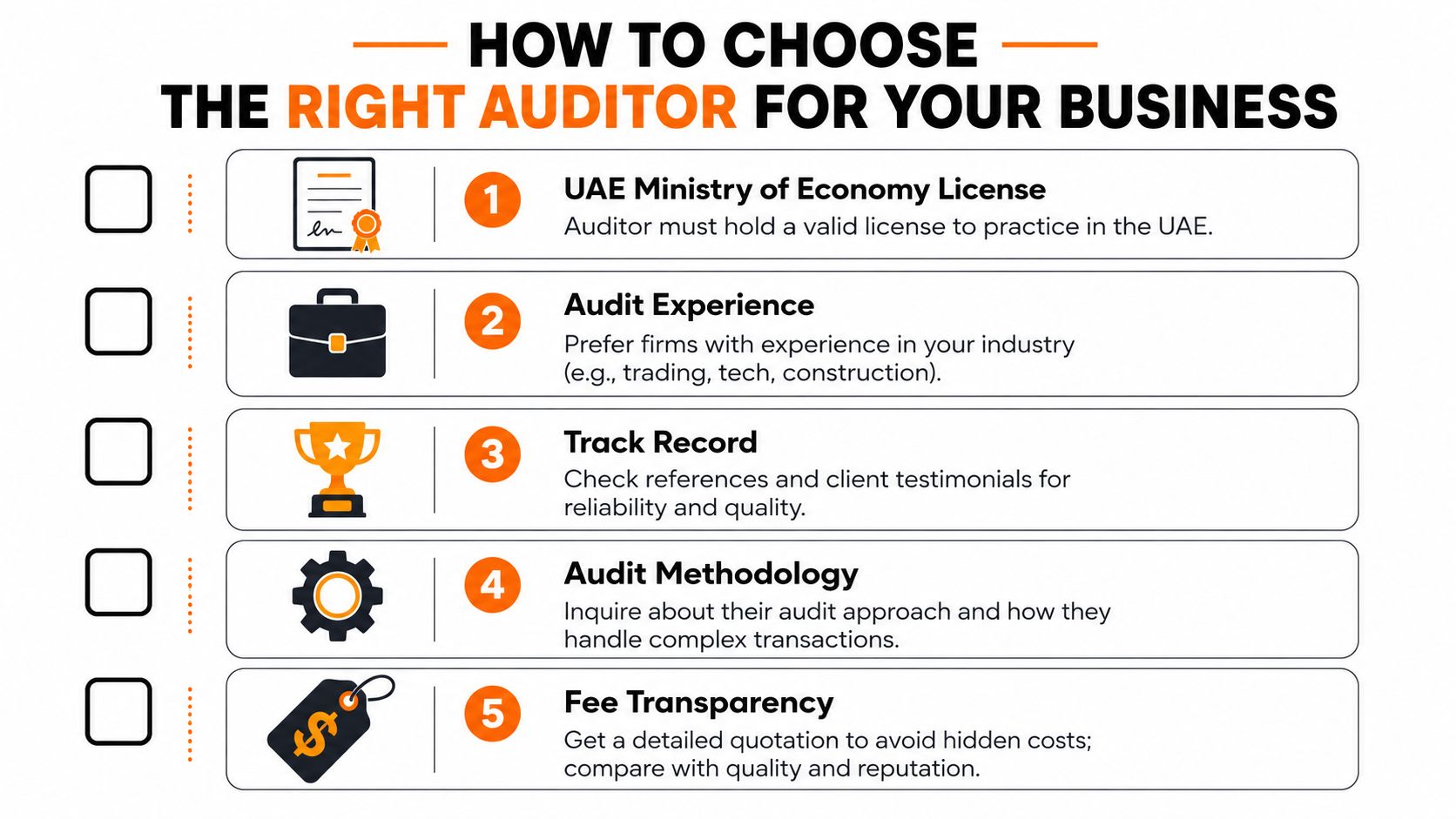
Five checks before appointment
Licence and recognition come first. Request evidence of the firm's UAE Ministry of Economy licence, then verify whether the relevant free zone accepts that auditor. DIFC entities need an auditor familiar with DIFC requirements. Do not assume that every UAE audit firm can handle every jurisdiction.
Match experience to your records. Trading companies, technology businesses, construction groups, and regulated financial-services entities present different audit risks. Select a firm that understands your revenue model, inventory or project accounting, related-party structure, and reporting framework.
Test the methodology. Ask how the team addresses revenue cut-off, bank confirmations, estimates, related-party transactions, foreign-group reporting, and unresolved prior-year matters. A credible proposal explains the procedures and expected evidence, not only the final deliverable.
Test the working relationship
Communication failures often delay fieldwork. Confirm who will manage the engagement, how the team will consolidate questions, and how management will receive draft findings. Require a named engagement partner or manager, a clear request list, and an escalation route.
Demand fee transparency. The engagement letter should separate the audit from financial statement preparation, VAT support, corporate tax work, specialist reviews, and regulator-specific submissions. Compare quotes only after confirming that their scopes match.
DIFC's monitoring work is a useful quality benchmark because it shows why oversight and documented procedures matter in a financial-centre environment. Use that benchmark to question how the auditor reviews its work, supervises staff, records findings, and reports issues. A firm that cannot explain those controls should not win the engagement because its proposal is cheaper.
Selection test: Ask the auditor to identify the three issues most likely to affect your company's audit opinion before discussing a discount.
Check references where possible, but seek practical evidence. Can the firm explain your mainland, free-zone, and corporate tax-related triggers without treating them as separate checklists? Can it identify which rules apply to your structure, protect independence, and respond when an authority's format differs from your parent company's requirements? If the answers are unclear, reject the quote. A low fee will not offset missed filings, rework, or compliance risk.
Smart Classic Business Hub and Your Audit Readiness
Audit readiness starts with records that are accurate, reconciled, and organised for the authority that will review them. Smart Classic Business Hub provides VAT-compliant accounting, bookkeeping support, and audit coordination, helping businesses prepare financial information for licensed audit partners while keeping the independence boundary clear.
The right preparation depends on structure. Mainland companies, free-zone entities, and businesses with tax-driven audit obligations shouldn't use the same checklist without checking the governing rules. Your finance team should identify its triggers, confirm the required auditor, maintain monthly reconciliations, and collect supporting documents before the year-end rush.
Use this short action list:
- Map the obligation: Record the mainland, free-zone, and corporate tax triggers that apply.
- Protect independence: Separate bookkeeping from the statutory audit where a self-review threat exists.
- Prepare evidence: Keep reconciliations, invoices, contracts, VAT records, and related-party schedules organised.
- Appoint early: Give the licensed auditor enough time to work to the applicable filing timetable.
Smart Classic Business Hub can review your bookkeeping and VAT records, map the audit obligations affecting your Dubai company, and coordinate preparation with an appropriately licensed auditor. Visit Smart Classic Business Hub to discuss your structure, filing requirements, and audit-readiness plan.