
Dubai recorded 6,998,414 residence transactions in 2025, according to the General Directorate of Residency and Foreigners Affairs, Dubai. That scale tells you something important about a UAE residence visa. It isn't a one-off stamp you collect and forget. It's a live legal link between you and a sponsor, a company, a family member or a qualifying category, and that link decides how long you can stay and what breaks when circumstances change. Choose the route by testing that link first, not by picking the most familiar visa label.
Which UAE Residence Visa Fits Your Situation
UAE residence visa types at a glance
| Visa type | Sponsor needed | Typical validity | Best suited to |
|---|---|---|---|
| Employment | Employer sponsor | 1, 2 or 3 years | Salaried staff with a job offer in the UAE |
| Investor through a company | Company as sponsor | 1, 2 or 3 years | Owners and shareholders running a UAE business |
| Family | Sponsoring resident | Generally 1, 2 or 3 years | Spouses and eligible dependants of a resident |
| Freelance | Issuing free zone or permit authority | Set by the issuing authority, confirm before applying | Independent professionals with a licensed activity |
| Golden | No individual sponsor | 5 or 10 years | Investors, entrepreneurs, exceptional talents and outstanding students |
The core split sits in the middle column. Most sponsored visas run for shorter cycles because they're tied to a job, a company licence or another resident's permit. Golden residence runs longer because your own qualifying evidence carries the application, with no individual sponsor in the chain.
That's not a small administrative system behind these choices. The UAE Federal Authority for Identity, Citizenship, Customs and Port Security reported 4,520,694 residence-permit issuances in 2025. With that volume, applications move fastest when the legal basis is clear from the first document.
Two readers, two different links
Say an engineer accepts a job with a Dubai firm. Her residence follows the employer. If that employment ends or the employer can't sponsor her, her basis for staying ends with it, even if she still has a flat, a bank account and clients who want her work.
Now say a founder owns a mainland company and takes residence through that company. His visa follows the company. A healthy order book doesn't protect him if the trade licence lapses, because the sponsoring entity is the thing the residence hangs from.
Practical rule: Ask who or what would have to stay valid for your residence to stay valid. That answer names your real route.
Use this quick test before you compare fees or timelines. If an employer or your own company sponsors you, start with the sponsored routes and check that sponsor's strength. If you hold a strong investment, talent or academic profile that stands on its own evidence, check Golden eligibility first. Freelancers sit between the two, so confirm the current validity rule directly with the issuing free zone or permit authority before you budget.
Eligibility Rules for Employees, Investors and Freelancers
Every route starts with a legal basis, meaning the specific fact that entitles you to live in the UAE. Readers often get confused here because they think nationality or registering a company creates that entitlement. It doesn't. The basis does the work, and each route names a different one.
For employment, the basis is a valid job offer from a UAE employer that's able to sponsor you. The employer isn't a formality. It's the entity standing behind your residence, so its licence status and its willingness to maintain your file matter for as long as you hold that visa.
For an investor through a company, the basis is ownership or a qualifying shareholding in an approved UAE company. You're not sponsored because you work hard in the business or because your name appears on its website. You're sponsored because company records show you hold a qualifying stake in an entity that's properly licensed.
Where applications quietly fail
The labels employee and investor describe different legal facts, and mixing them up is a common reason files stall. One person can hold both roles, but each role needs its own evidence.
Say you're named as an employee of a company your business partner owns. You manage sales, sign proposals and run the office day to day. That still doesn't give you an investor basis unless you also hold a qualifying share in that company. The employee label supports an employment route. It can't be stretched into an investor route just because your responsibilities look senior.
For freelance residence, the basis is a professional activity that the issuing free zone or permit authority licenses. Check that your real work, described plainly, matches a licensable activity before you commit. A mismatch between what you sell and what your permit covers creates problems later, even if the initial paperwork looks tidy.
For Golden residence, the basis is one qualifying category proved by your own evidence, without an individual sponsor. That's why the evidence bar sits higher. There's no employer or company carrying the application for you.
Don't build a document pile yet. First write down, in one sentence, the basis you're claiming. Then use the documents table in the application section to match evidence to that sentence. If you can't finish the sentence cleanly, you haven't chosen a route. You've chosen a label.
Sponsoring Family Members Under UAE Income Rules
Family sponsorship runs on income and dependency controls, not on your job title. A senior title with low documented pay fails the test. A modest title with pay and accommodation that meet the threshold passes it.
The UAE Government Portal page on residence visas for family members states that a resident may sponsor a spouse, unmarried daughters, sons under 25, and children with special needs if the sponsor earns at least AED 4,000 monthly, or AED 3,000 plus employer-provided accommodation. Sponsored family members aged 18 or above must pass a medical-fitness examination at an approved UAE health centre.
How the threshold works in practice
Say you earn AED 3,500 a month and your employer provides your flat. You meet the test, because your salary plus qualifying accommodation satisfies the lower band. Earn the same AED 3,500 without employer-provided accommodation and you don't meet it, because you're below the AED 4,000 line that applies when accommodation isn't part of the package.
That example shows why payroll changes matter beyond your bank balance. If your documented salary drops or you lose qualifying accommodation, you may be unable to establish or renew dependent residence, even while your business stays active and your own work continues as normal.
The legal link runs further. Dependent permits follow the sponsor's residence permit. If the sponsor's permit is cancelled, the dependants' visas must be cancelled too. One person's change of job, company restructuring or move from an employer route to an investor or Golden route can therefore affect the whole household at once.
Treat your family's residence as one connected file, because the system already does.
Plan accordingly. Keep payslips and accommodation evidence current, not reconstructed at renewal time. Track the sponsor's expiry date alongside each dependant's, and flag any salary or housing change the month it happens. Families rarely get caught out by the rule itself. They get caught out because nobody noticed the sponsor's circumstances had already moved.
Golden Visa Categories and Investment Thresholds
A Golden Visa changes the sponsorship link: residence rests on meeting a qualifying category rather than on one employer or individual sponsor. That can provide continuity if a job changes, but the applicant must keep the evidence supporting the chosen category in order. The label alone does not protect a residence permit if that basis no longer holds.
Golden visa categories, validity and thresholds
| Golden category | Validity | Threshold or key requirement |
|---|---|---|
| Public investment | 10 years | Public investment of at least AED 2 million |
| Real estate investor | 5 years | Minimum investment of AED 2 million |
| Exceptional talent | 10 years | Evidence of exceptional talent in an eligible field |
| Entrepreneur | 5 years | Innovative or technical project validated by an approved business incubator or relevant authority |
| Outstanding student | 5 or 10 years | Academic achievement and level of study |
| Humanitarian pioneer | 5 or 10 years | Eligibility confirmed by the relevant authority |
| Frontline hero | 5 or 10 years | Recognised frontline service confirmed by the relevant authority |
The UAE Government Portal Golden Visa page describes renewable residence for 5 or 10 years without the usual individual sponsor requirement. Its categories include investors, entrepreneurs, exceptional talents, outstanding students, humanitarian pioneers and frontline heroes. Public-investment applicants may qualify for a 10-year visa, while real-estate investors may qualify for a 5-year visa with a minimum investment of AED 2 million.
The table is easiest to use as an evidence checklist. An exceptional-talent application depends on credentials in an eligible field. An entrepreneur generally needs a technical or advanced project validated by an approved incubator or relevant authority. Student eligibility depends on academic achievement and level of study.
Matching yourself to a row
A founder developing logistics software may qualify under the entrepreneur category if an approved incubator validates the project. The application rests on that validation, not on an employer's sponsorship. If the founder's company licence or project status changes, the supporting basis may need attention.
A researcher with recognised work in an eligible field may apply as an exceptional talent. The researcher's credentials support the application for the longer validity period. In both examples, evidence takes the place of an individual sponsor, so informal or incomplete proof can weaken the application.
Golden residence is renewable, does not require an individual sponsor and allows the holder to sponsor family members. This can suit founders and specialists seeking continuity, but it does not remove the need to maintain the qualifying basis. Before applying, gather the relevant investment records, incubator or authority letter, academic results or talent credentials. Ask which event could break the link: a job change affects an employer-sponsored route, while a change to the investment, project validation or other category evidence can affect a Golden Visa application.
How to Apply for a UAE Residence Visa, Step by Step
Start before step one. You'll need a valid passport with enough validity to cover the visa, recent passport photographs, the core documents for your route and a clear sponsor or qualifying basis. Applicants who skip this check usually discover the gap after they've already paid for something downstream.
Documents and checks by residence route
| Route | Core documents | Extra checks |
|---|---|---|
| Employment | Passport copy, passport photographs, employment contract, entry permit | Medical fitness test, biometric data and Emirates ID |
| Investor | Passport copy, recent photographs, business plan and proof of financial stability | Corporate bank account, medical fitness test, biometric data and Emirates ID |
| Family | Sponsor's residence visa, proof of income or salary with accommodation, dependant's passport and relationship certificates | Medical fitness test for dependants aged 18 or older |
| Golden | Passport copy, photographs and category evidence (investment, talent, academic or incubator validation) | Medical fitness test, biometric data and Emirates ID |
| Freelance | Passport copy, photographs, freelance permit application and proof of qualifications | Medical fitness test, biometric data and Emirates ID |
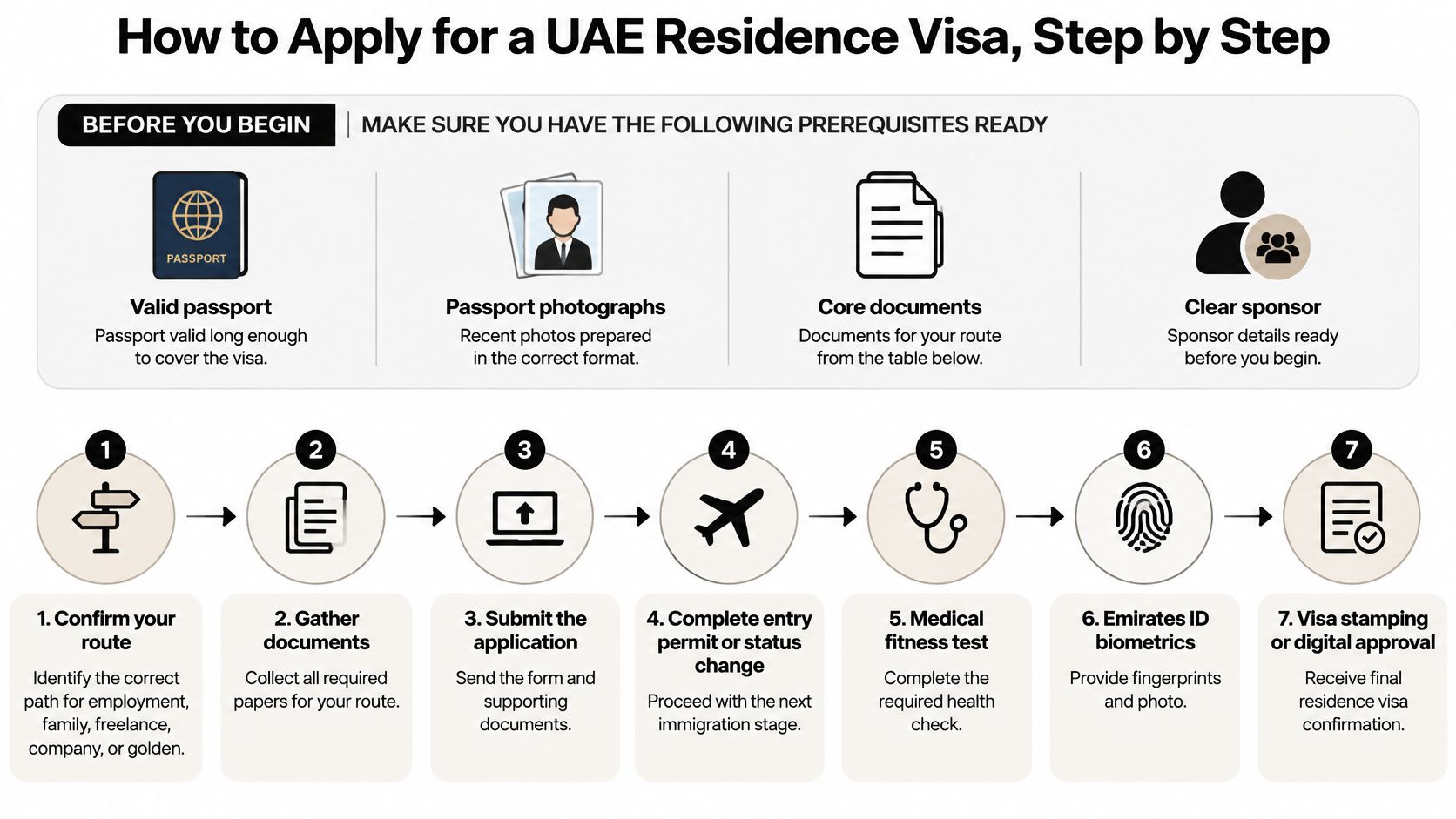
The application sequence
Choose the route and confirm the sponsor or qualifying category. This decides every later document. For investors, step one means deciding the investment type and choosing a free zone or mainland jurisdiction. The usual slip is skipping the business plan and hoping the ownership papers speak for themselves.
Gather the documents listed for your route. Missing papers stall the first approval more often than difficult cases do. Check names and dates match across your passport, contracts and certificates before anything is submitted.
Submit documents for initial approval. Investors submit to the DED for mainland businesses or the relevant free zone authority. A corporate bank account may need to be opened at this stage, so don't leave banking until the end.
Complete the medical tests and biometric capture. After initial approval, this stage covers medical tests, biometric data and obtaining an Emirates ID. Book early, because a late appointment delays everything behind it.
Obtain the Emirates ID. This is your day-to-day identity document in the UAE, so check the details printed on it as soon as it arrives.
Receive the residence visa and check the expiry date. Compare it against your passport validity immediately and diary both dates. A mismatch you spot today is a formality. The same mismatch found at renewal is a delay.
Processing time for each stage isn't fixed in one place, so check the overall timeline against current GDRFA Dubai or ICP service information before you book flights, sign a lease or promise a start date to an employer or client.
Renewals, Absences and Budgeting for Fees
A residence visa depends on a sponsorship link that can change. Before renewal, check whether the sponsor remains eligible, whether your job, investment or other qualifying basis still supports your route, and whether your travel fits its conditions. The UAE Government Portal general provisions for the residence visa explains that standard sponsored visas are generally issued for 1, 2, or 3 years, while qualifying unsponsored categories can run for up to 5 or 10 years. It also states that Golden Residency is renewable for 5 or 10 years and does not require an individual sponsor.
A visa label alone does not show what may interrupt your stay. A sponsor's circumstances can affect the route tied to them, while a Golden Residency holder does not depend on an individual sponsor. Review the sponsorship basis before making travel or renewal plans.
Absences and grace periods
Time outside the UAE and the period after a visa ends can affect your plans, but the applicable conditions depend on the route and circumstances. Check the current absence and grace-period rules on the government portal before arranging an extended trip or relying on time after expiry or cancellation. A change in sponsorship or residence status can also affect how those rules apply.
Keep a renewal checklist covering passport validity, your Emirates ID record, medical or insurance requirements where they apply, and any changes to the job or investment that qualifies you. Check these well before renewal, so a change in the sponsor's status or your own documents does not surface at the last moment.
For budgeting, separate costs by category rather than relying on one advertised total. Allow for government residence fees, medical fitness tests, biometric capture, Emirates ID charges and freelance permit fees where your route requires them. Fees can change, so check current GDRFA Dubai or ICP schedules before applying. Treat an unconfirmed figure as something to verify, not a cost you can safely assume.
Mistakes That Delay or Reject Your Application
Most failed applications aren't mysterious. A document is missing, a threshold isn't met or the sponsoring basis changed while nobody was watching. Read each row as a symptom you might see, with the fix beside it.
Application mistakes, consequences and fixes
| Mistake | Consequence | Fix |
|---|---|---|
| Sponsor salary below AED 4,000 (or AED 3,000 without accommodation) | Family sponsorship fails at issuance or renewal | Keep payslips and accommodation proof current |
| Sponsor residence permit cancelled | Dependants' visas must be cancelled too | Track sponsor and dependant expiry dates together |
| Passport close to expiry | Application or renewal delayed | Renew the passport before the residence visa expires |
| Company trade licence lapses | Sponsored employees and investors lose their sponsoring basis | Renew the licence before the residence dates |
| Choosing a sponsored route for a long-term plan | Renewal needed every one to three years | Test Golden eligibility before applying |
| Missing medical or biometric appointment | Emirates ID step delayed | Book an approved health centre early |
The costliest rows are the sponsor-side ones. A lapsed trade licence or a salary drop doesn't affect one file. It can affect every employee, investor and dependant whose residence hangs from that sponsor, all at the same time.
Recovering from a refusal or stall
Don't resubmit the same file and hope for a different reader. Work through a short recovery sequence instead:
- Match the row: Find which mistake above describes your refusal or delay.
- Correct the cause: Fix the document or the underlying basis, not just the covering form.
- Resubmit cleanly: Send the corrected file once the sponsor, income or passport position supports it.
Quarterly habit: Review sponsor and dependant expiry dates together every three months, so a problem on one side never reaches the other unnoticed.
That single habit prevents most of the table. Passport renewals, licence renewals and appointment bookings are all cheap when they're early. They're only expensive when they're urgent.
Choose Your Route and Confirm Eligibility Before You Apply
Make the decision by answering three questions in order. Don't start with forms, fees or appointment slots, because each of those changes depending on how you answer.
First, whose legal basis do you hold? Name it plainly. Employer, company, family sponsor, freelance permit authority or your own Golden category evidence. If you can't name it, stop here and settle that before spending anything.
Second, does your evidence meet that route's test? Compare what you can document today against the eligibility basis for employees, investors and freelancers, and against the relevant category threshold if you're aiming at Golden residence. Evidence you'll have later doesn't support an application filed now.
Third, is the sponsor's side current? Check income and accommodation proof for family cases, the trade licence for company cases and every expiry date that your residence depends on. A strong applicant behind a lapsed sponsor still has a weak file.

If your three answers point to one route, act on it. Gather that route's documents, then book the medical and biometric appointments so the sequence keeps moving. Smart Classic Business Hub, a Dubai-based management consultancy, can assist investors with visa applications and trade licence renewals so the residence and the company stay aligned. It offers an Investor Visa Package for the UAE and provides investor visa services to help entrepreneurs start and grow businesses in the Dubai Mainland and Free zones.
Do one concrete thing this week. Set the first reminder for your passport expiry and your visa expiry, with enough lead time to renew the passport first. That reminder protects every route, whichever one you choose.
If you'd like your company formation, investor visa application and trade licence renewals handled as one joined-up process in Dubai Mainland or the Free zones, talk to our team about the right route for your situation. Visit Smart Classic Business Hub to discuss your eligibility and next steps before you apply.