
Professional studies for small and mid-sized commercial projects in the UAE usually cost between AED 30,000 and AED 90,000. A basic study can start near AED 3,500, while complex industrial, infrastructure or multi-location work often runs from AED 100,000 to AED 250,000, and some large professional-services engagements go past AED 1 million.
That spread is not a pricing glitch. A feasibility study cost is a risk-reduction purchase. You are paying for evidence that matches the capital, the loan, or the licence you are about to commit, not for a thicker PDF. A founder testing a small Dubai service idea and a sponsor raising bank debt for a multi-site build should not buy the same pack. Match depth to financing exposure and downside. Ignore the cheapest headline until you know what it leaves out.
What a Feasibility Study Costs in the UAE
There is no reliable standard fee, because price follows project scale, sector complexity, geographic coverage, and how much primary research the decision needs. MeAccurate's UAE market review places professional studies for small and mid-sized commercial projects broadly between AED 30,000 and AED 90,000. More complex industrial, infrastructure, or multi-location investments cost approximately AED 100,000–250,000, while large engagements at major professional-services firms may exceed AED 1 million. The same review reports percentage-based pricing of roughly 0.5%–2% of estimated project cost for large infrastructure or mixed-use developments.
Advertised basics sit far below that band. Labeeb's UAE fee notes show publicly listed work from about AED 3,500 for a basic study to AED 250,000 or more for large investment-grade assignments. Desk research plus a high-level financial model is often about AED 30,000–40,000. Expert interviews and supplier quotations commonly lift the range to AED 50,000–60,000. Fieldwork such as surveys or focus groups can push it to AED 60,000–90,000 or more. A desk review and model may take only a few weeks. Lender-grade work adds demand surveys, engineering analysis, regulatory review, supplier quotations, environmental assessment, and independent financial modelling.
| Scope level | Typical fee (AED) | What is included | Typical project |
|---|---|---|---|
| Basic template or online study | from 3,500 | Limited desk review and summary model | Early idea screening |
| Desk research with financial model | 30,000 to 40,000 | Market review, high-level model and stated assumptions | Small commercial venture |
| Interviews and supplier quotes added | 50,000 to 60,000 | Expert interviews and vendor pricing | Restaurant, retail or clinic |
| Fieldwork added | 60,000 to 90,000 | Surveys or focus groups on top of the above | Mid-size commercial project |
| Complex industrial, infrastructure or multi-location | 100,000 to 250,000 | Technical, regulatory, environmental and location analysis | Factory or multi-site investment |
| Large professional-services engagement | May exceed 1,000,000 | Investment-grade work with lender-level assurance | Major infrastructure or fund |
| Percentage-based fee | 0.5% to 2% of project cost | Scaled to project value | Large infrastructure or mixed-use development |
Read each row as an added deliverable, not as a brand label. The fee rises because someone has to collect, test, and stand behind new evidence. A template can screen an idea. It will not defend a loan. A percentage fee can look modest on a huge scheme and still be a large dirham invoice.
Treat every figure as indicative. Name the decision first, whether that is company formation, bank finance, fundraising, a government approval, or a major capital spend, and split professional fees from out-of-pocket research and technical costs. Then take two or three written quotes against that same scope before you judge who is expensive.
Five Drivers That Move the Price
Price a feasibility study the way you price a car service. The model of car and the depth of inspection set the bill, not how many times the car visits the workshop. Two proposals with the same title can differ because one inspects the brakes and the other only reads the dashboard.
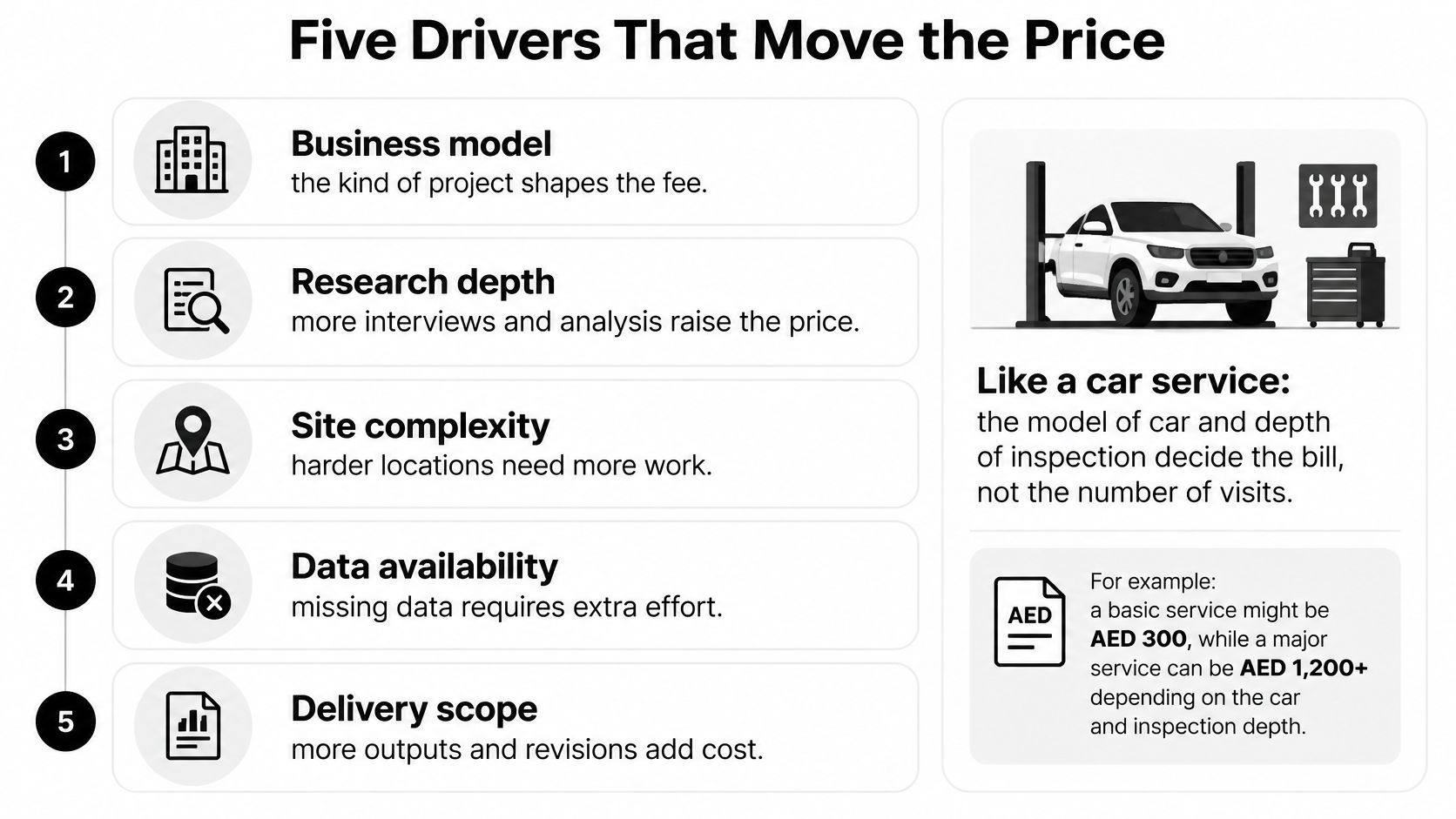
Scope is the first driver. One product in one Dubai catchment is the lower-cost setting. Several emirates, several phases, or a hold-and-operate case plus a sale case multiplies research hours before anyone opens a spreadsheet.
Research depth is usually the steepest step. Published desk data is cheaper and faster. Primary surveys, focus groups, and site interviews take longer to design, field, and clean, and that is the step that moves many commercial studies out of a mid band and into the upper commercial band.
Financial modelling is next. A single base case with one rent and one payroll assumption is a screening tool. Base, upside, and downside cases, with sensitivity on occupancy, price, and delay, take more build time and more senior review. That extra model is what a credit committee debates.
Sector changes who must be in the room. Simple retail or a light service business can stay with market and unit-economics work. Regulated healthcare, education, industrial, or food and beverage projects need technical input, licensing review, and sometimes environmental checks. Those specialists bill on their own clock.
Consultant level changes the hourly rate and the rework. Analyst-led drafting is cheaper per hour. Partner-led work with a named sign-off costs more and usually cuts the loop where a bank sends the pack back. Pay for seniority when an outsider will challenge the file. Don't pay partner rates to format a screening note.
Location acts like a multiplier, even if it isn't a sixth line on the invoice. One known site with public data stays lean. Several plots, landlord access, municipal checks, or travel outside the consultant's home emirate adds visits and local data collection. Test scope first. It sets the hours for every other driver. Shrink the question, and research, modelling, specialists, and travel all shrink with it.
Practical rule: If you can cut a market or a phase without changing the decision, cut it before you argue about day rates.
Why a Cheap Study Can Cost More
A feasibility study earns its fee by reducing the risk attached to a decision. Match its depth to your financing exposure and potential loss, not to the lowest quote. A cheaper study can be sensible for a small, reversible test. It is poor value when the decision involves substantial capital, debt, a long lease, or a regulated opening.
An indicative comparison cited by Insights' UAE market analysis puts average cost overruns at 27% for projects without structured feasibility analysis and 9% for projects supported by a detailed study. That is an 18 percentage point difference, not a guaranteed saving or an official UAE government figure. Treat it as a warning about exposure, not a promise that a report will prevent overruns.
On a AED 5 million project, a 27% overrun amounts to AED 1.35 million; a 9% overrun amounts to AED 450,000. The difference is AED 900,000. A study costing AED 40,000–90,000 represents about 0.8%–1.8% of the initial project budget. Judge that fee against the loss a weak decision could expose you to, not just against another provider's discount.
Financing assumptions deserve the same scrutiny. Unsecured borrowing usually costs more than secured borrowing. Enter the rate from your own lender quote to see what an assumption means: on a AED 500,000 balance, annual interest is AED 500,000 × your quoted rate. For example, if your lender quotes a rate of r, the annual interest before fees is AED 500,000 × r. A weak estimate of startup capital, working-capital timing, or break-even can leave you paying for money you did not need, or short of cash before revenue begins.

The trade-off also applies to equipment. Equipment buying advice for hospitality operators explains why a low purchase price can lose its appeal once downtime and replacement are considered. A study that cannot support a financing decision may lead to paying for another one. Buy the depth needed to test the downside, not a thin report chosen only for its price.
For a small test you can close cheaply, a lighter study may be the right choice. Where debt service, a long lease, or regulatory approval is at stake, pay for analysis that checks market demand, operating assumptions, sensitivity, cash flow, and regulatory requirements.
How to Compare Quotes on Scope Instead of Price
Send the same brief to every firm. Then score the scope, not the total at the bottom. A low headline that drops fieldwork is a different product.
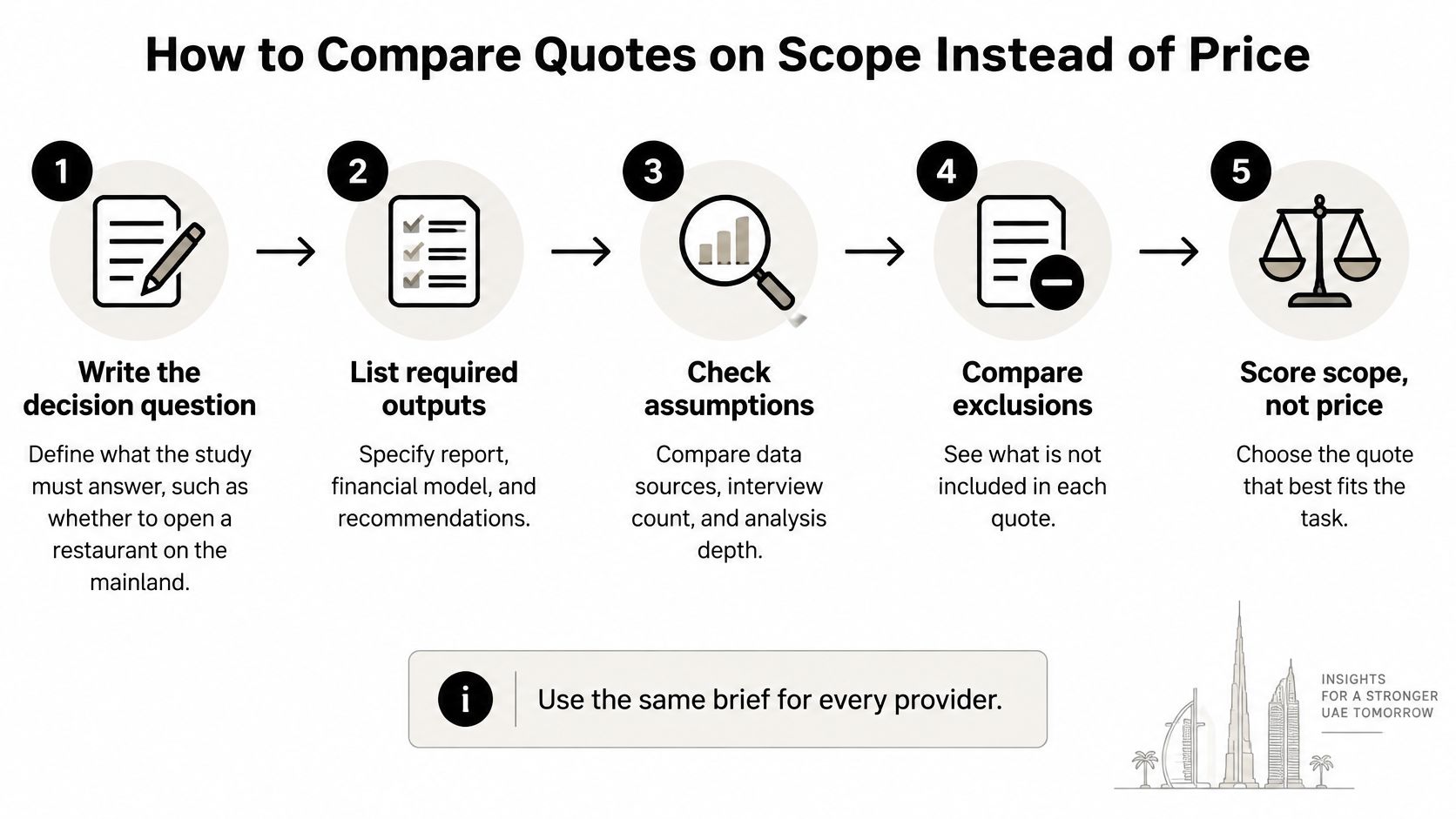
Write the decision question. State it in one line, such as whether to open a restaurant on the mainland. Every later line item should trace back to that question. The common mistake is asking for “a feasibility study” and letting the vendor invent the audience.
List the evidence that decision needs. Customer demand, licensing, unit economics, and a downside case are typical. A small service concept rarely needs a multi-market tome. A regulated clinic often does need local demand and a licensing path. The mistake is copying another sector's contents list.
Demand a line-item scope matrix. Each deliverable needs hours and an owner, so you can see partner time versus junior time. The mistake is accepting “market research” as a single lump with no hours behind it.
Read the assumptions register. Every rent, wage, price, and ramp input should name its source. The mistake is a clean model whose inputs are the consultant's memory.
Confirm the validation method. Interviews, surveys, published data, and supplier quotations are not interchangeable. The mistake is treating a desk average as if customers had been asked.
Agree revision rounds. Say how many rounds are inside the fee and what counts as a change request. The mistake is discovering after draft one that a new scenario is a new invoice.
Set a stop or go threshold. Examples include a minimum payback or a maximum funding gap. Without it, the report narrates and never decides. The mistake is paying for analysis you can't act on. If you are unsure whether you need this file or a full plan, read how a feasibility study differs from a business plan before you brief anyone.
Split professional fees from out-of-pocket costs. Surveys, paid data, travel, and technical subcontractors should sit on their own lines so totals compare. The mistake is cheering a low professional fee that excludes the fieldwork you already said you needed.
A quote that cannot show these items is not cheaper. It is less defined, and undefined scope is how the second invoice appears.
Sample Budgets for Five UAE Scenarios
The study fee should reflect the cost of getting the decision wrong. A founder testing one Dubai service idea needs a lighter study than a sponsor seeking lender financing for an industrial project. The figures below are indicative examples built from the ranges above, not quotations. Match the study scope to your financing exposure and downside, then buy more depth when the decision involves borrowing, regulated activity, or multiple sites.
A founder testing a Dubai service idea needs customer validation, unit economics, and a licensing check. An SME restaurant owner on the mainland needs interviews, supplier quotations, and cash-flow analysis before committing to fit-out. A clinic operator expanding in Dubai needs local demand research and licensing review. A multi-site hospitality or logistics group needs location-by-location analysis and construction-cost sensitivity. An industrial or infrastructure sponsor may need technical, environmental, and independent financial work to support a lender decision.
| Scenario | Likely scope | Study fee (AED) | Other costs to budget |
|---|---|---|---|
| Founder testing a Dubai service idea | Customer validation, unit economics, licensing check | 3,500 to 30,000 | Free-zone setup and first-year fees, priced in the company setup quote |
| SME restaurant on the mainland | Desk research, interviews, supplier quotes, cash-flow model | 50,000 to 60,000 | Mainland setup and first-year fees, priced in the company setup quote, fit-out excluded |
| Clinic expansion in Dubai | Regulated sector, local demand survey, licensing and regulatory review | 60,000 to 90,000 | Licensing fees and equipment, not fixed in published study-fee guides |
| Multi-site hospitality or logistics group | Multi-location analysis, sensitivity model, construction cost escalation | 100,000 to 250,000 | Site surveys and a construction-cost escalation allowance, set per project |
| Industrial or infrastructure investment | Lender-grade technical, environmental and financial work | 250,000 or more, or 0.5% to 2% of project cost | Engineering analysis and an independent model, priced with the technical scope |
Setup, licensing, fit-out, equipment, and working capital sit outside the study fee. Compare the study budget with the relevant setup quote, and leave unknown costs unfilled until you have a basis for pricing them. A tidy spreadsheet is no reason to invent a fit-out or equipment total.
Desk-based work often takes a few weeks. Fieldwork and lender-grade packs take longer, so confirm the calendar alongside the fee. For public-private partnerships, the UAE Ministry of Finance PPP Manual treats feasibility, transaction structuring, and tender management as implicit project-development costs averaging about AED 10.5 million. It says these costs should not exceed 7% of total capital expenditure, implying a practical minimum project scale of roughly AED 150 million. Use that as a reference for large projects, not as a basis for an SME quote. For a borrowing decision or a second site, select a study tier that can test the downside, not the row with the lowest fee.
Budgeting for the Fee and Hidden Costs
The professional fee is the visible line. The misses sit beside it. Budget surveys and fieldwork, paid data sources, supplier quotations, travel and site visits, and revisions past the agreed rounds as their own lines. If a proposal folds those into “miscellaneous”, ask for them split out before you sign.
Build-cost movement
Construction, hospitality, logistics, and property models need an explicit escalation allowance, not one flat inflation guess. Dubai Statistics Centre's Construction Cost Index methodology tracks 361 commodities and services collected from 92 establishments across the emirate, organised by building type and construction stage. Analysts can separate site preparation, structural works, materials, and services. The Centre has reported a 0.40% rise in the general construction-cost index in one recent quarter. A 0.40% quarterly movement compounds to about 1.6% over four quarters before land, financing, design changes, authority requirements, or imported equipment.
Link the capital schedule to the relevant index category. Run at least base, upside, and downside cases. Test funding needs, break-even occupancy or sales, debt-service coverage, and project IRR. If fit-out cost is unknown, write unknown. Don't backfill it.
A four-line template
Add a contingency on the study budget itself. A 10% to 15% allowance is a common planning convention, not a UAE rule. Copy these four lines into a spreadsheet.
- Professional fee. The fixed or percentage quote for the agreed scope.
- Out-of-pocket research and travel. Surveys, data, supplier work, site visits, and technical subcontractors.
- Contingency. The 10% to 15% planning band, released only when a named change appears.
- Total budget. Fee plus out-of-pocket plus contingency, set beside setup and launch costs.
Franchise and multi-unit openings pick up the same hidden lines, from fit-out deposits to pre-opening payroll. Ways to reduce franchise launch expenses from Franchise Foundry are a useful cross-check when you are listing what the study fee will never cover. Put the study next to first-year formation costs using our UAE business setup cost page, and run scenarios through the Business Setup Cost Calculator on the site so the study isn't the only number you stress-test.
Choose a Provider and Confirm the Scope Before Signing
Buy a team that can produce the study, the business plan, and the financial model together, and that can carry company setup and compliance so the operating assumptions match the licence you will get. We provide financial management advisory, corporate finance, business consultancy, feasibility studies, business plans, company formation, PRO services, and the related compliance work, including offshore registration, tax residency certificates, VAT-compliant accounting, audit, and liquidation. Splitting the model from the licensing path is how rent, visa, and activity assumptions drift apart.
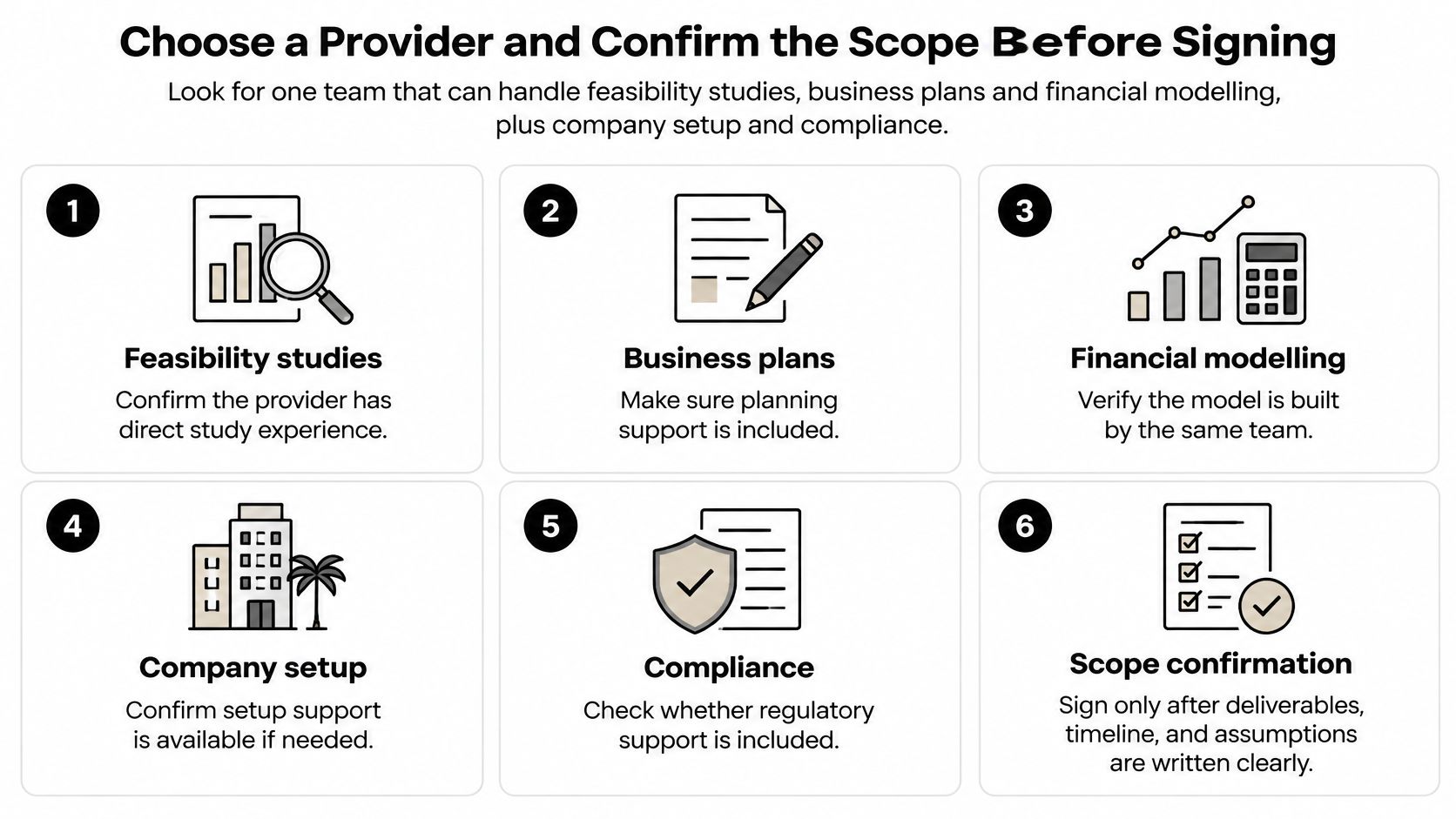
Start with an initial consultation. We use that meeting to learn the business requirements and objectives, and to judge which support the file needs, such as company registration, visa processing, or government approvals. Say whether the output is for an internal stop-or-go, a bank, or an investor. For an existing business, be ready for financial statements and a letter of intent as well as the concept note.
Before you sign, ask for a sample report, the names of the consultants who will do the work, and a fee that is either fixed or percentage-based and written down. Then put the earlier tests into the contract. The line-item scope matrix, the assumptions register, the revision limit, and the stop or go threshold all belong in the signed scope. Our feasibility study consultants in the UAE work from that written scope so the model, the plan, and the setup path stay on one brief.
Use one plain test. If the provider cannot explain, in a few sentences, the decision the study serves, send the scope back. Don't negotiate a discount on a vague pack.
This week, request two or three quotes against the same written scope. Choose the quote whose evidence matches the decision and the money at risk, not the lowest total on the page.
Smart Classic Business Hub prepares UAE feasibility studies, business plans, and financial models for founders, SMEs, and investors who need a clear stop or go before they spend or borrow. We align that work with company formation and ongoing compliance so the assumptions in the model match the licence and the setup budget. Visit Smart Classic Business Hub to book an initial consultation and scope the study to your decision.