
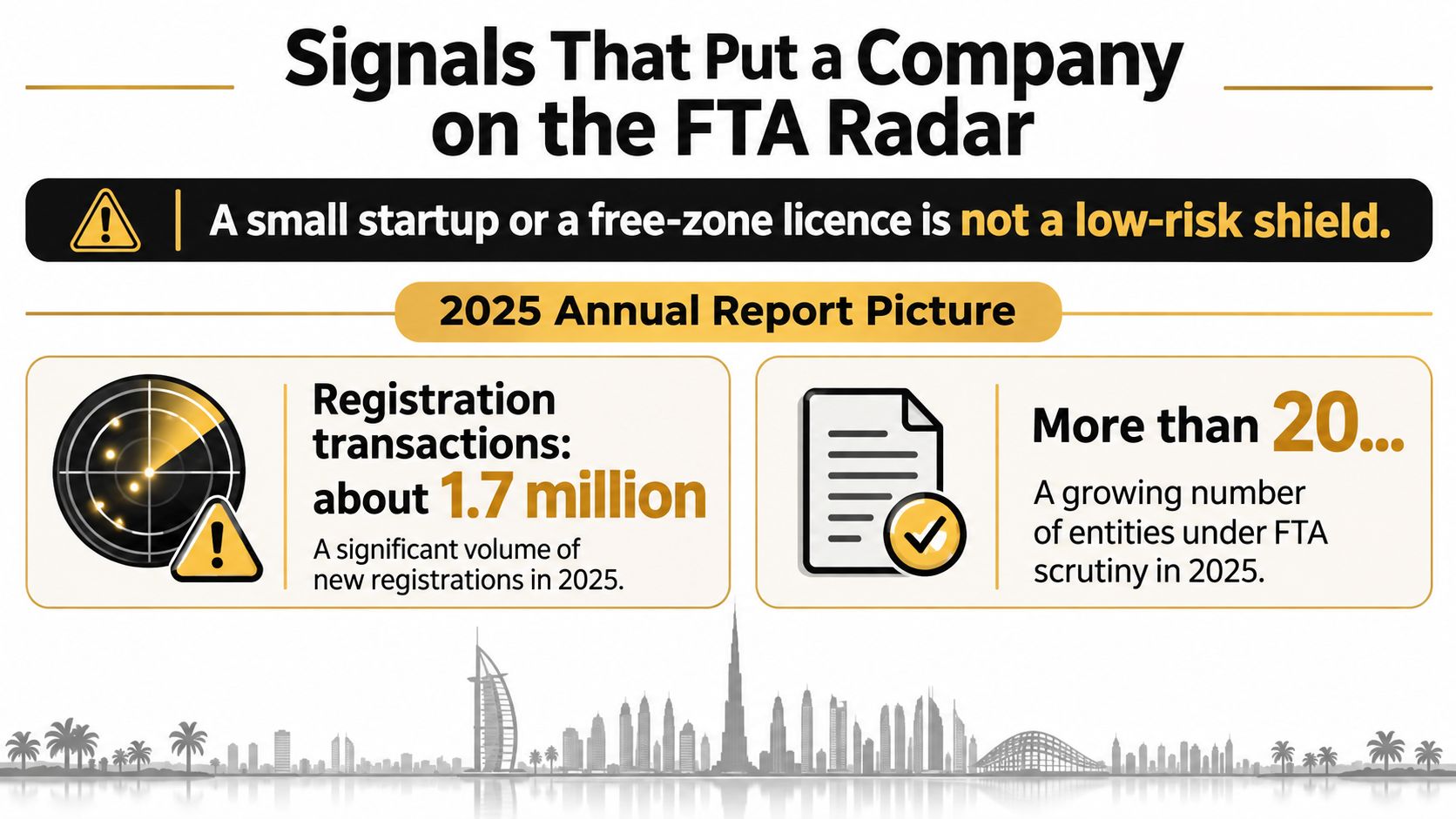
The FTA reviewed approximately 1.7 million tax-registration transactions in 2025, according to its annual report announcement. That scale challenges a common assumption: being a small company, or holding a free-zone licence, doesn't make your tax file invisible.
A business tax audit concerns the evidence behind your declarations, not just whether you submitted them. For a UAE owner, the useful question isn't whether the FTA might make contact. It's whether your invoices, accounting records, tax returns and bank activity support the same explanation.
What a UAE Business Tax Audit Covers
An FTA business tax audit checks whether a taxpayer's records support its tax position under the Tax Procedures Law and relevant tax legislation. It differs from an internal accounts review, which a business commissions to identify bookkeeping errors or improve financial controls. Company size and a free-zone licence do not, by themselves, determine whether a file is reviewed. Inconsistencies across tax returns and supporting records can prompt questions.
Under the Federal Tax Procedures Law, the FTA generally must notify a taxpayer at least 10 business days before a tax audit. An audit normally takes place during official working hours. A taxpayer can ask an auditor to show official identification, obtain a copy of the notification and request copies of original paper or digital documents taken.
Four FTA checks that are not the same thing
Read the document you receive to identify the procedure, period and information requested. A visit, a query and an audit are different steps, and the notice helps establish which one applies.
| Procedure | What it checks | Typical notice | What you can request |
|---|---|---|---|
| Field inspection | On-site invoices, registration and visible trading activity | An on-site visit, which may not be a full audit notification | Identification and confirmation of the inspection's scope; have trade-licence and invoice records available |
| Tax audit | VAT and/or Corporate Tax declarations under the Tax Procedures Law | Formal notification, subject to the general notice rule and applicable exceptions | Auditor identification, the notification and copies of documents taken |
| Clarification request | A particular figure, transaction or apparent mismatch | A written information query | Identification of the item and supporting information required |
| Registration review | Whether registration is required and registration details are correct | Registration correspondence or a request for evidence | Confirmation of the registration issue under review |
A field inspection concerns what inspectors can establish at the business premises. It does not by itself show that historical returns have been examined or accepted. A tax audit can examine declarations and their supporting records in greater depth. VAT and Corporate Tax may both be relevant, but each remains a separate tax test.
Match the response to the request
A clarification request may ask about a bank receipt that does not readily match reported sales. Establish whether it represents customer revenue, borrowing or a transfer, then connect it to evidence such as a contract, bank statement or ledger entry. An unexplained attachment leaves the reviewer to guess how the transaction fits.
A registration review asks about registration status or details. A sales reconciliation alone will not answer a question about when trading began. The response should address the specific issue in the correspondence.
For a general overview of UAE tax topics, you can explore UAE tax information. Build an evidence file that connects the return to the general ledger, invoices, bank statements, contracts, asset register and related-party papers. Organize the records so each figure can be traced to its source, rather than sending an unexplained folder of attachments.
Corporate Tax and VAT Figures Auditors Test
An auditor needs to establish which rules apply to the period being examined before testing your calculation. A correct rate applied to the wrong income, or a correct calculation filed late, can still leave a compliance problem.
The Ministry of Finance's Corporate Tax overview explains that Federal Decree-Law No. 47 of 2022 introduced Corporate Tax for financial years beginning on or after 1 June 2023, with taxable income up to AED 375,000 taxed at 0% and income above that threshold generally taxed at 9%. It also states that taxable persons, including free-zone companies, must register, with returns and payment generally due nine months after the tax period ends.
Key UAE business tax dates and rates
| Item | Value | Note |
|---|---|---|
| VAT start date | 1 January 2018 | Standard rate of 5% |
| Corporate Tax start date | Financial years beginning on or after 1 June 2023 | Applies to net income of corporations and other businesses |
| Corporate Tax band | Taxable income up to AED 375,000 at 0% | Free-zone qualifying-income treatment has separate conditions |
| Corporate Tax band | Taxable income above AED 375,000 generally at 9% | Check applicable reliefs and special treatment |
| Corporate Tax return and payment | Generally nine months after the tax period ends | Separate from VAT filing |
The key distinction is taxable income versus turnover. Don't apply the Corporate Tax bands directly to sales or assume that the profit displayed in your accounting software is already the final taxable amount.
For a hypothetical business with AED 500,000 of taxable income under the ordinary rate structure, the calculation separates AED 375,000 from the remaining AED 125,000. Applying the respective bands produces AED 11,250 of Corporate Tax, assuming no relief or special regime changes the result.
A free-zone licence isn't the evidence
Free-zone treatment requires more than producing a licence. The business must support the relevant qualifying-income conditions through its activities, income classification and accounting records.
Related-party charges need particular attention. Keep the agreement, calculation and commercial explanation together, and use transfer-pricing documentation guidance to organise the supporting file.
Practical rule: A tax calculation should show how you reached the declared figure, not merely repeat it.
Maintain distinct reconciliations for accounting profit to taxable income, VAT outputs to recorded revenue, and any qualifying-income or exemption claim to its supporting evidence. Differences can be legitimate, but they need an explanation.
Signals That Put a Company on the FTA Radar
A small startup or a free-zone licence isn't a low-risk shield. Owners should examine the consistency of their records before relying on headcount, office size or business location as reassurance.
The FTA's annual-report picture includes extensive registration review and field-inspection activity. That doesn't establish a published selection formula, and it doesn't mean every mismatch causes an audit. It does make it unwise to assume that the Authority considers each filing in isolation.
Look for contradictions across systems
A useful risk review starts with comparisons you can perform yourself:
- Sales against VAT outputs. Identify invoices missing from the return and explain credit notes, timing differences and supplies with different treatments.
- Bank credits against sales. Separate customer receipts from loans, owner funding and transfers between company accounts.
- Customs against inventory. Trace import declarations into stock, fixed assets, returns or subsequent supplies.
- Corporate Tax revenue against VAT records. Document why the figures differ instead of expecting identical totals.
- Activity against registration. Check whether the recorded commencement of trading agrees with the registration position.
- Related-party charges against contracts. Retain evidence of the service, pricing basis and actual performance.
- Free-zone claims against income evidence. Classify the underlying transactions rather than treating every receipt alike.
These are potential scrutiny signals, not a list of automatic audit triggers. A difference may reflect correct accounting or tax treatment, but an undocumented difference leaves the reviewer without that explanation.
The mismatch matters more than headcount
Say a mainland trader's bank credits exceed the sales ledger because an owner advanced working capital. The discrepancy doesn't automatically establish hidden sales. A signed financing record and a bank transfer trail can explain the funding without changing genuine revenue.
Now consider a free-zone consultancy that receives money from an overseas related company. Its licence doesn't establish how that receipt should be treated. The contract, service-delivery evidence, customer details and pricing support provide the basis for evaluating the claim.
Don't remove a legitimate deduction or relief simply to make a reconciliation look cleaner. Identify the reason for the difference and preserve the proof.
Create a mismatch register with columns for the transaction, systems affected, explanation, evidence and person responsible. Unresolved entries deserve attention before you spend time debating whether your business is too small to attract interest.
How an FTA Audit Runs From Notice to Assessment
An audit is easier to manage when you treat it as a controlled exchange of evidence. The exact sequence can change with the scope and circumstances, so follow the actual notification and requests rather than a generic timetable.
From notification to testing
- Read the scope. Identify the taxpayer, tax type, periods and requested records. Check whether the communication initiates an audit or asks for narrower information.
- Arrange attendance. Appoint a responsible contact and make sure the accounting team can retrieve the relevant files.
- Control document production. Maintain a register of requests, responses, original documents and copies supplied.
- Support transaction testing. Connect each requested return line to its calculation, ledger entry and underlying evidence.
Don't assume the auditor understands your accounting labels. An account called “other receipts” needs a breakdown showing what the entries represent.
From questions to a decision
During testing, the FTA may seek explanations for differences or unsupported positions. Answer with a concise reconciliation and identifiable records, separating confirmed facts from matters still being investigated.
- If the evidence supports the return, explain the treatment and provide the relevant documents.
- If you find an error, establish which tax and period it affects before choosing the correction route.
- If an assessment follows, check the calculation, legal basis and stated response requirements promptly.
An assessment can involve additional tax and administrative penalties. If you disagree, investigate the applicable reconsideration procedure; if payment is the difficulty, check whether an instalment arrangement is available and what conditions apply.
Neither route should be assumed to suspend other obligations automatically. Obtain advice on the particular decision before allowing a response deadline to pass.
Records to Keep for Seven Years
For Corporate Tax preparation, the record-retention floor is at least seven years after the relevant tax period ends. Keep the underlying evidence, not just a PDF of the submitted return.
The FTA's Corporate Tax administrative-penalty decision sets a penalty of AED 10,000 per record-keeping violation, increasing to AED 20,000 for a repeated violation within 24 months. Retention therefore deserves the same ownership and checking as filing.
What to retain and for how long
Treat this as a working evidence file, not a shopping list of documents.
| Record | What the auditor is testing |
|---|---|
| Invoices, sales and purchase ledgers, purchase orders, delivery notes | Whether declared outputs and inputs reflect real supplies; retain within the applicable tax-record window |
| Bank statements and financing documents | Whether cash movements support declared supplies, costs and funding |
| Asset purchases and disposals, liabilities, shareholdings | Ownership, capital transactions and balance-sheet support |
| Contracts and transfer-pricing support | The legal basis of income and the support for related-party pricing |
| Audited financial statements | The financial starting point for the Corporate Tax computation and relevant claims |
| Same file during a dispute, ongoing audit or notice of intended audit | Preserve evidence beyond routine destruction dates where extended retention applies |
The purpose is traceability: an auditor should be able to follow a declared amount back to the transaction and its supporting documents. Not every transaction involves an immediate bank movement, so retain evidence for accruals, unpaid invoices and non-cash adjustments too.
Make retrieval part of record keeping
Use a searchable folder structure organised by legal entity, tax period and record type. Keep original invoice numbers intact and store correction entries with the reason, preparer and supporting calculation.
A spreadsheet index can connect return lines to ledger accounts and document locations. Export important records from accounting software before changing systems, and test that archived files still open.
Use accounting record-keeping requirements guidance to turn that structure into a repeatable procedure. Assign someone to check completeness, access permissions and backups, rather than assuming the bookkeeper's working folder is the permanent archive.
Keep a corrected calculation alongside the original and its explanation. Don't overwrite the history you may later need to demonstrate.
Audited statements don't replace invoices or ledger evidence. Where a financial-statement audit is required, retain both the signed statements and the schedules supporting their figures.
Set aside a working week to identify missing periods, allocate a file owner and confirm the earliest records that must remain available. Suspend routine deletion whenever a dispute or audit-related preservation requirement applies.
Penalties and Cash Exposure from a Weak File
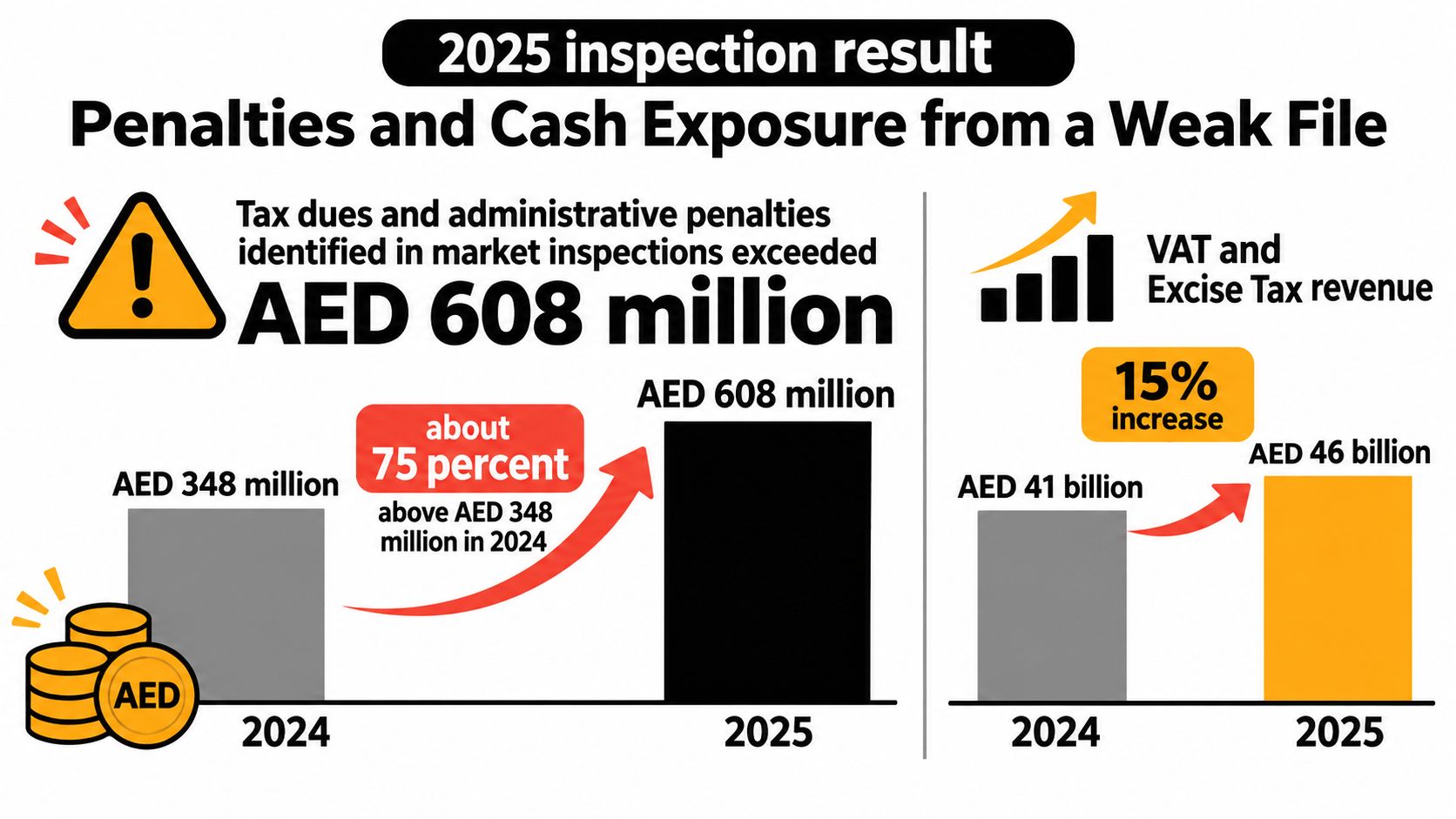
Tax dues and related administrative penalties identified during 2025 market inspections exceeded AED 608 million, approximately 75% above AED 348 million in 2024, according to the FTA's market-inspection announcement. These are inspection findings across the market, not a prediction of an individual company's liability.
For an SME, the practical concern is the combination of additional tax, administrative penalties and the time needed to reconstruct records. Paying an accountant to repair the ledger doesn't itself settle a tax shortfall.
What a weak tax file can cost
| Failure | How it is treated | Cash or decision point |
|---|---|---|
| Required records not kept | A separate record-keeping violation | Administrative penalties can arise independently of unpaid tax |
| Return figure that doesn't match invoices or the bank | Potential incorrect declaration requiring investigation | Establish the correct tax and applicable penalties |
| Supply or import omitted from a return | Potential underreported tax, subject to the correct treatment | Assess the omitted transaction, not just its bookkeeping entry |
| Corporate Tax return or payment after its deadline | Separate from any VAT lateness | Check the filing and payment consequences independently |
| Errors identified during market inspections | Tax dues and related administrative penalties | Market-wide totals aren't a tariff for a particular business |
Distinguish an accounting error from a tax error
A customer receipt posted to the wrong debtor account may be a bookkeeping error without changing the tax declared. By contrast, a taxable sale omitted from the return may require a tax correction even if the accountant later enters it correctly.
An import also needs transaction-specific analysis. Don't assume every unmatched customs entry represents an undeclared sale, or that fixing inventory automatically fixes the import's VAT treatment.
Use a decision sequence:
- Establish what happened. Identify the invoice, supply, payment, tax treatment and affected period.
- Calculate the effect. Determine whether the mistake changed tax, disclosure or only accounting classification.
- Choose the lawful correction. Check the applicable return-adjustment or voluntary-disclosure procedure and its timing.
- Plan the cash requirement. Separate additional tax from possible penalties and professional costs.
If documents are missing, list them and request genuine copies from banks, suppliers or customers. Don't fabricate invoices or backdate agreements to create a cleaner-looking history.
Reconsideration and eligible payment arrangements are response tools, not substitutes for evidence. The same underlying sales can affect different tax computations, so assess VAT and Corporate Tax exposure separately without assuming their liabilities will be identical.
How to Run a Pre-Audit Risk Review
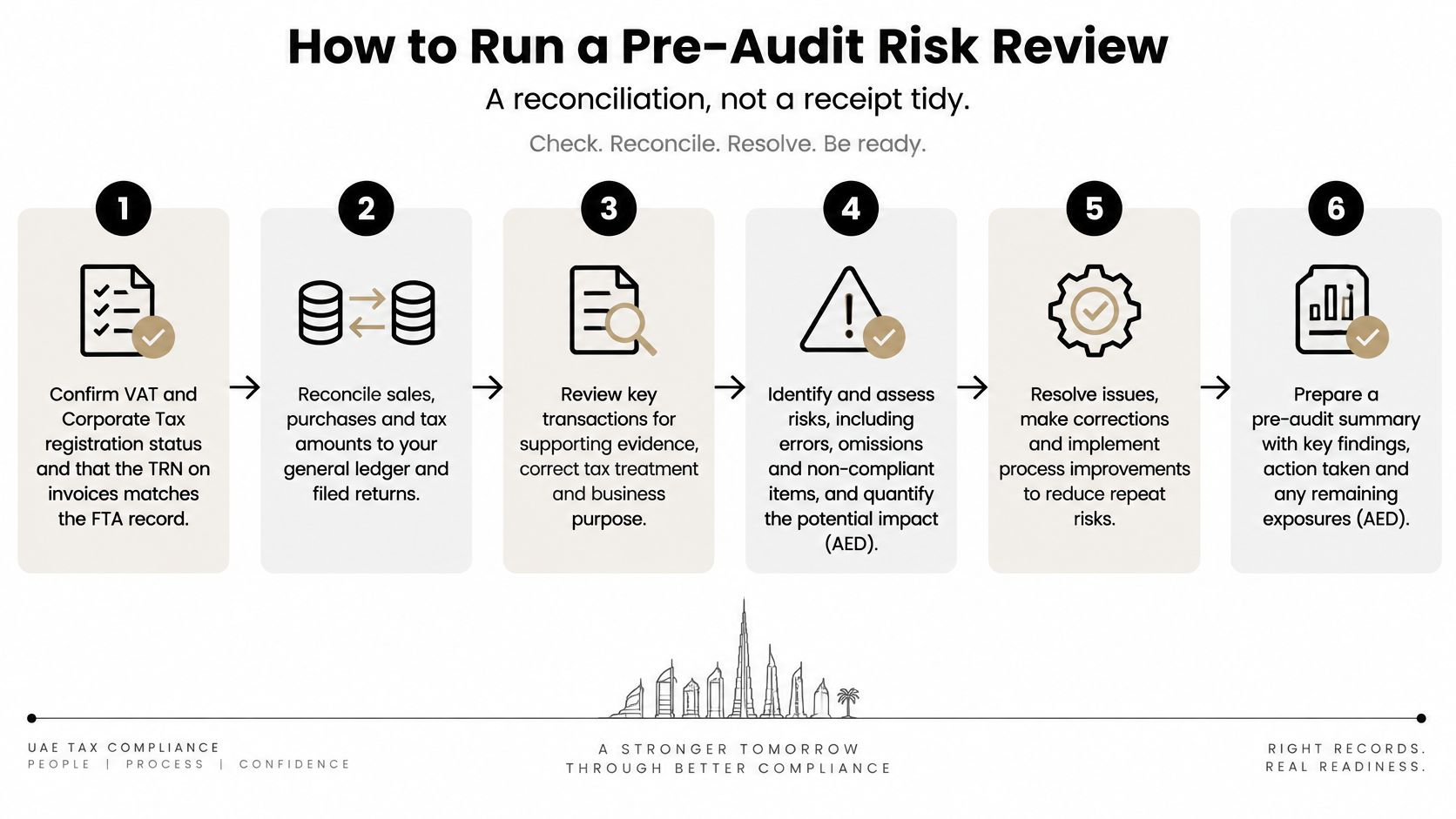
A pre-audit review checks whether each material declaration can be traced back to records and explained clearly. Treat it like following a trail: a return line should lead to a calculation, then to the underlying invoices, contracts or other evidence.
For tax groups, the Ministry of Finance's announcement on audited financial statements explains the reporting framework, including audited special-purpose aggregated statements and the treatment of separate stand-alone statements for members. Keep records beyond routine destruction where a dispute or audit requires it.
Rebuild the declarations
- Confirm registration details. Check VAT and Corporate Tax status separately, including the registration numbers used on records and correspondence.
- Reconstruct a recent period. Trace sales invoices into the ledger and VAT workings. Reconcile receipts, but do not treat every bank credit as revenue.
- Account for imports. Match customs declarations with supplier invoices, inventory, assets or another documented destination.
- Review the profit bridge. Check adjustments between accounting profit and taxable income, including expenses treated differently for tax.
- Test special claims. Review free-zone treatment and related-party positions against contracts, transaction details and supporting calculations.
- Confirm reporting requirements. Check whether the entity's status, revenue or group arrangement requires audited statements, and confirm that the appropriate statements exist.
- Preserve the file. Follow applicable retention rules, restrict deletion where needed and keep readable exports of working records.
- Resolve genuine errors. Separate accounting corrections from tax omissions, then identify the appropriate correction procedure.
A UAE VAT audit checklist can help track VAT evidence. It does not replace a separate Corporate Tax review.
Test the explanation with a transaction
Suppose a trading company's customs record shows goods missing from its purchases. A supplier invoice and warehouse receipt might show that the goods arrived but were posted to the wrong period. The reviewer should assess the accounting and tax consequences, rather than adding the amount to sales.
For a free-zone consultancy, a related-party receipt might be labelled qualifying income without supporting analysis. Check the service agreement and evidence of delivery, then document how the applicable conditions have been assessed.
The review is complete when every return line has a document path and each unresolved issue has an owner and a lawful next action. Keep relevant records available if a dispute or audit means routine deletion should pause.
Respond Once the FTA Notice Arrives
Treat the notice as the start of a controlled project. Record when it arrived, identify the procedure and tax periods, and diarise every response requirement stated in the communication.
Assign a lead contact who can coordinate accounting, management and any external adviser. Staff should forward questions to that person rather than guessing what a missing invoice might have contained.
Keep the response factual and traceable
- Preserve the starting position. Save the filed returns, existing ledgers and supporting schedules before making corrections.
- Build a request register. Record each requested item, responsible person, due date and submission reference.
- Explain gaps clearly. Distinguish documents not yet retrieved from documents that never existed.
- Review before submission. Check that calculations agree with attachments and that explanations address the actual question.
A newly prepared reconciliation can explain existing transactions. Label it clearly as a current working paper; don't present it as a contemporaneous contract or invoice.
Separate disagreement from inability to pay
If an assessment appears incorrect, compare its reasoning with the evidence and seek advice on reconsideration promptly. If the figures are accepted but cash is constrained, investigate payment options and eligibility without assuming approval.
Keep communications, submitted files and proof of delivery together. Continue complying with current filing obligations while the historical matter is being resolved.
Engage a qualified UAE tax adviser before the visit if you don't have an internal lead who can evaluate the tax treatment and manage the evidence. Early review gives you a clearer explanation of the facts, not a licence to rewrite them.
Smart Classic Business Hub offers VAT-compliant accounting, audit and tax consulting, alongside regular compliance reviews and guidance on UAE regulatory requirements. Visit Smart Classic Business Hub to arrange a review of your reconciliations, supporting records and unresolved tax-file gaps before an FTA visit.