
The cheapest free-zone licence isn't necessarily the cheapest way to run your business. A low-cost package can become an expensive mistake if it excludes your activity, doesn't support the workspace you need, or leaves you relying on tax treatment your transactions don't qualify for.
A useful free zone guide starts with what you'll do, where your customers are and how you'll operate. The licence comes after those decisions, not before them.
Which UAE Free Zone Fits the Activity
| Zone or cluster | Best fit | Scale signal | Check before you pay |
|---|---|---|---|
| Jafza | Trade, logistics, manufacturing | An established port-linked business ecosystem | Warehouse availability, port access, visa allocation, bank documentation and mainland trading route |
| DMCC | Commodities, trading, professional services | 2,048 new businesses in 2024, taking its community above 25,000 companies, according to the DMCC annual report | Exact activity wording, office type, visa quota, banking requirements and mainland customers |
| Dubai Airport Freezone, Dubai Silicon Oasis, Dubai CommerCity | Technology, airport logistics, e-commerce | More than 78,000 specialised employees in the first half of 2024, according to the Dubai Media Office | Sector fit, suitable premises, staff visas, transaction evidence for banking and mainland delivery arrangements |
| Hamriyah Free Zone | Industrial and manufacturing projects | Attracted 900 companies in 2024, while Sharjah Airport International Free Zone attracted more than 700, as reported by Arabian Business | Land, utilities, industrial approvals, employee accommodation arrangements and domestic distribution |
| Sharjah Airport International Free Zone | Aviation-linked and light commercial trade | The airport-linked counterpart in the Sharjah figures above | Actual airport access, permitted goods, storage, visa entitlement and bank-ready contracts |
| Wider UAE platform | Commercial, industrial, logistics, technology, media, financial and professional activities | A national network of authorities and sector-specific environments | Each authority's activity list, facilities, visa rules, banking documentation and mainland access conditions |
There isn't one national free-zone product. Use this table as a shortlist, not as approval to begin trading: a zone's general sector focus doesn't mean every activity within that sector is available under every package.
Jafza deserves attention when moving and storing goods is central to the business, because a cheaper desk elsewhere won't replace a workable cargo route. DMCC is worth comparing when the relevant trading or professional community matters more than the lowest registration price.
For technology, airport logistics and e-commerce, compare the individual premises and operating arrangements within the Dubai Integrated Economic Zones ecosystem rather than treating the cluster as interchangeable. Its registered company numbers increased by 24.6% in 2025, according to the Dubai Media Office, but growth alone doesn't establish suitability for your business.
Compare the operating model, not just the address
Hamriyah is a sensible starting point for a project whose feasibility rests on industrial space and utilities. Sharjah Airport International Free Zone warrants investigation when airport-linked movement and suitable storage could reduce handling complications.
Our guide to free zones in Sharjah can help narrow that comparison. For either location, take a goods list and a facility specification to the authority rather than asking only for its cheapest package.
The wider UAE platform suits founders who haven't yet found an exact match. However, a longer shortlist isn't always helpful: eliminate any option that cannot confirm your activity, workspace and staffing requirements in writing.
Practical rule: Compare quotes only after giving each authority the same description of the business. A desk package and an industrial facility are not competing versions of the same purchase.
If most buyers, staff and delivery work will sit on the mainland, include a mainland route in the comparison before committing to a free zone.
How a Free Zone Company Really Works
Say you're starting a design consultancy. You need permission to provide design services, a legal entity that can sign contracts and a workspace arrangement the licensing authority accepts. You don't necessarily need the same company structure or premises as a distributor importing electrical equipment.
A free zone is a designated jurisdiction with its own authority, activity list, premises rules and renewal arrangements. It's a framework within which you establish a business, not one uniform company type.
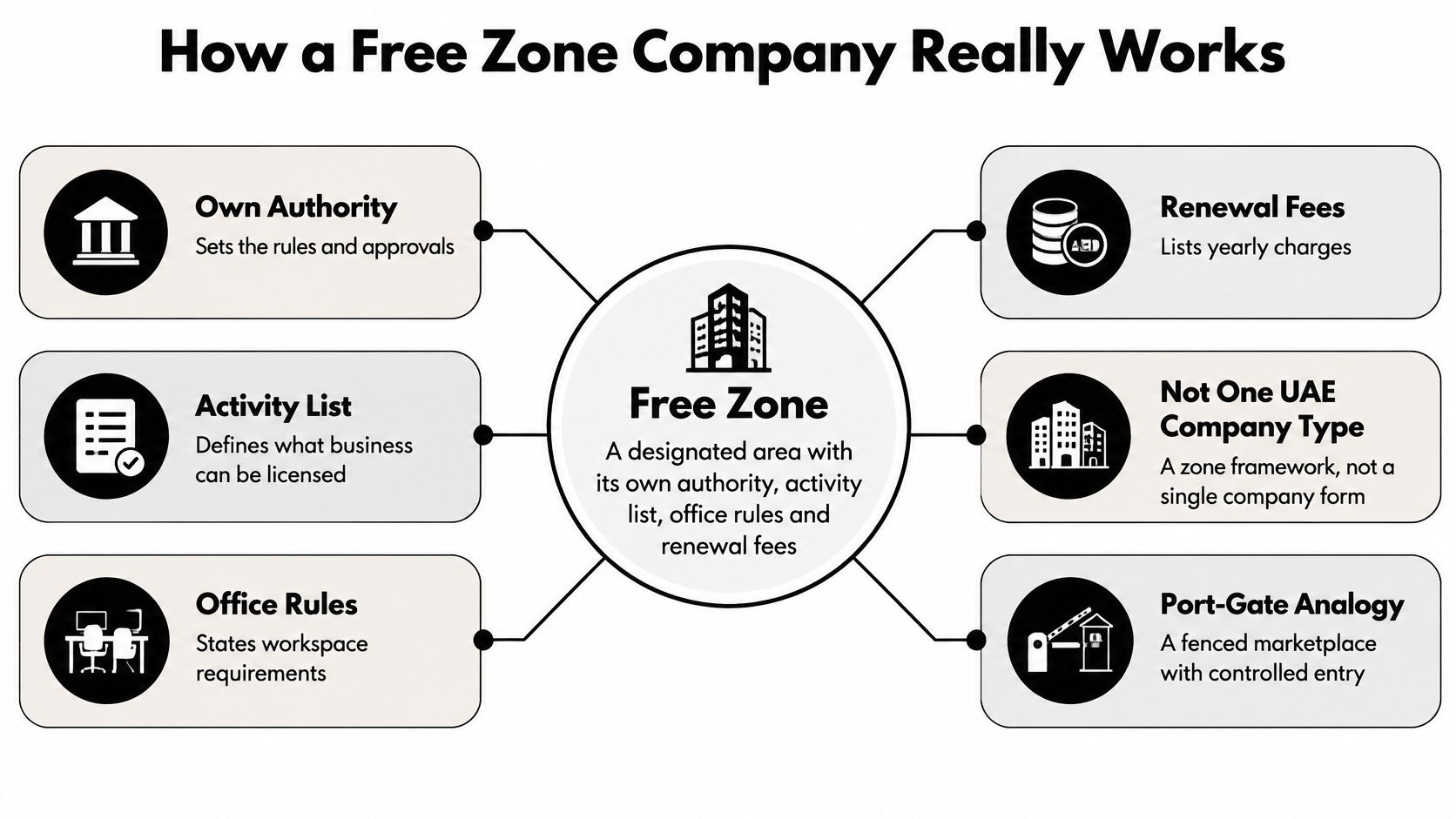
Think of a port gate
A useful analogy is a marketplace beside a port. The marketplace has its own manager, entry conditions and operating rules, while transactions through its gate must also satisfy the rules on the other side.
Not every free zone is physically fenced, and the analogy isn't a customs ruling. It explains why establishing a company inside a zone doesn't automatically give it unrestricted permission to operate everywhere outside it.
Official UAE free-zone information states that investors can generally establish companies with 100% foreign ownership; it also describes more than 40 multidisciplinary free zones, another official count exceeding 36, and more than 2,000 licensed economic activities. Those different counts reflect classification, not a reason to assume all authorities offer equivalent licences.
The licence identifies the activities your company may undertake under its authority's rules. It doesn't, by itself, authorise you to open a mainland shop, carry out regulated contracting or conduct any activity because a customer requests it.
Ask questions that separate the routes
- Activity wording: Does the permitted activity describe what you'll deliver and invoice?
- Ownership: Who will own the company, and does the proposed legal form accommodate that structure?
- Physical footprint: Where will staff work, stock sit and services be performed?
- Customer location: Where are buyers based, and what permissions will you need to serve them?
For the design consultancy, remote project work may fit one route, while opening a customer-facing mainland studio requires a different assessment. Keep commercial permission separate from tax classification: approval to invoice a customer doesn't settle how that income is taxed.
If the business will mainly operate on the mainland, obtain a mainland comparison before choosing a flexi-desk.
How to Set Up the Licence Step by Step
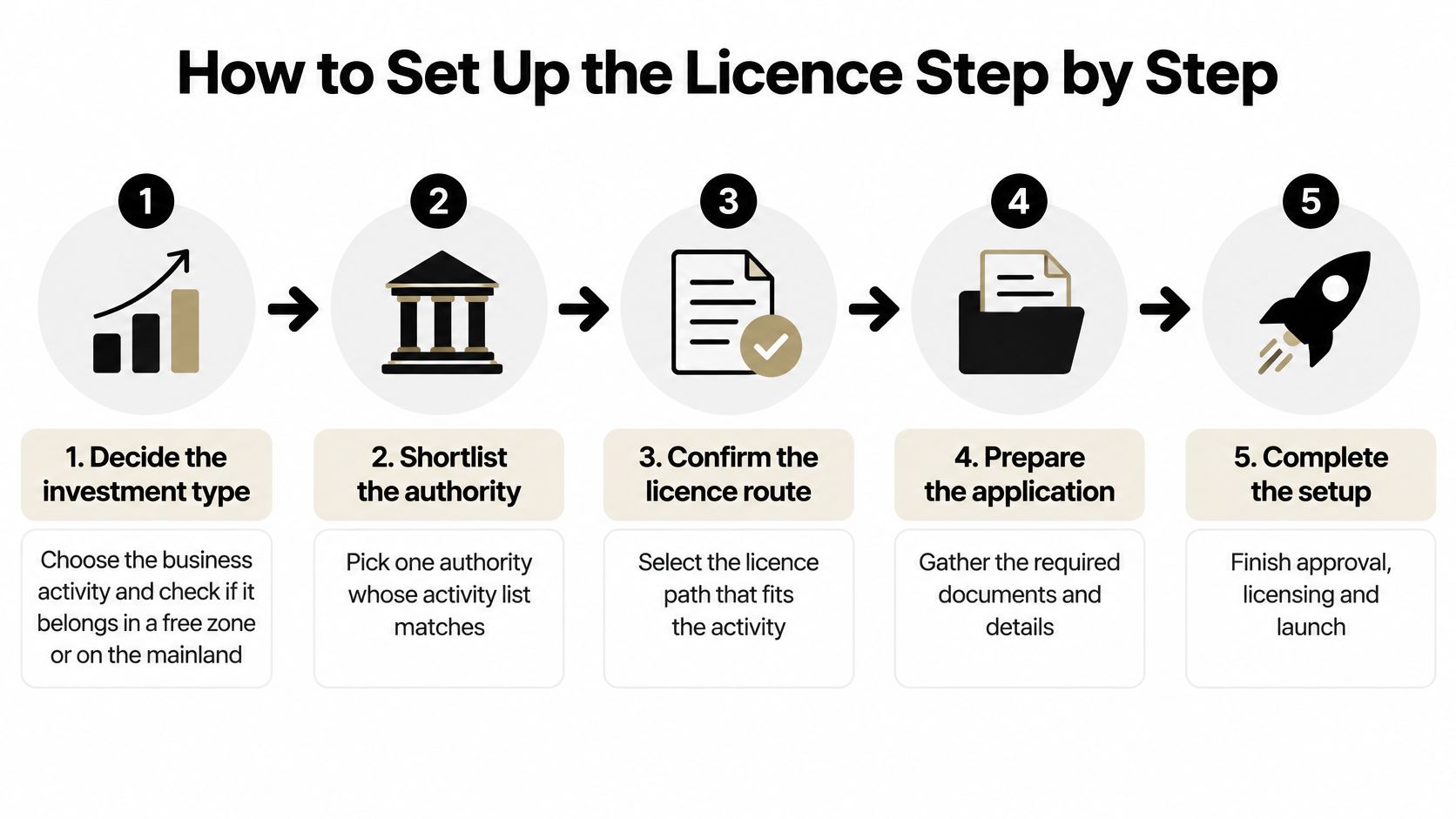
A licence follows the business you plan to run, not the other way around. Before applying, write down what you sell, who buys it, how you deliver it and what premises you need. The broader steps to start a new business can help with planning, while the licensing application must meet the chosen authority's requirements.
Follow the formation sequence
Decide the investment type and jurisdiction. Establish whether the activity belongs in a free zone or on the mainland. Choosing a visa package before deciding what business will support it can lead to a poor fit.
Shortlist the authority and legal form. Confirm the activity and select an available structure, such as a free zone establishment or free zone company. Similar names do not guarantee the same shareholder or governance requirements.
Prepare the application file. Investor-visa documents typically include a passport copy, recent photographs, a business plan and proof of financial stability. Request the company-formation checklist separately, including any corporate shareholder documents or activity-specific approvals that apply.
Submit for initial approval. Send a free-zone application to the respective authority. Mainland businesses submit to the relevant economic department, or DED. Initial approval does not authorise every possible operation.
Secure compliant premises. Match the facility to the approved activity, whether that means a flexi-desk, office, warehouse or industrial space. Check that it suits planned staffing before signing a lease.
Complete registration and licensing. Pay the confirmed charges, collect the licence and arrange the immigration steps needed for owner or employee visas. Keep approvals, receipts and incorporation documents together.
Choose the licence family carefully
- Commercial or trading: Covers approved goods trading. It does not automatically permit manufacturing those goods.
- Professional or consultancy: Covers approved advice or services, not the sale of stocked products without the relevant permission.
- Industrial: Covers approved production or processing, with premises and operating approvals that fit the activity.
- E-commerce: Applies to approved online selling. Selling through a website does not remove product or storage requirements.
- Freelance permit: May suit eligible individual activities where offered by the authority. It is not an unrestricted substitute for a company.
For example, a consultancy that plans to sell hardware should check its licence before accepting those orders. Adding a website changes the sales channel, not the activity authorised by the licence.
Setup cost checklist
| Cost item | In headline fee? | Ask for in writing |
|---|---|---|
| Licence and registration fee | Usually yes, confirm the package | Itemised authority fee schedule |
| Facility | Often separate | Lease term, size, deposit and permitted use |
| Investor and employee visas | Often separate | Visa entitlement and itemised processing charges |
| Subsequent licence renewal | Usually outside the initial setup quote | Renewal fee and due date |
| Activity approval and add-ons | Don't assume inclusion | Written approval and associated charges |
A low headline fee can still be the wrong choice if the activity, facility or visa allocation does not fit. Separate consultancy charges from authority fees, and obtain written activity confirmation, a facility quote and a confirmed visa allocation before paying.
When the 0% Corporate Tax Rate Applies
A Qualifying Free Zone Person doesn't receive the ordinary AED 375,000 zero-rate band on its non-qualifying taxable income: that income is generally taxed at 9% from the first dirham, according to the Federal Tax Authority's Corporate Tax General Guide. That's a significant difference from assuming that a free-zone licence exempts a small business from corporate tax.
The test concerns both the company and its income. Under the FTA's Free Zone Persons guide, Qualifying Income can receive 0%, while non-qualifying taxable income is generally subject to 9%.
Classify the transaction before applying a rate
Free zone income and corporate tax treatment
| Revenue situation | Typical treatment | What must be true | Record to keep |
|---|---|---|---|
| Qualifying Income of a Qualifying Free Zone Person | Eligible for the qualifying rate | Entity conditions and transaction classification are satisfied | Customer status and location, activity analysis and contract |
| Non-qualifying taxable income | Subject to the non-qualifying rate from the first dirham | Correct classification and continued eligibility for qualifying status must be assessed | Separate ledger and supporting calculation |
| Transactions with mainland UAE customers | Not automatically disqualified or automatically qualifying | Assess the activity, counterparty, applicable qualifying rules and permanent-establishment exposure | Contracts showing the parties and where work occurs |
| Excluded activity | Generally non-qualifying, with potential consequences for status | Apply the excluded-activity and de minimis rules | Activity description, invoices and classification memo |
A mainland customer's address alone doesn't determine the answer. Nor should an excluded transaction be treated merely as an isolated tax charge without assessing whether it affects the company's qualifying status.
Check the company-level conditions
The qualifying framework requires adequate UAE substance, Qualifying Income, compliance with the de minimis condition and transfer-pricing rules, no election into the standard regime, and audited financial statements. Our explanation of free-zone corporate tax provides a focused starting point for reviewing that classification.
For practical purposes, create a revenue register before the first invoice. Give each revenue stream fields for customer location and status, activity type, where work is performed, possible permanent-establishment exposure and excluded-activity treatment.
Then design the bookkeeping around those classifications. Keep separate ledger codes for income categories and retain contracts, delivery evidence and the reasoning behind each treatment.
A licence address is not evidence that an invoice qualifies for preferential tax treatment.
Consider a consultant who also earns a referral commission. Even if both amounts arrive in the same bank account, they need separate activity analysis; calling everything consultancy income doesn't resolve the distinction.
Use a yes-or-no readiness test: can you identify the customer, activity and tax classification behind every invoice line? If not, you're not ready to budget on preferential treatment.
Filings That Continue After Incorporation
Inactive doesn't mean compliance-free. A company with no customers can still have a licence expiry date, ownership records to maintain and tax obligations to assess.
Build the calendar around the entity's legal form, financial year-end, licensed activities, revenue status and mainland operations. Don't copy another founder's deadlines just because you registered in the same zone.
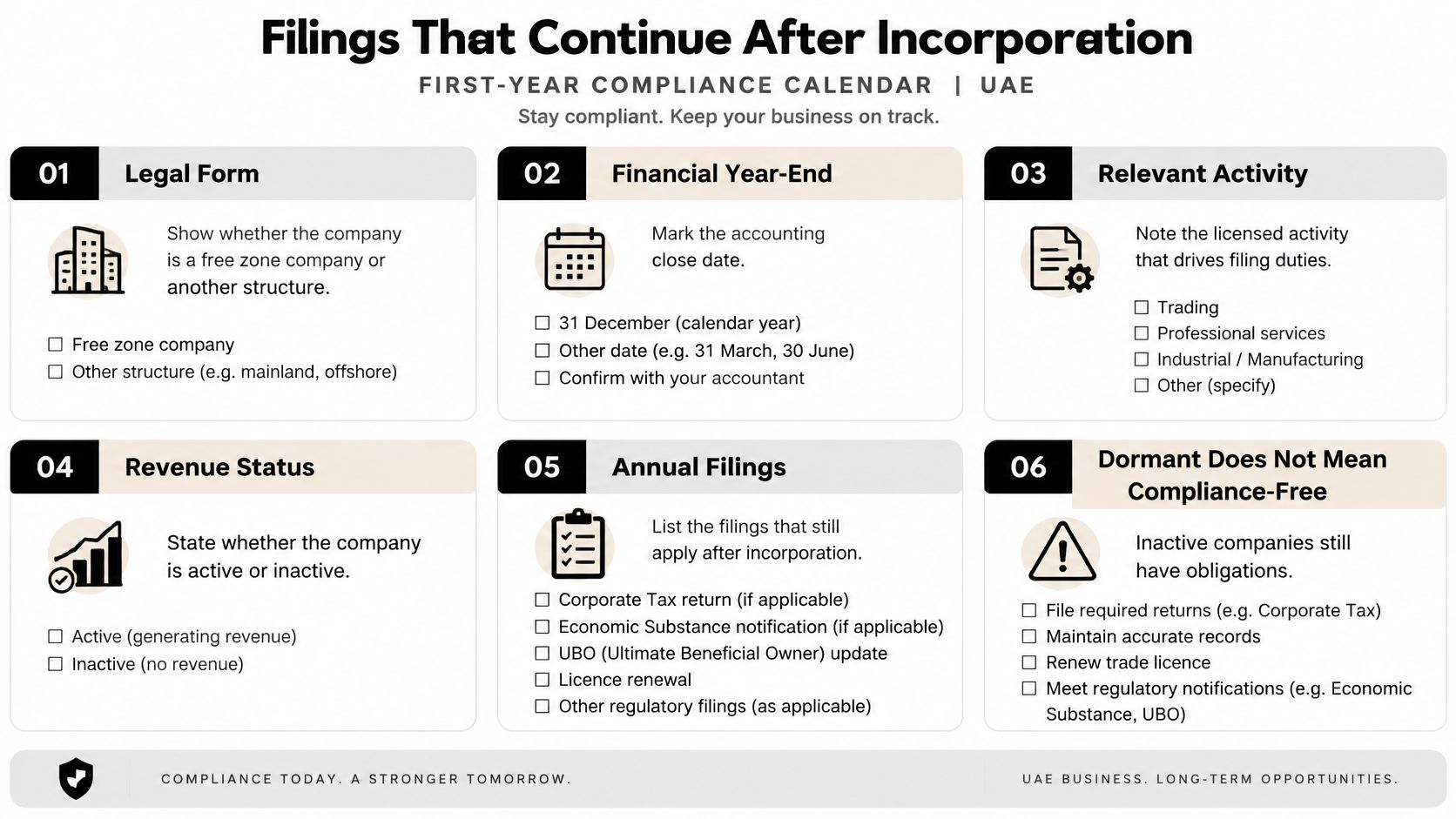
Give each obligation an owner
First-year free zone compliance calendar
| Duty | Applies if dormant? | Usual timing |
|---|---|---|
| Licence renewal | Yes, if keeping the entity licensed | Authority's stated expiry date |
| Corporate tax registration and return | Assess even when no tax is payable | Applicable FTA deadlines |
| Accounting records split by income type | Keep books, including setup and bank transactions | Throughout the financial year |
| Beneficial-owner information | Applicable ownership disclosures still need attention | Registrar's deadlines and when details change |
| Economic Substance notification | Assess historical periods and scope, not dormancy alone | Applicable notification deadline |
| Economic Substance Report | Only for a period and entity within the reporting scope | Applicable reporting deadline |
| Audit | Where the zone or qualifying tax status requires it | Financial-statement preparation cycle |
| Immigration file | Relevant where a file or visas exist | Establishment-card and visa expiry dates |
Assign a named person to each row. Store the submission acknowledgement beside the underlying return or application, rather than relying on an email saying it was handled.
Treat Economic Substance as a scope question
The UAE government's Economic Substance guidance describes annual notifications for in-scope entities and, where applicable, an Economic Substance Report within 12 months of financial year-end. It also requires attention to whether relevant-activity income and exemption conditions affect the obligation.
For a newly formed company, don't turn that historical framework into an automatic recurring filing instruction. Confirm which financial periods remain covered under the current rules and whether any legacy obligations exist; economic substance reporting and corporate-tax substance requirements are separate questions.
A company with no sales may still have paid registration fees, received shareholder funding or incurred bank charges. Record those movements and retain the supporting documents rather than waiting for trading revenue to begin.
Our guide to accounting record-keeping requirements helps organise that evidence. Use separate folders for ownership records, authority correspondence, banking, contracts and filings.
Calendar discipline: Record both the deadline and the evidence needed to complete the task. A reminder without the supporting documents won't produce a reliable filing.
Open a tax diary, a substance note and a licence-renewal record during your opening month. Those working files should describe your actual entity, not a generic package.
Three Founders and the Zone They Needed
The electronics re-exporter
An electronics trader plans to receive shipments, hold inventory and dispatch orders to overseas distributors. A desk licence looks inexpensive, but it doesn't solve receiving, inspection, storage or cargo release.
Jafza's development illustrates why an operating ecosystem matters: the first Jebel Ali free-zone law was issued on 6 May 1980, and Jafza was established in 1985, starting with 19 companies, according to the Dubai government's account of its history. The relevant lesson is the integration of business registration with warehousing, customs and distribution.
The founder should map the movement of a shipment before comparing licence quotes. Who receives it, where is it stored, and who handles its release?
The deciding fact is customs access.

The software consultancy
A software consultant delivers remote implementation work to overseas businesses. Subject to authority approval, a professional activity and an accepted flexi-desk arrangement may match that operating model without unnecessary premises.
The situation changes when a proposed contract requires staff to work regularly at a mainland customer's site. Before signing, the founder should examine the service permissions, delivery location and tax classification rather than assuming the original setup still fits.
The useful document is the draft customer contract. It reveals obligations that a short licence description might miss, including on-site support and responsibility for implementation.
The deciding fact is customer location and delivery arrangements.
The light manufacturer
A founder comparing a Dubai trading desk with industrial premises in Sharjah initially focuses on the difference in package prices. But the business needs power capacity, material storage, loading access and permission to run equipment.
Hamriyah or Sharjah Airport International Free Zone may warrant consideration, subject to the specific process and facility approvals. Neither should be selected solely because manufacturing appears in a broad marketing description.
The founder should prepare a facility specification covering equipment, utilities, storage and vehicle access. A site visit and written confirmation of permitted use are more valuable than a prestigious mailing address.
The deciding fact is the facility.
Frequently Asked Questions About Free Zones
Can a free-zone company sell to UAE mainland customers?
Sometimes, but don't assume its licence alone authorises every mainland transaction. Goods distribution, remote services and opening physical premises raise different permission questions, while tax classification requires a separate assessment of the transaction.
Can a foreign founder fully own a free-zone company?
Generally, yes, subject to the authority, legal structure and activity conditions. Confirm the proposed shareholder arrangement in writing, especially if another company will hold the shares or the business needs regulated approvals.
Does a flexi-desk satisfy the facility requirement?
Only where the authority accepts it for your activity and staffing plan. It may suit eligible remote services, but it doesn't provide permission to store goods, install machinery or operate a customer-facing outlet.
Does a dormant company still have to file?
It still needs an obligation-by-obligation review. Keep the entity's records current, assess tax registration and returns, and check renewal, ownership, immigration and any applicable historical reporting requirements rather than treating absent revenue as a blanket exemption.
Is preferential corporate tax treatment automatic?
No. The company must meet the qualifying conditions, and the income must receive the correct classification. Keep the operating evidence and accounting analysis that support the position, rather than relying on the wording of an incorporation advertisement.
Confirm the Zone Before You Pay
Write these lines before committing money:
- Exact activity: Describe the goods or services you'll invoice, not just trading or consultancy.
- Customer map: Identify where buyers are based and where you'll fulfil the contracts.
- Facility requirement: Specify the workspace, storage, utilities and staffing arrangements.
- Revenue classification: Identify income requiring further tax analysis before relying on preferential treatment.
If any line is blank, pause the purchase. A discount doesn't compensate for a licence that cannot support the business.
Turn the description into a decision
At Smart Classic Business Hub, we begin with an initial consultation to understand your requirements and objectives, including the registration, visa processing and government approvals you may need. We guide the jurisdiction and legal-structure decision through to obtaining the investment licence.
Use the setup cost checklist to distinguish authority charges from premises, immigration and renewal costs. Our website's Business Setup Cost Calculator can provide a starting estimate, but it shouldn't replace a written, activity-specific quotation.
Bring the operating description and any draft contracts to the assessment. Don't pay for the licence until the activity approval, facility plan and tax analysis support the same business model.
Smart Classic Business Hub helps founders assess UAE jurisdictions, choose a suitable company structure and coordinate licensing, with ongoing tax and accounting support after formation. Visit Smart Classic Business Hub to book an initial assessment, bringing your activity description, customer map, facility requirements and proposed revenue streams.