
The most popular advice on closing a UAE company is also the most expensive. You're told to cancel the trade licence first, take the certificate, and sort everything else later. Don't. A cancelled licence doesn't cancel a tax registration, a visa, a lease, or a creditor's claim. It leaves them running while you lose the company vehicle you need to settle them cleanly.
Closure in the UAE isn't one filing. It's a synchronisation problem across the licensing authority, the Federal Tax Authority, staff, banks, utilities and creditors. The company liquidation process works when you fix the order before you pay for notices. Pick the right route, build one claims file, and date every step from your last trading day. Get that order wrong and a cheap cancellation becomes months of reopened files and penalties.
Which UAE Closure Route Fits Your Company
Start with one question. Can the company pay staff, suppliers, leases, tax and known claims in full from its own assets? Your answer chooses the route, the person in charge and the authority watching you. Don't choose by price.
If assets cover every claim, you're looking at voluntary solvent liquidation. Shareholders appoint a liquidator, the liquidator collects what's owed, pays verified claims, and only then returns anything left to shareholders. If assets don't cover claims, you don't have a routine cancellation. You have an insolvency problem, and calling it a cheap closure won't change that.
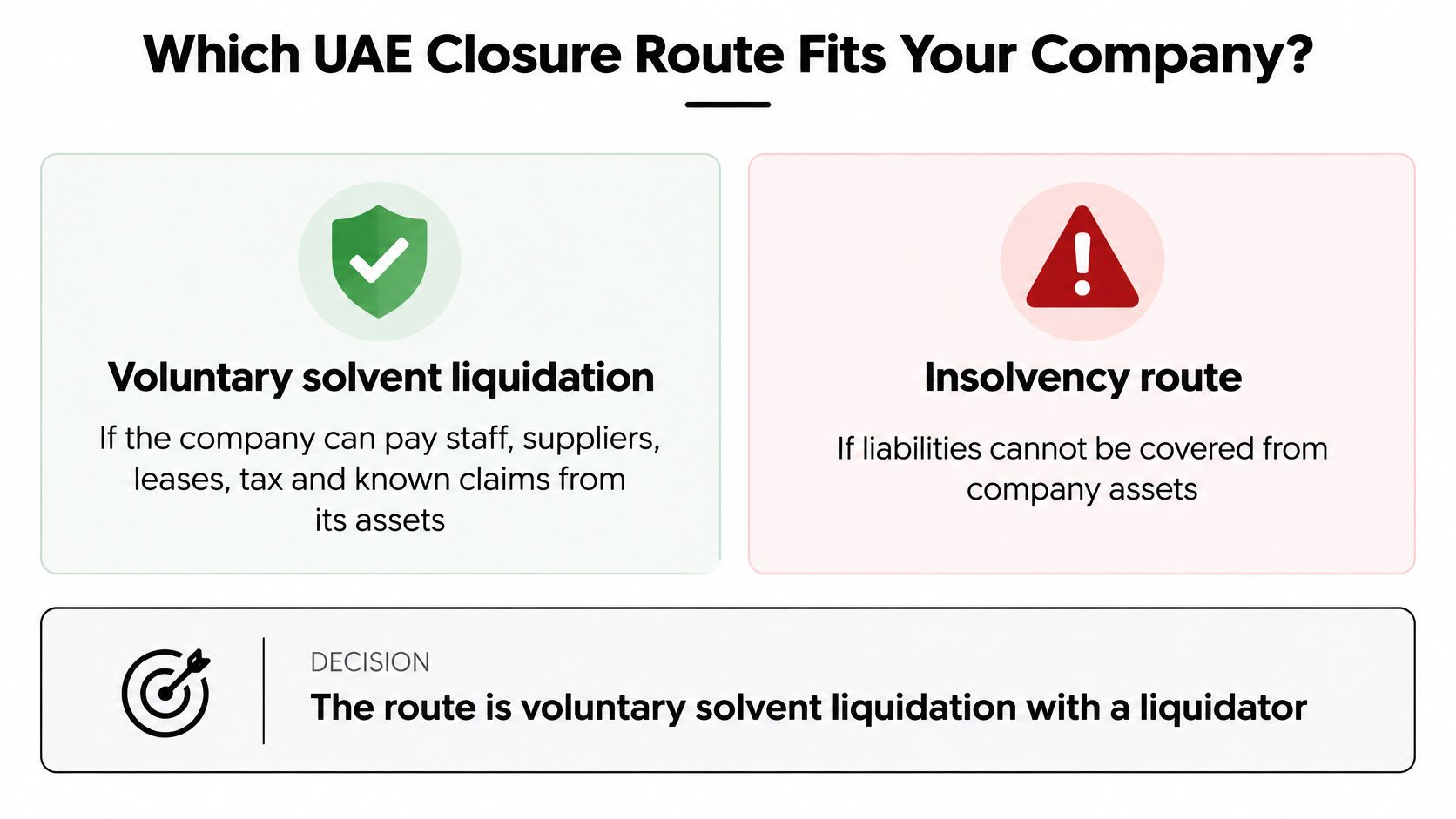
The Solvent or Not Fork
The UAE Government Portal summary of the bankruptcy law explains that Federal Decree-Law No. 51 of 2023 on Financial Restructuring and Bankruptcy took effect on 1 May 2024, after publication in the Federal Gazette on 31 October 2023, replacing the former 2016 regime. It defines bankruptcy as a collective process for settling a debtor's obligations by liquidating assets and businesses and distributing the proceeds among creditors.
That law doesn't push every distressed company straight into liquidation. It also provides consensual out-of-court financial restructuring, composition procedures, formal financial restructuring and potential new financing under legally defined conditions. Liquidation follows when those measures are unsuitable or unsuccessful. The law created a dedicated Bankruptcy Court framework and strengthened court-appointed trustees who manage proceedings, asset realisation and creditor distributions.
| Path | When it fits | Who runs it | Public notice | Closed means |
|---|---|---|---|---|
| Voluntary solvent liquidation | Assets cover employees, suppliers, leases, tax and known claims | Shareholders appoint a liquidator | Dubai mainland, one day in two Arabic newspapers, then 45 days | Licence, visas and tax registrations ended |
| Out-of-court or formal restructuring | Distressed but a deal or court composition can keep the business | Debtor, creditors, and where required the Bankruptcy Court | Not a closure notice | Company continues under the deal |
| Court insolvency liquidation | Liabilities exceed recoverable assets, or restructuring has failed | Bankruptcy Court and a court-appointed trustee | Court-directed | Assets realised and distributed under Decree-Law 51 of 2023 |
Name Your Register Next
Your register tells you which forms, notices and clearances apply. A Dubai mainland commercial company follows the Department of Economy and Tourism sequence. Free zones such as DMCC, JAFZA and IFZA use their own portals and forms, so you follow that zone's rulebook, not Dubai mainland guidance. Offshore vehicles, including JAFZA Offshore, RAK ICC and ADGM entities, still need a liquidator to end contracts, collect debts and realise assets before any return to shareholders.
A dormant company isn't automatically clear either. No trading doesn't mean no corporate tax or VAT filing exposure, and it doesn't prove solvency. Before you appoint anyone, carefully test the numbers. Founders who still have choices about timing and asset sales should also think about strategies for maximizing after-tax exit value before distributions are locked in, because the order of payments affects what shareholders can lawfully receive.
Mark two things on paper now. Solvent or not. Which register holds the licence. If you can't answer the first with evidence, you aren't ready for notices.
How the Company Liquidation Process Runs
Take a Dubai mainland commercial company as the worked example. The order matters more than speed, because each document enables the next stage. The Dubai Government guide to closing your business sets out a sequence built around notarised minutes, a liquidator's acceptance, a dissolution certificate, newspaper publication and a 45-day period for creditors and other claimants to submit claims. It isn't a simple licence cancellation form.
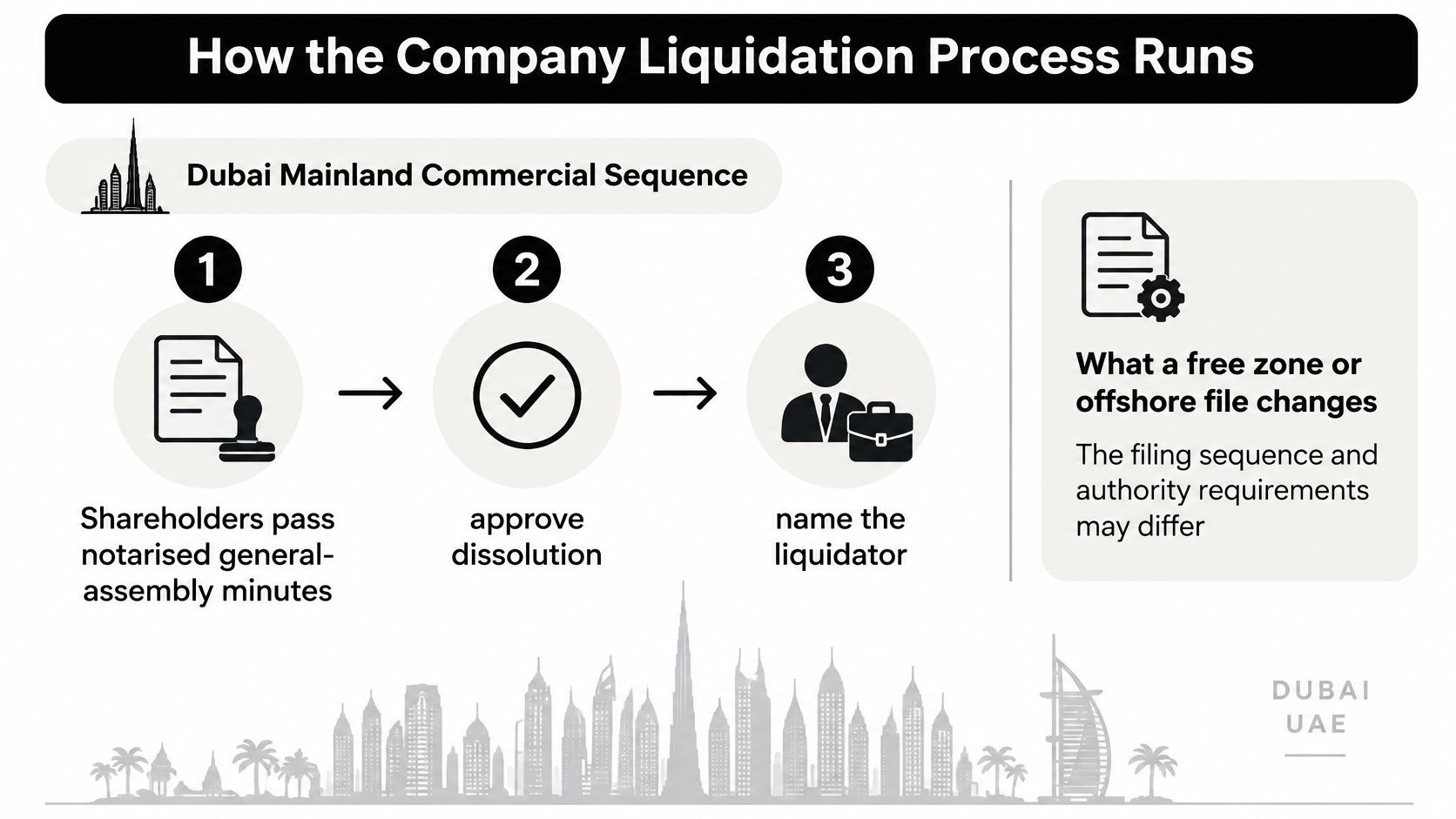
The Eight Steps in Order
- Pass the shareholder decision. Shareholders approve notarised general-assembly minutes that approve dissolution and name the liquidator. Without this, the liquidator has no authority.
- File the liquidator's acceptance. The liquidator submits an acceptance letter with supporting documents, including licence, auditor-registration proof and notarised signature documents. The authority checks the person is eligible before anything becomes public.
- Receive the dissolution certificate. The authority issues the dissolution and liquidator-appointment certificate. Your licence is still active at this point. This certificate starts phase two, it doesn't finish closure.
- Publish the notice. Publish a liquidation notice for one day in two Arabic local newspapers. Keep the original newspapers. Photocopies won't build your final pack.
- Leave the claims window open. Creditors and other claimants get 45 days to file claims. Use this time to settle, not to wait. Log every claim, verify it against contracts and statements, and pay or dispute it in writing.
- Clear people properly. Cancel labour cards through the Ministry of Human Resources and Emiratisation, pay final wages, unused leave and end-of-service amounts, and line up visa cancellation in the right sequence. Staff clearance isn't an afterthought you add after deregistration.
- Submit the final pack. After the window closes, file the original newspaper publications, the liquidator's final report, and a declaration from the liquidator and partners confirming no objections were received within the 45 days, together with the meeting minutes and dissolution certificate. If objections did arrive, show how each one was settled.
- Request final deregistration. Ask for final cancellation only after that pack is accepted. This is the point where trade licence cancellation in Dubai ends the licence, rather than merely recording your intention to close.
What Changes Outside Mainland Dubai
Free zone and offshore companies keep the same logic, resolution, liquidator, notice, claims, clearances, then cancellation. The zone or registrar replaces the Dubai newspaper pair with its own notice method and forms, and you'll work through its portal instead of the mainland counter. Don't copy a mainland checklist into DMCC, JAFZA or RAK ICC and assume it'll be accepted.
Keep bank accounts open until claims, refunds and final distributions are settled. Closing the account early strands money owed to the company and leaves you paying creditors from personal funds, which muddies the liquidator's report. Utilities, lease deposits and telecom accounts follow the same rule. Close them when the final bill is issued and evidenced, not when you hand back the keys.
The appointment certificate is permission to liquidate. It is not proof that you have closed.
Follow the file order every time. Resolution, notice, claims, clearances, then cancellation. If a service offers to reverse that order to save time, ask which authority will accept the final pack.
Build the File and Settle Claims
A cheap licence cancellation can be the costliest shortcut. Closure is a synchronization problem: the licensing authority, Federal Tax Authority (FTA), staff, banks and creditors all need the right information, or the licence may end while tax filings and claims remain open.
Build a dated file that shows what the company owes, what it is owed, and what evidence supports each entry. A liquidator's work may include handling contracts and disputes, realising assets, collecting amounts due, paying creditors and distributing any remaining funds to shareholders. The exact formalities depend on the company's register, so confirm its requirements before preparing or signing a solvency statement.
Build a Dated Liabilities Matrix
Use one spreadsheet, with an owner, amount, supporting evidence and status for every item. Date each entry and update it as payments or settlements are completed. Include:
- Tax: Corporate tax, VAT, penalties and open return periods.
- People: Final wages, unused leave, end-of-service amounts, notice pay and visa costs.
- Premises and services: Rent to the exit date, reinstatement, utilities, telecoms and applicable Ejari or zone facility charges.
- Trading claims: Supplier balances, customer deposits, advances for undelivered work and refunds.
- Finance: Bank facilities, secured lenders, credit cards and shareholder loans.
- Contingent items: Disputes, threatened litigation, guarantees and warranties that could lead to claims.
Keep the records traceable to ledger entries, invoices, payroll records and bank statements, in line with UAE accounting and record-keeping requirements. For electronic signatures, check the formalities with the relevant register before relying on a signed document. Closer Innovation Labs on UAE eSignature legality
Order payments according to the company's obligations and the liquidator's advice. Employees, government dues, secured lenders, trade creditors and shareholder loans may not have equal priority. Shareholders receive a distribution only if the liabilities are settled and the accounts show a surplus.
Prove Every Payment
Keep a written settlement or no-claim confirmation for each resolved item. Attach supporting proof, such as a bank record, payroll record, tax filing or asset-sale invoice, to the relevant entry in the liquidation file. If a supplier agrees to accept a reduced amount, get the agreement in writing before paying. A bank transfer by itself does not establish that the creditor accepted the reduced sum as full settlement.
The register may require a registered auditor to review the closing accounts and the liquidator's final statement of affairs. Confirm that requirement early and allow for the audit in your closure budget. Reconciled accounts make it easier to trace each figure from the file to the underlying records.
Set a clear last trading day. Stop invoicing for new work, issue final tax invoices for work already delivered, avoid new commitments and tell customers in writing how to raise warranty or deposit questions. If the matrix shows a shortfall, pause the voluntary closure route and get restructuring or insolvency advice before making payments or promising distributions.
Timelines and Official Costs by Jurisdiction
Read the clocks before you read any quotation. Government fees are only part of the cost, and statutory waiting periods don't shrink because a consultant is efficient.
| Stage | Mainland Dubai | Free zone | Offshore |
|---|---|---|---|
| Resolution and liquidator appointment | Notarised general-assembly minutes and acceptance letter | Zone resolution and liquidator forms | Special resolution, solvency statement where the register requires it |
| Dissolution or appointment certificate | AED 520 in official Dubai guidance | Zone fee schedule, not a single UAE tariff | Registrar fee set by that registrar's schedule |
| Public notice | Two Arabic newspapers for one day | Zone portal or newspaper, as that zone requires | Notice method set by the register |
| Creditor claims window | 45 days minimum | Confirm the zone rule, many follow a similar claims period | Claims period set by the register |
| Labour and visa clearance | MOHRE labour cards, then visa cancellation | Free zone plus immigration if visas were sponsored | Only if the vehicle sponsored staff |
| Corporate tax deregistration | Licence cancellation and accounts to that date, FTA up to 40 working days, apply within 3 months | Same FTA process | Same FTA process if the entity is in scope |
| VAT deregistration | Separate FTA application and deadline | Same FTA process | Same FTA process if VAT-registered |
| Final deregistration | After newspapers, final report and no-objection declaration | Zone clearance, then licence cancellation | Registrar closure after the liquidator's report |
What the Dubai Mainland Figures Actually Mean
The UAE Government Portal guidance on closing a mainland business lists AED 520 for the dissolution and liquidator-appointment certificate, after notarised minutes and the liquidator's acceptance letter with licence, auditor-registration and notarised-signature documents. It then requires a one-day notice in two Arabic newspapers, creating a mandatory 45-day creditor-claim period, before the liquidator submits the original publications, final report and declaration that no objections were received, while labour cards are cancelled through MOHRE.
That AED 520 is one certificate fee. It isn't your project cost. Newspaper publication, Arabic translation where you need it, liquidator fees and any final audit are professional costs on top of government fees. Where a free zone or offshore registrar hasn't given you a published standard fee for your exact entity type, get its current schedule in writing rather than budgeting from another zone's price.
Add the Clocks Together Honestly
The 45 days is a minimum claims window, not a completion date. Preparation before the notice, authority review, disputed claims, missing clearances and incomplete financial records all sit outside it. A clean solvent file often runs for several months once you add settlement time and final deregistration.
Federal tax runs on a separate clock that applies across mainland, free zone and offshore entities in scope. Corporate tax deregistration needs the licence-cancellation document and financial statements through the cancellation date, so your closing accounts can't be an afterthought. VAT deregistration is a separate application with its own deadline, handled through the Federal Tax Authority rather than your licensing authority.
Build your plan backwards. Add the longest statutory wait to your own time for collecting receivables, settling staff, closing leases and preparing accounts. Never quote 45 days to shareholders, landlords or buyers as the project length. You'll miss the date and lose credibility with every party whose clearance you still need.
Pitfalls and Your First Week
Most failed closures don't fail on the resolution. They fail because one connected file was left open. A licence stays alive, a tax account stays active, or a visa blocks the final step, and the founder pays to restart work they thought was finished.
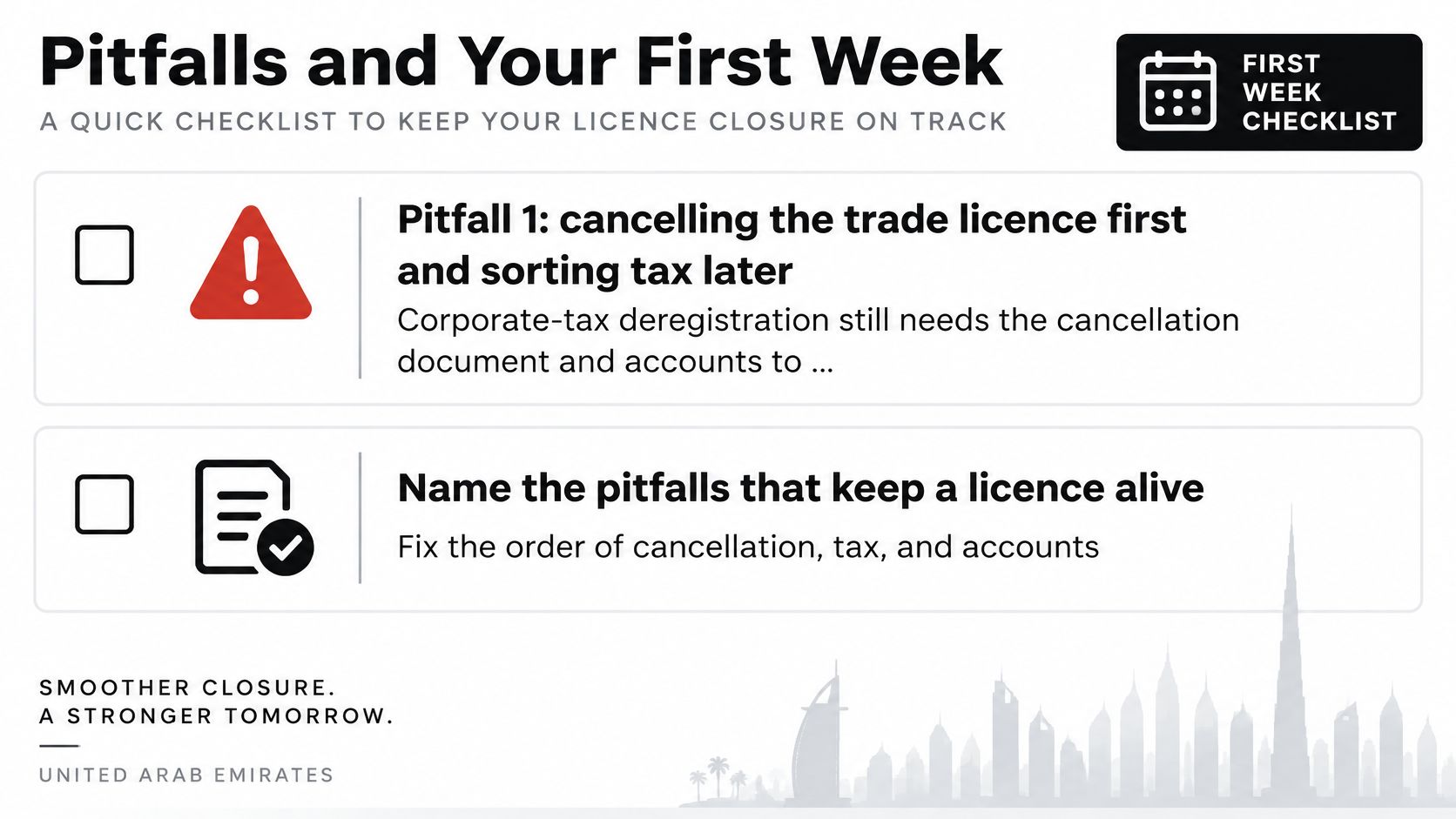
Pitfall 1 Cancelling the Licence First and Sorting Tax Later
This is the costliest shortcut. The Federal Tax Authority corporate tax deregistration service states that deregistration for liquidation requires the licence-cancellation document and financial statements through the cancellation date, with a service standard of up to 40 working days for a complete application. Corporate tax deregistration must be handled within the applicable three-month period after cessation or liquidation, while VAT deregistration follows a separate process and deadline.
Cancelling a licence doesn't automatically end tax obligations. You must still file required returns, settle tax and administrative penalties, and retain evidence of cessation. A dormant company can therefore still owe returns and penalties. If you cancel first and discover later that closing accounts don't exist, you've created urgency without removing the work.
Pitfall 2 Treating the Dissolution Certificate as Closure
The certificate appoints your liquidator and records dissolution. It doesn't deregister the company. Until the authority accepts the original newspapers, final report and no-objection declaration, assume the licence remains active and obligations continue. Founders who stop monitoring renewal dates, tax periods and bank correspondence at this stage create avoidable penalties.
Pitfall 3 Starting a Solvent Liquidation Without Solvency
A voluntary route needs evidence, not optimism. If your liabilities matrix doesn't cover tax, staff, leases, suppliers, customer advances or litigation, don't sign a solvency statement and hope a receivable arrives. Pause, test negotiated settlements, and take specialist restructuring or insolvency advice if the shortfall remains. Continuing as though the company were solvent delays closure and can turn manageable creditor discussions into disputes.
Pitfall 4 Leaving People Until Last
Visas, final wages, unused leave, end-of-service amounts and labour clearance must move with the creditor window, not after it. Work through end-of-service benefits in the UAE for each employee, agree the final settlement in writing, and sequence labour card and visa cancellation so nobody is left out of status. Say a small consultancy has three sponsored staff and one shareholder on an investor visa. Each person may need a different cancellation or transfer path, and your final pack shouldn't be the moment you discover that.
Pitfall 5 Ignoring Guarantees, Deposits and Advances
A public notice doesn't erase a personal guarantee a shareholder signed for a bank facility, lease or supplier account. List every guarantee separately and get written releases where the beneficiary will give them. Do the same for customer deposits and advances. If you took money for work you won't deliver, that is a claim, even if the customer hasn't complained yet.
Readiness checklist: Last invoice issued, banks reconciled, claims logged, staff cleared, tax applications dated, evidence retained.
Your First Week Start List
- Date the last trading day. Stop new invoices and commitments from that date, issue final tax invoices, and prepare closing financial statements to the cancellation date you'll later file.
- Fill the liabilities matrix. Choose solvent liquidation, negotiated settlement or insolvency advice from the numbers, not from the cheapest quotation.
- Name the register. Write down Dubai mainland, the specific free zone, or the offshore registrar, then obtain that authority's current forms and fee schedule.
- Collect the core pack. Gather passports, the trade licence, constitutional documents, accounts, tax registrations and bank statements in one indexed file.
- Prepare authority for overseas shareholders. Where a shareholder can't attend, arrange a power of attorney matching UAE formalities. Our legal team drafts Power of Attorney documents in compliance with UAE laws and regulations so the document accurately reflects the client's intentions and covers all relevant aspects of authority delegation.
- Book professionals in the right order. Appoint the liquidator and plan any final audit only once the matrix shows the company can pay. Booking notices before that test wastes money if you need to change route.
We start with an initial consultation and assessment, where our experts learn your business requirements and objectives and assess which services are needed. That matters here because Smart Classic Business Hub also offers company liquidation, professional PRO services, bank account opening, and accounting and bookkeeping, so licence, government clearance and closing accounts can be sequenced together rather than chased separately. One consultation confirms which filings apply to your register and tax position.
Apply the readiness test before any public notice. Every liability line should have a payment, a waiver, or a written reason it isn't a company debt. If a line has none of those, your first week isn't finished.
Book a solvency and register check before you publish any liquidation notice, and we'll map your licence, staff, bank and Federal Tax Authority filings into one dated closure plan. Smart Classic Business Hub handles company liquidation alongside PRO follow-up and closing accounting support, so you can confirm the right route first and then complete each clearance in order. Visit Smart Classic Business Hub to start with an initial consultation and assessment for your company.