
Your bookkeeper says the VAT return is ready, but the supporting folder tells a different story. An overseas software invoice is missing, a supplier credit note hasn't reached the ledger, and nobody has checked whether the sales forecast changes your registration position.
That's where VAT accounting in the UAE needs to start, with a monthly control process rather than a rush before submission. The return matters, but so does the evidence behind every dirham of input VAT you recover.
VAT Rates, Thresholds and Deadlines at a Glance
A Dubai consultancy can submit its return on time and still miss a registration trigger. The filing calendar only works when monthly checks catch changes in taxable activity before an application is due.
The UAE introduced VAT on 1 January 2018. The standard rate is 5%, and qualifying supplies may be zero-rated at 0%, as set out in the Federal Tax Authority's tax obligations guide. The guide also gives the resident mandatory registration threshold as AED 375,000 in taxable supplies and imports over the preceding 12 months, or expected within the next 30 days. Voluntary registration is available at AED 187,500 in qualifying supplies, imports or eligible expenses.
Core UAE VAT rates, thresholds and deadlines
Use this table as a monthly control sheet. Confirm the filing period assigned to the business in EmaraTax, then record its actual period-end and due dates in the working papers.
| Item | Value or governing rule | Applies to |
|---|---|---|
| Standard VAT rate | 5% | Most taxable supplies and imports |
| Zero rate | 0%, where qualifying conditions are met | Qualifying taxable supplies |
| Mandatory registration threshold | AED 375,000 | Resident taxable supplies and imports, measured over the preceding 12 months or expected within the next 30 days |
| Voluntary registration threshold | AED 187,500 | Qualifying supplies, imports or eligible expenses |
| Time to apply after mandatory trigger | Within 30 days | Submission of the application after the mandatory trigger |
| Default tax period | Three months, unless the FTA assigns another period | Check the period shown in EmaraTax |
| Return and payment due | 28 days after the tax period ends | Both VAT return submission and payment |
| Record retention | At least five years | VAT records and supporting evidence |
| Simplified tax invoice ceiling | Confirm current eligibility and ceiling before use | Invoice value, including VAT, and recipient circumstances |
Rates affect more than the amount charged. The tax code selected for each transaction also affects reporting and input VAT recovery. Zero-rated, exempt and out-of-scope transactions are different categories, even when no VAT appears on the invoice.
Registration thresholds need their own monthly review. Non-resident businesses may have a registration obligation regardless of turnover if no UAE party is responsible for settling the tax, so the resident threshold test should not be applied automatically to a foreign entity.
Practical rule: Assign each VAT obligation an owner and review date, and retain the calculation behind it. A calendar reminder alone will not catch a change in expected taxable activity.
Keep the reference sheet current as part of the monthly close. Reconcile actual transactions against expected activity, follow up on missing documents, and update the registration calculation when the business outlook changes. That gives the return reviewer a traceable basis for both the figures filed and the VAT recovered.
Who Must Register and When to Watch the Threshold
A large order deserves attention, but adding it to last year's turnover alone can produce the wrong registration conclusion. You need to distinguish a historical threshold crossing from the separate test for expected taxable activity.
The FTA's VAT registration service guidance applies mandatory registration when taxable supplies and imports exceed AED 375,000 during the preceding 12 months, or are expected to exceed that amount within the next 30 days, and requires the registration application within 30 days of the mandatory trigger. It also allows voluntary registration from AED 187,500, based on the relevant supplies, imports or taxable expenses.
Test the order book, not just annual accounts
Suppose a consultancy has steady revenue below the mandatory threshold and wins a substantial project. The bookkeeper shouldn't assume that signing the contract automatically settles the registration question. Check when the taxable supplies are expected to occur, what the agreement commits the parties to in practice, and whether the historical or forward-looking test is met.
A forecast is evidence, not a substitute for analysis. Keep signed contracts, accepted purchase orders and delivery schedules behind it. Separate confirmed work from speculative pipeline opportunities.
| Business situation | Registration position | Practical decision |
|---|---|---|
| UAE-resident business exceeds the mandatory test | Registration required | Establish the trigger date and submit the application |
| Business meets voluntary eligibility but not the mandatory test | Registration available | Compare recoverable input VAT with compliance effort and pricing effects |
| Business below voluntary eligibility | Registration generally unavailable on that basis | Continue monitoring qualifying activity |
| Non-resident making taxable UAE supplies without a UAE party responsible for the tax | Registration may be mandatory regardless of turnover | Review the supply arrangement before trading |
Voluntary registration can make sense where a business incurs meaningful recoverable costs and sells to customers able to recover VAT. It's less attractive where customers judge the final price and can't recover the tax themselves. Don't register just to appear established.

Use a monthly registration schedule with separate columns for historical taxable activity, expected supplies, supporting documents and the date a trigger arose. Assign someone to investigate unusual revenue movements rather than merely approving the total.
For application planning, use the UAE VAT registration threshold guidance alongside your business licence, ownership identification and supporting financial records. Start gathering documents while reviewing eligibility, so missing paperwork doesn't delay submission once registration becomes compulsory.
Sorting Every Transaction into the Right VAT Category
Think of the ledger as a sorting office. Every invoice needs the correct destination before it reaches the return, and sending everything without a VAT charge into the same bin creates avoidable errors.
The important distinction is why no VAT appears, not merely that the invoice shows none. A qualifying zero-rated supply remains taxable. An exempt supply has a different consequence for the recovery of directly related costs.
VAT categories and their effect on the return
| Category | VAT on sales | Input VAT recovery | Typical example |
|---|---|---|---|
| Standard-rated | Standard output VAT charged | Generally recoverable when evidence and recovery conditions are satisfied | Consulting services to a Dubai client |
| Zero-rated | Taxable at the zero rate | Generally recoverable, subject to conditions | Export meeting the relevant qualifying conditions |
| Exempt | No output VAT charged | Generally blocked on directly attributable costs | Qualifying exempt residential property or financial services |
| Out of scope | Outside the relevant VAT charge | Assess the underlying activity separately | Employee salaries and passive dividend receipts |
| Reverse charge on imported services | Recipient accounts for applicable output VAT | Recoverable only to the extent recovery conditions are met | Overseas cloud software used for taxable business activities |
Don't treat the examples as automatic classifications. An overseas customer address doesn't, by itself, establish zero-rating. Likewise, property and financial-service transactions need their own treatment review rather than a blanket exempt code.
Reverse charge is a mechanism, not a sales category. It belongs in the comparison because it needs a distinct accounting workflow, but the recipient must consider both the output entry and the recoverability of the corresponding input amount.
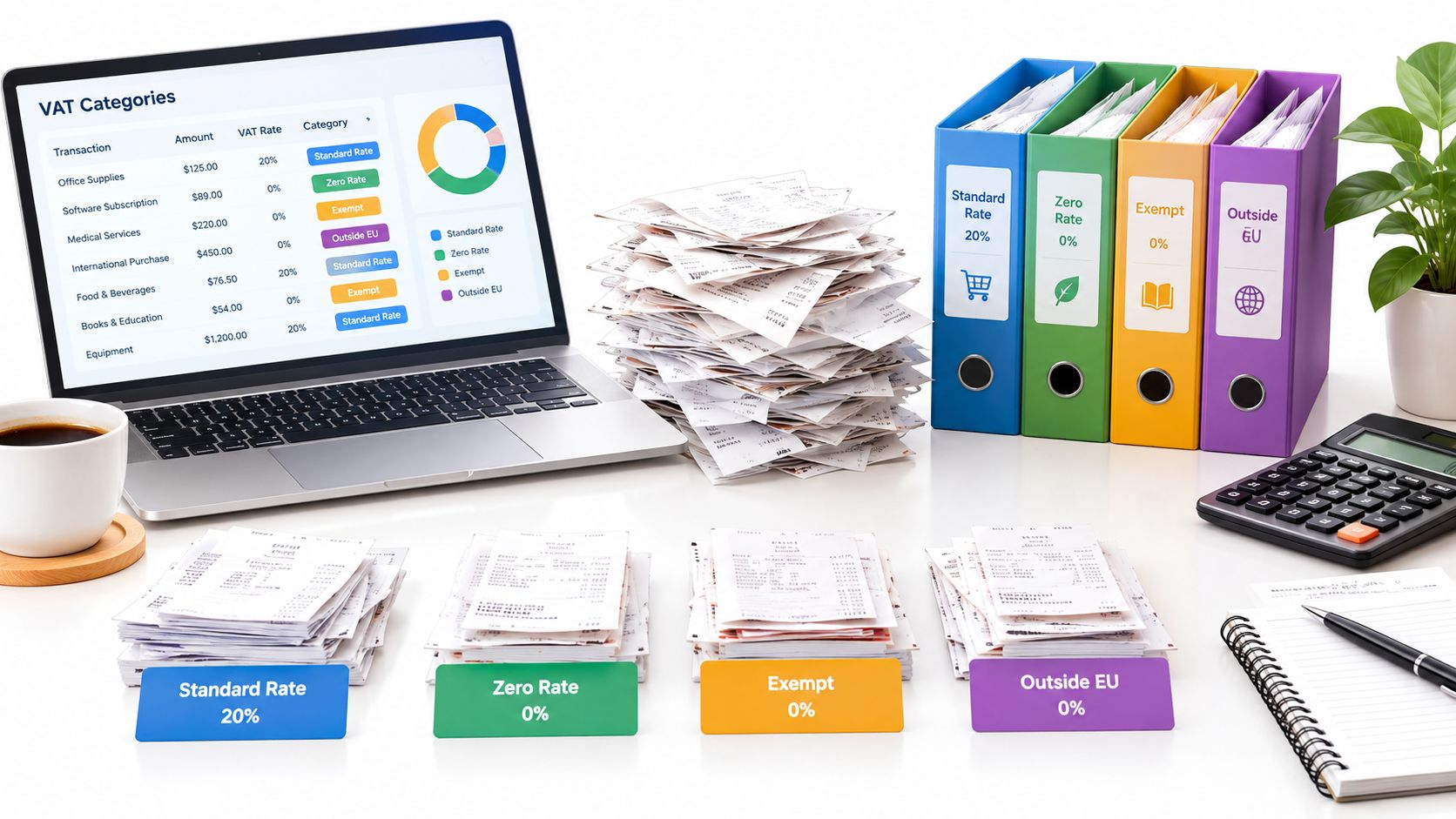
Code at line level
A supplier invoice can contain items with different treatments. If the bookkeeper assigns a single tax code to the invoice total, the software may calculate accurately while reporting the wrong underlying transactions.
Use separate codes for domestic taxable purchases, recoverable imported services, non-recoverable costs and transactions requiring review. Keep the list manageable, but don't compress materially different treatments into a generic purchases code.
- Capture the reason: Record why an unusual supply qualifies for its treatment.
- Separate shared costs: Flag expenses supporting both taxable and exempt activities for recovery review.
- Control overrides: Require approval when staff change a default supplier or product tax code.
The cheapest correction is usually at invoice entry, while the person handling the transaction still understands it. Leaving classification until return preparation means reconstructing facts from descriptions such as professional fees or miscellaneous expenses.
Invoices, Records and Evidence That Protect Input VAT
A return can add up correctly and still contain unsupported input-tax claims. A bank payment proves money moved. It doesn't establish the nature of the supply, the validity of the invoice or the business's entitlement to recover the tax.
Build the evidence check into purchase processing. Before a document reaches the recovery schedule, review the supplier identity, recipient details where applicable, tax registration information, invoice reference, issue date, description, taxable amount and VAT breakdown.
Make the document trail usable
Use a document naming convention tied to the ledger transaction reference. Attach invoices to entries in systems such as Zoho Books, Xero or QuickBooks, and retain a controlled archive that doesn't depend on a staff member's email account.
A full-invoice template and a simplified-invoice template shouldn't be interchangeable. Establish when each may be used, then lock the approved formats so sales staff can't remove required fields for convenience.
For a practical archive structure, use the accounting record-keeping requirements guide to organise the documents around tax periods and transaction references. Retrieval matters as much as storage: the reviewer should be able to move from a return balance to a ledger line and then to its supporting document.
An invoice folder isn't an audit trail unless someone can connect each document to the amount claimed.
Imported services need a separate evidence check
DLA Piper's explanation of the FTA clarification states that a UAE recipient generally needn't self-issue a tax invoice when the overseas supplier provides an invoice or equivalent document showing the supply details and consideration. The recipient must still account for reverse-charge output VAT, retain supporting documents and demonstrate taxable business use to recover input VAT.
That distinction matters for software subscriptions, advertising, cloud hosting and overseas consulting. Don't suppress the reverse-charge entry because the supplier hasn't charged UAE VAT, and don't assume the corresponding input amount is automatically recoverable.
Where the foreign supplier provides no invoice, self-invoicing may be necessary. If that's impractical, consider whether an administrative exception should be requested rather than inventing a document internally and treating the matter as resolved.
For teams moving towards structured invoice exchange, SIX ERP's explanation of how Peppol invoicing works provides useful operational context. Keep the distinction clear: exchanging invoice data and establishing a valid recovery claim are different tasks.
Before approving the recovery schedule, check:
- Identity and substance: The supplier and purchased service match the commercial arrangement.
- Supporting documents: The invoice, contract and relevant delivery evidence are accessible.
- Business use: The cost supports recoverable activity rather than an automatically assumed full claim.
- Adjustments: Credit notes remain linked to the original invoices and accounting entries.
How to Prepare and File a VAT Return Step by Step
The VAT return should be the output of a completed close, not the place where the accountant starts investigating the books. Prepare a return pack that another competent reviewer can follow without relying on the preparer's memory.
The FTA's return filing and payment guidance says the tax period is generally three months, unless another period is prescribed, with filing and payment due within 28 days after period-end, moving to the next working day where the deadline falls on a weekend or public holiday. It also requires returns where no VAT is payable and generally requires specified VAT records to be retained for at least five years after the relevant tax period.
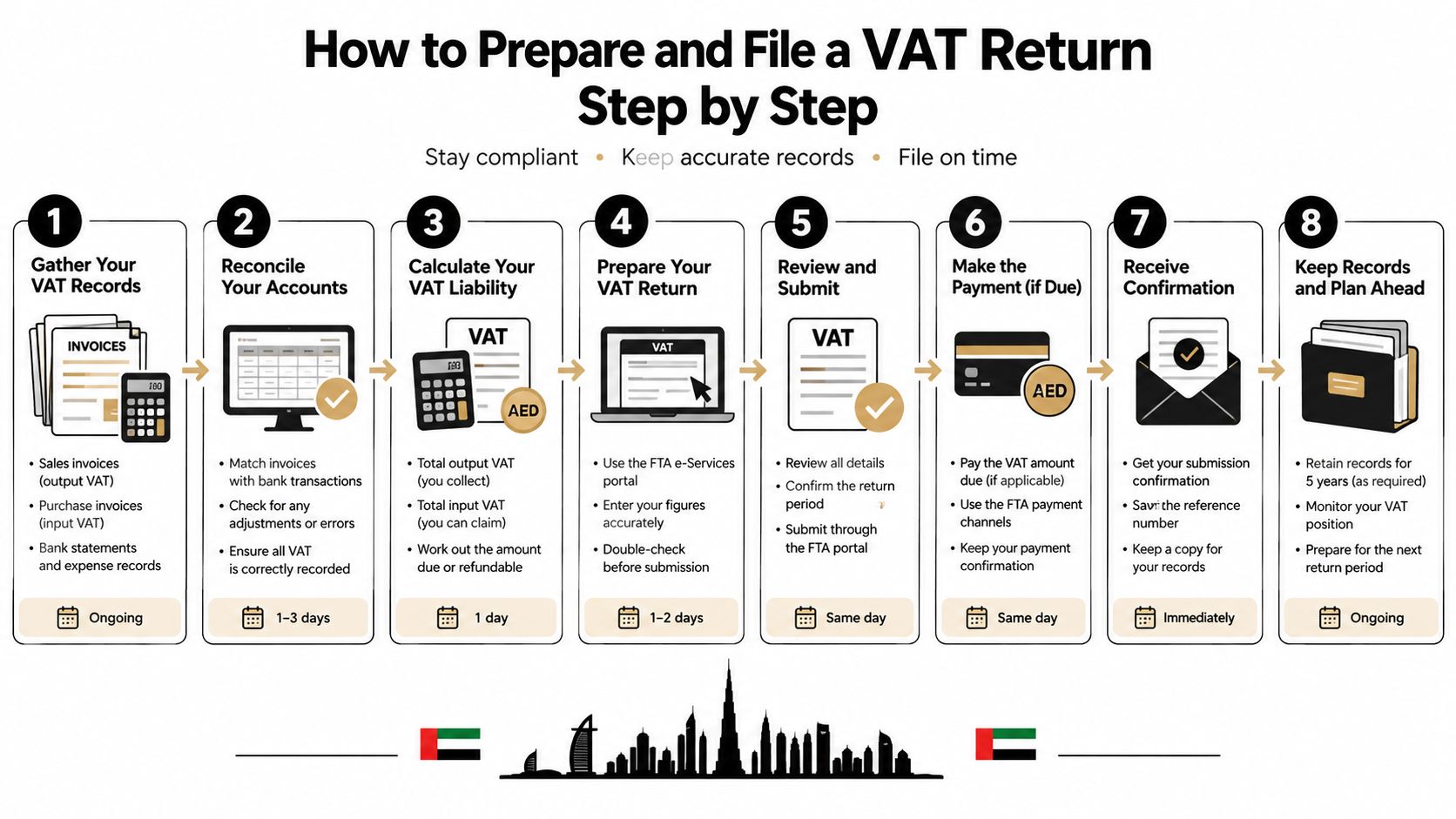
Complete the close before submission
Close the transaction ledgers. Establish the period cut-off, identify missing sales and purchase entries, and review documents posted after the close. Don't assume invoice receipt date always determines the VAT period.
Reconcile output VAT. Match sales records and credit notes to the VAT control account. Check cancellations and adjustments rather than relying solely on the sales report total.
Review recoverable input VAT. Match claims to supplier documents and the recovery assessment. Remove unsupported or non-recoverable amounts from the claim, while retaining a clear exception log.
Check imported transactions. Reconcile overseas-service expenses to reverse-charge workings. Confirm that output accounting and input recovery have each received an explicit treatment.
Resolve unexplained differences. Investigate duplicate entries, manual journals and balances carried from earlier returns. Don't post an unexplained balancing adjustment just to make the report agree.
Obtain independent review. Someone other than the preparer should test unusual transactions, changes in treatment and material movements. Record the questions and their resolution.
Calculate and submit. Agree the return to the approved working papers before entering or uploading the figures in EmaraTax. Save the submission acknowledgement with the final version.
Pay and reconcile settlement. Arrange payment separately from submission, confirm its status and reconcile the settlement to the VAT liability.
Follow the journal logic
Use this illustrative journal pattern to check whether your ledger tells the same story as the return:
| Transaction | Debit | Credit |
|---|---|---|
| Standard-rated sale | Accounts receivable, invoice gross amount | Sales, net amount; output VAT, tax amount |
| Recoverable purchase | Expense or asset, net amount; recoverable input VAT, eligible tax | Accounts payable, invoice gross amount |
| VAT netting | Output VAT control | Recoverable input VAT control; net VAT settlement liability |
| Payment | VAT settlement liability | Bank |
The calculation is output VAT less recoverable input VAT, adjusted for the relevant return items. Keep non-recoverable purchase tax within the appropriate expense or asset treatment rather than leaving it in the recovery account.
A nil payment position still needs this process. Equal output and input balances don't prove that either side is correct, and submission doesn't replace reviewer approval.
Penalties for Late Filing, Late Payment and Missing Records
A business can create a compliance problem without deliberately understating tax. A missed registration review, an unsubmitted nil return or a payment instruction left awaiting approval can each require separate attention.
Don't build a penalty budget from an old blog table. Confirm the current applicable penalty decision and its effective provisions with the FTA or your adviser before relying on a monetary amount. Registration, filing, payment, record retention and invoicing are distinct obligations, so fixing one doesn't automatically resolve the others.
Common UAE VAT penalties and how to avoid them
| Violation | Control that prevents it |
|---|---|
| Late registration | Monthly historical and forward-looking registration review, with a recorded trigger date |
| Late return filing | Filing date set in advance, named submitter and backup access arrangements |
| Late payment | Payment instruction approved before the deadline, followed by status confirmation |
| Failure to keep records | Tax-period folders, retention controls and tested document retrieval |
| Incorrect or missing tax invoice | Approved invoice templates and exception checks before issue |
The prevention work should be more specific than asking the accountant to be careful. Give the finance team separate completion fields for return preparation, approval, submission and payment confirmation.
Respond to the underlying failure
When someone identifies a missed obligation, establish the facts before changing the ledger. Preserve the original calculation, identify affected periods and transactions, and ask the adviser to assess the appropriate correction route.
- Registration issue: Reconstruct when the obligation arose and gather the supporting sales records.
- Return issue: Compare the submitted version with the corrected working papers and document each difference.
- Payment issue: Check the actual payment and account status, not just the bank instruction.
- Evidence issue: Obtain authentic replacement documents or supplier corrections, not internally altered invoices.
Management check: A reminder is effective only when someone confirms completion. Silence after the reminder isn't evidence that the obligation was met.
Review recurring exceptions at management level. If missing supplier documents appear every period, the purchasing process needs fixing. If payment approvals repeatedly arrive late, change the authorisation workflow rather than sending increasingly urgent emails.
Choosing Between In-House, Software and Outsourced VAT Accounting
Outsourcing bookkeeping doesn't transfer the taxable person's responsibility for the underlying transactions. The owner still needs someone inside the business to verify purchases, answer commercial questions and approve the evidence supplied to the accountant.
PwC's explanation of the FTA VAT amendments highlights the importance of verifying the validity and integrity of supplies before deducting input tax, and retaining invoices electronically where required or issued through the UAE e-invoicing system. These aren't problems that an accurate spreadsheet alone can solve.
Comparing VAT accounting models
| Model | Best for | Owner effort each month | Main risk | Cost pattern |
|---|---|---|---|---|
| In-house accountant | High-volume or cross-border businesses | High during oversight and exception resolution | Key-person dependence and missed rule changes | Salary, training and software |
| Accounting software with VAT module | Digital invoices and a capable bookkeeper | Medium | Mis-set tax codes and unverified supplier data | Subscription plus set-up |
| Outsourced VAT-compliant firm | SMEs near registration or with imported-service purchases | Low, with document sign-off | Incomplete source documents supplied by the business | Monthly retainer or per-return fee |
| Software plus outsourced review | Growing SMEs with increasing transaction complexity | Medium | Coordination gaps between systems and advisers | Subscription plus retainer |
Software and people aren't substitutes. Every model needs a ledger, controlled access, document retention and someone capable of making treatment decisions.
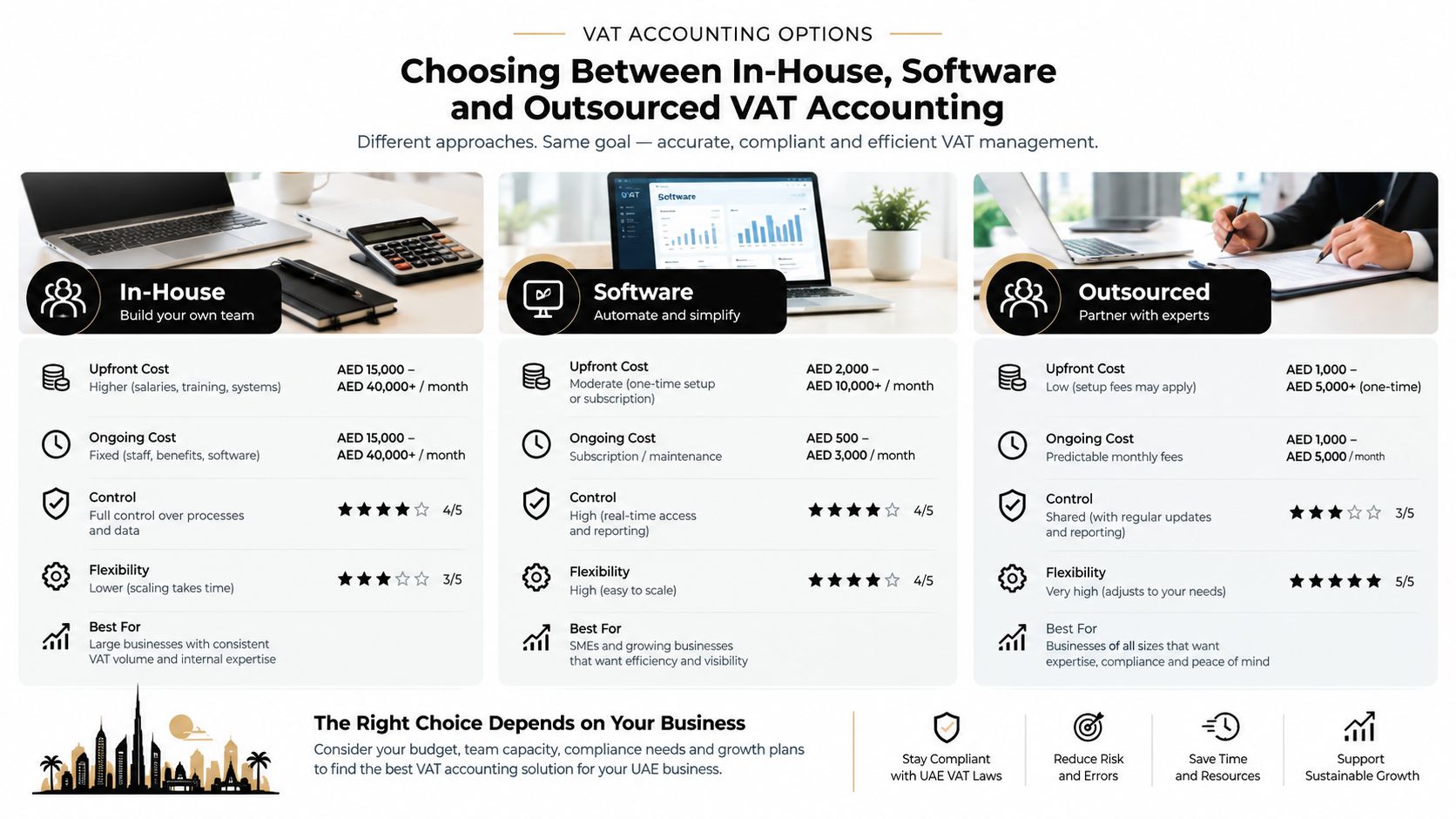
Choose around exceptions, not invoice count alone
An in-house accountant makes sense when operations require frequent decisions and immediate access to commercial staff. Budget for review and cover during absence, not just the salary.
Software-led bookkeeping works when source documents are consistent and the bookkeeper understands VAT treatment. Use the accounting software guide for UAE businesses to assess document attachment, tax-code controls, reverse-charge handling and usable exports before choosing a platform.
Outsourcing suits businesses that need specialist oversight without a full internal finance team. Ask whether the fee includes monthly reconciliation, registration monitoring, query resolution and review, or merely preparation from totals you provide.
A hybrid arrangement often suits a growing SME: internal staff capture transactions promptly, while an external accountant reviews exceptions and the return pack. Define who can alter tax codes and who signs off unresolved items.
Before appointing anyone, request a sample monthly checklist covering vendor verification, credit notes, imported services and electronic record retention. Then ask who owns each task. The useful deliverable isn't just a submitted return, it's a defensible set of books behind it.
Smart Classic Business Hub offers VAT-compliant accounting, bookkeeping and audit support for UAE businesses that need organised ledgers and reliable supporting records. Visit Smart Classic Business Hub to discuss your transaction mix and request a monthly VAT control scope covering reconciliations, document checks and return preparation.