
You've formed the company, paid for the trade licence, and expect the free zone visa to follow automatically. Then the authority asks for an establishment card, immigration registration, an entry permit, a medical test, Emirates ID biometrics, and documents you didn't realise were part of the file.
That confusion is normal because “free zone visa” isn't one product. The free zone sells a business setup and an immigration pathway. The immigration authority issues the residence permit. Your quota, sponsorship, validity, work rights, and renewal obligations sit between those two systems.
What a Free Zone Visa Actually Is in the UAE
A UAE free zone visa is a residence permit supported by a company licensed in a UAE free zone. It gives an eligible founder, partner, employee, or dependant the right to reside in the UAE, subject to the relevant category and immigration approval. It isn't the trade licence itself, and buying a licence doesn't automatically create residency.
The UAE has 40 free zones serving sectors such as retail, agritech, healthcare, financial technology, logistics, media, and information and communications technology, according to the UAE Government's business and residency guidance. Each authority can set its own licensing packages, permitted activities, office requirements, and visa allocation rules within the federal immigration framework.
The three layers founders confuse
First, the trade licence. The free zone authority issues this document. It proves that the company exists and may conduct the activities listed on the licence. It may also determine the immigration package and the number of applications the company can support.
Second, the establishment card. This is the company's immigration identity. Dubai's immigration authority describes it as a card containing the establishment's official information. Without an active establishment card, the company generally can't act as the sponsoring entity for residence applications.
Third, the residence permit. The relevant immigration authority, such as GDRFA Dubai or the federal ICP system, reviews the application and issues the residence status. The permit is connected to the holder's Emirates ID application and depends on completed immigration, medical, identity, and security procedures. The UAE's general residence visa provisions explain why incorporation alone doesn't activate residency.
The sequence that produces the visa
The practical sequence is:
- Incorporate or license the company.
- Register or activate the establishment card.
- Apply for an entry permit or in-country status adjustment.
- Complete medical fitness and security procedures where required.
- Register biometrics and apply for Emirates ID.
- Receive the residence permit.
The free zone may market this as a visa package, but it can't guarantee that every applicant will qualify. Quota, activity, job title, documents, medical fitness, security approval, and immigration status all matter. That distinction controls the rest of the decision. A package may promise an “investor visa”, while the final residence permit still depends on the sponsoring company's active file and the applicant's category.
Practical rule: Treat the licence as the right to operate, the establishment card as the company's immigration access, and the residence permit as your personal right to live in the UAE.
Types of Free Zone Visas You Can Apply For
Founders usually need to choose between an owner or partner route, an employee route, dependant sponsorship, and a qualifying independent residence category. The right choice depends on what you do inside the company, not on which label sounds most attractive.
Investor or partner residence
This route suits a shareholder, partner, or owner whose residence is connected to a licensed free zone company. The authority will assess the company documents, ownership position, establishment status, and available quota. Holding shares doesn't automatically qualify a founder for every long-term residence category.
The ordinary sponsored route is usually the logical starting point when the founder wants residence through the company and doesn't meet the separate requirements for a Green Residence. Sponsored residence permits are commonly issued for one, two, or three years, depending on the category and sponsoring establishment, as set out in the UAE Government's residence rules.
Employee residence
An employee residence application is tied to the free zone company's employment arrangement and available allocation. The file can require a free zone employment contract, salary certification, work authorisation, passport documents, and any supporting qualifications requested by the authority.
Don't confuse residence with unrestricted work rights. A person sponsored by one company normally needs the appropriate work permit and authority approval to work in that arrangement. The UAE guidance on recruiting in free zones also makes clear that visa quotas depend on the package purchased and should be confirmed directly with the relevant free zone.
Dependant residence
A resident may be able to sponsor eligible family members, including a spouse, children, or other supported dependants, subject to the applicable income, accommodation, relationship, and immigration requirements. The dependant's status is separate from the founder's company quota, so family planning should be discussed before purchasing the business package.
A quotation that includes one investor application doesn't necessarily include dependant sponsorship. Ask for a written breakdown of the company's allocation, the founder's application, employee applications, and family applications.
Green Residence
Green Residence is a separate, potentially more flexible route for qualifying high-skilled workers. GDRFA states that the high-skilled-worker category can last five years without requiring a traditional guarantor or employer, but the applicant must hold an approved work permit, work in a level 1, 2, or 3 occupation under the relevant classification, have at least a bachelor's degree or equivalent, and earn at least AED 15,000 per month, according to the official Green Residence service requirements.
| Visa Type | Who It Is For | Key Eligibility | Validity |
|---|---|---|---|
| Investor or partner residence | Shareholders, partners, and eligible founders | Valid company, ownership evidence, active establishment file, available quota | Commonly one, two, or three years for sponsored residence |
| Employee residence | Staff hired through the free zone company | Employment contract, work authorisation, approved role, company quota | Depends on category and sponsor |
| Dependant residence | Eligible family members of a resident sponsor | Relationship evidence, sponsor eligibility, accommodation and income requirements | Depends on the sponsor and category |
| Green Residence | Qualifying high-skilled workers | Approved work permit, eligible occupation, bachelor's degree or equivalent, AED 15,000 monthly salary | Five years for the stated high-skilled route |
Free Zone Visa vs Mainland Visa vs Green Residence
The best route depends on where you need to trade, who controls the sponsorship, and how much renewal administration you can tolerate.
A free zone residence route works well for a focused activity operated through a defined jurisdiction. It can provide a clear setup pathway and foreign ownership structure, but your company's immigration capacity remains connected to its free zone package, establishment file, licensed activity, and authority approvals.
A mainland structure is more appropriate when the business needs broad onshore trading or a wider choice of operating locations. It shouldn't be selected merely because someone describes it as more established. It should be selected because the business model needs mainland access.
Green Residence changes the sponsorship relationship. A qualifying applicant may hold residence without the traditional employer guarantor, but that flexibility comes with personal eligibility requirements. The applicant must prove the approved work arrangement, occupational classification, education, and salary criteria. It isn't a shortcut for every shareholder.
The decision in practical terms
| Dimension | Free Zone Visa | Mainland Visa | Green Residence |
|---|---|---|---|
| Sponsorship | Usually connected to a free zone company | Connected to a mainland employer or company structure | No traditional employer guarantor for the qualifying route |
| Ownership | Suits founders using a free zone company | Suits businesses requiring mainland operations | Depends on the applicant's qualifying status and structure |
| Business mobility | Works within the licensed activity and applicable free zone framework | Better suited to unrestricted mainland trading | Residence flexibility doesn't itself expand the company's licensed activities |
| Quota | Depends on package, workspace, activity, and authority approval | Managed through the mainland company and applicable rules | Not a substitute for company employee quota |
| Renewal friction | Company licence, establishment card, quota, and residence must remain aligned | Employer and immigration file must remain compliant | Applicant must continue meeting category requirements |
| Best fit | Focused activities and founders controlling setup costs | Businesses trading broadly onshore | Skilled professionals who meet the independent eligibility rules |
For a founder comparing jurisdictions, the mainland versus free zone Dubai comparison is useful only if you test it against your actual activity, customers, office needs, and staffing plan.
My verdict: choose a free zone when your activity fits its permitted framework and you want a controlled setup. Choose mainland when unrestricted onshore trading is central to revenue. Consider Green Residence when you meet the eligibility criteria and value reduced dependence on a company sponsor more than a packaged setup.
How to Apply for a Free Zone Visa Step by Step
The visa application is a chain. A missing document at an early stage can stop every later step, so don't treat the entry permit as the finish line.
1. Issue or amend the trade licence
The company first needs an active licence with the relevant activity and an available visa allocation. If you add staff, change activities, or move premises, the authority may need to reassess the company's immigration capacity.
The UAE free zone company registration guidance helps explain the formation side, but formation and residence remain separate processes.
2. Activate the establishment card
The free zone authority submits or supports the establishment-card registration. This creates the company's immigration file and allows it to sponsor eligible applications. An inactive or expired establishment card can block a founder's application even when the trade licence itself appears valid.
3. Apply for an entry permit or status adjustment
An applicant outside the UAE normally uses an entry permit to begin the residence process. Someone already inside the country may use an in-country status adjustment where permitted, avoiding the need to leave and re-enter.
GDRFA states that a work entry visa allows the holder to remain in the country for 60 days from entry, or until the residence requirements are completed. For the high-skilled Green Visa work-entry route, the published fee is AED 200 plus 5% VAT, with an additional AED 500 inside-country fee where applicable, according to GDRFA Dubai's official service information. Those figures apply to the stated route, not every ordinary company-sponsored free zone application.
4. Complete the medical fitness test
Applicants aged 18 or above must complete a medical-fitness examination before residence issuance. Use an authorised centre and take the exact documents requested by the authority. A medical appointment can be wasted if the entry permit, passport copy, or application reference doesn't match the file.
5. Register Emirates ID biometrics
The applicant submits the Emirates ID application and attends biometric registration where required. The residence permit is linked to this identity process, so an incomplete Emirates ID file can delay the final immigration outcome.
6. Receive the residence permit
After the medical, security, identity, and document checks are complete, the authority issues the residence permit. The permit may be digital rather than represented by an old-style passport sticker, depending on the current process, but the legal outcome is still residence status tied to the approved category.
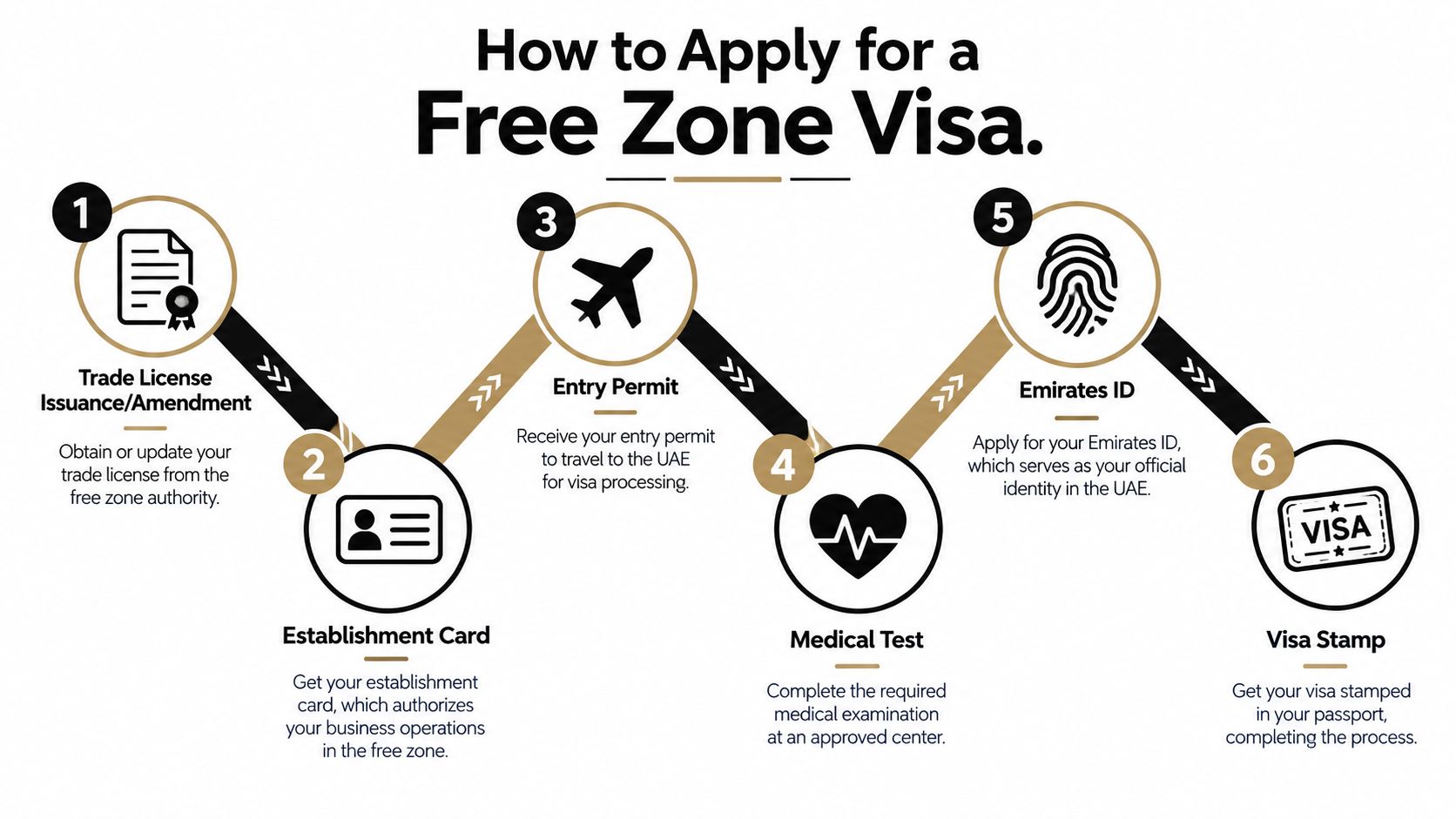
The stages that most often stall are the establishment-card activation, quota confirmation, status adjustment, and document review. Check passport validity, photographs, employment documents, qualifications, ownership papers, and the company's immigration status before filing. A clean application is faster than an urgent correction.
Free Zone Visa Costs You Should Budget For
Don't accept a single headline price without asking what it includes. A free zone visa quotation may combine the licence, establishment card, immigration allocation, government charges, medical procedure, Emirates ID, and professional handling. Those are different cost layers, and they may renew on different schedules.
The verified official fee information does not establish a universal price range for every free zone package. It does confirm the published entry-permit fee for the specified high-skilled Green Visa route, while the wider cost of an ordinary free zone residence application varies by authority, category, quota, and whether the applicant is inside the UAE.
Ask for an itemised quotation
| Cost Item | What to Confirm |
|---|---|
| Trade licence and visa allocation | Whether the package includes the licence, activity, workspace, establishment status, and the stated quota |
| Establishment card | Whether activation and renewal are included or charged separately |
| Entry permit | Whether the quoted amount applies to the selected residence category and to an applicant inside or outside the UAE |
| Medical fitness | Which authorised centre and service level the quotation covers |
| Emirates ID | Whether the application and any delivery or service charges are included |
| Residence issuance | Whether the quoted residence process includes status adjustment, authority charges, and final issuance |
| Professional handling | Whether the adviser is managing document preparation, appointments, corrections, and follow-up |
| Renewal | Which items recur when the licence, establishment card, and residence status reach expiry |
A government fee isn't the same as a free zone fee. The zone controls its licensing package, workspace conditions, quota structure, and administrative charges. The immigration authority controls the residence process and category approval. Ask the provider to label each line as free zone charge, government charge, medical charge, identity charge, or service fee.
The only specific fee stated in the verified material for a defined route is AED 200 plus 5% VAT for the Green Visa high-skilled-worker entry visa, with AED 500 inside-country fee where applicable, as noted in GDRFA's service information. Don't copy that figure into an ordinary investor quotation without checking the category.
Budget for renewal before the first visa is issued. The sponsor remains responsible for keeping the company's immigration status active and renewing eligible residence permits before expiry. A low initial price is poor value if it excludes the establishment card, quota, status adjustment, or renewal administration.
Common Pitfalls That Delay or Block a Free Zone Visa
A trade licence proves that the company is licensed. It doesn't prove that the company has an available visa slot, an active immigration file, or an approved applicant.
Quota mismatch
The company may have purchased a package with limited immigration capacity, while the founder plans to sponsor several employees and dependants. The fix is simple in principle. Confirm the permitted quota, workspace condition, activity restrictions, and any increase process before signing the package.
Don't rely on a sales description such as “investor visa included”. Ask whether that means an application slot, an establishment-card allocation, or an issued residence permit.
Incomplete or inconsistent documents
Missing qualifications, unclear passport scans, inconsistent names, expired documents, or an employment contract that doesn't match the company activity can stop the file at review. Prepare one controlled document set and use the same spelling across the licence, passport, application, contract, and Emirates ID record.
The quietest delay usually starts before submission. Reviewers can only approve the file they receive, not the information the founder intended to provide.
Medical and security checks
Applicants aged 18 or above must complete medical fitness procedures, and residence issuance also depends on security checks. Don't treat these as administrative formalities. A failed or referred result can require clarification, additional documentation, or a different immigration decision.
Disclose relevant information accurately and use an authorised testing centre. Never book the final travel or employment plan around an unapproved application.
Wrong entry or status route
An applicant already inside the UAE may need an in-country status adjustment, while an applicant outside the country generally follows an entry-permit route. Filing the wrong route can force cancellation and reapplication.
Give the free zone or immigration adviser the applicant's exact location and current visa status before the entry permit is submitted. This is particularly important when the applicant is changing from another residence category.
Assuming the visa survives a company problem
The sponsor must maintain a valid establishment and immigration status. Unpaid obligations, an expired licence, a cancelled employment relationship, or an unclosed previous file can create problems for a new application or renewal.
Use a written compliance calendar. Track licence renewal, establishment-card renewal, residence expiry, Emirates ID expiry, employment changes, and dependant status separately.
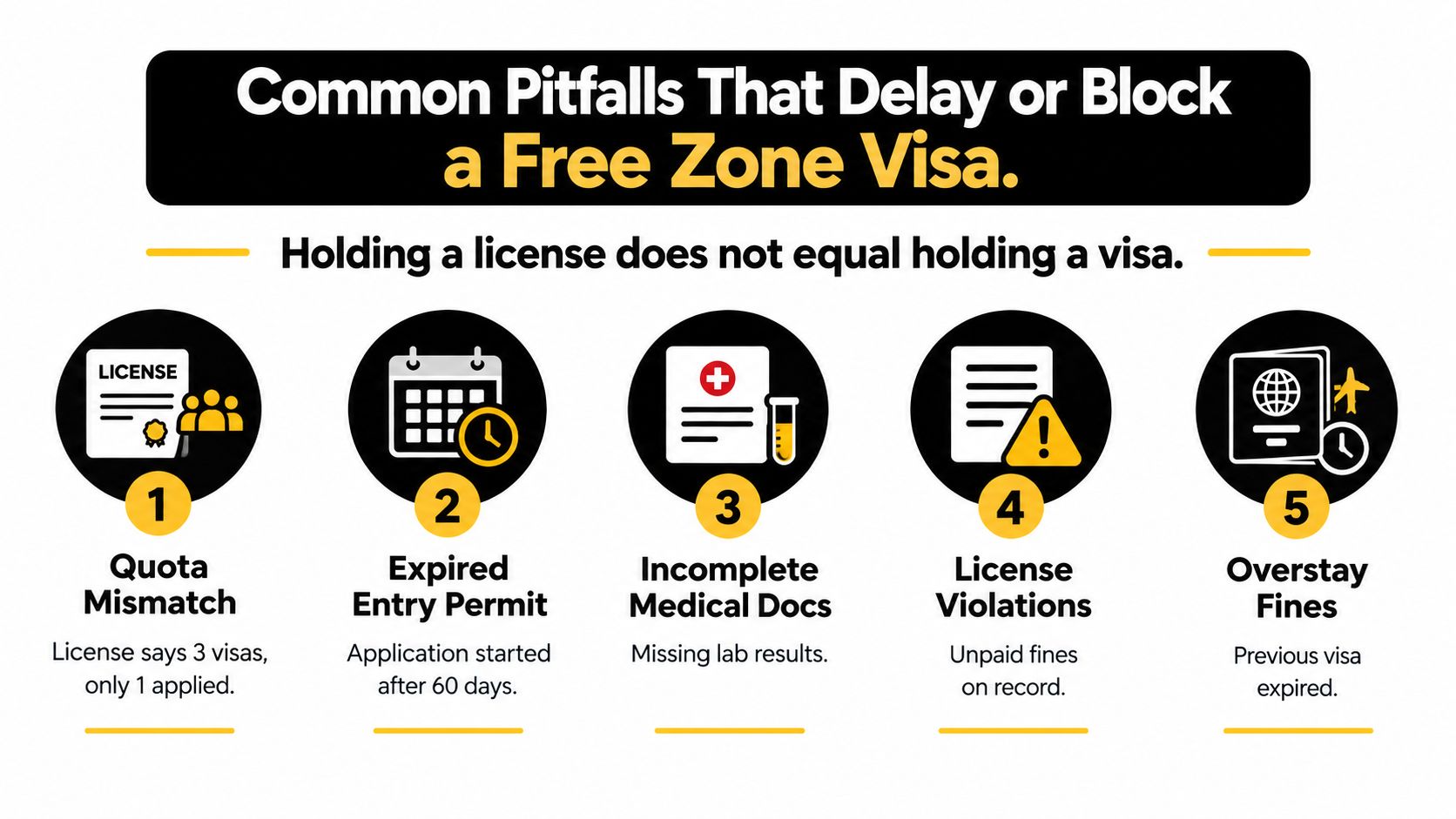
The practical protection is pre-checking. Verify quota, company status, applicant location, passport documents, qualifications, job role, contract, medical requirements, and prior immigration records before paying for the next stage.
Renewals, Cancellations, and How Smart Classic Helps
Renewal is where founders discover that the licence and the visa are separate obligations. Renewing the company doesn't automatically renew every residence permit, and renewing a residence permit doesn't renew the company's licence or establishment card.
Start the review before expiry. The residence and Emirates ID process can require updated documents, medical fitness, biometrics, authority approval, and confirmation that the sponsor remains eligible. The UAE residence visa renewal guidance should be checked alongside the specific free zone's current procedures.
Keep three renewal dates
Maintain separate records for:
- Company licence renewal, which keeps the business authorised to operate.
- Establishment-card renewal or amendment, which keeps the company's immigration file usable.
- Residence and Emirates ID renewal, which keeps the individual's status active.
A founder who tracks only the residence expiry can still face a blocked renewal if the company file or quota isn't valid. A founder who renews only the licence can leave employees or family members exposed to immigration penalties.
Cancellation is a formal process
When a shareholder exits, an employee leaves, or the company closes, the related residence status must be cancelled through the proper authority. Don't assume that cancelling an employment relationship closes the immigration file.
Settle outstanding obligations, coordinate with the free zone and immigration office, and obtain confirmation of cancellation. Leaving a visa open can create problems with future applications, status changes, and company closure. PRO coordination matters because the sponsor is usually responsible for the file.
A business setup adviser can manage the document checklist, monitor quota headroom, prepare establishment-card amendments, coordinate medical and Emirates ID stages, and communicate with the free zone and immigration authority. Smart Classic Business Hub provides free zone formation, investor visa assistance, PRO support, and ongoing compliance services, so its role can extend beyond the initial application into renewals and cancellations.
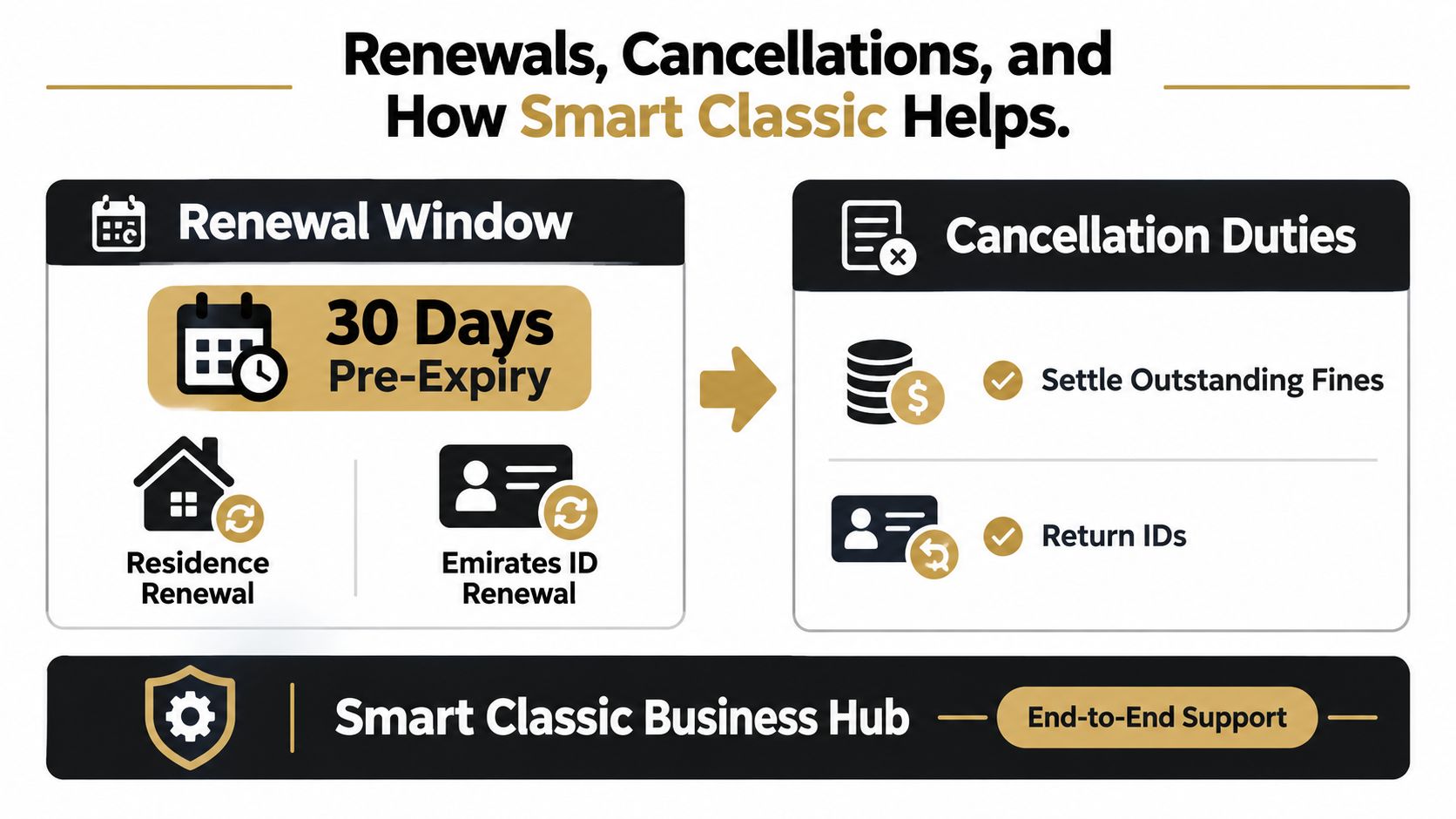
The right decision still comes down to four questions: Who owns the company? Where will it trade? What immigration quota does it need? Who will manage renewal and cancellation? If the free zone matches the activity and the company can maintain its immigration file, the route is practical. If the business needs broad mainland mobility, choose a structure that supports that reality. If the founder qualifies independently for Green Residence, compare the personal eligibility burden against the convenience of company sponsorship.
Smart Classic Business Hub can review your free zone activity, quota, establishment-card status, applicant documents, and renewal obligations before you commit to a package. Visit Smart Classic Business Hub to discuss the right residence route and have the application, renewal, or cancellation process managed through one point of contact.