
A founder calls at 9:15 on a Sunday morning because the company's Dubai trade licence expired overnight. The owner assumed the Department of Economy and Tourism, DET, would send a reminder, then discovered that the tenancy record needed updating and a regulated activity approval had also lapsed. The renewal itself wasn't complicated. The preparation was missing.
That distinction matters. Dubai trade licence renewal is an annual compliance requirement, and Dubai authorities expect businesses to renew on time to maintain legal standing and avoid operational interruption. For a mainland company, the practical question isn't only how to renew trade license in Dubai. It's whether your Ejari, company records, activity approvals, and payment file are ready before you press the renewal button.
Treat the process as a 30-day readiness window, not a single transaction. That approach gives you time to correct the issues that most often block an otherwise routine renewal.
Why Most Dubai Renewals Go Sideways Before They Begin
A company can have enough funds, an active business, and an available owner, yet still hit a renewal block because the records behind the licence no longer match. The portal checks more than the expiry date. It compares tenancy information, company details, activities, and required approvals before allowing the transaction to finish.
Start with the licence record. Check the expiry date, licence number, legal form, registered address, trade name, partners, manager, and listed activities. Compare each item with the company's current position. A departed partner, an activity added without a formal amendment, or a changed trade name can turn a routine renewal into an amendment application.
Complete the three pre-flight checks
Confirm the expiry date. Use the current trade licence and the official licensing record, not an old PDF saved in an email. Dubai mainland renewals are handled by DET, and the Invest in Dubai service supports online submission through the emirate's business portal. Renewal is also available through online channels, SMS to 6969, or registered service centres, as stated in the official Dubai licence renewal guidance.
Verify the Ejari or tenancy record. The Ejari must be active and match the company's registered address and details. If the office has moved, the lease has changed, or the tenancy record is close to expiry, correct it before opening the licence application. An expired or mismatched Ejari is a common reason for portal rejection.
Reconcile the company record. Compare the trade name, partners, manager details, legal form, and activity codes with the documents you will submit. A shareholder change, premises move, or new service may require an amendment before renewal. Do not use renewal to cover an inaccurate record.
Practical rule: Renewal extends an accurate licence. It does not repair an outdated company record.
The timing matters because several corrections depend on other parties. A landlord may need to update the tenancy record, a partner may need to provide a current document, and a regulator may need to issue an approval or NOC. Use the 30-day window to clear landlord, partner, and regulator dependencies before opening the portal. This sequencing is what separates a smooth renewal from a late service-centre visit and an avoidable interruption.
Renewing a Dubai Mainland Trade Licence Step by Step
A mainland renewal can move from login to licence quickly, or stall before payment. The difference is usually the order of checks: confirm the company record, test the tenancy evidence, clear activity approvals, then submit. Treat the period before expiry as a readiness window, not a single portal transaction.
Prepare the file before logging in
Start with the current trade licence, renewed Ejari or accepted tenancy record, partner and manager documents where requested, and approvals tied to regulated activities. The Invest in Dubai portal and Dubai Now app are practical digital starting points. DET remains the authority for issuing and renewing Dubai mainland trade licences.
Log in with UAE Pass, select the licensed company, and open the renewal service. Check the displayed legal form, trade name, activity list, partners, manager, address, and expiry information against your records. A change made internally does not automatically update the portal. If any field is wrong, stop and correct the company record before submitting.
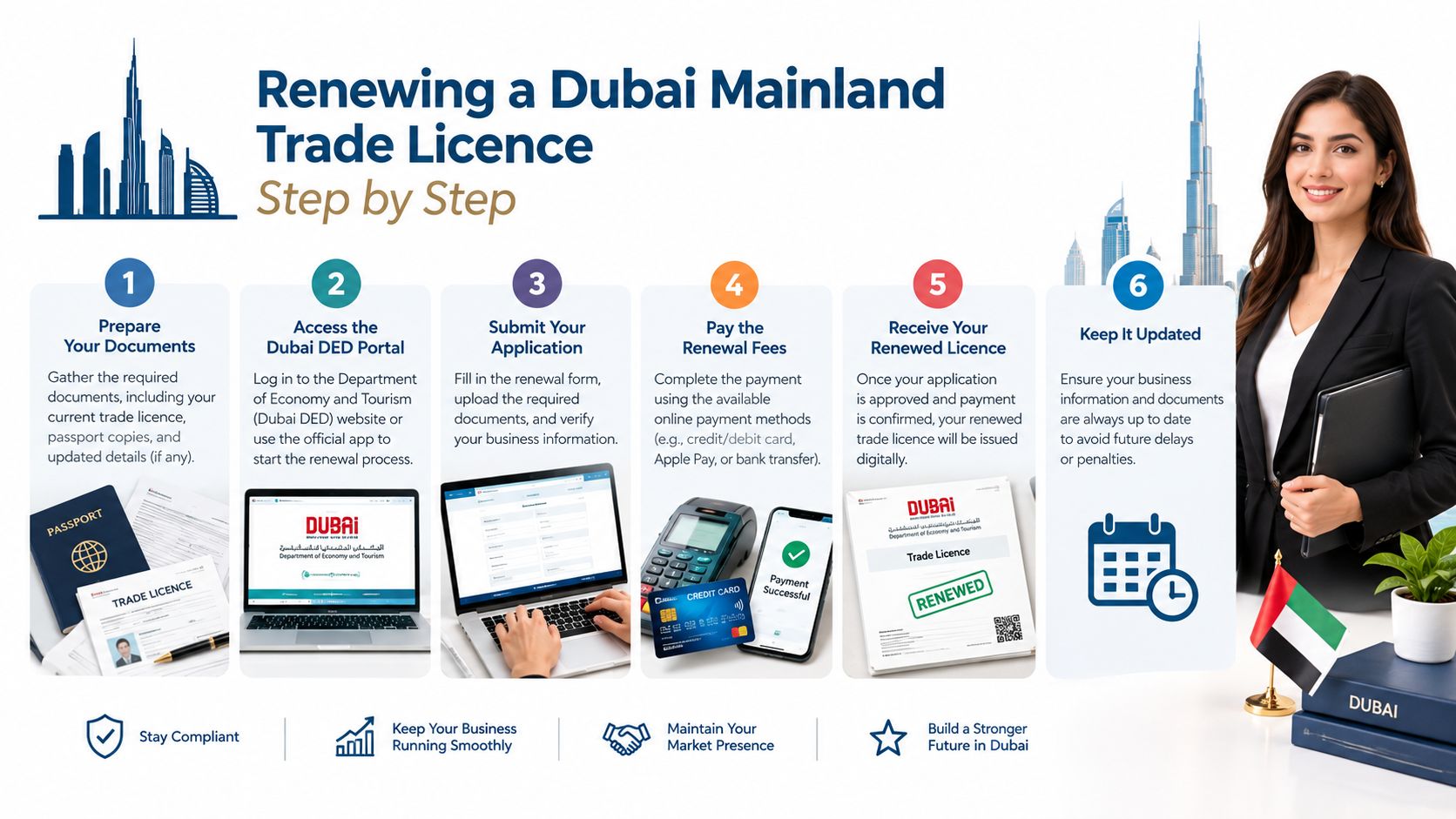
Submit, clear approvals, and pay
Upload the Ejari or tenancy document when the system requests it. Check the external approvals tile rather than treating it as a routine payment step. A regulated activity may require a current approval or NOC from another authority before DET can issue the renewed licence.
For a straightforward file, the portal generates a payment voucher after reviewing the information and documents. The statutory line items appear on the voucher for review before payment. Confirm the company name, licence period, activity details, and amount, then save the receipt and download the renewed licence PDF after issuance.
Activity-related applications may receive an approval or rejection through some government service paths within 3 to 15 days. A clean file can proceed to payment and issuance after the voucher appears. If the portal fails, use a registered DET service centre. A typing or Tasheel counter can submit documents, but it cannot correct an expired Ejari or supply a missing approval.
Use Goodhand mainland license renewal for a practical overview of the mainland workflow and supporting documents. For the transaction itself, follow the requirements shown in DET and Invest in Dubai channels. Record the renewal date and start the next Ejari and approval checks before the licence approaches expiry.
How Free Zone Renewals Differ From the Mainland Path
A free zone renewal can go smoothly when the zone account, lease evidence, approvals, and corporate documents are ready before expiry. It can also stall even when the business has no operational changes. Each free zone operates its own portal, lease process, document rules, and fee schedule. DMCC, JAFZA, Dubai Airport Freezone, RAKEZ, Sharjah Publishing City, and other authorities can request different documents for similar activities.
Start the readiness check around 30 days before expiry. Confirm the zone lease, flexi-desk arrangement, or facility record in the authority's system. A mainland company usually relies on an Ejari-linked tenancy record, while a free zone company may need evidence issued or recognised by that zone. Uploading a mainland tenancy document to a free zone portal will not satisfy a zone-specific property check.
Review the activity and immigration file at the same time. Some free zones require an activity approval, NOC, or updated corporate document before renewal can proceed. Visa services may sit in the same account as the licence renewal or use a separate workflow. Treat those as separate checks, not as automatic parts of one payment.
Mainland and free zone renewal at a glance
| Step | Mainland, DET | DMCC | JAFZA/DAFZ | RAKEZ/Other |
|---|---|---|---|---|
| Primary portal | Invest in Dubai or DET channels | DMCC member portal | Authority-specific portal | Authority-specific portal |
| Premises evidence | Ejari or accepted tenancy record | Zone lease or facility record | Zone lease or facility record | Lease, flexi-desk, or authority-approved premises |
| Activity approvals | External approvals where required | DMCC or regulator approvals where applicable | Authority and activity approvals where applicable | Zone and activity approvals where applicable |
| Payment structure | DET charges plus applicable statutory line items | DMCC tariff and service charges | JAFZA or DAFZ tariff | Authority-specific tariff |
| Visa workflow | May connect with wider government services | Authority-specific | May be separated by service | Depends on the authority |
| Document sensitivity | Partner, activity, tenancy, and approval records | Corporate documents and zone records | Lease and corporate records | May require original or attested corporate documents, including share certificates or board resolutions |
JAFZA published guidance states that licences renew yearly, with an option of up to 3 years for customers holding plot leases. Do not apply that exception to every free zone or every JAFZA customer. Confirm the available term with the authority before preparing payment.
Document form can decide whether a file moves forward. DMCC may focus on corporate and zone records, while RAKEZ or another authority may request original or attested share certificates, board resolutions, or other corporate papers. Check the authority's current checklist during the 30-day window.
For general context on free zone licensing, use this free zone trade license guide. The Dubai Development Authority licence renewal guidance is a separate reference for the relevant authority's renewal requirements, not a substitute for JAFZA, DMCC, or RAKEZ instructions.
What Renewal Actually Costs and What Delay Adds
A founder can arrive at the portal with the renewal fee ready and still face a higher invoice. Mainland renewal may combine DET charges, market fees, Ejari renewal, activity-specific requirements, and service handling. One 2026 estimate places a typical SME mainland renewal total at AED 8,000 to AED 15,000, although the licence and premises determine the final amount, as outlined in this 2026 Dubai trade licence cost analysis.
Build the budget around the complete transaction. Allow for recurring Knowledge Dirham and Innovation Dirham charges, tenancy renewal, external approvals, and service-centre or typing support. Free zone companies should request a current statement from their authority because bundled services and base fees differ. For a comparative breakdown of mainland fee components, see this guide by Explorer Computer LLC.
Renewal costs versus delay penalties at a glance
| Cost component | On-time renewal, AED | 30 days late | 60 days late | 90 days late |
|---|---|---|---|---|
| Renewal and related charges | Authority and file dependent | Authority and file dependent | Authority and file dependent | Authority and file dependent |
| Late renewal penalty | None if completed on time | May apply under the relevant schedule | May apply under the relevant schedule | May apply under the relevant schedule |
| Mainland late penalty example | AED 0 | AED 250 per month of delay | AED 250 per month of delay | AED 250 per month of delay |
| Operating with an expired licence | Not applicable | Separate administrative exposure may apply | Separate administrative exposure may apply | Separate administrative exposure may apply |
| Free zone treatment | Authority tariff | Authority tariff | Authority tariff | Possible escalation or termination risk |
Dubai mainland guidance reports a late renewal fine of AED 250 per month beyond the relevant grace period, according to this Dubai trade licence renewal penalty guidance. The same guidance states that operating with an expired licence can trigger an AED 5,000 administrative fine. Continuing after administrative closure can lead to a further AED 10,000 fine, under the same guidance. A four-month delay would therefore add AED 1,000 in late penalties alone, before other charges or approvals.
Free zone penalties follow each authority's published rules. DMCC's revised schedule lists AED 0 for a licence expired 0 to 30 days, AED 2,500 for 31 to 60 days, and AED 5,000 for 61 to 90 days. A licence beyond 90 days may be terminated by the authority, as explained in the DMCC revised late renewal penalty schedule.
Dubai also announced an AED 1 billion economic support package on 30 March 2026, including a deferral of certain mainland trade licence fees for three months starting 1 April 2026, as reported in the current cost guidance. Temporary relief can change the payable amount, so check the live authority announcement rather than rely on an old fee table. For wider budget planning, compare the fee components in this Dubai trade licence cost guide, then confirm the amount shown in the official portal.
Five Traps That Stall a Dubai Trade Licence Renewal
A renewal can stall even when the company has operated without issues for years. The portal flags a problem, but the reason often sits in the tenancy record, ownership file, activity approvals, or payment setup. These are the checks I make first when a founder says, “The renewal won't go through.”
1. The Ejari is expired or mismatched
Symptom: The system rejects the tenancy document or blocks final submission.
Root cause: The Ejari has expired, the address differs from the licence, or the tenant and company details do not match.
Fix: Renew or correct the tenancy record before starting the licence application. Give the official system time to reflect the updated information, then submit again. Re-uploading the same incorrect document will not solve the issue.
2. Partner records are outdated
Symptom: The portal displays an old partner, manager, or shareholder structure.
Root cause: A transfer, addition, resignation, or document change was never formally recorded or attested.
Fix: Complete the required amendment before standard renewal. If a partner is outside the UAE, arrange the required authorisations and current identity documents early. An internal shareholder agreement does not replace the authority's official record.
3. An external approval is pending
Symptom: An external approvals tile appears, or the application stays under review.
Root cause: A regulated activity requires a current NOC or approval from another authority, and the portal may not retrieve it automatically.
Fix: Identify the regulator, renew the approval, and attach it to the licence file. For regulated businesses, renewal follows a clearance sequence. Treat the approval as a separate task within the pre-expiry readiness window, not as a payment-stage detail.
4. The activity or trade name no longer fits
Symptom: The business operates differently from the activity code or trade name printed on the licence.
Root cause: The company changed its offer but did not complete the formal amendment.
Fix: Compare invoices, contracts, website services, and licence activities. Where they no longer align, ask DET or the relevant free zone whether an amendment must come before renewal. Do this before paying, because a successful payment does not correct an inaccurate licence record.
5. Payment fails at the last screen
Symptom: The voucher is generated, but payment is declined or remains incomplete.
Root cause: An expired card, insufficient balance, an unapproved transaction, or a missed statutory fee line can interrupt payment.
Fix: Review the full voucher, including all statutory line items shown on it. Use a payment method that can cover the full amount, then save the receipt and application reference immediately. A clean payment record makes any portal follow-up much easier.
Your 30-Day Renewal Readiness Checklist
The countdown starts 30 calendar days before expiry. That gives the owner, PRO, accountant, landlord, and regulators a clear operating window instead of a last-minute scramble.
Days 30 to 21
Pull the current licence and verify the expiry date, legal form, trade name, shareholders, manager, registered address, and activity codes. Gather recent amendments and compare them with the authority record. If the company's reality and the licence differ, decide whether an amendment needs to come first.
Days 20 to 15
Mainland businesses should confirm that the office lease and Ejari remain active and correctly connected to the company. If the tenancy needs renewal or correction, handle it now. At the same time, identify any NOCs or external approvals required for the business activity, including approvals from sector regulators where applicable.
Days 14 to 10
Open the correct service channel. Use Invest in Dubai or the applicable DET route for mainland companies, and use the relevant free zone portal for free zone entities. Sign in, select the company, inspect the displayed information, and prepare the documents for upload. If the system presents an external approvals tile, don't bypass it. Resolve the approval requirement before payment.
Days 9 to 5
Submit the application, review the voucher, and pay all listed charges. Save the receipt and application reference in a compliance folder. If the application is rejected, read the reason carefully and fix the record behind the rejection rather than submitting an unchanged file.
Days 4 to 1
Check the transaction status and download the renewed PDF once issued. Send it to the accountant, bank, visa or PRO team, and any counterparties that require current corporate documents. Owners who prefer a managed process can also review corporate PRO services in Dubai when the renewal involves amendments, approvals, or several linked government transactions.
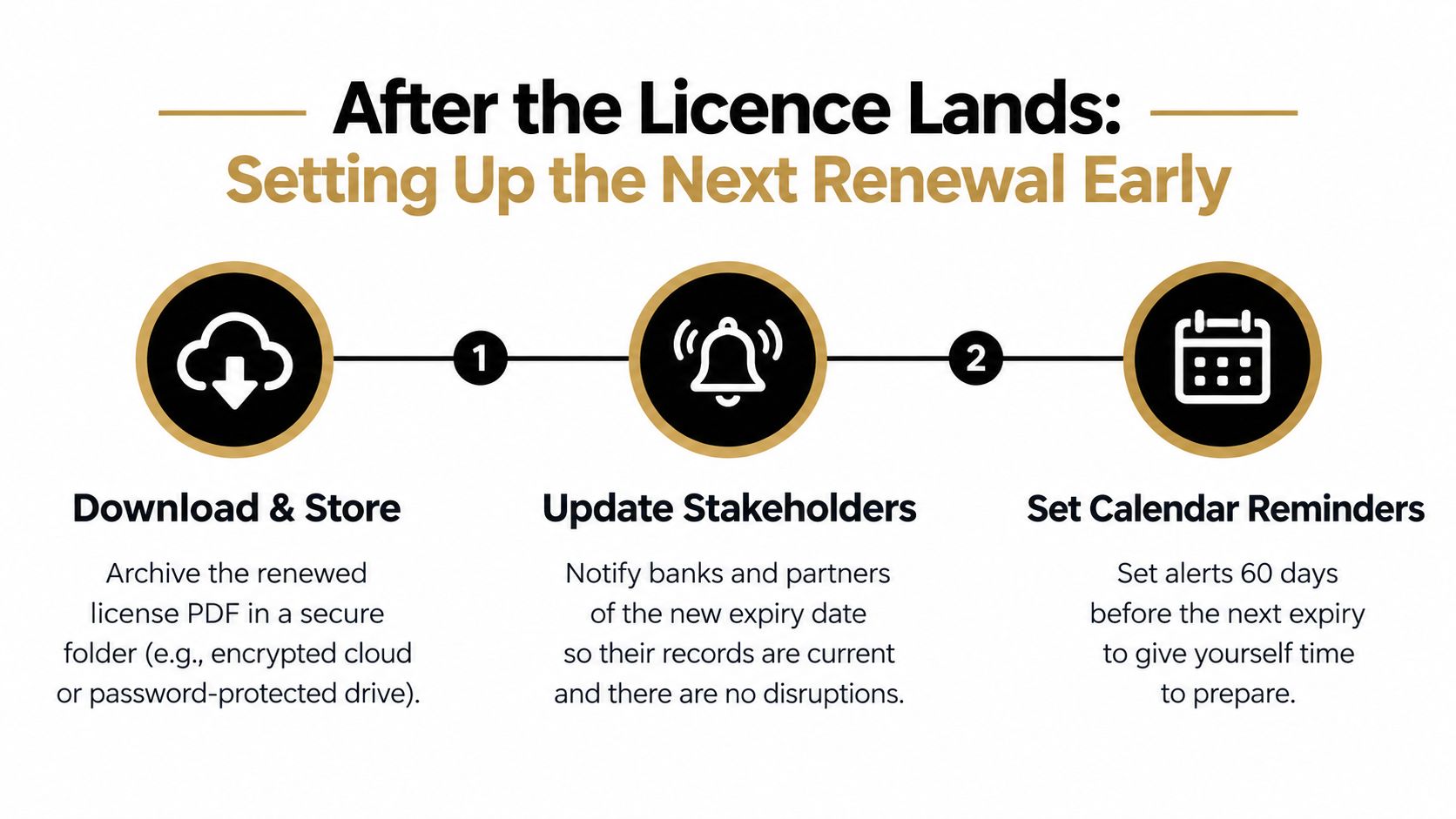
Print this checklist and assign each line to a named person. “The company will handle it” isn't an owner. Put the founder, PRO, finance lead, or administrator beside each task, with a deadline and evidence of completion.
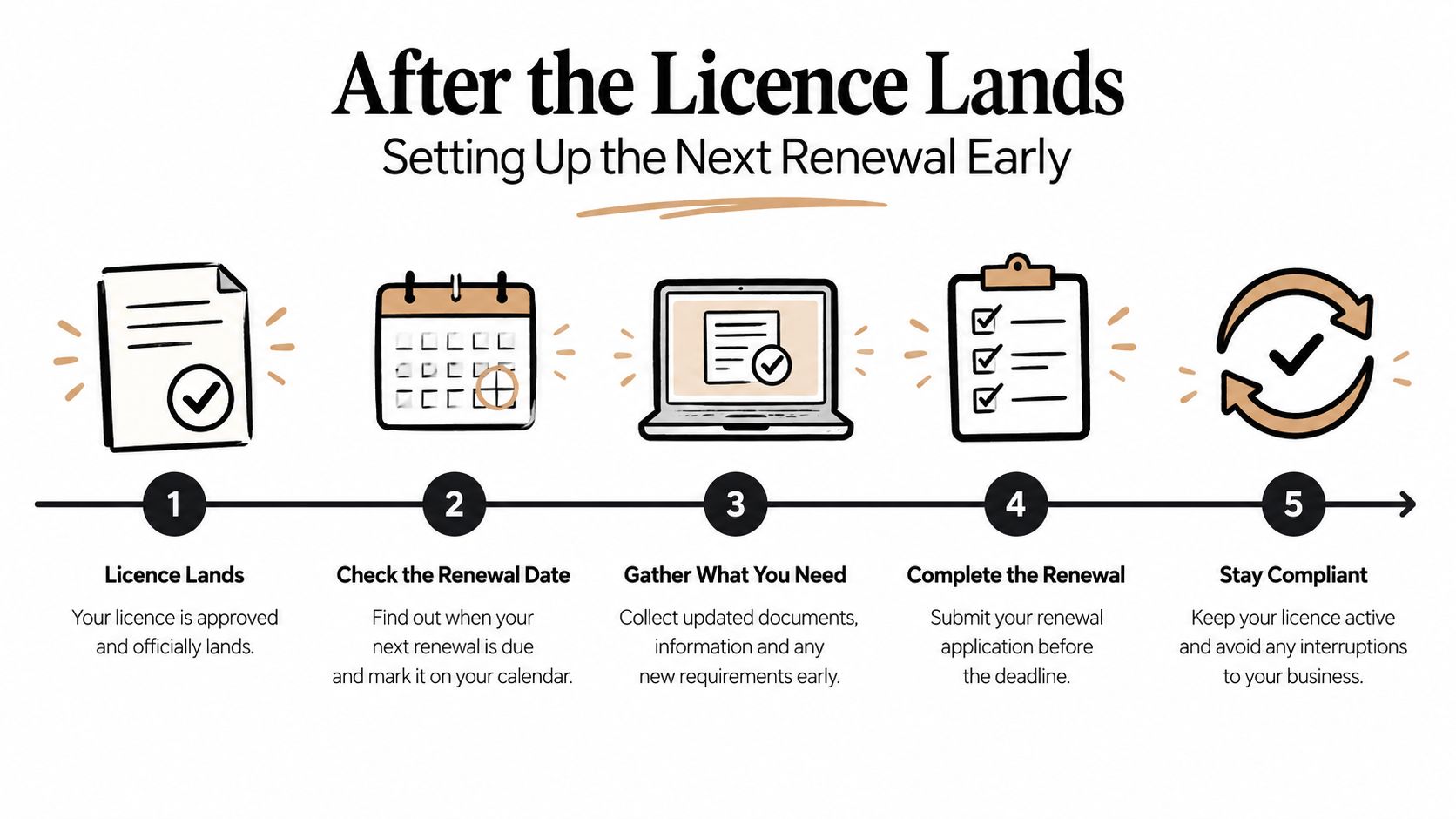
After the Licence Lands Setting Up the Next Renewal Early
The renewed PDF closes one transaction and opens the next compliance cycle. The first task is simple: download the licence, name the file clearly, and store it beside the previous version in a secure company folder. Keep the payment receipt, approval documents, tenancy record, and amendment paperwork in the same location so the next renewal starts with a complete file.
Then update every place that relies on the licence expiry date. That usually includes invoicing templates, bank KYC records, tenancy files, supplier onboarding records, insurance documents, and any external authority account where the licence number is registered. Give the updated PDF to the accountant so VAT-compliant records and corporate tax work use the correct company reference.
Map the dependencies around the licence
Your trade licence isn't the only document with a deadline. Create a separate register for:
- Tenancy and Ejari: Record the lease and Ejari status alongside the licence.
- Sector approvals: Track Civil Defence, Dubai Municipality, RTA, DHA, health, education, or other activity-related approvals where relevant.
- Corporate records: Note shareholder, manager, board resolution, and authority documents that may need updating.
- Operational registrations: Review bank, chamber, immigration, insurance, and supplier records that depend on current company documents.
Assign each dependency to a person, not a shared inbox. A named owner can chase a landlord, regulator, or service centre. A generic reminder usually waits until the problem becomes urgent.
Set the next cycle before this one fades
Create calendar reminders at 75, 60, and 30 days before the next expiry date. The first reminder should trigger a document review, the second should confirm Ejari and approvals, and the final one should verify submission and payment readiness. This turns renewal into a repeatable operating rhythm instead of an annual emergency.
If your licence expires soon, check the Ejari first, then reconcile the company record and activity approvals before opening the portal. Smart Classic Business Hub can review documents, submit the renewal application, and handle final payment for Dubai businesses that want the process managed. Visit Smart Classic Business Hub to discuss your renewal file and set up the next compliance cycle before the deadline becomes a problem.