
You usually realise you need VAT accounting in the UAE a bit later than you should. Sales are moving, invoices are going out, suppliers are being paid, and someone says, “We crossed the threshold last month, didn't we?” At that point, most businesses don't have a tax problem yet. They have a records problem.
That distinction matters. VAT rarely goes wrong because the return form is difficult. It goes wrong because the bookkeeping underneath it was never built for VAT in the first place. Sales were posted without proper tax codes, supplier invoices were saved as photos in WhatsApp chats, import costs weren't tied back to purchase entries, and no one checked whether the business should have registered earlier.
In the UAE, VAT accounting services are useful long before a filing deadline arrives. They sit between commercial activity and tax compliance. If the books are organised properly, filing is routine. If they aren't, every quarter becomes a clean-up exercise, and every clean-up exercise increases the chance of error, missed recovery, or avoidable penalties.
When a UAE Business First Needs VAT Accounting
A UAE business first needs VAT accounting when turnover is approaching the mandatory registration line, not when the owner finally logs into EmaraTax. Under the Federal Tax Authority rules, a business must register for VAT when taxable supplies and imports exceed AED 375,000 in the previous 12 months or are expected to exceed that amount in the next 30 days, while voluntary registration is available above AED 187,500 through the FTA VAT registration rules.
That trigger catches more founders than they expect. They watch cash in the bank, not rolling taxable turnover. The result is familiar: revenue grows, registration is delayed, and the accountant is called only after invoices have already been issued without a VAT structure behind them.
Start with diagnosis, not portal access
The first useful piece of work isn't form filling. It's a diagnostic review of what the business is selling and buying.
That review usually covers:
- Sales mix: Whether supplies are standard-rated, zero-rated, exempt, or affected by reverse-charge treatment.
- Cross-border exposure: Whether imported services, goods movements, or overseas vendors create VAT entries the bookkeeper hasn't been posting correctly.
- Input tax position: Whether costs are likely to be recoverable, partly recoverable, or blocked.
- Source documents: Whether invoices, credit notes, customs papers, and supplier records are being stored in a way that can support a return.
A lot of founders understand the threshold issue from other systems before they understand the UAE one. A simple comparative explainer like GST registration requirements from Nexist is useful because it shows the same operational truth across tax systems: registration is only one step, and record design matters just as much.
For a UAE-specific explanation of the trigger point, the VAT registration threshold in the UAE is the point most SMEs need to track continuously.
The real sequence that works
The cleanest sequence is straightforward:
- Forecast taxable turnover across a rolling 12-month view.
- Brief a VAT adviser or accountant before registration is due.
- Register on EmaraTax with the right supporting data.
- Reconfigure the accounting system so tax codes, invoice sequencing, supplier TRN details, and place-of-supply fields are captured properly.
- Close the first tax period cleanly with reconciled books.
- File from reconciled ledgers, not from rough spreadsheets.
Practical rule: If the books are still being “fixed later”, VAT registration has already started too late.
Retroactive registration is common. It's also expensive in time and attention. Once a business has to reconstruct prior periods, the work stops being ordinary bookkeeping and turns into forensic recovery of invoices, revenue dates, and tax treatment decisions that should have been made at the time of sale.
What VAT Accounting Services Actually Cover
Most owners hear “VAT accounting” and think of one job: filing the return. In practice, proper VAT accounting services sit in four layers. Each layer feeds the next one, and if the first layer is weak, the later work becomes slower, costlier, and less reliable.
Layer one means disciplined bookkeeping
The bottom layer is ordinary bookkeeping done with VAT in mind. That means sales and purchase entries are posted with the correct tax treatment at transaction level, not corrected in a rush at quarter end.
A competent team should be doing all of the following as routine work:
- Recording sales properly: Invoice date, customer, tax code, gross and net values, and any zero-rated or exempt treatment.
- Reviewing purchases carefully: Supplier details, invoice validity, recoverability, and whether the expense belongs in the business at all.
- Reconciling to bank and POS records: Because VAT returns built from unreconciled ledgers usually contain hidden omissions or duplicates.
A plain-language primer like Zynthoro on VAT for SMEs is helpful for founders because it explains why VAT isn't just a tax form issue. It's an accounting classification issue first.
Layer two is VAT-specific accounting
Many general bookkeepers start to struggle here. VAT-specific accounting goes beyond posting invoices. It involves maintaining the VAT ledger, separating input tax into recoverable and non-recoverable buckets, and tracking transactions that need special handling.
Common examples include imported services, staff-related expenses, mixed-use costs, and supplies that don't fit a simple domestic sale pattern. If those items are posted loosely, the return may still be filed, but it won't be defensible.
A return can be submitted on time and still be weak. Timing doesn't cure poor ledger quality.
Layer three is filing and payment control
The filing layer includes preparation of the VAT 201 return, reconciliation back to the general ledger, review of unusual balances, and submission through EmaraTax. It also includes payment planning.
In the UAE, filing work is part tax and part project management. Someone has to make sure the books are closed, the schedules match, management questions are answered, and the payment is made by the deadline. Businesses often underestimate the payment side. Filing on time doesn't solve a cash planning problem if the VAT payable wasn't anticipated.
Layer four covers advisory and assurance
The final layer is what businesses usually need after they've already had a problem once. This includes health checks, Voluntary Disclosure support, audit preparation, and advice on more technical areas such as related-party transactions, group structures, or cross-border services.
Most UAE firms package these layers into a monthly arrangement rather than pricing every action separately. That's sensible. In VAT work, effort follows transaction count, document quality, and complexity of treatment, not revenue alone. A low-margin distributor with messy imports can require more VAT work than a higher-revenue consultancy with clean invoicing and few suppliers.
Core Service Lines Explained
A UAE VAT practice usually touches a client in a predictable order. Registration comes first for some businesses, but for others the first assignment is a backlog review because the company has already been trading and the books aren't aligned. Either way, the core service lines are fairly consistent.
Registration and setup
VAT registration work includes assessing whether the business should register, preparing the EmaraTax application, gathering supporting documents, and making sure the accounting records will support the first return once the TRN is issued.
For some groups, the technical question isn't whether to register. It's how the registration should sit with the legal structure, branches, related entities, or special transaction flows. Good registration work ends with more than a certificate. It should also leave the client with ledgers, tax codes, and invoice procedures that match the registration position.
Bookkeeping and VAT posting
This is the engine room. It includes coding customer invoices, posting supplier bills, validating key supplier details, reconciling bank movements, reviewing POS or marketplace reports where relevant, and maintaining a trial balance that supports tax reporting.
A business feels this service line every week, not every quarter. When it's done well, management can see what's payable, what's reclaimable, and what needs review before the filing cycle begins.
Return filing and reconciliation
A VAT return should never be prepared as a stand-alone exercise. The proper sequence is ledger review, reconciliation, exception clearing, return drafting, management sign-off, submission, and archive of support.
The Federal Tax Authority reported AED 46 billion in VAT and Excise Tax revenues in 2025, up from AED 41 billion in 2024, while tax registration transactions rose to 1.7 million, up 20%, according to the FTA annual report announcement. For practitioners, that scale matters because filing now sits inside a much larger and more active compliance environment. Businesses should assume their submissions need to be consistent, traceable, and easy to support.
Audit support and defence
Audit support starts long before the authority asks for documents. It includes document indexing, invoice traceability, consistent ledger narratives, and a clear chain from return figures back to source records.
Where businesses struggle is not always the tax logic. It's retrieval. The invoice exists, but no one can find the signed copy. The import file exists, but it isn't tied to the purchase ledger. The supplier confirmation sits with a former employee. Audit support solves those operational failures.
Advisory and corrections
This line covers Voluntary Disclosures, pre-audit health checks, transaction reviews ahead of legal changes, and technical opinions on grey areas. It's also where firms help clients decide whether an old error should be corrected in current books or formally disclosed through the proper route.
| Service Line | What It Includes | Client Deliverable |
|---|---|---|
| Registration | EmaraTax application, document pack, structure review, ledger setup | TRN certificate and VAT-ready chart of accounts |
| Bookkeeping and VAT posting | Invoice coding, purchase posting, supplier checks, reconciliations, trial balance review | Clean books and VAT-relevant ledgers |
| VAT return filing | VAT 201 preparation, ledger reconciliation, review schedules, submission, payment coordination | Filed return, acknowledgement, payment support file |
| FTA audit support | Document indexing, sample tracing, response drafting, liaison during reviews | Organised audit file and managed authority correspondence |
| Advisory | Voluntary Disclosures, technical reviews, related-party and cross-border analysis | Documented positions and corrective action plan |
How VAT Accounting Services Are Priced in the UAE
VAT pricing in the UAE usually follows one of three models. The right one depends less on turnover than on transaction volume, record quality, and how often the accountant has to step in and repair weak internal processes.
The three fee structures firms actually use
The first model is the monthly retainer. For SMEs, that often falls in the AED 1,500 to AED 5,000 range, depending on volume and scope. This usually bundles bookkeeping oversight, VAT postings, reconciliations, and periodic filing support.
The second is per-return pricing. That commonly sits around AED 800 to AED 2,500 per filing when reconciliation is included. It suits businesses with low transaction counts, simple activity, or seasonal trading patterns where a full monthly engagement would be underused.
The third is project-based work. Registration projects often sit in the AED 1,500 to AED 4,000 range, while audit defence or correction exercises are usually scoped separately because effort depends on document condition and issue complexity.
What changes the quote
The number on the proposal usually moves for practical reasons, not cosmetic ones.
- Transaction volume: More invoices mean more coding, more checks, and more reconciliation.
- Multiple entities or TRNs: Groups need cleaner intercompany treatment and more review time.
- Special VAT areas: Free zone issues, imported services, reverse-charge reviews, and partial recovery questions all increase technical handling.
- Reporting expectations: If the client also wants monthly management accounts, cash flow reporting, or board packs, that's a broader finance function, not pure VAT work.
Cheap VAT support often means someone is pricing only the filing form and assuming the books won't need repair. That assumption rarely survives the first review.
| Pricing Model | Typical AED Range | Best Suited For |
|---|---|---|
| Monthly retainer | AED 1,500 to AED 5,000 | SMEs with regular monthly activity and ongoing bookkeeping needs |
| Per-return | AED 800 to AED 2,500 per filing | Low-volume or seasonal businesses with clean books |
| Project-based | AED 1,500 to AED 4,000 for registration, separately scoped for defence work | New registrations, backlog clean-up, audits, and one-off technical matters |
A retailer with heavy monthly invoicing often gets better value from a retainer because the accountant is maintaining the ledger continuously. A business with infrequent transactions and one simple filing cycle may spend less on a per-return basis. The wrong pricing model doesn't just change cost. It changes behaviour. If the accountant is only engaged at return time, nobody owns the monthly discipline that keeps VAT accurate.
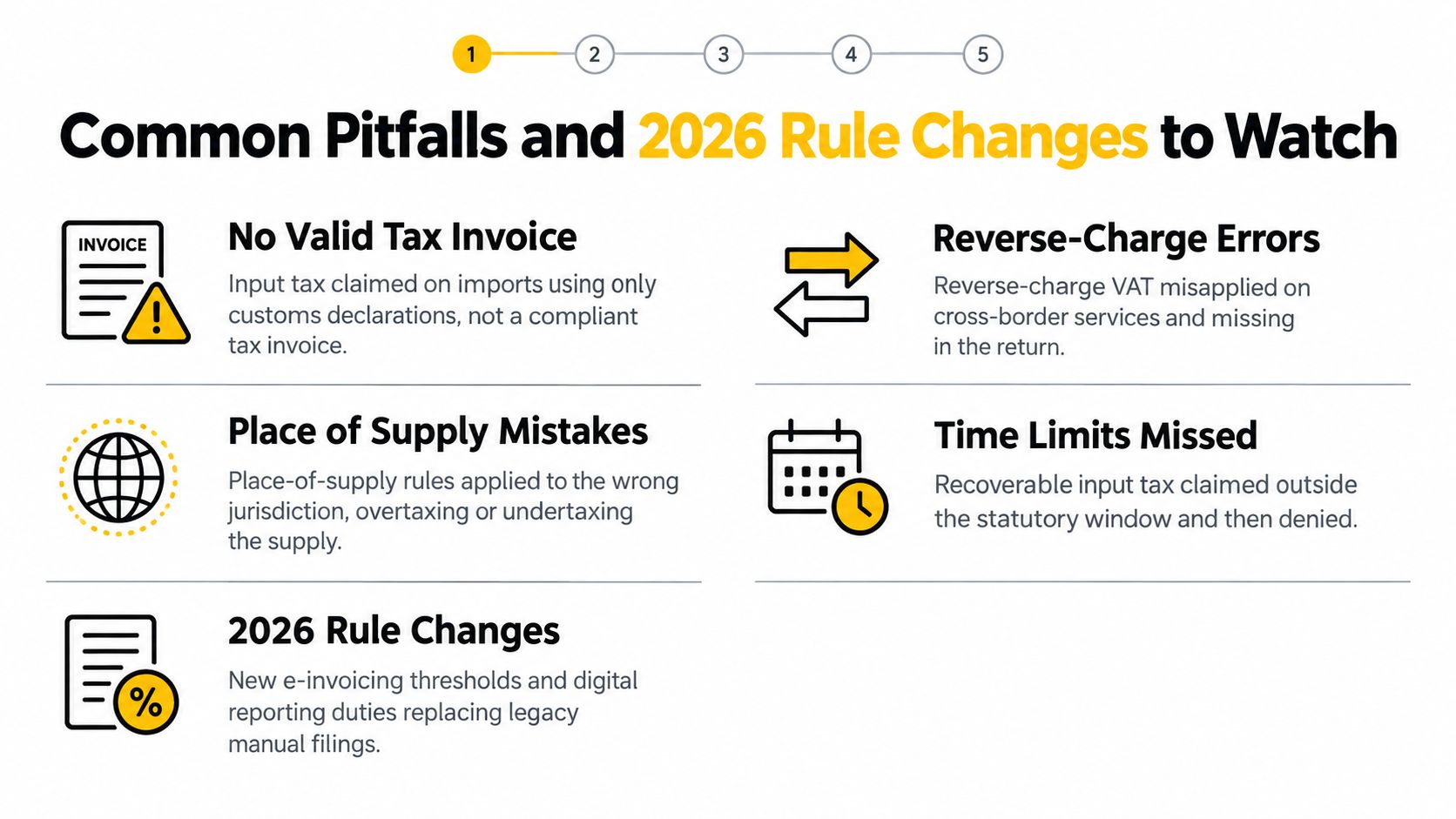
Common Pitfalls and 2026 Rule Changes to Watch
Most VAT failures aren't exotic. They come from ordinary operational shortcuts that run for months without challenge, then surface during a review. By then, fixing the problem means recreating evidence, adjusting past returns, or defending positions that were never documented properly at the time.
The failures that keep recurring
The first recurring problem is input tax claimed without proper supporting invoices. This happens often with imports, reimbursements, and supplier records that were saved informally rather than retained in a proper accounting trail.
The second is reverse-charge error handling. Imported services and similar cross-border costs are easy to post incorrectly when the finance team treats the supplier invoice like an ordinary domestic purchase.
Another common failure is late payment despite on-time filing. Some businesses focus so heavily on submission that they forget VAT is also a cash process. If the liability isn't forecast, the return is filed but the payment lands late.
Then there's the correction problem. A past error is found, everyone agrees it's wrong, and yet no one decides whether it should be addressed through current-period adjustment or a formal disclosure route. Delay usually makes that decision harder, not easier.
The enforcement backdrop is less forgiving
The operational environment in the UAE has become harder to ignore. Reporting on FTA enforcement data states there were roughly 176,000 field inspection visits across all emirates in 2025, up from 93,000 in 2024, and AED 608 million in tax dues and penalties were identified, up from AED 348 million, as discussed in this coverage of VAT enforcement and inspections.
That doesn't mean every SME will face an inspection. It does mean businesses should stop treating VAT as a form-submission exercise and start treating it as a records-and-controls function.
The 2026 changes many businesses still haven't planned for
A major practical issue is the five-year expiry on excess recoverable VAT. Recent UAE coverage says excess recoverable VAT can only be carried forward or refunded within five years from the end of the originating tax period from 1 January 2026, which makes old credit balances and unreconciled input VAT a live clean-up issue, as noted in this review of UAE VAT compliance changes for 2026.
A second issue is process redesign around reverse-charge and supplier checks. UAE reporting says self-invoicing under the reverse charge mechanism was removed from 1 January 2026 and new supplier verification rules affect input VAT deduction from 1 October 2026, according to The National's report on the October regulation changes.
For SMEs, these changes aren't academic. They affect how purchase invoices are reviewed, what documents are collected, and whether the ERP or bookkeeping system forces the right checks before a claim is made. A practical VAT compliance checklist should now include historic credit review, supplier verification steps, and a written rule for handling imported-service costs.
The quarterly return is too late to discover that the document set was never good enough to support the claim.
Choosing the Right VAT Accounting Provider
Choosing a VAT provider in Dubai isn't mainly about price. It's about who will touch your books, how they manage risk, and whether they can keep control when the file gets messy.
Questions worth asking before you sign
Start with supervision. Ask whether the engagement is overseen by a registered tax agent with a valid FTA permit number, or whether the work is being passed to a freelancer with no formal accountability.
Then ask about software. A decent provider should tell you which accounting platform they standardise on, how source documents are stored, and whether you own the accounting data file at all times. If a firm makes leaving difficult by controlling access to your own records, that's a commercial risk as much as a compliance one.
The engagement letter matters more than the sales call
Request a sample engagement letter and read it closely. It should define deliverables, timing for monthly close, timing for return preparation, and what happens if the FTA sends correspondence or requests support.
Useful vetting questions include:
- Who reviews the work: Is there senior review before filing, or only data entry?
- How are errors handled: Will they recommend Voluntary Disclosures when needed, or roll differences into the next quarter?
- What happens during an audit: Who responds, who attends, and what costs are additional?
- Which sectors do they know: Hospitality, e-commerce, free zone distribution, and professional services all carry different VAT habits and risk points.
One practical option in the local market is Smart Classic Business Hub, which offers VAT-compliant accounting as part of a broader UAE compliance and finance support scope. That matters for businesses that want one provider handling setup, bookkeeping alignment, and ongoing tax administration instead of splitting those tasks across separate advisers.
A provider doesn't need to promise perfection. They do need a clear method, clear ownership, and the discipline to say when the books aren't ready to file.
Treating VAT Accounting as an Ongoing Function
The healthiest VAT files come from ordinary routines, not heroic quarter-end effort. Daily posting, weekly checks, monthly review, and periodic health assessments are what keep the return clean.
A strong rhythm usually looks like this:
- Daily coding: Sales and purchases are entered with the right tax treatment when they happen.
- Weekly reconciliation: Bank, cash, POS, and supplier balances are matched while differences are still easy to explain.
- Monthly VAT review: Recoverable input tax, unusual entries, and unresolved document issues are cleared before they age.
- Periodic filing preparation: The return is built from reviewed ledgers, not guessed from summaries.
Why continuous work is cheaper than repair
Businesses save money in real terms. The cheapest month to maintain VAT discipline is the current month, while the most expensive month is the one you have to reconstruct later.
The broader tax system also supports that view. The FTA said total VAT and Excise revenues collected reached AED 46 billion in 2025, and tax registration transactions increased to 1.7 million, showing a growing compliance base, according to this FTA report summary. In a system handling that scale, weak records don't stay hidden forever.
The 2026 shifts raise the cost of delay even further. Historic credits need active review. Supplier verification can't be an afterthought. Reverse-charge treatment needs updated controls. If your team waits until the filing week to think about VAT, those issues arrive too late to solve neatly.
For businesses that don't want a full in-house finance function, outsourced support works best as a steady monthly discipline, not an annual firefighting contract. If you need a practical starting point for the submission side, this guide to VAT filing in the UAE is the kind of process reference every SME should keep close.
If your VAT books need proper structure, not just last-minute filing, Smart Classic Business Hub can help with VAT-compliant accounting, registration support, bookkeeping alignment, and ongoing compliance management in the UAE. That's usually the difference between filing a return and controlling the numbers behind it.