
You've got the passport copy, a business plan, and too many browser tabs comparing Dubai mainland, free zones, and offshore structures. The difficult part isn't submitting a form. It's choosing a structure that still works when you need a bank account, staff visas, a physical office, local customers, or government contracts.
Dubai remains a powerful entry point, but incorporation is only the beginning. The Dubai Free Zones Council reports 27 free zones under 11 authorities, with those zones accounting for 38% of Dubai's foreign trade (verified free-zone overview). At the same time, Dubai Chamber of Commerce membership reached 292,486 active companies in 2025, after 71,830 new companies joined during that year (Business Insider coverage). You're entering a busy market, not an empty one.
Why Dubai in 2026 and What This Guide Covers
Dubai's appeal comes from the range of incorporation environments available to founders. The UAE has about 40 free zones nationwide, while Dubai hosts more than 20, according to the Dubai investment portal (Dubai free zones list). That concentration gives founders access to sector-focused options in areas such as finance, logistics, media, technology, commodities, and professional services.
But more choice creates more ways to choose badly. The jurisdiction determines the licensing authority, permitted activities, office requirements, visa capacity, customer access, and the approvals you'll need. A consultancy selling mainly to UAE companies has a different structural need from an exporter, a technology holding company, or an international contractor with no local operations.
Practical rule: Choose the activity and customer geography before choosing a package. The cheapest licence is expensive if it prevents you from serving your intended market.
This guide focuses on the decisions that matter in 2026, including the newer route for certain free-zone companies to register mainland branches, changes affecting foreign ownership, updated incorporation documents, and the compliance work that follows licensing. It also covers the formation sequence, overlooked cost categories, visas, banking, PRO support, accounting, and the competitive pressure that comes with Dubai's rapid business formation.
For broader context on the emirate's commercial environment, this Dubai investment outlook can help you assess the market beyond the licence itself. Founders who want a concise overview of the wider advantages can also review the benefits of setting up a business in Dubai, but don't let general benefits replace an activity-specific setup decision.
Choosing Between Mainland, Free Zone, and Offshore
There isn't a universally superior jurisdiction. Mainland suits businesses that need direct UAE market access. Free zones suit founders who want a specialised ecosystem and a defined operating base. Offshore structures suit international holding or contracting purposes where a UAE operating presence isn't required.
| Criterion | Mainland | Free Zone | Offshore |
|---|---|---|---|
| Licensing authority | Dubai Department of Economy and Tourism | Relevant free-zone authority | Offshore registry, such as JAFZA Offshore or RAK ICC |
| UAE mainland trading | Direct access, subject to activity rules | Usually requires a distributor, branch, or specific permission | Not designed for local operating activity |
| Foreign ownership | Available for most activities, subject to sector rules | Generally available under the authority's rules | Designed for international ownership structures |
| Office expectation | Usually a suitable physical premises and tenancy registration | Flexi-desk, shared office, or physical premises, depending on authority and activity | No conventional operating office requirement |
| Visas | Available based on establishment and premises eligibility | Available based on package, premises, and quota | Generally not intended as a visa route |
| Best fit | Local services, retail, contracting, government-facing work | Sector-focused services, trading, technology, media, logistics | Holding assets, owning intellectual property, international contracts |
Mainland is the default choice when your revenue depends on UAE customers, local delivery, retail, government work, or unrestricted movement across Dubai. Don't choose a free zone solely because the initial package looks cheaper if your customers are sitting outside the zone and you'll need another arrangement to serve them.
Free zones are more attractive when your business has a clear sector fit, international clients, or a need for a structured operating community. The UAE's free-zone model has historically supported foreign entry, sector clustering, and simplified licensing, but each authority has its own activity list, document standards, office rules, and pricing.
Offshore is a different product, not a cheaper version of a normal Dubai operating company. It can suit an international holding structure or ownership arrangement, but it generally won't give you the operating tools founders expect, such as a straightforward local trading presence or a standard investor visa.
Use this mainland versus free zone comparison as a starting point, then test the result against your actual customers, staff, premises, and banking needs.
Picking the Right Activity and Licence Type
Your activity is the first technical decision. It determines the authority, licence category, external approvals, permitted business description, office requirements, and sometimes the legal form available to you. Get it wrong and the application can stall after you've already paid for documents, premises, or professional assistance.
Start with the work you'll invoice for. A software company that develops applications, a consultancy that advises clients, and a business that sells hardware may need different activity selections even if they operate under one brand. Don't describe a regulated or technical activity as generic trading just to avoid an approval. The authority may reject the application or request clarification when the business model appears in your bank, visa, tax, or customer documents.
Match the licence to the work
- Commercial licensing generally fits buying and selling goods, import and export, retail, and trading activities.
- Professional licensing is commonly used for consultancy, marketing, information technology, and other services.
- Industrial licensing is relevant to manufacturing and normally requires a suitable physical facility and additional technical or environmental clearances.
- Tourism, education, healthcare, transport, and financial activities can require approvals from the relevant regulator before licensing is completed.
The legal structure matters as well. A founder may use a sole establishment, limited liability company, branch, or another structure depending on ownership, activity, and jurisdiction. The licence title alone doesn't tell you whether the company can hire staff, lease the right premises, import goods, or contract with your target customers.
Check approvals before paying
Dubai and UAE guidance emphasises identifying the business activity and location, then securing any required approvals before final licensing. Healthcare, education, tourism, transport, and financial services should be reviewed early, not after the trade name has been reserved.
A bank may also question a vague activity description. Your licence, website, business plan, invoices, and expected account transactions should tell the same story. A clear activity matrix prevents the common mismatch between what the licence says and what the company intends to do.
For practical assistance with the application and trade licence support in Dubai, prepare a short description of your services, customers, delivery model, premises, and expected staffing before speaking to an authority.
The Formation Process Step by Step
The cleanest applications follow a logical order. Start with the commercial idea, convert it into an approved activity, then move through the authority's incorporation workflow. Submitting documents in the wrong sequence creates avoidable rework.
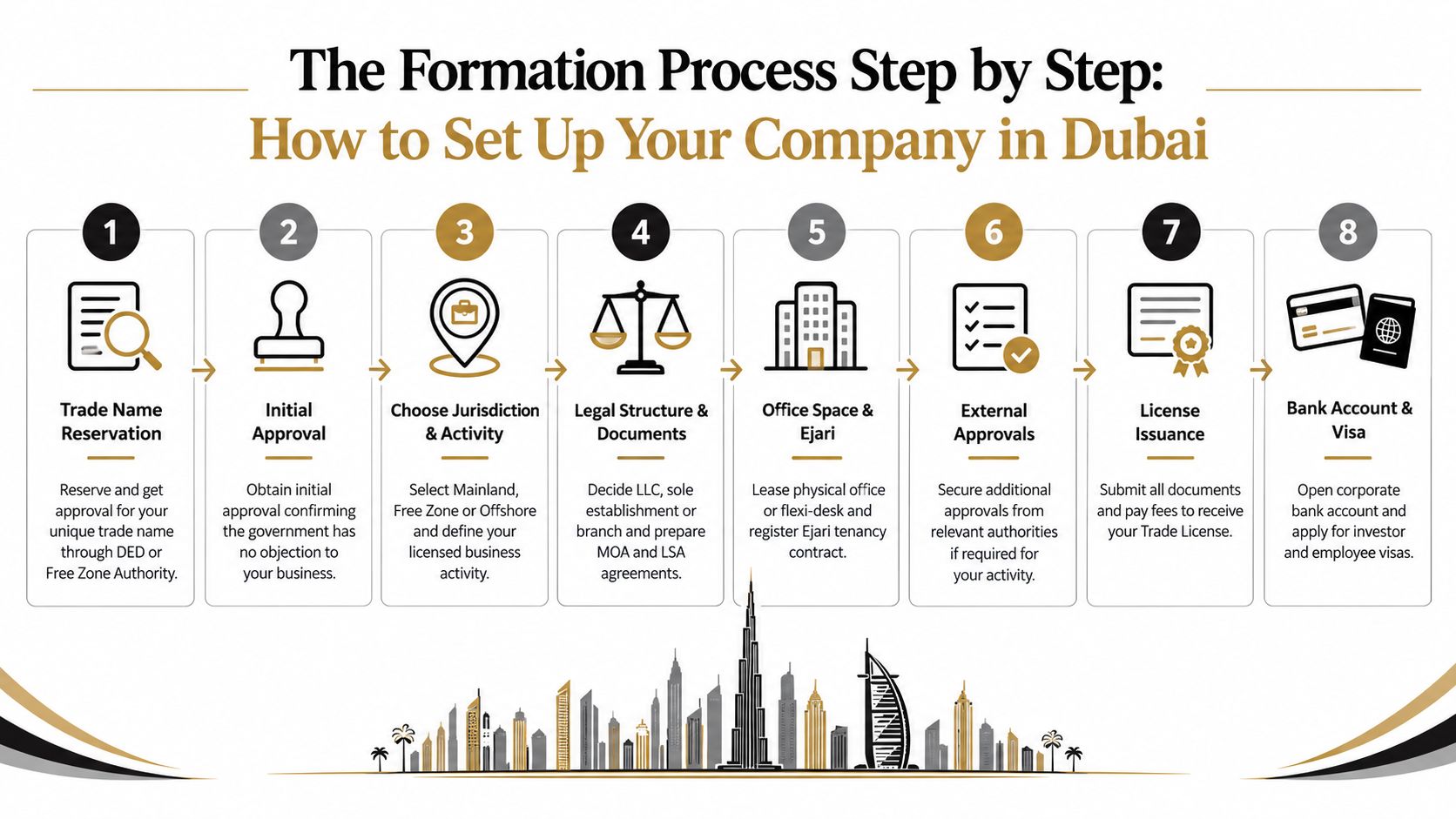
1. Reserve the trade name
Submit the proposed name through the DET channel or the selected free-zone portal. Names that conflict with public order, religious sensitivities, political references, public figures, or existing registrations can be rejected. If the name refers to an individual, ownership and supporting identity documents may be relevant.
2. Obtain initial approval
Initial approval confirms that the authority has no objection in principle to the proposed formation. It isn't the final licence. Regulated activities can still require separate approvals before the authority issues the completed licence.
3. Confirm the jurisdiction and activity
At this point, verify that the chosen activity exists in the selected jurisdiction and that the legal form supports your ownership and operating plan. Don't treat mainland, free zone, and offshore as interchangeable application destinations.
4. Prepare incorporation documents
Depending on the structure, you may need a memorandum or articles of association, shareholder information, manager details, resolutions, and identity documents. Use the authority's current templates rather than recycling documents from an older setup.
5. Arrange premises and tenancy registration
Mainland companies normally need premises suitable for the activity, with the tenancy documentation registered through the appropriate process. Free zones may offer flexi-desk or shared-office solutions, but those packages can affect visa capacity and operational credibility.
6. Secure external approvals
The exact regulator depends on the activity. Financial services, healthcare, transport, tourism, education, and other controlled sectors may need additional approval before final licensing.
7. Pay and receive the licence
Once the authority accepts the documents and approvals, pay the prescribed fees and obtain the trade licence or electronic licence. Dubai's official setup guidance says many cases can be handled online, with eligible digital applications potentially receiving a licence within minutes (Dubai business setup guidance).
8. Apply for the establishment card, visas, and banking
The licence doesn't automatically give you a bank account or residence status. Apply for the establishment card, then process visas, medical fitness procedures, Emirates ID requirements, and corporate banking separately.
DMCC illustrates how much automation can improve the process. Its official workflow uses a 100% digital three-step process covering online pre-approval, payment and document signing, followed by office selection (DMCC business setup). Once the licence is issued, set up bookkeeping immediately. Teams that automate bookkeeping at launch are less likely to lose invoices, miss reconciliations, or discover compliance gaps after trading begins.
Real Cost Breakdown and Where Founders Overspend
A headline licence quote rarely represents the full first-year commitment. You'll usually pay for the licence, registration, name reservation, initial approval, incorporation documents, establishment card, premises, visas, banking support, and accounting or PRO work.
The verified market range for a Dubai trade licence is AED 10,000 to AED 50,000 or more, depending on the activity and jurisdiction (DMCC cost guidance). Treat that as one line, not the total budget.
| Cost item | Mainland | Free zone | Offshore |
|---|---|---|---|
| Trade licence | AED 10,000 to AED 50,000+ | AED 10,000 to AED 50,000+ | Authority-specific |
| Trade name and initial approval | Payable fees apply | Payable fees apply | Registry-specific |
| Incorporation documents | MOA and attestation may apply | Authority templates and signing fees may apply | Registry and agent fees may apply |
| Establishment card | Usually required for visas and labour processing | Usually required where visas are needed | Often not relevant to a standard visa route |
| Office or registered address | Physical premises and tenancy registration may be required | Flexi-desk or office package, depending on authority | Registered-agent arrangement |
| Visa and identity processing | Separate fees for each applicant | Separate fees for each applicant | Generally not a standard operating-company benefit |
| PRO support | Optional, but useful for government workflows | Optional, but useful for renewals and visas | Often handled through the registered agent |
| Accounting and tax compliance | Ongoing professional cost | Ongoing professional cost | Structure-dependent |
The office is often the real swing factor
A mainland setup may require a physical office that fits the activity and supports the intended staffing level. A free zone may offer a flexi-desk, but a low-cost package can become unsuitable when you need more visas, client meetings, storage, or regulatory credibility. Ask what the package includes, what it excludes, and how the authority calculates quota.
The most common overspending comes from accepting a bundled package without reading the exclusions. Check whether the quote includes name reservation, establishment card, document attestation, office registration, immigration deposits, medical processing, Emirates ID, visa stamping, and renewal support.
Budget discipline: Keep the first-year budget separate from the annual renewal budget. Formation fees, immigration work, premises, and compliance don't all repeat in the same way.
Don't defer accounting until the first tax deadline. A monthly bookkeeping arrangement may feel unnecessary before revenue arrives, but reconstructing transactions, invoices, and expenses later costs more than maintaining clean records from the first bank payment.
Visas, PRO, Banking, and Compliance After Setup
The licence is the handover point, not the finish line. After issuance, the company needs an establishment card if it will sponsor visas, and the founder must complete the relevant immigration, medical, Emirates ID, and residence procedures. Each stage depends on accurate documents and active government files.
A PRO typically handles labour and immigration submissions, establishment records, visa applications, renewals, dependent applications, and changes when staff or shareholders leave. Portal delays happen, but incomplete applications create more trouble than slow systems. Give the PRO the exact shareholder documents, tenancy records, passport copies, and signed forms requested by the authority.
Banking needs a credible file
Banks assess the business behind the licence. Prepare the incorporation documents, ownership information, expected customer profile, business plan, contracts or invoices where available, source-of-funds explanation, and details of the countries involved in payments. A non-resident founder or a free-zone company with no clear operating explanation may face additional questions.
Don't choose a bank solely because an agent says it's fast. Ask whether the bank supports your activity, expected transaction pattern, currency needs, online banking requirements, and shareholder profile. Banking assistance can organise the application, but no adviser can guarantee approval.
Compliance starts with the first transaction
The UAE Ministry of Economy identifies location, business activity, and payment of prescribed fees as central parts of commercial licensing (company establishment guidance). After licensing, maintain the same accuracy across tax registration, beneficial ownership information, invoices, contracts, payroll, and accounting records.
Review whether VAT registration applies to your business, whether corporate tax registration is required, whether free-zone income qualifies for any available treatment, and whether your activity creates other reporting duties. Don't assume that a free-zone licence removes every tax or accounting obligation.
A departing partner can also trigger a visa cancellation chain. If the company's immigration file, shareholder records, employee visas, and bank signatories aren't updated together, the remaining team may face delays with renewals or account access. Build an exit checklist before the first partner leaves.
2026 Rule Changes Most Guides Still Miss
The old mainland-versus-free-zone checklist is incomplete. Dubai now gives certain free-zone companies a route to register a mainland branch under Dubai Executive Council Resolution No. 11 of 2025, although eligibility depends on DET rules and financial establishments licensed in DIFC are excluded from that pathway (guide to Dubai company formation).
That change matters, but it doesn't mean every free-zone company can freely trade across the UAE. The branch needs an eligible activity, the correct DET permission, and its own licensing and compliance treatment. Implementation details and permitted-activity lists have also remained an area requiring direct verification, so don't rely on a sales brochure promising unrestricted mainland access (implementation discussion).
| Rule change | Who it affects | Effective date | Practical impact |
|---|---|---|---|
| Mainland branch route for certain free-zone companies | Eligible free-zone entities seeking Dubai mainland activity | 2025 | May avoid creating a separate mainland company, but only for permitted activities and approved structures |
| Expanded foreign-ownership options | Founders in eligible mainland and strategic activities | Current rules require activity-level verification | Ownership can be available without relying on outdated sponsor assumptions |
| Updated MOA and AOA requirements | New companies and companies amending their documents | Current setup cycles | Use current templates and confirm manager, share, and e-signature provisions |
| Free-zone corporate-tax treatment | Free-zone companies with qualifying income and mainland activity | Current tax framework | Analyse qualifying income separately from other turnover and maintain supporting records |
| Greater cross-jurisdiction data transparency | Mainland and free-zone entities | Rollout and implementation require confirmation | Expect more consistent record matching across licences, ownership, and compliance files |
Recent legal commentary also highlights that foreign-ownership options and governance requirements have continued to change, which means old templates can mislead founders (UAE online company setup commentary). Use the current authority template and verify the activity before signing.
Before spending money, answer five questions:
- What exactly will the company invoice customers for?
- Are the customers in Dubai, elsewhere in the UAE, or outside the country?
- Do you need a physical office, storage, client reception, or only a registered desk?
- How many founder, employee, and dependent visas will you need?
- What can you realistically allocate for the first year, including compliance and renewals?
Then follow this order:
- Reserve the trade name.
- Obtain initial approval.
- Confirm the legal form and jurisdiction.
- Secure municipality, RERA, DHA, tourism, transport, education, financial, or other sector approvals where required.
- Execute the current MOA or AOA.
- Register the lease or free-zone office solution.
- Pay for licence issuance.
- Obtain the establishment card.
- Process investor and employee visas.
- Complete medical, Emirates ID, and residence procedures.
- Open the corporate bank account.
- Put bookkeeping, tax review, beneficial ownership records, and renewals on a calendar.
One cost sanity check is useful. A mainland trade licence, Ejari office, and one employee visa typically falls in the AED 25,000 to AED 45,000 range before professional fees, based on the setup benchmark provided in the brief. Treat it as a planning band, not a guaranteed quotation, because activity, premises, immigration requirements, and authority fees change the result.
If mainland is your likely route, book a DET appointment or authorised service channel. If free zone is more suitable, shortlist two zones against your activity matrix instead of choosing from a generic list. Engage a registered PRO or formation agent to coordinate the portals, approvals, visas, and post-licensing records rather than chasing each government process alone.
Smart Classic Business Hub can help compare mainland, free-zone, and offshore structures, coordinate trade licensing and PRO approvals, and organise ongoing accounting and compliance support. Visit Smart Classic Business Hub to discuss your activity, customer geography, visa needs, and first-year setup plan before you commit to a jurisdiction.