
You're a Dubai freelancer with a valid residence visa, a UAE bank account, and foreign clients asking for proof that you're tax resident in the UAE. The request often arrives just before a dividend payment, consultancy invoice, pension transfer, or treaty filing deadline. You can spend time assembling the evidence, or you can discover later that the certificate covers the wrong period or uses the wrong applicant category.
A UAE Tax Residency Certificate (TRC) is formal proof of tax residency issued through the Federal Tax Authority. It isn't a personal income tax registration document. The UAE doesn't impose personal income tax, but foreign tax authorities, withholding agents, banks, and treaty counterparties may still ask for evidence that you're resident in the UAE before granting relief.
This guide explains how to get a Tax Residency Certificate through two separate workflows: the natural person route and the juridical person route. You'll find the eligibility tests, evidence packs, EmaraTax filing sequence, realistic processing considerations, common document mismatches, and a final readiness checklist.
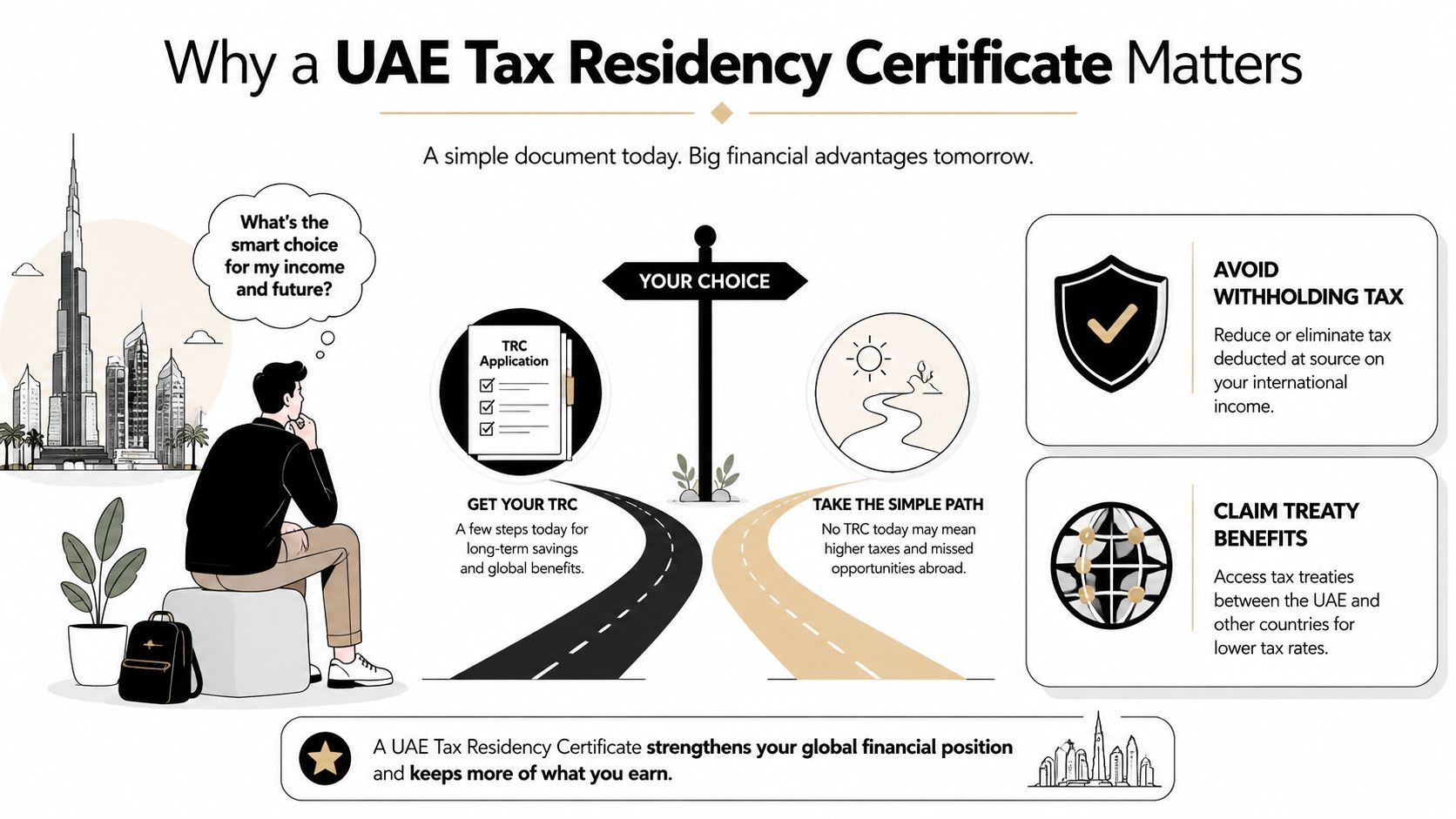
Why a UAE Tax Residency Certificate Matters
A freelance permit holder in Dubai may wonder whether a TRC is worth the administrative effort. If a foreign client, investment platform, pension administrator, or tax authority needs proof of residence, the answer usually depends on what the document will be used for. A residence visa proves immigration status. A TRC addresses a different question, namely where you're treated as tax resident for the relevant period.
The main commercial value appears when you're dealing with a double taxation agreement. A foreign country may apply withholding to income paid from that country, even when you live and work in the UAE. Its tax authority or paying agent may ask for a UAE TRC before applying treaty relief, reducing withholding, or accepting a claim that the same income shouldn't be taxed at the full domestic rate.
For foreign investors and high-net-worth individuals, the practical objectives are often clear:
- Reduce double taxation exposure: Provide formal UAE residency evidence when your home or source country reviews foreign income.
- Support treaty claims: Give a foreign tax authority or withholding agent the document needed to assess treaty treatment.
- Evidence a genuine operating base: A company may need to demonstrate that its UAE residence position is supported by management, licensing, premises, and records.
- Answer institutional due diligence: Banks and counterparties may request formal tax-residency proof as part of their onboarding or compliance review.
The certificate doesn't create residency by itself. It confirms that your facts and supporting documents satisfy the relevant UAE test. That distinction matters when planning travel, maintaining a home, operating a business, or answering questions from another country's tax office. For context on the wider UAE personal tax position, see this guide to personal tax in the UAE.
Who Qualifies as a UAE Tax Resident
The FTA's guidance separates individual applications into distinct eligibility routes. The cleanest route is physical presence in the UAE for 183 days or more during a 12-month period. The alternative applies to people present for 90 to 182 days, but those applicants must support their presence with additional UAE ties and a carefully matched evidence file. The FTA guidance summarised by KPMG also identifies Emirates ID or passport entry and exit evidence, together with UAE income or salary evidence where applicable, for natural persons applying for double taxation agreement purposes.
Natural person tests
Start by identifying the test you're claiming. Someone who has spent 200 days in the UAE during the relevant period will normally build the application around physical presence. The entry and exit evidence must support the period stated in the form, and the dates should align with the certificate coverage.
The 90 to 182-day route needs more than a travel record. The applicant must show relevant connections such as UAE employment or business activity, a permanent place of residence, or the centre of personal and financial interests. In practice, that means a freelancer may need to connect a residence document with a trade licence, employment evidence, UAE income, or other records that explain why the UAE is the applicant's base.
A British founder on an investor visa may have a credible application under the shorter-presence route if the UAE residence and business evidence are organised and consistent. A Spanish engineer who has spent 200 days in the UAE has a more direct physical-presence case, provided the immigration evidence supports the stated dates.
Juridical person route
A company follows a different workflow. The FTA expects corporate documentation that establishes the entity's legal existence and identifies how it operates in the UAE. The evidence commonly includes the valid licence, lease agreement, incorporation records, memorandum of association, corporate tax registration number if available, and authorised signatory documents.
The company's licence, registered address, management records, contracts, and financial information should tell the same story. A certificate isn't a substitute for substance. If the requesting authority is assessing where a company is managed, the corporate file should make the UAE connection understandable without relying on assumptions.
| Applicant Type | Statutory Test | Key Evidence | Typical Coverage Period |
|---|---|---|---|
| Natural person | 183 days or more of physical presence during the relevant 12-month period | Emirates ID, passport entry and exit evidence, UAE residence and income records where applicable | Past or current period that has already started |
| Natural person | 90 to 182 days with additional UAE ties | Presence evidence plus employment, business, residence, income, or personal and financial interest evidence | Past or current period that has already started |
| Juridical person | UAE legal existence and documented UAE business connection | Licence, incorporation documents, lease, memorandum, corporate tax details if available, financial and signatory records | Period selected in the application and supported by records |
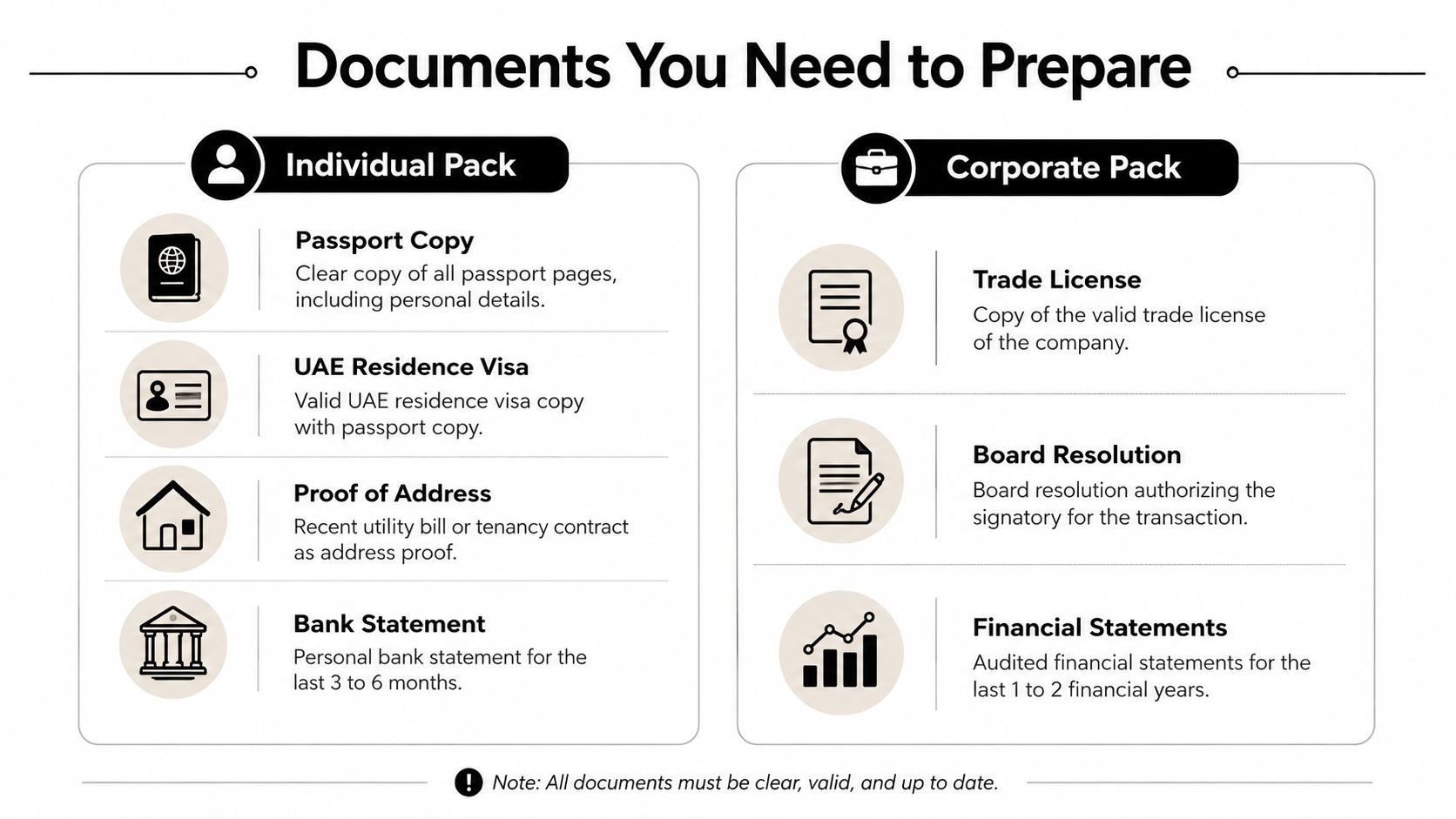
Documents You Need to Prepare
The quickest applications are built before the applicant opens EmaraTax. Treat the file as an evidence map, not a pile of attachments. Every document should support the eligibility test, applicant type, certificate purpose, or requested period.
Individual pack
For a natural person, prepare a clear passport copy, UAE residence evidence, Emirates ID, and immigration records showing entry and exit dates. The FTA's process specifically relies on identity and presence evidence, so a travel record that doesn't cover the stated period can undermine an otherwise strong application.
Add documents that explain your UAE ties. A tenancy contract or Ejari supports your place of residence. A UAE bank statement supports financial activity. A salary certificate can support employment income, while a trade licence can explain self-employed or freelance activity. Where the application is made for treaty purposes, include the UAE income or salary evidence applicable to your circumstances.
Before uploading, check:
- Identity consistency: Your name and passport details should match across the passport, Emirates ID, visa records, bank statement, and application.
- Date coverage: The travel evidence, tenancy, bank records, and income documents should relate to the requested period.
- File clarity: Scans should be readable, complete, and uploaded under the correct document category.
- Document language: If a foreign document needs authentication or translation, arrange it before submission. Applicants working against a deadline can review document authentication services to organise that step.
Corporate pack
For a juridical person, the file normally includes a valid trade or business licence, certificate of incorporation, lease agreement, memorandum of association, and corporate tax registration number if available. The FTA also asks for authorised signatory documents, which may include the signatory's identification and evidence of authority to act for the company.
A corporate application becomes vulnerable when the legal documents don't connect. An amended licence may show a different name from the memorandum. A board resolution may appoint one signatory while the upload identifies another. A flexi-desk arrangement may need a clear explanation of the company's registered office and operating address.
The FTA's TRC service requirements make the workflow evidence-led. Use a document index and label each file by applicant, period, and purpose. If you're also organising the company's wider tax registrations, keep the TRC evidence separate from material used for obtaining a UAE tax identification number.
Filing Your Application Through EmaraTax
EmaraTax uses a linear process. Most avoidable delays happen because applicants choose the wrong service type, select a period they can't support, or upload documents without first checking that the evidence answers the selected eligibility route.
Create the account and select the service
Create or access your EmaraTax account using the available login method, including UAE Pass where applicable. Open Other Services, select Tax Residency Certificate, and choose the relevant applicant profile. The distinction between a natural person and a juridical person is important because the FTA reviews different evidence for each.
If a TRN applies to your profile, select the correct TRN. Then choose the certificate type and purpose. Treaty-related applications should be prepared with the foreign authority's requirements in mind, particularly if it has a prescribed form or treaty article that must be addressed.
Choose the period carefully
The requested period must be supportable. UAE tax guidance states that a TRC period cannot be prospective. It may relate to a past period or a current period of up to 12 months, but the period must already have started and the supporting evidence must match it.
Many applicants lose time. They select a financial year because it suits an internal deadline, then discover that their tenancy, bank activity, or travel records don't cover the same dates. Decide the period first, then build the evidence pack around it.
Complete, upload, pay, and submit
Complete the form with the applicant's legal name, identification details, purpose, period, and eligibility information. Upload each document in the correct field. Don't combine unrelated records into one unclear file unless the portal or guidance requires it.
The EmaraTax sequence is:
- Create or access the account.
- Open Other Services.
- Select Tax Residency Certificate.
- Choose the relevant TRN where applicable.
- Select the TRC type.
- Complete the application.
- Upload supporting documents.
- Pay the application and review fee.
- Submit the request.
- Download the certificate after approval.

The FTA may request additional evidence inside the portal. Respond in the same application rather than starting a new request, and answer each point directly. Once approved, retrieve the digitally signed PDF and check the legal name, identification details, coverage period, certificate purpose, and any treaty reference before sending it to a foreign authority. Keep your TRC records with broader UAE compliance documentation, including any VAT and tax filing support.
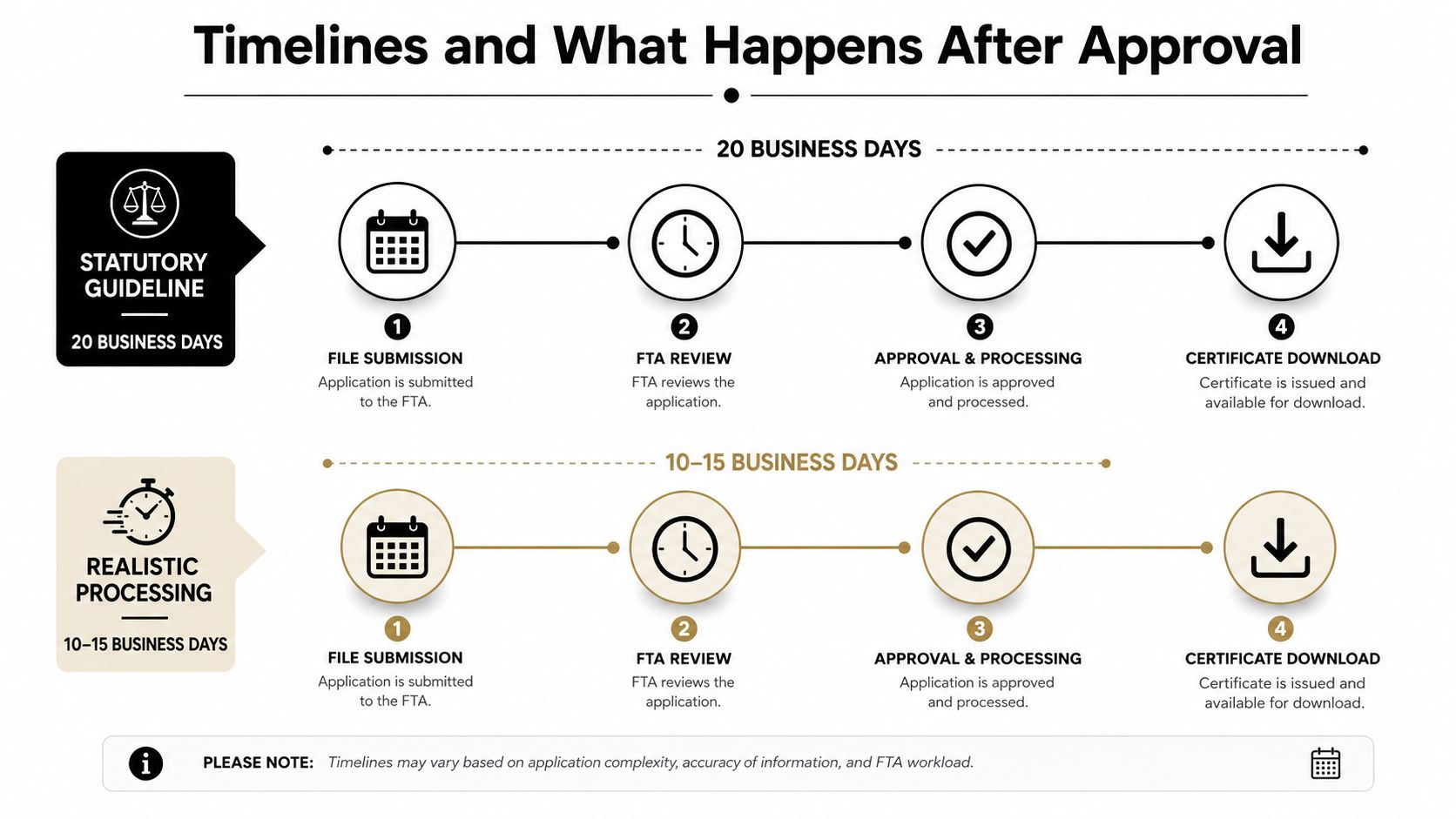
Timelines and What Happens After Approval
A practical UAE benchmark places the complete TRC process at about 3 to 6 weeks end to end, with pre-approval commonly around 5 to 10 working days and post-approval issuance around 3 to 5 working days, according to regional tax-advisory guidance in the TRC process document from Trident Trust. These are working benchmarks, not a promise of approval by a fixed date. The FTA's review time depends on the completeness of the submission and its review workload.
What controls the first review
The biggest variable is file quality. A correct certificate type, suitable applicant category, complete evidence pack, and consistent financial-year coverage give the reviewer a coherent application. Missing travel evidence, unclear residence ties, or a document that belongs to another period can lead to a clarification request and extend the process.
Treat the application as two stages:
| Stage | What happens |
|---|---|
| Pre-approval review | The FTA checks the application type, eligibility route, identity records, period, and supporting evidence |
| Post-approval issuance | The approved certificate is processed and made available for download through the application |
A treaty application may involve an additional foreign tax form. If the receiving authority has supplied a form for the UAE authority to complete, prepare it in advance and ensure that names, periods, and signatures match the EmaraTax submission.
While waiting, contact the foreign tax adviser or withholding agent and confirm exactly what they'll accept. Ask whether they need an original PDF, a translated copy, an attestation, an apostille, a completed treaty form, or a certificate referring to a specific country or income period. That preparation prevents a second delay after UAE approval.
Common Pitfalls That Delay or Reject Applications
The most expensive mistake is often not weak eligibility. It's submitting a technically neat application under the wrong category or for a period the FTA can't certify. A certificate that doesn't match the counterparty's request may be unusable even if the FTA issued it correctly based on the information provided.
Category and period errors
A natural person and a company don't prove UAE tax residence in the same way. If the foreign authority needs evidence for a company but the applicant submits an individual TRC, the document won't answer the question being asked. Confirm the recipient's requirement before selecting the EmaraTax service.
Prospective periods create another avoidable problem. The TRC must relate to a period that has already started, so don't file for a future period because a contract or dividend schedule refers to it. Select a supportable past or current period and make sure the documents cover it.
Mismatched records
Review the spelling of the legal name, passport number, Emirates ID details, company name, licence number, and signatory information. Small differences can trigger questions, particularly when the bank statement, licence, board resolution, and identity documents were issued at different times.
For a corporate application, the authorised signatory must be identifiable from the uploaded authority documents. If the board resolution names one person and the application is signed by another, correct the resolution or provide the proper power of attorney before resubmitting. If a foreign document is not in an accepted format, arrange an appropriate translation or authentication rather than uploading an unexplained scan.
| Pitfall | Correction |
|---|---|
| Wrong natural person or juridical person category | Confirm the recipient's requirement and file under the matching EmaraTax applicant type |
| Prospective certificate period | Select a past or current period that has already started and is supported by records |
| Entry and exit evidence doesn't cover the claimed period | Obtain updated immigration evidence and reconcile the dates before upload |
| Name or identification mismatch | Correct the source document where possible and provide a clear explanation or supporting identity record |
| Missing corporate authority | Upload the board resolution, power of attorney, or other authorised signatory evidence that matches the applicant |
| Incomplete corporate incorporation file | Add the valid licence, incorporation records, memorandum, lease, and other FTA-requested documents |
Don't assume rejection means the underlying residency position is wrong. Often, the application fails to prove the selected route. Correct the evidence gap, change the category or period where necessary, and respond through the existing portal request when the FTA asks for more information.
Practical Tips and Final Checklist for Applicants
Use the following as a final file review before logging into EmaraTax.
Natural person readiness
- Select the test: Identify whether you're relying on physical presence of 183 days or more, or the 90 to 182-day route with additional UAE ties.
- Reconcile travel records: Check passport evidence or the relevant immigration report against the period stated in the form.
- Prove the UAE connection: Gather Emirates ID, residence evidence, tenancy or Ejari, bank records, and salary or business documents that fit your route.
- Check the recipient's purpose: Confirm whether the certificate is for a double taxation agreement, a domestic request, or another institutional requirement.
- Check the period: Don't request a prospective period, and don't rely on documents that begin after the claimed period.
Juridical person readiness
- Confirm corporate identity: Match the trade licence, incorporation certificate, memorandum, lease, and application name.
- Confirm authority: Make sure the authorised signatory's identity and appointment documents agree.
- Explain the office: If the company uses a flexi-desk or shared facility, prepare a clear explanation of the registered premises and business activity.
- Map the financial records: Keep corporate bank and accounting records aligned with the requested period.
- Prepare treaty forms: If a foreign tax authority supplied a form, complete the applicant sections and check the signing requirements before upload.
A treaty TRC and a domestic-purpose TRC shouldn't be treated as interchangeable without checking the recipient's instructions. The right document depends on who requested it, why they requested it, and which period or treaty provision they need to assess. A Certificate of Fiscal Domicile may be more suitable in a particular jurisdiction or transaction, so confirm the exact document name before filing.
Practical rule: If a company has multiple shareholders, changing signatories, amended constitutional documents, or cross-border income, have an experienced UAE tax agent review the file before submission. The value is not merely completing the form. It's catching the mismatch that would otherwise send the application back for rework.
If you're ready to proceed, organise your evidence by applicant type and requested period, then have a UAE-focused adviser check the file before payment and submission.
Smart Classic Business Hub helps individuals and companies prepare UAE Tax Residency Certificate applications, organise supporting documents, and manage related business and tax compliance work. Visit Smart Classic Business Hub to discuss your TRC requirements and prepare the correct EmaraTax filing route.