
A Dubai trading company can have its VAT return filed, bank account reconciled, and books apparently complete, yet still struggle when an inspector asks for the ledger behind a refund claim. The problem often isn't that the transaction never happened. It's that the invoice sits in a former accountant's inbox, the import file is on a disconnected laptop, or the corporate tax working paper was never saved with the return.
That situation exposes the central issue with UAE accounting record keeping requirements. There isn't one universal five-year rule. VAT, corporate tax, and company law create overlapping obligations, and each can apply a different retention period to the same document. SMEs need a record-keeping system that maps documents to each applicable regime, preserves an audit trail, and lets the business retrieve evidence without depending on one employee or an outsourced bookkeeper.
Why Record Keeping Is a Legal Obligation in the UAE
A company may produce balanced accounts and submit its returns on time, yet fail a basic inspection request because the supporting invoice, contract, bank entry, or approval record cannot be retrieved. In practice, that gap is a compliance failure, not merely an untidy filing system. UAE accounting record keeping requirements come from several legal regimes, so the retention clock depends on both the document and the obligation it supports.
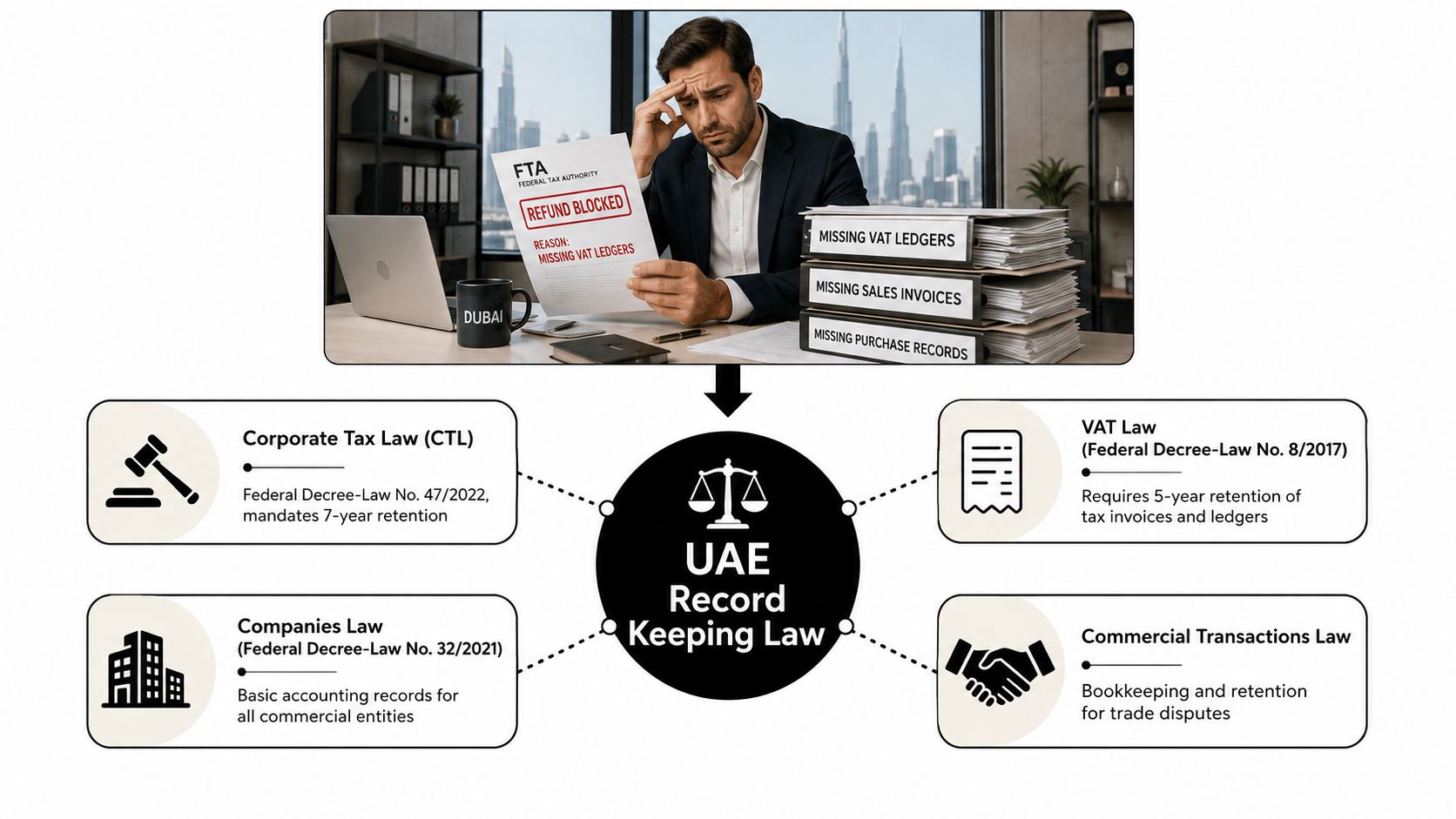
The main legal pillars apply together:
- VAT legislation: Taxable persons must preserve VAT records and supporting documents for the relevant retention period. The UAE legislation portal's VAT framework provides the statutory reference for that obligation.
- Corporate tax legislation: Relevant records generally fall under a seven-year preservation standard after the end of the tax period. The UAE corporate tax record retention provisions set out this requirement.
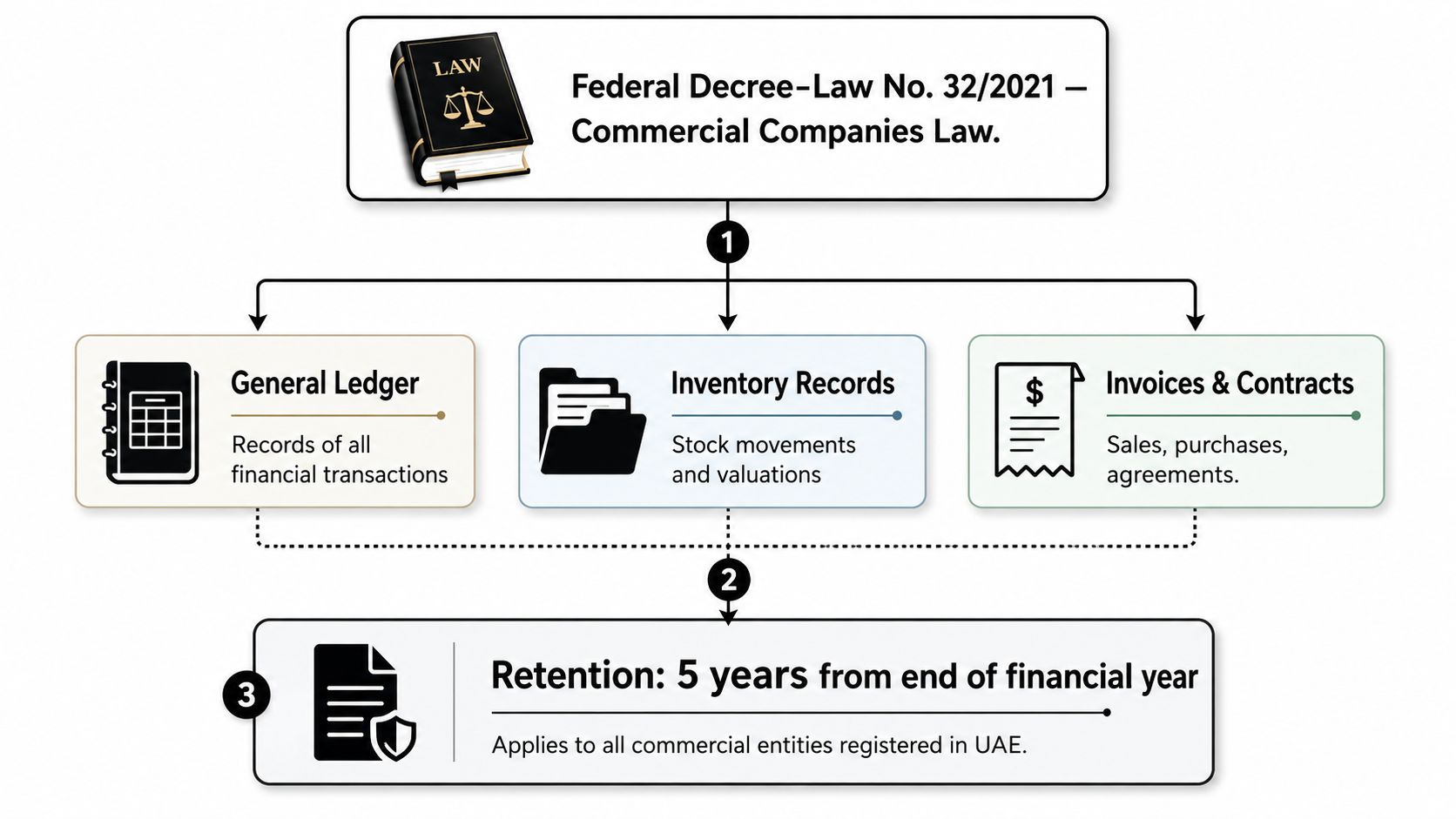
- Companies Law: Commercial entities must keep accounting records at their headquarters for at least five years from the end of the fiscal year. The Commercial Companies Law text establishes this company-law baseline.
Build a layered compliance stack
Assign each document to every rule it may satisfy. A sales invoice can support VAT, corporate tax revenue, and the company's financial statements. A fixed-asset file may have a longer VAT retention period, while a board resolution belongs mainly to the company's governance records.
Practical rule: Keep a document until every applicable retention period has ended. Do not delete it just because the shortest tax clock has expired.
For an FTA inspection, final reports are only the starting point. Inspectors may request the source invoice, contract, bank movement, import evidence, approval trail, adjustment entry, and calculation linking the transaction to the return. Store those items with clear file names, access permissions, and an audit trail. If the general ledger balances but the evidence is scattered across an employee's laptop, an old accountant's inbox, and disconnected cloud folders, the business still has a record-keeping problem.
VAT Record Retention Rules and Document Categories
For VAT, the common baseline is at least five years after the end of the relevant tax period, according to the UAE VAT record-keeping guide. That period applies to the core accounting and tax records behind taxable activity, but it isn't the correct end date for every asset or transaction category.
Capital assets require retention for at least ten years, while real estate records require retention for at least fifteen years, under the same VAT guidance. A finance team that files everything into a single “VAT five years” folder will eventually misclassify a property transaction or dispose of a capital-asset schedule too early.
The document test should follow the return, not the vendor list. Keep the evidence supporting:
- Output tax: Tax invoices, sales journals, credit notes, disposal records, and records of non-business use.
- Input tax: Supplier tax invoices, purchase ledgers, expense support, and documentation for unclaimed input tax.
- Imports and exports: Customs records, import documentation, export evidence, and related commercial paperwork.
- Adjustments: Corrections, debit or credit notes, reverse-charge workings, and VAT return reconciliations.
- Tax summaries: Records showing output tax, reverse-charge tax, and recoverable input tax.
A useful filing rule is to store the return, reconciliation, and source documents together. If an inspector opens an input-tax line, the team should be able to move from the return to the ledger, then to the invoice and payment evidence, without asking the supplier or former accountant to rebuild the file.
VAT record retention periods by document type
| Document Type | Retention Period | Legal Basis |
|---|---|---|
| Tax invoices and sales records | At least 5 years after the end of the relevant tax period | UAE VAT record-keeping guidance |
| Purchase invoices and input-tax support | At least 5 years after the end of the relevant tax period | UAE VAT record-keeping guidance |
| Credit notes and adjustment records | At least 5 years after the end of the relevant tax period | UAE VAT record-keeping guidance |
| Import and export documentation | At least 5 years after the end of the relevant tax period | UAE VAT record-keeping guidance |
| Capital-asset records | At least 10 years | UAE VAT record-keeping guidance |
| Real estate transaction records | At least 15 years | UAE VAT record-keeping guidance |
Businesses that need operational help should also align their files with their VAT filing process in the UAE. The filing workflow should produce an evidence pack, not merely a submitted return.
Corporate Tax Record Retention and the Seven-Year Standard
Corporate tax changes the retention conversation because the relevant standard is seven years after the end of the tax period for taxable and exempt persons, based on the corporate tax record-preservation requirement. That period is longer than the ordinary VAT baseline, so a business that stores only five years of general accounting records creates a gap in its corporate tax evidence.
The corporate tax file should explain how the financial statements became the tax return. That means retaining the general ledger, subsidiary ledgers, trial balance, financial statements, tax adjustments, deduction workings, and supporting contracts. Where relevant, the file should also contain related-party agreements, transfer pricing documentation, qualifying income calculations, and correspondence supporting positions taken in the return.
A practical example shows the difference. If a tax period ends in 2024, the ordinary VAT five-year clock reaches 2029, while the corporate tax seven-year clock reaches 2031. The example illustrates why the same ledger should normally remain available until the longer applicable period ends.
| Tax Regime | Standard Retention | Extended Periods | Example Tax Period End | Earliest Disposal Date |
|---|---|---|---|---|
| VAT | 5 years after the relevant tax period | Capital assets 10 years, real estate 15 years | 2024 | 2029 for ordinary VAT records |
| Corporate tax | 7 years after the relevant tax period | Preserve longer where another legal obligation applies | 2024 | 2031 for ordinary corporate tax records |
Keep the tax computation connected
Corporate tax records fail in practice when the return is saved as a standalone PDF. The PDF shows the conclusion, but it doesn't necessarily show the bridge from accounting profit to taxable income, the reason for an adjustment, or the source of a related-party balance.
Use a dedicated corporate tax folder containing:
- Final financial statements and signed approval records.
- General ledger and subsidiary-ledger exports.
- Tax return workings and adjustment schedules.
- Related-party agreements and transfer pricing support, where applicable.
- Evidence for deductions, exemptions, elections, and carried-forward positions.
A structured corporate tax planning approach should therefore include document governance. Planning decisions are difficult to defend if the calculations and source evidence disappear before a later review.
Companies Law Baseline for Accounting Records
A company may satisfy its tax filing duties yet fail a basic Companies Law review if its books cannot explain local activity. As outlined earlier under the Commercial Companies Law baseline, UAE companies must keep accounting records at their headquarters for at least five years from the end of the fiscal year. The records should show the company's financial position and transactions clearly.
The obligation belongs to the UAE legal entity. A mainland LLC, free-zone company, or branch may use different systems, but each must maintain records for its own UAE activity. A branch should not depend solely on a parent company's overseas consolidation file. The local file needs to explain its transactions, balances, and financial position.
The required working set extends beyond tax invoices. Keep records that connect the ledger to the underlying decision and transaction:
- General and subsidiary ledgers.
- Sales and purchase records.
- Inventory movement and valuation records.
- Bank and cash records.
- Contracts and supporting agreements.
- Financial statements and approval records.
- Shareholder and director resolutions relevant to financial decisions.
Apply the longest applicable clock
The Companies Law period is the legal baseline. VAT and corporate tax can impose longer retention periods for particular documents, so one record may sit under several requirements at once. Preserve it for the longest applicable period instead of applying separate deletion dates across disconnected folders.
This rule also makes the external audit process easier to manage. Auditors typically trace an entry through supporting documents, approvals, bank evidence, and the financial statements. Set retention around that evidential trail, not only the minimum date stated in an internal policy.
Acceptable Formats and Location Requirements
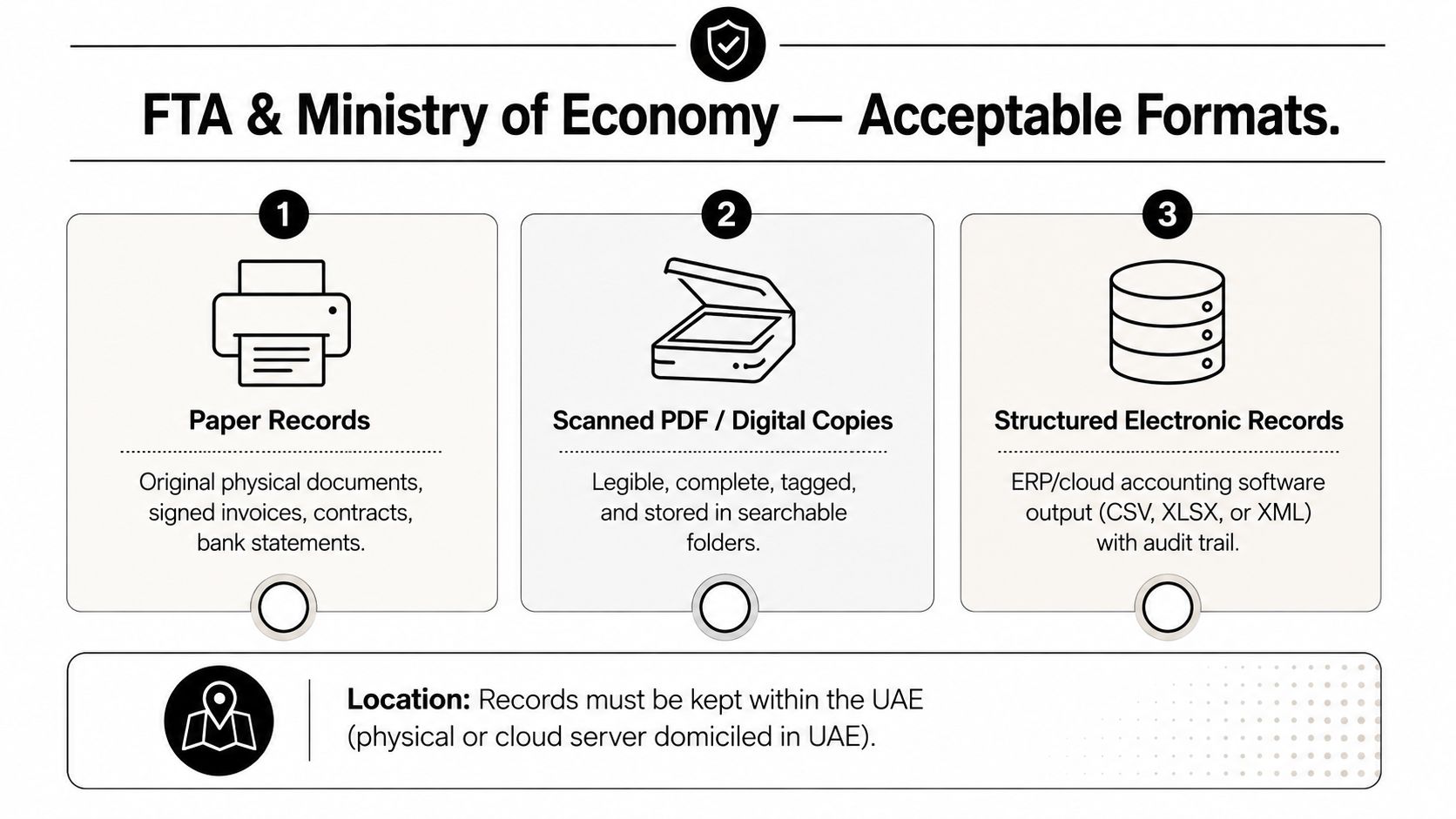
Paper, scanned copies, and structured electronic records can all form part of a workable record-keeping system, provided the files remain legible, complete, reproducible, and protected against unexplained alteration. The medium matters less than whether the business can produce the record and connect it to the accounting entry.
Paper records still have a place for signed agreements, original documents, and records where the original carries evidential importance. Scanned PDFs are more useful when they contain searchable text, consistent names, and a clear link to the supplier, customer, transaction date, and ledger reference. Structured exports from ERP or cloud accounting systems help an auditor test populations, trace changes, and review transaction-level detail.
Make “accessible” an operational standard
A record isn't practically accessible if only the former accountant can open the drive. Before relying on cloud storage, confirm that the company controls administrator access, user permissions, export functions, and backup recovery. An encrypted offline drive can be a useful backup, but it doesn't help during an inspection if nobody can locate the password or verify that the files are complete.
Use this working checklist:
- Readable: Open sample files from each retention year.
- Searchable: Test searches for invoice number, supplier, customer, and transaction date.
- Traceable: Link every return line or ledger entry to its supporting document.
- Protected: Keep an audit trail for edits, approvals, and deletions.
- Recoverable: Test restoration from backup media rather than assuming it works.
- Available: Maintain current credentials and documented ownership of systems.
- Translatable: Be prepared to provide Arabic translations when requested.
The retention clock should be recorded in the document register. For every category, note the relevant tax period, fiscal year, applicable regime, and disposal date. That prevents the common error of counting from the upload date when the governing period runs from the end of the relevant tax period or financial year.
Digital Record Readiness for FTA Inspections
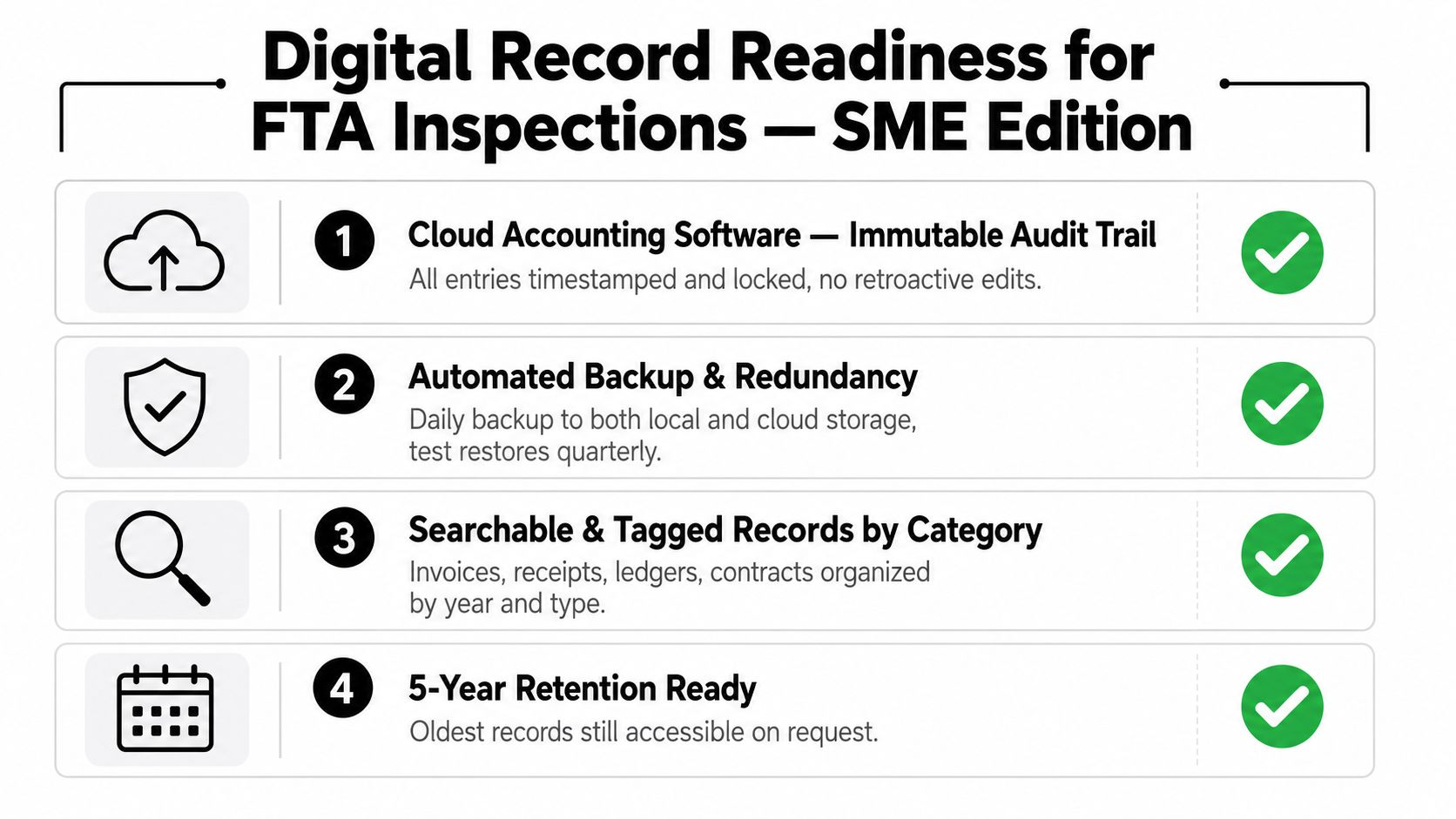
Digital readiness means a stranger with authority can follow the transaction without needing your institutional memory. The system should answer four questions quickly: what was recorded, when was it recorded, who changed it, and where is the supporting evidence?
Start with the accounting platform. Zoho Books, QuickBooks, and Xero can support organised workflows when the business configures user permissions, approval controls, audit history, and export routines properly. Software alone doesn't create compliance. A system with shared logins and unreviewed manual journals can be harder to defend than a disciplined spreadsheet process.
Use four practical controls
- Cloud accounting: Keep the ledger current and preserve the platform's audit trail. Export key ledgers and reports so the evidence isn't trapped inside a subscription account.
- OCR processing: Convert supplier invoices into searchable records. Image-only PDFs slow retrieval and make it harder to locate duplicated invoices, tax numbers, or missing fields.
- Shared-drive structure: Organise first by tax period or financial year, then by record category. Vendor-only folders hide the relationship between invoices, returns, reconciliations, and adjustments.
- Outsourced-bookkeeping governance: Keep company-controlled credentials, signed deliverables, handover procedures, and a documented export schedule. Never allow the entire record set to depend on one bookkeeper's personal email.
The ten-minute inspection check
Before an FTA interaction, assign someone who wasn't involved in preparing the return to perform a short retrieval test. Ask that person to locate a sales invoice, purchase invoice, bank transaction, import document, adjustment, and corporate tax working from the relevant period.
If they find orphaned files, WhatsApp images, bank statements without transaction-level exports, or unexplained currency conversions, fix the workflow rather than manually assembling a presentation folder. The test should also confirm folder naming, user access, backup availability, and the connection between the ledger and source evidence.
Sample Document Map for a Typical UAE SME
A document map turns a retention policy into a working spreadsheet. For a trading SME, the first column identifies the document, the next identifies every applicable regime, and the final column records the date on which disposal could be considered after the longest obligation has been satisfied.
| Document Type | Retention Period | Legal Source | Notes |
|---|---|---|---|
| Sales invoices | At least 5 years for VAT, 7 years for corporate tax where relevant | VAT rules, corporate tax rules | One invoice can support output VAT, revenue, and taxable-income evidence |
| Purchase receipts and tax invoices | At least 5 years for VAT, 7 years for corporate tax where relevant | VAT rules, corporate tax rules | Keep approval, payment, and tax treatment support together |
| Import declarations | At least 5 years for VAT, 7 years for corporate tax where relevant | VAT rules, corporate tax rules | Match customs evidence to inventory and supplier records |
| Payroll records | Retain according to the applicable accounting and tax record obligations | Companies Law, corporate tax rules where relevant | Preserve payroll journals, payment evidence, and reconciliations |
| Bank statements and transaction exports | At least 5 years under the corporate-law baseline, 7 years where relevant to corporate tax support | Companies Law, corporate tax rules | Statements alone may not explain individual ledger entries |
| Fixed-asset registers | At least 10 years for capital-asset VAT records, or longer where another rule applies | UAE VAT guidance | Link additions, disposals, invoices, and depreciation workings |
| Intercompany agreements | At least 7 years where relevant to corporate tax support | Corporate tax rules | Retain the agreement with pricing, invoices, and settlement evidence |
| Board minutes and financial approvals | At least 5 years under the corporate record baseline, with longer preservation where connected to another obligation | Companies Law | Keep signed minutes and related resolutions in the governance archive |
Stock counts deserve particular attention. A year-end inventory figure can appear in the financial statements, but the supporting count sheets, valuation method, adjustment approval, and reconciliation may be stored separately or discarded by warehouse staff. Keep those materials with the closing accounts so the reported inventory balance remains explainable.
Penalties for Non-Compliance Across Tax Regimes
Penalty exposure depends on the regime and the type of failure. The figures listed in the brief should be checked against the current legislation and applicable penalty decisions before a business relies on them, because administrative rules can change and a single incident may involve several breaches.
The tax record-keeping amounts identified for UAE businesses include:
| Regime | Penalty Type | Amount / Trigger | Legal Basis |
|---|---|---|---|
| VAT | Failure to keep required records | AED 10,000 for a first-time failure, based on the verified data | Federal UAE VAT legislation |
| VAT | Failure to submit an excise tax return | AED 5,000, based on the verified data | Federal UAE tax penalty framework |
| VAT | Late registration | Up to AED 20,000, based on the verified data | Federal UAE tax penalty framework |
| Corporate tax | Failure to maintain required records | AED 10,000, based on the verified data | Cabinet Decision No. 49 of 2023 |
| Companies Law | Accounting and governance failures | Fines and, in serious cases, licence consequences | Commercial Companies Law |
The operational trigger is often a mismatch, not an obviously fraudulent document. Inspectors may compare declared turnover with bank credits, ask for import correspondence behind inventory purchases, or request support for related-party positions. A missing transfer pricing file can leave a transaction technically recorded but practically undefended.
Administrative penalties aren't the only concern. Officers can face consequences under company law, and serious failures may affect the company's ability to operate. The prudent response is to correct gaps early, document remediation, and obtain professional advice where a return or assessment is already under review.
Best-Practice Procedures for Ongoing Compliance
Year-end clean-ups create avoidable risk. A small finance team works more reliably when it treats record keeping as a repeating control cycle, with each review building on the previous one.
Use a cadence that matches the transaction flow:
- Weekly: Reconcile bank feeds to ledger entries, review VAT-impacting invoices, and chase missing supplier tax invoices.
- Monthly: Update the fixed-asset register, review depreciation calculations, confirm intercompany balances, and record a corporate tax provision.
- Quarterly: Reconcile import records to customs documentation, compare payroll records with WPS files, and review related-party pricing support.
- Annually: Confirm that the retention register is complete, move eligible records into controlled archive storage, and verify shareholder-loan documentation before corporate tax filings.
The exact division of responsibility matters. A bookkeeper can process daily entries, a finance manager can review monthly reconciliations, and an external auditor can test the annual financial statements and control environment. That layered model works because each person reviews evidence produced by the preceding process instead of assuming the prior step was correct.
A retention policy without an owner is only a folder structure.
Businesses with mixed finance and personnel responsibilities can use resources on finance and operations for HR teams to clarify how payroll, approvals, employee expenses, and finance controls interact. The accounting archive should show who approved a cost, how it was paid, and how it entered the ledger.
Record Keeping Considerations for Foreign Investors
Foreign investors need two retention maps, one for the UAE entity and one for the parent or controlling jurisdiction. A UAE company may need to preserve records under VAT, corporate tax, and Companies Law, while the group's home-country tax, audit, transfer pricing, and governance rules may require a different period or format.
Don't assume overseas consolidation solves the UAE obligation. A mainland company, free-zone entity, or branch should maintain a local mirror of its UAE transactions, ledgers, tax workings, contracts, and supporting records. The branch's local books should be distinguishable from the parent's consolidated reporting, even when the parent prepares the group accounts.
A practical foreign-investor control
Create an entity-level register with:
- UAE legal entity and branch details.
- UAE tax periods and fiscal years.
- Parent-company reporting deadlines.
- Applicable VAT and corporate tax retention dates.
- Transfer pricing and related-party files.
- Beneficial ownership and governance records.
- System owner, backup owner, and retrieval procedure.
The main risk is fragmentation. If invoices sit in Dubai, contracts sit with the parent, and the ledger is maintained in another country, the business may struggle to produce a complete transaction trail during a UAE review. Align the systems before the first filing, and document which records remain in the UAE entity's controlled archive.
Quick Reference Retention Periods by Document Type
Use the following table as a starting register, not as permission to delete files automatically. Where a document falls under several regimes, preserve it according to the longest applicable period and check whether an open review, dispute, assessment, or transaction-specific rule requires continued retention.
| Document Type | Retention Period | Legal Source | Storage Format |
|---|---|---|---|
| VAT tax invoices and credit notes | At least 5 years after the relevant tax period | UAE VAT rules | Paper, searchable PDF, or structured electronic record |
| VAT import and export records | At least 5 years after the relevant tax period | UAE VAT rules | Customs file linked to ledger and invoice |
| Capital-asset records | At least 10 years | UAE VAT guidance | Asset register with invoices, disposals, and workings |
| Real estate transaction records | At least 15 years | UAE VAT guidance | Controlled digital archive with supporting contracts |
| Corporate tax financial statements and ledgers | 7 years after the relevant tax period | UAE corporate tax rules | Signed statements, ledger exports, and tax workings |
| Corporate tax supporting documents | 7 years after the relevant tax period | UAE corporate tax rules | Searchable period-based folders |
| Companies Law accounting records | At least 5 years from the end of the fiscal year | Commercial Companies Law | Headquarters archive and controlled digital copy |
| Governance and approval records | Preserve under the applicable corporate record policy | Commercial Companies Law | Signed minutes and resolutions |
A finance team that needs to distinguish income statements, balance sheets, cash-flow information, and related disclosures can review this guide to core financial statements explained. Clear financial reporting makes the retention map easier to maintain because each supporting schedule has a defined place in the reporting chain.
Smart Classic Business Hub helps UAE businesses organise VAT-compliant accounting, bookkeeping, audit support, and corporate tax records around the retention clocks that apply to their operations. If your SME needs a practical document map, digital-accessibility review, or ongoing compliance support, visit Smart Classic Business Hub and arrange a consultation.