
A company audit in the UAE is a formal, independent examination of a business's financial statements by a licensed auditor. It's required by law for most mainland LLCs and joint stock companies, and it's increasingly tied to corporate tax compliance for entities exceeding AED 50 million in revenue.
You may be asking this after your accountant mentioned audited accounts, your free zone asked for financial statements during licence renewal, or your bank requested more than management accounts. These requests can sound similar, but they don't always have the same legal basis.
For a UAE founder, the useful question isn't just, “Do I need an audit?” It's, “Which audit trigger applies to my company, and what must I prepare?” The answer usually depends on your legal structure, mainland or free zone status, revenue, tax group position, and the purpose of the financial statements.
Understanding What a Company Audit Is
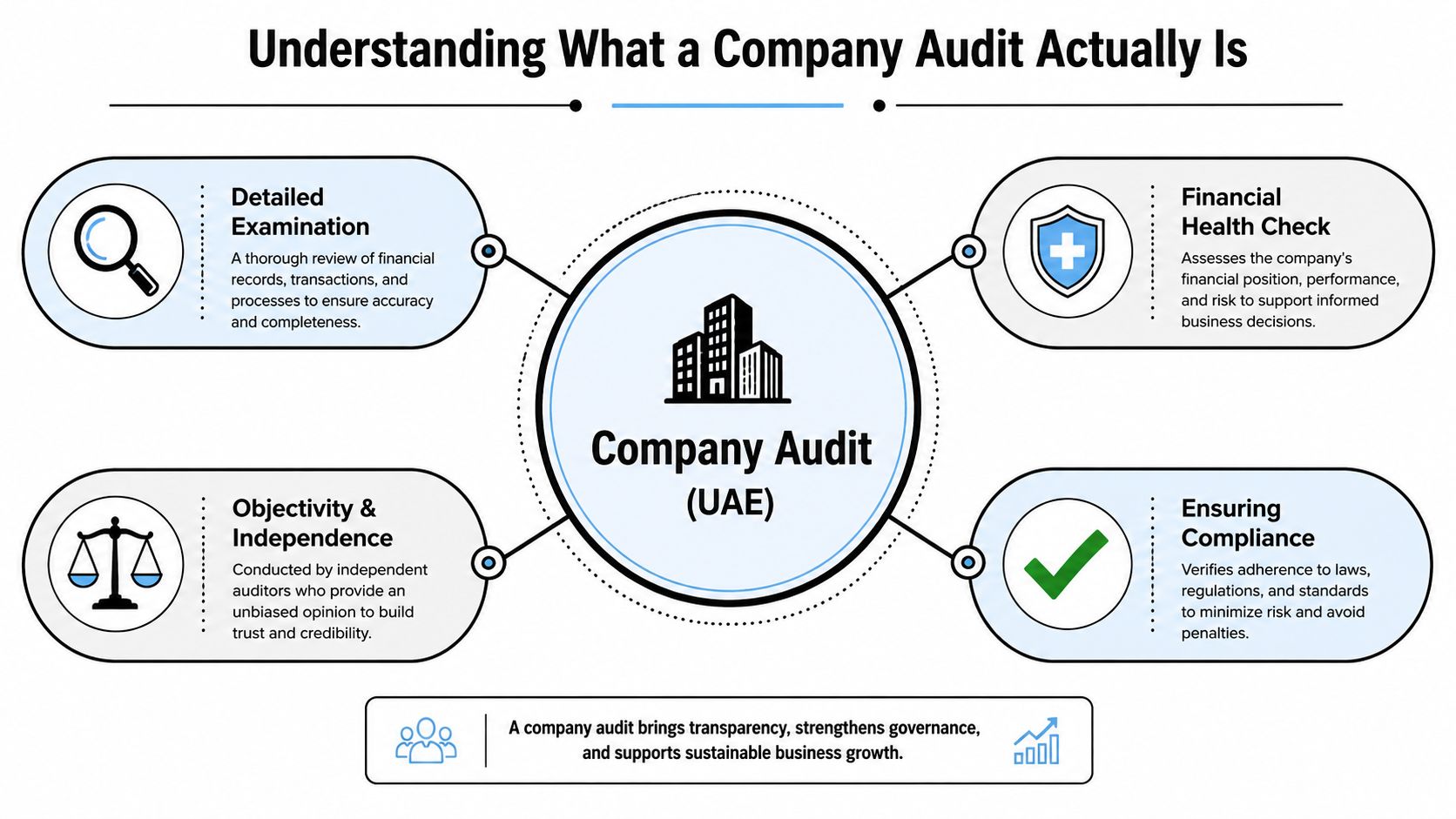
Your invoices are filed, suppliers are paid, payroll is tracked, and the bookkeeper has prepared the accounts. It is natural to see the finance work as finished. An audit starts with those records and tests whether they support the story told by the financial statements.
A company audit is an independent examination of financial statements and supporting records by a licensed auditor. Beyond totaling invoices, the auditor assesses whether the statements present the company's financial position fairly and whether the evidence supports the reported figures. In the UAE, this work covers the balance sheet, profit and loss account, related-party transactions, the Commercial Companies Law, and the company's articles of association. Federal Decree-Law No. 32 of 2021 sets out the requirement for every joint stock company and limited liability company to appoint one or more auditors for an annual audit.
The roles are different. A bookkeeper records transactions. The finance team prepares reports. An internal reviewer may test procedures for management. The external auditor examines evidence independently and issues a formal opinion for people outside the day-to-day finance function. That opinion gives shareholders, lenders, regulators, and other users a clearer basis for evaluating the accounts.
What the auditor examines
The scope varies by company, but the auditor commonly reviews:
- Financial statements: The balance sheet, profit and loss account, cash flows where applicable, and related notes.
- Transaction evidence: Sales invoices, purchase documents, bank records, payroll information, contracts, and payment approvals.
- Related-party activity: Transactions involving owners, directors, connected companies, or other related parties.
- Legal compliance: Whether the accounts and relevant practices align with the law and the company's constitutional documents.
- Financial judgement: Revenue recognition, provisions, asset values, liabilities, and evidence supporting going-concern assumptions.
The outcome is an audit opinion, not a simple approval stamp. It explains whether the financial statements are materially fairly presented under the applicable reporting framework. UAE mainland audited financial statements are prepared under IFRS and signed by a licensed auditor, as described in UAE audit requirements and filing guidance.
Practical rule: A clean accounting file makes the audit easier, but it does not replace the auditor's independent examination.
If you need suitable professionals, an auditor hiring platform can help compare options. Confirm the auditor's licensing, experience, independence, and familiarity with your company's jurisdiction before making an appointment.
Three Triggers That Make an Audit Mandatory in the UAE
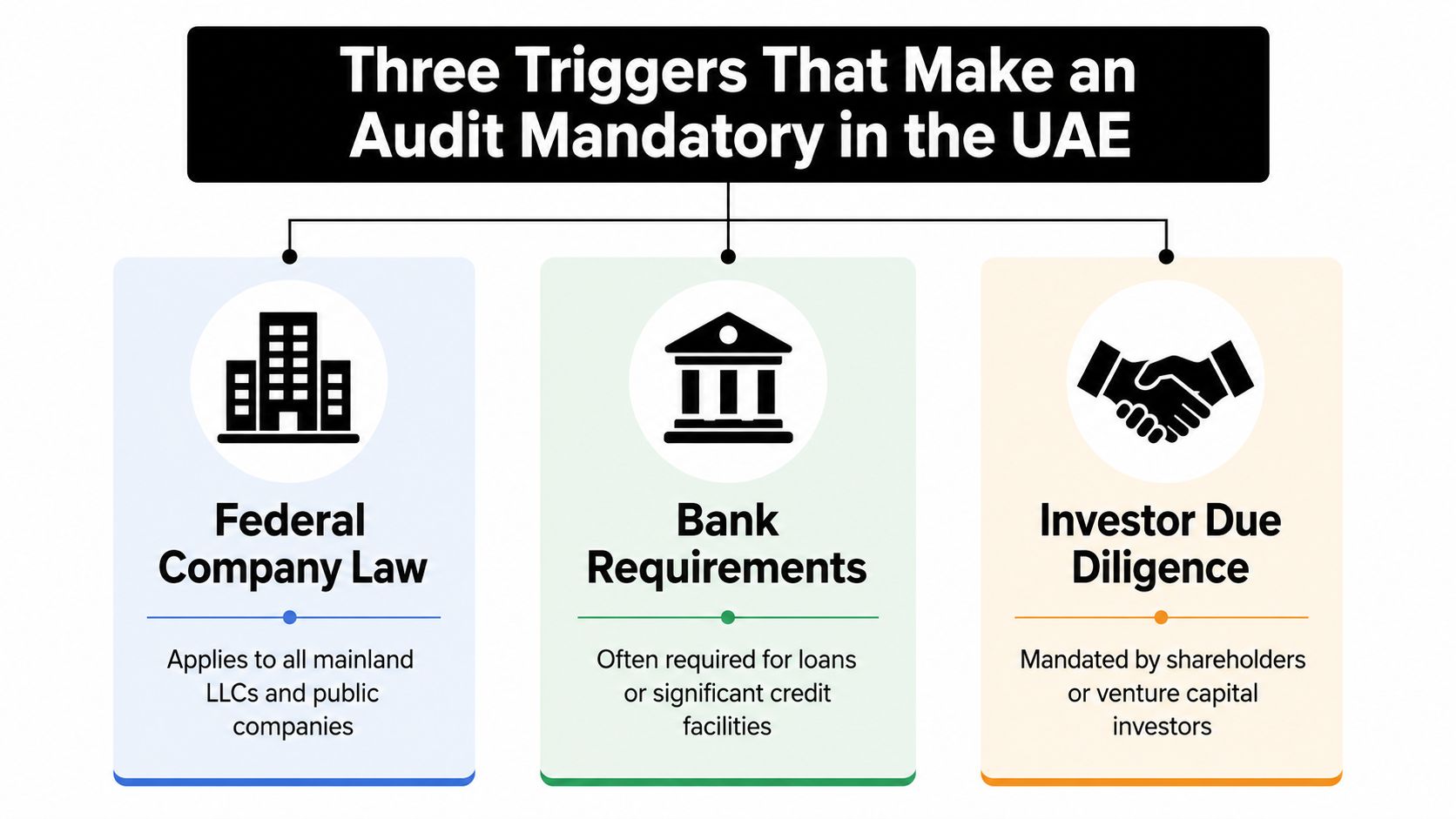
Audit obligations in the UAE come from different sources. Treating them as one universal rule creates avoidable confusion, particularly for businesses operating through a free zone or a tax group.
Use this decision framework.
First trigger, company law
If your business is a mainland limited liability company or joint stock company, company law is the starting point. Federal Decree-Law No. 32 of 2021 requires each LLC and joint stock company to appoint one or more auditors to audit its accounts annually. The obligation therefore isn't limited to large listed businesses. It reaches common structures used by entrepreneurs and SMEs. The UAE Commercial Companies Law also connects the auditor's responsibilities with the balance sheet, profit and loss account, related-party transactions, and compliance with the law and articles of association.
This means a mainland LLC may need an annual statutory audit even if its revenue is below the corporate tax audit threshold.
Second trigger, free zone licensing
Free zones operate under their own licensing and administrative requirements. Many free zone entities need audited financial statements for licence renewal, while qualifying free zone persons must maintain audited financial statements to support their 0% corporate tax position. The exact requirement depends on the relevant free zone authority and the company's status.
Ask your free zone authority or adviser a precise question: “Are audited financial statements required for my licence renewal, and what reporting period and format do you accept?” Don't assume that a company-law exemption, if one applies to your structure, removes a licensing requirement.
Third trigger, corporate tax
Corporate tax creates a separate audit question. Ministerial Decision No. 84 of 2025 requires audited financial statements for a taxable person outside a tax group whose revenue exceeds AED 50 million in the relevant tax period, and for qualifying free zone persons. The decision applies to tax periods starting 1 January 2025 and replaced the prior rule. Read the Ministry of Finance decision.
Tax groups also need attention. Audited special purpose financial statements are required for tax groups regardless of consolidated revenue under the guidance summarised in UAE statutory audit procedures.
A practical decision tree looks like this:
- Is the entity a mainland LLC or joint stock company? Start with the annual company-law audit obligation.
- Is it registered in a free zone? Check licence renewal rules and qualifying free zone conditions.
- Does revenue exceed AED 50 million for the relevant tax period? Assess the corporate tax audit requirement.
- Is the business part of a tax group? Confirm whether special purpose audited financial statements are required.
- Is revenue AED 3 million or less and the entity eligible for Small Business Relief? Relief may apply until 31 December 2026, but it doesn't remove every bookkeeping or statutory-record obligation. Crowe's explanation of Ministerial Decision No. 84 of 2025 provides the relevant context.
For a broader comparison of how compliance deadlines can differ across jurisdictions, Nexist's Australian SME tax deadlines guide offers useful background, although UAE founders must apply UAE-specific rules to their own structure.
Types of Company Audits and When Each Applies
Not every financial review has the same purpose. A statutory audit, an internal audit, and a tax-focused audit may involve overlapping records, but they produce different outcomes and serve different audiences.
| Audit Type | Trigger | Scope | Deliverable |
|---|---|---|---|
| Statutory audit | Company law, structure, or applicable licensing rule | Annual financial statements and relevant legal and financial records | Independent audit report and audited financial statements |
| Corporate tax audit | Revenue above the applicable threshold, qualifying free zone status, or tax group requirements | Records supporting tax reporting and financial statement preparation | Audited financial statements or special purpose financial statements |
| Internal audit | Management's risk, control, or operational needs | Processes, controls, systems, compliance, and selected business activities | Internal findings, recommendations, and corrective actions |
| Special-purpose audit | A specific regulatory, shareholder, lender, or tax requirement | A defined financial question or reporting basis | Report designed for the stated purpose |
| Review engagement | A lower-assurance request where a full audit isn't required | Limited procedures and management explanations | Review conclusion, not a full audit opinion |
Statutory audit
A statutory audit is the formal external examination required by law or a licensing authority. It's designed for users such as shareholders, regulators, banks, and other stakeholders who need independent assurance over the financial statements.
Tax-related audit
A corporate tax audit requirement doesn't necessarily create a completely separate set of books. Instead, it increases the importance of audit-ready revenue records, complete supporting documents, tax adjustments, and evidence supporting reported results. A high-turnover business needs controls that allow the auditor to trace revenue from contracts and invoices through the accounting records and financial statements.
Internal and special-purpose work
An internal audit is commissioned by management to assess risks, controls, and processes. It can identify weaknesses before an external audit, but it doesn't replace a statutory audit signed by an independent licensed auditor.
A special-purpose engagement may focus on a defined question, such as a tax group's reporting requirement, a lender's information request, or a shareholder transaction. Its scope must be agreed clearly because a report prepared for one purpose may not satisfy another authority.
A review engagement sits below a full audit in assurance. The practitioner performs limited procedures and provides a conclusion based on that work. If your bank, free zone, regulator, or tax adviser asks for “audited financial statements”, don't assume a review will be accepted. Confirm the required deliverable before appointing the professional.
The Audit Process from Engagement to Final Report
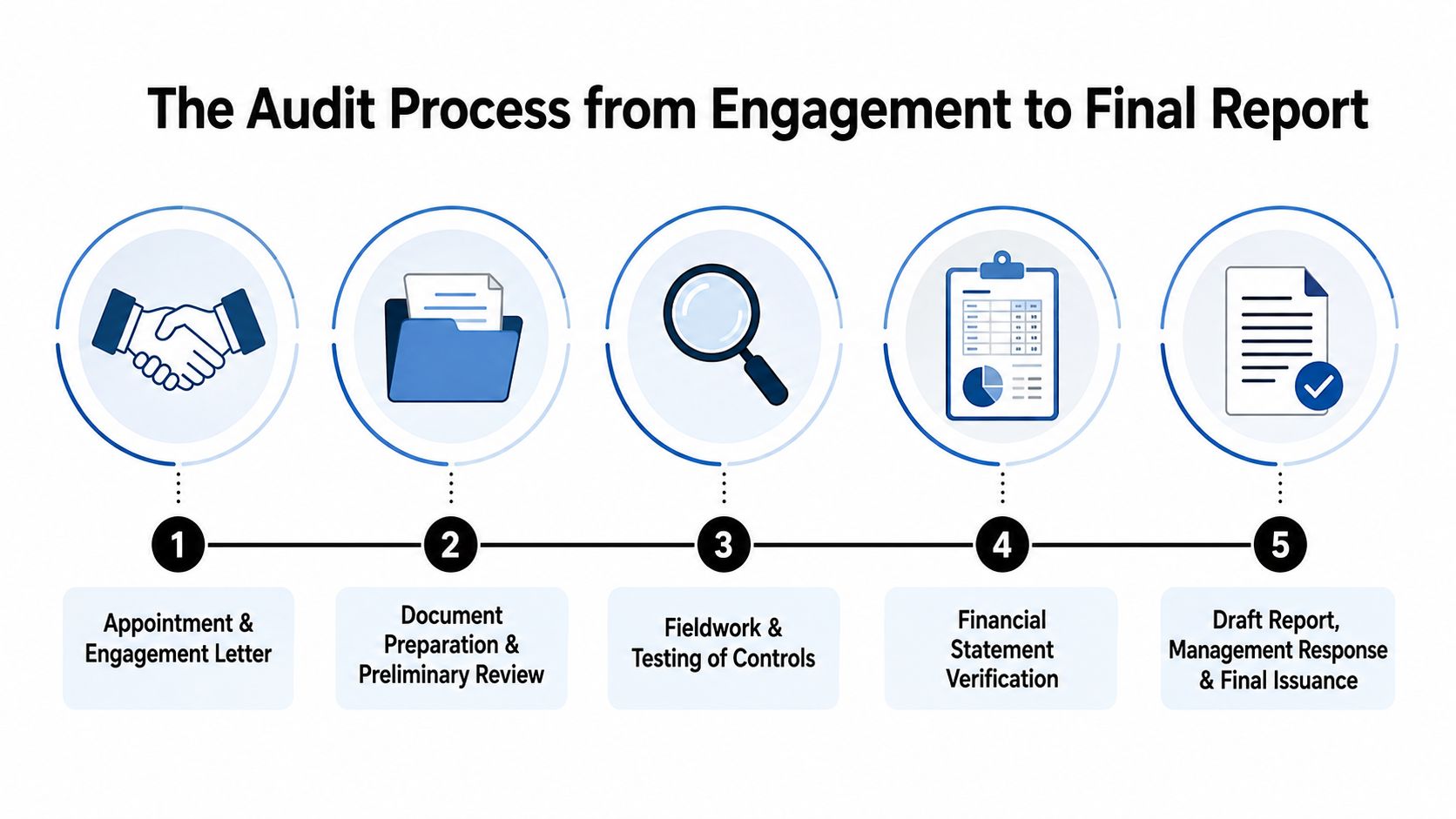
An audit follows a sequence that becomes easier to manage once each stage has a clear purpose. Management and the auditor work through an organised engagement, with responsibilities on both sides and regular communication throughout.
Appointment and planning
The company appoints a licensed auditor and signs an engagement letter. This document should set out the reporting period, applicable reporting framework, management's responsibilities, expected deliverables, access to records, and communication arrangements.
The auditor then builds an understanding of the business. They review revenue streams, bank accounts, inventory where relevant, related-party transactions, significant contracts, accounting systems, and areas where the financial statements could contain material errors. Good planning gives the company time to resolve gaps before fieldwork begins. Incomplete records usually lead to more requests and a more difficult closing stage.
Fieldwork and evidence
During fieldwork, the auditor requests records and tests selected transactions and balances. The business may need to provide:
- Core accounting records: Trial balance, general ledger, reconciliations, journals, and financial statement drafts.
- Commercial evidence: Sales contracts, invoices, purchase documents, supplier statements, and customer balances.
- Banking and payroll evidence: Bank confirmations, statements, payment listings, salary records, and relevant employment documentation.
- Ownership and governance records: Shareholder information, board or management approvals, and related-party schedules.
- Tax information: Corporate tax calculations, elections, schedules, and supporting reconciliations where relevant.
The auditor may ask management questions, inspect documents, compare balances, and test whether controls operated as described. Prompt answers help keep the work focused. Management should also explain unusual transactions clearly, rather than leaving the auditor to reconstruct the underlying story.
For UAE companies subject to the applicable filing rules, audited financial statements should be prepared under IFRS, signed by a licensed auditor, and filed within four months after the financial year-end. Confirm the exact requirement for your company's legal form and licence, as noted earlier in the discussion of UAE audit obligations.
Completion and opinion
Near completion, the auditor discusses proposed adjustments, outstanding evidence, management representations, and control or reporting matters. The final opinion may be unmodified, or modified if a material issue exists or sufficient appropriate evidence could not be obtained. The meaning depends on the circumstances, so management should ask the auditor to explain the report in plain English.
For a practical explanation of the stages, see this guide to the external audit process. Keep books closed regularly, reconcile accounts, and preserve evidence throughout the year. That routine makes the final reporting stage easier to complete.
Common Audit Findings and How to Prevent Them
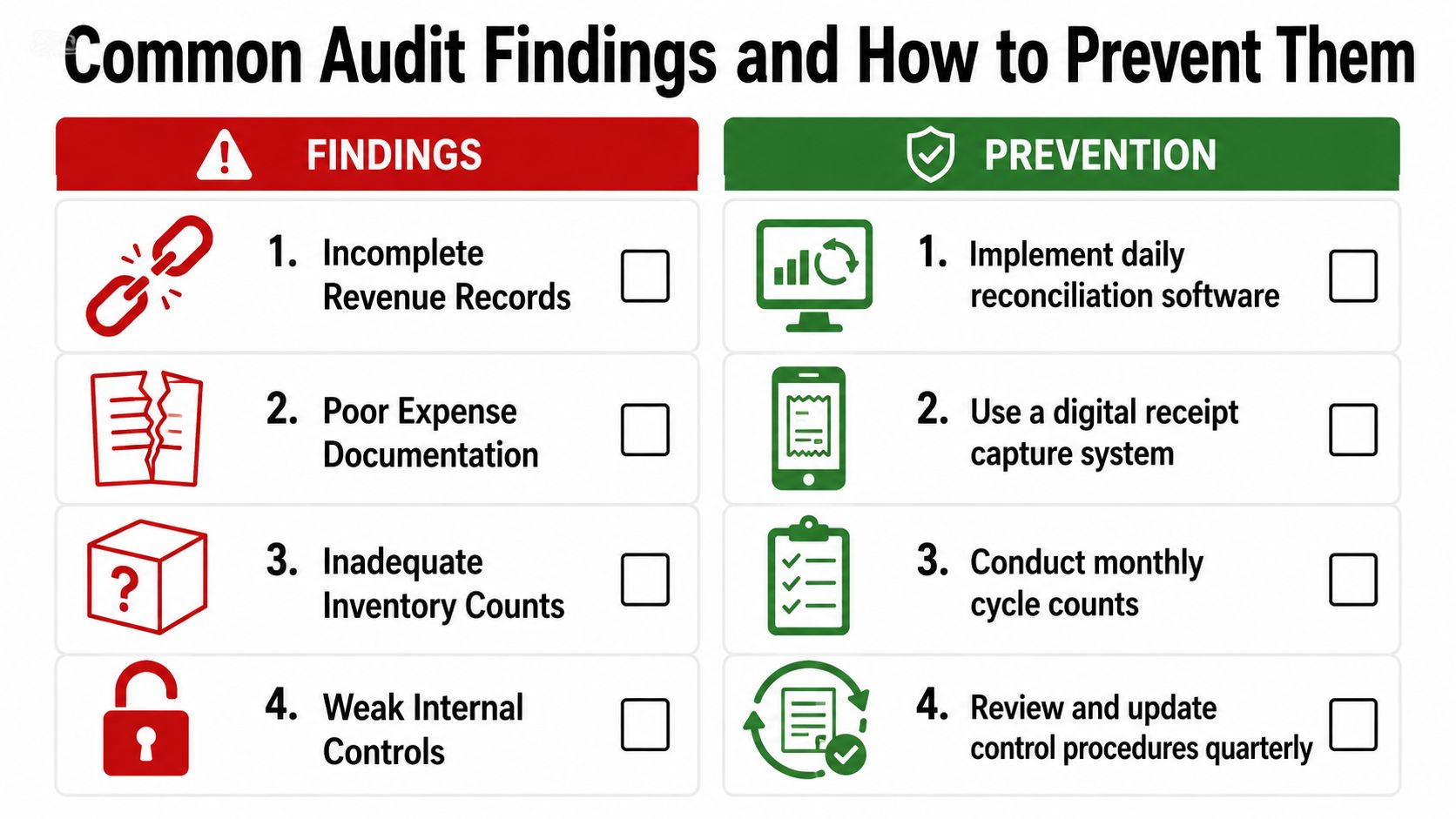
Audit findings often originate from routine business habits such as late invoicing or informal related-party transactions. A sales team may issue an invoice after delivery, a director may pay a company expense from a personal account, or a supplier document may remain in an email inbox. Months later, the auditor sees an incomplete trail rather than one isolated mistake.
Build a repeatable evidence process into daily finance work instead of waiting for the auditor's request list.
Revenue records that don't tell the full story
Auditors need to connect recorded revenue with contracts, invoices, delivery evidence, receipts, and cut-off decisions. Missing invoices, unexplained credit notes, or inconsistent customer balances make revenue difficult to verify. For businesses approaching the corporate tax threshold, complete revenue records also matter because reported turnover can affect the audit scope.
Use a daily reconciliation process. Match sales-system records with invoices, bank receipts, and the general ledger. Keep a written explanation for unusual adjustments, cancelled invoices, and transactions recorded near year-end.
Expenses without supporting evidence
An expense may be genuine but still difficult to audit if its invoice, approval, contract, or payment evidence is missing. Digital receipt capture helps staff submit documents when they make a purchase. Clear approval rules show who authorised the cost and why.
Attach documents to the accounting entry rather than leaving them across personal email accounts. A monthly review can identify missing evidence before the external auditor requests it.
Related-party transactions left informal
Owners and directors may move funds between personal and company accounts or transact with connected businesses. The accounting entry alone does not explain the commercial terms, approval, balance, or settlement plan.
Maintain a related-party register. Record the parties involved, transaction nature, amount, terms, approvals, and outstanding balances. These transactions also connect with the auditor's statutory work under the Commercial Companies Law, as outlined in Federal Decree-Law No. 32 of 2021.
Going-concern evidence gaps
A profitable-looking income statement does not by itself show that the business can meet future obligations. Auditors may need management's assessment, cash-flow information, financing evidence, budgets, and explanations for overdue liabilities or dependence on a small number of customers.
Prepare a rolling cash-flow view and document its assumptions. If the business faces pressure, discuss it early with the auditor rather than withholding difficult information.
For VAT record discipline, use this VAT compliance checklist alongside the broader accounting close process.
How Smart Classic Supports Your Audit Readiness
A founder preparing for licence renewal discovers that the books are incomplete, related-party balances are unclear, and tax records sit in separate files. The audit then becomes a rushed search for evidence. Readiness works better as a year-round routine: keep VAT-compliant books, reconcile accounts, document transactions, and review reporting duties before a filing deadline appears.
Smart Classic Business Hub connects company formation and PRO services with audit coordination and VAT-compliant bookkeeping. It can also support corporate finance decisions, feasibility work, and liquidation planning, giving a UAE business one point of contact as its needs change. A new mainland structure may require formation guidance and statutory reporting. A free zone company may need licence renewal support and audited statements, while a growing group may need records arranged for tax and management reporting.
Digital controls improve preparation when they show who changed a record, when it changed, and which evidence supports the entry. Reviewing governed finance workflows with audit trails can help a business assess how controlled processes support accountability while leaving judgement with its advisers.
Choose an adviser who can separate company-law compliance, free zone licensing, and corporate tax requirements. Smart Classic's guide to auditing firms in the UAE offers a way to frame that choice around your entity, jurisdiction, and reporting purpose instead of price alone.
Start by recording your entity type, jurisdiction, tax group status, revenue position, financial year-end, and filing destination. This review can show whether an audit is required for statutory compliance, licence renewal, corporate tax, stakeholder confidence, or several purposes.
Smart Classic Business Hub can organise VAT-compliant accounting records, prepare statutory and tax-related audit materials, and coordinate reporting for your UAE structure. Visit Smart Classic Business Hub to request a consultation.