
A popular shortcut says to search for a “SAIF Zone company list,” copy the names into a spreadsheet, and start contacting businesses. That approach is useful for discovery, but it's weak for due diligence. A company name alone won't confirm whether the business is active, which activity it's licensed for, whether the contact details are current, or whether the entity is suitable as a supplier, partner, or acquisition target.
SAIF Zone was established in 1995 and is described by the authority as the world's first ISO 9001 certified free zone and the first free zone area located within an international airport in the UAE. Official materials state that it hosts over 8,000 companies from 160 countries, while a UAE Ministry of Economy filing records 6,399 licensed companies at the time of that filing, with commercial, industrial, and services entities represented (SAIF Zone overview, UAE Ministry of Economy document). Those different figures reflect different reporting contexts, not a reason to treat every online directory as a complete registry.
The practical record you need should contain the company name, business activity, licence type, establishment year where available, contact details or website, short description, and verification notes. Use the sources below in a workflow: discover names, cross-check details, contact the company, and document the source and date of every result.
1. SAIF Zone Investors Directory Official
The official SAIF Zone Investors Directory is the strongest starting point when the purpose is more serious than lead generation. It's connected to the authority responsible for businesses operating in Sharjah Airport International Free Zone, so it should be your first reference for confirming whether a name belongs in a formal due-diligence file.
The directory may not behave like a fully open, downloadable master database. That limitation matters. Finding a broad list may require an enquiry, a confirmation request, or an official extract rather than a simple browse-and-export process.
Practical rule: Treat third-party directories as discovery tools. Treat SAIF Zone confirmation as the authority-level step.
Use the directory when you need to:
- Confirm the entity name: Check the legal spelling before sending contracts, purchase orders, or partnership documents.
- Validate licensing information: Ask for confirmation of the relevant licence details and registered activity where the decision requires it.
- Resolve conflicting records: Use the authority as the tie-breaker when a directory, website, and company profile show different information.
- Document a compliance decision: Save the response, extract, or confirmation with the date and the person or department contacted.
This source is less convenient for building a large outreach list, but its strength is data integrity. If you're assessing a supplier, distributor, investor, or potential partner, convenience shouldn't outrank authority confirmation. Businesses also reviewing office options can place the directory work alongside practical research into offices in Sharjah, but office suitability doesn't replace licence verification.
2. SAIF Zone Official Website
The SAIF Zone official website functions as a central hub for authority news, announcements, licensing information, forms, rules, and contact routes. Use it to understand the operating context around a company, then match that information against the entity's own documents and direct replies.
News and announcements can identify newly signed investors, facility developments, and sector initiatives. They provide useful discovery signals, but a mention does not confirm that a business currently holds an active licence. The page may omit the company's full legal name, registered activity, licence details, or present status.
Use the website to narrow the question
Start with the business requirement rather than a company name. A procurement team seeking a logistics provider needs different checks from a founder comparing entity structures. Reviewing the authority's activity and licensing information first helps define the questions you will ask a potential supplier, distributor, or partner.
The site can help you:
- Interpret licence categories: Compare commercial, industrial, and services activities before assessing whether a company appears suitable.
- Find official contact channels: Send enquiries through authority-provided routes instead of relying only on a phone number copied from a directory.
- Review setup requirements: Founders can examine the relevant forms and rules before choosing an entity structure or preparing an application.
- Track recent signals: News pages may point to companies or sectors that warrant further research.
Use the website for authority context and enquiry routes. Use a company's licence, registration documents, current contact response, or formal authority confirmation to verify its activity and status.
Official materials describe an international business ecosystem and reported company inflows and activity across the zone's business parks (SAIF Zone investor information). That context supports market mapping, but it does not make an announcement a live company register. For founders comparing free zones in Sharjah, the same workflow applies: review jurisdiction requirements, shortlist suitable activities, and confirm the entity and licence through authoritative evidence before committing funds or signing agreements.
3. SAIF Zone Official LinkedIn Page
The SAIF Zone LinkedIn page is a real-time discovery feed for investor activity, memoranda, events, facility expansions, and sector developments. Authority posts can identify companies before they appear in independent directories. Search the page by company name, product category, or sector keyword, then record each relevant post for follow-up.
Use LinkedIn for trend mapping and activity signals. Posts may reveal businesses involved in logistics, fragrances, manufacturing, trading, or other commercial fields. Those clues help narrow searches across the official website, company pages, and external directories, but they do not establish a company's legal status or permitted activity.
A LinkedIn mention functions as a lead-generation signal; licence validity must still come from the authority.
The platform provides speed and context. A post may identify a company representative, facility, partnership, or expansion theme, giving outreach teams a clearer reason to make contact. It can also show which sectors SAIF Zone is actively presenting, which supports market mapping and partnership research.
Review the limitations before using a post for procurement or compliance:
- Promotional framing: Posts usually highlight positive developments and may omit legal details.
- Incomplete identity data: A post may use a trading name instead of the exact registered entity.
- Changing contact paths: Employees change roles, company pages evolve, and profiles may remain visible after circumstances change.
- No status confirmation: Social content cannot independently confirm current licence validity.
Record the post URL, publication date, displayed company name, and next verification action. If you need to tag a company in outreach, use this practical LinkedIn company tagging guide. Keep engagement records separate from compliance evidence. The practical sequence is LinkedIn discovery, official SAIF cross-checking, direct company contact, and written documentation. The SAIF Zone LinkedIn page can start the search, while authority records and company documentation support the final decision.
4. ArabianLocal Companies in SAIF Zone Sharjah
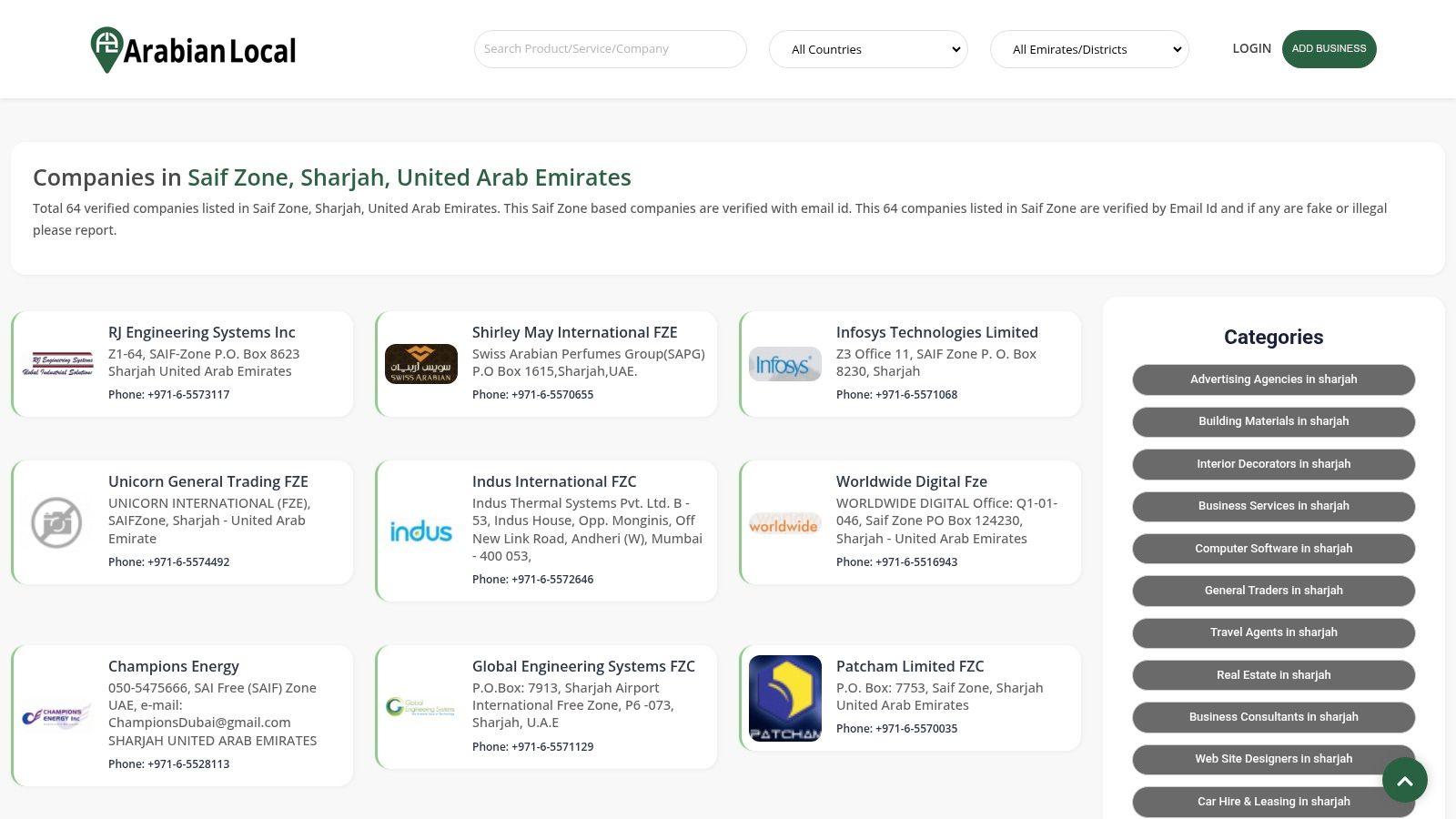
ArabianLocal's SAIF Zone directory works best as a local discovery tool. Listings may include businesses using a SAIF Zone address, with phone numbers, PO Boxes, location details, and business descriptions. That information helps procurement teams identify potential suppliers, sales teams build prospect lists, and founders map the types of businesses represented in the area.
Use the directory to create candidates, not to complete verification. A listing does not establish that a company remains active, holds a current licence, or is authorised for the activity you require. Confirm those points through an official authority response, the company's current website, or reliable company documentation before approving a supplier, sending payment, signing a contract, or proposing a partnership.
Capture these fields while screening each result:
- Exact displayed name: Keep the listed spelling and search for possible legal-name variations.
- Contact details: Record the phone number and PO Box, then confirm that the contact route still works.
- Address clues: Note the unit, building, or location reference for follow-up.
- Business description: Classify the lead by apparent activity, without treating the description as licence evidence.
- Verification status: Label the record discovered, contacted, cross-checked, or authority-confirmed.
Directory listings are updated on different schedules, so a phone number or unit reference may be months out of date. The local coverage can still expose smaller Sharjah businesses that broader international databases miss. For a dependable result, send the candidate's legal name and intended activity to SAIF Zone, then retain the written response with your procurement or outreach records.
5. Emarat.directory SAIF Zone Filter
Emarat.directory's SAIF Zone search serves as a discovery tool for companies associated with SAIF Zone. Its location and category filters reduce irrelevant Sharjah results, which helps when the search starts with a business type rather than a known legal name.
Use the filter to build targeted shortlists for categories such as tiles, MEP supply, trading, or other commercial activities. Category labels can expose potential suppliers, competitors, and partnership candidates that a general search may miss. They indicate how a listing has been classified, however, not whether the company holds a current licence for that activity.
Record each candidate's displayed name, page URL, phone number, address, and business description. Keep alternative spellings because a directory name may differ from the legal entity name. A unit or office reference can guide follow-up, while the listed contact details require testing before they support outreach or procurement.
Use it for discovery, then verify
Start with one activity keyword and the SAIF Zone location filter. Save promising records and compare the name with the company's own website and official SAIF Zone channels. The website can help assess products, markets, certifications, and response channels. It cannot, by itself, confirm licence status or current authority records.
For a practical screening log, mark each lead as:
- Discovered: found through the Emarat.directory filter.
- Contacted: a listed phone number or email produced a response.
- Cross-checked: the name and contact details matched another reliable record.
- Authority-confirmed: SAIF Zone verified the entity, activity, or status.
Coverage and freshness vary across third-party listings. A missing company may still operate in SAIF Zone, while an existing page may contain an outdated phone number, address, or category. Send the candidate's legal name and intended activity to SAIF Zone when licensing or status affects a supplier decision, partnership, payment, or company-formation plan. Retain the response with the screening record.
This filter is strongest at the top of the funnel. Treat it as a way to find candidates, not as approval evidence.
6. Yellow Pages Network Top Suppliers in SAIF Zone
Yellow Pages Network's SAIF Zone results are oriented toward supplier discovery. Listings may include descriptions, contact information, warehouse references, unit details, or external links to company websites. Those clues are valuable for procurement teams that need to find businesses with a physical presence or a particular supply capability.
The warehouse or unit reference can be more useful than a generic address. It gives a buyer a question to ask during outreach, such as whether the company still operates from that unit or whether the listed location is an office, warehouse, or registered correspondence address.
A sourcing team can use the platform in three passes:
- Build a category list: Search for the product or service rather than relying only on company-name searches.
- Group by physical clues: Separate entries with unit or warehouse references from entries with limited location detail.
- Cross-check before approval: Compare the company name, phone, website, and address with official or first-party records.
Where it falls short
Yellow Pages Network isn't an official SAIF Zone register. Its international coverage can produce inconsistent levels of detail, and a company card may not tell you when the information was last reviewed. Don't infer current activity from a listing alone, even if the page looks detailed.
Use it to discover vendors, identify possible on-ground contacts, and create a procurement pipeline. Then ask each shortlisted supplier for its legal name, relevant licence information, product scope, and current contact person. For higher-risk purchases, seek authority confirmation before treating the supplier as verified.
This source is strongest when combined with the official directory. Yellow Pages Network finds candidates, the company confirms commercial capability, and SAIF Zone confirms the regulatory record.
7. YellowPages-UAE Sharjah Free Zone Companies
YellowPages-UAE's Sharjah free-zone listings work as a UAE-focused discovery source, not as a definitive SAIF Zone register. The pages include companies registered at SAIF Zone addresses, with contact details and activity descriptions. Their local focus helps compare a company found through an official or first-party source.
Check the address before treating a result as relevant. A Sharjah free-zone page can include records from more than one jurisdiction, and a company associated with a Sharjah free zone is not located in SAIF Zone unless the address or another authoritative record confirms it.
Apply it as a cross-check
Use this directory after building a partial company record. Search the legal or trading name, then compare the listing with information from another source. Matching names, phone numbers, websites, addresses, and activities can support outreach or procurement research. The listing cannot confirm an active licence or current operating status.
Capture the result in a working sheet:
- Directory identity: Record the company name exactly as displayed.
- SAIF connection: Copy the address wording that associates the business with the zone.
- Commercial description: Note the products or services listed.
- Contact comparison: Check the phone, website, and email against other records.
- Open questions: Flag differences for direct confirmation or an authority check.
The practical value is discovery. Use the directory to find supplementary records, alternate spellings, and contact routes that are absent from other databases. Do not use it alone to make a legal conclusion about licensing, incorporation, or current activity.
Founders comparing jurisdictions can also review research on companies in Sharjah free zone. Treat that material as market context, then ask the relevant authority to confirm the company-specific record before forming a company, appointing a supplier, or pursuing a partnership.
8. Sharjah Chamber of Commerce and Industry Business Directory
The Sharjah Chamber of Commerce and Industry provides a broader emirate-level business reference rather than a dedicated SAIF Zone registry. Search by “SAIF,” address terms, company name, or business activity to identify members that may be relevant to your target list.
This source adds context that ordinary directories often lack. A chamber record can support outreach research, help identify businesses active in Sharjah's commercial ecosystem, and provide another route for comparing contact details. It can be particularly useful when a company has limited web presence but participates in local business networks.
The chamber's coverage is broader than the zone, so filtering requires care. A result connected to Sharjah isn't necessarily based in SAIF Zone, and membership information shouldn't be confused with confirmation of a free-zone licence. Some detailed services or records may also depend on the portal's access rules.
Best use cases
- B2B outreach: Identify local companies and potential introductions.
- Contact validation: Compare chamber contact details with the company website and other directories.
- Market mapping: Understand how a target sector appears across Sharjah, not only inside SAIF Zone.
- Name resolution: Find a more complete company name when a third-party listing uses a shortened version.
Add the chamber result as supporting evidence in your spreadsheet. Record whether it confirms location, membership, contact information, or only a company mention. For a supplier approval or investment decision, follow the chamber check with a direct company request and official SAIF verification. The chamber is a credible local reference, but it isn't a substitute for the licensing authority.
9. SEDD Industrial Directories
SEDD is a government reference for interpreting industrial activity and licensing context across Sharjah, rather than a ready-made SAIF Zone company list. The Sharjah Economic Development Department may provide publications or industrial directories containing company names, activity descriptions, entity types, and documentation requirements.
Its strongest use comes after discovery. If a third-party directory identifies an industrial company, compare the listed activity with SEDD's terminology and classifications. This can clarify what the business appears to do and which supporting documents to request. It still cannot confirm that the company is currently registered in SAIF Zone.
Use SEDD for interpretation
SEDD material may be published as PDFs or structured reports instead of a searchable company database. Review the document's scope and publication details before treating a result as evidence. Record the company name, stated activity, entity reference, and any documentation guidance separately from contact or licence data.
Use the source to:
- Clarify industrial terminology: Compare a company's description with official activity language.
- Map sectors across Sharjah: Identify industrial themes beyond the free zone.
- Interpret entity references: Understand forms such as FZE and FZC in context.
- Prepare document requests: Ask a candidate company for records relevant to its stated activity.
For procurement or partnership research, mark SEDD as supporting evidence for activity interpretation and Sharjah-level market mapping. Verify the company's address, contacts, current licence, and registered activities through SAIF Zone or directly with the company. This source combination separates discovery and context from formal status verification.
10. D&B Hoovers SAIF Zone Authority Profile and Related Entities
Use D&B Hoovers' SAIF Zone profile after identifying a company, not as your primary discovery source. It provides a global B2B database for firmographic details, contact research, related entities, and possible corporate connections.
This makes it suitable for building a commercial dossier around a known company. Procurement and investment teams can examine ownership clues, subsidiaries, related organisations, business descriptions, and additional contacts when the available record supports those fields.
Coverage varies significantly between companies. Some profiles are detailed, others are sparse, and full data access requires a subscription. Treat the record as enrichment, not proof that a business holds a current SAIF licence or remains active in the zone.
Apply D&B Hoovers after identity checks
The database can help you:
- Standardise company records: Reconcile name variations and corporate descriptions before comparing suppliers.
- Extend contact research: Identify additional business contacts where the profile provides them.
- Map related entities: Review subsidiaries and connected organisations for ownership or partnership research.
- Build an investor file: Add firmographic context after establishing the legal identity.
Start with SAIF Zone or another authoritative channel for formal licence and status confirmation. Then use D&B Hoovers to enrich the verified record for procurement, outreach, partnerships, or company-formation research. Compare names, addresses, activities, and contacts across the sources. If they conflict, record the discrepancy and ask the company or SAIF Zone to clarify the legal and licensing position.
Top 10 SAIF Zone Company Directories Compared
| Source | Primary value / best use (🏆) | Key features (✨) | Trust / quality (★) | Target audience (👥) | Access / price (💰) |
|---|---|---|---|---|---|
| SAIF Zone – Investors Directory (official) | 🏆 Authoritative verification for compliance & extracts | ✨ Linked to licensing unit; direct extracts; up‑to‑date records | ★★★★★ | 👥 Compliance teams, legal, auditors, consultants | 💰 Fee on request for formal extracts |
| SAIF Zone – Official Website (news/updates + contact) | 🏆 Timely announcements, rules & forms | ✨ News, licensing rules, forms, contact channels | ★★★★ | 👥 Entrepreneurs, registrars, researchers | 💰 Mostly free; official docs may incur fees |
| SAIF Zone – Official LinkedIn Page | 🏆 Real‑time signals on investors, MOUs & expansions | ✨ Frequent posts; keyword search; sector trend signals | ★★★ | 👥 Market researchers, BD, PR teams | 💰 Free; informal (verify with SAIF) |
| ArabianLocal – Companies in SAIF Zone (Sharjah) | 🏆 Fast lead‑list builder with contact details | ✨ Browseable listings; phones; PO boxes | ★★ | 👥 Sales & outreach teams, local researchers | 💰 Free/low‑cost; verify entries |
| Emarat.directory – SAIF Zone Filter | 🏆 Quick niche/category searches within SAIF | ✨ Location filter; category tags; company pages | ★★ | 👥 Recruiters, niche procurement, sector researchers | 💰 Free; coverage varies |
| Yellow Pages Network – Top suppliers in Saif Zone | 🏆 Supplier discovery & on‑ground unit references | ✨ Supplier cards; unit/warehouse refs; contact links | ★★ | 👥 Procurement, sourcing, logistics teams | 💰 Free; confirm listings |
| YellowPages‑UAE – Sharjah Free Zone Companies | 🏆 Broad free‑zone scan & cross‑check for SAIF mentions | ✨ UAE‑centric listings; activity & contact pages | ★★ | 👥 SMEs, local market researchers | 💰 Free; requires SAIF filtering |
| Sharjah Chamber of Commerce & Industry (SCCI) – Business Directory | 🏆 Credible member directory for trade validation | ✨ Official member data; searchable by keywords/address | ★★★★ | 👥 B2B introducers, exporters, trade partners | 💰 Mostly free; some member‑only details |
| SEDD – Industrial Directories (Sharjah Economic Dev Dept) | 🏆 Government sector context & licensing guidance | ✨ Industrial directories; activity codes; sector reports | ★★★★ | 👥 Policy analysts, compliance officers, investors | 💰 Free reports; often PDF/report format |
| D&B Hoovers – SAIF Zone (authority profile & entities) | 🏆 Investor‑grade dossiers & firmographic enrichment | ✨ Global B2B data; cross‑references; export/enrichment tools | ★★★★ | 👥 Investors, M&A teams, corporate research | 💰💰 Subscription / paywall for full data |
Turn Directory Results Into Verified Business Leads
A useful SAIF Zone company list is a working research file, not a copied page of names. Start by defining what you need from the search. A supplier shortlist requires product fit, contactability, location clues, and commercial responsiveness. A partner review may require ownership information, operating history, legal identity, and activity confirmation. A company-formation decision requires a different set of questions, including activity selection, entity structure, setup requirements, and ongoing compliance.
Collect names from discovery sources, but label each source by function. The official Investors Directory and SAIF Zone authority channels belong in the verification column. ArabianLocal, Emarat.directory, Yellow Pages Network, and YellowPages-UAE can help find suppliers and outreach targets. LinkedIn is useful for recent signals and sector mapping. SCCI adds Sharjah business context, SEDD helps interpret industrial activity, and D&B Hoovers can enrich records after you know which companies deserve deeper review.
A defensible workflow
- Define the target profile: Write down the required activity, product or service, location, contact role, and risk level.
- Collect candidate names: Search official announcements, LinkedIn, local directories, chamber resources, and supplier databases.
- Standardise identity: Record the legal name as confirmed, while keeping trading names and spelling variations in separate fields.
- Record supported facts: Add licence type and establishment year only when a reliable source supports them. Don't fill gaps with assumptions.
- Compare contacts: Check phone numbers, websites, emails, addresses, and unit references across sources.
- Contact the company: Ask for the current legal name, relevant activity, licence information, contact person, and business capability.
- Request authority confirmation: Escalate to SAIF Zone when the decision carries compliance, payment, investment, or reputational risk.
- Document the result: Save the URL, response, extract, publication date, contact date, and verification status.
The reason for this discipline is fragmentation. Independent pages show different partial counts, including listings of 72 businesses, 64 verified companies, and 48 companies, which demonstrates why no single scraped page should be treated as the definitive registry (explanation of fragmented SAIF Zone lists). The authority has also reported attracting over 700 international and local companies during 2024, while its official materials describe a much larger established ecosystem (SAIF Zone 2024 announcement). These figures serve different purposes. They show momentum and scale, but they don't verify an individual company.
Smart Classic Business Hub can help founders and operating companies assess free-zone setup, company formation, compliance, accounting, tax residency, feasibility, and outreach requirements through its UAE business consultancy website. That support can make the research process more practical, but it isn't a substitute for confirmation from SAIF Zone or another competent authority.
Before you approve a lead, check the following:
- Legal identity: Is the company name exact and consistent?
- Activity: Does the stated business match the activity you require?
- Licence type: Is the relevant entity or licence structure supported by documentation?
- Establishment year: Is it sourced, or has it been guessed from an old listing?
- Contact route: Do multiple sources point to the same current channel?
- Physical presence: Does the address or unit reference need confirmation?
- Status: Has SAIF Zone or another authoritative source confirmed the record where necessary?
- Audit trail: Have you recorded the date and source for every material fact?
For a broader approach to building defensible prospect records, consult this guide to verified leads for marketers. The same principle applies here: discovery creates possibilities, while verification creates a business record you can rely on.
Smart Classic Business Hub helps entrepreneurs and companies with UAE free-zone company formation, compliance, VAT-compliant accounting, feasibility work, and practical business planning. If you're turning a SAIF Zone company search into a supplier, partnership, or formation decision, visit Smart Classic Business Hub for guidance on the next steps and the documents you'll need.