
You've got the trade licence, the office lease is in motion, and the next obvious step feels like a bank account. Then the first relationship manager asks for shareholder records, Emirates ID copies, a board resolution, a source-of-funds note, and a business model summary, and suddenly the issue is no longer opening an account. It's proving to a compliance team that your company behaves like the file says it should.
That gap catches founders off guard because the UAE banking market is large, liquid, and selective. The Central Bank of the UAE’s January 2025 bulletin shows total deposits of about AED 2.136 trillion, up from AED 1.474 trillion in the earlier series shown in the same bulletin, which tells you the local system has enough depth to matter strategically for business banking relationships. At the same time, opening a corporate bank account Dubai is still a compliance-heavy process, not an administrative one. Banks ask for trade licence documents, shareholder records, Emirates ID or visa copies, and KYC material before they'll even consider approval, and the minimum deposit requirement can sit anywhere from AED 25,000 to AED 500,000, with some digital options starting at AED 0. Central Bank of the UAE national banking statistics and corporate account requirements in Dubai make the point plainly enough.
Practical rule: if the bank has to rebuild your business story from scratch, your file is already weak.
The founders who move fastest don't start at the branch counter. They start by shaping the application around what compliance wants to see: turnover, currencies, customer geography, supplier geography, and why the UAE is the operating base. That's the playbook.
Why a Trade Licence Is Not Enough
A freshly issued trade licence gives a founder confidence, but it does not create a bank relationship. I've sat through enough onboarding meetings to know how this usually goes. The licence is printed, the office is arranged, and the founder walks in expecting a simple account opening. The bank treats the file like a risk review, then sends it to compliance for a second look.
That is because the corporate bank account Dubai process is built around due diligence, convenience is secondary. UAE banks commonly want a trade licence, ownership documents, passport and Emirates ID copies for shareholders and signatories, and a source-of-funds or business-model explanation before they clear a file. Independent UAE guidance also says traditional banks usually take 2 to 6 weeks rather than same-day onboarding, and slow or unclear responses are a major cause of delay. UAE business bank account onboarding guidance lines up with what compliance teams ask for.
What founders underestimate on day one
The first mistake is treating the licence as the main event. The bank wants to know whether the business activity matches the declared customer base, whether the company can justify incoming and outgoing payments, and whether the ownership structure is transparent enough to pass KYC and AML review.
The second mistake is waiting until the meeting to assemble the file. By then, the relationship manager is only an interface, not the decision-maker. The file needs to survive compliance review without the founder standing there to explain every line. If the business model is vague, the bank reads that as risk. If the transaction story changes from one document to the next, approval gets harder.
Why the market itself matters
The scale of the UAE banking system means banks can afford to be selective. Deposits are deep, competition is real, and compliance standards are not soft just because the market is business-friendly. That is why a corporate account in Dubai is treated as a milestone, not a formality.
Founders who get approved fastest do one thing early. They shape the application around what compliance wants to see, turnover, currencies, customer geography, supplier geography, and why the UAE is the operating base. The licence opens the conversation, but the bank only opens the account when the story, ownership, and transaction logic all fit together.
Choosing the Right Entity Type for Banking
The structure you choose at incorporation shapes bank appetite long before the application lands on a compliance desk. Mainland, free zone, and offshore companies all exist for different commercial reasons, but banks look at them through a different lens, one that is built around risk, transaction profile, and expected operating footprint. If you pick the wrong structure for the way you trade, you can make onboarding harder than it needs to be.
Mainland, free zone, and offshore from a banker's point of view
Mainland companies usually have the broadest access to UAE banking, because they can trade across the local market. Banks still scrutinise them closely, though, because local activity can mean a wider range of counterparties, payment patterns, and sector exposure. That makes the declared business activity and customer profile especially important.
Free zone companies are popular with foreign founders because they often fit international trading models and allow full foreign ownership. Banks generally accept them, but some free zones and activity codes trigger more scrutiny than others, especially when the capital source, supplier geography, or payment corridors look unusual. If your company is international in practice, the bank will want proof that the structure fits that reality.
Offshore companies are a different case. They're usually designed for holding or international purposes, and they often struggle to open fully operational UAE accounts. In practice, many offshore entities end up looking for specialist or international banking solutions instead of standard local operating accounts.
For readers comparing ownership and operational flexibility, the legal structure itself matters as much as the bank. A clear overview of sole proprietor versus LLC structures in Dubai helps founders avoid choosing an entity that looks tidy on paper but awkward in banking.
How jurisdiction changes approval odds
A residency visa is helpful, but it's not always mandatory. Still, having at least one UAE-resident shareholder or signatory often improves approval speed and bank appetite, particularly with tier-1 institutions. That matters because a bank can approve a file faster when the operational base feels anchored in the UAE.
A useful internal test is simple. If the entity type, activity code, and expected payments don't point in the same direction, the application will feel forced. If they do, the file looks like a real operating business, which is what the bank wants to see.
Building Your KYC Dossier the Right Way
A bank officer usually starts by checking whether the file tells a clean story. They want to see the company's legal status, who owns it, who can sign, and whether the activity profile makes sense for the account being requested. If those pieces arrive in the right order, the file reads like a real operating business instead of a stack of unrelated PDFs.
Put the dossier in bank order, not founder order
Start with the trade licence, because that establishes the company's legal existence. Then add the MOA or shareholder agreement, followed by the board resolution that authorises the account opening and names the signatories. After that, attach passport copies and Emirates ID or visa copies for shareholders and signatories, then proof of address and any source-of-funds documents.
A short business profile should sit near the front of the pack, not buried at the end. It should explain what the company sells, who pays it, which currencies it expects to receive, and which countries sit at the centre of its customer and supplier network. Banks use that information to decide whether the case belongs with a digital-first product or a relationship-managed review.
If the file includes supporting corporate documents, place them where they help the bank verify ownership and continuity. Include your certificate of good standing alongside the MOA and shareholder agreement if the structure calls for it. That order helps the reviewer connect the legal entity to the people behind it without hunting through the file.
Keep the declared transaction profile consistent with the invoices, contracts, and payment corridors already visible in the file.
What the business-model note must answer
The business-model write-up does not need marketing language. It needs operational clarity. If monthly receipts come from one region and supplier payments go to another, say so plainly. If you expect low transaction volume, say that too, because overpromising activity is one of the fastest ways to trigger extra questions.
The note should also explain how compliance can read the source of funds without guessing. If the business is funded by shareholder capital, retained earnings, or a clear commercial pipeline, say which one applies and show the supporting documents in the same sequence. A file that makes the funding trail easy to follow tends to move faster than one that forces the bank to infer the story.
fintech compliance with OneSafe can be a useful reference point for founders who want to see how AML and KYC logic is organised in practice, especially when they are assembling documentation for a bank review. The broader principle is the same, compliance teams want a file that explains the company before they have to interrogate it.
A practical example matters here. I have seen a founder prepare a turnover note that matched the actual invoicing pattern instead of the aspirational sales target she wanted to project. That single adjustment removed the need for several clarification emails and cut the approval process by about two weeks in practice, because the bank no longer had to reconcile the story against the evidence.
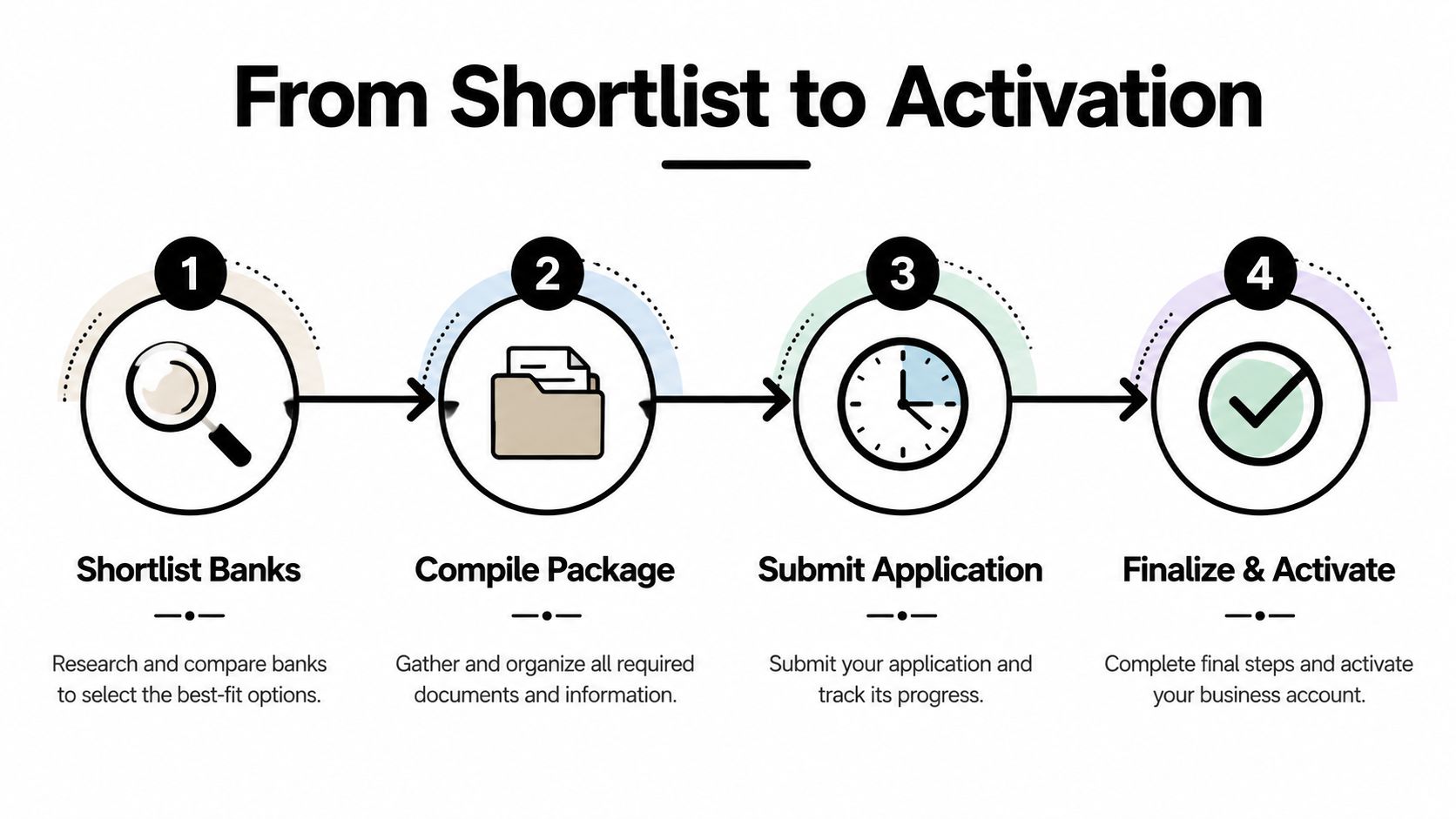
From Shortlist to Activation
A bank application looks like one event from the outside. In practice, it is a sequence of decisions, and each one can be handled well or badly. Founders who treat it like a workflow usually get a cleaner result than founders who send the same file to six banks and hope one of them bites.
Shortlist first, then submit once
Pick one or two banks whose risk appetite fits your entity type, activity code, and payment pattern. That approach is safer than firing the application at multiple banks at once, because repeated simultaneous applications can itself raise questions in compliance systems. The aim is not to create volume, it is to create fit.
Use the shortlist to map the bank to the business model. A consulting company with modest activity should not chase the same product tier as a trading firm with frequent cross-border transfers. The file needs to match the institution, not the other way round. A helpful comparison of good banks for business accounts in Dubai can support that matching exercise.
The interview and compliance phase
Once the file is submitted, the relationship manager usually guides the process, but the true approval decision rests with the compliance team. The test comes when compliance asks for clarification on turnover, counterparties, currencies, or source of funds. If you answer slowly or vaguely, the file cools down. If you answer quickly and consistently, you keep the review moving.
That is why traditional banks do not move at the same pace as a basic digital sign-up. The timing itself is not the main issue. Rework is. A clean dossier, a clear interview, and fast responses usually do more for speed than chasing the bank that sounds quickest in the market.
A good application does not just answer questions, it prevents the wrong questions from appearing.
What activation really means
Activation is not just approval. It is the point at which the account is funded, operational controls are set, and the company can start using it for payments and payroll. If the bank asks for more information at the end, treat that as part of the same process, not a separate inconvenience.
One useful resource for teams that want to examine banking workflows in operational terms is the DataLunix ServiceNow banking overview, because the process mindset matters as much as the documents themselves. Bank onboarding is a workflow, and workflows reward organisation.
A practical example matters here. I have seen a founder prepare a turnover note that matched the actual invoicing pattern instead of the aspirational sales target she wanted to project. That single adjustment removed the need for several clarification emails and cut the approval process in practice, because the bank no longer had to reconcile the story against the evidence.
Matching Bank Tier to Your Cash Flow
A Dubai corporate account should match the way the business moves money. A startup with a thin, uneven transaction pattern will not be served well by a bank that expects heavier balances and more explanation, while a company with repeat local receipts may find a basic setup too limited. In practice, the wrong tier creates avoidable friction from the first review onward.
The three practical tiers
Digital-first and neo-bank products usually suit startups and lower-transaction SMEs. Recent UAE-focused sources, including Monetary Library's discussion of corporate banking options in the UAE, place minimum-balance expectations in the AED 0 to AED 50,000 range for this tier, which is why it remains accessible for businesses that do not need treasury-style service or large balance commitments. The paperwork may feel lighter, but the bank still checks the same core story.
Local conventional banks sit in the middle. Recent UAE-focused sources, including Monetary Library's UAE corporate banking overview, place them around AED 50,000 to AED 100,000 in minimum-balance expectations, alongside full KYC and a more traditional review process that usually includes a relationship manager and in-person or video interaction. This tier fits companies with regular local operations and a steady but not excessive flow of transactions.
International and treasury-style banks sit at the top end of the market. Recent UAE-focused sources, including Monetary Library's banking guide for UAE businesses, place them at AED 100,000+ minimum-balance expectations, with deeper due diligence and a stronger multi-currency orientation. They suit businesses that already have meaningful cross-border requirements and can justify a more complex banking relationship.
Dubai corporate bank tiers at a glance
| Bank tier | Typical minimum balance | Best fit | Compliance load |
|---|---|---|---|
| Digital-first | AED 0 to AED 50,000 | Startups, low-transaction SMEs | Lighter, but still detailed |
| Local conventional | AED 50,000 to AED 100,000 | Established SMEs, local operators | Moderate to high |
| International or treasury-style | AED 100,000+ | Cross-border businesses, larger groups | Highest |
Cash flow is the practical decision point, brand familiarity should be secondary. If your monthly movement is modest and predictable, a lighter structure usually makes more sense than a prestige bank that expects a stronger balance cushion and a deeper due diligence narrative.
Choose the account that matches how the company actually trades, not the version the founder envisions for six months from now.
A lot of SMEs try to force themselves into the wrong tier because they assume a bigger name improves credibility. In banking, that usually just increases friction. The safer choice is the one the compliance team can understand quickly and the business can maintain without strain.
Why Banks Say No and How to Pre-empt It
Most rejections in Dubai are not random. They happen when the file and the business logic do not line up, or when the bank cannot quickly understand how the company will operate. Once you see that pattern, the refusal stops feeling like a personal rejection and starts looking like a procedural outcome.
The repeat failure points
A vague business description is a common problem. If the bank cannot see what the company sells, who pays it, and which countries are involved, the file looks incomplete even when every legal document is present. The same applies when the declared transaction profile does not match the activity code or when the customer geography looks high risk without explanation.
Another trigger is inconsistent interview answers. If the founder says one thing, the shareholder note says another, and the invoices suggest a third story, compliance will pause the file. The fix is straightforward in theory, but hard in practice, align every document before submission.
Undercapitalising the account is the hidden mistake many SMEs make. Some banks still impose minimum-opening or fall-below balances in a broad range, so launching too lean can create a review later even after approval. That is not just a balance issue, it is a confidence issue, and it is one reason files get pushed back before activation.
How to reduce refusal risk
- Write the business in bank language: explain what you sell, where customers are based, where suppliers are based, and which currencies you use.
- Match activity and payments: if the entity says consultancy but the transaction pattern looks like trading, expect questions.
- Prepare for risk corridors: explain any higher-risk geographies instead of hiding them.
- Keep every answer consistent: the relationship manager, shareholder memo, and invoice sample should tell the same story.
- Fund the account properly: avoid opening with a balance that immediately drifts into fall-below territory.
The key point is simple. The relationship manager may collect the file, but compliance decides whether the file survives. If you want approval, build for the reader who signs off.
Your Next Step and How Smart Classic Helps
The clean sequence is straightforward. Confirm the entity type and activity, build the bank-ready KYC dossier in the right order, shortlist one or two banks that fit the business model, submit once, answer compliance queries quickly, and only then activate payments and payroll. Everything else is noise.
A practical checklist helps founders stay focused:
- Confirm the legal structure and whether it fits the expected banking route.
- Prepare the KYC pack in bank order, not in whatever order the files happened to be saved.
- Draft the transaction profile with real customers, suppliers, currencies, and geographies.
- Shortlist the bank tier that matches the company's cash flow and balance capacity.
- Respond fast to queries so the file doesn't go cold.
If you want a structured way to handle the preparation, Smart Classic Business Hub works on the bank-facing side of the process, including entity alignment, document sequencing, transaction profile design, and introductions through trusted partners. That can save founders from treating onboarding as a guessing game and lets them stay focused on clients, operations, and revenue.
The process is work. It doesn't have to be a black box.
If you want help preparing a corporate bank account Dubai file that makes sense to compliance teams, Smart Classic Business Hub can review your entity, organise your KYC pack, and guide the bank selection process. Visit Smart Classic Business Hub to start with a practical onboarding plan built around your actual business model.