
You're in Dubai, the flights are tempting, and the trip looks simple on paper. Then the visa question lands on your desk, and the first mistake people make is assuming their UAE residence card decides everything. It doesn't, because for a Schengen visa for UAE residents, the starting point is your passport nationality, your travel dates, and where you're filing from in the UAE.
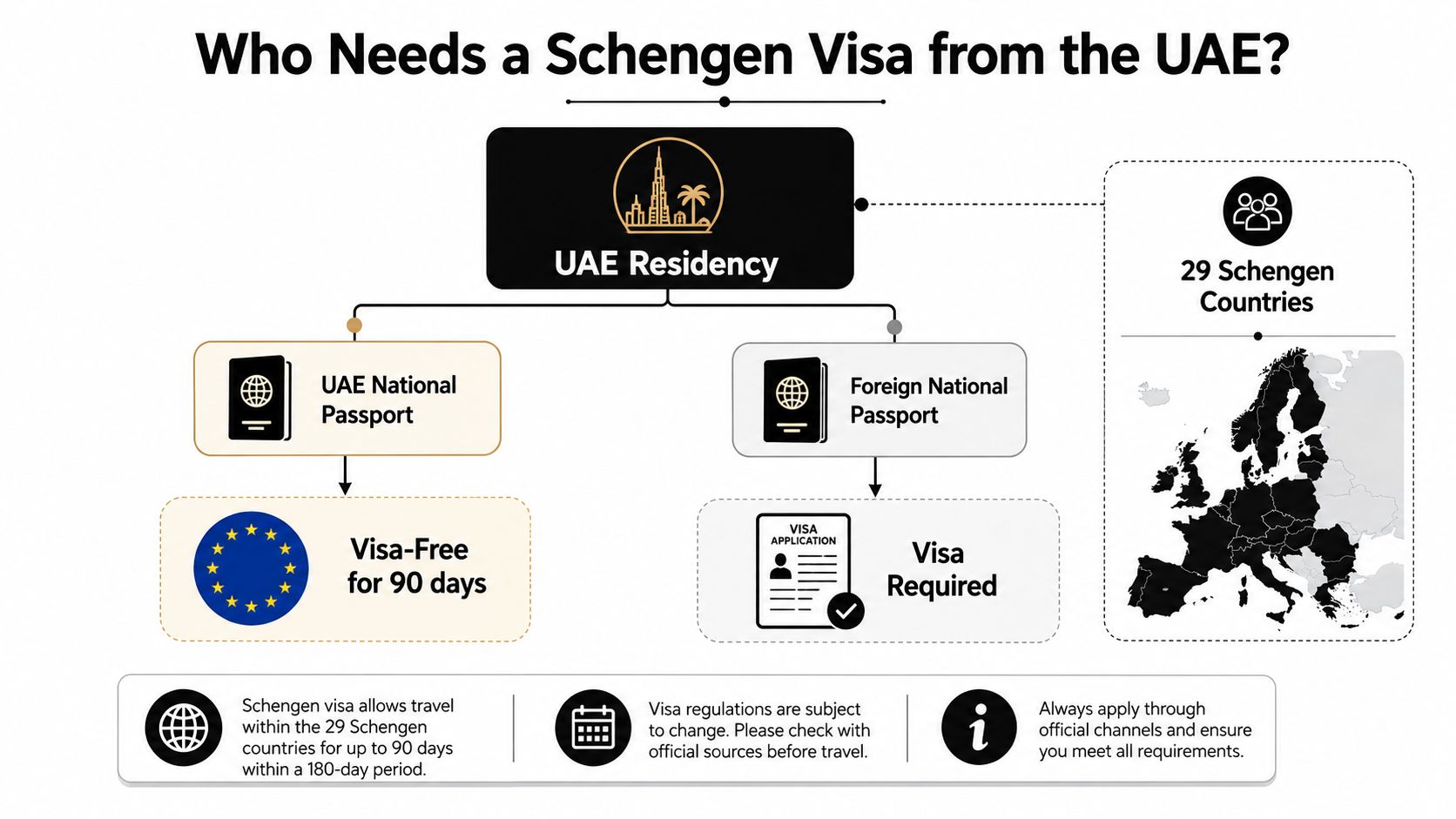
The Schengen Area now covers 29 European countries (Wego's UAE residents guide), and that matters because the rules split fast. UAE nationals can travel visa-free for up to 90 days in any 180-day period (Wego's UAE residents guide), while most other UAE residents still need a short-stay Schengen visa before departure. If you live in the Emirates, don't guess based on your Emirates ID, check the passport first.
Who Needs a Schengen Visa from the UAE
If you live in the UAE and you're planning Europe travel, start with one question, not ten. What passport do you hold? That answer decides whether you are visa-exempt or whether you need to file a Schengen application from Dubai, Abu Dhabi, or another UAE centre.
Passport nationality beats residence status
A UAE residence visa tells a consulate that you live here, but it does not change your passport nationality. One tenant in the same Dubai building can travel visa-free, while the neighbour next door needs a full Schengen file.
For UAE nationals, the position is straightforward, they can enter the Schengen Area visa-free for short stays up to 90 days in any 180-day period (Wego's UAE residents guide). For many other UAE residents, especially holders of Indian, Pakistani, Filipino, Egyptian, or South African passports, a visa is still required unless their nationality is on the exemption list. A British passport holder living in Dubai is usually in a very different category from an Indian passport holder living next door, even if both have valid UAE residency.
If your passport normally needs a Schengen visa, your UAE residence card will not change that.
Fast self-check before you spend money
Check your passport status first, and do it before you book flights or hotels. Use the passport visa check for UAE residents to confirm whether your nationality is visa-exempt. Then look at your itinerary, because if you are visa-required, the country routing and document set matter later in the process.
If you are visa-free, you do not need to build a Schengen file for short travel. If you are not, stop treating the process like a generic Europe guide and treat it like a UAE filing problem. The same residence card can lead to different filing outcomes depending on nationality and routing, and that is where most wasted time starts.
Meeting the Eligibility Baseline Before You Apply
The first rejection usually starts before anyone looks at the trip plan. In the UAE, consulates and visa centres expect your passport, residence permit, insurance, and travel dates to line up cleanly. If one piece is off, the file becomes harder to defend even before it reaches a case officer.
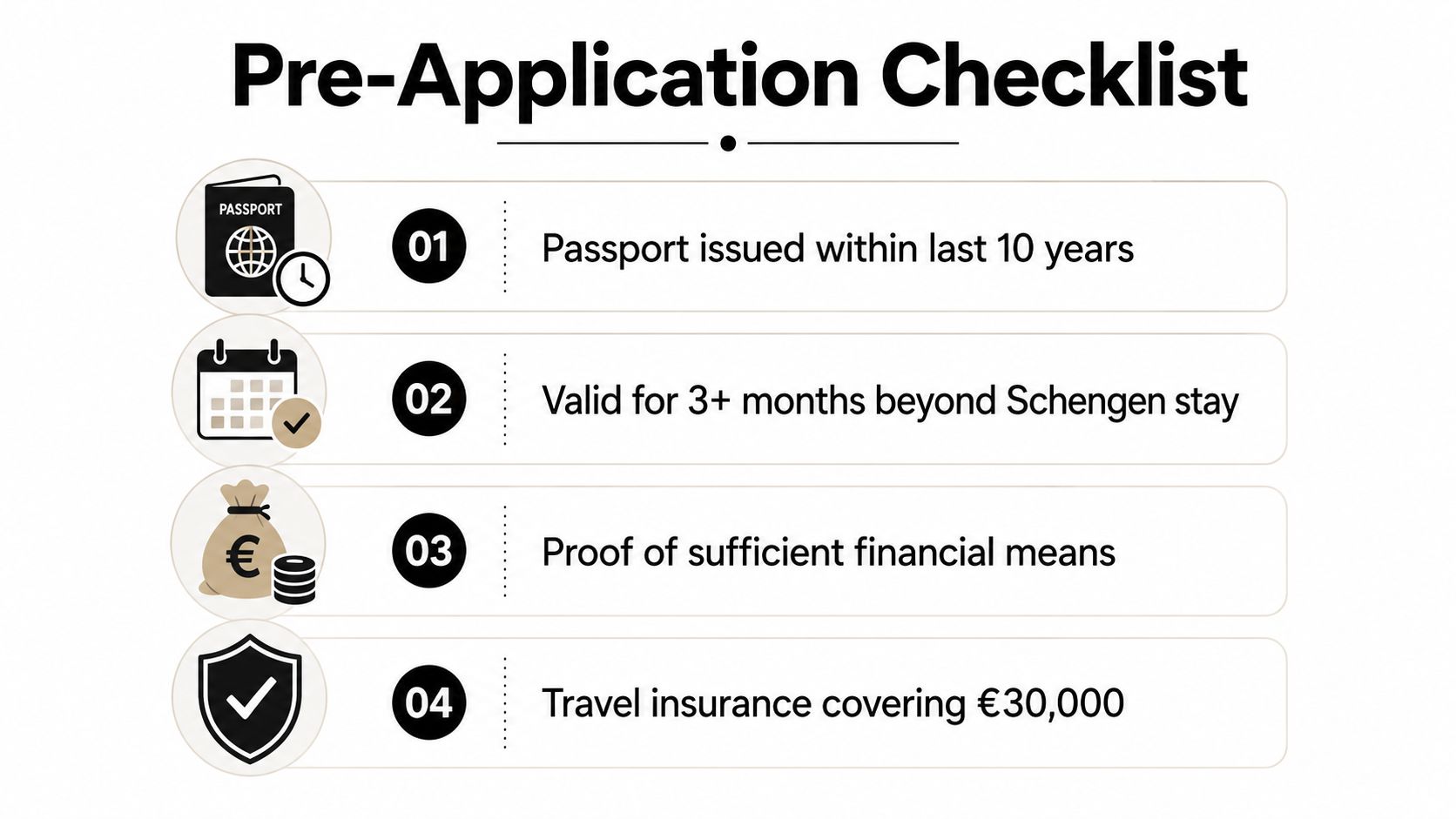
The four checks that should never fail
Your passport generally needs to have been issued within the last 10 years and stay valid for at least 3 months beyond your planned departure from the Schengen area. Your UAE residence visa should also remain valid for at least 3 months beyond your return date. For medical cover, the standard threshold used in Schengen files is EUR 30,000 minimum travel insurance (EU visa guidance).
Biometrics are the other checkpoint people mishandle. If you have already given fingerprints for a Schengen application within the last 59 months, a fresh capture may not be needed, depending on the case. That does not mean you skip the appointment. It means you confirm whether your earlier biometrics still count before you plan around a walk-in or a full submission.
If your passport status is unclear, run a quick passport visa check for UAE residents before you spend on hotels or flights.
Do not build a trip around a passport renewal or residence renewal that is already close to expiry. Fix the document timing first, then buy flights.
Apply early, not late
The EU allows applications no earlier than 6 months before travel and no later than 15 days before travel, with a normal processing time of 15 days. In practice, UAE residents should not file that tight. Peak periods and back-and-forth on documents can stretch the wait, so a realistic window is 4 to 6 weeks before departure if you want room for appointments and centre delays (EU visa guidance).
For a broader UAE-specific check before you commit to the Schengen file, use this UAE visa check by passport number. If your residency, passport validity, and travel dates do not align, do not force the application. Technical refusals waste time and money, and they usually come from avoidable timing mistakes, not from the trip itself.
If you are comparing where to stay while you sort the paperwork, compare luxury hotel rates before you lock in non-refundable bookings.
Picking the Right Consulate and VFS Center in the UAE
UAE residents often encounter this issue more than any other. People gather all documents correctly, then submit the application to the wrong consulate because they booked based on convenience rather than jurisdiction. The filing route is mandatory, and if your itinerary points to the wrong country, the file can stall before review.
Route the trip before you route the documents
The rule is simple, apply to the country where you'll spend the most nights. If the stay is equal across countries, apply to the country of first entry (Danish visa guidance). That sounds basic until you're splitting time between Paris and Milan, or juggling meetings in Frankfurt and Amsterdam with a hotel base somewhere else.
For UAE residents, the key is to map the trip to the correct consulate or VFS/TLS channel in Dubai or Abu Dhabi before you touch the portal. A France file, a Germany file, an Italy file, and a Netherlands file can each come with different appointment timing and checklist expectations. If your business travel has meetings in one city and overnights in another, the biggest mistake is filing by the first city you liked, not by the stay pattern the consulate will use.
If the itinerary changes after submission, don't assume the file will adapt quietly. The consulate still judges the application you lodged.
Equal nights and mixed business trips
Equal-night trips need discipline. If you're spending the same number of nights in two Schengen countries, use the first-entry rule instead of trying to game the system. For business travel, keep the destination logic clean, especially when meetings, exhibitions, and hotel stays sit in different countries.
A good way to sanity-check the travel plan is to compare the booking pattern with the actual trip purpose, then confirm the route before paying for appointments. If you're also arranging hotel pricing in parallel, a neutral resource like compare luxury hotel rates can help you align accommodation decisions with the city that will anchor the visa file. Don't let the hotel search drive the consulate choice, the consulate choice should drive the hotel search.
Documents, Appointments, and the Biometric Walk-In
The filing process is more mechanical than people expect. Once the route is correct, the job is to build a file that proves you live, work, and travel in a stable way from the UAE. Consulates in Dubai and Abu Dhabi look for consistency, not just volume of paperwork.
Build the file in the right order
Start on the relevant consulate or VFS portal, then complete the application form. After that, upload or prepare the supporting documents, pay the fee, and book the in-person visit for submission and biometrics. The sequence matters because many applicants start with hotel bookings and flight holds before they've even checked whether the employer letter, residency, or passport dates are clean.
The basic document set usually includes a passport bio-page, Emirates ID, UAE residence visa copy, travel insurance, flight reservation, hotel bookings, bank statements, salary certificate, and an NOC where required. For business cases, add the employer letter and the relevant invitation or conference proof. A strong cover letter should tie the itinerary to your employment and show why the trip makes sense now.
What Reviewers Look For
They're not just checking whether the papers exist. They're checking whether your UAE life looks stable enough to return to after the trip. That means 3 to 6 months of bank statements, a believable salary pattern, and a cover letter that matches your job, purpose, and travel dates.
For applicants who need support with background paperwork and local admin, how can I get police clearance is worth reviewing if your file includes broader employment or police clearance requirements. You don't need every possible document, you need the right ones that support the story your file is telling.
Core Schengen Document Set for UAE Residents
| Document | Why Consulates Ask | UAE-Specific Note |
|---|---|---|
| Passport bio-page | Confirms identity and validity | Check issue date and expiry before booking |
| UAE residence visa copy | Proves legal residence in the UAE | Make sure the residency timing fits the trip |
| Emirates ID | Matches local identity records | Bring the original when the centre requests it |
| Salary certificate | Supports employment and income | Best paired with a clear NOC |
| Bank statements | Show financial stability | Keep the history consistent with your salary |
| Hotel bookings | Support itinerary credibility | Match them to the country that owns your filing route |
| Flight reservation | Shows travel intent | Don't overcomplicate it with unstable changes |
| Travel insurance | Meets the medical threshold | Must satisfy the EUR 30,000 baseline |
| Cover letter | Explains the trip clearly | Should connect work, dates, and return plan |
If you're filing as a company employee and need help cleaning up the document trail, How Can I Get Police Clearance? is the kind of supporting administrative step some applicants use alongside their visa pack. For a straightforward case, keep the submission crisp and consistent, then attend the appointment with originals ready.
Fees, Processing Times, and When to Pay
UAE residents usually get tripped up on the full bill, not the sticker fee. They budget for the visa charge, then discover centre service fees, courier add-ons, and currency conversion at payment. Treat the application as a total cost from the start, and you avoid the usual surprise at the counter.
What to expect at payment time
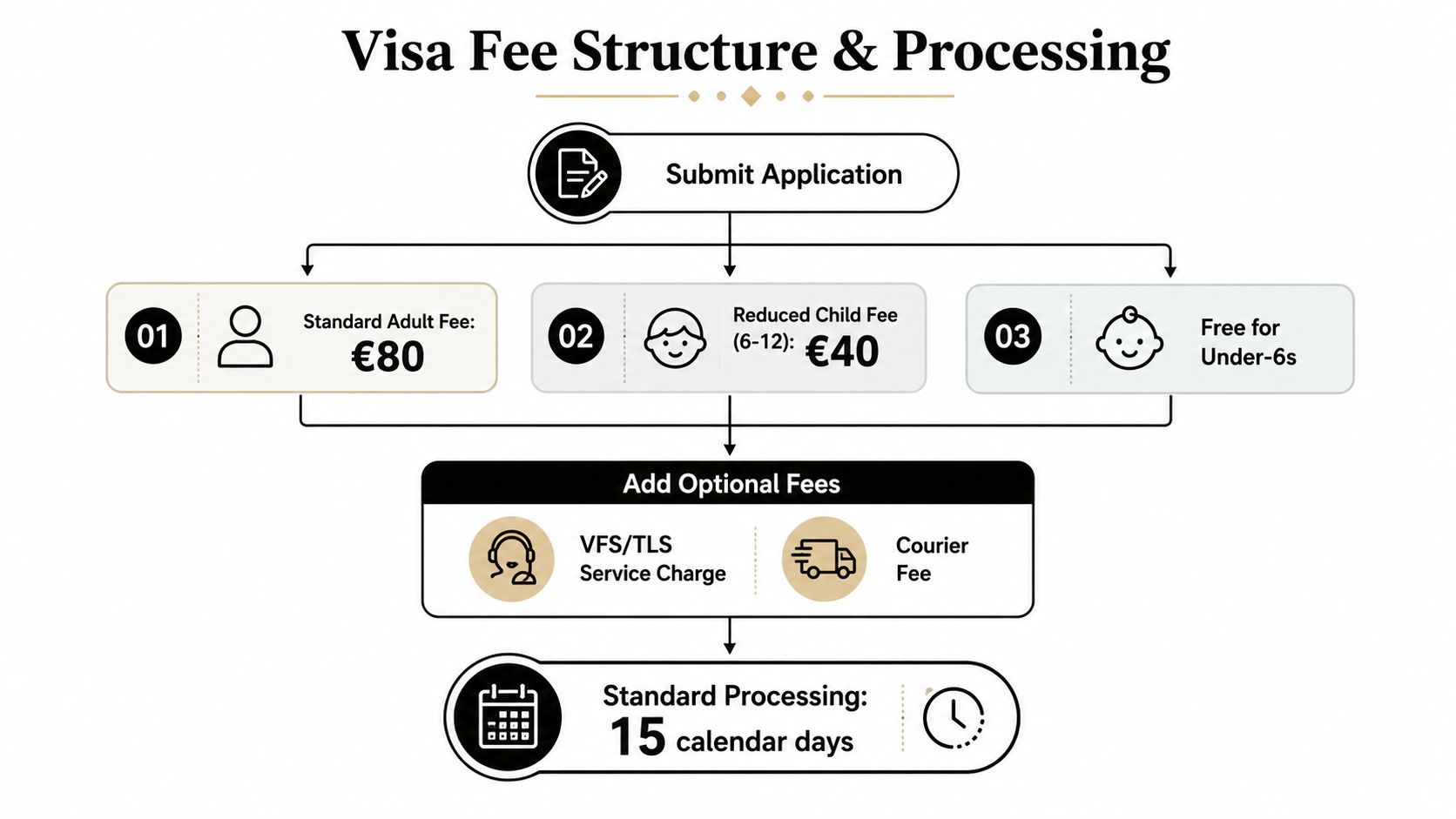
The standard Schengen structure charges adults at the normal rate, applies a reduced fee for children 6 to 12, and does not charge children under 6. VFS and TLS centres often add service charges, courier fees, and premium-lounge options, and those extras are usually paid in AED at the local centre. Keep the receipt. If the file needs a query later, that payment record saves time.
Processing usually takes 15 days once the mission has the application, not when you click submit online. Peak-season handling can stretch to 30 to 45 days. If the mission needs extra investigation, the 45-day ceiling can apply as a fallback.
The practical rule is simple. The faster you file near a holiday period, the more likely you are to run into delays at the centre or at the mission.
Budget the trip with a buffer, because appointment timing, service charges, and centre extras can move the final amount. For a cleaner view of how business travellers should set up the application side before paying, see the UAE business visa checklist and filing approach. If you need a practical guide for modern expense control, the same habit helps here, keep the visa outlay separated from the rest of the trip spend.
Pay only when the file is ready
Do not pay early just to feel organised. Pay when your documents are aligned, your itinerary makes sense, and your passport and residence-visa dates clear the baseline. If you pay first and sort the file later, you only create pressure and push yourself toward a weak submission.
A sensible UAE approach is to keep a small cushion for conversion, service fees, and any add-ons that were not in your original plan. For Schengen filing, that matters even more when your residence visa is close to expiry or your trip sits near a consulate holiday window. Submit once, pay once, and keep the file clean. That is how you protect both the budget and the timeline.
Business Travel from the UAE on a Schengen Visa
Business travellers from Dubai and Abu Dhabi need a different document strategy from holiday applicants. A tourist file says you want to visit. A business file has to show why you're meeting people, why the trip is tied to work, and why you'll return to the UAE when the meetings end.
Tourist pack versus business pack
The tourist version is mostly about travel intent, hotel bookings, insurance, and financial support. The business version adds the employer layer, which is where many applications get stronger or weaker very quickly. That means an employer NOC on company letterhead, a host-company letter, event registration, or a meeting schedule that makes the trip legible to the consulate.
If you're travelling for a trade fair, conference, client review, or site visit, make the purpose obvious in the paperwork. A messy bundle that mixes personal sightseeing with work meetings looks unfocused. A clean bundle says, “I'm attending this event, meeting these people, staying these dates, then coming back.”
Common UAE business patterns
Dubai-based founders and professionals often move through the same trip patterns. Frankfurt for industry events, Paris for client meetings, Italian manufacturing visits, and Amsterdam for tech summits all fit the same logic, but the paper trail must match the destination. If you're moving across multiple cities, list the travel purpose by date so the consulate can see that the main purpose is coherent.
For operational discipline, use a document system that captures invitations, expenses, and booking changes in one place. A guide for modern expense control is useful here because business travel only works if the receipts, dates, and approvals stay tidy from day one. Keep the visa file aligned with your expense records, not separate from them.
For businesses that want outside help with the local process, the business visa UAE page is relevant because the same administrative discipline that supports UAE business travel also supports visa prep. Smart Classic Business Hub can handle parts of the immigration and document flow, which matters when an owner or manager is travelling often and doesn't want gaps in the file.
Handling Refusals and Improving Your Approval Odds
A refusal is annoying, but it's not mysterious. The letter usually points to a specific problem, and in UAE cases the usual issues are weak proof of ties, thin financial evidence, insurance that doesn't satisfy the rules, or an itinerary that doesn't make sense. If you ignore the reason and reapply with the same file, you've wasted your own time.
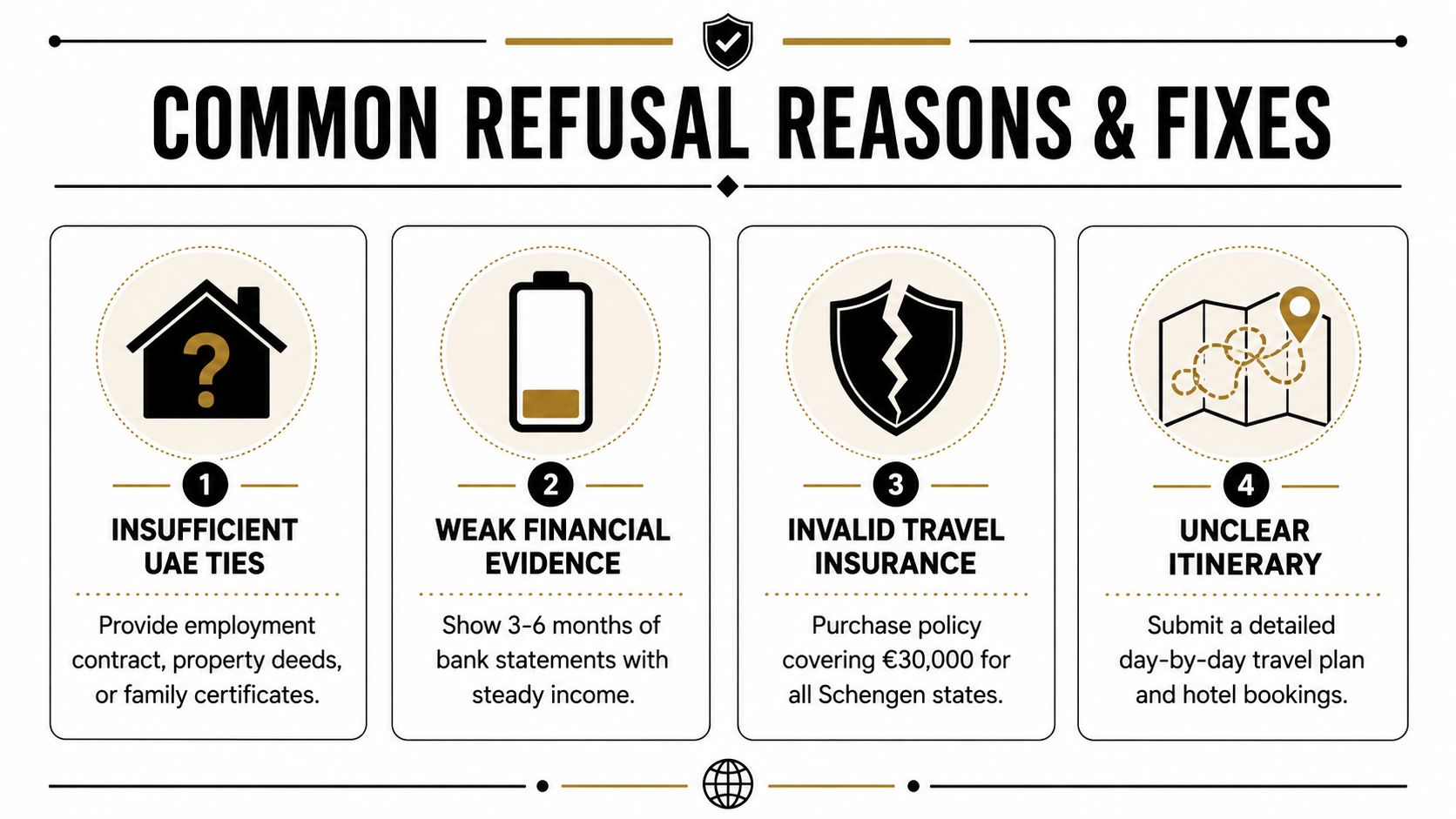
Fix the refusal reason, not just the symptoms
Read the refusal letter carefully. If the issue is employment or UAE ties, add stronger proof such as a clear contract, salary support, or family and residence documents. If the issue is money, use cleaner statements and avoid trying to make a balance look bigger than it really is. If the issue is itinerary confusion, rebuild the travel plan so the nights, cities, and purpose all match.
Watch the UAE residence timing
This is the bit many generic guides miss. If your UAE residence visa is close to expiry while the Schengen file is in process, don't pretend it's a non-issue. If renewal is already underway, some applicants proceed with caution, but if the residency status is unstable and the travel dates are tight, delay the trip and submit a cleaner file later. Consulates care about whether you're legally and stably resident in the UAE, not whether you were optimistic at booking time.
When reapplying, fix the weak points before you submit again. Strong approval odds usually come from a stable UAE residency position, bank statements that match your income, a precise itinerary, a valid EUR 30,000 insurance policy, and a passport with enough validity left. Those aren't extras, they're the basics.
The fastest way to improve a weak Schengen file is not to argue with the first refusal. It's to remove the exact problem that caused it.
If you want a clean Schengen filing from the UAE, Smart Classic Business Hub can help with the document handling, immigration process support, and related administrative steps that often slow applicants down. Visit Smart Classic Business Hub if you want practical help with visa paperwork, business setup, or resident-status documentation before you book the next trip.