
Your finance person is chasing supplier invoices. Your sales team has already issued invoices to clients. Your bank account looks healthy, but you're not sure how much of that cash belongs to the FTA. Then someone mentions an audit, a missed filing, or a Free Zone rule change, and VAT suddenly stops feeling like a back-office task.
That's where most UAE founders get stuck. VAT in the UAE isn't just adding the standard 5% rate to an invoice. It sits inside your pricing, contracts, accounting, procurement, imports, customer onboarding, and reporting. If one part of that chain breaks, the problem usually shows up later, when it's more expensive to fix.
The risk is not theoretical. In its 2022 assessment, the European Commission estimated the EU VAT compliance gap at €781 billion, equal to 8.6% of total VAT tax liability, and noted that the gap had widened despite digitalisation efforts (European Commission Taxation and Customs Union assessment). Different market, same lesson. Digital tools help, but process gaps and human error still create real losses.
For UAE entrepreneurs, a practical VAT compliance checklist needs to work in daily operations. It should tell you what to review, who owns each task, what documents must exist, and when to escalate the issue to a consultant before it turns into an FTA problem. The ten tasks below do exactly that. Use them to stay compliant, protect cash flow, and keep VAT from becoming a growth blocker.
1. 1. Master VAT Registration and Threshold Management
Registration errors usually start before the application is even submitted. A founder assumes turnover is still below the threshold, or waits for year-end accounts, or treats branch activity as if it doesn't count yet. By the time the issue comes to light, the registration date is already the primary problem.
In the UK, HMRC's digital VAT regime made threshold monitoring impossible to ignore. Businesses with taxable turnover above £90,000 had to register and comply with Making Tax Digital requirements, affecting approximately 1.5 million businesses (HMRC VAT threshold and MTD guidance). The UAE system is different, but the operational lesson is the same. Thresholds need active monitoring, not casual estimation.

What founders should monitor weekly
If you run an e-commerce company, trading business, consultancy, or agency, turnover can move faster than expected. One large contract can change your position.
- Track taxable revenue, not just cash received: Sales booked, deposits, staged contracts, and invoiced work can all affect your VAT position.
- Review group structure early: Mainland entities, Free Zone entities, and branches can create registration questions that shouldn't be left to admin staff alone.
- Keep registration documents ready: Trade licence, authorised signatory documents, business activity details, and banking information should be organised before you need them.
- Check if voluntary registration is commercially useful: Some businesses register early because clients expect a Tax Registration Number and proper VAT invoices.
A Free Zone tech company selling to mainland corporate clients often chooses voluntary registration because commercial credibility matters as much as technical obligation. A fast-growing online seller may have the opposite issue and discover that sales crossed the line before management noticed.
Practical rule: If turnover is moving quickly, don't wait for the accountant's month-end close to check registration exposure.
If you need the process itself mapped clearly, review this step-by-step guide to VAT registration in the UAE. It also helps to understand how thresholds affect solo operators and contractors, especially if your business model is lean or project-based. This overview on understanding VAT limits for freelancers gives useful context.
2. 2. Perfect Your VAT Return Filing Cadence
Late filing isn't always caused by negligence. More often, no one owns the calendar, sales invoices are still being corrected after month-end, and purchase documents arrive after the draft return is already prepared. That creates rushed submissions and avoidable errors.
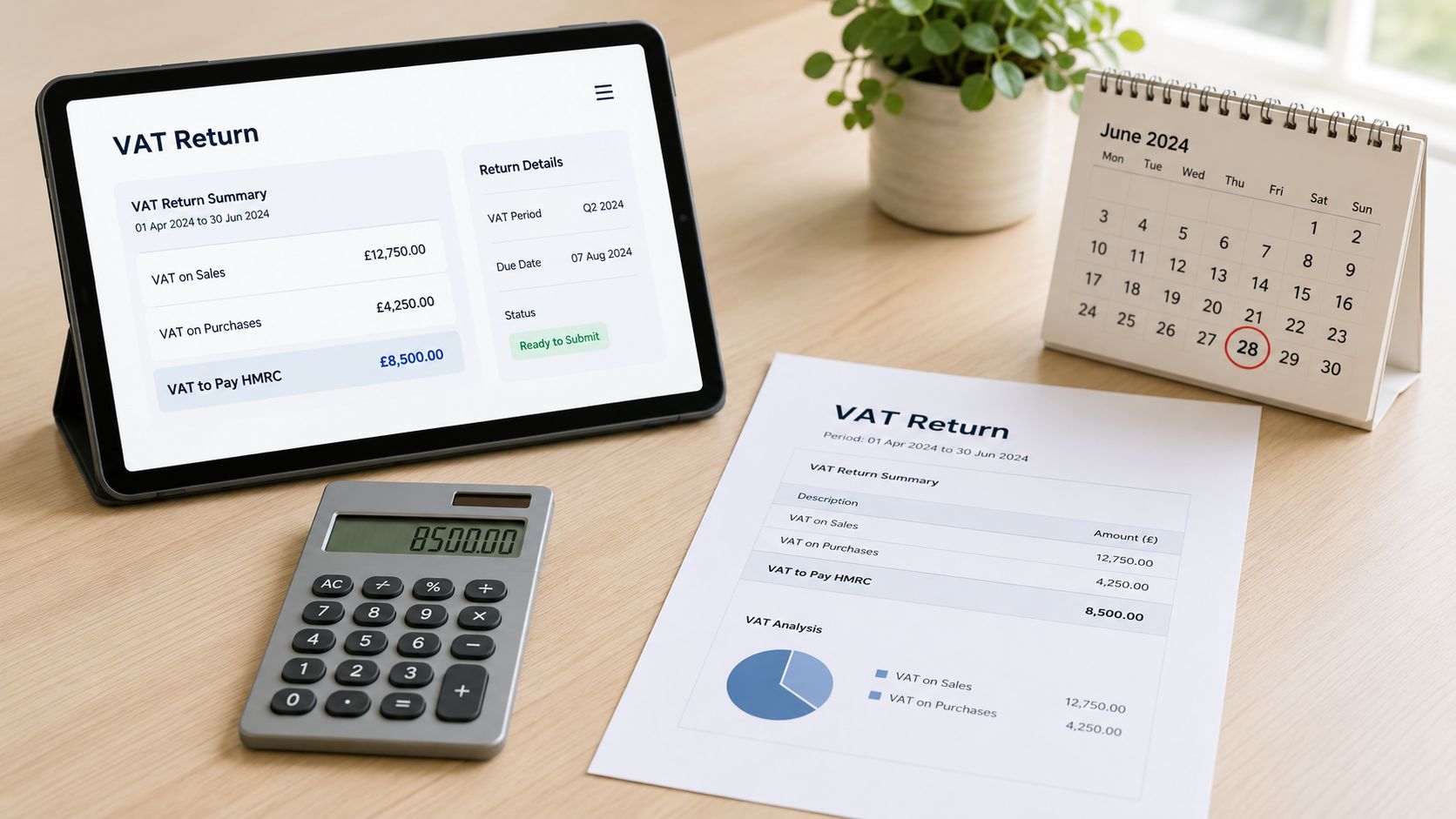
Your filing cadence should follow a fixed operational sequence. Close sales. Close purchases. Reconcile bank movements that affect VAT timing. Review adjustments. Then file. If your business waits until the final days of the cycle to start checking records, you're already behind.
Build a filing rhythm your team can actually follow
A Dubai retailer with mixed supplies, a consulting firm billing milestones, and a restaurant with constant transaction volume don't need the same workflow. They do need the same discipline.
- Assign one owner for VAT close: Someone must be accountable for collecting the final data set and approving the return package.
- Lock transaction cut-off dates: Stop backdating invoices casually. It makes return preparation unreliable.
- Separate review from data entry: The person posting transactions shouldn't be the only one checking VAT treatment.
- Prepare support files with the return: Keep reconciliations, exception notes, and unusual transaction explanations together.
A filing process becomes stronger when software and people do different jobs. Software handles repeatable calculations well. People need to review edge cases, credit notes, special transactions, and coding mistakes.
The UK's move to digital VAT filing changed record-keeping permanently. HMRC required digital records and software-based submissions, and businesses had to keep organised records for at least six years (Making Tax Digital for VAT requirements). The UAE has its own framework, but the practical takeaway is identical. VAT filing only works when record-keeping is disciplined from day one.
For businesses that need a cleaner monthly process, Smart Classic's guidance on VAT filing in the UAE is a useful operational reference.
3. 3. Optimise Input VAT Recovery
Many businesses underclaim input VAT because they're overly cautious. Almost as many overclaim because they treat every supplier invoice as recoverable by default. Both habits hurt the business. One drains cash. The other creates audit risk.
Input VAT recovery works best when procurement, finance, and operations all understand what makes an expense claimable. An IT consultancy buying software licences, laptops, and outsourced support has a straightforward recovery profile. A business with mixed activities, client entertainment, shared costs, or poorly documented purchases doesn't.
What recovery discipline looks like in practice
Your accounting system should not be the first place where recoverability is considered. The thinking should happen when the expense is approved, booked, and matched to the purpose of the business purchase.
Consider these working habits:
- Match the invoice to the business purpose: If the expense supports taxable business activity, document that connection.
- Review supplier invoices for completeness: Missing VAT details, weak descriptions, or informal bills often cause problems later.
- Keep supporting records together: Contracts, delivery notes, purchase orders, and payment evidence make the VAT position easier to defend.
- Flag grey-area expenses early: Shared costs, mixed-use costs, and non-routine purchases should be reviewed before the return is finalised.
A manufacturer claiming VAT on raw materials and plant maintenance usually has a clear path. A founder-led services business using one card for business and personal spending does not. The more informal the spending pattern, the harder it becomes to support recovery.
Recovery isn't about claiming everything possible. It's about claiming what you can support without hesitation if the FTA asks tomorrow.
An experienced consultant often saves money without taking reckless positions. The right advisor won't just increase claims. They'll help set a defensible policy, clean up expense coding, and identify which invoices need stronger backup before they ever reach the VAT return.
4. 4. Maintain Flawless Invoicing and Documentation
If your invoices are weak, your VAT position is weak. It doesn't matter that the sale was genuine or the service was delivered. Bad invoicing creates problems for output VAT, input VAT, customer disputes, and audit defence all at once.
This issue shows up constantly in growing SMEs. Sales teams issue invoices from Word or Excel. Operations send delivery confirmations through email only. Finance later tries to rebuild the transaction trail from scattered files. That approach works until the first serious review.
The documentation stack that actually holds up
A VAT-compliant business doesn't store just invoices. It stores evidence of the full transaction.
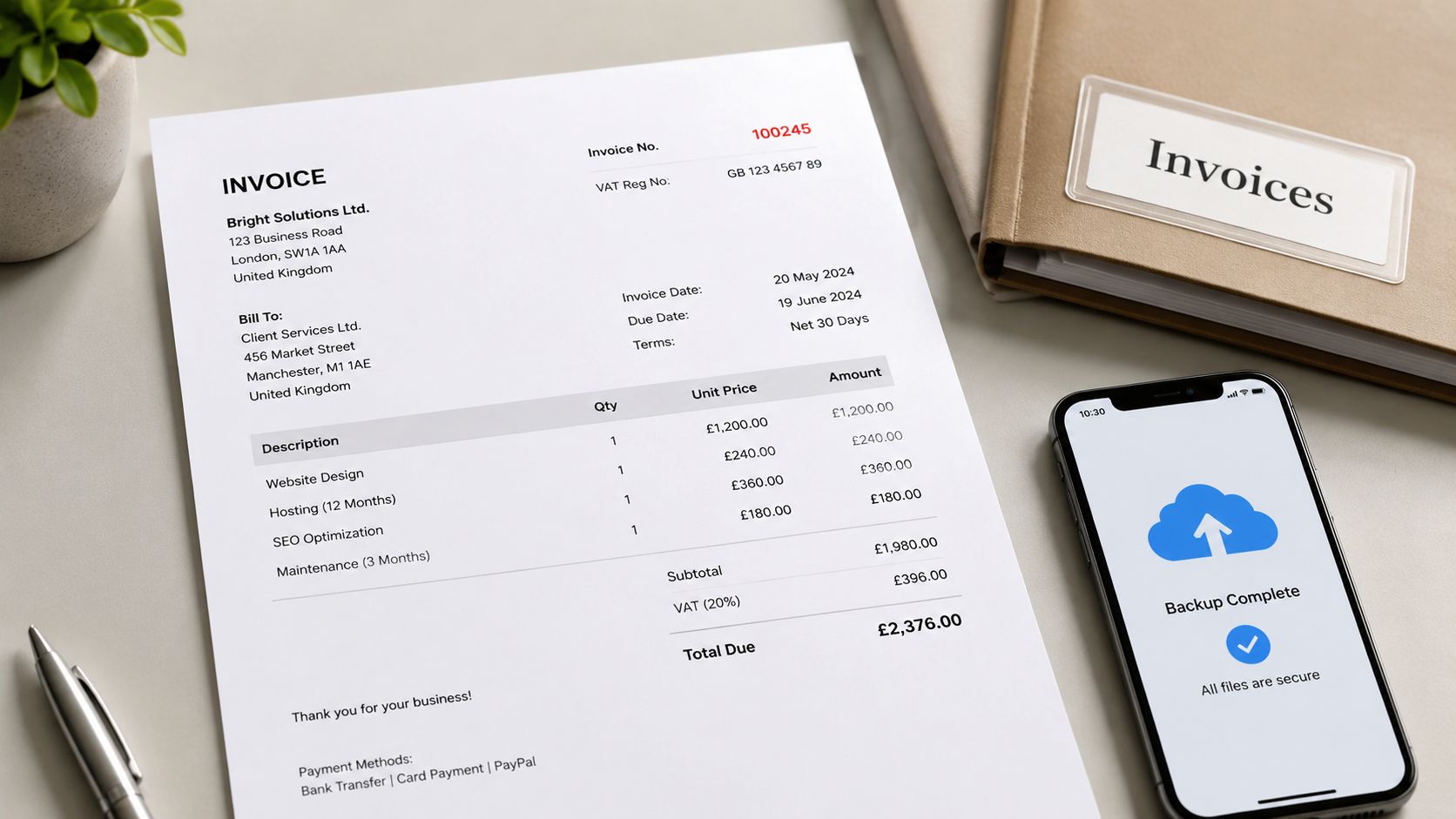
- Issued invoice: Correct customer details, clear description, VAT treatment, and consistent numbering.
- Commercial support: Quote, signed contract, sales order, delivery note, completion confirmation, or timesheet.
- Payment trail: Bank receipt, remittance advice, or matched ledger entry.
- Adjustment records: Credit notes, cancellations, revised invoices, and explanation for the change.
For a B2B trading company, customer VAT details need to be collected accurately before invoicing starts. For an e-commerce business, invoice generation should be linked to the sales platform and accounting software, not handled manually after the sale. For a service provider, milestone approvals and signed deliverables often matter just as much as the invoice itself.
The UAE is also moving toward stricter digital invoice expectations. Existing checklists often miss practical steps such as verifying FTA-certified e-invoice software and validating invoice QR code requirements under the upcoming mandate. If your invoicing process still relies on templates and manual edits, that weakness won't age well.
5. 5. Prepare for a VAT Audit Before It Happens
Most businesses prepare for an audit after they receive notice. That's too late. By then, the main issue isn't tax knowledge. It's retrieval speed, document consistency, and whether the story in your ledgers matches the documents in your folders.
Audit readiness is operational, not theoretical. A manufacturing company needs supplier invoices, stock records, customs documents, and sales support aligned. A consultancy needs contracts, milestone approvals, timesheets, and expense support. A real estate business needs transaction files that show exactly why each VAT treatment was applied.
What an audit-ready file should contain
Think in terms of transaction trails, not document dumps. A hundred unlabelled PDFs are not a compliance system.
- Reconciliations that tie return figures to ledgers
- Clear document folders by tax period and transaction type
- Policies explaining how the business treats common VAT scenarios
- Notes for exceptions, corrections, and unusual entries
- Management review evidence for major or high-risk transactions
The businesses that handle audits best usually do one thing differently. They create a repeatable archive every filing cycle instead of relying on people's memory later.
Field note: If finance needs three different WhatsApp chats and two former employees to explain a transaction, you are not audit-ready.
This is also where a consultant adds value beyond bookkeeping. Internal teams know what happened commercially. A tax advisor translates that into evidence the authority can follow. If your records are fragmented, or if prior returns were prepared without a clear review process, get a pre-audit health check done before the FTA forces the timetable. For general risk control ideas outside tax, this practical compliance guide is a helpful reminder that documentation discipline is a business-wide issue, not just a finance issue.
6. 6. Classify Taxable vs. Exempt Supplies Correctly
Classification mistakes create silent errors. You can file on time every period and still build a serious problem if the supply itself is coded wrongly from the start.
This is common in businesses with mixed activities. A company might sell consulting, arrange financing support, lease property, or bundle service packages that don't all receive the same VAT treatment. If staff use one default code for everything, the return may look tidy while being wrong in substance.
Where businesses usually get classification wrong
A few patterns show up repeatedly in SME reviews:
- Bundled services are treated as one line without analysis
- Industry assumptions replace transaction-by-transaction review
- Staff copy old invoice templates even when the service changed
- Accounting codes are set up once and never revisited
A professional advisory firm may invoice standard consulting as taxable, while some adjacent services require much closer review. A property business might treat one transaction based on habit, even though the contract structure changed. An education or healthcare-related operator may assume all revenue in the sector follows one treatment. That's rarely safe.
The UAE standard VAT rate is 5%, and automated validation tools in the local market increasingly check whether coding aligns with UAE-specific rates and reverse charge rules. In the UAE, adoption of automated VAT compliance checklists has surged by 68% since 2023, and the Dubai Economic Department reported that 74% of SMEs in Dubai now use third-party ERP-integrated checklists to validate tax codes, reverse charges, and cross-border transactions before filing (UAE VAT automation and SME adoption data).
That doesn't mean software replaces judgement. It means software can catch repetitive coding mistakes, while a consultant should review the underlying tax logic for new products, unusual contracts, and mixed supplies.
7. 7. Use Bad Debt Relief to Recover VAT
Bad debt relief is one of the most overlooked parts of a VAT compliance checklist because many founders focus only on sales and filing. They forget that output VAT already paid on an invoice can become a cash-flow burden when the customer never settles.
This matters most in B2B businesses with long payment cycles. Contractors, wholesale traders, professional services firms, and distributors often carry overdue balances for months while still dealing with the VAT impact of the original invoice. If your accounts receivable team and tax process don't speak to each other, relief opportunities are missed.
Treat bad debt as a tax process, not just a credit control issue
A proper process usually starts in receivables, but it shouldn't end there.
- Tag overdue invoices for tax review: Don't leave old debts sitting in the ledger with no tax follow-up.
- Document collection efforts: Reminder emails, call logs, legal notices, and settlement attempts matter.
- Review whether the debt is uncollectible: Management should record why the business considers the debt impaired.
- Track any later recovery: If the customer pays after relief is claimed, the VAT position may need updating.
A trading company with unpaid invoices from a distributor, or a service provider whose client ceased operations, should not rely on memory months later. Keep a dedicated bad debt file with correspondence, ageing reports, and internal approval notes.
The trade-off here is simple. If you file relief aggressively without thorough documentation, you create a future audit issue. If you never review bad debts at all, you hand over cash unnecessarily. The right approach is controlled, evidence-based, and linked to your receivables process.
8. 8. Navigate Special VAT Treatments and Sectoral Rules
General VAT advice breaks down quickly in specialised sectors. Insurance, healthcare, education, property, financial services, and related-party transactions all need closer handling because the commercial reality and tax treatment don't always align neatly.
A private clinic, for example, may have core medical activity and side revenue that doesn't follow the same treatment. A real estate group may handle residential and commercial transactions through similar workflows even though the VAT treatment differs. A financial services business might bundle exempt and taxable elements in one engagement.
Don't use a generic checklist for a specialised business
This is especially important for Free Zone entities. One of the biggest gaps in off-the-shelf guidance is the lack of useful instruction for businesses dealing with the recent UAE Free Zone regulatory shift. Generic UK and EU checklists don't help much when the actual issue is whether a Free Zone company meets the Qualifying Free Zone Person criteria under Cabinet Decision No. 55 of 2023.
That means your VAT compliance checklist should include checks such as:
- Review whether the business activity fits Free Zone treatment assumptions
- Confirm whether income streams affect QFZP analysis
- Document why a particular exemption or treatment is being used
- Escalate structural questions before signing contracts, not after filing
A Free Zone business can be fully organised administratively and still be exposed if management never tested whether its activity mix matches the treatment being used.
For specialised sectors, the consultant's role is not just to file returns. It's to review contracts, revenue models, and internal coding before those assumptions become embedded in the accounting system.
9. 9. Manage Cross-Border VAT Imports Exports and Reverse Charge
Cross-border VAT is where many UAE businesses outgrow their original setup. Importers start with simple customs clearance, then add re-exports, overseas suppliers, drop shipments, or digital services. Suddenly the bookkeeping team is trying to interpret commercial flows they were never trained to classify.
The mistakes usually happen at the edges. Goods are imported under one code but sold under another assumption. Export files are missing supporting records. Overseas service purchases aren't reviewed for reverse charge implications. Free Zone routing is treated as if it automatically solves the tax question.
The documents matter as much as the transaction
If you claim export treatment or recover import VAT, your file needs to prove it. A logistics-heavy business should be able to produce commercial invoices, shipping records, customs support, and customer documentation without rebuilding the file from scratch.
- Keep customs and finance aligned: Import declarations, invoice values, and ledger postings should match.
- Review overseas service purchases carefully: Reverse charge issues often arise from software, consulting, licensing, or management charges.
- Separate domestic and export workflows: Don't let staff use the same invoice logic for both.
- Validate product classification early: The wrong product coding can cause customs and VAT problems at the same time.
If your goods movement depends on customs classification, this guide to HS code use in Dubai trade operations is worth reviewing alongside your VAT process. For service transactions, this plain-language reverse charge VAT guide is a useful cross-check when teams are dealing with foreign vendors and non-standard billing arrangements.
In the UAE, checklist design is increasingly shaped by cross-border complexity. The Federal Tax Authority's enforcement of documentation rules has pushed more businesses toward automated validation, and audited companies frequently fail where reporting entity, period, or transaction checks were incomplete rather than entirely absent.
10. 10. Understand Penalties and Amendment Procedures
A strong VAT compliance checklist doesn't assume perfection. It assumes that mistakes will happen and builds a clear response when they do.
That response matters because delay makes almost every VAT problem worse. A wrong classification left uncorrected gets repeated in later invoices. A filing error becomes harder to unwind once the next return is submitted. An ignored notice from the FTA turns a manageable issue into a formal dispute.
Fix errors with a process, not a panic reaction
When an issue is found, management should answer four questions immediately. What went wrong. Which periods are affected. How much data needs review. Whether the error points to a one-off mistake or a broken process.
Useful internal steps include:
- Freeze the transaction set involved: Stop staff from making informal edits while the issue is being reviewed.
- Gather the support file before amending anything: Returns should be corrected based on evidence, not assumption.
- Assess root cause: Was the issue caused by setup, coding, timing, training, or missing review?
- Decide whether professional representation is needed: If the issue spans multiple periods or involves high-risk treatment, don't handle it casually.
In the UAE market, the practical case for stronger controls is clear. A 2025 report by the UAE Ministry of Finance stated that 82% of companies using checklist tools reduced audit preparation time by 70%, and 94% said those tools improved compliance with tax residency certificates and VAT-compliant accounting (UAE Ministry of Finance compliance technology overview). That doesn't eliminate penalties by itself, but it shows what happens when businesses stop treating VAT as an improvised task.
If your company has discovered an old filing issue, missing records, or a recurring coding problem, bring in a consultant early. Amendment work is far cheaper when the facts are still recoverable and the business can still explain its own records.
10-Point VAT Compliance Comparison
| Task | 🔄 Complexity | ⚡ Resource Requirements | ⭐ Expected Outcomes | 📊 Ideal Use Cases | 💡 Key Advantages / Tips |
|---|---|---|---|---|---|
| 1. Master VAT Registration and Threshold Management | Moderate, administrative steps, timing sensitive | Low–Moderate, documents, registration portal, advisor time | Legal compliance, ability to recover input VAT | Businesses approaching/over AED 375,000; startups planning growth | Register proactively, keep records, use FTA portal, consult advisors |
| 2. Perfect Your VAT Return Filing Cadence | High, recurring monthly accuracy required | Ongoing, accounting staff/software, filing controls | Timely settlements, reduced audit risk, cash flow visibility | Retailers, service firms with frequent transactions | Integrate accounting software, set reminders, review invoices before filing |
| 3. Optimise Input VAT Recovery | High, strict eligibility and exclusions | Moderate–High, invoice management, tax expertise | Improved cash flow, lower net VAT payable | Exporters, manufacturing, capex-heavy businesses | Keep compliant invoices, separate recoverable expenses, reconcile quarterly |
| 4. Maintain Flawless Invoicing and Documentation | Moderate, detailed mandatory fields and retention | Moderate, invoice systems, storage, staff training | Clear audit trail, simplified VAT claims, fewer disputes | High-volume retailers, e‑commerce, B2B suppliers | Automate invoices, use templates, conduct periodic invoice audits |
| 5. Prepare for a VAT Audit Before It Happens | High, comprehensive record organization | High, time, storage, cross-dept coordination, advisors | Faster audits, fewer penalties, documented defenses | Larger firms, regulated sectors, businesses with complex transactions | Centralize records, run annual prep checks, document VAT positions |
| 6. Classify Taxable vs. Exempt Supplies Correctly | High, nuanced rules and mixed supplies | Moderate, tax advisory and accounting controls | Accurate returns, maximized input recovery, audit readiness | Real estate, financial services, education, mixed-service firms | Create written policies, review quarterly, train staff on coding |
| 7. Use Bad Debt Relief to Recover VAT | Moderate, procedural and timing rules (e.g., 6+ months) | Low–Moderate, debt tracking, supporting documentation | VAT relief for uncollectible invoices, improved liquidity | B2B sellers, firms extending credit, exporters with delayed payments | Maintain collection evidence, flag eligible invoices, reverse if recovered |
| 8. Navigate Special VAT Treatments and Sectoral Rules | Very high, sectoral exceptions and changing guidance | High, specialist advisors, ongoing monitoring | Proper exemption application, optimized VAT position | Financial institutions, healthcare, education, insurance, real estate | Engage sector specialists, document exemption rationale, monitor updates |
| 9. Manage Cross-Border VAT: Imports, Exports & Reverse Charge | Very high, place-of-supply, customs and reverse‑charge rules | High, customs brokers, export docs, tax specialists, systems | Zero-rating where eligible, compliant import VAT recovery | Exporters, importers, international service providers, e‑commerce | Retain export docs, verify customer location, consider binding rulings |
| 10. Understand Penalties and Amendment Procedures | Moderate, penalty rules complex, appeal paths required | Moderate, compliance monitoring, legal/advisory support | Minimized penalties, corrected returns, preserved reputation | All VAT-registered businesses, those with prior errors | Automate reminders, use voluntary disclosure, file amendments promptly |
Your Next Step From Checklist to Compliance
A VAT compliance checklist is useful only when it lives inside the business. It has to sit in your sales process, purchasing approvals, accounting setup, document storage, and management review. If it exists only as a PDF saved on someone's desktop, it won't protect you when deadlines tighten or when the FTA asks questions.
That's why implementation matters more than theory. A founder needs to know who checks customer tax details before invoicing. Finance needs to know which supplier invoices can be claimed and which need more support. Operations need to know which documents must exist before a transaction is treated as export, exempt, or recoverable. Management needs visibility over filing dates, unresolved exceptions, and recurring errors. Without that structure, VAT becomes reactive.
The strongest systems I see in the UAE are not always the most expensive. They are the most disciplined. They use one source of truth for invoices and accounting. They review unusual transactions before filing, not after. They keep working papers with each return. They don't rely on memory, informal approvals, or verbal explanations. And when the business enters a grey area, they ask for advice early.
This matters even more now because UAE compliance expectations are becoming more digital and more operational. Businesses are dealing with evolving Free Zone interpretations, more scrutiny over documentation, and increasing pressure to align invoicing, bookkeeping, and tax reporting. Generic checklists written for other jurisdictions don't solve that. UAE entrepreneurs need a process built around local rules, local practice, and the way their own business trades.
A professional consultant is most useful at three moments. First, when you're setting up the system and need the registration, coding, and document flow designed correctly. Second, when the business changes, such as adding a new revenue stream, entering cross-border trade, or restructuring through a Free Zone or group entity. Third, when something has already gone wrong and you need to correct it before the issue expands.
Smart Classic Business Hub works best when it isn't called in only after a filing problem or audit notice. The better use of an advisor is to make the business audit-ready in normal periods, when there's still time to clean the data, train staff, fix coding, and set proper controls. That turns VAT from a recurring source of stress into a managed business process.
If your current VAT process depends on spreadsheets, scattered invoices, and one person remembering the deadlines, don't wait for a formal problem. Tighten the system now. The cost of structure is always lower than the cost of repair.
Smart Classic Business Hub helps UAE founders build VAT processes that work in real operations, not just on paper. If you need support with registration, filing, VAT-compliant accounting, Free Zone questions, audit readiness, or broader business setup and compliance, speak to Smart Classic Business Hub for practical, hands-on guidance specific to your company's needs.