
Growth creates this problem. Your sales are moving, clients are paying, expenses are building up, and someone asks a simple question you can't keep pushing aside. Do we need to register for VAT now?
For many UAE founders, that's the moment when the business starts to feel more formal. The commercial side is working. The compliance side suddenly matters. The good news is that VAT registration in the UAE is manageable when you approach it properly. The bad news is that many applications get delayed for avoidable reasons, usually because the business owner starts inside the FTA portal before the paperwork, business activity details, and signatory records are lined up.
If you're trying to understand how to register for VAT without getting stuck halfway through, the practical answer is this. Treat VAT registration as a documentation and data-matching exercise first, and an online form second.
Your Guide to UAE VAT Registration
The UAE introduced a standard 5% VAT rate on 1 January 2018, and the change became part of normal business life very quickly. According to Taxually's summary of UAE VAT registration data, over 200,000 businesses registered within the first year, and businesses with annual turnover under AED 3 million accounted for roughly 70% of new VAT registrations by the end of 2019. That tells you something important. VAT registration is not only for large groups. SMEs are a major part of the system.
That's why founders shouldn't treat VAT as a sign that the business has become complicated or risky. It usually means the business is becoming established. The issue isn't whether VAT exists. The issue is whether your registration is prepared well enough to move through the FTA process cleanly.
What most business owners actually need
Most articles explain the legal framework and stop there. In practice, founders usually need answers to more grounded questions:
- Am I required to register yet, or would voluntary registration make more sense?
- What documents will the FTA ask for, not just in theory but in upload-ready form?
- Why do some applications move quickly while others stall?
- What happens if my trade licence activity doesn't match what I select online?
Those are the questions that determine whether registration feels routine or frustrating.
Practical rule: The FTA portal is much easier to complete when your licence details, owner details, financial figures, and bank records all tell the same story.
A more useful way to think about the process
The cleanest VAT registrations usually have three things in place before anyone logs in:
- A clear registration basis. Mandatory or voluntary.
- A complete document pack. Current, legible, and consistent.
- Aligned business data. Especially business activity descriptions, signatory authority, and turnover figures.
If you need hands-on support with that preparation, VAT services in Dubai can help organise the filing side before errors turn into delays.
Should You Register for VAT Mandatory vs Voluntary
The first decision isn't technical. It's strategic. You need to decide whether the law requires registration now, or whether registering early would help the business.
The two routes
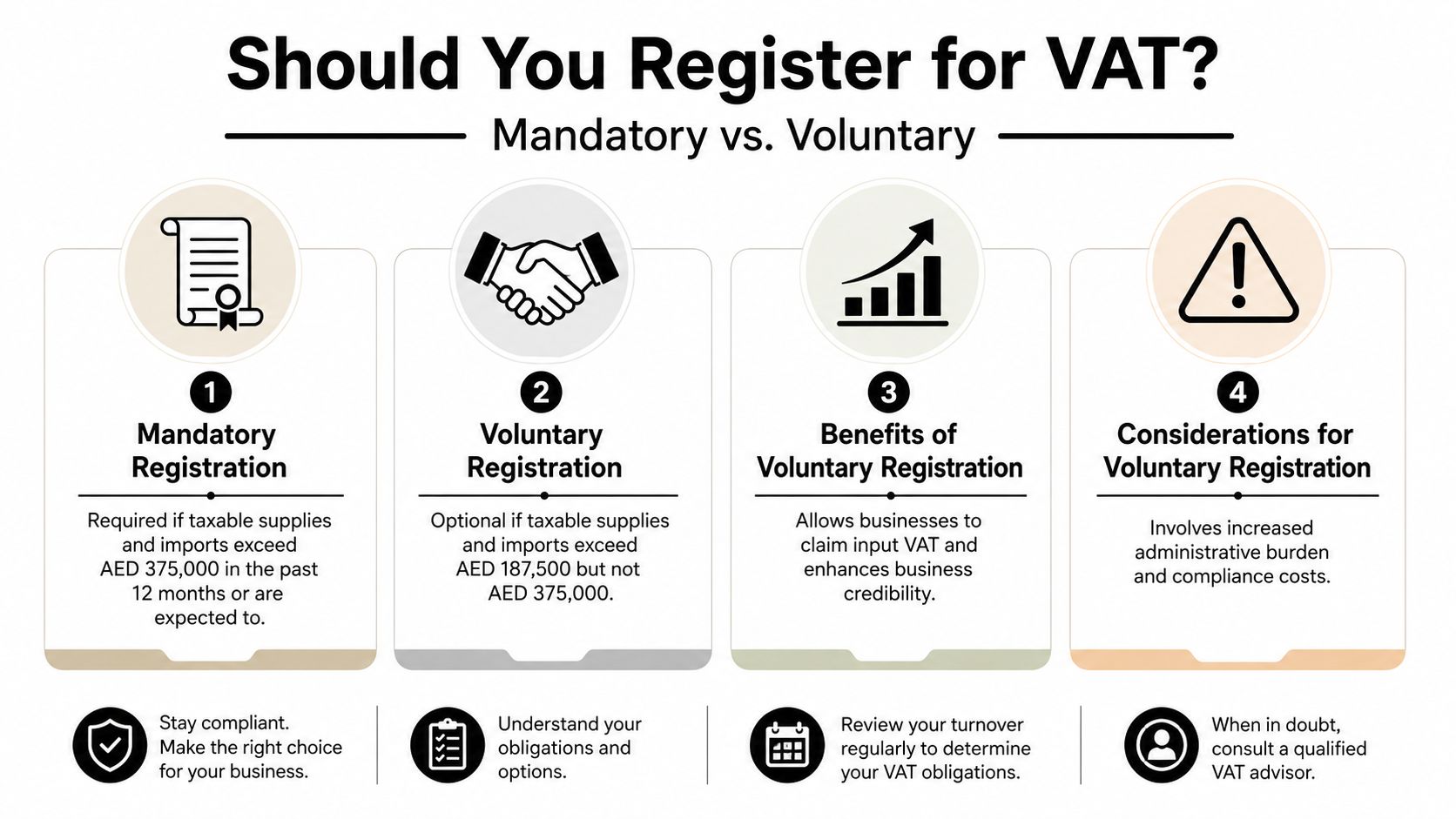
In the UAE, mandatory VAT registration applies when a taxable person's annual taxable supplies and imports exceed AED 375,000. Voluntary registration is possible from AED 187,500. FTA statistics covering 2018 to 2021 showed that roughly 40% of all VAT registrants were voluntary, often used by SMEs to recover input VAT and present a more established profile early on.
That matters because many startup founders assume VAT registration starts only once they are forced into it. That isn't always the smartest move.
VAT registration thresholds in the UAE
| Criteria | Mandatory Registration | Voluntary Registration |
|---|---|---|
| Threshold | Taxable supplies and imports exceed AED 375,000 | Taxable supplies and imports exceed AED 187,500 |
| Legal position | Required | Optional |
| Typical reason | Compliance obligation | Early input VAT recovery and commercial readiness |
| Best suited to | Businesses already above the threshold or clearly approaching it | Startups and SMEs with taxable spend or near-term growth plans |
| Trade-off | Must register and comply fully | Gains benefits, but takes on the same compliance duties once registered |
When mandatory registration is straightforward
Some cases are obvious. A trading company with steady invoicing, a consultancy with signed annual contracts, or an e-commerce seller with regular UAE sales usually shouldn't wait once turnover clearly crosses the threshold.
The mistake I see most often is hesitation caused by rough bookkeeping. Founders know revenue is climbing, but because invoices, bank receipts, and accounting records aren't fully organised, they delay the registration decision. That's risky. VAT registration starts with the facts of your taxable activity, not with whether your spreadsheets are tidy.
When voluntary registration makes sense
Voluntary registration can be sensible when the business is below the mandatory threshold but already incurring meaningful VAT-bearing costs or working with corporate clients who expect VAT invoices.
Typical examples include:
- Startup service firms that spend heavily on software, fit-out, outsourced support, or professional fees.
- Import or trading businesses that want to recover VAT on purchases sooner rather than later.
- B2B suppliers whose clients are more comfortable dealing with VAT-registered counterparties.
- Growth-stage SMEs that know they'll likely cross the mandatory threshold and want an orderly start.
Voluntary registration is often useful when the business model is already commercial and documented, even if turnover hasn't yet reached the mandatory point.
What doesn't work well
Voluntary registration isn't automatically right for every small business. If your records are weak, your customer base is mostly end consumers, or your operations are still too early to document properly, registration can create pressure before it creates value.
Once registered, you take on filing and record-keeping duties. So the better question isn't only “Can I register?” It's “Can I stay compliant after registration?”
Preparing Your Documents for a Smooth Application
Most delays begin before submission. A founder opens the portal, starts entering data, and then discovers that the trade licence copy is outdated, the bank letter doesn't match the legal name, or the authorised signatory can't complete the declaration properly.

Build your file pack before you log in
Prepare your documents as if someone else had to file the application for you. That forces clarity and usually exposes gaps early.
A practical pre-submission pack should include:
- Trade licence and incorporation records. These show the legal identity of the business and the activities it is licensed to carry out. Make sure the licence is current and readable.
- Passport and Emirates ID for owners or authorised signatories. The FTA checks who is acting for the business. Names should match other records exactly.
- Turnover evidence and financial summaries. Use organised accounting records, sales invoices, contracts, and supporting figures that justify your registration basis.
- Bank details. The business bank information should align with the registered entity name. Mismatches often create unnecessary questions.
- Authorisation records. If an advisor, tax agent, or staff member is completing the filing, authority should be clear and properly documented.
Why these documents matter
The FTA isn't only checking whether your business exists. It's checking whether the person applying has authority, whether the commercial activity is coherent, and whether the turnover story is credible.
That's why “almost correct” documents are a problem. A licence with one activity, an application with another, and invoices describing something else can make a straightforward business look inconsistent.
The formatting issues that waste time
Founders often focus on whether they have the document, but the stronger question is whether the document is submission-ready.
Check these points carefully:
- Legibility. Blurry scans and cut-off pages create friction fast.
- Name consistency. Company names should match across the licence, bank records, and application fields.
- Current validity. Expired identification or old licence copies can slow everything down.
- Logical support. If you're applying voluntarily, the supporting records should clearly show why.
A clean VAT application usually feels boring. That's a good sign. No surprises, no patched-together files, and no unexplained discrepancies.
Don't ignore signature readiness
One overlooked issue is the sign-off stage. If the authorised person isn't ready to review and confirm the filing, the application can stall for reasons that have nothing to do with tax.
If your business is setting up internal approval or remote document execution, it helps to review essential eSigning steps before submission. That's particularly useful when owners, managers, or representatives are in different places and timing matters.
Navigating the FTA e-Services Portal Step by Step
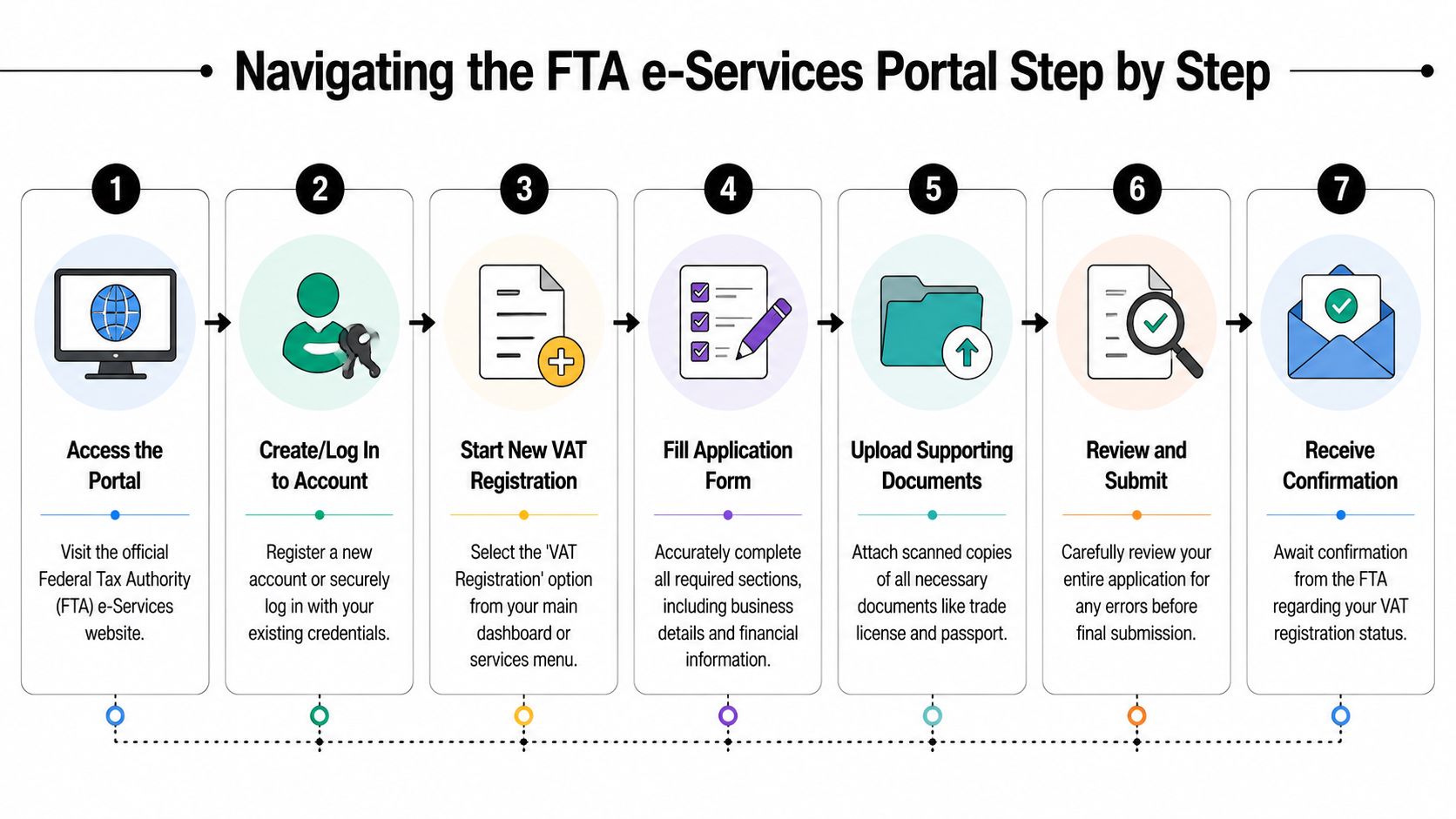
The online filing itself is not the hardest part. The harder part is answering each field in a way that reflects your real commercial position and matches your official records.
Start with access and account control
The registration is completed through the FTA e-Services portal. Before you begin, confirm who will own the login and who is authorised to submit the declaration. That sounds basic, but many SMEs lose time because the accountant has partial information, the owner has the login, and no one has gathered everything into one controlled file.
The cleanest workflow is simple. One person coordinates the documents, one person reviews the financial basis, and the authorised signatory approves the final version.
Complete the legal and trade details carefully
The business profile section should mirror your legal records. Enter the company name exactly as registered. The licence details should align with the actual licence copy. If the structure includes multiple stakeholders or representatives, list them in the same way your supporting records show them.
This is also where many businesses make the first avoidable error. They treat business activity descriptions casually.
The business activity field matters more than people expect
The “nature of business activity” entry isn't a throwaway field. It helps determine how the FTA understands the commercial profile of the business.
Choose activities that align with your trade licence and actual operations. If your licence allows general trading but your invoices and contracts show niche technical services, make sure the selected activity category doesn't create a contradiction. The goal is not to sound broad. The goal is to sound accurate.
If the application describes your company differently from your licence and transaction records, the system has a reason to pause and ask questions.
Turnover information needs support
When the portal asks for turnover information, don't guess. Use accounting records, issued invoices, signed contracts, or structured forecasts supported by real business activity.
For mandatory registration, your figures should show why the threshold has been crossed. For voluntary registration, your figures and expenses should support the commercial logic of registering now. Rounded, unsupported estimates tend to attract scrutiny.
Uploads and declaration stage
By the upload stage, every document should already be named clearly and checked for readability. This is not the place to realise the passport copy is missing a page.
Before final submission, review the declaration as if you were reviewing someone else's application. Check for name mismatches, wrong dates, duplicate entries, and inconsistent activity labels. These are small errors, but they often trigger follow-up.
What separates quick approvals from flagged applications
Benchmark data shows that digitally prepared SMEs with correctly mapped data typically receive their TRN within 2 to 5 working days. When commercial licensing data is misaligned with the FTA application, roughly 12% to 15% of registrations are flagged for manual review, extending the process to 10 to 14 days.
That's the practical difference between a clean application and a sticky one. It usually isn't about the complexity of the business. It's about whether the commercial, legal, and tax details match across all records.
A simple portal checklist that works
Use this before pressing submit:
- Licence match. The selected activity should reflect the trade licence and real operations.
- Signatory clarity. The person submitting must have clear authority.
- Turnover support. Figures should come from organised records, not memory.
- Document consistency. Names, dates, and entity details should line up across all uploads.
- Final review. Read the full application once without editing, just to spot contradictions.
For businesses that don't want to manage the filing internally, Smart Classic Business Hub handles VAT registration support as part of its broader compliance and setup work.
Common VAT Registration Mistakes and How to Avoid Them
Many founders assume VAT registration problems come from difficult cases. Usually they come from ordinary cases handled casually.

Mistake one underestimating turnover
Some businesses wait too long because they look only at one revenue stream or only at cash received. Others ignore imports or taxable supplies that should be included in the registration analysis.
The fix is straightforward. Review your commercial activity using proper accounting records and invoice history, not mental estimates. If your bookkeeping is behind, catch that up before filing. Don't use the registration form as a substitute for internal financial review.
Mistake two choosing vague or wrong business activities
This is common with SMEs that have broad trade licences but more specific actual operations. The application ends up sounding generic while the invoices, contracts, or website show something narrower or different.
Use the activity selection to describe what the business does within the scope of its licence. If the licence wording is broad, anchor the application in the primary revenue-generating activity.
Mistake three uploading incomplete or inconsistent records
A missing page, old passport copy, outdated licence, or bank document under a different business name can all slow the process. None of these errors is dramatic. Together, they create doubt.
A simple internal review helps:
- Check validity dates on ID and licence documents.
- Compare names word for word across licence, bank letter, and application.
- Review scan quality on every upload before submission.
- Make one person responsible for the final file set.
Small inconsistencies rarely look small to a reviewing authority. They look like a file that needs more checking.
Mistake four treating non-resident registration like a normal local filing
Many guides often prove inadequate. A common point of failure is VAT registration for non-resident entities. The FTA requires foreign e-commerce sellers or service providers making taxable supplies in the UAE to register, yet many guides fail to explain the need for localised evidence such as a tax agent arrangement, virtual office invoices, or platform contracts that prove economic activity in a form the authority can assess. The Jake & James overview of voluntary VAT registration practicalities is useful here because it highlights how patchy general guidance can be for foreign or offshore applicants.
For non-resident or offshore cases, don't rely on generic internet checklists. Prepare entity documents, trading evidence, marketplace records where relevant, and any local support paperwork in a structured way. These applications often fail because the business is real but the evidence is presented without enough UAE context.
Mistake five ignoring related compliance setup
Some businesses focus only on receiving the TRN and forget the accounting side that follows. That creates a second problem immediately after approval. VAT registration is linked to invoicing, record-keeping, payment tracking, and later filing.
If your finance process is still manual or fragmented, clean it up early. Even something as basic as a clear payment voucher form can help standardise supporting records around business payments and audit trails.
Your TRN Is Issued What Happens Next
Receiving your TRN feels like the finish line, but it's really the start of VAT compliance. From that point, the business needs to operate like a VAT-registered business every day, not only when a return is due.
Your immediate priorities
First, make sure your invoicing reflects your VAT registration properly. Your finance team, accountant, or outsourced bookkeeper should know when VAT applies, how to present it on invoices, and how to maintain supporting records behind each transaction.
Second, keep records in an organised way from day one. Businesses get into trouble when they register neatly and then return to loose spreadsheets, scattered receipts, and inconsistent payment support.
What good post-registration discipline looks like
A practical setup usually includes:
- Clear sales invoicing with the TRN shown correctly on relevant business documents.
- Purchase record control so input VAT positions can be supported.
- A filing calendar with a clear owner.
- Regular bookkeeping review instead of a rush just before submission.
The easiest VAT return is the one you've been preparing for every week, not the one you try to rebuild at the end of the period.
Keep the registration aligned with real operations
As the business evolves, your VAT profile may need review. New activities, expansion into new channels, ownership changes, or cross-border supply patterns can all affect how your records should be maintained.
That's why many SMEs choose ongoing support rather than one-off registration help. If you need assistance after the TRN is issued, VAT filing in UAE is the part that keeps the registration useful and compliant, instead of turning it into a recurring source of stress.
If you want practical help with VAT registration, document review, or post-registration compliance, Smart Classic Business Hub can support the process from setup through ongoing filing, so your business can stay focused on trading while the compliance side stays organised.