
You're probably looking at a cheap listing in International City right now. It says “partition room”, “bed space”, or “family partition”, and the rent looks far better than a studio. That's exactly where people make the wrong decision. They focus on affordability first and legality later.
In Dubai, that order should be reversed. A partition that isn't properly authorised can turn into a tenancy dispute, an inspection problem, or a safety issue overnight. If you're a tenant, you could lose money and stability. If you're a landlord or small operator, you could end up defending an arrangement that was never compliant in the first place.
A key issue with partition in International City isn't whether supply exists. It obviously does. The main concern is whether the setup matches the unit's approved use, preserves safe escape routes, and can survive scrutiny from building management, the landlord, and the relevant authorities.
What Partition Really Means in International City
People use the word partition loosely. That causes trouble. In practice, different people mean completely different things when they advertise a partition in International City.
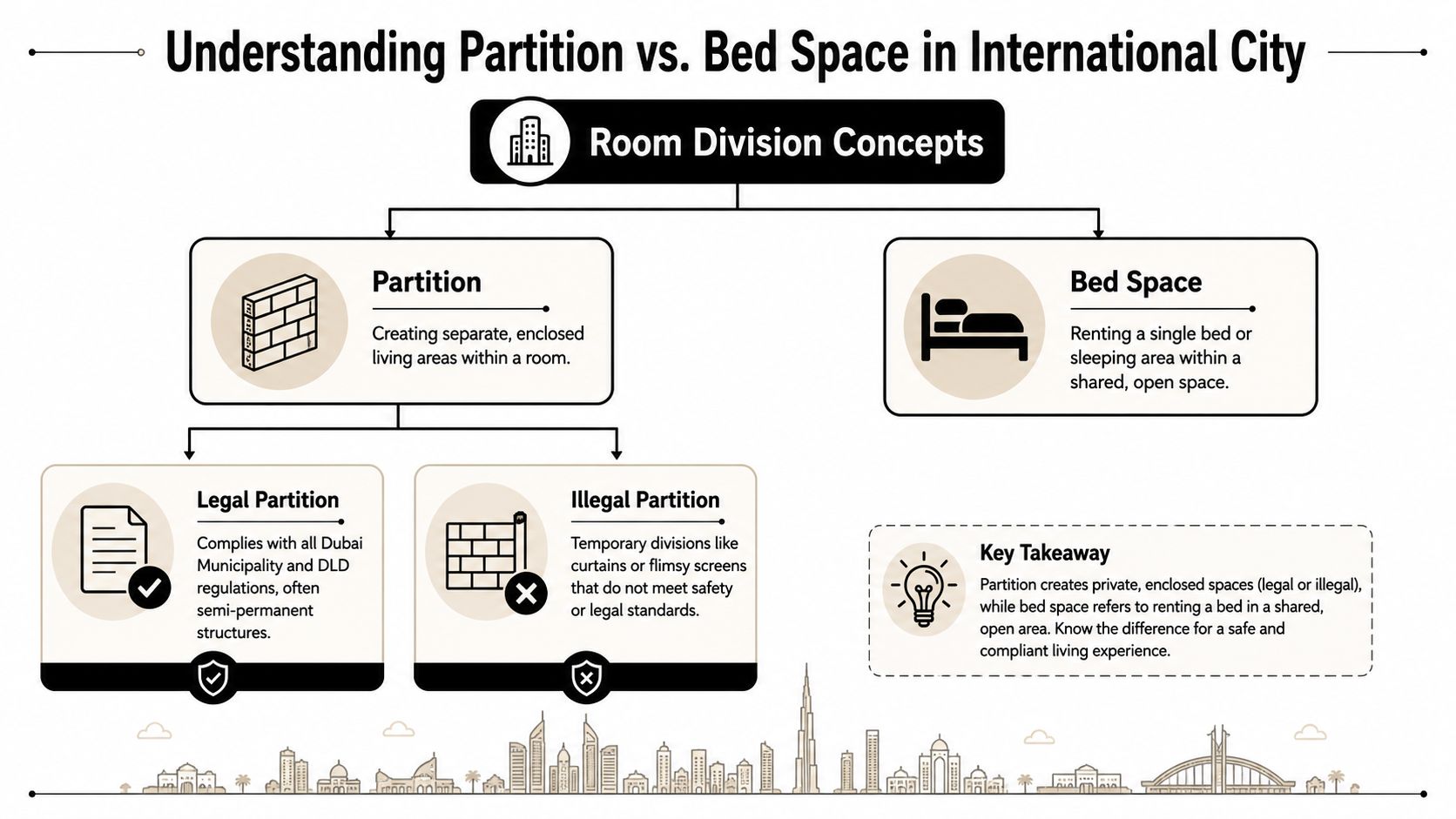
The three setups people confuse
The first is a bed space. That usually means you're renting a bed or sleeping area inside a shared room. There may be no real room division at all. Sometimes it's just furniture placement, a curtain, or a screen.
The second is a temporary partition. This is often made with gypsum board, lightweight framing, or other non-structural materials to create an enclosed or semi-enclosed space inside an existing room. This is what most residential listings mean when they say “partition room”.
The third is a structural alteration. That's no longer a casual fit-out. If someone changes the approved internal layout in a way that affects the original unit design, you're no longer talking about a simple privacy solution. You're talking about a regulated alteration with compliance consequences.
A partition ad tells you almost nothing by itself. The legal question is what was built, where it was built, and whether the unit was approved to function that way.
Why International City has so many partition listings
International City is a high-density, low-cost rental district where partition supply is concentrated because it addresses affordability constraints. But the benchmark for legal viability is the apartment's approved occupancy and fit-out status, not the advert itself. A shared-room listing may describe only about 10 m² of furnished space, yet that space still has to work within Dubai's building and safety framework, as reflected in listings in International City on Dubizzle.
That's why cheap availability doesn't prove legality. It only proves demand.
Residential partitions are not office partitions
A lot of people borrow ideas from commercial interiors and assume the same logic applies at home. It doesn't. In offices, partitions are usually planned around approved layouts, staff flow, and fit-out standards. If you want a clean example of how partitions are used for achieving office privacy and quiet, that's useful for design thinking, but it is not a shortcut for residential compliance.
Residential units in International City have a different risk profile. Sleeping areas raise questions about ventilation, occupancy, access, and emergency escape. A partition that seems harmless because it “isn't brick” can still be a compliance problem.
The Legal Framework for Room Partitions in Dubai
If you want the short version, here it is. Your landlord doesn't get the final say. A room partition can affect tenancy rules, building compliance, and fire safety at the same time.

In Dubai, partitioned or bed-space arrangements are regulated through tenancy, building, and civil-defence rules rather than by informal market demand. The practical compliance risk is straightforward. Any internal subdivision that creates extra sleeping rooms, blocks egress, or bypasses approved unit layouts can trigger enforcement for life-safety and housing-code issues, as noted in this background on partition room arrangements in International City.
What Dubai Municipality cares about
Dubai Municipality's concern is the built environment. The key questions are physical.
- Was the approved unit layout changed
- Did someone create additional enclosed sleeping areas
- Is ventilation still adequate
- Can people exit safely
- Do the altered spaces still match the intended use of the property
If the answer to those questions is poor, the partition is risky even if the tenant and landlord both agreed to it privately.
What the tenancy regulator cares about
The tenancy side is different. The issue here is documentation, subletting, occupancy, and whether the actual use of the unit matches the tenancy arrangement.
A common mistake is assuming a signed side agreement between tenant and occupant makes the setup legitimate. It doesn't. If the tenancy contract, owner consent, building rules, and actual occupancy pattern don't align, the partition arrangement becomes vulnerable during disputes.
Practical rule: If the arrangement only works when nobody asks questions, it's not a sound rental arrangement.
What Dubai Civil Defence cares about
Civil-defence logic is brutally simple. In an emergency, people need to get out fast. They also need layouts that don't trap smoke, hide exits, or create blind internal rooms that were never intended for sleeping.
That's why flimsy internal subdivisions can become serious problems. A curtain, improvised screen, locked inner area, or badly placed partition may look like a privacy upgrade on a listing. In a fire scenario, it can become an obstruction.
Why enforcement happens
Authorities don't crack down because they dislike low-cost housing. They act when units become overcrowded, undocumented, or physically unsafe. International City attracts heavy demand because it offers lower-cost options, but that same demand encourages informal arrangements that ignore approved occupancy and fit-out conditions.
Here's the blunt assessment for both tenants and landlords:
| Risk area | What triggers concern | Likely problem |
|---|---|---|
| Tenancy | Unapproved subletting or unclear occupant status | Disputes, weak enforceability |
| Building compliance | Internal layout changed without proper basis | Inspection exposure |
| Fire safety | Blocked egress or unsafe sleeping spaces | Serious life-safety risk |
| Building management | Complaints from neighbours or overcrowding signs | Investigation or forced removal |
If you're renting or creating a partition in International City, stop thinking like a bargain hunter. Start thinking like someone preparing for inspection, complaint, or conflict. That's the standard that matters.
How to Get Approvals and Stay Compliant
Most problems start with people doing the work first and asking permission later. That's backwards. If you want a partition arrangement that has a chance of standing up, deal with approvals before any wall, divider, or enclosure goes up.
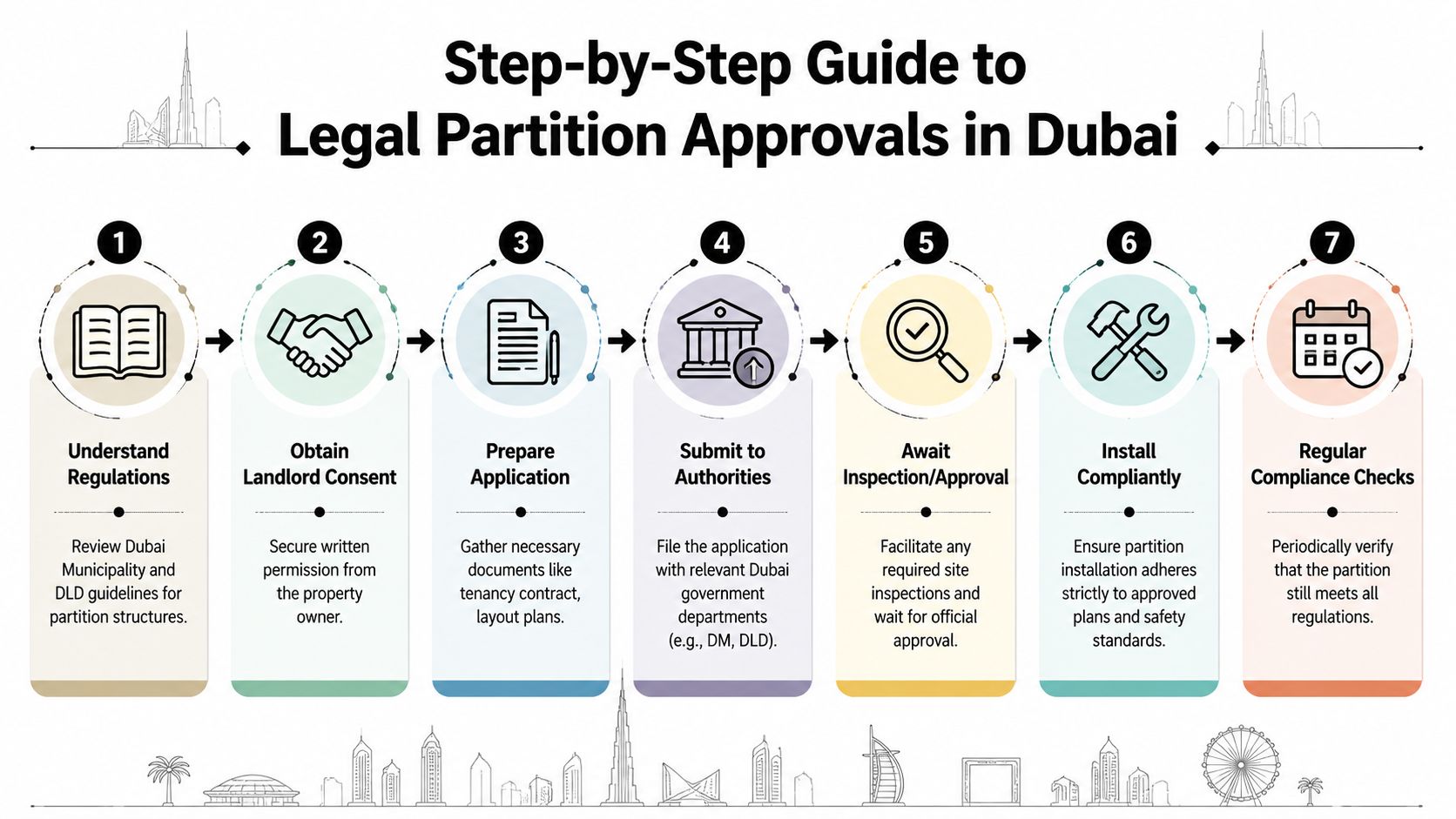
Start with the owner, not the contractor
If you're a tenant, your first document is written owner consent. Verbal approval is weak. A WhatsApp message is better than nothing, but it still may not protect you if the issue escalates. You need clear written confirmation that the owner knows what is proposed and agrees to it.
If you're a landlord, don't assume your own approval ends the matter. Building management rules, approved layouts, and safety obligations still apply.
Use a compliance-first checklist
Before any installation, check these points in order:
Confirm the original layout
Compare the current flat condition with the approved design and actual intended use.Check the tenancy position
Make sure the occupancy arrangement matches the contract and doesn't rely on informal subletting.Get owner consent in writing
This should identify what will be added, where, and who bears responsibility for removal if required.Ask whether building management approval is needed
In practice, many informal setups commonly fail on this point.Review life-safety basics
Don't create enclosed sleeping spaces that compromise access, ventilation, or escape.Use a documented installer
You need records, scope, and materials. Casual labour with no paperwork leaves you exposed.
Know when a simple divider stops being simple
A minor, removable privacy divider is not the same as creating a new enclosed room. Once the partition changes how the unit functions, especially for sleeping use, you're in a different category of risk.
That's why I tell small landlords to treat every partition proposal as a mini compliance review. Ask what the unit becomes after the change, not just what the divider looks like.
If a partition creates “one more room” on paper or in practice, assume you need deeper review before proceeding.
Get help when the paperwork touches government process
If the setup intersects with landlord approvals, occupancy questions, PRO support, or wider regulatory admin, it makes sense to use firms that already handle business setup and PRO services in Dubai. They won't replace a technical fit-out review, but they can help organise the documentation side and keep owners or operators from making procedural mistakes.
Keep a paper trail after approval
Don't stop once the partition is built. Keep:
- Owner approval records
- Tenancy documents
- Contractor invoice and scope
- Layout sketches or plans
- Any building correspondence
- Photos of the final installation
If a complaint arrives later, these records matter. People who can document what they did are always in a stronger position than people who say, “everyone in the building does it”.
Vetting Contractors and Estimating Costs
The cheapest installer is often the most expensive mistake. That's not a slogan. It's how illegal partitions keep getting built.
A handyman may offer to “close off” part of a hall or bedroom quickly. The problem is that speed and low price don't answer the fundamental questions. Will the work match the agreed scope? Will the materials create a hazard? Will the partition alter the use of the flat in a way that invites enforcement? If the answer is unclear, don't hire them.
Ask harder questions before you accept any quote
Often, only one question is asked. “How much?” That's the wrong opening.
Ask this instead:
What kind of partition are you proposing
A screen, a lightweight divider, or a fully enclosed room behaves very differently from a compliance standpoint.What materials will you use
If the contractor is vague, move on.Can the partition be removed without damaging the unit
Reversibility matters.Have you worked inside occupied Dubai residential units before
Residential work is not the same as office fit-out.Will your invoice and scope describe the work clearly
If the paperwork is sloppy, the project usually is too.Who is responsible if building management objects
Many installers disappear the moment there's a complaint.
Cost estimates are only rough guidance
I won't pretend there's one standard market rate for every partition. The cost depends on material, finish, size, access, and whether the work is a simple privacy divider or a more substantial enclosure. What matters more than the lowest figure is whether the finished work remains defensible.
| Partition Type | Common Material | Estimated Cost per Square Meter (AED) | Key Consideration |
|---|---|---|---|
| Open privacy divider | Lightweight panel or screen | Varies | Lowest compliance complexity, but still must not obstruct access |
| Basic room divider | Gypsum board with light framing | Varies | Can become risky if it creates an enclosed sleeping area |
| Higher-finish enclosed partition | Gypsum board with upgraded finish and door set | Varies | Greater risk if it changes occupancy use or circulation |
| Glass or office-style partition | Aluminium and glass | Varies | More common in commercial spaces than residential flats |
If you're comparing layouts for staff accommodation, co-working, or broader occupancy planning, it helps to understand the difference between informal room division and properly planned office spaces in Dubai. Many people mix those categories and make bad property decisions because of it.
My recommendation
Use a licensed, documented contractor only. Get a written scope. Refuse vague material descriptions. Refuse “don't worry, everyone does it” advice. That sentence has cost a lot of people money.
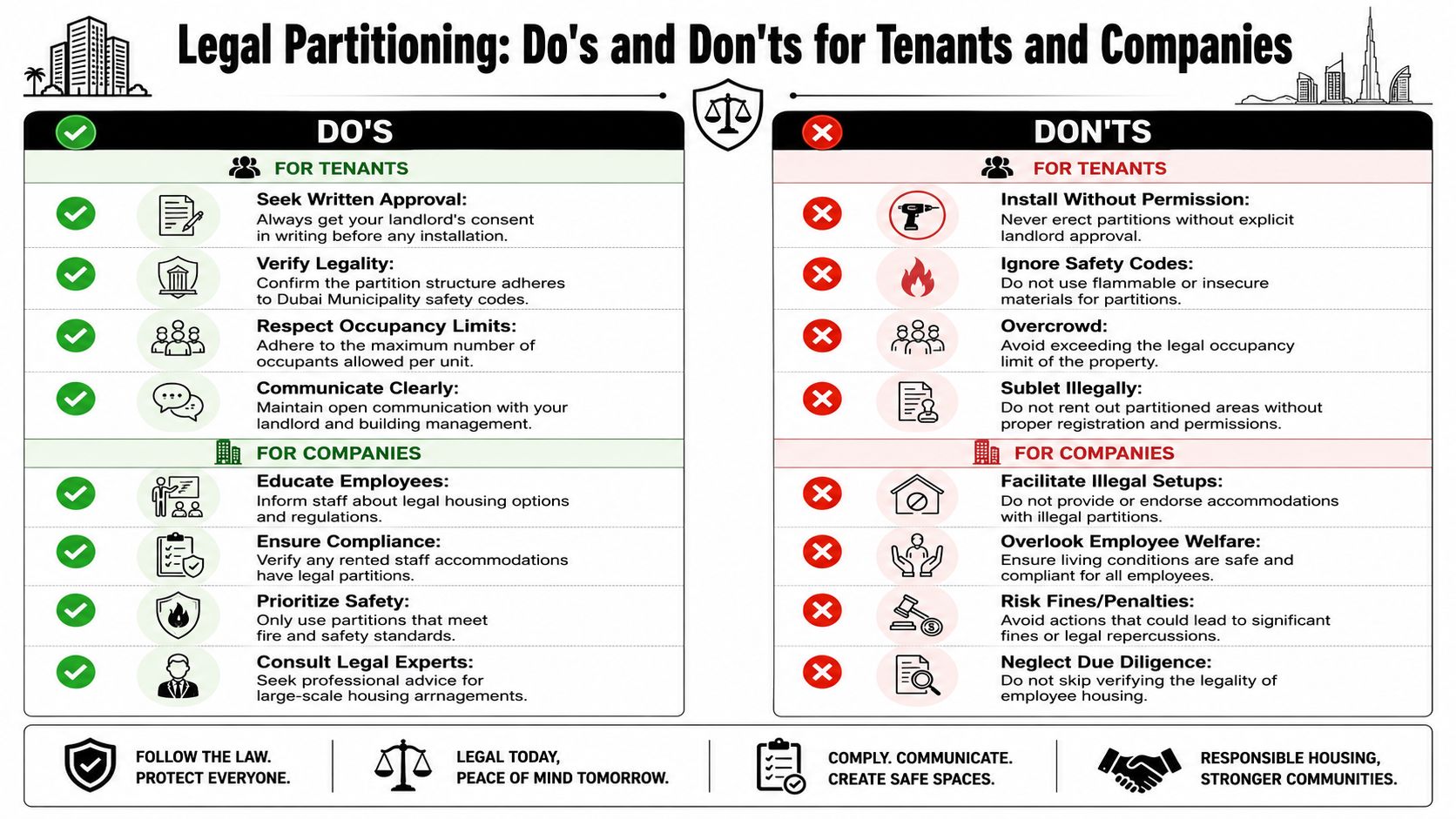
Do's and Don'ts for Tenants and Companies
Most readers need clarity regarding the following issues: Tenants want something affordable. Small landlords want stronger yield. Companies want practical staff housing. All three groups can walk straight into avoidable trouble if they treat partition listings as harmless shortcuts.
Dubai Municipality has explicitly prohibited rent increases and tightened oversight on subleasing and shared accommodation in overcrowded buildings. That changes the core question. It's no longer “where can I find a partition?” It's whether the arrangement is permitted, documented, and likely to survive inspection or eviction disputes, as noted in this discussion of oversight on subleasing and shared accommodation.
For tenants
Do
- Ask who the legal landlord is. If the person collecting money can't clearly explain their authority, treat the listing as high risk.
- Check whether the space is enclosed. A curtain setup and a real divided area are not the same thing.
- Look at the exit path. If the partition narrows movement, hides the door, or creates an awkward route out, walk away.
- Ask what happens if building management objects. If nobody has an answer, you'll be the one absorbing the disruption.
- Keep written records. Payment receipts, chat history, and agreed terms matter if the arrangement collapses.
Don't
- Don't assume cheap means acceptable. Low rent often reflects legal uncertainty, poor privacy, or safety compromise.
- Don't move in based on a photo only. Listings rarely show the circulation problems or overcrowding pressure.
- Don't sublet your own partition casually. Informal sharing creates another layer of exposure.
- Don't ignore warning signs. Multiple bunk beds, sealed windows, improvised locks, and maze-like layouts are red flags.
If you can't explain the occupancy arrangement clearly in one minute, the setup is probably too messy to trust.
For landlords and companies
Do
- Treat partitions as compliance issues, not décor choices. Once sleeping use is involved, the stakes rise.
- Match the actual use to the paperwork. Your tenancy structure, occupancy pattern, and physical layout should tell the same story.
- Review staff housing carefully. If your team uses low-cost shared accommodation, audit it. Don't outsource that judgement to an agent.
- Use documented channels when sourcing space. If you're comparing practical shared options, look at organised rental references such as rooms for rent in Business Bay to understand how formal listings differ from improvised partition setups.
Don't
- Don't chase yield by squeezing extra rooms into a flat. That's the behaviour that attracts scrutiny.
- Don't rely on verbal approvals. They fall apart the moment a dispute starts.
- Don't put employees in questionable housing. If something goes wrong, welfare and reputational issues become your problem.
- Don't wait for a complaint. By then, your options are narrower and more expensive.
The bottom-line judgement
A compliant arrangement is slower to set up, more boring, and less flashy than a classified ad. That's exactly why it's safer. The market rewards speed. Enforcement punishes shortcuts. You need to decide which side of that equation you want to be on.
Conclusion Navigating Partitions with Confidence
A partition in International City can be a practical solution. It can also be a poor-quality workaround that creates legal and safety exposure for everyone involved. The difference comes down to one thing. Compliance.
If you're a tenant, don't rent a partitioned space just because the monthly cost looks manageable. Check whether the arrangement is documented, physically safe, and consistent with the property's approved use. If you're a landlord or operator, stop thinking about extra rent first. Think about enforceability, inspections, building management objections, and occupant safety.
That's the fundamental frame for this issue. Compliance isn't bureaucracy for its own sake. It's risk management. It protects your money, your tenancy position, and your ability to stay in control when someone asks for documents or inspects the property.
Dubai gives people plenty of ways to structure housing and business operations properly. Informal partition setups only look simple until there's a complaint, a dispute, or an emergency. Then every shortcut becomes expensive.
If the arrangement is unclear, pause it. If the paperwork is weak, fix it. If the layout compromises safety, don't proceed.
If you need practical help reviewing tenancy documents, organising approvals, or handling the wider compliance side of property and business matters in Dubai, Smart Classic Business Hub provides UAE business setup, PRO, and regulatory support that can help you make better-informed decisions before a small partition issue turns into a bigger legal problem.