
You're probably seeing the same problem most founders see. One website says you can launch in the UAE for a very small amount. Another gives you a figure that feels several times higher. Then a consultant quote lands in your inbox and adds visa, office, and approval costs you hadn't budgeted for.
That confusion usually comes from one mistake. People ask for the licence price when they should be asking for the total cost of ownership.
A UAE company isn't a single fee. It's a stack of decisions. Jurisdiction, activity, visa count, office footprint, banking readiness, and compliance support all change the first-year budget. If you only compare headline prices, you can choose the cheapest setup and still end up paying more overall because the structure doesn't fit how you'll operate.
Decoding Your UAE Business Setup Dream
Entrepreneurs don't start with a cost problem. They start with a business goal. You want to sell into Dubai, open a consultancy, trade internationally, relocate with your family, or create a vehicle for regional expansion. The budget question appears next, and that's where the market gets noisy.
The phrase UAE business setup cost sounds like it should produce one answer. It doesn't. It behaves more like a travel budget. A plane ticket tells you very little about the actual trip if you haven't considered baggage, hotel, transport, and how long you're staying. Business setup works the same way.
Practical rule: Don't approve a setup budget until you can see which items are one-time, which renew annually, and which rise each time you add staff.
A proper budget usually starts with three filters:
Operating scope
Are you serving the local UAE market directly, or are you mainly trading or consulting across borders?People plan
Will it be only the founder at launch, or do you need employee visas quickly?Premises reality
Can you begin with a flexi-desk or shared arrangement, or does the business need a physical office from day one?
Those questions matter more than the sales pitch attached to a low entry price. A package can look affordable and still be wrong for your model if it limits market access, visa capacity, or banking practicality.
The founders who budget well usually do one thing differently. They stop chasing the lowest quote and start matching the structure to the business. That's how you avoid paying twice. Once for a cheap setup, and again to fix it later.
The Three Paths to Your UAE Company
Before discussing fees, it helps to understand the three legal routes. Think of them like choosing where to live in a new city. Your address shapes what you can access, what rules apply, and how much flexibility you have.
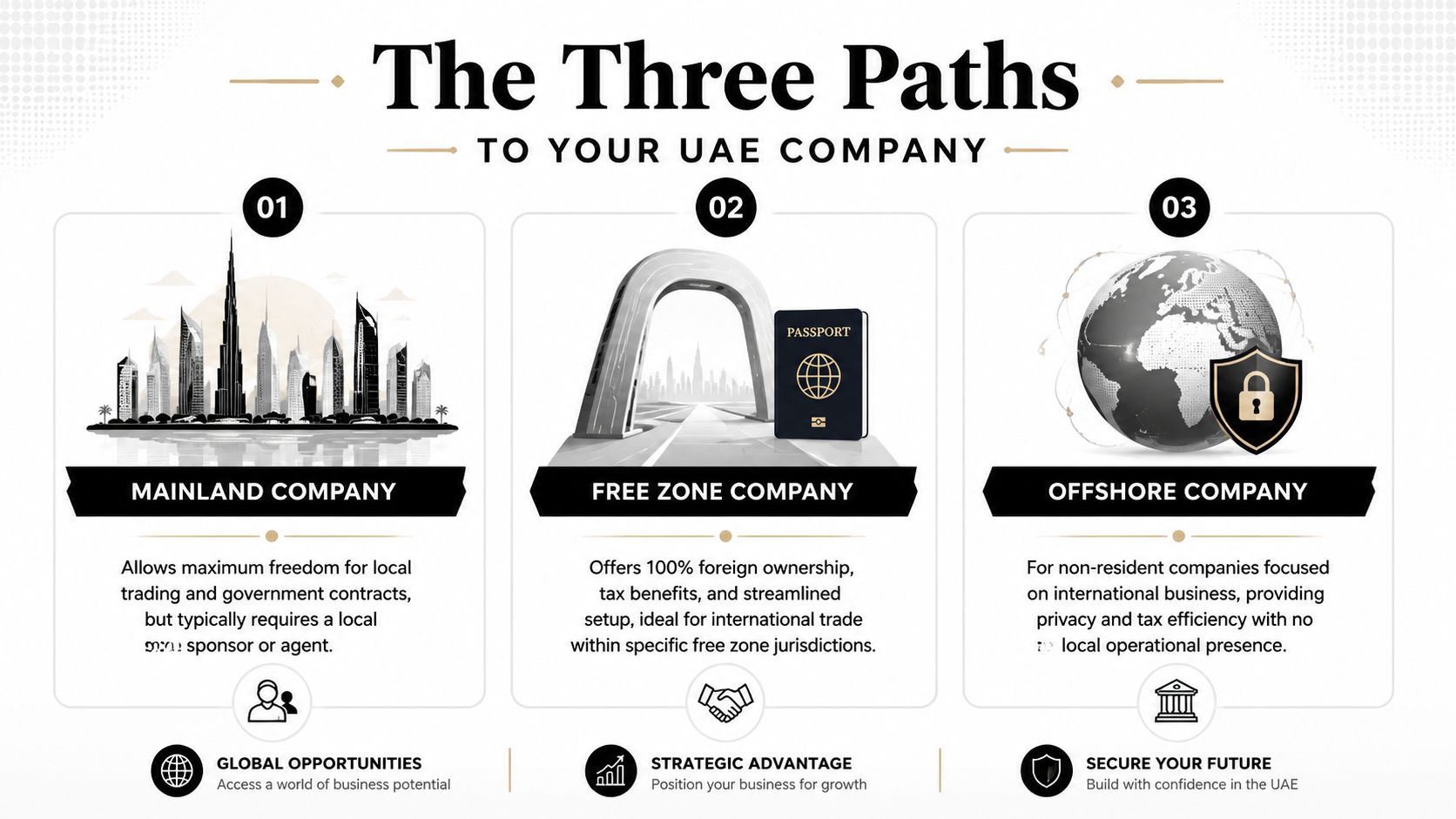
Mainland company
Mainland is like buying a house in the city centre. You pay more attention to approvals, premises, and formalities, but you get broad operating freedom. For many businesses, that means direct access to the local UAE market and a structure that suits onshore operations.
It's the route people choose when they want market reach first and cost efficiency second. If your revenue depends on doing business broadly inside the UAE, mainland often makes sense even when the entry budget is heavier.
For a practical comparison of these legal routes, see this guide on mainland vs free zone in Dubai.
Free zone company
A free zone is closer to a long-term lease in a well-managed gated community. The entry is usually more packaged, the process is often cleaner, and the operating rules are more defined by that specific zone.
This route suits founders who want foreign ownership, structured administration, and a smoother launch path. It's particularly common for services, consulting, digital businesses, and international trade models that don't need the same local operating footprint as mainland companies.
Offshore company
Offshore is different again. It's more like having a legal holding address rather than opening a shop. It can suit international holding, asset ownership, or cross-border structures, but it isn't the same as building an operating presence inside the UAE.
That distinction matters. Some founders hear “cheaper structure” and assume “better startup option”. If your actual goal is hiring locally, sponsoring visas, or carrying out day-to-day UAE operations, an offshore route may not match the job.
The real choice
The legal path should follow the business model, not the other way round.
- Choose mainland if local market access is central.
- Choose free zone if you want a structured launch with controlled overhead.
- Choose offshore if the company is mainly a holding or international structuring vehicle.
A lot of overspending starts here. Founders pick the wrong neighbourhood, then spend the next year compensating for that decision.
Calculating Your Mainland Business Setup Cost
Mainland cost planning is rarely about one invoice. It's about several mandatory pieces that add up. That's why two businesses with similar turnover expectations can face very different first-year budgets.
One useful benchmark comes from an older but still illustrative Dubai mainland breakdown cited by RAKEZ. It shows totals of AED 12,987 for a professional licence, AED 17,987 for a commercial licence, and AED 32,987 for an industrial licence, with licence fees often ranging from AED 10,000 to AED 15,000 depending on the activity, as noted in RAKEZ's mainland and free zone comparison.
Why activity changes the budget
A professional activity and an industrial activity don't carry the same setup path. The more operationally complex or regulated the activity, the more moving parts usually sit behind the licence itself. That's why comparing two mainland quotes without checking the actual business activity is risky.
A realistic mainland budget often includes items such as:
Trade name and initial approvals
Small on paper, but they're part of the formal launch sequence and affect the timing of the whole application.Licence issuance
This is the visible part of the cost, but it isn't the whole budget.Premises-related requirements
Mainland usually becomes more expensive when office commitments enter the picture.External approvals
Some activities need extra permissions beyond the core licence process.
Mainland is usually the better fit when operational freedom matters more than minimising the first invoice.
What works and what doesn't
What works is building the mainland budget from the business backward. Start with the activity, then office reality, then staffing. What doesn't work is taking a generic “mainland package” at face value and assuming it covers every approval your sector might need.
A simple way to think about it is this:
| Mainland budget question | Why it matters |
|---|---|
| What is the exact activity? | It affects licence type and possible approvals |
| Do you need premises immediately? | Office commitments can reshape the budget |
| How many people need visas soon? | Immigration costs rise with headcount |
| Will you need sector-specific permissions? | Extra approvals can add time and cost |
Mainland can be the right answer. But it's rarely the cheapest answer once you include the full operating footprint.
The All-Inclusive Cost of UAE Free Zones
Free zones appeal to founders because the pricing often feels cleaner. Instead of building the budget line by line, you're usually looking at a bundled setup that may include the licence, registration, and a basic workspace solution such as a flexi-desk.
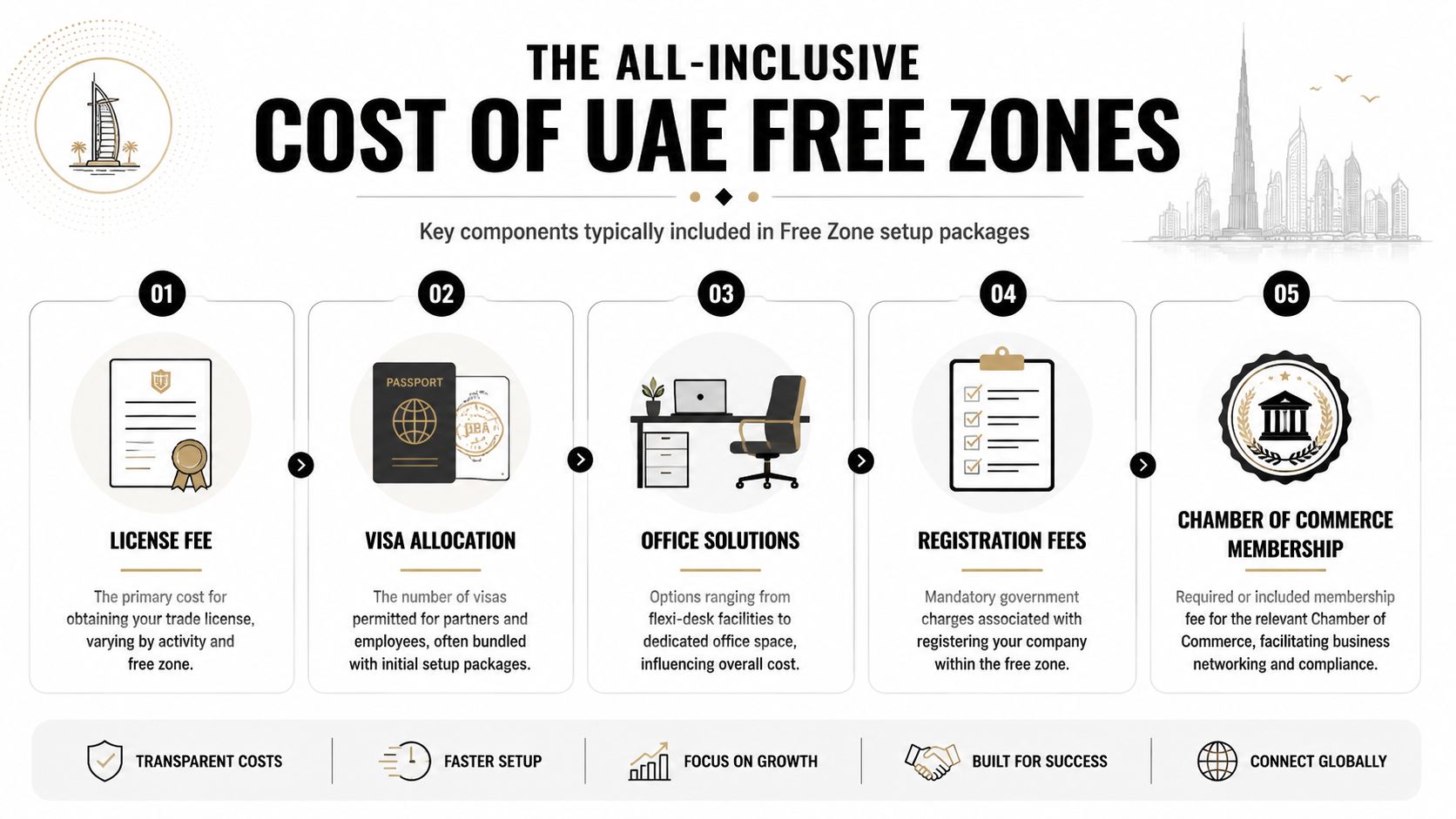
That bundled model is why free zones often feel easier to understand than mainland. But “all-inclusive” doesn't mean universal. It means certain core elements are packaged together within that specific jurisdiction.
Premium Dubai zones versus lower-cost alternatives
A foundational benchmark for a Dubai free-zone setup is that first-year company formation typically costs AED 35,000 to AED 50,000, including the business licence, company registration, and a flexi-desk, according to DMCC's Dubai free zone cost overview. Within that benchmark, DMCC lists a registration fee from AED 9,000, an annual licence fee of AED 10,000 to AED 50,000, and a typical share capital of AED 50,000.
That's the part many founders miss. The licence isn't the setup. It's one major component inside a wider first-year package.
At the other end of the market, RAKEZ cites an all-inclusive free-zone package with a visa at AED 16,500 per year, as noted in this guide to Dubai free zone company setup cost. That spread tells you something important. Free zones don't have one market price. Dubai premium zones and non-Dubai or lower-cost zones solve different problems.
What your money is really buying
With free zones, price often tracks more than paperwork. It can reflect brand value, location, infrastructure, ecosystem fit, and how appealing that jurisdiction is to clients, partners, and banks.
A founder choosing between a premium Dubai zone and a lower-cost alternative should ask:
- Do clients care about the jurisdiction address?
- Is the free zone recognised in my sector?
- Will I use the office or ecosystem benefits?
- Am I paying for prestige when I only need functionality?
The package trap
The common mistake is buying on headline cost alone. A lower-cost package can be excellent for a solo consultant, online service provider, or early-stage firm that wants a compliant, lean entry point. The same package can become restrictive if the business quickly needs more visas, dedicated space, or a location that carries stronger market signalling.
A cheap free zone isn't automatically good value. It's good value only when the operating limits match the business plan.
A better way to compare free zones
Use a value lens, not just a fee lens.
| Free zone factor | Cheap package view | Better decision view |
|---|---|---|
| Licence | Lowest listed fee | Does the activity fit properly? |
| Workspace | Included desk | Is it enough for banking and operations? |
| Visa allocation | One visa included | Will you need more soon? |
| Location | Non-Dubai may cost less | Does address prestige matter to clients? |
That's where the core free-zone decision sits. Not “which one is cheapest?” but “which one avoids overpaying for benefits I won't use?”
Beyond the License Fee The Hidden and Recurring Costs
Many budgets falter when founders account for setup, only to discover the company also needs immigration processing, workspace upgrades, bank support, bookkeeping, insurance, and routine renewals.
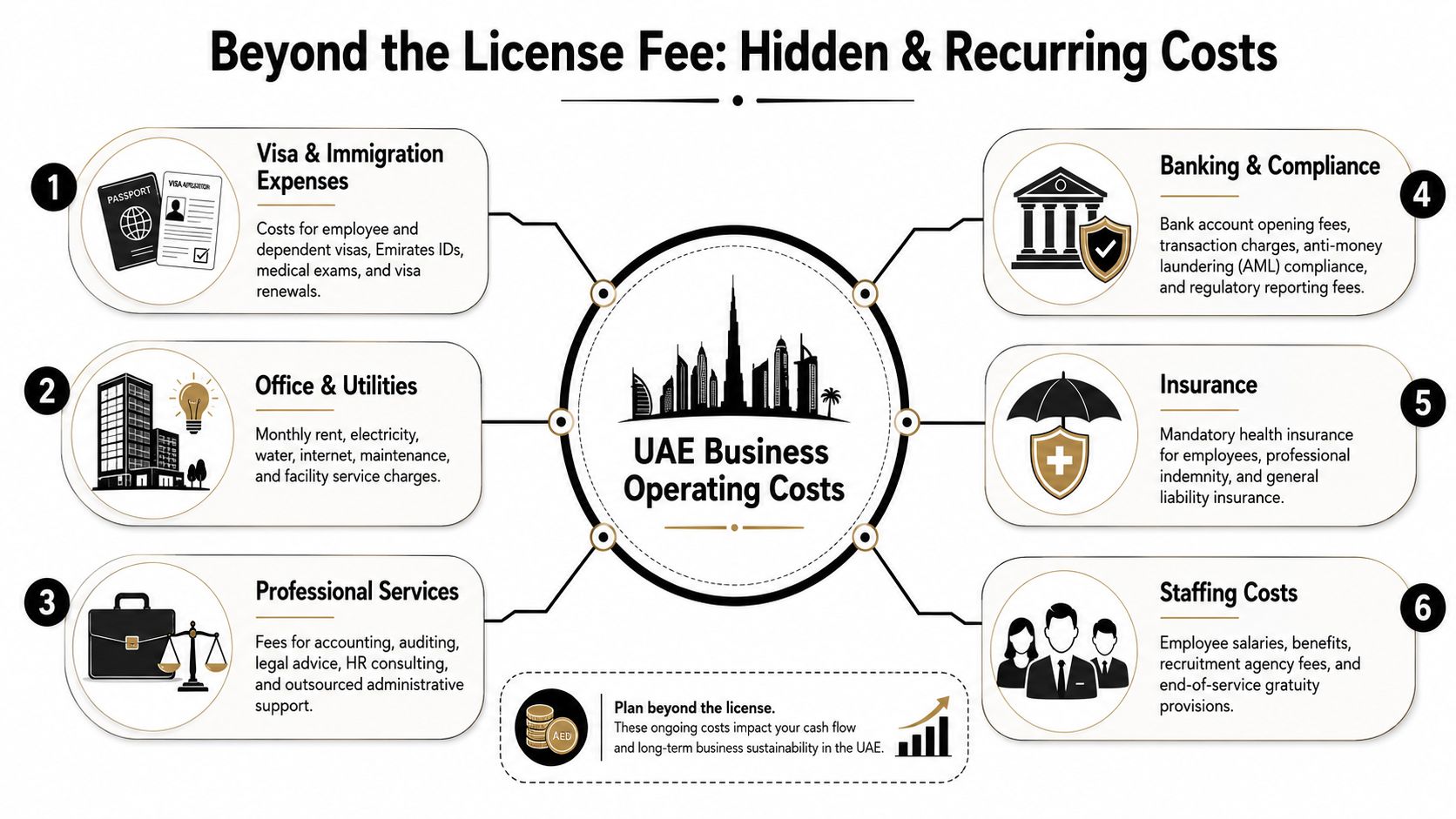
The licence gets you into the game. It doesn't cover the whole season.
Visas and staffing change everything
One of the clearest cost drivers is headcount. Visa costs are commonly benchmarked at AED 3,000 to AED 5,000 per person, and mainland first-year totals often start above AED 30,000 to AED 40,000 but can rise to AED 50,000 to AED 150,000+ once office requirements, external approvals, and multiple visas are added, according to this UAE startup cost calculator breakdown.
That is why a founder-only plan and a team-of-five plan should never share the same budget logic.
A practical checklist looks like this:
Founder visa
Often the first non-licence cost people add.Employee visas
Each hire changes both immigration spend and office needs.Dependants
Relevant for founders relocating with family.Renewals and processing admin
These aren't dramatic individually, but they matter in cash-flow planning.
The recurring costs people overlook
The second budget leak is everything operational that sits outside the formation quote.
Office and utilities
A flexi-desk keeps entry lean. A dedicated office changes the cost base and often the long-term commitments.PRO and government liaison support
Many founders can technically manage formalities themselves, but time gets eaten quickly by admin, approvals, and document follow-ups.Accounting and compliance
Once the company is active, record-keeping and regulatory discipline matter. This is not the glamorous part of setup, but it protects the business.Banking support
Banking can be straightforward or frustrating depending on the activity, documents, and transaction profile. For founders comparing support options, this overview of a UAE business banking account process helps frame what banks and advisors typically look for.
If your setup quote doesn't discuss annual operating admin, it's a partial quote, not a full budget.
Your personal cost base also matters
Founders often isolate company cost from living cost, then find the total move is tighter than expected. If you're relocating, it helps to understand Dubai living costs alongside company expenses so your business budget and personal cash-flow plan don't conflict.
The real total cost of ownership
The most useful way to budget is to split costs into three layers:
| Cost layer | What it includes |
|---|---|
| Setup layer | Registration, licence, core approvals |
| Activation layer | Visas, ID processing, workspace, banking assistance |
| Operating layer | Renewals, accounting, insurance, admin, staffing growth |
Some firms use external support to keep these layers organised. For example, Smart Classic Business Hub offers setup, PRO, banking support, accounting, and related compliance services under one roof, which can help founders compare bundled versus separate-provider costs. That isn't always necessary, but a coordinated model can reduce surprises when several moving parts need to align.
Sample Budgets and Smart Cost-Saving Strategies
Abstract advice only goes so far. It helps to look at real-world founder profiles and ask what each one is buying.
The solo freelancer
This founder sells services remotely, needs a legal UAE presence, and wants one visa with minimal overhead. In practice, this person usually benefits from a lower-cost free-zone route rather than paying for Dubai prestige they won't monetise early.
The sensible budget mindset is lean but not unrealistic. The setup should cover the company, founder immigration needs, and enough admin support to get trading and banking moving. The mistake here is choosing a premium jurisdiction because it sounds impressive, then carrying unnecessary annual cost.
The mainland e-commerce trader
This business needs stronger local operating flexibility and may need premises and more formal approvals as it grows. The starting price can look manageable on paper, but the actual spend changes when visas, space, and trading operations begin to scale.
For this founder, saving money doesn't mean forcing a free-zone structure that creates operational friction later. It means controlling the office footprint, phasing hiring carefully, and making sure the activity is licensed correctly from the start.
The international consulting firm
This company wants a polished Dubai presence, clean administration, and a jurisdiction that clients recognise. It may choose a premium free zone because the address, ecosystem, and presentation support the business model.
That doesn't mean spending without discipline. It means paying for reputation and convenience only where those factors help win work or support expansion.
Good cost control doesn't come from buying the cheapest setup. It comes from refusing to pay for capabilities you won't use in the first year.
Cost-saving strategies that actually work
Some savings tactics are productive. Others create expensive corrections later.
Start with the operating model, not the cheapest quote
If the structure fits, renewals and growth are usually easier to manage.Keep the workspace light at launch
A flexi-desk or shared model often preserves cash while the business validates demand.Add visas only when the role is justified
Staffing decisions affect both direct immigration cost and office commitments.Bundle admin where it reduces friction
Setup, PRO, and accounting can be easier to manage when responsibilities are clearly coordinated.Review cost discipline as an operating habit
Broader planning methods can help founders trim waste after setup as well. This practical guide to BMA's cost strategy insights is useful if you want a structured way to think about fixed versus variable cost pressure.
The strongest cost-saving move is usually restraint. Don't build the year-three structure in month one.
Your Next Step Toward a Precise UAE Budget
By now, the pattern should be clear. UAE business setup cost is never just the licence fee, and it's never one universal number. It depends on where you incorporate, what you're licensed to do, how many people need visas, and how much operating infrastructure the business needs from day one.
The founders who avoid budget shocks usually do two things well. They separate setup cost from ongoing ownership cost, and they choose a jurisdiction that supports the business they're building, not the one they imagine five years from now.
If you're still comparing quotes, ask every provider the same direct questions:
- What is included in year one?
- What renews annually?
- What changes when I add visas or office space?
- Which approvals or compliance items are outside this quote?
Those four questions expose most hidden gaps quickly.
A precise budget starts when your activity, visa plan, and jurisdiction are mapped together. That's the point where estimate turns into decision.
If you want a clearer view of your likely first-year and ongoing costs, Smart Classic Business Hub provides UAE company formation support across mainland, free zone, and offshore structures, along with PRO, banking, accounting, and compliance services. A practical next step is to use their cost calculator or request a consultation to compare jurisdiction options against your actual business model.