
You're probably here because the UAE setup market gives you three words over and over, mainland, free zone, and offshore, and somehow each website makes its own option sound like the obvious choice.
That's where most founders get stuck. They don't need more slogans about “easy setup” or “tax benefits”. They need to know which structure fits the way the business will sell, invoice, hire, bank, and grow.
A founder planning to trade internationally often leans towards a free zone. A consultant serving clients across Dubai may assume free zone is enough, then later discover mainland access matters. An investor may hear “tax-free” and only ask questions after the company is formed. By then, changing structure is slower and more expensive than choosing correctly at the start.
Decoding Your UAE Business Setup Options
In practical terms, the UAE gives most entrepreneurs three broad paths.
Mainland is the route for businesses that want broad access to the UAE local market. Offshore is usually used for holding structures and specific cross-border purposes, not for everyday operating businesses in the UAE. Free zone sits in the middle. It's a real operating structure, but it comes with its own rules, authority, and limits.

That middle option became a major part of the UAE business system over time. The country's free-zone model is widely traced to Jebel Ali Free Zone, established in 1985, and the system has since expanded to over 45 free zones across sectors including logistics, finance, technology, media, manufacturing, and e-commerce, as outlined in this overview of the UAE free-zone model.
The confusion founders usually have
The question usually isn't just what is free zone in UAE. The key question is, “Will this structure work for the way I plan to do business?”
That's a better question.
A free zone can be an excellent fit if your customers are outside the UAE, your activity suits a specialised zone, or you want a more self-contained registration process. It can be the wrong fit if you expect unrestricted mainland trading from day one, or if you're choosing only on headline promises.
Pick the jurisdiction around your operating model, not around the cheapest first-year package.
What matters from this point onward
When founders ask me about free zones, I focus on four things first:
- Customer location: Are you selling mainly outside the UAE, inside the UAE, or both?
- Business activity: Some activities fit certain zones neatly. Others don't.
- Office reality: Do you need only a desk, a proper office, warehousing, or regulated premises?
- Tax exposure: “Free zone” doesn't automatically mean zero tax in every case.
Those trade-offs matter more than marketing language. Once you understand them, the free-zone decision becomes much clearer.
What Exactly Is a UAE Free Zone
A UAE free zone is best understood as a business island inside the UAE. It sits within the country, but it operates under its own administrative system for company formation and ongoing compliance.
That distinction is the whole point.
Instead of registering through the mainland commercial framework, a company in a free zone deals with the free zone authority for licensing, registration, and operational compliance. That separate structure is why free zones can offer features such as 100% foreign ownership, full capital and profit repatriation, and a more simplified approval process for qualifying activities, as described in this PKF guide to UAE free zones.
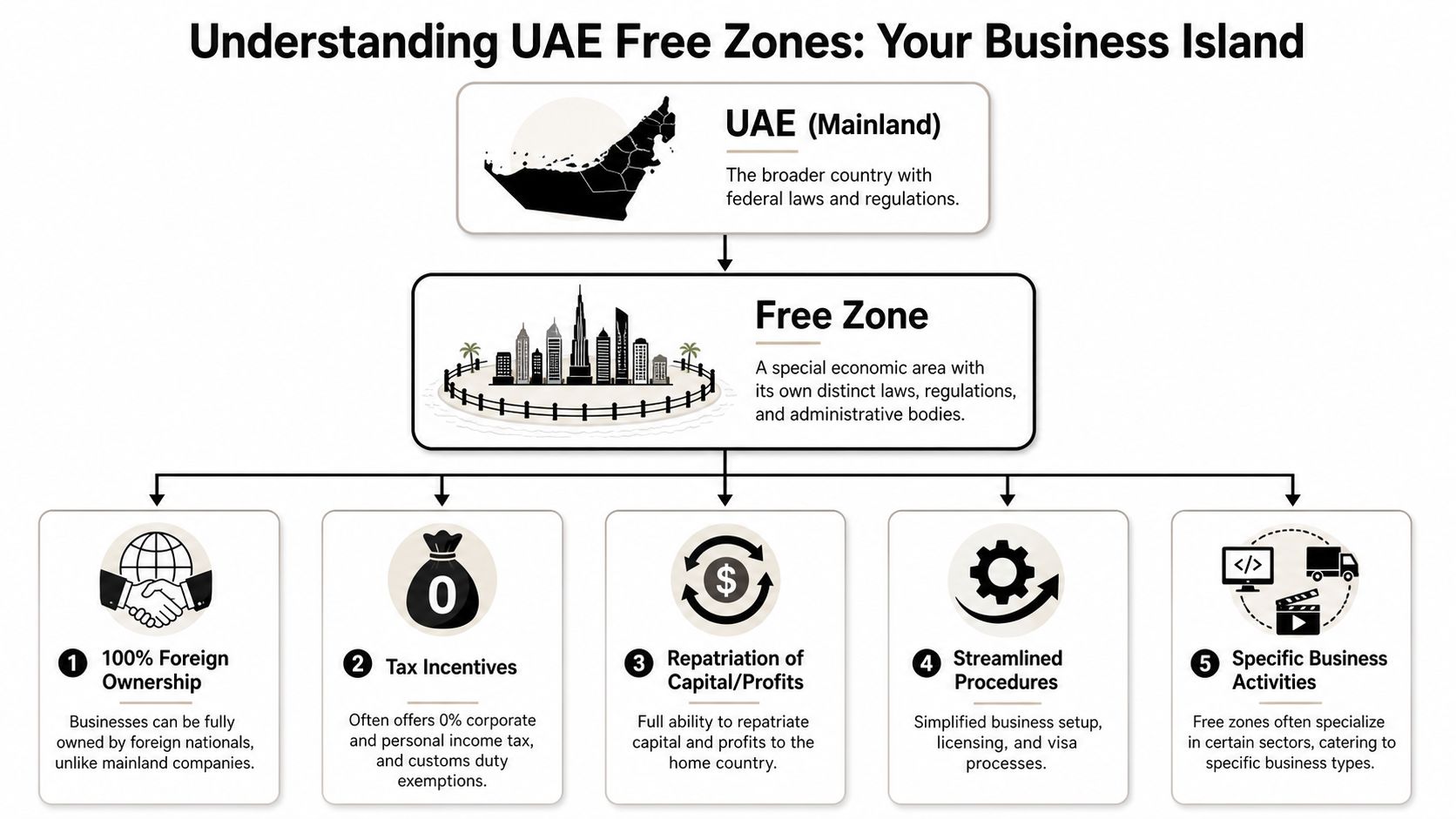
Think of it as a self-contained business district
If mainland setup is like entering the public road network, a free zone is like entering a managed industrial estate with its own gate, rules, and administration.
That doesn't make it better in every case. It makes it different.
Inside a free zone, the authority often controls:
- Licence issuance: It decides which activities it will permit
- Entity formation: It governs how your company is incorporated within that jurisdiction
- Immigration support: Many free zones coordinate visa-related steps within the same system
- Facility options: The zone often ties office type, desk package, or warehouse space to your licence and visa position
Why this structure exists
Free zones weren't created just to lower friction for paperwork. They were designed to attract foreign investment and support targeted sectors.
That's why one zone may suit logistics businesses, another may suit media companies, and another may be more practical for consulting or tech. The zone itself is part regulator, part infrastructure provider, and part commercial ecosystem.
Not all zones register every company type or every activity. That's one reason founders should review the rules carefully before applying. If you want a closer look at how these special jurisdictions work, this guide on designated free zones in the UAE is a useful starting point.
A free zone isn't just an address. It's a separate rulebook, administered by a separate authority, for a specific kind of business environment.
What a free zone is not
It's not a universal shortcut.
It doesn't remove the need to choose the right activity, maintain proper compliance, or think through how you'll serve mainland customers. It also doesn't mean every licence gives the same operational freedom. Two free zones may both offer foreign ownership, but the day-to-day fit can be very different.
That's why the label alone doesn't answer much. The zone, the activity, and the business model have to line up.
Key Benefits of a Free Zone Company
Free zones became popular for practical reasons, not just branding. For many founders, they solve three early problems at once. Ownership, administration, and international trading efficiency.
Why so many founders start here
A free zone company is often attractive because it gives foreign entrepreneurs a cleaner entry point into the UAE. Instead of building around a locally driven commercial process, they can enter through a jurisdiction designed for outside investment and cross-border activity.
That design has real commercial weight. In Dubai, free-zone trade volume was AED 394 billion in 2018 and grew to AED 464 billion in 2020, an increase of about 17.8%, according to this Dubai free zones trade overview. For business owners, that matters because it shows free zones are not a niche setup route. They are a serious part of the trading economy.
The advantages that matter in practice
- Full ownership: Many founders choose free zones because they can hold 100% foreign ownership. That gives clarity on control, shareholding, and exit planning.
- Capital movement: Free zones are known for full repatriation of capital and profits. For international owners, that matters when structuring group companies or moving retained earnings.
- Trade-friendly mechanics: These jurisdictions are built around import, export, and regional distribution logic. Customs treatment and zone-based processes can be especially relevant for trading businesses.
- Simpler setup flow: In many cases, the same authority handles licence approval, incorporation, and related administrative steps. That usually means fewer handoffs.
Where free zones work especially well
Some business models tend to fit free zones naturally:
| Business type | Why a free zone often suits it |
|---|---|
| Export trading | The structure aligns with cross-border movement of goods |
| Consulting for overseas clients | Ownership and administration are usually straightforward |
| E-commerce with regional distribution | Certain zones are built around logistics and fulfilment |
| Sector-specific firms | Cluster-based zones can make activity approval more practical |
The benefit founders misunderstand
The biggest benefit isn't “cheap setup” or “no questions asked”. It's alignment.
When the zone matches the activity and the market, the company runs more smoothly. Banking conversations tend to make more sense. Facility selection is easier. Licence wording is clearer. Expansion planning becomes less reactive.
The right free zone saves friction later. The wrong free zone creates friction in every renewal, invoice, and customer contract.
That's why experienced founders don't ask only what the benefits are. They ask whether those benefits apply to the way the company will actually operate.
Free Zone vs Mainland vs Offshore A Practical Comparison
Most setup mistakes happen because founders compare jurisdictions by price first and operations second. That order should be reversed.
If your business needs unrestricted access to customers across the UAE, mainland usually deserves serious attention. If you're forming a holding structure, offshore may be relevant. If you want an operating business with a separate authority and a strong international focus, free zone often enters the conversation.
UAE business jurisdictions at a glance
| Feature | Mainland Company | Free Zone Company | Offshore Company |
|---|---|---|---|
| Regulatory home | Mainland commercial framework | Free zone authority | Offshore registry framework |
| Local UAE market access | Generally suited for direct local trading | Depends on structure and permitted interaction with mainland | Not typically used as a local operating vehicle |
| Foreign ownership | Depends on activity and legal framework | Commonly supports full foreign ownership | Commonly used for foreign-held structures |
| Office model | Varies by activity and authority requirements | Often linked to zone package and licence terms | Usually not chosen for day-to-day UAE operations |
| Visa route | Commonly available for operating businesses | Commonly available through the zone | Usually limited or not the primary purpose |
| Best fit | Businesses serving the UAE domestic market | Cross-border trade, services, specialised sectors | Holding and certain international structuring uses |
How to decide like an operator
Use a simple filter.
If your revenue will come mainly from UAE mainland customers, don't assume free zone is the default. If your business will import, re-export, consult internationally, or operate inside a specialised cluster, free zone may be the better tool.
If you're still weighing the two main operating routes, this comparison of mainland vs free zone in Dubai can help frame the decision.
The practical strengths and weaknesses
Mainland usually makes more sense when local trading freedom matters more than administrative simplicity. It gives broader domestic positioning, but the setup path and compliance pattern can be different.
Free zone usually makes more sense when the company is internationally oriented, activity-specific, or built around an ecosystem such as logistics, media, or tech. The trade-off is that mainland interaction needs to be assessed carefully.
Offshore is where many founders get misled. They hear the word and assume it's a cheaper version of a UAE company. Usually it isn't the right answer for an entrepreneur who needs staff, visas, contracts, and an active local presence.
A quick reality check
Ask these three questions before choosing:
- Where will invoices come from most often
- Where do customers sit
- What will the company physically need to operate
If your answer is “inside the UAE retail or local service market”, mainland often comes into focus. If your answer is “international clients, regional trade, or specialised activity”, free zone can be a strong fit.
That's the pertinent comparison. Not which one sounds easier, but which one supports the business you're building.
How to Set Up Your Company in a UAE Free Zone
The setup process is manageable when you treat it as an operating decision, not just a registration task. The form itself is rarely the hard part. Choosing the right activity, authority, and office model is where most of the thinking should happen.
The UAE has more than 40 specialised free zones, with official and sector-focused references citing figures from over 40 to 46, and the network is estimated to support roughly 40% of the UAE's total exports including re-exports, according to this UAE Embassy overview of free zones. That tells you something important. These zones are built as trade and logistics infrastructure, not just licensing counters.
Start with the business activity, not the brochure
A founder should first match the actual business activity to a zone that permits it. This sounds obvious, but many people start with package pricing, then try to force the activity into the licence later.
That approach usually causes delays.
A practical review should cover:
- Activity fit: Does the zone permit what you'll really do?
- Customer geography: Will you serve overseas clients, UAE clients, or both?
- Facility need: Do you need flexi-desk, office space, warehouse space, or a regulated environment?
- Visa expectations: How many owners and employees need residency support?
The formation path most founders follow
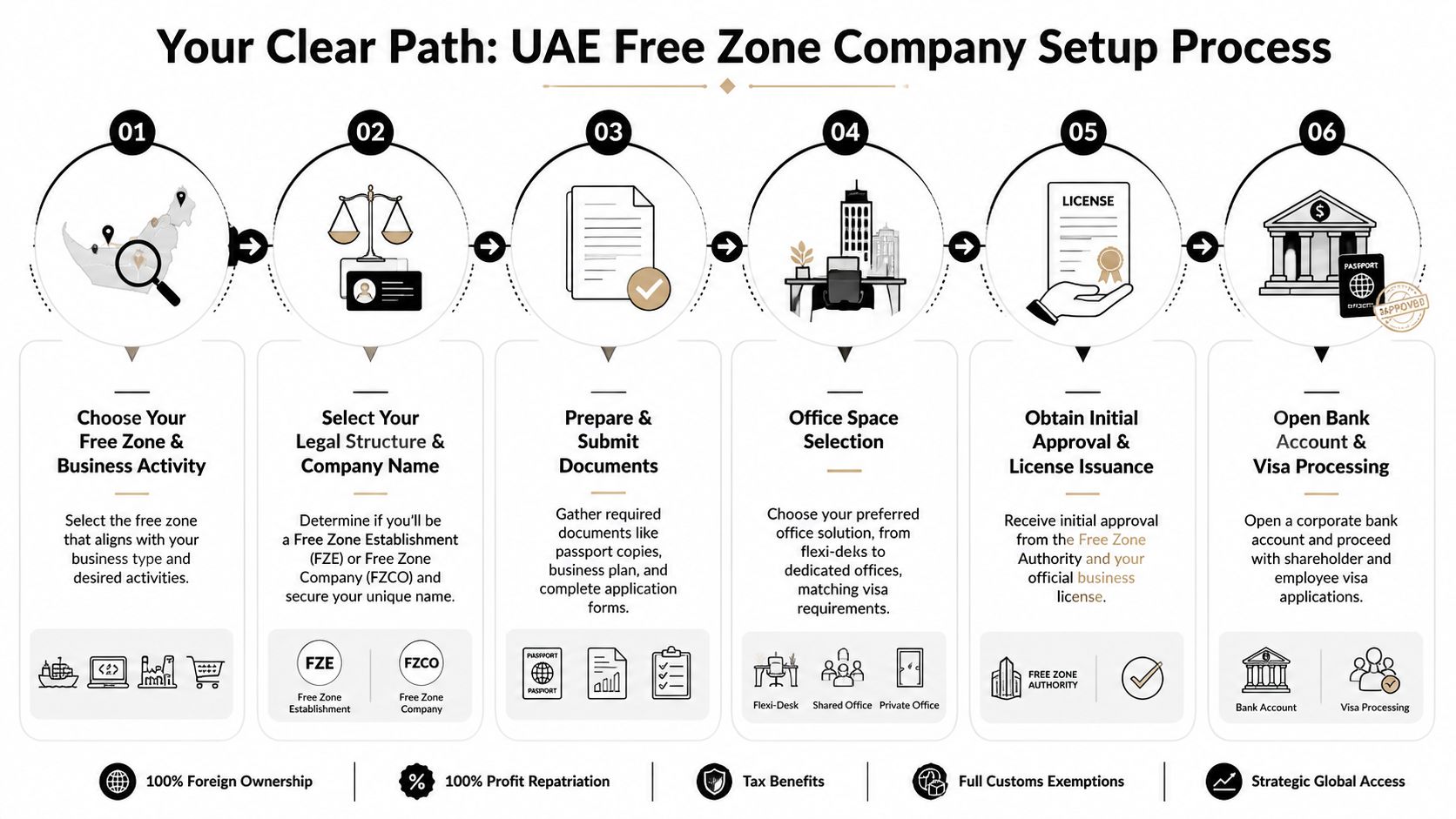
Once the zone is shortlisted, the process usually moves through a sequence like this:
- Choose the zone and licence activity that matches the operating model.
- Select the legal structure and reserve the company name.
- Prepare documents such as shareholder identification and application forms required by the authority.
- Confirm office or desk arrangement based on the package and visa requirement.
- Receive licence and incorporation documents after approvals.
- Proceed with bank account opening and visa processing once the company is active.
Each of those steps sounds simple on paper. The actual work is in getting the inputs right the first time.
Where founders lose time
Three issues usually slow the process:
- Wrong activity wording: The business description doesn't match the intended work.
- Wrong zone choice: The authority is efficient, but the zone itself doesn't fit the business.
- Weak document preparation: Incomplete or inconsistent paperwork creates back-and-forth.
For founders comparing budgets before they choose a jurisdiction, this page on Dubai free zone company setup cost helps frame what typically affects the total.
Good setup work is mostly front-loaded thinking. Once the structure fits, the paperwork becomes much easier.
One practical option is working with a consultancy that handles setup, compliance coordination, and related services under one roof. Smart Classic Business Hub is one such Dubai-based firm that supports free zone, mainland, and offshore formation alongside accounting, PRO services, and related compliance tasks.
Common Pitfalls and Real-World Limitations
At this point, marketing language usually breaks down.
A free zone can be an excellent structure. It can also be the wrong structure chosen for the right reasons. Most problems come from assumptions that were never tested before incorporation.
The mainland access misunderstanding
Many founders hear “UAE company” and assume they can trade anywhere in the country in the same way from day one. That isn't a safe assumption with a free zone entity.
The key issue is how the business will interact with the mainland market. If your sales model depends heavily on direct UAE domestic business, you need to examine that before setup, not after. A free zone licence may still work in some models, but the commercial path is not always as direct as founders expect.
The tax-free myth after corporate tax
This is the misunderstanding that now matters most.
Free zone branding still often leans on the phrase “tax-free”, but that phrase needs qualification. UAE-focused guidance notes that free zone companies can be subject to the UAE's 9% corporate income tax if they earn mainland revenue or fail to meet qualifying conditions, as noted in this discussion of UAE free-zone tax treatment.
That means the correct question isn't, “Is a free zone tax-free?”
It's, “Will this specific company, with this revenue mix and this operating model, qualify for the intended treatment?”
Don't buy a free zone company for yesterday's tax headline. Buy it for today's compliance reality.
Other mistakes that cost founders later
- Choosing by package price alone: A low-cost licence can become an expensive mistake if the activity or office model doesn't fit.
- Ignoring office implications: Some founders choose the smallest package, then realise their staffing or visa needs don't match it.
- Treating all zones as interchangeable: They aren't. Different authorities vary in activity scope, process, facilities, and commercial logic.
- Using vague business descriptions: If the licence wording is too broad or too narrow, operations can become awkward later.
What works better
A better decision process looks like this:
| Question | Why it matters |
|---|---|
| Where are my customers | It affects jurisdiction choice |
| What exactly will I sell | It affects licence activity approval |
| Will I need UAE mainland access | It affects whether free zone is sufficient |
| What income streams do I expect | It affects tax analysis |
| What facilities and visas do I need | It affects package and cost fit |
That framework avoids the common trap of choosing the company first and discovering the business model second.
Your Next Steps with Smart Classic Business Hub
If you've read this far, you already know the short answer to what is free zone in UAE.
It's a separate business jurisdiction inside the UAE, run by its own authority, designed to attract investment and support specific commercial activity. But the useful answer is more practical than that. A free zone is the right tool only when it matches how your company will sell, operate, hire, and handle tax.
That's why the best setup decisions rarely start with “Which licence is cheapest?” They start with “Where are my customers, what activity do I need, and what happens when I grow?”
A better way to choose
Before moving ahead, review these points carefully:
- Map the sales model: International, mainland UAE, or mixed?
- Check the activity wording: It should reflect what the business will do.
- Assess the office requirement: Desk, office, warehouse, or specialised facility?
- Review tax exposure early: Especially if mainland revenue may enter the picture.
What support should look like
The right advisor doesn't just file forms. They should help you pressure-test the structure before money is spent, then coordinate setup, renewals, immigration steps, and compliance in a way that matches the business model.
If you want a practical discussion around free zone versus mainland, licence activity fit, visa planning, and ongoing compliance, Smart Classic's website shows the broader scope of support available for UAE company formation and related services.
If you need help choosing the right jurisdiction and handling the setup properly, speak with Smart Classic Business Hub. They help founders and companies with UAE business formation, including free zone, mainland, offshore, compliance, PRO support, accounting, and related operational requirements.