
You've got sales moving, suppliers billing, customers paying, and then someone on your team asks a simple question that suddenly isn't simple at all. “Do we need to register for VAT now?”
That's usually the moment VAT stops feeling like a back-office detail and starts affecting pricing, invoices, accounting, cash flow, contracts, and risk. In Dubai, that shift happens fast. A business can move from early traction to compliance exposure without much warning, especially if turnover is rising, service lines are changing, or cross-border work is increasing.
Good VAT handling isn't about filling in a form once a quarter. It's about setting up a business process that works under scrutiny. If the records are weak, invoices inconsistent, or tax treatment guessed instead of checked, the problem doesn't stay inside finance. It spills into margins, working capital, and management time.
That's why vat consultancy dubai matters most when a business is growing, changing, or entering the UAE market for the first time. The right adviser doesn't just tell you what VAT is. They help you decide when to register, how to classify transactions, how to build VAT-ready books, and how to avoid the sort of mistakes that become expensive only after they've been repeated for months.
Navigating Dubai's VAT Landscape An Introduction
A familiar Dubai situation starts like this. A company grows faster than its finance process. Sales teams close contracts, suppliers issue invoices, and the owner assumes VAT can be sorted once the accountant has time. Then a bank asks for cleaner financials, a customer requests a proper tax invoice, or an internal review shows the business may have crossed the registration threshold earlier than expected.
By that stage, VAT is no longer a filing task. It is an operating issue tied to billing, cash flow, contract wording, and audit risk.
In practice, the hard part is rarely the headline rule. The hard part is deciding what the business should do now, with the records, systems, and commercial commitments already in place. That is why a good vat consultancy dubai engagement should start with operational readiness, not generic tax theory.
The immediate questions are usually commercial. Should the company register now or should it already have registered? Can input VAT be recovered on setup costs and mixed-use expenses? Are current invoices valid for VAT purposes? Is the finance team coding transactions in a way that will still work once the UAE's 2026 e-invoicing mandate starts changing invoice controls and reporting expectations?
Those are management decisions as much as tax decisions.
A practical consultant focuses on the points where businesses usually lose time and money:
- Registration judgement: reviewing turnover, taxable activity, group structure, and cross-border supplies to determine whether registration is required or strategically useful
- Invoice and contract control: checking whether customer invoices, supplier documents, and contract clauses support the intended VAT treatment
- System readiness: making sure accounting codes, approval workflows, and document retention can support returns now and e-invoicing requirements later
- Exposure review: identifying late registration risk, weak evidence for input tax recovery, and recurring errors before they turn into penalties or disputes
I see the same trade-off often. Businesses can wait and deal with VAT once the pressure is obvious, but delayed action usually means reconstructing old transactions, reissuing invoices, and explaining gaps to the Federal Tax Authority. Early review costs less and gives management better options.
This also explains why training matters. Even with an external adviser, the people raising invoices, approving expenses, and posting entries need enough working knowledge to spot issues early. These benefits of VAT training for businesses become clearer once a company starts scaling across multiple customers, entities, or revenue streams.
The businesses that handle VAT well do not treat it as a quarter-end chore. They build a process that can hold up under review, adapt to growth, and cope with the tighter digital compliance standards now coming into view in the UAE.
Understanding UAE VAT Fundamentals
A company can be profitable, busy, and still mishandle VAT from the first invoice. I see this often with new Dubai businesses that start selling quickly, cross the registration threshold, and only then realise their invoices, contracts, and bookkeeping were not set up for tax reporting. Fixing that later usually means rechecking old transactions, correcting customer documents, and defending positions that should have been decided at the start.
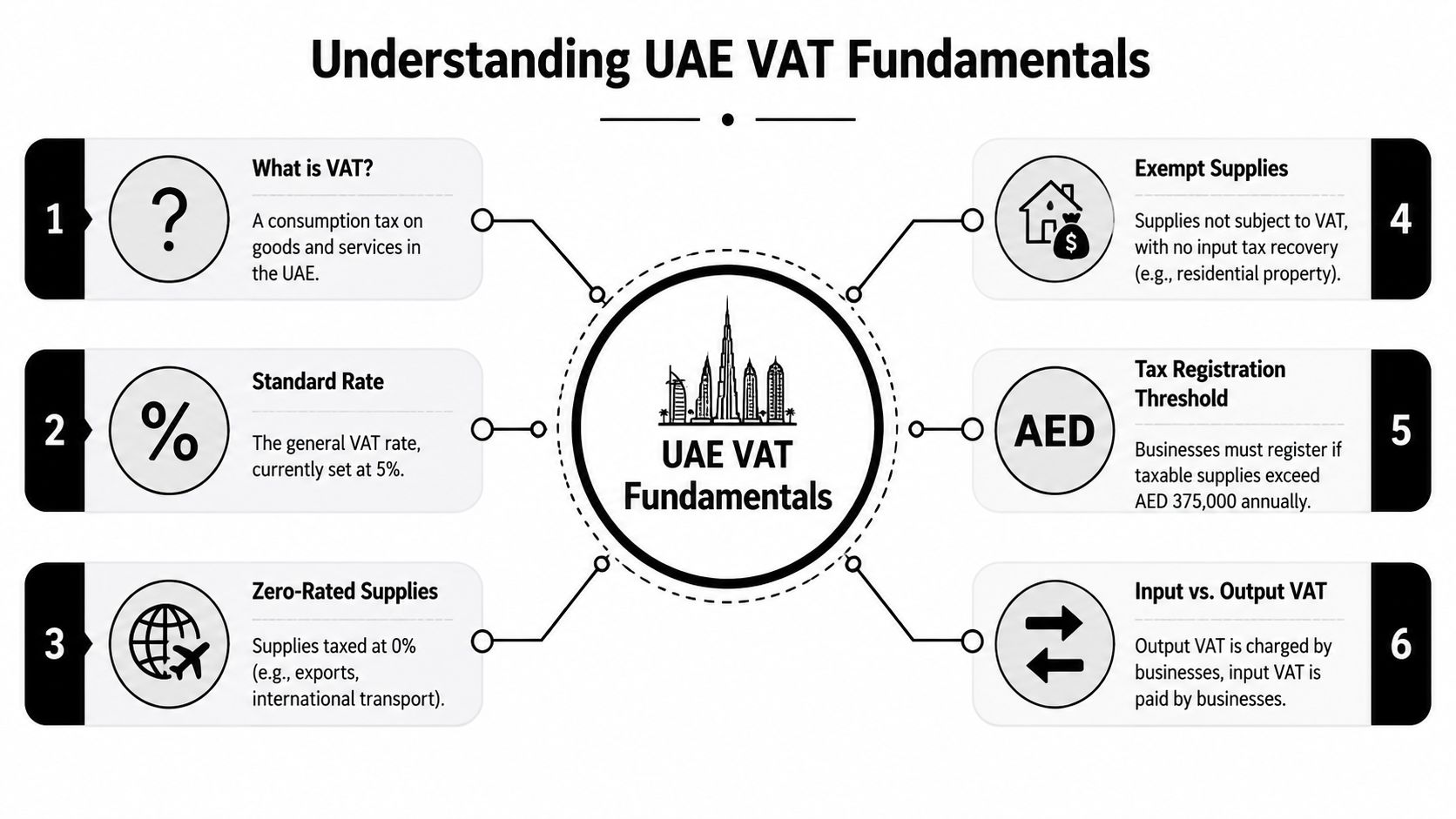
At the rule level, UAE VAT is simple enough. VAT applies at 5% in many standard cases, and registration becomes mandatory once taxable supplies and imports cross the legal threshold. Voluntary registration can also make sense earlier for some businesses. The harder part is applying those rules correctly to the business's daily operations.
The VAT classifications that affect profit and process
The first issue to settle is how your sales are classified. Businesses regularly confuse standard-rated, zero-rated, and exempt supplies, then discover the problem during return preparation or an FTA review.
- Standard-rated supplies: VAT is generally charged at 5%.
- Zero-rated supplies: These remain taxable supplies, but the rate applied is 0%.
- Exempt supplies: VAT is not charged, and input tax recovery can be restricted.
That last point affects margin. If a business treats an exempt supply as zero-rated, it may overstate recoverable input VAT and file returns on the wrong basis. The error is not just technical. It changes pricing assumptions, cash flow expectations, and how finance teams code transactions.
Registration is a legal test and a commercial decision
The mandatory registration threshold is AED 375,000. The voluntary threshold is AED 187,500. Those figures matter, but the decision should not be reduced to watching a number on a spreadsheet.
A consultancy with low overheads and mostly end customers may gain little from voluntary registration if the added admin outweighs the recoverable VAT. A trading company importing stock or a project business with high setup costs may want registration earlier because input tax recovery matters from day one. Group structures, mixed supplies, and cross-border activity can complicate the picture further.
This is also where 2026 starts to matter. Businesses that register without cleaning up invoice data, tax codes, approval flows, and document storage will face more work when the UAE e-invoicing rollout tightens digital record expectations. A sound VAT setup now reduces that later conversion effort.
What to verify before registering
Before filing any registration application, check four operational points:
- Your taxable supplies are identified correctly. Revenue lines should be mapped by VAT treatment, not grouped loosely.
- Customer invoices can support compliance. The tax content, wording, and supporting details should be consistent with UAE rules.
- Input VAT recovery is supportable. Supplier invoices, expense policies, and bookkeeping should produce a clear audit trail.
- Your team can maintain the process after registration. Registration is the start of a reporting obligation, not the end of a setup task.
If you want a practical reference for what happens after registration, this guide to VAT filing requirements in the UAE helps connect the rules to the ongoing reporting work businesses need to manage.
Training also has a direct effect on accuracy. Teams that issue invoices, approve purchases, and post entries need enough VAT knowledge to identify issues before quarter-end. The benefits of VAT training for businesses are easy to see once transaction volume increases or the business begins handling more than one revenue type.
Good VAT control starts before the first return. In Dubai, the main test is whether the business can apply the rules consistently through sales, purchasing, reporting, and the digital compliance changes already coming into view.
Core Services of a VAT Consultancy Firm
Many business owners assume a VAT consultant does one thing. Register the company, file returns, and answer the occasional question. In Dubai, that's too narrow. The better firms support a full compliance cycle, and that matters because VAT errors usually begin upstream in records, invoicing, and transaction coding.
The UAE VAT advisory market is built around a practical rhythm. Registered businesses must add VAT to taxable sales, collect it, and file returns quarterly, with ongoing documentation, invoicing, and audit-readiness obligations. This overview of VAT consultancy services in Dubai notes that providers commonly offer registration, deregistration, return submission, refund claims, compliance reviews, and audit support, often alongside accounting and financial advisory. That integrated model is useful because tax filing and financial reporting often fail when they're managed in separate silos.
What a consultant actually handles
A capable VAT adviser usually supports the business across several practical layers:
- Registration and deregistration: Assessing eligibility, preparing documents, and handling the process when a business enters or exits the VAT system.
- Return preparation: Reviewing the books, reconciling tax positions, and submitting returns based on defensible records.
- Bookkeeping alignment: Making sure ledger design, invoice capture, and tax coding support compliant reporting.
- Advisory work: Answering treatment questions before contracts, imports, billing changes, or new service lines create downstream errors.
- Audit support: Organising documents and responding coherently if the Federal Tax Authority reviews the business.
Why integrated support usually works better
When bookkeeping sits with one provider, filing with another, and management reporting with a third, nobody owns the full picture. One team posts transactions. Another team files from whatever data appears in the ledger. The owner only learns there's a problem when numbers don't reconcile.
That's why a combined model often works better. If one firm handles the books, VAT logic, and financial reporting, classification problems are more likely to be caught before filing. Businesses that need ongoing support can also review options such as VAT filing in the UAE as part of a wider compliance workflow rather than a standalone deadline exercise.
Good VAT work starts before the return. Filing is only the visible end of a longer control process.
VAT Consultancy Services and Indicative Pricing in Dubai
| Service | Description | Indicative Price Range (AED/Year) |
|---|---|---|
| VAT registration support | Eligibility review, document preparation, application handling | Varies by provider and business complexity |
| VAT return filing | Periodic review of books, reconciliation, return submission | Varies by filing volume and record quality |
| VAT health check | Review of invoicing, ledger coding, recovery position, and compliance gaps | Varies by scope |
| VAT audit support | Document preparation, issue review, and response support | Varies by case complexity |
| Integrated VAT and bookkeeping | Ongoing accounting, reconciliations, VAT coding, and filing support | Varies by transaction volume and reporting needs |
| Advisory retainer | Ongoing answers on transaction treatment, contracts, and operational changes | Varies by access level and business needs |
No honest consultant should give a standard fee without understanding transaction volume, industry, record quality, and whether the books need clean-up first. That's not evasive. It's sensible scoping.
If you want a simple non-tax explanation of why all this matters, this article on how compliance protects your company is a useful companion. It frames compliance as business protection, not bureaucracy.
Onboarding Your VAT Consultant A Step-by-Step Process
Most VAT engagements go wrong for a simple reason. The client expects the consultant to “take care of it”, but the consultant receives incomplete records, inconsistent invoices, and no clear view of how the business earns money. A smooth onboarding process fixes that early.
The first useful conversation is not about forms. It's about business activity. A consultant needs to understand what you sell, who you sell to, where your customers are, how invoices are issued, and how your books are currently maintained. Without that, the advice may be technically correct in theory and unusable in practice.
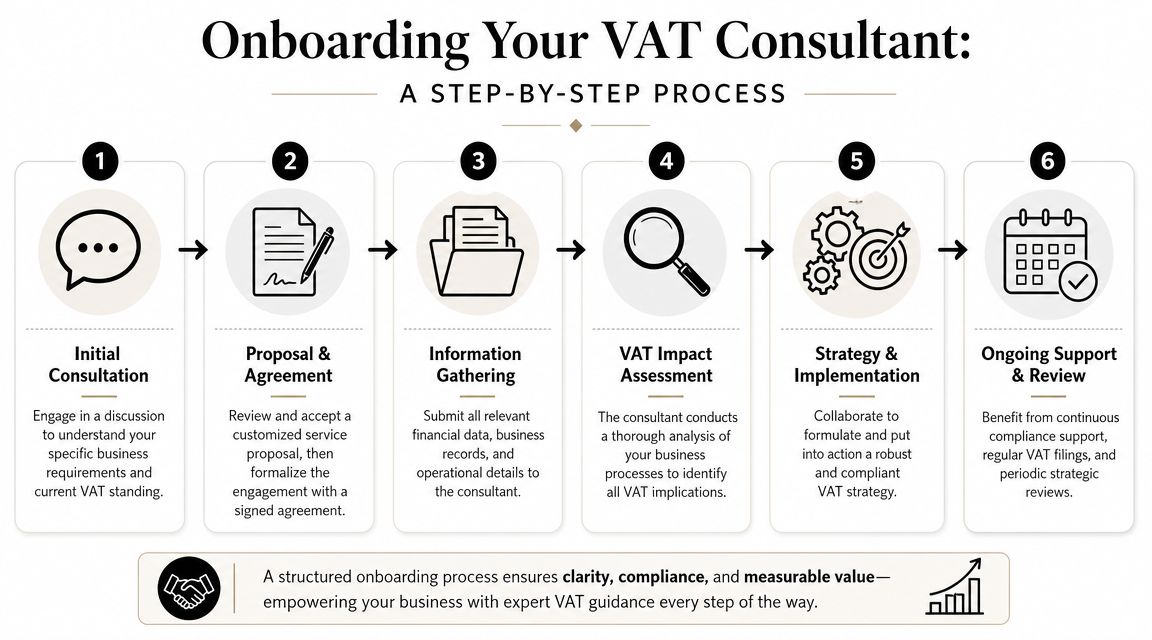
Step by step onboarding in real terms
Initial consultation
The consultant identifies your VAT position, likely exposure areas, and immediate priorities. If you're not yet registered, this stage often focuses on whether you should act now or monitor closely.Document collection
Expect to provide trade licence records, constitutional documents, financial data, sales records, purchase records, and sample invoices. If your records are scattered across spreadsheets, email attachments, and bank statements, the onboarding will take longer.Transaction review
The essential analysis begins. The adviser checks how sales and purchases are currently being classified and whether the chart of accounts supports VAT properly.System and process setup
If the bookkeeping setup is weak, the consultant may recommend changes to account mapping, invoice format, approval controls, and record retention habits.Registration or return preparation
Depending on your stage, the engagement moves into registration support or first-period filing. If you're preparing to register, a practical starting point is this guide on how to register for VAT in the UAE.Review after first cycle
The first filing period usually reveals where the business still has gaps. Good consultants use that cycle to refine controls rather than submitting and moving on without deeper analysis.
What clients should prepare in advance
A business owner can make onboarding dramatically easier by organising a few things before the first meeting:
- Clean invoice samples: Include both sales and purchase invoices currently used by the business.
- Revenue breakdown: Show what the business sells, not just total income.
- Expense categories: Clarify major cost lines and whether supporting documents exist.
- Accounting access: Give the consultant visibility into the bookkeeping system early.
The consultant can't build a sound VAT position from incomplete operational facts. The more clearly your team can show how work is sold, billed, and recorded, the better the advice will be.
Common VAT Compliance Mistakes to Avoid in Dubai
The most expensive VAT mistakes in Dubai are rarely dramatic. They're repetitive. A business uses the wrong tax treatment on a group of invoices, codes expenses inconsistently, or files based on a ledger that was never designed for VAT logic in the first place.
One of the most important technical risks is classification. This resource on UAE VAT controls and compliance risks highlights a point many businesses underestimate. Weak chart-of-accounts mapping often leads to misclassifying zero-rated, exempt, and standard-rated items, which distorts recoverable input tax and raises audit exposure with the Federal Tax Authority.
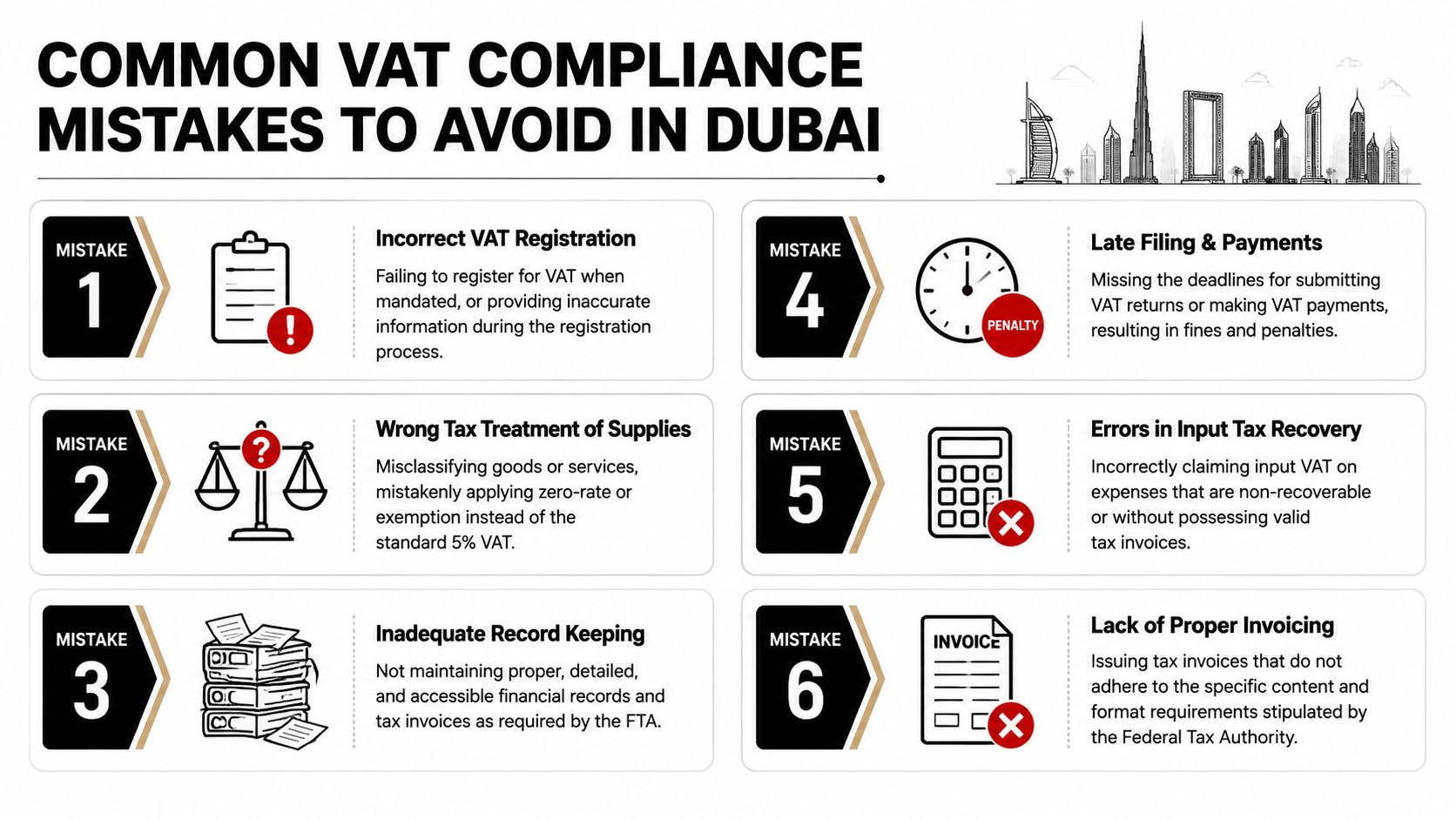
The mistakes that keep recurring
- Late action on registration: Owners monitor bank receipts, not taxable supplies, and react too late.
- Poor supply classification: Teams apply one treatment to everything because it seems easier.
- Weak invoice discipline: Sales invoices go out missing key tax information or with inconsistent wording.
- Messy input tax claims: Purchase VAT is claimed without a valid basis or without checking whether recovery is available.
- Fragmented record keeping: Supporting documents sit across email, WhatsApp, paper files, and disconnected spreadsheets.
Why bookkeeping design matters more than most firms admit
Many businesses think VAT errors happen because staff forget a rule. Often the deeper issue is system design. If the chart of accounts doesn't separate transaction types clearly, the accounting team ends up using judgement on the fly. That's where mistakes multiply.
A healthy VAT process depends on coding discipline. Standard-rated sales should not sit in the same bucket as items with a different VAT treatment. Costs that may affect recovery need visibility. If the bookkeeping system hides those distinctions, every return becomes partly manual, and manual VAT processes are where errors survive longest.
The biggest VAT risk is not a single wrong invoice. It's a process that keeps producing wrong invoices without anyone noticing.
What actually prevents these problems
The fix is rarely “be more careful”. Businesses reduce errors when they build controls that make the right treatment easier than the wrong one.
| Risk area | What works | What doesn't |
|---|---|---|
| Transaction coding | Clear tax codes tied to real supply types | One generic VAT code for everything |
| Invoicing | Standard templates reviewed before issue | Staff editing invoice wording manually |
| Input recovery | Expense review tied to valid documentation | Claiming based on assumptions |
| Filing | Reconciliation before submission | Pulling figures directly from unreconciled books |
| Audit readiness | Central document storage and traceable records | Searching for backup only after questions arise |
A consultant adds value here because they can spot where the accounting structure itself is causing the VAT problem.
How Smart Classic Business Hub Elevates Your VAT Strategy
A common Dubai VAT problem starts like this. A company registers on time, files on time, and still creates risk because its invoices, tax codes, and approval flow were never built for tighter digital reporting. The immediate filing gets done, but the underlying process stays weak.
That is why businesses searching for vat consultancy dubai often need more than registration support or return preparation. They need a working VAT process that fits how the business sells, buys, approves, and records transactions. The pressure is increasing as companies prepare for more digitised tax control, including planning for the proposed July 2026 e-invoicing rollout. Businesses that start early usually face fewer system changes, fewer exceptions, and less disruption to finance teams.

Different businesses need different VAT support
A start-up usually needs simple controls that a small team can maintain. The goal is to issue correct invoices, keep the right records, and avoid building a finance process that is heavier than the business itself.
An SME has a different problem. Transaction volume increases, supplier types widen, and exceptions become more frequent. At that stage, the question is whether the accounting setup can support consistent VAT treatment without forcing staff to improvise.
Foreign-owned businesses often need clarity on structure as much as compliance. They may already have finance teams and reporting lines outside the UAE, but local VAT treatment still depends on the facts on the ground. Cross-border services, intercompany charges, and local documentation standards all need to line up.
Why forward planning matters before 2026
E-invoicing readiness starts long before any technical connection goes live. It affects invoice data fields, approval rules, customer and supplier master data, ledger mapping, and the ERP or accounting system's ability to produce reliable tax information. If those basics are weak, the future transition becomes slower and more expensive.
A practical adviser improves results. Smart Classic Business Hub helps clients review the finance process behind the return, not only the return itself. That includes identifying where VAT treatment breaks down in daily operations, whether the issue sits in system setup, document flow, staff handling, or the way unusual transactions are escalated for review.
For businesses that want coordinated support across setup, accounting, and tax administration, VAT services in Dubai can be useful as part of a single operating model rather than a disconnected filing task. That approach tends to work well when management wants one clear view of compliance responsibility.
If your team is also reviewing invoice capture and document extraction, tools like DigiParser for UK VAT processing are a useful reference point. The VAT rules are different, but the operational lesson is the same. Better source data usually leads to cleaner reporting, faster reviews, and fewer avoidable VAT corrections later.
Frequently Asked Questions About VAT in Dubai
Should I register voluntarily before I have to
A business in its first growth phase often asks this after signing a larger customer or investing heavily in setup costs. The right answer depends less on the threshold itself and more on timing, recoverable input VAT, customer expectations, and whether the finance process can support monthly compliance without creating new errors.
Voluntary registration can work well if the company is incurring taxable costs and wants to recover input VAT early. It can also help in B2B sectors where clients prefer dealing with a VAT-registered supplier. But registration is not just a certificate. It creates filing deadlines, invoice rules, recordkeeping requirements, and a higher need for clean transaction coding from day one.
If the books are still being cleaned up, early registration may cost more in corrections and adviser time than it saves in recoveries.
How are services to customers outside the UAE treated
This area causes repeated mistakes, especially for consulting, digital, and cross-border support services. The treatment depends on the facts of the supply, including what is being supplied, where the customer belongs for VAT purposes, and whether any specific UAE rules change the default position.
A UAE VAT explainer discussed in this overview of VAT consultancy questions in the UAE notes that consultancy is not exempt and may be zero-rated or standard-rated depending on the transaction.
The practical point is simple. Do not assume every invoice to a foreign customer gets the same VAT treatment. Review the contract, the place of use, the customer profile, and the supporting documents before the invoice is issued. That discipline also matters for 2026 e-invoicing readiness, because poor tax logic in the source transaction usually becomes harder to fix once invoice data flows directly through structured systems.
What happens if my business has both taxable and exempt activity
Input tax recovery becomes more restrictive and more technical. If the business makes both taxable and exempt supplies, it may not be able to recover all VAT on overheads and shared costs. The accounting setup needs to distinguish direct attribution from residual costs, and management usually needs clearer reporting than standard bookkeeping provides.
This issue shows up often in SMEs that added new services over time but never updated chart of accounts, expense coding, or document controls to reflect the new VAT position.
A weak setup here creates two problems. The business can overclaim and face penalties later, or underclaim and lose cash unnecessarily.
Do non-residents need different VAT advice
Yes, in many cases they do.
Non-resident businesses entering the UAE market usually need advice that goes beyond registration thresholds. The key questions are operational. What activity creates a UAE VAT obligation, who is responsible for charging tax, what documents must be issued locally, and how should billing and collections be structured before trading starts.
That matters even more where the UAE entity, overseas head office, and third-party customers are all involved in one supply chain. In those cases, the wrong setup can create avoidable registration, invoicing, and recovery problems from the first transaction.
If you're dealing with VAT uncertainty, registration timing, filing pressure, or e-invoicing readiness, Smart Classic Business Hub can help you organise the compliance side of your UAE operation with practical support around business setup, VAT-compliant accounting, and ongoing advisory.