
Dubai attracts a particular kind of founder. You can see the upside clearly. Fast market access, international customers, strong infrastructure, and a business culture that moves quickly when the structure is right. What usually creates hesitation isn't the opportunity. It's the number of decisions that need to be made before the business is properly on its feet.
A founder might arrive thinking the first question is, “How do I get a licence?” In practice, that’s rarely the first true priority. The fundamental concern is whether the business should sit in the mainland, a free zone, or offshore, how banking and visas will be affected, what the tax and reporting obligations will look like, and whether the structure chosen today will still make sense once the company starts hiring, invoicing, or raising capital.
That’s where business advisory dubai matters. Not as a document service. Not as a middleman for forms. As a decision layer that helps you avoid expensive wrong turns.
Embarking on Your Dubai Business Journey
Entrepreneurs start with momentum and too many tabs open. One tab compares free zones. Another explains mainland licences. A third promises “fast setup” with almost no context about what happens after incorporation. By that point, the founder usually has the same concern: if the setup is wrong, everything else becomes harder.
Dubai rewards speed, but it doesn't forgive casual planning. A structure that looks cheaper at the start can create operational friction later. A licence that seems broad enough can become restrictive when you try to open a bank account, add an activity, sponsor staff, or present the company to investors.
That pressure is happening in a market with very real scale. The UAE business management consulting market reached USD 2.6 billion in 2024 and is projected to reach USD 8.1 billion by 2033, while free-zone registrations surpassed 70,500 in 2024, according to IMARC’s UAE business management consulting market analysis. Those figures tell you something important. Businesses aren’t just entering the market. They’re entering a market where guidance on setup, compliance, and operating structure has become part of normal commercial reality.
For founders trying to sort through the basics, a practical starting point is this guide on how to start a business in UAE. It helps frame the early decisions before costs and obligations begin to stack up.
The best early decision isn't choosing the fastest setup. It's choosing the structure you'll still be happy with after your first year of operations.
What Business Advisory Really Means in Dubai
In Dubai, a good advisor acts more like a navigator than a processor. Paperwork is part of the job, but paperwork isn't the value. The value is knowing which route reduces friction, where the regulatory bottlenecks usually appear, and what needs to be aligned before the business starts trading.

Advisory is risk management in practice
A lot of companies think advisory starts when something goes wrong. That's usually too late. In Dubai's competitive market, inadequate financial planning is a primary driver of business failure, and businesses that use ongoing advisory tend to be more resilient than firms that respond only after cash flow or regulatory problems appear, as noted in this review of why businesses in Dubai struggle without proper financial advisory.
That’s the difference between reactive support and strategic support.
A reactive firm waits for:
- A licence issue that delays a renewal
- A tax problem that surfaces during filing or audit preparation
- A banking mismatch between the stated activity and actual operations
- A cash gap that appears after growth has already put pressure on payroll, inventory, or receivables
A strategic advisor works earlier:
- Before setup, by pressure-testing the structure
- Before hiring, by mapping visa and workforce implications
- Before scaling, by tightening reporting, margins, and internal controls
- Before a funding conversation, by making sure the numbers stand up to scrutiny
What advisors actually do beyond forms
Founders often lump everyone together. Setup agents, PRO teams, accountants, tax specialists, and corporate finance advisors all get called “consultants”. In reality, business advisory dubai should combine those moving parts into one coherent operating plan.
A useful way to judge the difference is to ask whether the advisor is only answering the question in front of them, or whether they’re also flagging the next three issues that decision will trigger.
For example, a company formation request should lead into questions like these:
- What activity wording fits the business model?
- Will the chosen jurisdiction support future contracts and staffing plans?
- How will VAT, accounting, and annual reporting work once the licence is issued?
- Does the ownership structure help or complicate investor entry later?
If those questions aren't being raised, you're probably buying processing, not advisory.
Practical rule: If an advisor talks only about getting the licence issued, they're discussing the beginning of the problem, not the full solution.
Why resilience matters more than speed
Dubai moves quickly. That’s a strength, but it also tempts founders into shortcuts. The setup itself can feel like progress, even when the commercial model behind it hasn’t been tested properly. Good advisory slows down the decisions that shouldn't be rushed, so the business can move faster later without hitting compliance or operational walls.
That’s why serious founders don't look at advisory as overhead. They treat it as insurance against avoidable mistakes, and as a planning tool for growth.
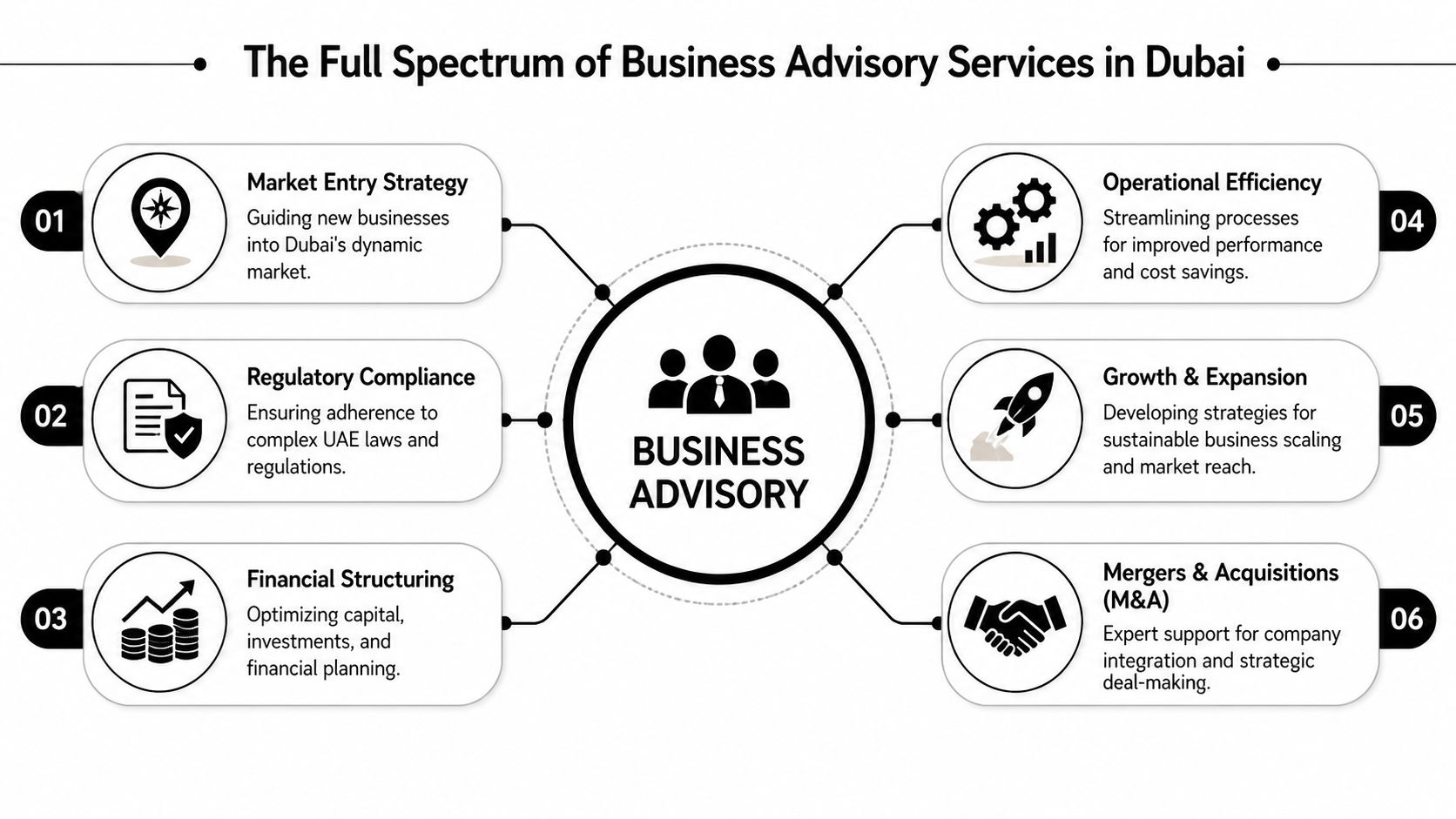
The Full Spectrum of Advisory Services
A proper advisory mandate in Dubai shouldn't feel like a random menu of services. It should map to the life of a business. Start well. Stay compliant. Grow without breaking the structure that got you into the market.
Business setup and formation
Many founders focus here first, and fair enough. The wrong setup creates avoidable complexity for years.
Mainland formation suits businesses that need broad local operating flexibility, direct commercial presence, and fewer restrictions around where they trade. It’s often the right choice when the company expects to hire actively, serve a wider domestic market, or build a local footprint that goes beyond a registration certificate.
Free zone formation can work well for founders who want a structured entry point, a defined ecosystem, or a setup aligned with a specific industry cluster. It can also be attractive for businesses that don't need every type of operational flexibility from day one. The mistake is assuming all free zones are interchangeable. They aren’t. Licensing scope, office requirements, visa handling, and commercial practicality vary.
Offshore structures are usually part of a broader ownership, holding, or asset strategy. They can be appropriate for investors and groups that want a vehicle for holding assets or managing cross-border structures, but they’re often misunderstood. Offshore doesn't mean “do anything from anywhere”. It has a purpose, and it needs to fit that purpose.
The practical problem formation advisory solves is simple. It stops founders from choosing a licence first and asking strategic questions afterwards.
Ongoing operations and compliance
Once the licence is issued, the business begins to face the work that affects continuity. At this stage, many firms realise they didn't need setup help alone. They needed an operating framework.
Core support usually includes:
- PRO services for government processing, renewals, amendments, and administrative follow-through
- VAT-compliant accounting and bookkeeping so the company records activity in a way that supports reporting, cash visibility, and compliance
- Audit coordination where required, with records prepared in a usable and defensible way
- Tax residency certificate support for businesses and individuals who need structured documentation
- Payroll and HR guidance where staffing decisions trigger regulatory obligations
- Liquidation support when a company needs to close cleanly rather than drift into unresolved penalties or administrative issues
This category matters because unresolved admin work compounds. A missed renewal, poor bookkeeping, or sloppy recordkeeping rarely stays isolated. It starts affecting visas, banking, tax filings, investor diligence, and management visibility.
Operational and financial improvement
This is the part founders often underestimate. They assume advisory is mainly legal and administrative. It isn't. Some of the strongest value comes from improving how the business runs.
According to this breakdown of why UAE firms use business advisory services, advisory aimed at operational efficiency can reduce overheads by up to 20 to 30 per cent in Dubai-based SMEs, while process reviews can identify procurement and workflow inefficiencies that materially affect cost and productivity. That matters because many companies don't have a revenue problem first. They have an execution problem first.
Operational advisory usually targets:
- Workflow bottlenecks
- Procurement leakage
- Weak reporting lines
- Manual processes that should be systemised
- Poor visibility over margins, stock, or receivables
A founder may feel busy every day and still have very little control over what the business is earning. Good advisors look for where work, data, and decision-making stop lining up.
The businesses that scale cleanly usually don't have fewer problems. They spot operational drag earlier and fix it before it spreads into cash flow, staffing, and customer delivery.
Strategic growth and restructuring
Once a business is stable, advisory shifts again. The questions become more commercial and more structural.
A mature advisor should be able to support:
- Feasibility studies before capital is committed
- Business plans that can stand up to partner, lender, or investor review
- Corporate finance discussions around capital structure, funding readiness, and expansion planning
- Restructuring decisions when the original setup no longer fits the operating model
- Mergers and acquisitions support where ownership, valuation, and integration need disciplined handling
- Exit and liquidation planning for companies closing, consolidating, or repositioning
One practical example is Smart Classic Business Hub, which provides company formation, PRO support, tax residency assistance, VAT-compliant accounting, audit, liquidation, feasibility studies, business planning, and corporate finance support as part of a broader UAE operating advisory scope. That kind of range matters when a company doesn't want five separate vendors giving disconnected advice.
What works and what doesn’t
A short comparison makes the difference clearer.
| Advisory approach | What usually happens |
|---|---|
| Service-by-service buying | The founder solves today's task but keeps creating tomorrow's problems |
| Integrated advisory | Licensing, finance, compliance, and growth decisions support each other |
| Cheap setup focus | Lower entry cost, higher correction cost later |
| Commercially aligned setup | More work upfront, fewer structural revisions later |
The underlying point is straightforward. Business advisory dubai isn't one service. It's the discipline of making setup, compliance, finance, and growth decisions work together.
Navigating the Unique UAE Regulatory and Tax Context
The UAE doesn't reward copy-paste business planning. A structure that works in one jurisdiction, or even in one Dubai free zone, may be the wrong fit in another context. That's why local advisory matters. The rules don't sit in separate boxes. Licensing, tax treatment, staffing, visas, and digital systems all influence each other.
Jurisdiction changes strategy
Founders often talk about mainland, free zone, and offshore as if they're only registration options. They’re strategic choices. They shape how the business contracts, hires, presents itself to banks, and handles future changes.
A practical advisory process usually starts by matching the legal structure to the commercial reality. If the company expects local trading activity, active hiring, or investor-facing growth, the advisor should test whether the proposed jurisdiction supports those moves cleanly. If the structure is mainly for holding, ownership, or cross-border planning, that analysis looks different.
A lot of avoidable mistakes come from choosing the jurisdiction based on speed or headline setup cost rather than actual operating needs.
Tax, reporting, and digital compliance are linked
Many founders still treat tax, bookkeeping, and systems as separate conversations. In the UAE, that separation creates risk. Your accounting process affects tax accuracy. Your software choices affect reporting quality. Your data storage and access practices can create legal exposure if they aren't aligned properly.
The IT side is often overlooked. In the UAE, advisory around digital transformation is important because companies need to comply with data sovereignty rules under TDRA regulations. Advisors help firms adopt compliant cloud solutions, and that shift can improve agility by 40 per cent, according to this overview of business advisory services in Dubai and UAE.
That matters for a simple reason. A company can't run compliant reporting on messy systems for very long. If data lives in the wrong places, access controls are weak, or reporting is stitched together manually, compliance becomes fragile.
For founders working through tax registration and recordkeeping, this overview of VAT services in Dubai is useful because it connects compliance work to day-to-day operations rather than treating VAT as a filing-only issue.
A tax problem often starts as a systems problem. The filing is where you notice it, not where it begins.
Localisation and workforce planning affect setup decisions
A business structure also needs to support people. Hiring plans, visa routes, role definitions, and employment administration all become harder when they weren't considered at formation stage.
That’s why immigration and workforce planning shouldn't sit outside the advisory conversation. If you're relocating or hiring from abroad, a practical reference like this moving to Dubai work visa checklist helps clarify the documentation path and the sequence of steps employees usually face.
A founder who understands the UAE context early usually makes cleaner decisions. Not because the market is harder than elsewhere, but because the moving parts are tightly connected.
How to Choose the Right Business Advisor in Dubai
Choosing an advisor in Dubai isn't about finding the firm with the lowest quote. It's about finding the one that sees around corners. Cheap support can be expensive if it leaves you with a weak structure, poor records, or a licence that doesn't match what the business does.
A useful test is whether the advisor asks better questions than you expected. If the conversation stays narrow, you should worry. Good advisors don't just respond to your requested service. They challenge assumptions, spot downstream issues, and make trade-offs explicit.
The criteria that actually matter
Look at relevance first. Have they worked with businesses like yours in stage, ownership profile, and operating model? A retail trader, a holding company, a consultancy, and a software startup may all register in Dubai, but they don't need the same structure.
Then look at how the work is delivered. Some firms sell a full package and then outsource key parts. That doesn't always make the advice bad, but it does create handoff risk. If the people who scoped the job disappear once you sign, expect friction.
A founder deciding between providers can also benefit from broader reading on growth-stage support. This article on accelerate startup growth advice is useful because it shows how founders can evaluate business support beyond the initial sales pitch.
Advisor evaluation checklist
| Evaluation Criterion | What to Look For | Red Flags |
|---|---|---|
| Business fit | Experience with your sector, size, and ownership model | Generic answers that sound identical for every client |
| Scope clarity | Clear explanation of what is included and what is not | Vague package language and verbal promises only |
| Regulatory understanding | Ability to explain why one structure suits you better than another | Immediate push toward one option without diagnosis |
| Financial literacy | Comfort discussing bookkeeping, tax impact, cash flow, and reporting | “We only do setup” with no view of operating consequences |
| Execution model | Named contacts, response process, and ownership of follow-through | Heavy reliance on third parties with no accountability |
| Transparency | Written fees, timelines, assumptions, and document requirements | Hidden charges, rushed commitments, or evasive pricing |
Questions worth asking before you sign
Ask these directly:
- Who will handle my file after onboarding?
- What parts of the work are done in-house?
- What tends to delay setups like mine?
- What compliance work starts immediately after incorporation?
- What changes if I hire, add shareholders, or apply for visas later?
Those questions do two things. They reveal competence, and they reveal honesty. A good advisor won't pretend the process is frictionless. They’ll explain where the friction usually is and how they reduce it.
For a benchmark on what a more complete advisory profile looks like, this list of top business consultants in Dubai can help frame your comparisons.
If a firm sells certainty where uncertainty still exists, be careful. Competent advisors explain risks clearly instead of hiding them behind confidence.
From Plan to Reality Client Success Stories
Advice becomes easier to judge when you see how it changes outcomes. The strongest proof usually isn't a polished pitch. It's whether the business ended up with a structure that worked when real decisions had to be made.

The foreign investor
A European investor came in wanting an offshore company because it sounded efficient and private. The initial brief was simple. Form the entity and move on. The problem was that the investor also wanted related documentation support for residency planning and smoother administration across several holdings.
The advisory work started by separating objectives instead of forcing one structure to carry all of them. The investor didn't need a generic setup. He needed an ownership vehicle that matched the asset strategy, plus a practical documentation process that wouldn't create issues later when banks or authorities asked for consistency.
The result wasn't the fastest route on paper. It was the cleaner route. Fewer contradictions, better alignment, and less corrective work later.
The local SME
A trading business in Dubai had been operating for some time, but the internal finance function was always behind. Sales were happening, invoices were going out, and management still couldn't get a reliable monthly view of what the company earned. VAT became the pressure point, but VAT wasn't the underlying issue. The fundamental issue was weak bookkeeping discipline and poor process ownership.
The fix was operational, not just accounting-based. Transaction records were reorganised, reporting routines were tightened, and responsibilities were assigned clearly instead of informally. Once that happened, the tax side became manageable because the records stopped fighting the filing process.
This is common with SMEs. Founders often think they need a tax rescue when they really need finance operations that produce usable information on time.
The tech startup
A founder with a strong product idea wanted to go live quickly. The temptation was to pick a licence, rent a desk, and start pitching. The problem was that the business model still had unresolved questions around target customer, cost assumptions, and commercial path.
The advisory work centred on a feasibility study and business planning before setup moved forward. That forced the founder to test assumptions properly. Which activity best reflected the actual product? What would be built first? What needed to be outsourced? What would a credible first-year operating plan look like?
That process did more than tidy up a deck. It gave the founder a stronger basis for choosing a mainland route and speaking to potential backers with more discipline.
What these stories have in common
Each company started with a different request. One wanted formation. One wanted compliance relief. One wanted momentum. None of them needed only what they first asked for.
They needed someone to identify the hidden decision behind the obvious request. That's usually where business advisory dubai proves its value.
Frequently Asked Questions about Dubai Business Advisory
What is a realistic budget for company setup and first-year advisory?
There isn't one universal figure, and anyone who gives you one before understanding your activity, jurisdiction, visa needs, and reporting requirements is simplifying too much. The cost depends on what you're building. A straightforward setup with limited operational needs looks very different from a company that needs visas, ongoing bookkeeping, tax support, and corporate documentation.
A better approach is to budget in layers:
- Formation costs
- Government and licence-related costs
- Advisory and document support
- First-year compliance work
- Contingency for changes, such as activity amendments or additional approvals
How long does the process usually take?
The honest answer is that timelines vary with the structure and with the founder's readiness. Delays usually come from incomplete documents, unclear activity selection, name issues, banking follow-up, or last-minute changes to ownership and visa plans.
The companies that move fastest usually do two things well. They prepare documents properly, and they decide key structural questions before starting submissions.
How does business advisory help with investor visas and Golden Visas?
Professional guidance has direct value. According to Emerald Business Advisors, UAE Golden Visa applications grew 35 per cent after the 2025 policy updates, while applications with incomplete feasibility studies or mismatched business activities face a 52 per cent denial rate. The same source also notes that some data suggests mainland SME setups have a 15 per cent higher visa approval rate than certain free zones. The details are outlined in this resource on UAE investor and Golden Visa advisory considerations.
That tells you something practical. Visa success isn't only about submitting forms. It depends on how well the business case, activity, and supporting documents line up.
Do startups need advisory, or only established companies?
Startups often need it more, because early structural mistakes are cheaper to prevent than to unwind. Established companies usually seek help after friction appears. Startups have the advantage of building correctly from the start.
What should I ask for in the first meeting?
Ask for a view, not a brochure. You want the advisor to comment on structure, reporting, likely compliance obligations, and operational trade-offs. If you want examples of how finance support affects smaller businesses in practice, these case studies in SME finance are useful because they show how process and funding decisions affect day-to-day stability.
Is business advisory a one-off service?
It can be, but the businesses that benefit most usually treat it as an ongoing relationship. Formation is one decision. Growth, hiring, tax discipline, restructuring, and exit planning are different decisions, and they don't all happen in the same month.
If you're weighing setup options, sorting out compliance, or trying to build a cleaner operating structure in the UAE, Smart Classic Business Hub provides Dubai-based support across company formation, PRO services, VAT-compliant accounting, tax residency documentation, audit, liquidation, feasibility studies, business planning, and corporate finance advisory. A useful first step is a direct conversation about your business model, jurisdiction options, and the practical obligations that follow once the licence is issued.