
You’re probably in one of two situations right now. Either you’ve already formed, or are about to form, a UAE offshore structure and assume the bank account is the simple final step. Or you’ve spoken to a few setup firms, heard phrases like asset protection, tax efficiency, privacy, and international banking, and now you want the practical version of what happens.
The practical version is less glamorous and far more useful.
An offshore bank account dubai isn’t a product you pick from a menu. It’s the result of a bank deciding that your structure, your background, your source of funds, and your business narrative all make sense together. If one piece is weak, the application drags, gets escalated, or fails without notice.
Most glossy guides skip that part. They also skip the hidden costs, the balance thresholds, the difference between a structure that banks like and one they tolerate, and the reason apparently legitimate founders still get rejected. That’s where most mistakes happen.
Why an Offshore Bank Account in Dubai is More Than Just an Account
A founder sets up an offshore company, pays the formation fees, and expects the bank account to be the easy final task. Then the bank asks for group structure charts, proof of source of wealth, contract samples, a clear reason for using Dubai, and sometimes evidence that the business has substance beyond a registration certificate. That is usually the moment the sales pitch ends and the actual process starts.
Dubai remains attractive for international entrepreneurs for good reasons. The tax position is favorable, the banking system is well known, and the jurisdiction is built for cross-border business. But an offshore bank account dubai is not a simple utility. It is a risk decision made by a bank that has to justify why it is comfortable taking you on.
That distinction matters because many applicants budget for setup and ignore the cost of getting the banking file into acceptable shape. They miss translation costs, document attestation, minimum balance expectations, account maintenance charges, compliance delays, and the opportunity cost of choosing the wrong structure first. I have seen clients lose weeks by applying with a file that looked fine to a setup agent but weak to a compliance officer.
A better starting point is to treat the account as part of the structure itself. The bank will assess the ownership chain, commercial logic, expected transaction profile, jurisdictions involved, and the credibility of the people behind the company. If you are still deciding on the entity route, the right UAE offshore company setup structure often makes the difference between a workable application and a file that stalls in review.
The marketing promise versus the file the bank actually sees
The sales version focuses on privacy, asset protection, and international flexibility. The bank focuses on something less glamorous. It wants a file that makes operational sense.
That means questions such as:
- Why is this company in the UAE and not in the founder's home country?
- Who is the ultimate beneficial owner, and can that be documented cleanly?
- What is the source of funds and source of wealth?
- What countries will send money to the account, and do those countries create added risk?
- Does the expected activity fit the stated business model?
Weak answers rarely produce a clear rejection on day one. More often, they trigger repeated requests for documents, internal escalation, or a quiet decline after time and money have already been spent.
Tax is part of that review as well. Founders who treat tax planning, entity formation, and banking as separate decisions usually create avoidable problems. Explorer Computer LLC's corporate tax overview is a useful background read if you want to understand why the account strategy should match the wider UAE structure from the start.
What banks are really pricing into their decision
The bank is not only opening an account. It is pricing the compliance burden of keeping that relationship.
A clean profile with a clear business purpose, understandable ownership, and predictable transaction flow is cheaper for the bank to monitor. A file with nominee layers, vague consulting activity, sanctioned-country exposure, unexplained wealth, or no practical UAE rationale is more expensive for the bank to monitor. That is why two applicants with similar net worth can get very different outcomes.
This is also why offshore banking in Dubai should never be sold as a secrecy product. UAE banks work under strict KYC, AML, and reporting rules. Clients who arrive expecting discretion without disclosure usually run into problems quickly.
The practical rule is simple. Treat the application like a due diligence file prepared for a skeptical reviewer, not like a formality at the end of company formation. That approach saves time, avoids hidden costs, and gives the bank a reason to say yes.
Choosing Your Foundation Offshore Entity vs Personal Ownership
A client incorporates the cheapest offshore company he can find, then starts calling banks. Two weeks later, he has paid formation fees, courier charges, document attestation costs, and advisory time, yet still has no account. The problem usually is not the bank alone. It is the mismatch between the ownership structure and the banking story.
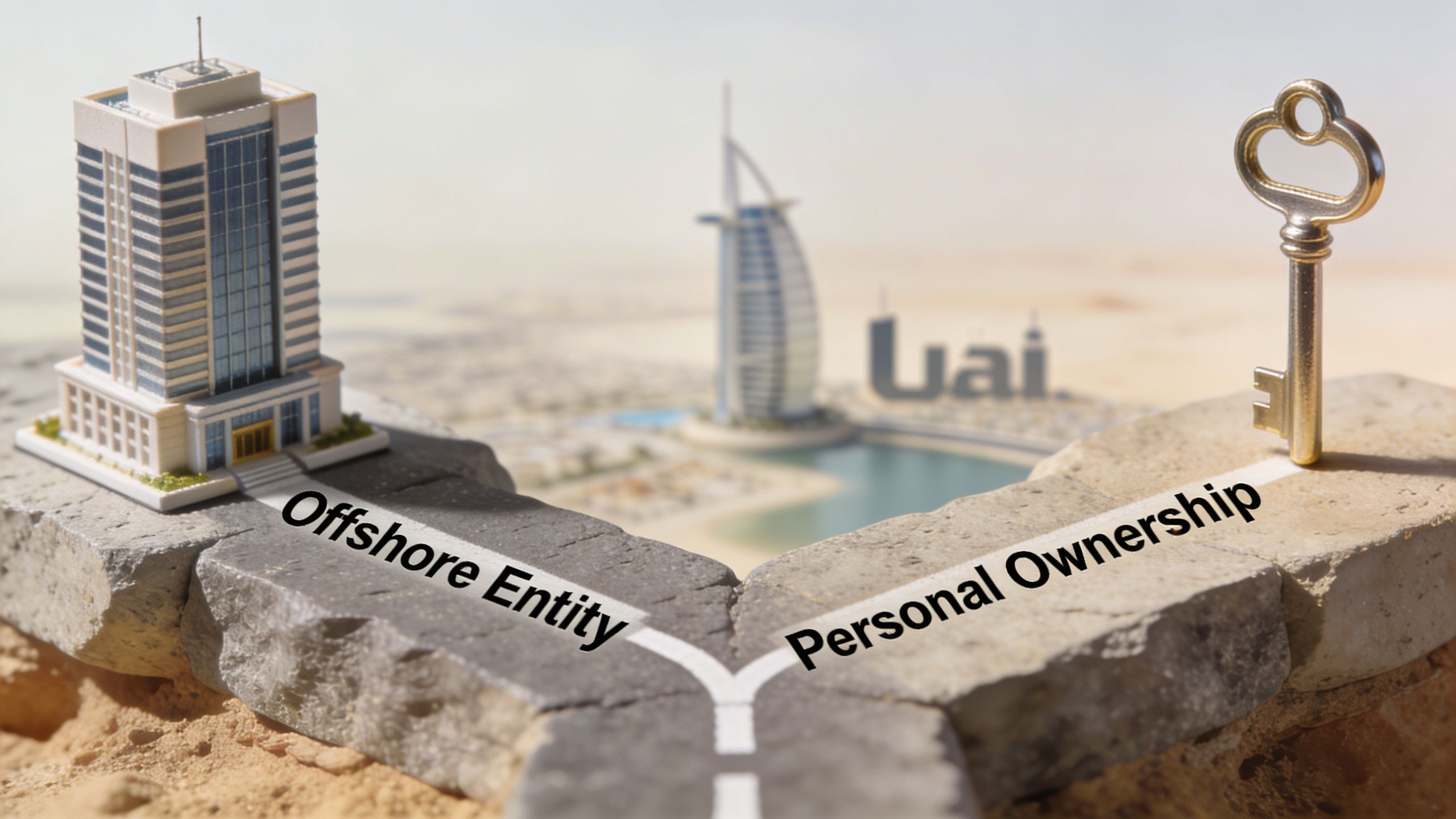
For non-residents, the first decision is rarely “which bank?” It is whether the account should sit under personal ownership or under an offshore entity that gives the bank a clearer commercial reason to onboard the relationship.
Why personal ownership often struggles
A non-resident personal application can work, but the bar is higher than many founders expect. Banks want a credible UAE link, a clear reason for using the account, and a personal financial profile that already looks well managed. If the file reads like “I want a Dubai account for flexibility,” that is usually too weak.
In practice, personal applications are often delayed or declined for more nuanced reasons than clients are told at the outset. The source of funds may be legitimate but poorly documented. The expected transaction activity may sound too broad. The applicant may have business interests in several countries but no simple explanation for why the UAE account sits at the center. None of these points looks dramatic on its own. Together, they create doubt.
That doubt is expensive. It leads to extra compliance queries, repeat submissions, certified document requests, and time lost while the client is already paying for a structure elsewhere.
Why offshore entities usually give the bank a better case
An offshore company often performs better because it gives the bank a defined framework. Ownership, purpose, counterparties, and expected transaction types can be explained in one coherent file. That is much easier for a relationship manager and compliance officer to defend internally than a loose personal banking request from a non-resident.
That does not mean any offshore company will do the job. Banks are not impressed by a certificate of incorporation on its own. They look at whether the entity matches its actual use case. A holding structure for shares or property is one thing. A supposed “consulting” company with no staff, vague contracts, and no practical UAE logic is another.
If you are comparing setup routes first, our UAE offshore company formation guide gives a useful starting point. The banking decision should still shape the formation decision, not follow it.
Comparing JAFZA, RAK ICC, and Ajman Offshore
Clients usually narrow the choice to JAFZA, RAK ICC, or Ajman Offshore. Legally, all three can form an offshore vehicle. From a banking perspective, they are not viewed the same way.
JAFZA
JAFZA is often the strongest fit for higher-value structures, established investors, and clients who want a jurisdiction banks already know well. Familiarity matters. A bank is more comfortable reviewing a structure it sees regularly, especially when the purpose is holding assets, group ownership, or investment planning.
The trade-off is cost. JAFZA is rarely the cheap option, and the banking relationships tied to that profile often come with higher balance expectations, stricter account maintenance standards, and less patience for low-activity companies. It can be the right answer, but it is not a budget answer.
RAK ICC
RAK ICC is the practical choice in many cases. It is commonly used for holding structures, SPVs, and straightforward ownership planning where the goal is clarity and acceptable setup cost. For many international clients, it strikes the best balance between credibility, efficiency, and banking usability.
Its weakness appears when founders expect the company itself to solve a weak file. It will not. If the owner profile is thin, the business rationale is generic, or the expected activity looks inconsistent, RAK ICC will not rescue the application.
Ajman Offshore
Ajman Offshore attracts cost-sensitive clients and owners who care about privacy. On paper, that can sound attractive. In banking, privacy is never the main selling point.
Some banks treat Ajman structures more cautiously, especially if the use case is not sharply defined. That does not make Ajman a bad jurisdiction. It means the supporting file has to work harder. If the structure exists mainly because it was cheaper to form, banks usually pick that up quickly.
The best offshore structure is the one that matches the real business purpose and survives bank scrutiny without forcing extra explanation.
Which foundation suits which client
| Structure | Best fit | Main strength | Main trade-off |
|---|---|---|---|
| JAFZA | Larger holdings, established investors, premium structures | Strong bank familiarity | Higher setup and banking costs |
| RAK ICC | Holding companies, SPVs, practical international ownership structures | Good balance of cost and usability | Still needs a clean owner profile and clear rationale |
| Ajman Offshore | Leaner structures with tight formation budgets | Lower entry cost | More questions from banks if the purpose is not clear |
The decision that creates avoidable banking problems
Founders often choose the formation route based on incorporation price, then try to make banking fit afterward. I see that mistake repeatedly. The hidden cost is not only the wrong company. It is the second round of legal documents, extra attestations, rewritten business summaries, and weeks spent repairing a file that could have been set up properly at the start.
A better sequence is simpler:
- Define the account’s real job: asset holding, investment activity, international receipts, property ownership, or group structuring
- Choose the entity that fits that job: some cases need an offshore company, others need a free zone operating company instead
- Test bank appetite before incorporation: a structure can be legally valid and still commercially weak for onboarding
- Build the ownership explanation early: beneficial ownership, source of wealth, and transaction logic should be aligned before submission
If the goal is a working bank account rather than just a company file, the foundation needs to be chosen with the bank in mind. That is where many applications are won or lost.
The Application Blueprint Documents Bank Selection and Process
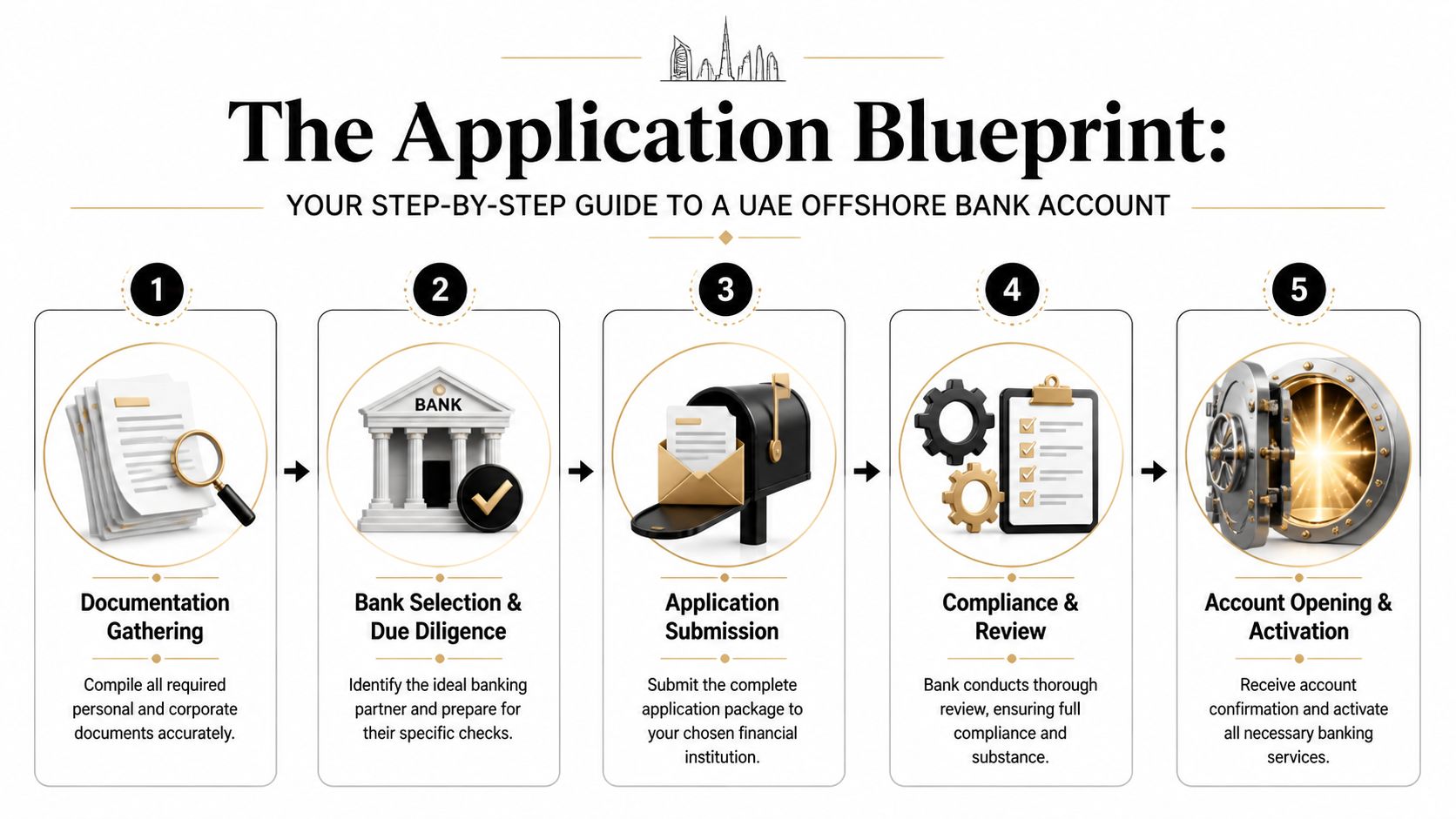
A founder pays the incorporation invoice on Monday, submits a bank application on Friday, and expects an account shortly after. Then the bank asks for a revised business summary, clearer source-of-wealth evidence, a group ownership chart, certified copies from another country, and an explanation for transactions that have not happened yet. That signifies the actual application phase.
A workable offshore banking file in Dubai is built for scrutiny, not for presentation. Compliance teams do not reward glossy packs. They approve files they can understand quickly, defend internally, and monitor after opening.
What the bank wants from the owner
The offshore company is only part of the review. The bank is underwriting the ultimate beneficial owner first.
A practical owner file usually includes:
- Identity documents: Passport copy and supporting ID records that match the application exactly, including name spelling and signature style.
- Residential evidence: Current proof of address or tax residence documents that are readable and issued within the bank’s accepted timeframe.
- Source of wealth support: Bank statements, business ownership evidence, investment records, sale documents, or other papers that explain how the owner built capital.
- Profile support: CV, company profile, tax documents, brokerage statements, or other records that make the client’s background consistent with the proposed account activity.
Weak owner files often fail for subtle reasons. The passport is valid, but the address proof is old. The declared wealth is reasonable, but the documents only show current cash and do not explain origin. The application says “international consulting,” yet the owner’s profile does not show a history that supports that activity. Those are common friction points.
What the bank wants from the company
Corporate applications take more work than many founders expect. The hidden cost is not just more paperwork. It is the time spent correcting gaps after the bank has already formed a negative first impression.
A realistic company file usually includes:
Formation documents
Certificate of incorporation, memorandum and articles, register extracts, and any nominee or corporate secretary records if they exist.Ownership chart
A clean UBO structure chart showing direct and indirect ownership, control, and the role of each entity in the chain.Board and signatory records
Board resolution, authorised signatory list, and identification for every person who will control or operate the account.Substance and activity explanation
A short account profile that explains what the company does, why Dubai is being used, which countries will send or receive funds, expected monthly turnover, expected balances, and the commercial reason for the structure.Certified or legalised documents where required
Some cases need notarisation, attestation, or legalisation from the home jurisdiction. Costs can accumulate unexpectedly, especially if documents need to be redone because names, dates, or ownership percentages do not match across the file.
One candid point. If the company’s commercial purpose cannot be explained in plain language in a few lines, the bank will struggle with it too.
How to choose the right bank
Bank selection should start with appetite, not branding. A well-known bank can still be the wrong bank for the file in front of you.
For a broader starting point, our guide to good banks for UAE business accounts helps narrow the field. For offshore structures, the filter needs to be tighter.
Match the bank to the activity
Some banks are more comfortable with passive holding structures, investment vehicles, or property-linked ownership. Others are more open to trading flows if the counterparties and jurisdictions are straightforward. A file built around cross-border consulting, digital services, crypto exposure, sanctioned-region touchpoints, or frequent third-party payments will face a different response.
Match the bank to the client profile
A client with an established group, audited financials, and a strong personal banking history is treated differently from a first-time founder with an offshore company and a projected business model. Both can succeed, but they should not be sent to the same institutions in the same way.
Check the operating reality
Online banking quality matters once the account is live. So do outbound transfer controls, multicurrency handling, user permissions, call-back procedures, and response time when a payment is held for review. I have seen founders chase account approval and only later discover that daily use is cumbersome.
What the real process looks like
In straightforward cases, the process can move quickly. In many cases, it slows down because the file reaches the bank before the story is complete.
A practical sequence looks like this:
- Pre-screen the case: Review the owner profile, activity, nationalities involved, countries of residence, and expected transaction pattern before choosing a bank.
- Build the file to one narrative: Personal documents, company papers, business summary, and source-of-wealth support should point to the same commercial story.
- Choose the bank by fit: Select for actual appetite, account purpose, and operating needs, not just reputation.
- Submit once, cleanly: Banks respond better to a complete file than to a rolling stream of missing documents.
- Answer compliance questions precisely: Short, specific replies work better than broad explanations that introduce new inconsistencies.
- Prepare for post-opening review: Early transactions are often checked against the onboarding narrative. If the account opens as an investment holding vehicle and immediately starts receiving unrelated trading income, the relationship can become difficult very quickly.
That final stage catches many applicants off guard. Approval is the start of monitoring, not the end of review.
Navigating Common Hurdles KYC Substance and Rejection
A trade licence, a certificate of incorporation, and a complete application pack do not guarantee approval. Many founders learn that too late.
Banks reject files that are legally valid all the time. The issue usually isn’t legality. It’s whether the bank believes the client’s structure and expected activity make commercial and compliance sense together.

What KYC is actually testing
KYC in offshore banking isn’t a document collection exercise. It’s a consistency test.
The bank wants to see that your identity, wealth, structure, purpose, and transaction pattern fit together without strain. If your offshore company says it exists to hold investments, but the account starts receiving unrelated commercial payments from multiple jurisdictions, the bank notices. If your application describes a lean consulting business but your structure looks over-engineered for that activity, the bank notices that too.
The rejection reasons people don’t hear early enough
According to this review of offshore account rejections in Dubai, applications can be refused even with valid registration. Common rejection patterns include unclear business activity and a mismatch between the corporate structure and its stated purpose. The same source notes that banks systematically scrutinise digital service providers and consulting startups, and those applicants need a stronger rationale to secure approval.
That aligns with what practitioners see repeatedly. Founders in these categories often assume “clean documents” are enough. They aren’t.
Three anonymised scenarios that explain the problem
The consultant with no operating logic
A founder sets up an offshore company and says it will provide strategy consulting to overseas clients. The documents are complete. The owner is legitimate. But the bank still sees a problem.
Why? Because the file doesn’t answer basic operating questions. Where is the team? How are services delivered? Why is an offshore holding-style entity the right vehicle for consulting revenue instead of a free zone operating company? The issue isn’t that consulting is forbidden. The issue is that the structure doesn’t convincingly fit the activity.
The digital founder with vague payment flows
A digital services business applies with a general business description and broad language about global clients. The owner expects incoming transfers from multiple countries in different currencies.
That may be commercially normal for the founder. To the bank, it can look undefined. If the file can’t explain what is sold, to whom, under what contracts, and why the UAE offshore structure is relevant, the bank may decide the risk team will spend too much time managing the account later.
The holding company that behaves like a trading company
A client forms a holding structure, gets the account approved, and then begins using it for operating receipts that don’t match the opening narrative. That often triggers review during the first operational period.
According to the KYC guidance referenced earlier, misalignment between the application narrative and first-quarter transaction flows can trigger manual reviews and payment freezes until further documents are produced. That’s one of the most common avoidable mistakes.
A bank can tolerate complexity. It won’t tolerate contradiction.
What improves approval odds
A stronger application usually has these characteristics:
- Clear business purpose: The activity is described in plain commercial language, not marketing language.
- Logical entity choice: The chosen structure matches the actual use of the account.
- Traceable wealth and funds: The owner can show where capital came from without forcing the bank to guess.
- Defined counterparties: Key customers, suppliers, or asset relationships are identifiable.
- Transaction realism: Expected currencies, payment routes, and account behaviour look believable for the stated model.
Substance matters after approval too
Founders often focus only on getting approved. The more disciplined approach is to plan for the first months after activation.
That means keeping early transactions aligned with the original profile, avoiding unexplained payment types, and being ready to support incoming and outgoing activity with proper contracts, invoices, and ownership records where relevant. The first account review often happens after opening, not before it.
The True Cost of a Dubai Offshore Account
A founder sees the headline promise first. Open in Dubai, bank internationally, protect privacy, keep the structure clean. Then the actual numbers appear, and the conversation changes.
A Dubai offshore account is usually a premium banking relationship, not a low-cost operating account. The bank may expect a meaningful balance, regular account activity that matches the stated business model, and a client profile that justifies the compliance work involved in keeping the account open.
What you actually pay for
The visible cost starts with setup, but that is rarely the part that causes regret. The bigger issue is capital efficiency.
A typical offshore arrangement can involve:
- Incorporation and advisory fees: company formation, document drafting, certification, and account-opening support
- Bank onboarding costs: account opening charges, compliance review fees, or relationship setup requirements, depending on the bank
- Minimum balance expectations: funds that may need to stay parked to keep the relationship in good standing
- Transaction costs: outgoing transfers, correspondent charges, FX conversion spreads, and card or trade service fees where relevant
- Ongoing maintenance: annual company renewal, registered agent fees, document updates, and banking admin work
For some clients, the better comparison is not offshore versus no account. It is offshore versus a mainstream UAE business account with lower balance pressure. If that is the decision you are making, review these UAE business account options with no minimum balance requirements before committing to an offshore structure that may be more expensive than your operation needs.
The hidden costs other guides skip
The direct bank fee is easy to quote. The indirect cost is what catches people.
Idle liquidity is the first problem. If a bank expects a stronger average balance than your business naturally maintains, that cash stops working elsewhere.
Rework costs come next. A weak file often leads to repeated requests for revised invoices, new shareholder documents, clearer source-of-funds evidence, or fresh attestations. Every round costs time, courier fees, certification fees, and sometimes legalisation fees.
Operational friction is another real expense. If your account profile was approved for one pattern of activity and the business starts using it differently, payments can slow down or stop until the bank is satisfied. That delay can cost more than the annual account fee.
Wrong-bank risk is the most expensive of all. I have seen clients choose a bank because the marketing looked friendly, only to find that the bank was a poor fit for their nationality, transaction corridors, industry, or offshore structure. The result is a rejected file, a stalled launch, and another full application somewhere else.
Cost is not only about fees
A cheaper setup can be expensive if approval odds are weak.
Some founders focus on the lowest incorporation quote or the fastest promised timeline. That approach often produces the worst banking outcome. If the entity type, shareholder profile, and transaction story do not line up, the client can spend money on formation and support, then still fail to get the account they need.
That is why the actual question is not, "What does the offshore account cost?" The better question is, "What will this structure cost me if the bank does not like it?"
Privacy has limits, and that matters
Offshore banking in Dubai is used for lawful structuring, asset holding, and international business. It is not a secrecy product.
Banks in the UAE work under reporting and compliance rules that require transparency on ownership, source of wealth, and account activity. Clients who approach offshore banking as a concealment tool usually create the very compliance concerns that lead to delay or rejection. Clients who treat it as a legitimate, well-documented banking arrangement tend to have a much cleaner path.
How Smart Classic Business Hub Ensures Your Success
The difference between a smooth approval and a frustrating rejection usually appears long before the bank meeting. It shows up in the structure selected, the way the file is prepared, and whether the commercial story is strong enough to survive compliance review.
That’s where experienced local guidance matters.
Smart Classic Business Hub works from the practical side of the process. The team helps clients choose the right UAE formation route before they commit to a setup that banks may dislike later. That includes assessing whether an offshore structure is appropriately suitable, or whether a different route would give the client a stronger banking outcome.
What good support changes
A capable adviser improves outcomes in ways clients often don’t see at first:
- Entity-bank fit: The structure is chosen with bank acceptance in mind, not just incorporation speed.
- Bank-ready documentation: The file is assembled to answer compliance questions before they’re asked.
- Narrative control: The owner’s profile, source of funds, and business purpose are presented coherently.
- Operational follow-through: The account opening strategy reflects how the account will be used after approval.

Why that matters in Dubai
Dubai banking is professional, but it isn’t casual. Banks expect substance, logic, and proper preparation. They also have internal preferences that aren’t obvious from public marketing material.
That’s why doing everything alone often costs more than expected. Not always in official fees, but in lost time, repeated submissions, avoidable restructuring, and missed banking opportunities. The right guidance reduces those mistakes before they become expensive.
Frequently Asked Questions
Can I open an offshore bank account in Dubai entirely remotely
Usually, no. You can complete much of the preparation from abroad, but many UAE banks still want the ultimate beneficial owner to appear in person for final verification and signature.
This is one of the first practical gaps between online marketing and real banking procedure. Clients often budget for setup fees and forget to budget for flights, hotel stays, local transport, document reprints, courier charges, and extra days in Dubai if the bank asks follow-up questions.
Is an offshore account the same as a free zone company account
No. Banks treat them as different risk cases because the underlying structures serve different purposes.
An offshore company usually makes sense for holding assets, international shareholding, or cross-border ownership planning. A free zone company usually fits operating businesses with staff, invoices, contracts, and visible commercial activity in the UAE. If the business behaves like an operating company but the structure is offshore, the bank may question why that vehicle was chosen in the first place. That is a common rejection trigger.
Is offshore banking in Dubai private
Dubai banking is private in the regulated sense. Client information is handled through formal compliance systems and bank confidentiality rules.
It is not anonymous, hidden, or outside international reporting standards. Banks will still ask detailed questions about ownership, source of wealth, tax residency, and expected transactions. Anyone expecting old-style secrecy usually runs into problems very early.
Why do some legitimate applications still get rejected
Because a legal company and a bankable file are not the same thing.
I see rejections for issues that applicants rarely expect: a shareholder profile that does not match the proposed activity, unclear links between personal wealth and startup capital, too many countries involved in the payment flow, weak proof of business rationale, or transaction volumes that look unrealistic for a newly formed offshore company. Even small inconsistencies across passports, utility bills, CVs, company documents, and business plans can slow a file down or push it out.
What should I prepare before speaking to a bank
Prepare more than the basic company papers. Banks want a clean, credible story supported by documents.
That usually means identification for all owners, ownership charts, proof of address, source of wealth and source of funds support, existing business background, expected incoming and outgoing payments, main counterparties, target countries, currencies, and a plain explanation of why an offshore account in Dubai fits the business model. If any part of that story is weak, fix it before the application starts. It is cheaper to correct the file early than to explain a rejection later.
How long does approval usually take
There is no fixed timeline. A well-prepared file can move quickly, but delays are common if the bank asks for more detail on ownership, transaction logic, or supporting evidence.
The slowest part is often not the bank. It is the applicant gathering better documents after submission because the first set was too generic.
What is the most overlooked cost
The hidden cost is failed positioning. Choosing the wrong entity, approaching the wrong bank, or submitting a thin file can cost weeks or months, plus extra notarisation, attestation, travel, translation, and restructuring expenses.
Those costs rarely appear in the promotional pitch. They appear after the first rejection.
If you want to open an offshore bank account in Dubai without wasting time on the wrong structure, the wrong bank, or a weak application file, speak with Smart Classic Business Hub. Their Dubai-based team helps founders and investors align company formation, compliance, and banking strategy so the account application stands on solid ground from the start.