
You’re likely comparing Sharjah against Dubai right now, with a spreadsheet open, a shortlist of free zones, and one nagging question: which setup gives you room to grow without locking you into the wrong cost structure from day one.
That’s the right question.
Most guides on companies in Sharjah free zone stop at listing names. That’s rarely enough. A trading company, a creative consultancy, and a light industrial operator can all register in Sharjah, but they shouldn’t all choose the same zone, the same licence, or the same facility model. The smart decision comes from matching your business activity to infrastructure, visa needs, office reality, and how quickly you expect to scale.
Why Sharjah Is the Smart Choice for Your UAE Business
A foreign investor often reaches the same point after comparing Dubai and Sharjah. The headline appeal of Dubai is clear, but the numbers on the setup sheet start raising harder questions. If your business needs storage, staff visas, trading access, or room to expand in year two, the cheaper decision upfront is not always the weaker one. In many cases, Sharjah is the more disciplined choice.
Sharjah works well for founders who care less about postcode signalling and more about operating logic. That includes import-export traders, light manufacturers, logistics firms, consultants, e-commerce operators, and media businesses that need a UAE base without taking on inflated fixed costs too early.
The actual advantage is not "Sharjah is cheaper." That is too simple and often misleading. The better way to assess Sharjah is through a decision matrix.
A business that depends on air cargo access will evaluate the emirate differently from a creative agency selling digital services. A manufacturer will care about land, utilities, and warehouse configuration. A consultant may prioritise licence scope, visa allocation, and whether a flexi-desk is enough for the first 12 months. Sharjah stands out because it gives you multiple zone models that suit different operating realities, especially if you compare options such as Sharjah Airport Free Zone for trade and logistics setups against media-focused or port-based alternatives.
Why experienced founders give Sharjah serious consideration
- Cost structure can be easier to control. Licence fees, facility choices, and staff overhead are often more manageable for businesses that need to protect margin in the first phase.
- The infrastructure fit is more specific. Sharjah is not one generic free zone proposition. It offers different environments for airport-linked trade, media activity, services, warehousing, and industrial use.
- Growth does not have to start with overcommitment. Many businesses can begin with a lighter facility model, then shift into offices, warehouses, or industrial space once revenue justifies it.
I usually advise clients to ignore broad statements like "best free zone" and ask a narrower question instead: which zone gives this business the right balance of cost, facility access, visa capacity, and expansion headroom?
That is why Sharjah keeps entering the shortlist. It gives companies in Sharjah free zone a practical route into the UAE with fewer forced compromises on budget and setup model. For the right business, that is not a secondary option. It is the smarter one.
Understanding the Sharjah Free Zone Ecosystem
A foreign founder usually reaches this point with a simple question: should the company be set up in Sharjah at all, and if yes, which free zone will make daily operations easier instead of harder? The answer starts with understanding that Sharjah is not one free zone with different price plans. It is a set of distinct operating environments built for different business models.
That distinction affects real decisions from day one. A consultancy can work with a flexi-desk and a service licence. A trading company may need customs processes, cargo access, and faster movement near the airport. A manufacturer may need industrial land, utility capacity, and room for heavy storage. If those realities are ignored at setup stage, the company often pays for the mistake later through amendments, relocations, or operational workarounds.
What a Sharjah free zone actually gives you
A free zone is a regulated business jurisdiction with its own authority, licence categories, facility options, and immigration process. You are not only buying a trade licence. You are choosing the rules, infrastructure, and setup model your company will operate under.
For many investors, the core benefits are straightforward:
- 100 percent foreign ownership
- Defined licensing frameworks for trading, services, media, industrial, and mixed activities
- Integrated formation and immigration processing through the zone authority
- Facility options ranging from flexi-desks to offices, warehouses, and industrial plots
The practical value is fit. If the zone regularly handles businesses like yours, approvals tend to be more predictable, documentation questions are easier to resolve, and the facility options usually make more commercial sense.
The decision matrix founders should use
I advise clients to sort Sharjah free zones using four filters before they compare package prices.
| Decision factor | What to test |
|---|---|
| Business activity | Does the zone clearly support your exact licence activity, or are you forcing a close alternative? |
| Facility need | Do you need only a desk and visas, or do you need office space, warehousing, land, or port access? |
| Budget tolerance | Is the lower upfront package still workable once visas, facility upgrades, and renewals are added? |
| Growth path | Can the business scale inside the same zone, or will you outgrow it within 12 to 18 months? |
Many founders go wrong. They choose the lowest advertised package, then discover the licence is too narrow, the visa quota is limited, or the facility type does not match bank or client expectations.
How the Sharjah ecosystem is organised
Sharjah’s free zone system works because the zones are segmented by operating reality.
SAIF Zone suits businesses that depend on trade flow, import-export activity, and airport access. For founders comparing logistics-led setups, it helps to review Sharjah Airport Free Zone business setup options with the operational question in mind: how often will goods, samples, or shipments need to move?
Hamriyah Free Zone fits companies that need physical scale. Industrial activity, manufacturing, processing, bulk storage, and port-linked movement usually belong here before anywhere else.
Shams is often the more practical route for service businesses, creators, consultants, and digital operators that want a lighter facility commitment and broader flexibility around media and service activities.
The point is not to memorise zone names. The point is to match the company’s operating model to the right environment.
A free zone should reduce operational friction, not create extra approval steps, transport costs, or licence compromises.
What this means in practice
A founder launching an e-commerce support agency and a founder importing machine parts are both looking at companies in Sharjah free zone, but they should not be shopping the same way. The first should ask about activity coverage, visa efficiency, and office requirements. The second should focus on customs practicality, storage, transport links, and whether the zone is set up to handle regular goods movement without delay.
Sharjah works well when the choice is deliberate. Once you view the ecosystem as a decision matrix instead of a list of zones, the right option usually becomes much clearer.
Comparing Sharjahs Major Free Zones
A founder opening a steel fabrication unit and a founder launching a content agency can both form companies in Sharjah free zone. They should not compare zones the same way. The right choice depends on where your business can tolerate friction. Cargo delays, facility limits, activity restrictions, visa allocation, and expansion costs all show up later if the zone was chosen on headline price alone.
Most serious comparisons in Sharjah come down to three names. Hamriyah Free Zone, SAIF Zone, and Shams. Each serves a different operating model. The practical question is simple: which one fits the way the business will earn money in year one and grow in year two?
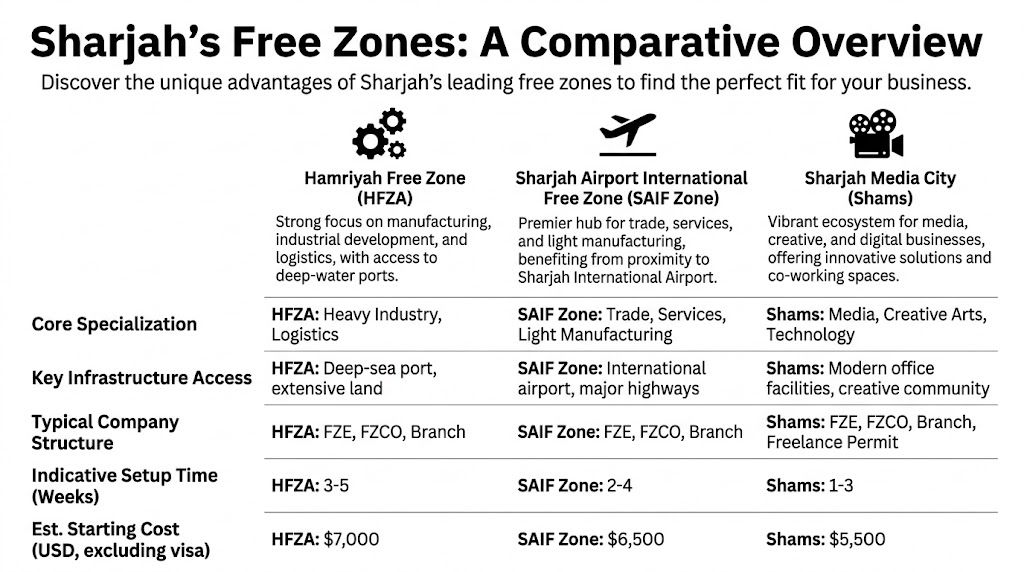
The fast decision matrix
Start with operating reality, not the sales brochure.
| If your business needs | Strongest first option |
|---|---|
| Port access, industrial land, heavy manufacturing suitability | Hamriyah Free Zone |
| Airport-linked trade, logistics, import-export, light manufacturing | SAIF Zone |
| Media, consultancy, digital services, flexible service-led setup | Shams |
Hamriyah Free Zone
Hamriyah is the first serious option for businesses that need space, port logic, and industrial infrastructure. Manufacturing, marine support, fabrication, processing, bulk storage, and land-intensive operations generally make more sense here than in a service-led zone.
A key advantage is operational fit. If your business needs warehouses, open yard space, worker accommodation planning, or room to expand equipment later, Hamriyah starts to justify itself quickly. Founders who choose a lighter zone to save on setup cost often end up paying more once they need storage, transport access, or approvals tied to industrial use.
Hamriyah is usually right when
- You need industrial or port-oriented infrastructure. This includes manufacturing, steel, maritime support, packaging, processing, and large storage requirements.
- Your goods movement is sea-linked or volume-heavy. Port access matters more when shipments are bulky, frequent, or margin-sensitive.
- You expect to expand physically. More stock, larger machinery, or additional units are easier to plan in an industrial zone than in a desk-based setup.
Hamriyah trade-offs
Hamriyah is often too heavy for a pure service business. If revenue comes from consulting hours, design work, software support, or remote delivery, you may be paying for an environment your company will not use.
I usually tell industrial clients to review how Hamriyah free zone company options are commonly structured for land, warehouse, and licence combinations before they compare package prices. The structure matters as much as the licence fee.
Cheap entry cost is rarely the cheapest decision for an industrial business. Facility mismatch becomes expensive fast.
SAIF Zone
SAIF sits in the middle of the Sharjah decision matrix. It suits trading companies, distributors, light manufacturers, spare parts businesses, and operators that care about airport access and practical cargo movement without needing the full industrial profile of Hamriyah.
This zone tends to work well for companies that import, hold, assemble, repack, or re-export goods on a regular basis. The advantage is not just proximity. It is the combination of commercial licensing, warehousing options, and logistics convenience for businesses where speed affects customer satisfaction and cash flow.
The trade-off is straightforward. If your company does not benefit from shipment frequency or stock movement, SAIF can be more infrastructure than you need. A solo consultant or small creative firm usually gains little from paying for a logistics-oriented base.
SAIF is usually right when
- You trade physical goods. Import, export, distribution, and resupply models often fit SAIF better than service-led zones.
- You need warehouse access without a heavy industrial setup. Light assembly, stockholding, and equipment supply are common examples.
- You expect cargo movement to be part of normal operations. Fast access becomes more valuable after launch than it looks during planning.
SAIF trade-offs
SAIF is less compelling for businesses that sell expertise rather than products. It can still work, but it is rarely the cleanest match if there is no inventory, no logistics pressure, and no need for physical operations.
Shams
Shams is usually the cleaner option for media businesses, consultants, digital operators, marketing firms, designers, educators, and founders building a lean service company. Its appeal is flexibility around service activities and a lighter facility commitment than the more trade-focused zones.
That matters because many early-stage founders do not need storage, cargo handling, or industrial approvals. They need a licence that reflects their actual business model, manageable setup cost, and enough flexibility to hire, invoice, and grow into adjacent service lines without restructuring too early.
Sharjah Media City positions itself as a hub for creative and entrepreneurial businesses on its official Shams website. That lines up with how it is used in practice. It is typically chosen by businesses whose main asset is people, content, expertise, or intellectual output.
Shams is usually right when
- Your revenue comes from services. Consultancy, media production, advertising, training, design, and online support businesses often fit well here.
- You want activity flexibility. This helps when the business may widen from one service line into related work.
- You do not need warehousing or industrial space. For many founders, this is the clearest dividing line.
Shams trade-offs
Shams is not a good answer for stock-heavy trading or manufacturing. If the business will import products, hold inventory, or operate from a workshop environment, a service-focused setup can create limits that show up later in banking, customs, or day-to-day operations.
Sharjah Free Zone Comparison HFZA vs SAIF vs Shams
| Feature | Hamriyah Free Zone (HFZA) | SAIF Zone | Shams Free Zone |
|---|---|---|---|
| Best fit | Manufacturing, heavy industry, maritime, storage | Trading, logistics, light manufacturing | Media, digital, consultancy, creative services |
| Infrastructure logic | Port-linked industrial environment | Airport-linked commercial and logistics environment | Flexible office and service-led environment |
| Space needs | Best for firms needing land, warehouse, or industrial units | Good for offices, warehousing, and light operations | Better for desks, offices, and lean service setups |
| Operational style | Asset-heavy and infrastructure-driven | Speed-driven and shipment-sensitive | Low-footprint and activity-flexible |
| Scalability pattern | Expand through larger industrial footprint | Expand through stock movement and commercial operations | Expand through team growth and service scope |
| Common mistake | Choosing it for a small consultancy | Choosing it without real logistics need | Choosing it for stock-heavy operations |
The simplest way to decide
Use four filters.
- What are you selling? Goods, services, or manufactured output?
- What creates delay in your revenue cycle? Shipping, approvals, production, or client delivery?
- What facility do you need in the first 12 months? Desk, office, warehouse, land, or workshop?
- What changes after the business proves itself? More staff, more stock, bigger machinery, or broader activities?
Those answers usually narrow the choice quickly. If the business is physical and expansion-heavy, start with Hamriyah. If it is trade-led and shipment-sensitive, start with SAIF. If it is service-led and lean, start with Shams.
Choosing Your Licence and Legal Structure
A founder can choose the right free zone and still create friction on day one by picking the wrong licence. I see this often with overseas investors who focus on package price first, then discover their approved activity does not match how they invoice clients, move goods, or explain the business to a bank.
The licence is not an admin detail. It is the legal description of how the company earns money.
Start with the revenue model, not the package title
Use the same decision logic from the zone selection stage. Ask what the business is doing, what it needs to handle physically, and how it expects to grow in the first two years. That usually points to the right licence faster than browsing package names.
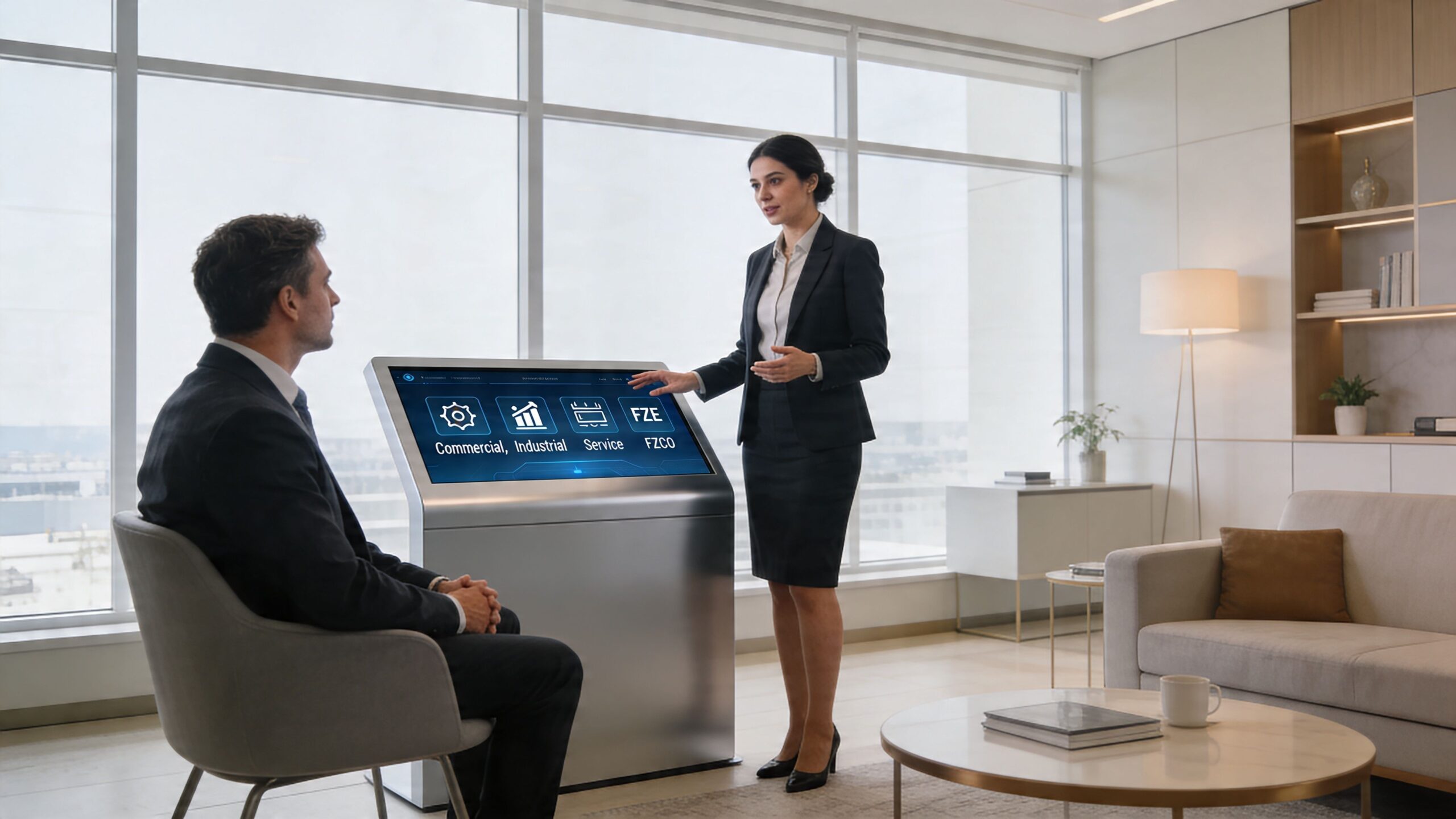
Most companies in Sharjah free zone fit into three broad licence paths.
Commercial licence
Choose this if the business buys, sells, imports, exports, distributes, or stores goods. This is the standard route for trading businesses.
It sounds straightforward, but the trade-offs matter. A commercial licence works well if revenue depends on product movement and supplier relationships. It also creates more scrutiny around customs documentation, product descriptions, warehouse needs, and invoice consistency. If the business will hold stock, SAIF or Hamriyah often makes more operational sense than a desk-only setup in Shams.
Service licence
Choose this if clients pay for expertise, time, execution, or digital output. Consultancy, marketing, software support, design, training, and many professional services fall into this category.
This is often the cleanest route for lean businesses, but it is also where founders overgeneralise. A vague activity such as "consultancy" can create avoidable questions later if the company is providing technical implementation, media production, recruitment support, or regulated advisory work. The safer approach is to describe the work accurately from the start.
Industrial licence
Choose this if the company manufactures, assembles, processes, packages, or transforms goods. If materials go in and a changed product comes out, treat it as industrial unless the authority confirms otherwise.
This route usually involves more approvals, more facility planning, and more documentation. It also gives the business a structure that matches production reality. For manufacturers, trying to save time by filing under a service or commercial activity usually causes bigger delays later.
The legal form should match ownership reality
Once the activity is clear, the legal structure becomes simpler. In practice, most founders choosing companies in Sharjah free zone look at three options:
- FZE for a single shareholder
- FZCO or FZC equivalent zone structure for two or more shareholders
- Branch for an existing UAE or foreign company that wants a Sharjah presence under the parent entity
This decision affects control, documentation, and compliance. A branch can be efficient if a parent company already exists and wants one ownership line. A new free zone entity is usually cleaner if partners are investing directly, splitting shares, or building a business that may later add investors.
Match the structure to the real business, not the future wish list
A lot of formation mistakes come from trying to keep every option open. Founders ask for broad trading "just in case" or add shareholders informally before the paperwork reflects it. Both choices create problems.
| Situation | Usually works | Usually causes problems |
|---|---|---|
| Solo consultant entering the UAE market | Service licence with single-owner structure | Broad trading activity added without a trading model |
| Two founders launching a product business | Commercial licence with multi-shareholder structure | Side agreements that do not match the incorporation documents |
| Factory or packaging business planning equipment import | Industrial licence in a zone built for operations | Service or trading licence chosen only to reduce approval time |
Choose the narrowest accurate activity set. It is easier to add scope later than to explain an inflated licence to a bank, counterparty, or compliance team.
A practical rule that works
Ask one direct question. What exactly is the customer paying for?
If the answer is advice, design, code, support, or project work, the starting point is usually a service licence. If the answer is goods being bought and resold, it is usually commercial. If the answer is a product being made, assembled, processed, or packaged, it is usually industrial.
Then check that against the zone decision. Shams usually suits lean service businesses. SAIF usually suits trade-led companies that need fast cargo access and practical office or warehouse options. Hamriyah usually suits industrial businesses and companies that need land, heavy infrastructure, or room to scale operations.
Simple structures age better in the UAE. Clean activity wording, the right entity type, and a licence that matches the revenue model will save time long after incorporation is finished.
The Complete Company Formation Process
A founder often reaches this stage with the big choice already made. The free zone is shortlisted, the licence direction is clear, and the budget is roughly known. The next question is more practical. How do you move from approval in principle to a company that can operate?
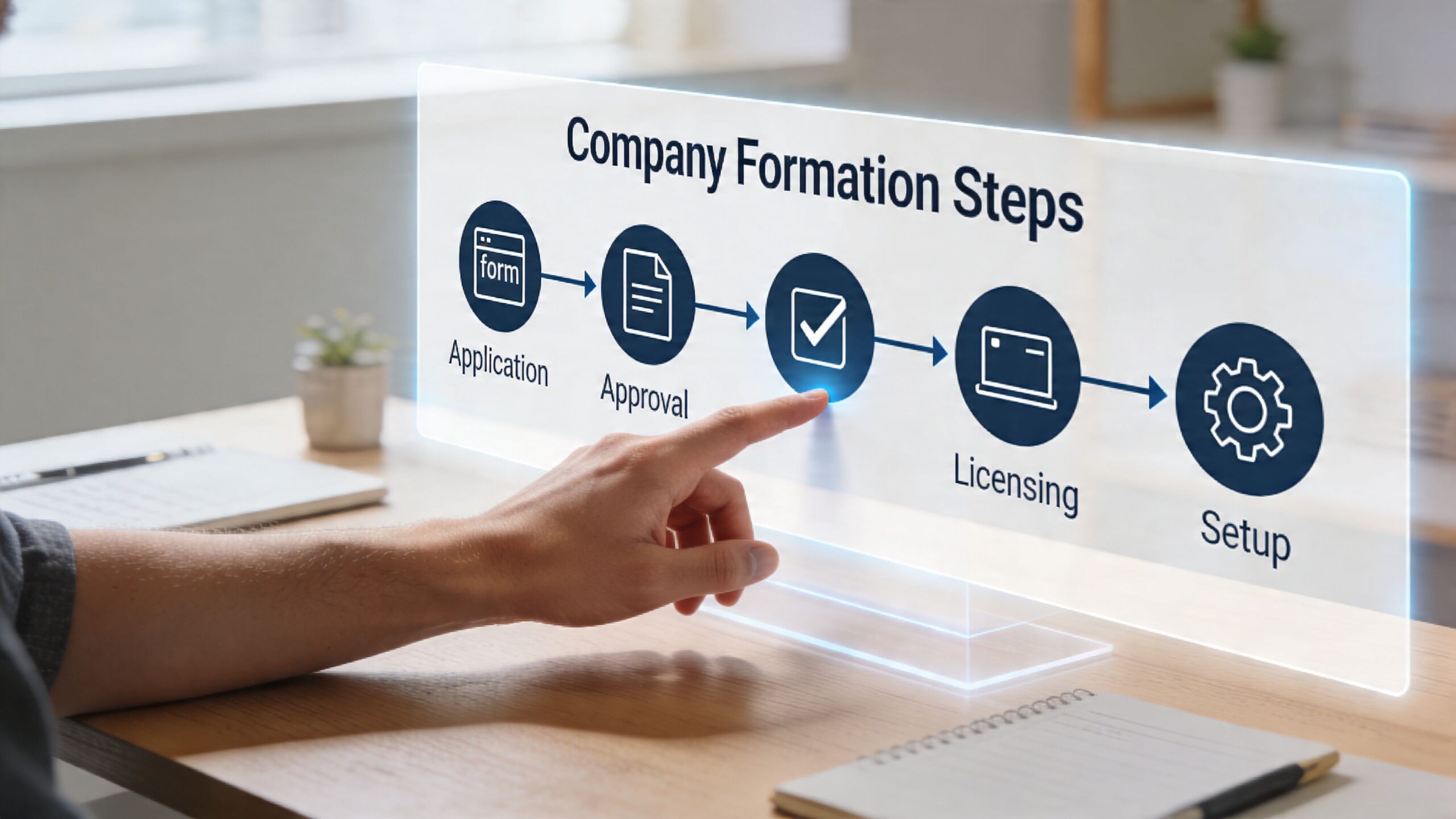
The answer matters because formation in Sharjah is not one action. It is a sequence of approvals, documents, facility commitments, immigration steps, and post-licence tasks. If those are handled in the right order, the process is usually straightforward. If they are handled out of order, even a simple setup starts to drag.
How the setup usually unfolds
The first stage is document alignment. The authority reviews the proposed activity, trade name, shareholder details, and the basic company structure. For some businesses, this is routine. For others, especially regulated trading, industrial, or technical activities, the authority may ask for a clearer description of what the company will do.
That step deserves more care than many founders give it. If the licence wording is vague, the problem rarely appears at incorporation. It appears later, during banking, customs registration, contract review, or visa processing.
Once the initial review is cleared, the incorporation documents are issued for checking and signature. At the same time, the facility choice is usually locked in. That can be a flexi desk, office, warehouse, or industrial unit, depending on the zone and the operating model.
The decision matrix becomes practical when considering different business types. A lean consulting or media company can usually move faster because the facility need is light. A trading business that expects staff visas or wants stronger banking optics may need a real office from day one. A manufacturing or packaging business has the longest path because premises, utilities, and operational approvals can affect the formation timeline.
What happens after the licence is issued
Licence issuance is a milestone, not the finish line.
If the owners or employees need UAE residence status, the company must then activate its immigration file. The standard sequence usually looks like this:
- Establishment card application so the company can use immigration systems.
- Entry permit or in-country status adjustment, depending on where the applicant is at the time.
- Medical test and Emirates ID processing.
- Residence visa stamping or final approval completion.
For many foreign investors, this is the point where expectations need to stay realistic. The company may be legally formed, but that does not mean the bank account is open, the visa is finished, and the business is fully ready to trade on the same day.
Where delays usually happen in practice
The pattern is fairly consistent across SAIF, Shams, and Hamriyah.
- Activity wording does not match the actual revenue model. This creates questions later from banks, clients, or compliance teams.
- Shareholder documents are inconsistent. Passport copies, addresses, signatures, and corporate documents must line up cleanly.
- The facility is chosen for price, not use case. That can create problems with visa allocation, inspections, or banking.
- Post-licence tasks are left too late. Immigration, account opening, and tax registration should be planned early, not after the licence arrives.
Tax is a good example. Many businesses do not need VAT registration on day one, but founders should still understand the threshold rules and timing. A practical reference is this guide on how to register for VAT in the UAE, especially if the company expects trading volume or service billing to build quickly.
The trade-off founders should understand
Speed, cost, and operating readiness are related, but they are not the same thing.
A lower-cost package can be enough for a solo service business that invoices overseas clients and needs one visa. The same package may be the wrong fit for a trading company that needs customs access, multiple staff visas, warehouse use, and a bank that wants to see substance. In that case, spending more at setup often saves time later.
The cleanest formations are the ones where the founder decides how the business will function in the first six to twelve months, then builds the company around that reality. That approach works better than choosing the cheapest option and trying to retrofit the business into it later.
Costs Visas and Taxes in Sharjah for 2026
When founders ask about cost, they usually mean three different things at once: setup spend, visa practicality, and tax exposure. Those need to be separated.
The first reality is straightforward. Costs vary by zone, activity, facility type, and whether your business needs desks, offices, warehouses, or industrial space. A service company in a flexible zone won’t approach the budget profile of a manufacturing operation requiring land or large units. That’s why generic price comparisons often mislead more than they help.
How to think about cost properly
Use this order instead of asking for the “cheapest package”:
- Activity first. The wrong licence can cost more to fix than you save at setup.
- Facility second. Office, warehouse, and industrial needs reshape the actual cost base.
- Visa plan third. Your visa requirement affects how lean your setup can realistically be.
The verified material also points to a gap in Sharjah-focused setup content around direct cost comparison between zones, especially for service businesses versus industrial operators. That’s a fair warning. If someone gives you a simple one-line answer on cost without asking about operations, treat that as a red flag.
Visa planning needs realism
Visa eligibility is usually tied to the company’s structure and facility model. Founders often assume they can start with the smallest footprint and add multiple visas without changing anything else. Sometimes that works. Often it doesn’t.
The better approach is to decide early:
| Business stage | Better planning question |
|---|---|
| Launch | Who genuinely needs a visa now? |
| Early growth | Which hires must be in the UAE? |
| Expansion | Does the facility still match headcount and business activity? |
That avoids a common problem where the company is legally formed but operationally constrained because the original setup was too narrow.
Tax and compliance in 2026
For taxes, founders need qualified tax advice specific to their structure and income profile. Free zone status can create advantages, but it doesn’t eliminate compliance obligations. Corporate tax treatment depends on how the company is structured, what it earns, and how it operates. VAT may also apply depending on your activity and turnover profile.
If your business is trading, invoicing in the UAE, or crossing standard registration thresholds, review the UAE VAT registration process and compliance steps early rather than after the first filing issue appears.
One niche area worth watching is sustainability-linked business activity. Verified data states that green sectors grew 25% in UAE free zones in 2025, with Sharjah capturing a significant share and offering tax rebates of up to 50% for qualifying eco-projects, according to this report on sustainable businesses in UAE free zones. That won’t apply to every company, but for recycling, eco-logistics, circular economy, or green consultancy ventures, it can affect zone selection and long-term cost planning.
Tax efficiency starts with the right structure. It doesn’t come from guessing what the rules might allow.
Practical FAQs for Setting Up in Sharjah
Can a Sharjah free zone company do business on the UAE mainland
Yes, but the practical method depends on the activity. Some businesses can serve mainland clients directly in ways that fit the rules. Others may need additional arrangements, approvals, or distribution structures. This should be checked before formation, not after your first mainland contract lands.
Is opening a corporate bank account difficult
It can be. Banks look at activity, shareholder profile, business substance, transaction logic, and document quality. Founders often assume the licence guarantees account opening. It doesn’t. Clean activity wording, a credible business model, and well-prepared documents matter a lot.
Do all Sharjah free zone companies need annual renewal
Yes, licence and related registrations generally require ongoing renewal and maintenance. You should also expect continuing compliance duties, which may include bookkeeping, records maintenance, UBO disclosure, and other regulatory updates depending on your structure and activity.
Which zone is best for a small startup
That depends on what the startup does. A digital consultancy and an equipment trader are both startups, but they need different environments. Founders should choose based on activity, space, and scaling model, not on the startup label alone.
Can I change my activity or upgrade later
Usually yes, but amendments take time and may trigger additional approvals or facility changes. It’s better to choose an accurate structure at the start than rely on future corrections.
If you want specific guidance on choosing the right Sharjah free zone, structuring your licence correctly, and handling the full setup process without costly missteps, Smart Classic Business Hub can help. Their team supports entrepreneurs and investors with UAE company formation, PRO services, VAT-compliant accounting, audit coordination, tax residency support, and practical compliance planning, so you can launch with a structure that fits how your business operates.