VAT filing in the UAE is a non-negotiable part of running a registered business. It involves submitting a regular VAT return to the Federal Tax Authority (FTA), where you declare all your sales and purchases and settle the net tax due. The standard rate is a straightforward 5%, but getting to grips with your specific obligations is the first real step to staying compliant.
Decoding Your Core VAT Obligations in the UAE
Before you can even think about filing a VAT return, your business needs to be registered with the FTA. This isn’t a choice for everyone; it’s directly tied to your company’s revenue. Understanding the registration thresholds is absolutely fundamental, because getting this wrong can lead to some hefty penalties right out of the gate.
The UAE tax system hinges on two main thresholds for VAT registration. This tiered approach is designed to let smaller businesses find their footing without an immediate tax burden, while ensuring larger, more established companies contribute as expected.
Mandatory vs Voluntary Registration
The big question—to register or not to register—usually comes down to your annual taxable turnover. This isn't just your profit; it's the total value of all supplies you make that aren't exempt from VAT.
- Mandatory Registration: If your taxable supplies and imports have crossed AED 375,000 over the last 12 months, you are legally required to register for VAT. There's no grey area here.
- Voluntary Registration: If your turnover is over AED 187,500 but still under the mandatory limit, you have the option to register.
Why would you register if you don't have to? It can be a smart strategic move. Voluntary registration allows you to claim back the VAT you pay on your business expenses. If you buy a lot from other VAT-registered suppliers, this can make a real difference to your bottom line.
To give you a quick reference, here’s a simple breakdown of the thresholds.
UAE VAT Registration Thresholds at a Glance
| Registration Type | Annual Taxable Turnover Threshold | Who It Applies To |
|---|---|---|
| Mandatory | Exceeds AED 375,000 | Businesses whose taxable turnover in the past 12 months (or next 30 days) is over this limit. |
| Voluntary | Between AED 187,500 and AED 375,000 | Businesses that meet the minimum threshold and want to reclaim input VAT. |
Keep this table handy as you monitor your finances. It’s the clearest guide to knowing exactly when you need to act.
A key piece of advice for new entrepreneurs: Don't wait until you've already crossed the threshold. Keep a close eye on your 12-month rolling turnover. The FTA gives you just 30 days to register after hitting AED 375,000, and that deadline sneaks up on you fast.
Since its introduction back in 2018, the UAE's integrated tax system has been widely adopted. The numbers speak for themselves—recent data shows that over 651,000 companies are now registered for corporate tax. This success is largely thanks to the user-friendly digital platforms that simplify compliance for both VAT and corporate tax. You can learn more about the UAE's growing tax compliance landscape to see how the system has evolved.
The Standard Rate and Why It Matters
The standard VAT rate across the UAE is a flat 5%. This single rate applies to the vast majority of goods and services sold in the country.
Getting this rate right is critical for everything from pricing your products and issuing correct invoices to, ultimately, your vat filing in uae. It determines the output tax you collect from your customers and is the foundation for calculating your final VAT liability to the government.
Preparing for a Flawless VAT Return Submission
A smooth VAT filing experience starts long before you even think about logging into the FTA portal. Honestly, the secret to a stress-free submission is all in the prep work and having your records in order. Get this part right, and the whole thing shifts from a quarterly headache to a straightforward business task.
This is more than just basic bookkeeping. For VAT filing in the UAE, your financial records have to be structured specifically to support your tax obligations. This means keeping clear, accessible, and compliant documents for every single transaction, giving you a complete audit trail whenever you need it.
The Foundation: Good Record-Keeping
The cornerstone of any solid VAT return is meticulous record-keeping. The FTA requires businesses to hold onto financial records for a minimum of five years. This includes a detailed log of all supplies and imports of goods and services.
Your records need to be detailed enough for the FTA to easily verify everything. Think of it like building a strong case for your VAT return figures; every number you pop into the VAT201 form needs a document to back it up.
Expert Tip: Don't just file your invoices and forget them. I always tell my clients to organise records by tax period right from the start. Using digital folders labelled "Q1 2024 Invoices," "Q1 2024 Expenses," etc., will save you countless hours when filing time rolls around.
Crafting VAT-Compliant Invoices
A standard invoice just won't cut it—it has to be a proper tax invoice. A VAT-compliant tax invoice has specific, mandatory information required under UAE law. If you issue incorrect invoices, you could face penalties and it can seriously complicate your ability to reclaim input tax.
To stay compliant, every tax invoice you issue must include:
- The words "Tax Invoice" clearly displayed.
- Your business name, address, and Tax Registration Number (TRN).
- The recipient's name, address, and TRN (if they're also registered).
- A unique invoice number and the date of issue.
- A clear description of the goods or services supplied.
- The total amount excluding VAT, the rate of VAT, and the final amount of VAT charged in AED.
Forgetting any of these details, especially the TRN, can cause major headaches for both you and your client.
Calculating Your Output and Input Tax
At its heart, your VAT return is just a summary of two key figures: output tax and input tax. Getting these calculations spot-on is the most critical part of the preparation phase.
Output Tax
This is the 5% VAT you collect on behalf of the government from your customers. You calculate this on all taxable sales you made during the tax period. It’s your job to collect it and pass it on to the FTA.
Input Tax
This is the 5% VAT you’ve paid on your business-related purchases and expenses. This can be anything from raw materials and office supplies to professional services and utility bills. You're eligible to recover this amount from the FTA.
The formula is simple: VAT Payable = Output Tax – Input Tax. If your output tax is higher, you pay the difference to the FTA. If your input tax is higher, you can claim a refund. It's also a good reminder that staying compliant goes beyond tax; for example, a seamless trade license renewal process is another key piece of operating smoothly in the UAE.
Essential Document Checklist for Submission
Before you even start filling out your return, get all your documents together in one place. A quick pre-submission check ensures you have everything you need and prevents that last-minute panic for missing paperwork.
Here’s a practical checklist I use:
- Sales Invoices: All tax invoices you issued to customers during the period.
- Purchase Invoices: All tax invoices you received from your suppliers.
- Bank Statements: Cross-reference your transactions with your bank records. It’s a simple check that catches a surprising number of errors.
- Import/Export Documentation: Customs declarations (like Bills of Entry) are absolutely essential for verifying VAT on imported goods.
- Credit and Debit Notes: Any documents issued for sales returns or price adjustments.
- Records of Zero-Rated or Exempt Supplies: If you have supplies that aren't subject to the standard 5% rate, you must have the paperwork to prove their status.
Modern accounting software can be a lifesaver here, automating much of this process. These tools can generate VAT reports, track your output and input tax, and ensure your invoices are compliant, making the entire VAT filing in the UAE process far more efficient and accurate.
Navigating the FTA e-Services Portal Step-by-Step
Alright, you've organised your records and crunched the numbers. Now for the final leg of the journey for your VAT filing in UAE: submitting the return through the Federal Tax Authority (FTA) e-Services portal. This is the official gateway for all things tax-related in the UAE. It might look a bit daunting at first, but once you get the hang of its layout, it's actually quite straightforward.
Think of this section as your screen-by-screen guide. We’ll walk through everything from logging in and filling out the VAT201 form to making the final payment, so you know exactly what to expect.
Accessing Your FTA Account and Finding the VAT Form
First things first, you need to get into your account. Head over to the official FTA e-Services portal and pop in the username and password you set up when you registered. If you're new to this whole process, our guide on how to register for VAT in the UAE is a great place to start.
Once you’re in, the dashboard gives you a bird's-eye view of your tax situation, flagging any returns that are due or payments that are outstanding. You'll want to find the VAT returns section, usually under a "VAT" tab. From there, you can "Open" the return for the correct tax period, which will bring up the VAT201 form.
This simple three-step process—collecting your data, calculating the figures, and giving everything a final review—is what you should do before even logging into the portal.
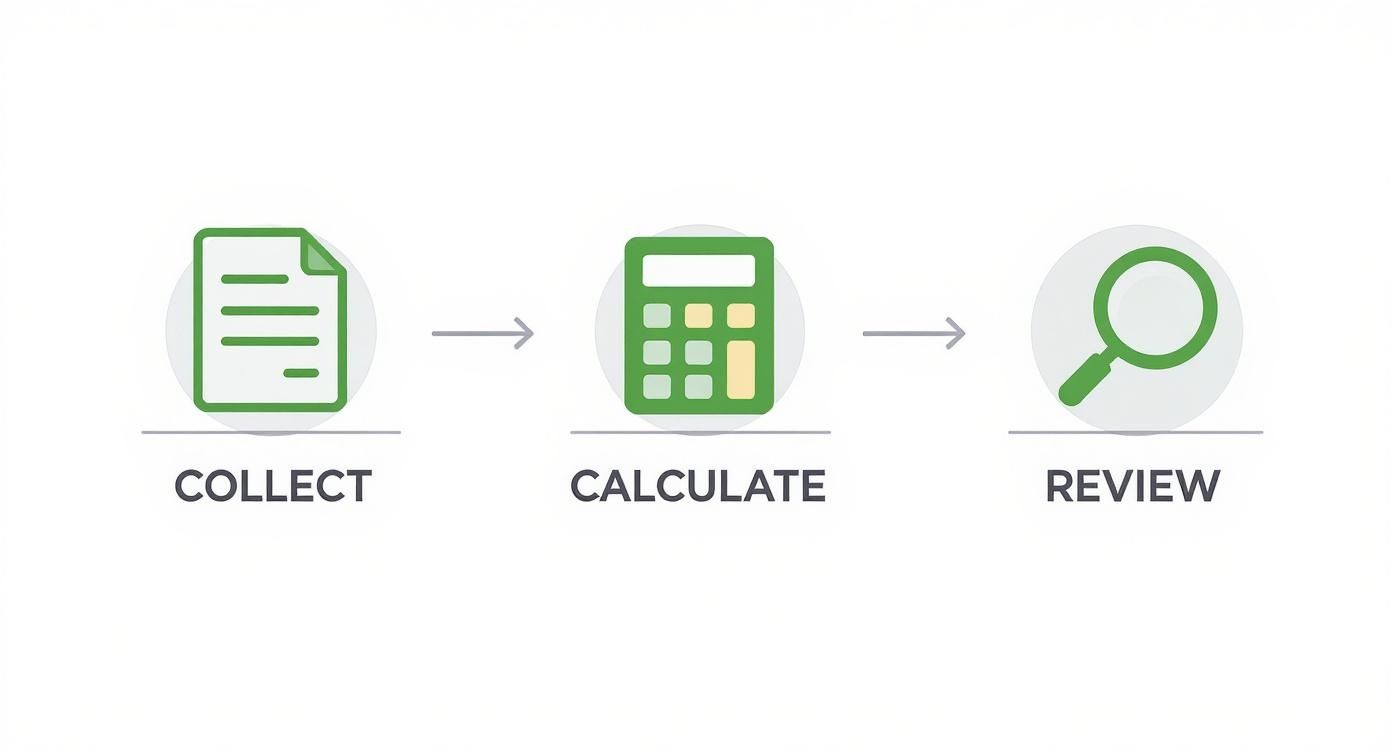
Trust me, following this workflow saves a world of headaches and drastically cuts down on the chance of making a mistake when you're entering the final numbers online.
Filling Out the VAT201 Form: A Box-by-Box Guide
The VAT201 form is logically structured to capture your sales (output tax) and purchases (input tax). It's broken down into different boxes, and you'll populate them with the figures you've already prepared. Before you start typing, it’s a good idea to have your summary spreadsheet or documents open and ready.
To help you get familiar with the form, here's a table breaking down the essential information you'll need.
Essential Information for Your VAT Return (VAT201 Form)
| Section of Form | Information Required | Where to Find This Information |
|---|---|---|
| Box 1: Taxable Supplies | The net value of all standard-rated sales, broken down by Emirate. | Your sales ledger or revenue report for the tax period. |
| Box 3: Reverse Charge | The net value of imported goods/services where the reverse charge mechanism applies. | Invoices from your overseas suppliers for services or goods. |
| Box 9: Taxable Expenses | The total value of your standard-rated expenses and the amount of input VAT you can reclaim. | Your purchase ledger or expense reports, supported by valid tax invoices. |
As you fill in the boxes, the portal automatically calculates the net VAT payable or refundable. This is a handy feature that acts as a live sanity check against your own calculations. If the numbers don't match, it's a sign to pause and double-check your figures before moving on.
Uploading Documents and Submitting Your Return
Once you’ve filled in all the numbers, the portal might ask you to upload supporting documents. This isn’t required for every single submission, but it's more likely if you're claiming a large VAT refund or if the FTA flags something unusual. It’s always good practice to have key invoices or summary reports scanned and ready in PDF format, just in case.
Before hitting that final "Submit" button, take a deep breath and use the review function. Go through every single box one last time, comparing the portal figures against your own summary. A simple typo can create a world of pain later on.
When you're absolutely sure everything is correct, go ahead and submit.
Making the VAT Payment
Submitting the form is a huge milestone, but you're not quite done. If you have VAT to pay, you need to settle the amount by the deadline, which is the 28th of the month following the end of the tax period.
The FTA gives you a few ways to pay:
- e-Dirham or Credit Card: This is great for smaller amounts and can be done directly through the portal.
- Bank Transfer (GIBAN): This is the go-to method for most businesses, especially for larger payments. The portal will generate a unique GIBAN (Generated International Bank Account Number) for that specific return. You must use this exact GIBAN when making the transfer from your bank.
Here’s a critical tip from experience: the FTA marks your payment as "received" on the date the money actually hits their account, not the date you send it. To be safe, always initiate your transfer at least two working days before the deadline. Late payment penalties start at 2% of the unpaid tax and climb from there, so it's not worth the risk.
Once your payment is confirmed, that's it! Your VAT filing in UAE is complete for the period. You'll get a confirmation from the portal—make sure to save a PDF of both the submitted return and your payment receipt for your records.
Handling Complex VAT Scenarios and Special Schemes
Basic sales and purchases are straightforward enough, but the reality of business in the UAE often throws more complex transactions your way. Knowing how to handle these nuances is what separates a smooth vat filing in uae from a compliance headache. Key areas like the Reverse Charge Mechanism and specific freezone rules are common sticking points, but getting them right is non-negotiable.
Don't assume these scenarios are just for big corporations. If you've ever paid for software from an overseas provider or operated from a freezone, you're already in this territory.

Demystifying the Reverse Charge Mechanism
The Reverse Charge Mechanism (RCM) is a concept that frequently trips people up. It essentially flips the script on who reports the VAT. Instead of the seller, the buyer becomes responsible. This mechanism kicks in when you import services or goods from outside the UAE.
Your overseas supplier won't charge you VAT. Instead, you—the recipient—must calculate and pay the VAT directly to the FTA. It's a critical accounting entry on your VAT return that many businesses miss.
The clever part of RCM is how it works on paper. You declare the VAT as both output tax (what you owe) and, if you're eligible, as input tax (what you can reclaim). For most businesses, these two entries cancel each other out. This means no actual cash payment is needed for the VAT itself, but the transaction is correctly reported to the FTA.
Let’s walk through a real-world example. Imagine your Dubai-based marketing agency subscribes to a digital analytics tool from a company in Ireland.
- The Irish company’s invoice will have no UAE VAT on it.
- When you file your return, you must calculate 5% of the invoice value.
- You then report this figure in your output tax section (as if you'd collected it) and your input tax section (as if you'd paid it).
This process ensures that tax on imported services is properly accounted for inside the UAE's tax system.
Mainland vs Freezone The VAT Distinction
Operating in a UAE freezone has its perks, but the VAT rules can be a minefield. Not all freezones are equal in the eyes of the taxman. The FTA makes a crucial distinction between standard freezones and what are known as "Designated Zones".
A Designated Zone is treated as being outside the UAE for VAT purposes, but—and this is a big "but"—only for the supply of goods. This has major implications for your accounting:
- Goods within a Designated Zone: Moving goods between companies inside the same Designated Zone, or from one Designated Zone to another, is not subject to UAE VAT.
- Services within any Freezone: This is where many get caught out. The supply of services within any freezone, whether it's "Designated" or not, is subject to the standard 5% VAT rate.
- Supplies to the Mainland: When a freezone business sells goods or services to a mainland company, it's considered an import into the UAE, and the usual VAT rules apply.
The very first step is to confirm your freezone's status. Getting this wrong can unravel your entire VAT return.
Applying for VAT Refunds
It’s not uncommon for your input tax (the VAT you paid on business expenses) to be consistently higher than your output tax (the VAT you collected). This often happens if you're heavily involved in exports or making major capital investments, putting you in a VAT refundable position.
When you file your return, the FTA portal automatically calculates and displays any net refundable amount. From there, you can submit a separate application to claim this money back. Be prepared for scrutiny; the FTA is thorough and will likely request supporting documents to verify your claim before processing the refund.
The system is also designed to support various business activities and schemes for citizens. For instance, the VAT refund programme for UAE nationals building new homes has seen massive uptake. By September 2021, the FTA had processed over 9,640 of these requests, marking a 107.1% jump from the previous year, largely due to simplified procedures. You can read more about the growth of this FTA initiative on their official site.
Dealing with Errors and Penalties
Let's be realistic: even with the best intentions and the most organised bookkeeping, mistakes can happen. An incorrect figure gets keyed in, an expense is misclassified—these things are part of running a business. When it comes to your vat filing in uae, the important thing isn’t pretending you'll never make a mistake; it's knowing exactly how to fix it, and fast.
The Federal Tax Authority (FTA) has clear procedures for corrections. Ignoring an error is the worst thing you can do. The moment you spot a mistake in a submitted VAT return, you need to act. Taking the initiative shows the FTA you’re serious about compliance and can save you a lot of trouble down the line.
How to Correct Mistakes with a Voluntary Disclosure
If you discover an error that led to underpaying tax by more than AED 10,000, you are legally required to file a Voluntary Disclosure. This is the official way to correct a significant mistake on a past return. You’re essentially raising your hand and telling the FTA, "I found an error, here are the right details, and here's the tax I owe."
Even if the error is under AED 10,000, it's still best practice to file one. It keeps your record clean and transparent.
Here’s what submitting a disclosure looks like:
- Log into the FTA e-Services portal.
- Find and complete the Voluntary Disclosure form, making sure to reference the original tax period where the error occurred.
- Provide a clear, honest explanation for the error.
- Pay the outstanding tax that resulted from your correction.
Crucially, you must do this before the FTA flags the issue or notifies you of an audit. Being proactive is your best defence.
Understanding Common FTA Penalties
Non-compliance comes with a price tag. The UAE's penalty system is designed to make sure everyone files accurately and on time, so it pays to know what you could be up against.
Here's a quick rundown of the most common administrative penalties:
- Late Registration: A flat penalty of AED 10,000.
- Late Filing of a VAT Return: AED 1,000 the first time it happens. If it happens again within 24 months, it jumps to AED 2,000.
- Late Payment of Tax Due: This one stings and grows over time. You’re hit with an immediate 2% penalty on the unpaid tax. After a month, a 4% monthly penalty kicks in on the remaining amount. This can keep accumulating up to a painful maximum of 300% of the tax you owe.
Let’s say your business owes AED 20,000 in VAT and you pay it a week late. You’ll get an instant penalty of AED 400 (2% of 20,000). If that amount is still unpaid a month later, the 4% monthly penalties start stacking up.
These fines are automatically triggered by the FTA's system, which makes meeting your deadlines absolutely critical.
How to Appeal an Unfair Penalty
What if you get a penalty you feel is unfair? Maybe the portal had a technical glitch, or a bank transfer was delayed for reasons completely out of your hands. You don't just have to accept it. You have the right to challenge it by submitting a Reconsideration Request through the EmaraTax portal.
You have to act quickly, though. The request must be filed within 40 business days of receiving the penalty notice. You'll need to build a solid case, explaining in detail why the penalty is wrong and backing it up with evidence—things like bank correspondence, error screenshots, or any other documentation that supports your claim. This is a formal review process, so a well-argued and documented appeal gives you the best shot at a successful outcome.
Frequently Asked Questions About VAT Filing in UAE
When it comes to the nuts and bolts of VAT filing in UAE, a lot of practical questions pop up, especially for unique business situations. Getting straight answers is the only way to stay compliant and steer clear of common headaches. Let’s tackle some of the most pressing questions we hear from business owners all the time.
When Must a New Business Register for VAT?
This is a big one for startups: when exactly do you need to jump into the VAT system? The rule is pretty clear-cut. You are legally required to register for VAT within 30 days once your taxable turnover hits the mandatory threshold of AED 375,000 over the past 12 months. My best advice? Keep a close eye on your rolling turnover right from day one.
There's also the option to register voluntarily. If your turnover or your business expenses climb past AED 187,500, you can choose to register. This can be a smart move, especially if your main clients are VAT-registered businesses. It lets you claim back the VAT you pay on your own expenses and can make your company look more established.
What Is the VAT Difference Between Mainland and Freezone Companies?
Understanding the line between mainland and freezone operations is absolutely crucial for VAT. For tax purposes, the UAE mainland is straightforward—the standard 5% VAT rate applies across the board. Freezones, however, have a bit more nuance. They're split into two categories: standard freezones and "Designated Zones."
A Designated Zone is treated as if it’s outside the UAE for VAT on goods. This means if you're transferring goods from one Designated Zone to another, no VAT applies. But, and this is a big but, that special status doesn't extend to services.
Here's the key takeaway: services supplied within any freezone, whether it's a Designated Zone or not, are subject to the standard VAT rules. And any time goods or services move from a freezone to the mainland, it's considered an import, and normal VAT procedures kick in.
How Do I Claim a VAT Refund?
Found yourself in a spot where your input tax (the VAT you've paid on expenses) is more than your output tax (the VAT you've collected on sales)? That means you're in a VAT refundable position. This happens a lot with exporting businesses or companies making major capital investments.
The process has two main parts:
- File Your Return: First, you complete your VAT return through the FTA portal. The system is set up to automatically calculate the net amount you're owed.
- Submit a Refund Application: After the return is in, you have to file a separate refund application, also through the portal.
The FTA will then look over your application. Don't be surprised if they ask for supporting documents, like copies of your biggest invoices, before they process the payment. For a closer look at different scenarios, our complete Dubai VAT guide has a ton of extra detail.
What Is the Reverse Charge Mechanism?
The Reverse Charge Mechanism (RCM) sounds complicated, but it's really just an accounting trick that moves the responsibility for reporting VAT from the seller to the buyer. In the UAE, you'll most often see this when you import services or goods from a supplier outside the country.
Instead of your overseas supplier charging you VAT, you account for it yourself. On your VAT return, you declare the VAT amount as both an output tax (as if you charged it) and an input tax (as if you paid it). For most businesses, these two entries simply cancel each other out. It neutralises the cash flow hit while making sure the tax on the imported service is properly declared to the FTA.
At Smart Classic Business Hub, we simplify the complexities of VAT compliance and business management in the UAE. From initial setup to ongoing accounting, our team ensures you can focus on growth while we handle the regulatory details. https://smartclassic.ae