When you're setting up a business in the UAE, one of the first and most critical decisions you'll face is choosing the right legal structure. For most entrepreneurs, both local and international, the answer is overwhelmingly the Limited Liability Company, or LLC. It’s the most common and versatile business structure you'll find here, and for good reason.
What Exactly Is a UAE Limited Liability Company?
Think of a UAE LLC as a protective bubble for you, the business owner. It creates a solid legal wall between your personal assets (like your home, car, and savings) and your company’s finances and debts. This separation is the cornerstone of the "limited liability" concept.
In practical terms, this means if your business runs into financial trouble or faces a lawsuit, your personal wealth is shielded. Creditors and legal claims can only go after the company’s assets, not yours. This single feature provides incredible peace of mind and is a major reason why the LLC is the go-to choice for everyone from ambitious startups to established international firms setting up in the Emirates.
Why is the LLC So Popular?
The numbers speak for themselves. In the first quarter of 2025 alone, the UAE saw a 16% jump in new business registrations, with LLCs dominating the field. This isn't a coincidence. Recent legal changes, particularly allowing 100% foreign ownership for most mainland activities, have made the LLC structure more attractive than ever. You can read more about this surge in UAE business registrations and what's driving it.
But it’s not just about protection. An LLC offers a flexible and scalable framework for your ambitions. You can set one up on your own or with partners—up to 50 shareholders are allowed. These shareholders can be individuals or even other companies (corporate shareholders).
This adaptability makes the LLC perfect for nearly any kind of business, whether you're in trading, offering professional services, or running an industrial operation. Profits are simply distributed among the shareholders according to the ownership percentages laid out in the company’s foundational document, the Memorandum of Association (MOA).
Key Characteristics of a UAE LLC
To give you a quick snapshot, here's a table summarising the core features of a UAE LLC. It’s a handy reference to see why this structure is so well-regarded.
| Feature | Description |
|---|---|
| Legal Status | A separate legal entity, distinct from its owners (shareholders). |
| Shareholder Liability | Limited to the value of their shares in the company’s capital. |
| Number of Shareholders | Can range from a minimum of 1 to a maximum of 50 partners. |
| Ownership | 100% foreign ownership is now permitted for most mainland activities. |
| Capital Requirement | No official minimum capital, but it must be adequate for the business activities. |
This table covers the basics, but as you can see, the combination of legal protection, ownership flexibility, and operational freedom makes the LLC a powerful tool for building a successful business in the UAE.
Choosing Your Business Jurisdiction
Figuring out where to register your UAE Limited Liability Company is one of the first, and most important, decisions you'll make. It’s a bit like choosing the foundation for your house; each jurisdiction—Mainland, Free Zone, and Offshore—is built differently. Each comes with its own set of rules, benefits, and limitations that will directly shape how your company can trade, grow, and operate.
Getting this right from the start is critical. This single choice will influence everything from your ownership structure and tax liabilities to who you can sell to and whether you can get visas for your team.
Mainland: The Gateway to the Local UAE Market
A Mainland LLC is registered directly with the Department of Economy and Tourism (DET) or a similar authority in the emirate you're setting up in. Think of this as the traditional route, giving you a golden ticket to trade directly with any customer or business, anywhere in the UAE, with zero restrictions.
If your game plan is to open a local shop, provide services directly to the UAE public, or bid on lucrative government contracts, then a Mainland setup isn't just an option—it's usually a requirement. It used to be that you needed a local Emirati sponsor, but recent legal changes now allow for 100% foreign ownership across most commercial and industrial activities, making it a far more attractive path than ever before.
Free Zone: A Hub for International Business
Free Zones are special economic areas, each with its own independent governing authority. With over 40 Free Zones scattered across the UAE, they are often themed around specific industries like media, technology, or finance. Setting up a Free Zone LLC is the perfect fit for businesses targeting international trade or serving clients outside the UAE.
The perks are hard to ignore:
- 100% foreign ownership is the default standard.
- Exemptions from corporate and personal income taxes are a major draw (though you still need to be mindful of the broader UAE Corporate Tax rules).
- You can take 100% of your capital and profits out of the country, with no currency headaches.
- The setup process is typically quicker and more straightforward than on the mainland.
The main trade-off? A Free Zone company is legally barred from trading directly in the UAE mainland market. To do that, you'll need to partner with a local distributor or agent. For a deeper dive, our guide on Mainland vs Free Zone differences in Dubai breaks it all down to help you make the right call.
Offshore: A Vehicle for Asset Management and Global Trade
An Offshore company, typically registered in a jurisdiction like Jebel Ali Free Zone (JAFZA) or Ras Al Khaimah International Corporate Centre (RAK ICC), is a completely different kind of tool. It’s not built for running day-to-day operations inside the UAE. Instead, it’s a strategic vehicle for international entrepreneurs and corporations.
An Offshore entity is best understood as a non-resident company. It can’t do business within the UAE, can't rent a physical office, and you can’t get residency visas through it. Its real job is to act as a holding company for international assets or to simplify global trade without needing a physical footprint in the Emirates.
This structure is ideal for managing a property portfolio, safeguarding intellectual property, or handling international invoicing. It offers fantastic confidentiality and asset protection but operates under very strict limitations.
Deciding between these three paths—Mainland, Free Zone, and Offshore—boils down to what your business actually does and where you want to take it in the long run.
This flowchart shows how your need for asset protection and operational freedom can point you to the right choice.
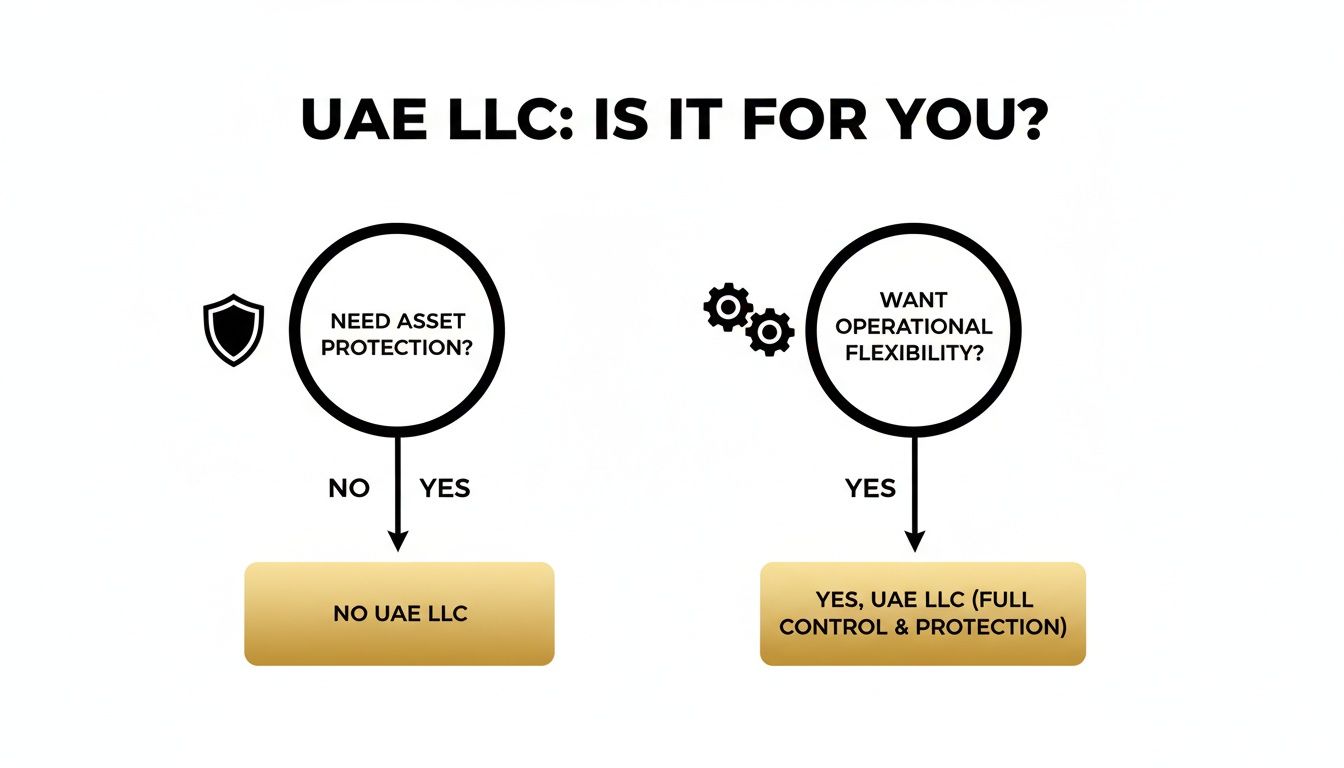
As the visual breakdown shows, the LLC structure is fundamentally about protecting your personal assets while giving you a flexible framework to run your business.
To make this even clearer, here's a side-by-side comparison.
Mainland vs Free Zone vs Offshore LLC Comparison
This table offers a direct comparison to help you quickly see which jurisdiction best aligns with your business goals.
| Attribute | Mainland LLC | Free Zone LLC | Offshore Company (RAK ICC/JAFZA) |
|---|---|---|---|
| Market Access | Unrestricted access to the entire UAE local market. Can trade directly with any business or consumer. | Restricted to trading within the free zone or internationally. Requires a local agent for mainland trade. | No trading allowed within the UAE. Strictly for international business and asset holding. |
| Ownership | 100% foreign ownership for most activities. Some strategic sectors may require an Emirati partner. | 100% foreign ownership is standard. No local sponsor needed. | 100% foreign ownership. No local involvement required. |
| Visas | Eligible to apply for employee and investor residency visas. The number depends on office size. | Eligible for residency visas. The number is typically linked to the package or office space leased. | Not eligible for residency visas. This is a non-resident entity. |
| Office Space | Mandatory physical office space required within the mainland jurisdiction. | Flexible options, including flexi-desks, serviced offices, and physical warehouses/offices. | No physical office is permitted within the UAE. Only a registered agent address is needed. |
| Taxes | Subject to 9% Corporate Tax on profits over AED 375,000. VAT registration is required if the threshold is met. | Often qualifies for a 0% Corporate Tax rate if criteria are met. VAT applies if trading in the UAE. | Exempt from UAE Corporate Tax and VAT as it does not conduct business in the UAE. |
| Best For | Retail, restaurants, local service providers, construction, and companies bidding on government tenders. | Import/export, international consulting, media, e-commerce, and technology startups serving a global market. | Asset protection, real estate holding, intellectual property management, and international invoicing. |
Ultimately, the right choice depends entirely on your business model. If local trade is your priority, the Mainland is your answer. For international focus with operational perks, a Free Zone is likely the best fit. And for pure asset management and global trade, an Offshore company is the perfect strategic tool.
Structuring Your Ownership and Management
Figuring out the ownership of your new UAE Limited Liability Company is one of the first, and most important, decisions you'll make. It’s a choice that defines everything from who’s in control and how profits are split, to how you might bring in investors down the line. Thankfully, the landscape here has changed dramatically, making the LLC more flexible and appealing for foreign entrepreneurs than ever before.
The old days of needing a local Emirati sponsor to hold a 51% stake are largely a thing of the past for most mainland businesses. Thanks to some game-changing legal reforms, you can now have 100% foreign ownership for the vast majority of commercial and industrial activities. This is a massive shift, giving international investors full command over their operations and business strategy.
Of course, it's not a blanket rule for every single activity. A handful of strategic sectors, usually tied to national security or critical infrastructure, still have specific ownership requirements. The key is to double-check the rules for your specific business activity before you lock in your company structure.
Defining Who Owns What
The UAE LLC is built for flexibility. You can set one up as a single shareholder, essentially creating a sole proprietorship but with the crucial protection of limited liability. Or, you can team up with partners—the law allows for up to 50 shareholders in one LLC.
This adaptability also applies to the type of shareholders you can have. Your company’s ownership can be made up of:
- Natural Persons: This just means individual entrepreneurs or partners putting in their own capital.
- Corporate Entities: Other companies, both from the UAE and abroad, can be shareholders. This is perfect for creating holding structures or joint ventures.
This mix-and-match approach allows for some pretty sophisticated corporate setups. A foreign parent company can easily establish a fully-owned subsidiary, or several individual investors can pool their resources to get a new venture off the ground.
Advanced Structures for Growth and Investment
Beyond the basics, the UAE has seriously upgraded its corporate law to support more complex financial arrangements, especially for companies looking to attract venture capital or private equity. This makes a UAE LLC a genuinely competitive option on the world stage.
The ability to create different classes of shares is a game-changer for attracting sophisticated investors. You can now design an ownership structure that separates voting rights from economic rights, offering a powerful tool for maintaining control while raising capital.
Recent changes to the Commercial Companies Law have brought in advanced mechanisms you’d typically only find in major international financial hubs. Now, you can define specific shareholder rights directly in your company's founding document, the Memorandum of Association. This includes creating multiple share classes with different rights to voting, dividends, and payouts if the company is sold. The law also formally recognises drag-along and tag-along rights, which are vital for managing exits and protecting both majority and minority shareholders. You can see how these legal updates align UAE companies with global standards.
What does this mean in practice? It gives founders and investors incredibly precise tools to craft their agreements. For instance, founders can keep control through shares with stronger voting rights, while offering investors preferential shares that give them a bigger slice of the profits. This level of customisation turns your LLC from just a legal requirement into a strategic asset, built for stability and ready for future growth.
Your Step-By-Step Company Formation Checklist
Getting a new business off the ground is an incredible feeling, but the process can feel overwhelming. Let's cut through the complexity. This checklist breaks down the entire journey of forming your UAE Limited Liability Company into clear, manageable steps, taking you from a simple idea to your official launch day.
The whole setup process involves working closely with government bodies, mainly the Department of Economy and Tourism (DET) in your chosen emirate. Think of it like building with LEGOs—each step clicks into place on top of the last, so following the right order is key to a solid foundation.

Step 1: Finalise Your Business Activities and Legal Structure
Before you do anything else, you need to nail down exactly what your business will offer. The DET maintains a list of over 2,000 approved business activities, and your choice dictates the license you'll need: commercial, professional, or industrial. This decision is critical because it impacts everything that follows, from your office requirements to any external approvals you might need.
At the same time, lock in your decision to operate as a Limited Liability Company. This means finalising who the shareholders are and what percentage of the company each person owns, all of which gets officially recorded in your legal paperwork.
Step 2: Reserve Your Trade Name
Your company's name isn't just a label; it's your identity. It must be unique and adhere to the UAE's naming rules—no offensive language, no religious references, and nothing that sounds like a government body. Once you've got a few solid options, you'll submit them to the DET for approval.
When your trade name is approved, it's reserved for a specific period, giving you the breathing room to complete the rest of the formation steps. It's a small but vital part of the process.
Step 3: Obtain Initial Approval
Think of the Initial Approval as the UAE government giving you a formal nod to proceed. It’s a certificate from the DET that confirms there are no objections to you setting up shop. You absolutely need this before you can move on to drafting your company's core legal documents.
To get this green light, you’ll typically need to submit:
- A completed application with your proposed company name.
- Passport copies for every shareholder and the appointed manager.
- A detailed business plan (this is often required for more specialised activities).
- A board resolution if an existing company is one of the shareholders.
This certificate is your proof that the proposed UAE limited liability company fits within the country's legal and economic framework.
Step 4: Draft and Notarise the MOA
The Memorandum of Association (MOA) is the constitutional backbone of your LLC. It's a legally binding document that details everything from shareholder stakes and profit distribution to management duties and day-to-day operational rules. Crucially, it must be drafted in both Arabic and English.
Once it's ready, all shareholders must sign the MOA in front of a public notary. This step makes the agreement official and cements your company's internal governance. For a more detailed look at the entire process, our guide on how to register a company in the UAE is a great resource.
A well-drafted Memorandum of Association is your company's internal rulebook. Investing time to get it right prevents future disputes by clearly defining the rights and responsibilities of every shareholder from day one.
Step 5: Secure a Physical Office and Issue the Trade Licence
For a mainland LLC, having a physical office address is non-negotiable. You’ll need to provide a valid tenancy contract registered through Ejari, Dubai's official lease registration system. This serves as concrete proof that your company has a legitimate physical presence in the UAE.
With your notarised MOA, Initial Approval, and Ejari certificate in hand, you're ready to submit your final application to the DET. After you pay the necessary fees, the authorities will issue your official Trade Licence. This is the moment you've been waiting for—it's your legal permission to begin operating. Congratulations, your company is now officially in business
Understanding Costs, Taxation, and Compliance
Launching your UAE Limited Liability Company is a huge milestone, but keeping it successful for the long haul means getting to grips with the financial side of things. It's not just about the initial setup fees. You need a clear picture of the ongoing operational costs, the local tax system, and the compliance rules you'll need to follow. Getting this right from day one is the secret to keeping your company in good legal standing and avoiding nasty surprises or penalties down the line.
Think of your financial plan in two phases: the one-time setup costs and the recurring annual expenses. The initial investment gets your trade licence issued, covers registration fees, and pays for the notarisation of your company's legal documents. But your financial duties don’t stop there; they just shift into a predictable yearly cycle.

Breaking Down Annual Running Costs
To keep your LLC operating legally, you'll face several recurring financial requirements each year. These are the non-negotiable costs that form the baseline of your operational budget.
Here’s a look at the key annual costs:
- Trade Licence Renewal: This is your most significant recurring fee. It's paid to the relevant economic department to keep your business legally active and authorised to trade.
- Office Rent: A mainland LLC has to maintain a physical address with a registered tenancy contract (Ejari). This could be anything from a budget-friendly flexi-desk to a full-sized private office, depending on your needs.
- PRO Services: Many businesses choose to retain a Public Relations Officer (PRO) on an annual basis. They handle all the government paperwork, visa processing, and document renewals, which can save you an incredible amount of time and hassle.
- Accounting and Audit Fees: Keeping accurate financial books isn't just good practice; it's mandatory. On top of that, many companies need an annual audit performed by a licensed firm to satisfy regulatory and banking requirements.
These costs are predictable, so be sure to factor them into your yearly financial forecasts. It’s the best way to ensure your business stays both solvent and compliant.
Navigating the UAE Corporate Tax System
The introduction of Corporate Tax was a massive shift in the UAE's financial world. The good news is that for a UAE limited liability company, the system has been deliberately designed to be competitive, especially for small and medium-sized enterprises (SMEs).
The tax structure is straightforward and works on a tiered system:
- 0% Rate: If your net profit is up to AED 375,000, you pay zero tax. This threshold offers huge relief for startups and smaller businesses, allowing them to get off the ground.
- 9% Rate: For any net profit that goes above AED 375,000, a standard rate of 9% applies.
This simple two-tier system means the tax burden is directly linked to profitability. It allows smaller businesses to reinvest their earnings back into the company and really fuel their growth.
As the backbone of the UAE's business environment, LLCs benefit from a tax system built with them in mind. The 0% tax rate below the AED 375,000 profit mark and the competitive 9% above it make for an attractive setup. Employers also need to manage a 12.5% GPSSA pension contribution for any Emirati staff, with 5% of that deducted from the employee.
VAT and Ongoing Compliance Duties
Beyond corporate tax, you also need to have Value Added Tax (VAT) on your radar. Registering for VAT becomes mandatory if your company's taxable supplies and imports cross AED 375,000 within a 12-month period.
Once you’re registered, you are legally required to charge VAT on your goods and services, file regular returns, and maintain compliant records. For expert help on this, you might find our detailed article on VAT filing services in the UAE useful.
Finally, remember that staying in good standing is about more than just paying taxes. You have to keep organised financial records and, in many cases, conduct an annual audit. These compliance tasks aren't just bureaucratic boxes to tick; they build credibility with banks, make you more attractive to investors, and ensure your business is built on a solid, sustainable financial foundation.
Frequently Asked Questions About UAE LLCs
Even with a solid plan, a few practical questions always pop up when you're in the thick of setting up a UAE Limited Liability Company. Let’s tackle some of the most common queries we hear from entrepreneurs, giving you straight answers to get you ready for what’s next.
Do I Need a Physical Office for My UAE LLC?
Yes, for any mainland LLC, a registered physical office address is non-negotiable. The authorities verify this with an Ejari, which is the official registration for tenancy contracts in Dubai. But don't panic—this doesn't mean you have to sign a long, expensive lease on a traditional office right out of the gate.
Modern, flexible solutions are perfectly acceptable and widely used. You can secure a dedicated desk in a co-working space or a serviced office to meet this legal requirement without breaking the bank. For free zone companies, a registered address is also mandatory, but it's almost always bundled into your initial setup package as a flexi-desk or a similar arrangement.
How Many Visas Can I Get with a UAE Limited Liability Company?
There isn't a single magic number for visa eligibility. It all comes down to your chosen jurisdiction and, crucially, the size of your office space. For mainland companies, the government allocates visa quotas based on the square footage of your registered office. It's quite straightforward: a bigger office gives you the ability to apply for more employee visas.
Free zones handle this a bit differently. They typically include a set number of visas in their standard formation packages and offer clear, upfront options to purchase more as your team expands. It's also worth noting that shareholders are usually eligible to apply for an investor visa, which is separate and tied to their ownership stake in the company.
Your office space and visa quota are directly linked on the mainland. This makes your choice of office a key strategic decision. Planning for team growth from day one will help you pick the right-sized space and avoid administrative headaches down the line.
Is Opening a Corporate Bank Account Difficult for an LLC?
Let’s be honest: opening a corporate bank account in the UAE isn’t the simple formality it once was. Due to stringent international compliance and anti-money laundering (AML) standards, the process has become much more rigorous. If you aren't prepared, it can become a real roadblock for your new business.
Banks now demand extensive documentation to verify the legitimacy of your entire operation. You'll need to have everything in perfect order, including:
- Your final trade licence and company registration documents.
- The notarised Memorandum of Association (MOA).
- Passport and visa copies for every shareholder.
- A solid, comprehensive business plan that clearly outlines your activities.
Because of this intense scrutiny, submitting a complete and professionally prepared application is absolutely critical. Even small mistakes, missing information, or inconsistencies can lead to major delays or an outright rejection. This is one area where getting professional help can make all the difference.
What Is the Process for Closing a UAE LLC?
Properly winding down a UAE LLC is a formal legal process called liquidation, and it’s something you can't afford to ignore. Just ceasing operations and walking away will lead to accumulating fines and legal trouble. The official process demands that you appoint a licensed liquidator to manage the entire dissolution from start to finish.
The process involves publishing a liquidation notice in both local Arabic and English newspapers, giving any potential creditors a chance to come forward. After that, you'll need to obtain final clearance certificates from various government bodies—think immigration, labour, and utility providers—to prove that all your dues have been settled. Only when these steps are complete can the liquidator submit a final report to cancel your trade licence for good, formally ending the company's legal existence.
Navigating the complexities of forming, running, or even closing a UAE limited liability company requires expert guidance. Smart Classic Business Hub offers comprehensive support at every stage, from initial setup and PRO services to compliant accounting and liquidation. Ensure your business journey is smooth and successful by partnering with a team that understands the local landscape inside and out. Get your free consultation with Smart Classic Business Hub today.