Setting up a company in a UAE free zone is a smart, efficient way for entrepreneurs to get started. It’s a strategic launchpad that offers massive benefits like 100% foreign ownership and serious tax advantages. For global businesses looking to plant a flag in the Middle East, this pathway is designed to sidestep many of the usual headaches and barriers to entry.
Why UAE Free Zones Are a Launchpad for Global Ambition
The United Arab Emirates didn’t just create free zones; it meticulously engineered them into powerful economic ecosystems. For decades, entrepreneurs and massive corporations alike have been drawn to these specialised hubs. The pull? A potent mix of financial perks, world-class infrastructure, and truly global connectivity. This is no accident—it's a deliberate, long-term strategy to cement the UAE's position as the go-to destination for international trade and innovation.

At the heart of their appeal are a few foundational benefits that directly boost a company's bottom line and operational freedom.
- Complete Foreign Ownership: Forget the old mainland rules that required a local partner. Free zones give you 100% ownership of your business, which means you have full control over your operations and, most importantly, your profits.
- A Tax-Friendly Environment: If your company qualifies, you could benefit from a 0% corporate tax on income. Combine that with zero personal income tax, and you’re looking at an incredibly attractive financial landscape.
- Total Profit Repatriation: You can send 100% of your capital and profits back to your home country without any restrictions. It’s your money, and you have complete flexibility with it.
- Simplified Set-up: From the initial registration to sorting out visas, free zone authorities have created founder-friendly processes designed to get you up and running—fast.
A Magnet for Foreign Investment
The success of this model is clear when you look at the numbers. UAE free zones are on track for an impressive 8% growth by 2025, pulling in an estimated $25 billion in foreign direct investment. With over 40 distinct zones across the Emirates, each with its own governing authority, they've become powerful engines driving the economy. Recent reforms, like allowing 100% foreign ownership and creating favourable tax rules for 'Qualifying Free Zone Persons,' have only poured fuel on the fire.
The real power of a free zone lies in its stability. It offers a predictable, pro-business environment that removes uncertainty, letting founders focus on scaling their vision instead of getting tangled up in complex local regulations.
Specialised Hubs for Every Industry
Beyond the universal perks, each free zone is a world of its own, tailored to specific industries. For example, the Dubai Multi Commodities Centre (DMCC) is a global epicentre for commodity trading. Over in Dubai Media City, you’ll find it buzzing with media and marketing firms.
This kind of specialisation creates vibrant communities where businesses in the same field can collaborate, innovate, and tap into a relevant, skilled talent pool. This strategic clustering is one of the key benefits of setting up a business in Dubai. When you pick the right zone, you’re not just getting an office space; you’re joining an ecosystem built for your success, surrounded by potential partners, clients, and suppliers. It makes your UAE free zone company formation more than just a legal step—it becomes a strategic one.
Choosing Your Ideal Free Zone and Business License
Picking the right free zone and business license isn't just a box to tick; it's the most critical decision you'll make when setting up your company here. This single choice dictates what you can do, how much you'll pay long-term, and how much room you have to grow. It’s all about finding that perfect match between your business vision and the unique ecosystem each zone provides.
Think of it like choosing a neighbourhood in a new city. Some are buzzing tech hubs perfect for a software startup, while others are sprawling industrial parks built for manufacturing. The UAE has over 40 free zones, each with its own rulebook, industry focus, and price list. The secret is to look past the slick brochures and dig into what your specific venture actually needs to succeed.
Aligning Your Business with the Right Free Zone
The first step is a serious look at your business needs. It’s easy to get drawn in by the lowest setup fee, but you need to think about the Total Cost of Ownership (TCO). This includes annual renewal fees, visa costs, and mandatory office space that can dramatically change the numbers over time.
Here are the factors I always tell my clients to focus on:
- Industry Specialisation: Is there an established community for what you do? A fintech company, for example, would almost certainly look at Dubai International Financial Centre (DIFC) or Abu Dhabi Global Market (ADGM) because of their world-class financial regulations. On the other hand, a logistics firm would be much better off in Jebel Ali Free Zone (JAFZA), with its direct port access and incredible infrastructure.
- Geographic Location: Don't underestimate proximity. If your business depends on frequent meetings in Dubai, setting up in a northern emirate might save you money initially but cost you dearly in travel time and logistics. Think about where your clients, suppliers, and future employees are based.
- Visa Allocation: How many employee visas do you need right now? And what about in two years? Your visa eligibility is usually linked to the size of your office. A simple flexi-desk package might only give you one or two visas, which could really hold you back when it's time to expand your team.
The rapid growth of certain zones tells a powerful story. In the first half of 2025, the Dubai Multi Commodities Centre (DMCC) brought in over 1,100 new companies. That pushed its total membership to nearly 26,000 firms, with huge interest coming from China, Türkiye, and the UK. It’s a clear sign of its global appeal for entrepreneurs. You can read more about this DMCC registration surge on mitchellscommercialrealty.com.
The key question to ask is this: "Which zone gives my business the specific tools, community, and regulatory environment it needs to thrive?" Answering that honestly from the start will save you a world of headaches and money later on.
Comparing Popular UAE Free Zones at a Glance
To give you a clearer picture, I've put together a quick comparison of three popular free zones. This should help you see how different zones cater to different business priorities.
| Feature | DMCC (Dubai) | RAKEZ (Ras Al Khaimah) | IFZA (Dubai) |
|---|---|---|---|
| Best For | Commodities, crypto, global trade, services | Manufacturing, industrial, general trading | Service-based businesses, consultancies, trading |
| Key Advantage | Prestigious location, strong industry clusters | Highly cost-effective, dual license options | Fast setup, flexible packages, no office required |
| Ownership | 100% foreign ownership | 100% foreign ownership | 100% foreign ownership |
| Visa Eligibility | Based on office size | Flexible, tied to package choice | Generous visa allocations with packages |
| Corporate Tax | 0% on qualifying income for Free Zone Persons | 0% on qualifying income for Free Zone Persons | 0% on qualifying income for Free Zone Persons |
| Annual Audit | Mandatory | Required for some license types | Not mandatory for most SMEs |
This table is just a starting point. Each zone has its own nuances, and the best fit truly depends on your specific business activities and long-term goals.
Decoding Your Business License Type
Once you’ve narrowed down your free zone options, it’s time to pick the right business license. This is the legal document that officially defines what your company is allowed to do. Getting this wrong can lead to fines or, worse, a complete stop to your operations.
The exact names might differ slightly from one zone to another, but licenses generally fall into three buckets:
- Commercial License: This is for any business involved in buying and selling goods—what we call trading. An e-commerce store importing electronics, a general trading company handling textiles, or a foodstuff distributor would all need a commercial license.
- Service License: If you're offering professional expertise, this is your category. It covers a huge range of activities like management consultancy, marketing agencies, IT support, and design studios.
- Industrial License: This license is for businesses that are making, processing, assembling, or packaging physical products. A furniture manufacturer or a cosmetics packaging facility would need an industrial license to operate legally.
Every single activity on your license has to be approved by the free zone authority. My advice is to be specific but also think ahead. If you have plans to add new services down the road, it’s often cheaper and easier to include those activities from the beginning rather than trying to amend your license later.
It's also worth getting a clear view of how these setups differ from operating on the mainland. For a deeper dive, check out our guide on the differences between mainland and free zone companies in Dubai. Taking a little extra time to plan your activities now ensures your license is a perfect fit for your ambitions from day one.
Mapping Your Company Formation Journey
Setting up your UAE free zone company is less about just filling in forms and more like executing a strategic project. It's not a simple checklist; the choices you make early on—like picking the right free zone and license—will ripple through the entire process, affecting everything from getting your visa to opening a corporate bank account. Understanding this flow from the start is the key to sidestepping common headaches and delays.
Once you’ve nailed down those foundational decisions, the real paperwork begins. This is where being organised and meticulous really pays off, turning your business idea into a fully operational company without any fuss.
Securing Your Trade Name and Initial Approvals
The first real step you'll take is picking and reserving your company’s trade name. It sounds easy, but this is often the first place people get stuck. Free zone authorities have very specific rules for names. Your choice needs to be unique, professional, and can't include anything offensive or religious.
Be aware that using words like "Global," "International," or even your own initials can require extra justification or sometimes even extra fees. A smart move is to submit three to five well-researched options, listed in your order of preference. This avoids the frustrating back-and-forth that can stall your application right out of the gate if your top choice gets rejected.
With your name approved, you'll put together the initial application package. This usually includes:
- Passport copies for every shareholder and manager.
- The main application form, which outlines your business activities.
- A brief business plan. Many free zones ask for this to get a clear picture of your company's scope and viability.
Getting this initial approval is basically the green light from the authority. It confirms your proposed business fits their rules and you're cleared to move on to the next stage.
Insider Tip: When you write your business plan, tailor it to the free zone you're applying to. If it's a tech-focused zone, for example, make sure you highlight the innovative side of your business. Showing that you're a good fit can help speed things up.
The flowchart below gives you a high-level look at the decision-making that gets you to this point, zeroing in on your industry, budget, and license type.
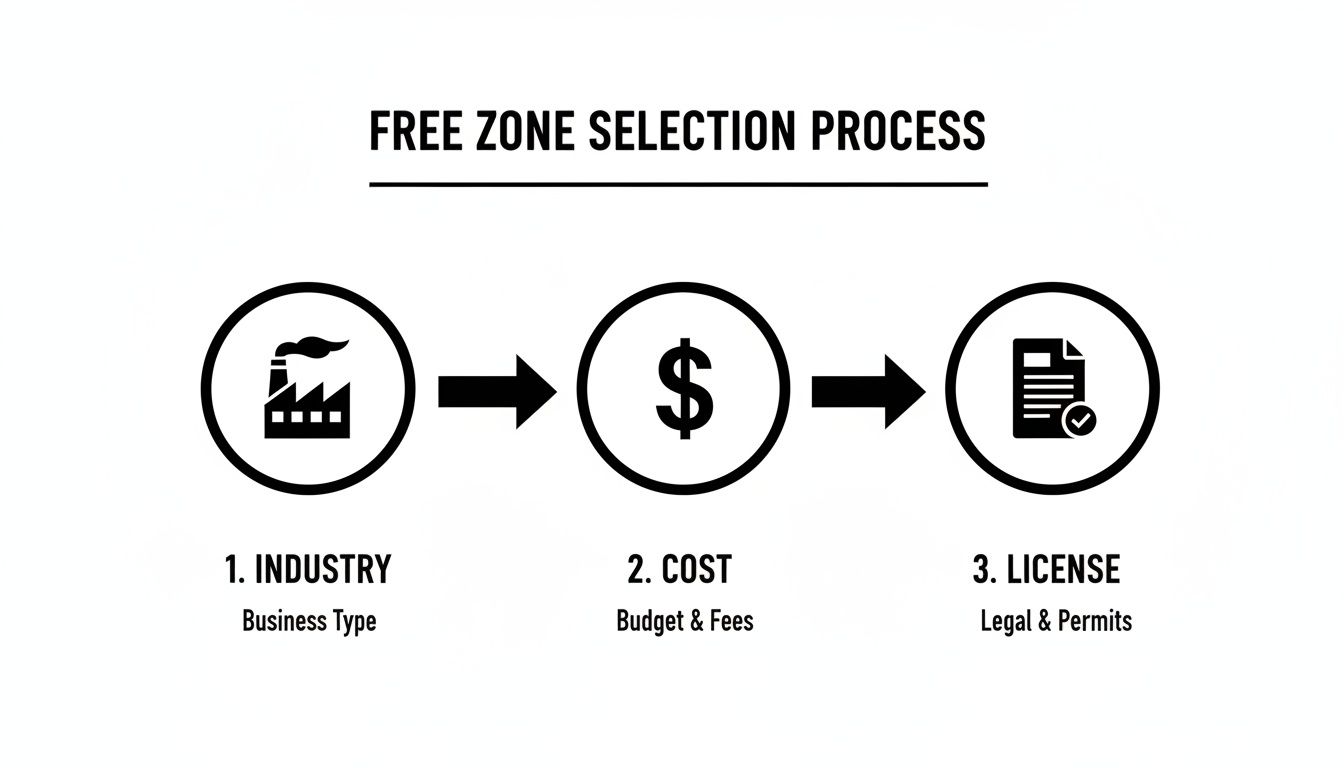
This visual really drives home how important it is to match what your business needs with what a free zone offers before you even think about starting the formal application.
The Registration and Payment Phase
Once you have that initial approval, it's time to finalise the company’s legal paperwork and pay the required fees. This is where things become official. You'll be asked to sign key documents like the Memorandum of Association (MOA), which is the legal blueprint of your company, detailing its structure, shareholders, and what it does.
Depending on the free zone and your chosen structure (like an FZE for one shareholder or an FZCO for several), you might be able to sign these documents remotely, or you might need to show up in person. After signing, you’ll get an invoice covering the registration, license, and any office-related fees. You need to pay this quickly to keep the process moving.
It is absolutely crucial to get a fully itemised quote before you start. I’ve seen entrepreneurs get caught out by hidden costs that weren't in the initial package price, like fees for an Establishment Card or mandatory e-channel registration. Knowing the full financial picture upfront saves you from any nasty last-minute surprises.
Issuance of Your License and Corporate Documents
After your payment goes through and all the paperwork is checked, the free zone authority will issue your official company license. This is the moment your business legally exists. Along with the trade license, you'll receive a set of vital corporate documents.
This package typically contains:
- Certificate of Incorporation: Think of this as your company’s official birth certificate.
- Share Certificates: These documents prove who owns what percentage of the company.
- Memorandum of Association (MOA): The final, signed legal constitution of your business.
- Lease Agreement: Your proof of address, even if it's just a flexi-desk.
These documents are your keys to the kingdom. You’ll need them for the next crucial steps, like applying for residency visas and, most importantly, opening that corporate bank account. Keep them safe and organised, because you’ll be showing them to people a lot.
The whole journey, from that first application to holding your license, can take anywhere from a few days to several weeks. It all comes down to how efficient the free zone is and how accurate your paperwork was. With your license in hand, you're officially ready for business.
Getting Your Paperwork and Legal Structure in Order
Once you've zeroed in on the right free zone and license, it's time to tackle the paperwork and decide on a legal framework for your company. This is where precision really matters. A single missing document or a small error can lead to frustrating delays, so getting this right from the start is key to a smooth setup.
Think of this step as building a compliance file. You're essentially proving who you are and legitimising your business in the eyes of the UAE authorities. The documents required are fairly standard across most free zones, but each one serves a critical purpose.
Your Core Document Checklist
Before you can move forward, you'll need to gather a few essential documents. While the specifics can vary slightly from one free zone to another, this foundational list is nearly always the same.
Here’s what you’ll almost certainly need to have ready:
- Passport Copies for All Shareholders: Clear, coloured copies are a must. Make sure every passport has at least six months of validity left. This is the main ID for everyone involved.
- Visa Page and Emirates ID Copies (If Applicable): If any shareholders are already UAE residents, you'll need to provide copies of their current visa page and Emirates ID.
- Proof of Address: A recent utility bill (less than three months old) for each shareholder is the standard way to verify where they live.
- A Brief Business Plan: Don't worry, this isn't a 50-page thesis. Most free zones just want a concise summary of what your business does, who you'll be selling to, and a basic financial forecast to show your model is viable.
Pro Tip: The secret to fast approval is treating your document submission like a professional audit. Ensure every copy is crystal-clear, every name matches exactly across all documents, and every field is filled. Small mistakes are the number one cause of delays we see.
Choosing Your Legal Structure: FZE vs. FZCO
Alongside your documents, you have to decide on your company's legal structure. In the UAE free zones, it almost always comes down to two choices: a Free Zone Establishment (FZE) or a Free Zone Company (FZCO). The decision is actually quite simple—it all depends on how many owners you have.
A Free Zone Establishment (FZE) is built for a single, sole owner. If you're a solo entrepreneur, consultant, or freelancer wanting to operate as a formal business with just one shareholder, this is the structure for you. It gives you limited liability, which keeps your personal assets separate from the company's.
On the other hand, a Free Zone Company (FZCO) is for any business with two or more shareholders. This is the go-to structure for partnerships, teams with co-founders, or any company bringing on multiple investors. An FZCO requires a Memorandum of Association (MOA) that clearly defines the shareholding split and the roles of each partner, creating a solid governance framework from day one.
For example, imagine two software developers launching a startup together. An FZCO is their only logical choice. It legally cements their 50/50 ownership, protecting both founders and creating a solid foundation for future investment rounds. Trying to run a partnership under an FZE structure would be impossible and create huge legal risks down the line.
This kind of clarity is a big reason why the UAE's business ecosystem is booming. The nation added an incredible 250,000 new companies in 2025 alone, pushing the total to 1.4 million—a staggering 119% growth since records began, driven largely by the straightforward appeal of free zone formations. You can discover more about the UAE's ambitious growth targets on Entrepreneur.com. Picking the right legal structure is a fundamental part of this success story.
Activating Your Business After Incorporation
Holding your new trade license feels like crossing the finish line, but it’s actually the starting gun for the next crucial phase of your UAE free zone company formation. Your business officially exists on paper, but now it's time to make it fully operational. The steps that follow are essential for activating your company, allowing you to hire staff, manage finances, and operate legally within the UAE.
This post-incorporation stage is where many entrepreneurs stumble, assuming the hardest part is over. In reality, navigating visa applications, bank account openings, and ongoing compliance requires just as much attention to detail. Getting these next steps right is what builds a sustainable and compliant business for the long term.
To give you a clearer picture, here are the key milestones you'll need to hit right after your company is registered.
Post-Incorporation Checklist Key Milestones
| Milestone | Typical Timeline | Key Objective |
|---|---|---|
| Establishment Card Application | 1-3 working days | Officially registers your company with Immigration, enabling visa sponsorship. |
| Residency Visa Process | 2-4 weeks | Secures legal residency for shareholders and employees to live and work in the UAE. |
| Corporate Bank Account Opening | 2 weeks to 2+ months | Establishes your company's financial foundation for transactions and payments. |
| VAT Registration (if applicable) | Before reaching the threshold | Ensures tax compliance with the Federal Tax Authority (FTA) to avoid penalties. |
| Annual Renewals | Annually | Maintains the company’s legal standing with the free zone and government bodies. |
Each of these steps is non-negotiable and crucial for smooth operations. Let's dig into what each one really involves.
Securing Your Establishment Card and Visas
The very first document you need after your license is the Establishment Card. This is a small, credit-card-sized document issued by the immigration authorities, and it's absolutely vital.
Think of it as your company's official key to the immigration system; without it, you cannot sponsor or apply for any residency visas for yourself, your partners, or your future employees.
Once your Establishment Card is issued, the visa application process can begin. It’s not a single step but a sequence of them:
- Entry Permit Application: This is the initial approval that allows you or your employee to enter the UAE for the purpose of employment.
- Status Change: If you are already in the UAE on a tourist visa, you will need to perform a "status change" once the entry permit is issued.
- Medical Fitness Test: All new residents must undergo a mandatory medical screening, which includes a blood test and a chest X-ray.
- Emirates ID Biometrics: You'll visit an official centre to have your fingerprints and photo taken for your Emirates ID card.
- Visa Stamping: The final step is submitting your passport to have the residency visa officially stamped inside.
This multi-step process can take a few weeks from start to finish, so it's wise to begin as soon as your company is incorporated.
The Challenge of Opening a Corporate Bank Account
Opening a corporate bank account in the UAE is often the most underestimated challenge for new business owners. Banks here have incredibly strict due diligence and Know Your Customer (KYC) requirements to combat money laundering. Simply having a trade license is not enough to guarantee a quick approval.
To increase your chances of a smooth process, you need to prepare a comprehensive file that tells a clear story. Banks want to see a legitimate business model.
A common mistake is assuming that all banks are the same. Each bank has a different risk appetite. A bank that is friendly to a general trading company might be hesitant to work with a crypto-related business. Researching which banks align with your industry is a critical first move.
Your application file should be meticulously organised and include:
- All corporate documents (license, MOA, share certificates).
- Passport, visa, and Emirates ID copies for all shareholders.
- A detailed business plan explaining your operations, target market, and revenue projections.
- Proof of business experience for the shareholders, such as a professional CV.
- Information about potential suppliers and clients to demonstrate legitimate business activity.
Being transparent and over-prepared is the best strategy here. The process can take anywhere from two weeks to several months, so start immediately and be persistent with your follow-ups.
Maintaining Long-Term Compliance
Your responsibilities don't end once your company is active and your bank account is open. Staying compliant is an ongoing commitment, not a one-time task. The two most important areas to manage are your accounting records and annual renewals.
The UAE implemented Value Added Tax (VAT) in 2018. If your company's annual turnover is expected to exceed AED 375,000, you are legally required to register for VAT. Maintaining accurate, VAT-compliant bookkeeping from day one is essential to avoid heavy penalties from the Federal Tax Authority (FTA). You can get a clearer picture by reading our detailed guide on how to register for VAT in the UAE.
Finally, remember that your trade license, lease agreement, and Establishment Card all have annual renewal deadlines. Mark these dates in your calendar and start the renewal process at least one month in advance. This foresight helps you avoid any fines or disruptions to your business operations, especially your ability to sponsor visas.
Your Top Questions About Free Zone Company Setup, Answered
Even with the best roadmap, you’re bound to have questions when setting up your company in a UAE free zone. It's completely normal. Juggling the rules of different authorities, legal paperwork, and the practical side of getting things done can feel like a lot.
We’ve put together direct answers to the most common—and critical—questions we get from entrepreneurs. Think of this as the inside track, clarifying the tricky details that standard guides often miss. Getting these right from the start can save you a world of time, money, and headaches later on.
Can My Free Zone Company Do Business on the UAE Mainland?
This is easily the question we hear most often. The short answer is, generally, no. A free zone license is designed for you to operate within your specific free zone and internationally. If you want to sell products or services directly to customers on the UAE mainland, the traditional route is to work with a mainland distributor or go through the process of setting up a mainland branch of your company.
However, things are changing. Some forward-thinking free zones now offer a dual license. This is a fantastic option that lets a free zone company operate on the mainland without the cost and hassle of establishing a whole new entity. It’s a game-changer, but not all free zones offer it. You absolutely must check the specific rules and any limitations with your chosen free zone authority before you sign on the dotted line.
What’s the Real Total Cost to Set Up a Free Zone Company?
Be careful with the package prices you see advertised online. That headline number is often just the starting point and usually leaves out several mandatory, one-off costs you need to get your business up and running. The actual total cost can vary hugely depending on the free zone you choose, your license type, how many visas you need, and your office setup.
To build an accurate budget, make sure you account for these common extras:
- Visa Processing Fees: This covers everything from the entry permit and medical test to your Emirates ID application and the final visa stamp in your passport.
- Establishment Card: This is a non-negotiable fee to register your new company with the immigration authorities.
- Annual Renewal Costs: Don’t forget that your license, office lease, and establishment card aren’t one-time fees. They need to be renewed every year.
Our advice? Never accept a quote that isn't fully itemised. A professional service provider should give you a complete breakdown of every single mandatory fee and potential extra. This way, you see the full financial picture upfront, with no nasty surprises.
How Long Does the Whole Setup Process Really Take?
While some free zones boast that they can issue a trade license in just a couple of days, that’s only one piece of the puzzle. The full journey—from submitting your first application to having your residency visa stamped in your passport and an active corporate bank account—typically takes about four to six weeks.
This timeline really depends on a few moving parts: the efficiency of the free zone authority, whether your documents are submitted perfectly the first time, and how quickly your bank moves through its strict due diligence checks. It’s always smart to build a little extra time into your business plan, as small delays can and do happen.
Do I Have to Be in the UAE to Set Up My Company?
The good news is that many free zones now allow for remote company registration. This is a massive convenience, letting you handle the initial paperwork and get your license issued from anywhere in the world.
However, you must be physically in the UAE for the final steps of your residency visa process. This involves a medical fitness test and giving your biometrics (fingerprints and photo) for your Emirates ID card. Some free zones might also require you to be there in person to sign the final incorporation documents. So, you should plan on making at least one trip to the UAE to get everything finalised.
Navigating the ins and outs of UAE free zone company formation is so much simpler when you have an expert in your corner. The team at Smart Classic Business Hub is here to guide you from start to finish, ensuring your setup is smooth, compliant, and perfectly matched to your business ambitions. Start your journey with a professional consultation today.