
Securing your brand with a registered trademark is one of the smartest first moves you can make in the UAE. Think of it as the legal foundation for your entire business identity, giving you the confidence to operate and grow without constantly looking over your shoulder. A trade mark registration in Dubai is what officially protects your name, logo, and reputation in this hyper-competitive market.
Why Brand Protection in Dubai Is a Critical Investment

In an economy as dynamic as Dubai's, your brand is easily your most valuable asset. It's not just a cool logo or a catchy name—it's your reputation, the trust you've built with customers, and your unique space in the market. Leaving that asset unprotected is like building a beautiful villa on a foundation of sand. The risks are real, and they can completely derail your business plans.
I've seen it happen. A new e-commerce store gains traction, and then suddenly, a copycat pops up using a nearly identical name and logo. They start siphoning off customers and muddying the original brand's good name. Without a registered trademark, the fight to stop them becomes a messy, expensive, and uncertain legal battle. Often, it ends in a forced rebrand, wiping out all the hard-earned brand equity.
The Tangible Value of a Registered Trademark
Getting your trademark officially registered takes it from a simple concept to a legally protected piece of intellectual property. This shift unlocks immediate and long-term benefits that are non-negotiable for any serious business in the UAE.
- Exclusive Rights: Registration gives you the sole legal right to use your brand for specific goods or services across all seven emirates. No one else can touch it.
- A Clear Deterrent: The ® symbol is a powerful warning shot. It tells the world you own your brand, making would-be copycats think twice.
- The Key to Growth: Want to franchise your concept or license your brand? A registered trademark is almost always the first thing partners will ask for. It provides the legal certainty they need.
- Instant Credibility: Having a registered mark shows customers, investors, and partners that you're a professional outfit committed to protecting your integrity.
A registered trademark isn’t just a defensive shield; it’s a proactive business asset. It adds tangible value to your company, gives stakeholders peace of mind, and secures your position in the market. It’s an essential step for any business planning for long-term success here.
A Competitive Edge in a Thriving Market
The UAE is pushing hard to be a global centre for innovation, and that means a flood of new businesses are entering the market every day. Just look at the numbers: the country saw 18,175 fresh trademarks filed recently, bringing the total number of active trademarks to a staggering 356,408. That tells you just how competitive it is out there—and why locking down your IP has never been more critical.
Securing your brand early doesn't just protect you from problems; it gives you a massive head start. For more practical strategies on safeguarding your business, our articles on brand protection Dubai offer some great insights. It's a small upfront investment that prevents enormous potential losses down the road and clears the path for secure, confident growth.
Getting Your Ducks in a Row Before You File
Jumping straight into a trade mark registration in Dubai without doing your homework is a rookie mistake, and frankly, a costly one. A successful registration isn't just about filling out a form; it's about the strategic prep work you do before you even start. Think of it as laying the foundation for your brand’s legal protection—get it right now, and you'll save yourself a world of pain, rejection letters, and wasted fees down the line.
It all boils down to one simple question: is your brand name or logo actually available and protectable? Too many entrepreneurs get attached to a name, only to find out it's either already taken or too generic to ever be legally theirs. This is why a proper trade mark search is your first, and most important, move.
Digging Deep: The Comprehensive Trade Mark Search
Before you spend a single dirham on applications, you need to hit the books—or in this case, the official database. The UAE Ministry of Economy has an online portal for searching existing trade marks. But this isn't just a quick search to see if the exact name is taken. You have to think like an examiner would.
You're looking for marks that are:
- Identical: The most obvious red flag.
- Phonetically Similar: Names that sound alike when spoken (think "Kwik" vs. "Quick").
- Visually Similar: Logos or fonts that give off the same vibe or impression.
- Conceptually Similar: Marks that trigger the same idea, even with different words or images.
A quick search might show an immediate conflict, saving you from a guaranteed rejection. If it looks clear, that's a good sign, but don't pop the champagne just yet. Professional searches can uncover pending applications or other uses that don’t always show up in a basic query. Our experience with trademark filing in the UAE has shown time and again that it’s the little details a simple search misses that can derail an application.
Choosing Your Battlefield: The Nice Classification System
Once you're fairly confident your mark is unique, it's time to define exactly what you want to protect. Trade marks aren't a blanket protection for everything; they're registered for specific categories of goods and services. This is all organised under an international system called the Nice Classification, which has 45 classes in total—34 for goods and 11 for services.
You absolutely must select the right class (or classes) for what your business actually does. Pick the wrong one, and you could leave your core products or services completely exposed.
Let's say you're launching a new coffee shop in Dubai. You’d likely need to register in several classes to be fully covered:
- Class 30: For the coffee itself, plus any pastries or sandwiches you sell.
- Class 43: For the café service—the act of providing food and drink.
- Class 21: If you plan on selling branded mugs or coffee makers.
- Class 35: If you're going to sell bags of coffee beans for others to retail.
Getting the classification wrong is one of the most common pitfalls we see. Be precise. Think about what you're doing today and where the brand could realistically be in five years. Yes, registering in more classes costs more upfront, but it provides much stronger, wider protection that pays for itself.
The Paper Trail: Prepping Your Documents
With your search and classes figured out, the final piece of the pre-filing puzzle is getting your documents in order. Having everything ready and correctly formatted from the start avoids the kind of administrative delays that can put your application on ice for weeks.
Here’s a quick rundown of what you’ll need before you hit 'submit'.
UAE Trade Mark Pre-Filing Checklist
This table summarises the essential checks and documents to have ready before you start your trade mark application with the UAE Ministry of Economy.
| Check/Document | Key Considerations | Why It Matters |
|---|---|---|
| High-Resolution Logo | Needs to be a crisp, clear digital file (JPG or PNG) in either black and white or colour. | This is the exact image that gets published and legally protected. No blurry files allowed. |
| Applicant Details | The full legal name and address of the individual or company that will own the mark. | Accuracy is critical here. Any mistake can affect the legal validity of your certificate. |
| Trade Licence Copy | If a company is applying, a valid copy of its trade licence is non-negotiable. | This serves as proof that your company is a legitimate, operating legal entity in the UAE. |
| Power of Attorney (POA) | If you're using a consultant, this document must be properly notarised and legalised. | The POA is what gives your agent the legal authority to sign and act for you with the Ministry. |
Ticking off every item on this checklist moves your application from a shot in the dark to a well-prepared submission. This is the foundational work that gives you the best possible shot at securing your brand’s future in Dubai's bustling market.
Navigating the UAE Trademark Application Journey
Once you've nailed down your pre-filing homework, you're ready to dive into the official trade mark registration in Dubai. This part of the process is less about creative brainstorming and all about precise, methodical execution. The entire journey is managed by the UAE Ministry of Economy, and while it's a logical path, every single detail matters.
The infographic below recaps those crucial pre-filing steps, showing how a proper search and classification builds the foundation for your application.
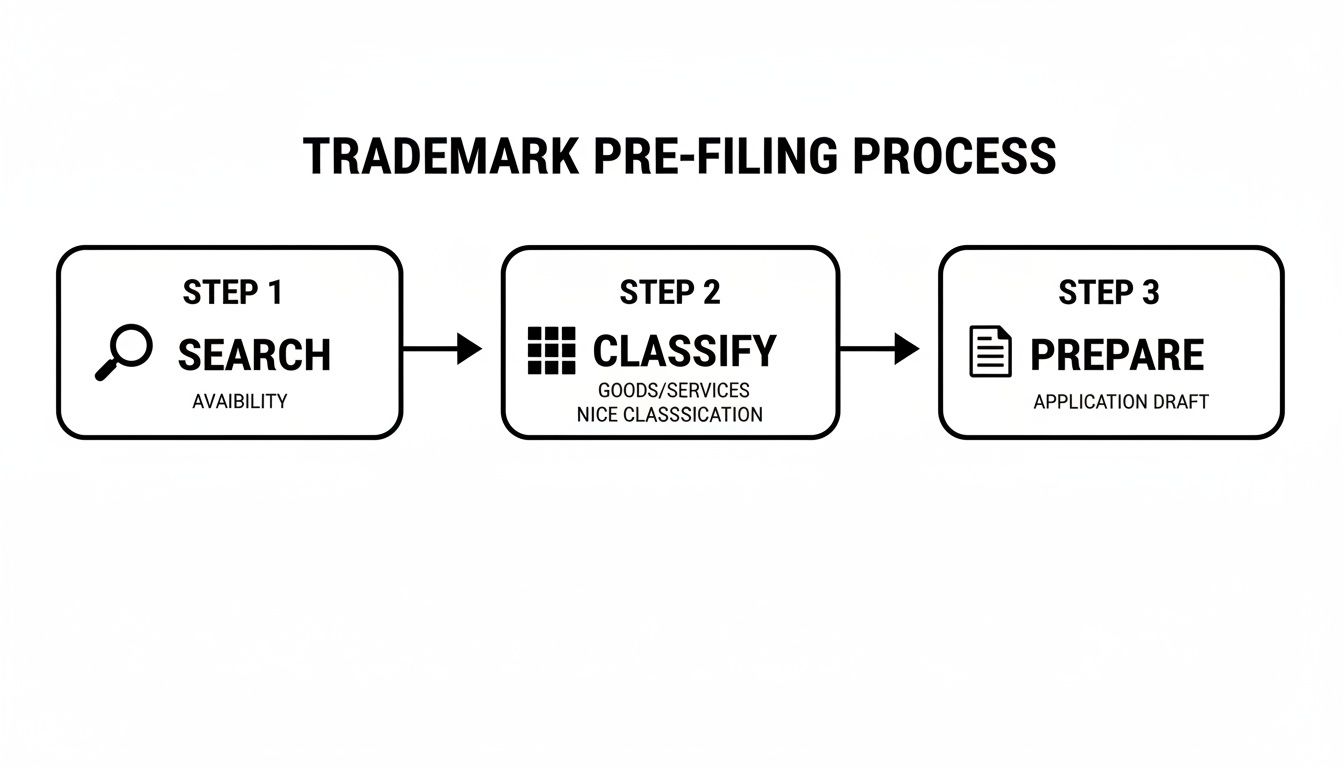
Stick to this structure, and you'll dramatically lower the risk of hitting an administrative roadblock right out of the gate.
Assembling Your Application Dossier
First things first: you need to gather all your documents. I like to think of this as building an application dossier—if even one piece is missing or incorrect, the whole thing can grind to a halt. The Ministry's online portal is efficient, but it doesn't do second chances for incomplete submissions.
Here’s a no-fluff checklist of what you'll need to have ready:
- A Clear Specimen of the Mark: This is a high-resolution digital file of your logo or the exact text for your wordmark. It must be absolutely identical to what you plan to use.
- A Valid UAE Trade Licence: If a company is applying, this is a must-have. It's the official proof that you're a legitimate, registered business.
- Legalised Power of Attorney (POA): This is the big one if you're using a consultant or a law firm. The POA needs to be notarised and legalised, a process that can take a surprising amount of time. Start on this document early.
- Passport Copy of the Signatory: You'll need a clear copy of the passport for the person signing the POA or the application on behalf of the company.
For anyone applying from outside the UAE, that Power of Attorney is especially critical. It often needs to be notarised in your home country, then attested by the UAE Embassy there, and finally attested again here in the UAE. I've seen more applications delayed by POA issues than anything else.
Submitting the Application and Facing Examination
With your paperwork in order, you can file the application through the Ministry of Economy's e-services portal. After you submit and pay the initial fees, your application officially enters the queue for examination. This is when a government examiner puts your mark under the microscope, checking it against existing registrations and legal rules.
The examiner is basically looking for two things:
- Absolute Grounds for Refusal: Is the mark itself problematic? For example, does it violate public morals, is it deceptive, or is it just a generic term? You can't trademark the word "Computer" for a computer shop.
- Relative Grounds for Refusal: Is your mark so similar to a previously registered trademark in a related class that it could confuse customers?
This examination stage can take anywhere from a few weeks to a few months. The good news is that the process has become incredibly efficient over the years. In fact, well-prepared applications have a very high chance of success. Over the past five years, UAE trademark applications have seen an average success rate of 80.27%. This figure, which you can read more about in this analysis of UAE trademark application success rates, should give entrepreneurs a lot of confidence in the system.
If the examiner does find an issue, you'll get an official notification. You're typically given 30 days to submit a legal argument explaining why your mark should be registered. This is a make-or-break moment where getting professional advice is almost always necessary to get a positive outcome.
Pro Tip: If you get an objection based on similarity to another mark, your response needs to be sharp. Focus on what makes your mark different—its appearance, sound, meaning, and especially the specific goods or services it represents. A well-crafted argument can often convince an examiner to see things your way.
The Publication Period and Potential Opposition
Let's say your application passes the examination—congratulations! But you're not quite at the finish line. The next step is publication. Your trademark's details are published in the Official Trademark Gazette and two local Arabic-language newspapers.
This isn't just a formality. The publication opens a 30-day window for anyone to formally oppose your registration. A competitor might argue that your mark is too close to theirs and will cause confusion in the market.
If someone files an opposition, the process pauses and a formal legal battle begins. Both sides present their case, and the Ministry makes a ruling. It can get complicated and expensive, which is another great reason to invest in a thorough search before you even file—it helps you sidestep these potential fights.
If those 30 days tick by with no opposition, you're in the clear. The Ministry will notify you to pay the final registration fees. Once that's done, they will issue your official trademark registration certificate.
This certificate is your golden ticket. It's your proof of ownership, giving you exclusive rights to use that mark for your chosen products and services across all seven emirates for an initial 10 years. You've successfully turned your brand identity into a legally protected, valuable business asset.
Breaking Down the Costs and Timelines
So, you're ready to protect your brand in the UAE. Smart move. But before we get too far, let's talk about two things every entrepreneur needs to get right: budget and timing. Getting a handle on the costs and the timeline for your trade mark registration in Dubai is non-negotiable. It’s the difference between a smooth process and one filled with nasty surprises.
The financial side of things really boils down to two key areas: the official government fees you can't avoid, and the professional fees you pay for an expert to steer the ship. The first lot goes straight to the Ministry of Economy for things like filing, publication, and the final registration. The second is what you'd invest in a consultancy to make sure every single step is handled flawlessly.
Understanding the Financial Investment
Let's be clear: registering your trade mark is an investment, not just an expense. The government fees are set, but they're calculated per class of goods or services. This is where it's easy to miscalculate.
Think about it this way: if you're launching a new coffee shop, you might think you just need one registration. In reality, you'd likely want to protect the brand name for the coffee itself (Class 30) and for the café services you provide (Class 43). That’s two sets of fees. Multiply that across a few more classes, and the costs add up.
This is also where professional fees come into play. While it might seem like an extra cost upfront, hiring a consultant is really about risk management. We’ve seen it happen too many times: someone tries to go it alone, picks the wrong class or files a mark that was never going to be approved, and ends up having to start all over again—paying all those government fees a second time. Getting it right from the start is always cheaper.
Remember, your trade mark is just one piece of the puzzle. For a wider view on budgeting for your entire business, our guide on the trade license Dubai cost offers a solid breakdown of what to expect.
The UAE government is serious about brand protection, recently updating its fee structure to reinforce this. It's no wonder, given the market is on fire—the first half of the year saw an incredible 129% explosion in trade mark registrations, with 19,957 new marks filed. This surge is a powerful indicator of just how dynamic and competitive the business environment is right now. You can dive into the specifics of this growth in this report from The National News.
For a clearer picture, let's compare the two routes you can take.
Cost Comparison: DIY vs Professional Consultancy
| Aspect | DIY Approach | Professional Consultancy (e.g., Smart Classic) |
|---|---|---|
| Initial Search | Free (but time-consuming and prone to errors if you don't know where to look) | Included in the service package; comprehensive search using professional tools to identify potential conflicts. |
| Government Fees | Paid directly to the Ministry of Economy. Risk of paying again if application is rejected. | Paid on your behalf. Guidance on class selection helps avoid unnecessary fees for incorrect classes. |
| Filing & Paperwork | You're responsible for all forms and submissions. Small mistakes can cause major delays or rejection. | All paperwork is prepared and filed by experts, ensuring accuracy and compliance with all regulations. |
| Handling Objections | You must respond to any official objections on your own, which often requires legal arguments. | Experts handle all communication with the Ministry, crafting strong legal responses to overcome objections. |
| Time Investment | Significant. You'll spend hours on research, paperwork, and follow-ups. | Minimal. You provide the details, and the consultancy manages the entire process for you. |
| Overall Risk | High. A rejected application means losing time and non-refundable government fees. | Low. Expertise significantly increases the chances of a first-time approval, protecting your investment. |
While the DIY approach might seem cheaper at first glance, the hidden costs of mistakes and lost time can quickly outweigh the initial savings. A professional service provides peace of mind and a much higher likelihood of success.
Mapping Out the Registration Timeline
When it comes to trade mark registration, you need to play the long game. This isn't an overnight process. From the day you hit 'submit' to the moment you're holding that registration certificate, you should realistically expect it to take several months—and that's assuming a smooth run with no bumps in the road.
Here's how it generally plays out:
- Filing and Examination: Once your application is in, it joins the queue. An examiner at the Ministry will review it for compliance. This step alone can take anywhere from a few weeks to a couple of months, depending on their workload.
- Publication: If the examiner gives it the green light, your trade mark gets published. It will appear for 30 days in the Official Gazette and two local newspapers, giving anyone the chance to object.
- Registration: No objections? Great. You’re on the home stretch. You'll pay the final registration fees, and the certificate will be issued.
On average, you're looking at a four to six-month journey from start to finish. But be warned: if an examiner has questions or, worse, a third party formally opposes your mark, that timeline can stretch out significantly.
This is another area where having an expert in your corner is invaluable. Navigating an official objection or an opposition requires a specific set of skills and legal arguments. Trying to handle it alone can bring your application to a dead stop. By planning for this timeline, you can properly align your marketing campaigns and brand launch, making sure you don't start using that little ® symbol before it's officially yours.
Maintaining and Enforcing Your Trademark Rights
Securing your trade mark registration in Dubai is a fantastic achievement, but it’s really just the beginning of a new chapter, not the end of the story. Your registration certificate isn't a "set it and forget it" document. Think of it as a powerful asset that needs active management to hold its value and legal power.
I often compare a trademark to a garden. You’ve planted the seeds and watched your brand grow, but now you have to tend to it. This boils down to two critical activities: renewing your registration to keep your rights alive and enforcing them to protect your patch from intruders. If you neglect either, all that hard work can unravel surprisingly fast.
Keeping Your Protection Current Through Renewal
Your UAE trademark registration is valid for 10 years from the filing date. While that’s a good long stretch of protection, the deadline can sneak up on you. Missing it can cause your trademark to lapse, leaving your brand completely exposed to copycats.
You can kick off the renewal process anytime within the final year of its validity. The UAE Ministry of Economy does offer a six-month grace period after the expiry date, but renewing during this time comes with late payment penalties. It’s far smarter—and cheaper—to handle this well in advance.
Mark your calendar, set multiple reminders, or even better, have your legal consultant manage the deadline for you. A lapsed trademark can be incredibly difficult, and sometimes impossible, to reclaim if someone else swoops in and registers it. Proactive management is everything.
Actively Monitoring for Infringement
Registration gives you the legal high ground, but it doesn't automatically stop others from trying to copy your brand. As the owner, it's on you to spot and act on infringements. This requires a hands-on approach to monitoring what’s happening in the marketplace.
So, what should you be looking for?
- Direct Copies: Competitors using your exact logo or brand name. This is the most obvious form of infringement.
- Confusingly Similar Marks: New businesses popping up with names, logos, or slogans that are phonetically or visually close to yours, creating a real risk of customer confusion.
- Domain Squatting: People registering domain names that include your trademark, often to sell them back to you at a ridiculous price or to divert your web traffic.
- Social Media Impersonation: Fake profiles or pages that mimic your brand to scam customers or trash your reputation.
Regularly searching online, keeping an eye on industry publications, and setting up alerts for your brand name are all practical first steps you can take.
Taking Action When Your Rights Are Violated
Discovering someone is infringing on your trademark is frustrating, but it’s crucial to act strategically. There’s a typical escalation path that provides a measured way to resolve the issue without immediately jumping into expensive court battles.
-
Cease and Desist Letter: The first official step is usually to have a legal professional send a formal "cease and desist" letter. This puts the infringing party on notice, informing them they are violating your registered rights and demanding they stop immediately. More often than not, this is enough to solve the problem.
-
Negotiation or Mediation: If the letter is ignored, the next phase might involve negotiation. Perhaps the other party was genuinely unaware of the conflict and is willing to rebrand. A structured discussion can sometimes lead to a much faster and cheaper resolution for everyone involved.
-
Legal Action: If all else fails, you have the right to file a trademark infringement lawsuit in the UAE courts. This is the most serious step, where you can seek financial damages and a court order to force the infringing use to stop.
Finally, don’t forget that properly using the ® symbol next to your registered mark is a powerful, passive enforcement tool. It serves as a public declaration of your legal ownership and acts as a strong deterrent, warning potential infringers that you are serious about protecting your brand.
Common Questions About Dubai Trademark Registration
Even with the best game plan, you're bound to have questions pop up during the trade mark registration Dubai process. That’s perfectly normal. Getting your head around the specifics of UAE intellectual property law can be tricky, especially if you're an international business or a first-time entrepreneur in the region.
I’ve pulled together some of the most common questions we get from clients day in and day out. The goal here is to give you straight, clear answers to help you tackle any specific hurdles and clear up confusion before you start.
Can a Foreign Company Register a Trademark in the UAE?
Yes, absolutely. Foreign companies and individuals are welcome to register a trademark in the UAE. You don't need to be a resident or have a local company set up to do it. The system is designed to encourage international brands to protect themselves here.
There is one key difference, though, and it comes down to paperwork. The most important document you'll need is a Power of Attorney (POA). This isn't just any POA; it must be notarised in your home country and then legally attested by the UAE Embassy there. Once it lands in the UAE, it needs one final stamp from the Ministry of Foreign Affairs.
For anyone applying from abroad, I can't stress this enough: use a local agent. They live and breathe this stuff. They’ll handle the entire POA legalisation maze and deal directly with the Ministry of Economy for you, which sidesteps any language barriers or procedural headaches.
What Happens If My Trademark Application Is Rejected?
Seeing a rejection notice can feel like a punch to the gut, but it’s not the final word. If the Ministry of Economy turns down your application, you get a 30-day window to file a formal appeal.
The examiner won’t leave you guessing; they'll give you specific reasons for the refusal. Maybe they found a mark that’s too similar, or they think your name is too generic and descriptive. Your job in the appeal is to build a solid legal argument that directly tackles and refutes their points.
This is where you really need a professional in your corner. Writing a winning appeal requires an intimate understanding of UAE trademark law and past cases. An experienced consultant can dissect the rejection, craft a compelling counter-argument, and dramatically improve your odds of overturning the decision.
What Is the Difference Between a Trade Name and a Trademark?
This is a big one. People mix these up all the time, but legally, they do completely different jobs.
-
A Trade Name: Think of this as the legal name of your business. It’s the name you register with an economic department (like Dubai Economy and Tourism) or a free zone authority. It identifies your company as an entity, but it offers zero protection for your brand.
-
A Trademark: This is what protects your brand identity—the name, logo, slogan, or even sound you use to sell your products or services. It's the unique identifier that separates you from your competitors in the marketplace.
Here’s a simple way to look at it: "ABC General Trading LLC" is the trade name. The product they sell under the brand name "QuickFix" is the trademark. You absolutely need to register both to fully protect your business and your brand.
Does a UAE Trademark Offer International Protection?
No, it doesn't. Trademark rights are strictly territorial. This means a UAE registration gives you exclusive rights to use your brand across all seven emirates, but that protection ends at the UAE border.
If you’re planning to expand, you have two main routes for international protection:
- File Directly: You can submit individual trademark applications in every single country where you want to be protected. This can be time-consuming and expensive.
- Use the Madrid Protocol: The UAE is a member of this handy international treaty. It lets you file one application and pay one set of fees to apply for protection in up to 130 member countries.
If you've got global ambitions, you need a global trademark strategy from the get-go. Figuring out which countries to target first and whether the Madrid system is right for you will save you a world of time and money down the road.
Navigating the complexities of trademark registration is a critical step in securing your brand's future. The experts at Smart Classic Business Hub are here to guide you through every stage, from initial search to final registration and enforcement.
Get a free consultation today to protect your most valuable asset.