Renewing your trade license in the UAE isn't just another item on your annual to-do list—it's a critical process that confirms your company's legal right to operate. Think of it as a non-negotiable requirement that keeps your business activities running smoothly and protects you from some pretty serious financial penalties. Let it slide, and you could face frozen bank accounts, blocked visa processing, and even find your business blacklisted.
Why Timely Renewal is So Important
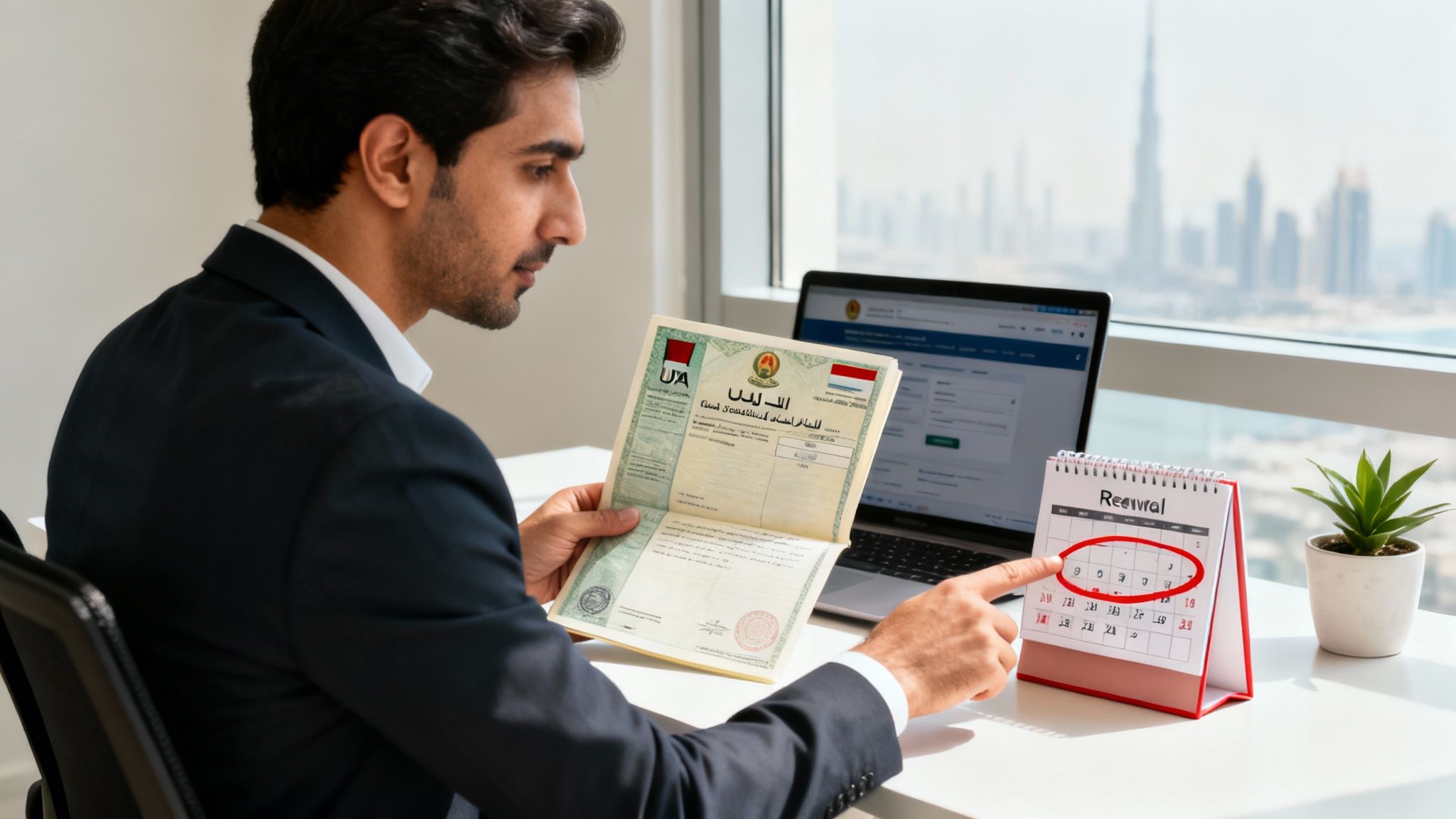
Your trade license is the legal heartbeat of your company here in the UAE. When it’s active, everything from banking to hiring new staff works as it should. The moment it expires, those essential operations can grind to a sudden halt. So, renewing on time is less about bureaucracy and more about smart, strategic business management that safeguards your investment and reputation.
The UAE’s business environment is absolutely booming, and the government is committed to maintaining a well-regulated landscape. By late 2024, the country had over 1.5 million active commercial licenses, a historic high. In that year alone, around 200,000 new licenses were issued, and Abu Dhabi saw a massive 27% jump in renewals. This growth shows just how focused the authorities are on compliance. You can learn more about this remarkable expansion and what it signals for businesses operating in the Emirates.
Proactively managing your renewal does more than just tick a box. It sends a clear message to authorities, banks, and potential partners that your business is stable, compliant, and professionally run. It’s a sign of good standing.
Mainland vs Free Zone: Know Your Authority
The very first thing you need to be clear on is who governs your license. The renewal process, required documents, and even the online portals are completely different depending on your jurisdiction. Getting this wrong is a common mistake that leads to wasted time and rejected applications.
- Mainland Companies: If you're set up on the mainland, your renewal is handled by the Department of Economy and Tourism (DET) or the specific Economic Department in your emirate. They are the gatekeepers for all commercial activities outside of the free zones.
- Free Zone Companies: For businesses inside a free zone, you'll deal with that zone's independent authority. Each one—whether it's DMCC, JAFZA, DIFC, or another—has its own set of rules, fees, and online systems.
It’s crucial to know which camp you fall into before you even start gathering your documents.
The Real Cost of a Delayed Renewal
Letting your license expiry date pass is a far more expensive mistake than most people realise. The consequences go well beyond a simple late fee and can seriously disrupt your entire operation.
First, you'll be hit with daily or monthly fines that add up surprisingly fast. What starts as a minor administrative cost can quickly become a significant financial headache. If the license remains expired, things escalate. Authorities can blacklist your company, which effectively blocks you from all government transactions. This means you can't sponsor new employee visas or even renew existing ones, putting a hard stop to any team growth.
Worst-case scenario? An expired license gives authorities the power to freeze your corporate bank accounts and could even lead to the cancellation of your company altogether. Getting back on track from that point is a complicated and costly ordeal. By treating your trade license renewal with the seriousness it deserves, you protect your company from these completely preventable—and potentially devastating—outcomes.
Getting Down to the Nitty-Gritty: Your Renewal Game Plan
Alright, let's move from theory to action. Renewing your trade license isn't a single event; it's a series of methodical steps. Get these right, and the process is a breeze. Get them wrong, and you're in for a headache. The journey actually starts long before you even think about logging into a government portal. It all begins with a few foundational checks that, in my experience, are too often overlooked.
First up, and I can't stress this enough, is your tenancy contract, the Ejari. If you're a mainland business with a physical office, a valid, current Ejari is absolutely non-negotiable. The authorities use it to verify your official business address, and an expired contract will stop your renewal application dead in its tracks.
Laying the Groundwork for a Smooth Renewal
Before you even touch an application form, you need to get your house in order. This proactive check-up is what separates a smooth renewal from a frustrating, delay-filled nightmare.
Think of it as preparing your file for inspection. You want to hand over a clean, compliant record to the authorities. This means settling any outstanding government fees, resolving old violations, and making sure your premises are fully compliant with regulations from bodies like the Dubai Municipality.
Another critical piece of prep work is checking for any special approvals linked to your specific business activities.
- Regulated Industries: If you're in a sector like healthcare, education, food trading, or construction, you’ll almost certainly need renewed approvals from external government bodies. A clinic, for example, can't renew its trade license without a fresh green light from the Dubai Health Authority (DHA).
- No Objection Certificates (NOCs): Certain activities also demand NOCs from various ministries or departments. Trying to start your renewal without these updated certificates is a guaranteed recipe for rejection.
Here's a pro-tip: remember that government portals are all interconnected. An unpaid fine with one department can easily block your license renewal with another. A clean slate is your best friend in this process.
Picking Your Path: Where to Renew
Once your prep work is solid, your next decision is how to file the renewal. The UAE gives you a few different options, catering to various comfort levels with technology. The route you take will hinge on whether your business is on the mainland or in a free zone—their systems are completely separate worlds.
For mainland companies, your primary port of call is the portal run by the Department of Economy and Tourism (DET) or the relevant economic department in your emirate. These online platforms are built for efficiency, letting you upload documents and pay digitally.
If you prefer a more hands-on approach, you can visit an authorised service centre, like a Tas'heel or Amer centre. These physical locations offer in-person assistance, which can be a lifesaver if you’re new to the process or dealing with a complicated case. The staff there can walk you through the forms and double-check your submission.
Free zone businesses have a different playbook. You'll use the dedicated portal for your specific authority. Every free zone, from DMCC to JAFZA, has its own online system with its own quirks and requirements. Getting familiar with your zone's portal is a must. For a deeper dive into how different these setups can be, check out our guide on the contrasts between mainland and free zone setups in Dubai.
The Final Step: Submitting Your Application with Precision
This is where accuracy becomes paramount. Whether you're online or at a service centre, the information you provide must be flawless and match your supporting documents exactly. A single typo in a name, a passport number, or your office address can flag your application for a manual review, adding serious delays.
Pay close attention to the technical specs when you upload documents. Most portals will tell you exactly what they need—PDF or JPG, and the maximum file size. A blurry, unreadable scan of a passport or Ejari is an instant rejection, no questions asked.
Common Submission Pitfalls to Avoid:
- Outdated Partner Info: Make sure every single passport and visa copy for all partners and shareholders is current. An expired document for just one person can halt the entire renewal.
- Mismatched Activity Codes: Double-check that the business activities you list on the renewal form are an exact match to what's on your current license.
- Ignoring Portal Notifications: Once you submit, keep a close eye on your email and the portal itself. The authorities might request more information, and a quick response can keep your application moving forward instead of getting cancelled.
By approaching the submission with this level of care, you turn what could be a major bottleneck into a straightforward administrative task. It's this final attention to detail that secures your company’s right to operate for another year.
Your Essential Renewal Document Checklist
Getting your documents together for a trade license renewal can sometimes feel like a high-stakes scavenger hunt. It's a common story: a single missing paper derails the whole process, leading to frustrating delays and, worse, potential fines. While the basic list of documents is fairly standard, the real trick is knowing which specific approvals your business needs based on its activities.
I always tell my clients to think of it in two parts: the non-negotiables that every business needs, and the special approvals unique to their industry. Nailing both from the get-go is the secret to a smooth, headache-free renewal.
This simple flow chart breaks down the typical renewal journey into its three main stages: getting prepared, submitting everything, and making the payment.
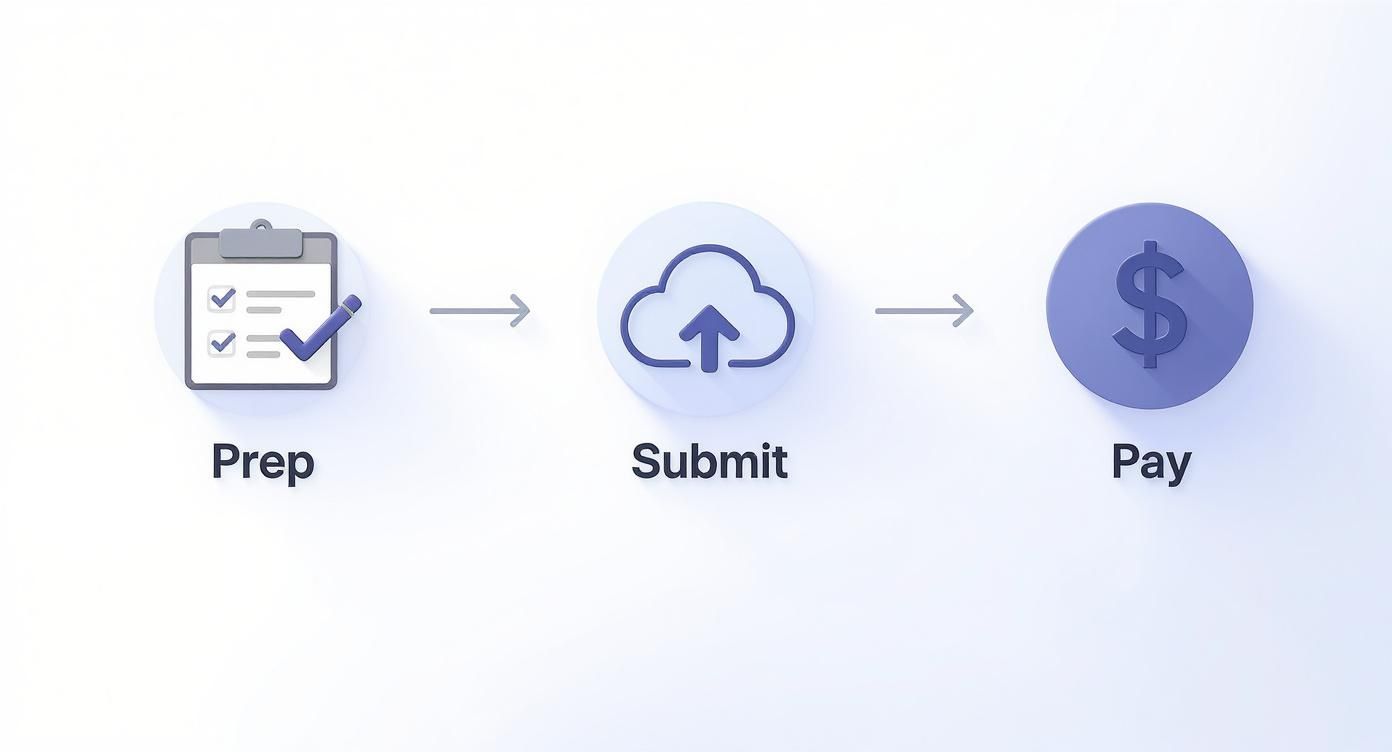
As you can see, that first 'Prep' stage is the foundation for everything that follows. If your documents aren't in order, you simply can't move on.
The Core Documents for Every Renewal
No matter what industry you’re in or whether you're on the mainland or in a free zone, a few key documents are the bedrock of your renewal application. Think of this as your primary checklist—without these, your application is dead on arrival.
- A Typed BR/1 Form: This is the official renewal application. It needs to be filled out perfectly, with no mistakes or inconsistencies.
- Copy of Your Current Trade License: Simple enough, but make sure it’s a clear, legible copy of the license you’re actually renewing.
- Valid Ejari Certificate: This is absolutely crucial for mainland businesses. The authorities need proof of your registered physical address, and your Ejari must be valid for at least one month after you apply.
- Passport and Visa Copies: You'll need valid, clear copies for every partner and shareholder on the license. Do a quick check of all expiry dates before you submit them.
Getting these documents sorted, organised, and ready to go is the most critical first step you can take.
Beyond the Basics: Situational Approvals and NOCs
This is where things can get tricky and where many business owners stumble. Certain business activities are regulated by external government bodies, and you can't renew your DED or free zone license without getting their updated stamp of approval first.
For instance, a healthcare clinic needs a fresh approval from the Dubai Health Authority (DHA). A private school needs a new No Objection Certificate (NOC) from the Knowledge and Human Development Authority (KHDA). A food trading company? They’ll need the green light from Dubai Municipality.
It's up to you to know if your business needs these external approvals. Assuming you don't is one of the most common and costly mistakes we see. Always double-check your licensed activities against the requirements of the relevant authorities well ahead of time.
The good news is that Dubai is constantly working to simplify these processes. Recent reforms have cut down on a lot of the red tape, with many approvals now handled digitally. For some businesses, this has slashed renewal times to as little as 48 hours.
This push for efficiency makes it even more important to have your own paperwork in perfect order. And don't forget about your financial compliance. For a refresher on another key business requirement, take a look at our detailed guide on how to register for VAT in the UAE. Staying on top of VAT is essential for keeping your business in good standing, which can only help make your renewal experience smoother.
Downloadable Trade License Renewal Checklist
To make this process as straightforward as possible, we’ve put together a handy checklist. It covers the core documents, tenancy requirements, and some of the most common special approvals you might need.
| Document/Requirement | Mainland | Free Zone | Notes |
|---|---|---|---|
| BR/1 Renewal Form | Required | Required | Must be typed and accurately filled out. |
| Current Trade License Copy | Required | Required | Ensure it's a clear, readable copy. |
| Ejari Certificate | Required | N/A | Must be valid for at least one month from application date. |
| Tenancy Contract | N/A | Required | The equivalent of Ejari for free zone authorities. |
| Passport & Visa Copies | Required | Required | For all partners/shareholders. Check expiry dates. |
| Emirates ID Copy | Required | Required | For all partners/shareholders. |
| External Approvals/NOCs | As Applicable | As Applicable | Depends entirely on your business activity (e.g., DHA, KHDA). |
| Shareholders' Resolution | If Applicable | If Applicable | Only if there have been changes to partners or shareholding. |
Use this table as your starting point to gather everything you need. Having it all organised before you begin the submission process will save you a world of time and stress.
Getting to Grips with Renewal Fees, Fines, and Payments
Let's talk numbers. Understanding the actual cost of your trade license renewal is crucial for budgeting and avoiding any nasty surprises. The final figure you see on your payment voucher isn't just one fee; it’s a breakdown of several different government charges. Once you know what you're paying for, it stops being a mystery and becomes a predictable business expense.
The biggest slice of the pie is, of course, the base license fee. This isn't a one-size-fits-all cost. It changes quite a bit depending on your company's legal structure, the specific business activities you're licensed for, and your jurisdiction—whether you're on the Dubai mainland or in a free zone. Think of this as the core payment for your legal right to operate for another year.
Breaking Down the Total Cost
Beyond that base fee, you'll notice a few other mandatory charges on your renewal invoice. These aren't optional extras; they're essential for keeping your company in good standing with the authorities. It’s smart to factor these into your budget from the start.
A major one for mainland businesses is the Chamber of Commerce fee. This is a standard charge that supports the Chamber's work in the local business community, and it's usually calculated based on your company’s legal type and the number of employees.
Another key item, again for mainland companies, is the market fee. This is a municipal levy calculated as a small percentage of your office's annual rent, as documented on your Ejari certificate. You might also find smaller charges for specific government services or levies if your business operates in a regulated sector.
The High Price of Procrastination
Putting off your trade license renewal is one of the costliest mistakes you can make in business here. The penalties for being late aren't just a slap on the wrist; they escalate quickly and can turn a manageable cost into a serious financial headache.
The moment your license expires, the fines start racking up. Often, it's an initial penalty followed by recurring monthly charges. For instance, a mainland license might get hit with a AED 200 fine right away, plus another AED 200 for every month it stays expired. It might not sound like much at first, but it adds up fast.
A delay of just a few months can easily add thousands of dirhams in penalties to your renewal cost. More critically, an expired license can lead to your company being blacklisted, which blocks all other government transactions, including visa applications.
Navigating Your Payment Options
Once you've got your payment voucher from the economic department or your free zone authority, settling the fees is pretty straightforward. The authorities have made this final step quite accessible to make sure nothing holds you up.
The quickest and most common way to pay is through the official government portals. Platforms like the DED's website or your free zone’s online system let you pay securely with a corporate card. This is usually the fastest route to getting your renewed license in hand.
If you prefer to pay in person, you can head to an authorised service centre. Places like Amer or Tas'heel centres will process your payment on the spot. Some local banks also let you pay government fees through their online banking platforms or even at an ATM.
Where to Pay:
- Online Portals: The go-to method for both DED and free zone renewals.
- Authorised Service Centres: A great option for in-person payments.
- Bank Channels: Check if your bank offers government fee payments through its app or ATM network.
Honestly, it just comes down to what's most convenient for you. The most important thing is to pay as soon as you get that voucher. Any delay at this final stage can still cause issues, so settling the payment promptly wraps up your trade license renewal and secures your business for another year.
Common Renewal Mistakes and How to Avoid Them
Even the most organised business owners can get tripped up during a trade license renewal. It’s usually a simple oversight—a small detail missed in the daily grind of running a company—that ends up causing major delays and headaches. Knowing these common pitfalls ahead of time is your best defence for a smooth, hassle-free renewal.

These aren't just minor admin issues; they can stop your application dead in its tracks and even lead to fines. Let’s walk through the mistakes we see most often and, more importantly, how you can steer clear of them.
Overlooking the Tenancy Contract
This is a big one. An expired or invalid tenancy contract (or Ejari, for mainland companies) is one of the quickest ways to get an immediate rejection. The authorities need to verify your physical business address, and an out-of-date contract is a serious red flag.
How to Avoid This:
- Check the Date Early: Get into the habit of checking your Ejari or tenancy contract expiry date at least three months before your license is due for renewal.
- Factor in Delays: Don't leave it to the last minute. Renewing your lease and getting a new Ejari can take time. Start the conversation with your landlord well in advance.
- Match the Details: Double-check that the address and details on your new tenancy contract match exactly what's listed on your trade license. Any discrepancy will cause a problem.
Getting this right is fundamental. Without valid proof of your address, your trade license renewal application won’t make it past the first review.
Ignoring External Approval Requirements
Many entrepreneurs, especially those in regulated fields, think their DED or free zone renewal is a single-step process. That’s a critical mistake. If your business activity is overseen by another government body, you must get their approval before you can renew your main license.
For example, a nursery trying to renew its license without an up-to-date approval from the KHDA (Knowledge and Human Development Authority) will be stopped. The DED simply will not process the license renewal until the KHDA gives its green light.
Key Takeaway: It’s your responsibility to know which external bodies regulate your business. Never assume your renewal only involves the economic department. You need to be proactive and contact these authorities early to get their approval process rolling.
Unresolved Violations and Outstanding Fines
The UAE government’s systems are incredibly interconnected. An outstanding fine or violation with one department—whether it’s Dubai Municipality, the RTA, or another entity—can block your progress with a completely different one. Trying to push through your renewal with unresolved issues is a surefire way to get stuck.
Compliance has never been more critical, especially as the UAE's business landscape grows so rapidly. By late September 2025, the country was home to nearly one million active commercial licenses, with sectors like e-commerce and construction leading the way. This boom highlights the government's focus on a tightly regulated environment where compliance is non-negotiable. You can discover more about the UAE's impressive business growth and what it means for entrepreneurs.
When to Partner with a Renewal Expert
Sure, you can handle your own trade license renewal. The real question is, should you? As a business owner, your time is your most valuable asset. Every hour you spend wading through paperwork, chasing approvals, and navigating government portals is an hour you're not spending on sales, strategy, or steering the ship.
This is where bringing in a PRO services firm isn't just a convenience—it's a strategic business decision.
Think about it. You're days away from your renewal deadline, but you're also deep in negotiations for a game-changing contract. Do you step away from that deal to figure out the latest portal updates and document requirements? Or do you hand off the entire renewal process to a team that does this day in and day out? An expert takes the entire administrative headache off your plate, from start to finish.
Making the Strategic Call
So, when does it make sense to outsource? The decision often boils down to a few critical factors. If your business is in a field that needs a bunch of external NOCs (No Objection Certificates), or if you’ve run into snags and delays with renewals before, an expert is a no-brainer. They know the potential roadblocks and how to navigate them before they become costly problems.
It's about more than just getting the task done. It’s about the peace of mind that comes from knowing a specialist is on the case, guaranteeing that every detail is correct and every deadline is met. This isn't just an expense; it's an investment in operational stability and risk management, protecting you from hefty fines and business disruptions.
Think of it as delegating a critical but time-consuming compliance task to a specialist. This frees up your mental and operational capacity to focus on what truly drives your business forward.
If you're weighing your options, take a look at a professional company PRO services package. Seeing the full scope of support available can make it clear how a strategic partnership keeps your business compliant and ready for another successful year, without you getting bogged down in the admin.
Frequently Asked Questions
When you're in the thick of a trade license renewal, a few questions always seem to pop up. Let's get you some clear, straightforward answers based on what we see every day.
What Are the Immediate Consequences of a Late Renewal?
Letting your trade license expire isn't just a minor administrative slip-up; it has real, immediate consequences. The most obvious hit is the fines, which can be charged daily or monthly. These add up faster than you'd think, turning a routine cost into a significant financial headache.
But it gets more serious. An expired license can lead to your company's bank accounts being frozen, which can cripple your operations overnight. It also stops you from sponsoring new visas or even renewing existing ones for your team. In the worst-case scenarios, your business could be blacklisted by the economic department, creating a much bigger problem to solve.
Is an Ejari Certificate Always Required for Renewal?
For pretty much any mainland company with a physical office, a valid Ejari certificate is non-negotiable. Think of it as the government's official proof of your business address. Without it, your renewal application hits a wall.
There are a few exceptions, like some virtual licenses or specific free zone setups that have their own tenancy contract rules. Still, the best approach is to assume you need a valid Ejari. Always check its expiry date well ahead of your renewal deadline to sidestep any last-minute surprises.
How Long Does a Typical Renewal Take?
This is a classic "it depends" situation. If all your paperwork is in order and you don't need any special approvals from other government bodies, the renewal can be incredibly quick. We often see them processed online in just a few hours, or at most, a couple of business days.
However, if your business activity needs a thumbs-up from another department—say, Dubai Municipality for a restaurant or the KHDA for a school—the timeline stretches. In these cases, you should budget for one to two weeks. The single biggest thing you can do to speed things up is to get everything prepared and organised from the start.
Sorting through these details is exactly where having an expert in your corner pays off. The team at Smart Classic Business Hub takes the entire renewal process off your plate. We handle everything from checking your documents to submitting the application and making the final payment, ensuring you stay compliant and can keep your focus where it belongs: on your business. Get in touch with our experts today!