So, what’s the real cost of a trade license in Dubai? The honest answer is it varies. You’ll typically see a range from AED 15,000 to AED 50,000, but this is just a starting point. The final figure really depends on your specific business activity, the legal structure you choose, and whether you set up on the mainland or in a free zone.
Think of it this way: things like office rent, visa applications, and special government approvals will all add to that initial baseline cost.
Your Guide to Understanding Dubai Trade License Costs
Starting a business in Dubai is an incredible opportunity, but the first question on every entrepreneur’s mind is, “How much will it really cost?” Trying to pin down a single price for a trade license is a bit like asking for the cost of a car—it completely depends on the model, features, and any customisations you pick. The total investment isn’t just one fee; it’s a sum of several distinct parts.
This guide is here to give you a clear financial snapshot right from the get-go. We’re going to break down the complex pricing into simple, understandable pieces. This is your financial menu for setting up a business in Dubai, setting the stage for a deeper look at each expense.
The Key Cost Influencers
Several variables have a direct impact on your final trade license cost. Getting a handle on these is the key to accurate budgeting and avoiding any nasty surprises later on. The main factors are:
- Business Jurisdiction: Your choice between a mainland or free zone setup is the biggest cost driver.
- Business Activity: Specialised activities needing outside approvals (like healthcare or construction) often come with higher fees.
- Legal Structure: The company’s legal form, whether a Sole Establishment or a Limited Liability Company (LLC), will affect the fees you pay.
- Office Space: A mainland license requires a physical office with an Ejari, while free zones offer more flexible options like desk space.
The base cost of a trade license in Dubai typically falls between AED 15,000 and AED 50,000 (that’s roughly USD 4,083 to USD 13,613). This wide range really highlights why careful planning is so important for optimising your setup costs—a crucial step for any startup or foreign investor.
To give you a clearer picture, here’s a quick breakdown of the main cost components you’ll encounter.
Summary of Key Trade License Cost Components in Dubai
This table provides a quick overview of the primary fees and charges that contribute to the total trade license cost in Dubai.
| Cost Component | Typical Price Range (AED) | Description |
|---|---|---|
| Initial Approval Fee | 150 – 250 | A one-time fee paid to the Department of Economy and Tourism (DET) to begin the process. |
| Trade Name Reservation | 600 – 800 | The cost to register and reserve your unique company name for one year. |
| Attestation of Documents | 500 – 2,000 | Fees for notarising legal documents like the Memorandum of Association (MOA). |
| Office Rent (Ejari) | 5,000 – 30,000+ | Varies hugely by location and size; mainland companies require a registered physical office. |
| Market Fees | 5% of office rent | A government fee calculated as a percentage of your annual office rental contract. |
| Government Service Fees | 1,000 – 4,000 | Various administrative and processing fees charged by different government departments. |
| External Approvals | 500 – 10,000+ | Required for specialised activities (e.g., healthcare, food, education) from relevant ministries. |
| Investor/Partner Visas | 3,500 – 7,500 per visa | Costs for residency visas for the business owners and partners, including medical tests and Emirates ID. |
These figures are a great starting point for your budget, but remember they can shift based on your specific business needs.
Preparing Your Financial Roadmap
Budgeting for your trade license is about more than just the initial fee. A realistic financial plan must also factor in visa processing, government service charges, and any potential third-party approvals. By understanding these variables from the start, you can create a much more accurate forecast and make better-informed decisions.
For a comprehensive look at all the financial pieces of the puzzle, check out our detailed guide on the cost of starting a business in Dubai. It gives you the foundational knowledge you need to navigate the financial side of your new venture with confidence.
A Look at the Core Licence Fees
To get a real handle on your trade licence Dubai cost, you need to know exactly what you’re paying for. Think of it like ordering a new car – there’s the base price, but the final bill changes with every option you add, from the engine to the leather seats. Setting up your business works the same way. There are foundational costs, and then there are the add-ons that depend on your specific activities.
Let’s break down the main fees you’ll see on your quotation. We’ll split them into two simple groups: the one-time payments you make right at the start, and the yearly costs to keep your business running smoothly. This way, you can look at any price list with confidence, knowing what each item means.
One-Time Setup Fees
These are the upfront costs to get your company officially on the map. They’re a one-off hit, but they make up a big chunk of your first year’s budget.
- Initial Approval Fee: This is your first official step. It’s a small fee, usually between AED 150 and AED 250, that you pay to the Department of Economy and Tourism (DET). It’s basically the government giving you a nod of approval, a green light to move forward with your application.
- Trade Name Reservation: Your company’s name is everything, and in Dubai, it needs to be unique and officially approved. This fee, typically around AED 600 to AED 800, secures your chosen name so no one else can take it. It’s like buying the domain name for your business—once you’ve paid, it’s yours.
- Memorandum of Association (MOA) Attestation: If you’re setting up an LLC, your MOA is the rulebook for your company, detailing ownership and how things will run. This document needs to be professionally drafted and notarised. The cost for attestation can be anywhere from AED 500 to AED 2,000, depending on how complex your company structure is.
- Ejari Registration: For any mainland company, a physical office is a must. Your tenancy contract has to be registered with the Ejari system, which is the official government platform for leases. This registration costs a few hundred dirhams and officially validates your business address.
It’s worth remembering that these one-time fees aren’t optional. They are the essential, non-negotiable costs for establishing a legal business presence in Dubai and must be part of your initial startup capital.
Recurring Annual Costs
Once you’re up and running, a few costs will pop up every year. Planning for these is key to staying compliant and managing your finances for the long haul.
The biggest yearly expense is, without a doubt, the main licence fee. The exact amount varies wildly based on your business activities and company structure, but it’s the heart of your annual renewal payment. This is the core fee that allows your business to legally operate for another 12 months.
On top of that, most companies need to maintain a membership with the Dubai Chamber of Commerce. This is another mandatory annual fee. Its cost is calculated based on your licence type, legal structure, and sometimes even the rental value of your office. While it’s a cost you can’t get around, membership adds a layer of credibility to your business and opens doors to a huge network.
Getting the difference between one-time and recurring fees is the first step to smart financial forecasting. Think of the setup as your initial investment, and the annual renewals as the ongoing operational cost to maintain your prime position in Dubai’s exciting market.
Mainland vs Free Zone Cost Comparison
Choosing between a mainland or free zone setup is one of the biggest decisions you’ll make, and it directly impacts your total trade license Dubai cost. Think of it like deciding between a standalone shop on a high street versus a kiosk inside a bustling shopping mall. Both have their perks and distinct cost structures, and the right fit hinges entirely on your business model.
A mainland license gives you the freedom to trade anywhere in the UAE, but this comes with specific costs like government service fees and municipality charges that are tied to your office rent. Free zones, on the other hand, often roll everything into an all-in-one package—license, desk space, visas—for a single, predictable fee. The trade-off? Your direct business activities are generally limited to within that zone and internationally.
The Financial Anatomy of a Mainland Licence
When you set up on the Dubai mainland, you’re registering directly with the Department of Economy and Tourism (DET). This gives you maximum operational freedom, but the costs are broken down and paid for individually. You’ll encounter separate fees for each step of the journey.
Key costs you’ll only find with a mainland setup include:
- Tasheel Government Service Fees: These are administrative charges for processing your various applications and government paperwork.
- Municipality Fees: This is a major recurring cost, calculated as 5% of your annual office rent, which goes to the Dubai Municipality.
- Local Service Agent Fees (if applicable): While 100% foreign ownership is now the norm for most activities, certain professional licenses might still need a UAE national as a service agent, which comes with an annual fee.
This chart gives you a sense of how the initial fees for any trade license are typically split.
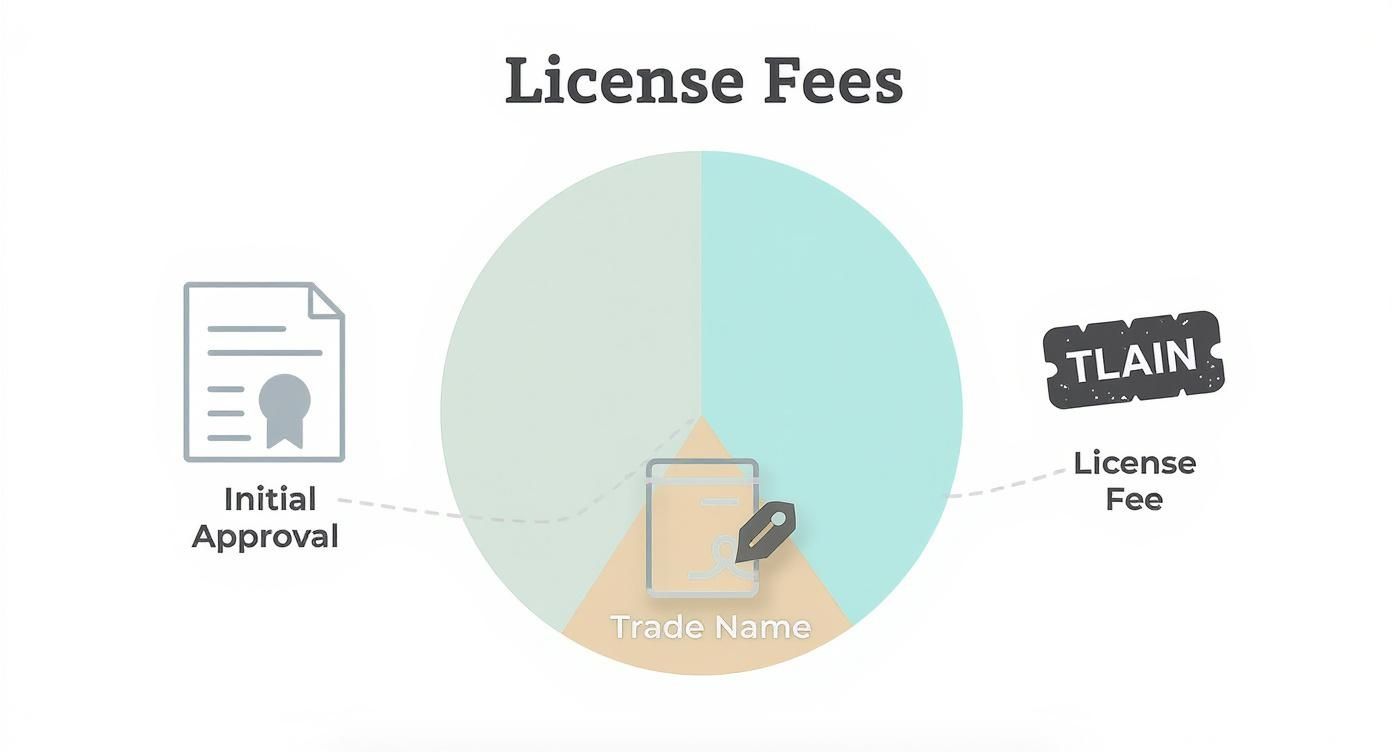
As you can see, the license fee itself is the biggest slice of the pie, but don’t forget about the initial approval and trade name reservation. They’re essential preliminary costs you need to budget for.
The All-Inclusive Approach of Free Zones
Free zones are essentially independent economic hubs, each with its own rulebook. Their biggest draw is the simplified, and often more affordable, startup packages they offer. They’re specifically designed to pull in foreign investment with perks like 100% foreign ownership, zero personal and corporate income tax, and the ability to send all your profits home.
The cost structure in a free zone is a different ball game. Instead of paying fees to multiple government bodies, you usually pay one consolidated fee to the free zone authority. This package deal often bundles:
- The trade license itself.
- Registration and trade name reservation.
- Eligibility for one or more residency visas.
- Access to a flexi-desk or a shared co-working space.
One of the biggest financial wins with a free zone is that you don’t have to worry about municipality fees or local sponsor charges. This can translate into huge savings, particularly for startups and small businesses that don’t need a big, dedicated office on the mainland.
Cost and Feature Comparison: Mainland vs Free Zone License
To truly grasp the differences, it helps to see the financial and operational features lined up against each other. Here’s a quick comparison to help you weigh your options.
| Feature | Mainland License | Free Zone License |
|---|---|---|
| Market Access | Unrestricted access to the entire UAE market. | Limited to the specific free zone and international markets. |
| Ownership | 100% foreign ownership for most business activities. | 100% foreign ownership is standard. |
| Office Requirement | Mandatory physical office space required. | Flexi-desk or virtual office options are widely available. |
| Key Costs | Itemised fees (Tasheel, Municipality, etc.). | Often a single, all-inclusive package fee. |
| Recurring Fees | Annual license renewal + 5% municipality fee on rent. | Annual license renewal fee paid to the free zone authority. |
| Visa Eligibility | Depends on office size; generally more flexible. | Typically linked to the package (e.g., 1-3 visas). |
This table makes it clear that the “better” option really depends on what you need your business to do and where you plan to do it.
Head-to-Head Cost Breakdown
To make a smart choice, you need to see the numbers side-by-side. The first-year cost for a mainland license can run anywhere from AED 50,920 to AED 107,520, once you factor in registration, office rent, visa processing, and PRO services. In contrast, free zone packages can start as low as AED 25,500 and go up to AED 112,000, depending on the zone’s reputation, the number of visas you need, and the type of office facility included.
The best way forward is to weigh your business’s operational needs against the financial realities of each jurisdiction. Our in-depth analysis gives a much clearer picture of whether a mainland or free zone setup is right for you, helping you match your budget to your business goals. By understanding these core differences, you can pick the path that offers the best value and sets your company up for long-term success in the UAE.
How Your Licence Type Shapes the Final Bill
Picking the right trade licence is one of the first, most fundamental decisions you’ll make, and it directly shapes your total business setup cost. Not all licences are created equal, either in price or purpose. Think of it like buying a vehicle: a small car, a delivery van, and a heavy-duty truck will all get you on the road, but they’re built for different jobs and come with wildly different price tags.
In Dubai, your core business activity is what determines whether you need a Commercial, Professional, or Industrial licence. Each category is designed to regulate a specific type of business, and this classification is a primary driver of your final trade license Dubai cost. Getting this right from day one is critical for accurate budgeting and ensuring your business is legally compliant.
Commercial Licence: The Cost of Trading
A Commercial Licence is your ticket to the world of buying, selling, or trading goods. This covers everything from a small e-commerce shop to a major import-export operation. As a general rule, this licence type tends to have higher associated fees.
Why the higher cost? It often comes down to the nature of trading itself. These businesses might need approvals from various external bodies like Dubai Customs or the Telecommunications and Digital Government Regulatory Authority (TDRA), adding layers of complexity and cost. For instance, a business trading in food products will need clearances from Dubai Municipality, and each of these steps adds to the final bill.
A Commercial licence is the key to trading activities, but it often involves more regulatory checkpoints. The need for external approvals and a physical office for inventory typically places its total cost above that of a Professional licence.
Professional Licence: The Price of Expertise
On the other hand, a Professional Licence is for individuals or companies offering specialised, skill-based services instead of physical products. This covers a massive range of fields, including marketing consultancy, IT services, legal advisory, and design agencies.
Typically, the base cost for a Professional licence can be lower than a Commercial one. That’s because service-based businesses usually have fewer external approval hoops to jump through and may not need a large office to store inventory. Of course, depending on the profession, you might still need a nod from specific governing bodies, like the Knowledge and Human Development Authority (KHDA) for educational services.
Comparing Real-World Scenarios
To see how this plays out in the real world, let’s compare two common business models:
- E-commerce Business (Commercial): An online store selling electronics is a classic trading activity, so it needs a Commercial licence. The costs will include the standard licence fees, potential warehousing or office rent for stock, and possibly approvals related to electronic goods. The total first-year cost could easily climb higher.
- Marketing Agency (Professional): A digital marketing consultancy provides expert services. It requires a Professional licence, and since it doesn’t hold physical stock, it can often operate from a smaller, more affordable office or even a flexi-desk, significantly cutting down overheads and initial setup costs.
Recent data throws these financial differences into sharp relief. For example, commercial licences for trading often see initial government fees land between AED 10,000 and AED 15,000, and that’s before you even factor in significant office rent. Professional licences, geared towards service providers, typically have lower base fees in the AED 5,000 to AED 10,000 range, contributing to a much more manageable overall setup cost. For more details on business licence costs, check out the insights on number9.ae.
Ultimately, your business activity isn’t just a label—it’s the critical factor that defines your financial journey in Dubai.
Uncovering the Hidden Costs of Business Setup
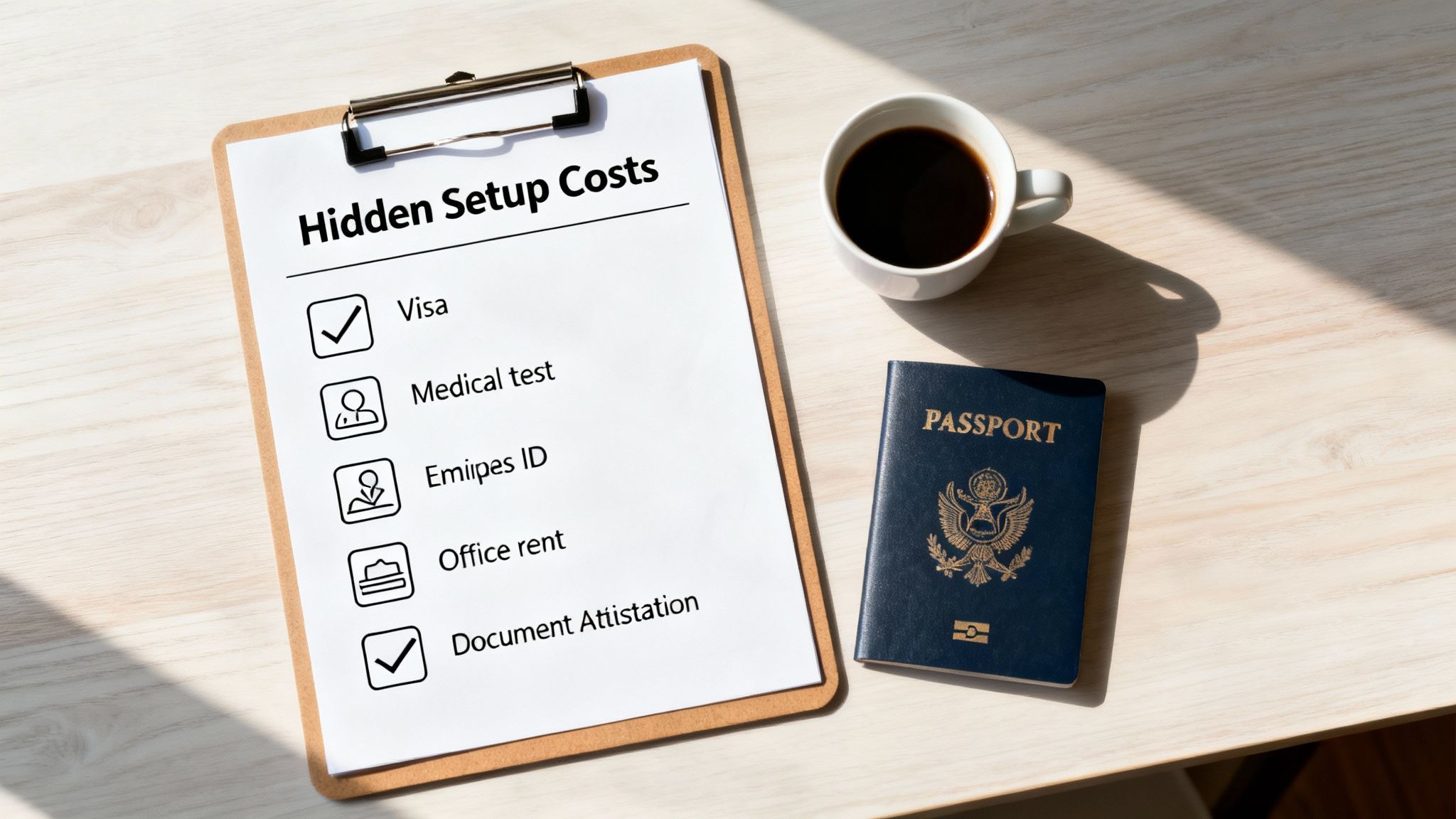
A smart budget for your trade license Dubai cost looks well beyond the first number you see on a quote. Too often, entrepreneurs are caught off guard by the final invoice because they focus only on the license fee itself, completely missing a handful of other crucial expenses.
These “hidden” costs aren’t about deception. They are simply part of the complete process of building a legally sound, fully operational company in the UAE.
Think of it like buying a house. The list price is just your starting point. You still need to factor in inspection fees, legal charges, and moving expenses to see the real total. It’s the same story when setting up a business in Dubai; several steps are involved, and each comes with its own price tag. Knowing these upfront is the secret to avoiding budget blowouts and enjoying a smooth launch.
Beyond the Licence Fee Itself
Once you have your initial approvals, the next layer of costs involves getting you and your team officially set up to live and work here. This is where visa processing fees come in, and they are a significant part of the total investment that many people underestimate.
For every partner or key investor needing a residency visa, you’ll need to budget for a few different things:
- Establishment Card Fee: This is what allows your new company to start sponsoring visas.
- Entry Permit: This lets the individual enter the UAE specifically to finalise their residency.
- Medical Fitness Test: A mandatory health check for all residency applicants.
- Emirates ID Application: The official federal identity card for every resident.
- Visa Stamping: The final step, where the visa is physically added to your passport.
These costs add up fast, especially if you have multiple partners. A single investor visa can run anywhere from AED 3,500 to AED 7,500, so it’s critical to multiply this by the number of partners who need one.
A common mistake is treating the trade license and residency visas as separate financial events. In reality, they are deeply interconnected. Your ability to live and work in the UAE is just as critical as the license itself, and both must be factored into your startup capital.
The Real Cost of Your Business Address
Another major expense, especially for mainland companies, is locking down a physical office. A registered tenancy contract, known as an Ejari, is an absolute must-have for a mainland license. The cost for this can vary wildly depending on what you need.
You might start with an affordable flexi-desk in a business centre to keep initial costs down. On the other hand, if your business needs a dedicated private office, the annual rent will become a major line item in your budget. This is where many free zones offer an advantage, often bundling a shared workspace right into their license packages.
Other potential costs that can pop up include:
- Document Attestation: If you’re bringing in corporate documents or educational certificates from abroad, they’ll likely need attestation from various government bodies, with fees at every step.
- Ministry Registrations: Certain business activities need extra approvals from specific ministries, and each has its own processing fee.
- Corporate Bank Account Setup: While opening the account is often free, some banks require minimum balances or have rules about initial deposits.
Finally, once you’re up and running, you’ll need to think about financial compliance. Our detailed guide on how to register for VAT in UAE is a great resource for understanding this crucial step once your revenue hits the mandatory threshold. By planning for all these additional costs, you build a complete and realistic financial roadmap for your Dubai venture.
Smart Ways to Lower Your Setup Costs
Getting your trade license is a non-negotiable investment, but that doesn’t mean you can’t be smart about it. A savvy entrepreneur knows how to manage expenses from the very beginning. This isn’t about cutting corners; it’s about making informed choices that give you the most bang for your buck.
With the right game plan, you can seriously trim your initial setup costs, all without putting the legal standing or future of your business at risk. This is about building a strong financial foundation from day one.
Choose Your Business Activities Wisely
One of the quickest ways to manage your trade license Dubai cost is to be laser-focused on your business activities. When you fill out that application, you have to list everything your company plans to do. Each activity group can add to the final bill, and some specialised ones need extra approvals from various government bodies, which adds even more to the cost.
So, how do you play it smart? Start lean. List only the absolute core activities you need to get off the ground. You can always amend your license and add more activities later on as your business grows and proves its model. Resist the temptation to add speculative or “just-in-case” activities—they’ll just inflate your invoice for no good reason.
Find the Right Free Zone Fit
If you’re heading down the free zone route, don’t just go with the most famous name you know. Dubai and the wider UAE are home to over 40 free zones, and each one has its own industry focus, pricing, and perks. Some are built for e-commerce, others are hubs for media companies or tech startups.
It’s a classic mistake: paying a premium for a fancy free zone package loaded with features you’ll never touch. Do your homework. Find a zone that actually caters to your niche, and you’ll likely find a much more affordable package that gives you everything you need and nothing you don’t.
Look for Multi-Year Licence Packages
Here’s an insider tip: many free zones, and even some mainland authorities, reward commitment. Instead of renewing your license every single year, see if they offer a two or three-year package. More often than not, it comes with a tidy discount.
This approach gives you two big wins:
- Immediate Savings: You’ll pay less over the long haul compared to renewing annually. Simple as that.
- Price Protection: It locks in your current rate, so you’re shielded from any potential government fee hikes for the next few years.
Yes, it means a bigger payment upfront, but the long-term savings can be significant. It also cuts down on your future admin headaches. Making smart moves like these early on is exactly how you launch a business in Dubai on solid financial footing.
Your Questions About Dubai Trade License Costs Answered
When you’re mapping out the financial side of a Dubai business setup, a lot of questions pop up. As you start budgeting for the trade license Dubai cost, it’s only natural to wonder about the cheapest routes, office rules, and what you’ll be paying year after year. This section cuts straight to the chase, answering the most common questions we hear from entrepreneurs just like you.
Think of this as your quick-fire guide to the practical money matters of launching your business in the UAE. Let’s tackle these head-on.
What Is the Cheapest Trade Licence in Dubai?
The most budget-friendly trade licences are typically found in specific free zones offering freelancer permits or e-commerce packages, with some starting as low as AED 12,000. These often include a flexi-desk, which cleverly ticks the box for your physical address requirement.
On the mainland, the DED Trader Licence for home-based businesses is another very cost-effective choice. It’s crucial to understand its limits, though—it’s built for sole traders, has tight restrictions on business activities, and won’t make you eligible for residency visas. The “cheapest” option really comes down to what you need, especially when visas enter the picture.
Can I Get a Trade Licence in Dubai Without an Office?
This is a big one, and it directly shapes your startup budget. For a mainland company, a physical office with a registered tenancy contract (known as an Ejari) is non-negotiable. There’s simply no way around this; it’s a fundamental part of the mainland business structure.
Free zones, however, play by different rules. Many of them let you secure your licence using a flexi-desk or a co-working space package. For startups, consultants, and solo entrepreneurs, this is a total game-changer, as it satisfies the physical address requirement for a fraction of what a private office would cost.
How Much Does It Cost to Renew a Trade Licence?
Here’s some good news: your annual renewal is almost always cheaper than the initial setup cost. Why? Because you’re not paying for all those one-time fees again, like initial approval, trade name reservation, and Memorandum of Association attestation.
Your renewal invoice will mainly consist of the core licence fee, Dubai Chamber of Commerce fees, and your office lease renewal. As a rule of thumb, you can expect the renewal cost to land somewhere around 70-80% of your first year’s total bill, although this can shift based on your jurisdiction and any government fee updates.
Are Payment Plans Available for Licence Fees?
Yes, absolutely. The upfront investment for a trade licence can be steep, and it’s a common worry. To make it more manageable, many business setup consultancies and even some authorities offer flexible payment options. It’s quite common to find instalment plans that let you break down the total cost over three, six, or even twelve months.
These plans are usually facilitated with a UAE-based credit card. When you’re talking to a consultant, don’t be shy about asking what payment plans they offer—it can make a massive difference to your initial cash flow.
Planning your business launch can feel overwhelming, but you don’t have to figure it all out on your own. The experts at Smart Classic Business Hub can give you a detailed, personalised cost breakdown based on your exact business needs, making sure there are no surprises down the road. Get your free consultation and customised quote today!