Choosing the right bank account is far more than just ticking a box—it's a core strategic decision that will be the financial bedrock of your entire UAE venture. For any company operating in Ras Al Khaimah, whether you're on the mainland, in a free zone, or set up as an offshore entity, a RAK business account is the essential tool for managing capital, processing payments, and staying compliant.
Why Choose a RAK Business Account for Your UAE Company?
Opting for a RAK business account is a savvy move for any entrepreneur looking to plant their flag in the UAE. Ras Al Khaimah has built a solid reputation as a pro-business emirate, backed by a strong financial ecosystem ready to support companies of all sizes. This choice will underpin your whole operation, making everything from daily transactions to long-term financial planning much smoother.
For example, a mainland company can use its RAK account to easily handle VAT-compliant bookkeeping and take payments from local clients. A free zone company in RAKEZ gets the benefit of easier international trade finance, while an offshore company can securely manage its global assets. You can get a better sense of how this works by reading our guide on how to open an offshore company and bank account.
Building a Foundation for Growth
Think of your corporate bank account as your business's financial identity. It's absolutely critical for:
- Managing Capital: Securely holding your working capital and any investment funds.
- Building Credit History: Creating a financial track record in the UAE is vital if you want to secure financing down the road.
- Simplifying Operations: Making payroll, supplier payments, and client invoicing a straightforward process.
- Ensuring Compliance: Keeping clean, clear records for audits and tax purposes.
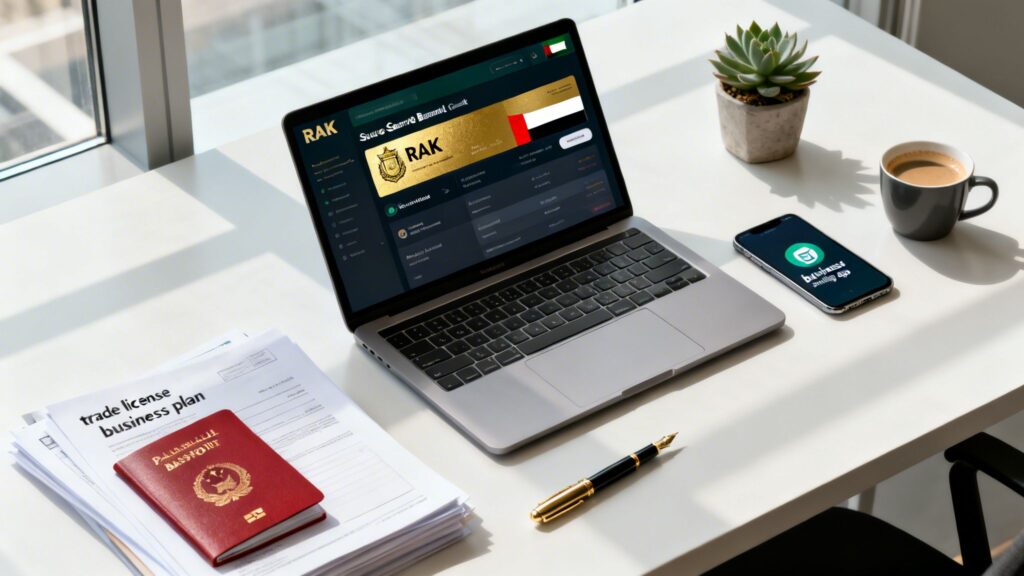
Here's a look at the kind of business accounts you might see on RAKBANK's online portal.

As you can see, banks offer different account tiers to cater to everyone from brand-new startups to large, established corporations.
The Stability of RAK's Banking Sector
Banking with an established institution gives you security and, frankly, peace of mind. The financial strength of banks in Ras Al Khaimah is a major plus for investors. Take RAKBANK, for example. By 2025, it reported a landmark profit of AED 2.6 billion, and its total assets grew beyond AED 100 billion as it marked 50 years of steady growth. That kind of stability tells you it's a healthy banking environment ready to back credible businesses.
Choosing a bank isn't just about features; it's about finding a partner. A stable, reputable bank gives you the confidence to focus on growing your business, knowing your finances are secure and well-managed.
Really understanding what goes into choosing the right business banking partner is crucial when you're selecting a RAK business account. This decision directly impacts your day-to-day efficiency and your company's long-term financial health. A great banking partner does more than just hold your money—it provides the tools and support you need to thrive.
Decoding Eligibility for Your Company Type
Opening a RAK business account isn't a simple, one-size-fits-all deal. A bank's decision to work with you is a complicated dance, and the very structure of your company dictates the music. Before you even start an application, you need to understand what banks in the UAE are actually looking for.
At the end of the day, it all comes down to one thing: risk. Every application is viewed through this lens, and your company type—whether it’s mainland, free zone, or offshore—is the single biggest factor that determines their risk assessment. Each setup has a different risk profile, which shapes the entire process from start to finish.
Mainland and Free Zone Companies
If you have a mainland LLC or a free zone entity (like one in RAKEZ), your physical presence is your biggest asset. Having a real office lease (your Ejari) and showing that you have actual operations in the UAE sends a powerful signal of legitimacy to the bank. It proves your business has substance, which immediately lowers its perceived risk.
While banks view both favourably, there are some subtle differences:
- Mainland LLC: Often seen as the most straightforward option, especially if your business deals primarily within the UAE market.
- Free Zone Company: Extremely common and well-understood by banks, particularly for businesses involved in international trade and services.
The key here is having a crystal-clear business model. If you're running a trading company, be ready for the bank to ask for things like sample invoices or contracts. If you’re a consultant, having a professional website and a list of clients will make your application much stronger.
A physical office lease is more than just a piece of paper; it’s proof of your commitment to operating in the UAE. Banks see it as a powerful sign that your business is genuine and has economic substance, which can often fast-track your application.
Offshore Company Scrutiny
Trying to open a RAK business account for an offshore company is a completely different ball game. These companies don't have a physical presence in the UAE and usually operate internationally, so they are automatically placed in a higher-risk category. Prepare for intense scrutiny.
Your application will live or die based on two critical points:
- Source of Funds: You must provide impeccable proof of where the initial and ongoing capital is coming from.
- Source of Wealth: Shareholders need to be ready to submit detailed personal financial histories.
For instance, an offshore company with shareholders from a high-risk jurisdiction is going to face an uphill battle. The bank will demand extensive documentation to satisfy its strict anti-money laundering (AML) and Know Your Customer (KYC) duties. There’s absolutely no room for grey areas here; every transaction and ownership detail must be transparent. We also touch on some related points for individuals in our guide to a non-resident bank account in Dubai. Positioning your profile correctly from the start is absolutely essential to avoid an instant rejection.
Preparing a Bulletproof Documentation Package
An incomplete or messy application is the quickest way to see your RAK business account opening get delayed—or worse, rejected. It’s best to think of your documentation not as a stack of paperwork, but as the comprehensive business case you’re presenting to the bank. A strong file anticipates every question and positions your company as a credible, low-risk partner.
This is about much more than just ticking boxes on a basic checklist. While you’ll obviously need your trade licence, Certificate of Incorporation, and Memorandum of Association (MOA), the real secret to a smooth approval lies in the supporting details. This is where you prove your professionalism.
Beyond the Basic Checklist
Let's get past the obvious. Every applicant submits a trade licence. What makes your application sail through is the quality and depth of the entire package.
Here are a few insider tips I’ve seen make a real difference time and again:
- Passport and Visa Validity: Make sure all shareholders and signatories have passports, residency visas, and Emirates IDs with at least six months of validity. An expiring document is an instant red flag that will bring the whole process to a screeching halt.
- Proof of Address: For any foreign shareholders, a recent utility bill (no older than three months) is the standard. Crucially, if the bill isn't in English or Arabic, you must get it legally translated. A shoddy translation or a simple screenshot from an online portal won't fly.
- Shareholder CVs: A clean, one-page professional CV for each shareholder helps the bank understand who is behind the business. It should focus on industry experience that’s relevant to your new company’s activities, which strengthens the case for your business's viability.
For a wider view on requirements, especially if you're an expat owner, this general guide on how to open a foreign bank account offers some useful context on what banks globally tend to look for.
A well-prepared application file is your best tool for navigating the bank's due diligence process. We’ve put together a table outlining the essential documents you’ll need to get started.
Essential Documents for Your RAK Business Account Application
| Document Type | What Banks Are Really Looking For |
|---|---|
| Company Documents | |
| Trade Licence | That your business is legally registered and its activities are clearly defined. |
| Certificate of Incorporation | Proof of the company's legal existence and formation date. |
| Memorandum/Articles of Association | A clear picture of the company's ownership structure, share distribution, and internal rules. |
| Business Plan | A credible story: How will you make money? Who are your customers? What are your financial forecasts? |
| Personal Documents (All Shareholders & Signatories) | |
| Passport Copies | That identities are verified and valid for at least 6 months. |
| UAE Visa & Emirates ID Copies | Confirms legal residency status in the UAE (if applicable). |
| Proof of Address (e.g., Utility Bill) | Verifies the residential address of all shareholders, especially non-residents. Must be recent. |
| Personal & Business Bank Statements | Evidence of good financial standing and a clean banking history (6 months is standard). |
| Shareholder CVs | Shows the people behind the company have the experience to make it a success. |
Keep this checklist handy, but remember that a relationship manager might always ask for additional supporting documents based on your specific business activity or shareholder profile.
The Business Plan Bankers Actually Read
Your business plan is arguably the most critical supporting document, especially for a new startup or an offshore company. Bankers simply don't have time for vague, 50-page manifestos. They need a clear, concise, and realistic document that quickly answers three fundamental questions:
- How will you make money? Spell out your revenue model in simple terms.
- Who are your customers? Define your target market and your plan to reach them.
- What do your finances look like? Provide grounded one-to-three-year financial projections showing revenue, profit, and major expenses.
A strong business plan tells a compelling story. It shows the bank that you've done your homework, understand your market, and have a credible plan to generate revenue. This isn't just paperwork; it’s your first opportunity to sell your vision to a key financial partner.
The recent business boom in the emirate shows exactly why this level of preparation matters. RAKBANK's 2023 results, for instance, revealed a 54.6% surge in profit before tax to AED 1.8 billion. This was fueled by opening over 10,000 new SME accounts and lending AED 2.2 billion. With that kind of volume, their systems are efficient but also extremely selective—only the most well-prepared applications make the cut.
This same attention to detail is just as important in other jurisdictions. If you're weighing your options, you might find our guide on opening a business bank account in Dubai helpful. Ultimately, the goal is to assemble a file that screams 'credible business,' and this is where having an expert on your side can truly prove its worth.
Navigating the Account Opening Timeline
You’ve submitted your perfectly organised application. So, what happens now? This is where the bank’s internal process kicks in, and understanding the timeline is key to managing your expectations. Opening a RAK business account isn't an overnight affair; it’s a detailed review process with several important stages.
The clock starts the moment your application is submitted and stops when you have your active account details and IBAN in hand. Even with remote pre-approvals, remember that at least one account signatory must visit the bank in person to sign the final documents. This is a standard, non-negotiable part of the UAE's strong anti-money laundering (AML) framework.
The initial documentation flow, which you control, sets the stage for everything that follows.

As you can see, the time you invest in assembling and reviewing your documents pays off. A clean, complete package moves through the bank's internal system far more smoothly.
The KYC and Compliance Bottleneck
The biggest variable in your timeline is, without a doubt, the Know Your Customer (KYC) and compliance review. This is where the bank’s team performs a deep dive into your business, its owners, and its operational model. A realistic timeframe from submission to account activation can be anywhere from two to six weeks.
So, what typically causes delays?
- Complex ownership structures, especially those with multiple corporate layers or shareholders from high-risk jurisdictions.
- A vague or unclear business model that makes it hard for the bank to understand your revenue sources.
- Incomplete or inconsistent documentation that forces the compliance team to stop and send queries back to you.
On the flip side, a straightforward application for a local mainland company with a clear ownership structure and a solid business plan often gets approved on the faster end of that spectrum.
The Compliance Call
Don't be surprised if you get a call from the bank's compliance department. This is a standard part of their due diligence. It's a formal interview where an officer will ask you pointed questions to verify the details you provided. Expect to talk about your business model, target customers, expected transaction volumes, and the countries you'll be doing business with.
Think of the compliance call as your final interview. Your goal is to answer every question with clarity and confidence, reinforcing the credibility you built with your application. Be ready to explain your business like you're pitching it to an investor.
This level of scrutiny is what keeps the UAE’s banking system robust and reputable. For instance, in Q1 2025, RAKBANK reported a 22.7% increase in profit after tax to AED 704 million, with its total assets climbing past AED 90 billion. This financial strength is underpinned by rigorous compliance, ensuring they partner with credible businesses. You can read more about RAKBANK's record growth and its implications on their banking practices.
Following Up the Right Way
Once your application is in, it's tempting to check in with your relationship manager every day. Resist that urge. There’s an art to professional follow-up. A polite email once a week to check on the status is perfectly fine—it shows you’re engaged but respectful of their internal processes.
If the bank sends you a query, your immediate and thorough response is crucial. Quick, clear answers are the single best way to keep your application moving. This proactive approach shows you're an organised and professional client they'll want to work with.
Partnering with Experts to Guarantee Success

Trying to open a RAK business account by yourself can feel like navigating a maze in the dark. The UAE banking system has its own set of unwritten rules and unspoken expectations that can easily trip up even the most prepared entrepreneurs. This is where bringing in a specialist can make all the difference.
Let's be clear: a bank’s main job is to assess and avoid risk, not to walk you through their internal approval process. Our job is the complete opposite. We focus entirely on making sure your application is perfectly positioned to meet the bank's risk criteria right from the start.
Bank Selection and Profile Matching
The first, and most important, step is choosing the right bank. This is where most solo attempts fail. A bank that’s keen on high-volume e-commerce businesses might instantly reject a general trading company dealing in certain commodities. Trying to force a fit is a common route to rejection.
We begin by digging deep into your business activity, ownership structure, and where your international transactions will be coming from and going to. We have direct lines to relationship managers across various banks in RAK and know exactly which ones are actively looking for clients with your specific profile. This targeted approach dramatically boosts your chances of a quick pre-approval.
A successful application isn't just about having the right documents; it's about presenting the right story to the right audience. We ensure your business profile speaks the bank's language, highlighting strengths and pre-emptively addressing any perceived risks.
Meticulous Documentation and Follow-Up
With the right bank chosen, we get to work on the paperwork. Our team goes through every single page of your application—from shareholder passports to the business plan—to ensure it hits the bank's strict compliance standards. We spot common mistakes like expiring documents or poorly translated utility bills that can completely derail an application.
But most importantly, we help you put together a business profile that tells a believable and compelling story.
The work doesn’t stop once the application is submitted. Our dedicated PRO team becomes your biggest asset, managing the crucial follow-up process. When the bank’s compliance team inevitably has questions, we’re on hand to provide instant, clear answers. This stops your file from sinking to the bottom of the pile and keeps it moving towards approval.
Frequently Asked Questions
Setting up your RAK company is one thing; getting the bank account sorted is another. It’s a process that often raises a lot of questions for entrepreneurs. We’ve put together answers to some of the most common queries we get.
Can I Open a RAK Business Account from Outside the UAE?
Not entirely. While we can handle all the groundwork remotely, UAE banking regulations are strict on this point. At least one account signatory must be physically present in the UAE to sign the final documents and meet the bank.
This is a mandatory security and anti-money laundering (AML) step, and there are no exceptions.
However, the good news is you don’t need to be here for the whole process. We can manage all the pre-approvals, file submissions, and back-and-forth with the bank for you. We’ll line everything up so your visit is just for the final, essential signatures, minimising your time in the UAE to just a day or two.
What Is a Realistic Minimum Balance for a RAK Business Account?
The required minimum balance—or Average Monthly Balance, as banks call it—really depends on the bank and the specific account you choose.
For most new businesses or SMEs in RAK, you should budget for a requirement somewhere between AED 25,000 and AED 50,000. If you’re a larger enterprise looking at a premium corporate account, expect that figure to be higher.
It's crucial to be realistic here. If your balance dips below the average, the bank will charge monthly penalties. You need to pick an account where maintaining the balance is comfortable and doesn't strain your cash flow. Always get this exact number from the relationship manager before you sign anything.
My RAK Business Account Application Was Rejected. What Now?
Getting a rejection is frustrating, but it’s definitely not the end of the line. Your first move should be to ask the bank for feedback, though be prepared for a vague answer due to their compliance policies.
A rejection is rarely personal. It’s almost always a mismatch between your company's profile and the bank's internal risk policies. The trick is to figure out that mismatch and find a bank that's a better fit.
The most common reasons for rejection are a business plan that isn't detailed enough, an unclear source of funds, or your business activity falling into a category the bank views as 'high-risk'.
Your best bet is to speak with a business setup expert. We can help you pinpoint the likely reason for the rejection, work with you to strengthen your application (like making your business plan more convincing), and then re-approach a different bank that is more receptive to your type of business.
Don't let banking hurdles slow down your UAE ambitions. The expert team at Smart Classic Business Hub can manage the entire process, from preparing your documents to securing final approval, ensuring it all goes off without a hitch. Let us handle your RAK business account opening so you can get back to what you do best—growing your business.