Setting up an offshore company in Dubai gives global investors a serious competitive edge. It's a highly tax-efficient structure that allows for 100% foreign ownership, making it a perfect vehicle for international trade, protecting your assets, and smart estate planning. Essentially, it lets you run a global operation from a stable and highly respected jurisdiction.
Why Set Up an Offshore Company in Dubai?

These days, savvy global entrepreneurs are looking for more than just tax havens. Dubai has shot to the top of the list not just for what it doesn't have—like burdensome taxes—but for what it offers. We're talking about a powerful blend of economic stability, strict confidentiality, and unmatched global connectivity.
An offshore entity here isn't just a piece of paper; it's a dynamic tool for managing international business and safeguarding your wealth.
The UAE government's forward-thinking approach to foreign investment has been a game-changer. Recent reforms now allow 100% foreign ownership across most sectors, completely removing the old need for a local Emirati partner. This move sends a clear message: the UAE is wide open for international business.
Strategic Advantages Beyond Tax Efficiency
While the absence of corporate tax is what gets most people's attention, the true power of a Dubai offshore company lies in its wider uses. Think of it as your central command for global activities, all based in a secure and credible location.
Here's what that really means for you:
- Robust Asset Protection: An offshore company legally separates your personal wealth from your business liabilities. This is crucial for shielding your assets from potential claims or economic turmoil back home.
- Enhanced Confidentiality: Your privacy is paramount. Unlike in many other jurisdictions, the details of directors and shareholders are not listed on a public register, ensuring your business dealings remain private.
- Simplified Global Trade: These structures are ideal for managing international invoicing, handling consulting fees, and holding intellectual property without the red tape you'd face with a mainland company.
A Gateway to International Markets
Dubai's prime location, right at the crossroads of Europe, Asia, and Africa, makes it a natural hub for global trade. Having an offshore company registered here instantly lends credibility to your business.
On top of that, the legal system is modern and internationally respected, which gives banks, partners, and clients the confidence to do business with you.
The decision to establish an offshore company in Dubai is often driven by a need for a secure, internationally recognised vehicle for wealth management and global business. It offers a sophisticated solution for complex financial planning.
The UAE offers two main jurisdictions for offshore companies: the Jebel Ali Free Zone Authority (JAFZA) and the Ras Al Khaimah International Corporate Centre (RAK ICC). Each has its own unique strengths, whether you're looking to own real estate or simply create a holding company.
To get a fuller picture, our guide explores the key benefits of setting up a business in Dubai, which perfectly complement the advantages of going offshore.
Choosing Your Jurisdiction: JAFZA vs. RAK ICC
Deciding where to set up your offshore company in the UAE is one of the most critical choices you'll make. This isn't just about paperwork; it's a foundational decision that will shape your company's cost, capabilities, and future potential. The two heavyweights in this space are Jebel Ali Free Zone Authority (JAFZA) and Ras Al Khaimah International Corporate Centre (RAK ICC).
Your specific business goals should be the only thing guiding this decision. It boils down to a simple question: What are you trying to achieve? Are you planning to purchase and hold property in Dubai? Or is your main aim a flexible, cost-effective holding company for your international assets and investments? The answer will almost immediately point you to either JAFZA or RAK ICC.
The JAFZA Advantage: A Must for Property Ownership
Let's be crystal clear: if your strategy involves buying real estate in Dubai, JAFZA is your only option. It holds the unique and powerful position of being the sole offshore jurisdiction legally permitted to own property within the emirate.
Imagine you're an international investor looking to acquire a portfolio of apartments in Dubai Marina. Setting up a JAFZA offshore company allows you to hold these properties under a corporate shield. This is a game-changer for asset protection and makes succession planning infinitely simpler compared to owning them in your personal name.
Beyond this crucial function, JAFZA carries significant weight. As one of the oldest and most respected free zones in the entire region, its name opens doors. International banks and financial institutions recognise the JAFZA brand, which can often make the corporate bank account opening process a bit smoother.
Things to keep in mind with JAFZA:
- Property Ownership: This is its undisputed main draw. If you want to own Dubai real estate through a corporate structure, JAFZA is non-negotiable.
- Prestige and Reputation: It’s a globally recognised authority, and that credibility can be a real asset.
- Cost Structure: You're paying for the premium location and unique benefits. Expect setup and annual renewal fees to be higher than with RAK ICC.
The RAK ICC Edge: Flexibility and Unbeatable Value
While JAFZA dominates the property niche, RAK ICC has cemented its place as the go-to choice for almost everything else. Located in Ras Al Khaimah, it’s earned a reputation for its modern regulations, operational agility, and a very competitive fee structure.
Think of an entrepreneur running a global consulting firm. They need a central entity to handle international invoices, manage profits, and hold shares in various startups. For this kind of setup, RAK ICC is the perfect vehicle. It offers a streamlined, affordable way to create a holding company without the premium price tag of JAFZA.
A key takeaway here is that RAK ICC is often the preferred choice for its sheer simplicity and efficiency. It delivers a solid legal framework for international trade, wealth management, and asset holding at a much more accessible cost.
The regulatory environment at RAK ICC is also highly praised for being progressive and in line with global compliance standards, making it a secure and reliable home for your offshore company.
JAFZA vs RAK ICC: A Head-to-Head Comparison
To really see the difference, it helps to put them side-by-side. Both jurisdictions offer 100% foreign ownership, a high degree of privacy, and zero corporate tax, but their ideal use cases are worlds apart.
| Feature | JAFZA (Dubai) | RAK ICC (Ras Al Khaimah) |
|---|---|---|
| Primary Use Case | Owning real estate in Dubai, prestigious holding company. | International trade, asset holding, consulting, investments. |
| Initial Setup Cost | Higher, reflects its premium status and Dubai location. | Lower and more competitive, offering excellent value. |
| Annual Renewal Fees | Generally more expensive. | More affordable for long-term maintenance. |
| Shareholder Privacy | High (details are confidential and not on a public register). | High (details are confidential and not on a public register). |
| Reputation | Excellent, long-established global recognition. | Strong, modern, and rapidly growing in popularity. |
| Location | Based within the Emirate of Dubai. | Based within the Emirate of Ras Al Khaimah. |
At the end of the day, the choice is driven by your strategy. If Dubai property is in your investment plan, the decision is already made for you—it has to be JAFZA. For almost every other offshore objective, from creating a holding structure to managing global transactions, RAK ICC consistently offers a more efficient and cost-effective path forward.
It's also important to understand what these offshore entities can't do. If your goal is to trade directly with customers inside the UAE, an offshore company isn't the right tool. In that case, you would need to explore a mainland company setup in Dubai, which is a completely different structure designed for local commerce.
Navigating the Company Formation Process
Getting your offshore company set up in Dubai is a clear, sequential process, but it demands a sharp eye for detail. Think of it less like a rigid checklist and more as a logical flow of actions. The journey begins with what might be the most crucial decision: choosing your registered agent.
This isn't just a box-ticking exercise. Your registered agent is your official representative on the ground, the one who will handle all communications with the authorities and ensure every piece of paperwork is submitted exactly as required.
At the same time, you'll need to select and reserve your company name. This is more than a creative task; the name has to follow the specific rules of your chosen jurisdiction, whether it's JAFZA or RAK ICC. Names must be unique, professional, and can't include references to any religion or government body. A good agent will pre-screen your preferred names for availability, saving you from a frustrating false start.
Assembling Your Documentation
With your agent and name sorted, it's time to gather the necessary personal and business documents. Precision is absolutely critical here. Each document needs to be in the correct format—which often means being notarised or attested—to be accepted by the registrar.
Here’s what a typical documentation package looks like:
- Passport Copies: You'll need clear, colour copies of the passports for every shareholder and director. These must be valid for at least six more months and properly notarised.
- Proof of Address: A recent utility bill (water or electricity works best) or a bank statement that clearly shows your residential address is required. Make sure it's no older than three months.
- Curriculum Vitae (CV): Each shareholder needs to provide a brief CV or professional profile. This helps the authorities understand your business background and area of expertise.
- Bank Reference Letter: A simple letter from your personal or corporate bank confirming you're a client in good standing adds a significant layer of credibility to your application.
Before you get bogged down in paperwork, this comparison can help you decide which jurisdiction makes the most sense for your goals.
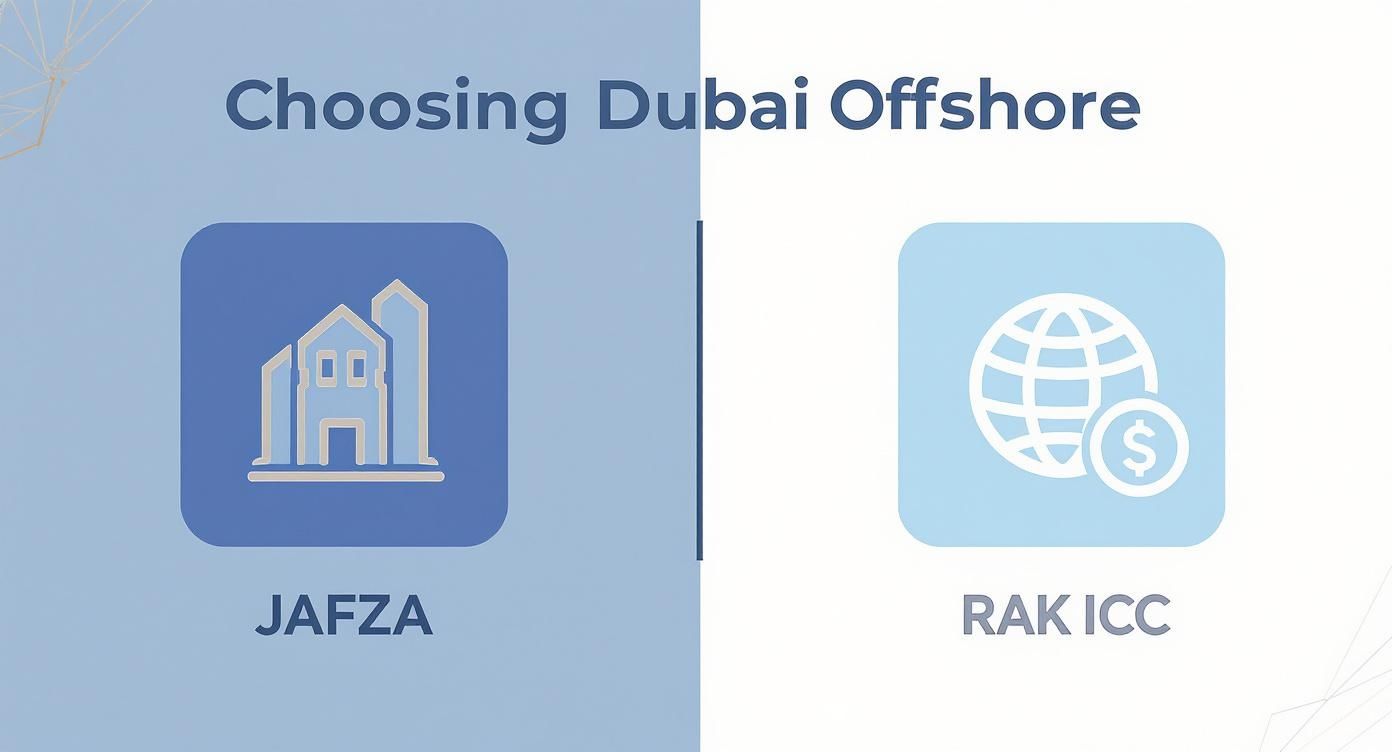
As you can see, the path for property ownership points clearly to JAFZA, while RAK ICC is the go-to for more flexible holding company structures. This initial strategic choice will guide the rest of your process.
Understanding the Timelines and Submission
Once your documents are compiled and checked, your registered agent submits the application to the relevant registrar. So, how long does it take? A realistic expectation is anywhere from three to ten working days from submission to receiving your Certificate of Incorporation, but this assumes every single document is perfect.
Any small discrepancy, like a poorly scanned passport or a missing attestation, can bring the process to a halt. These issues can cause delays of days or even weeks. This is where an experienced provider like Smart Classic Business Hub proves invaluable. We meticulously review every detail before submission, catching potential problems and ensuring the process moves forward without hitting any speed bumps.
The speed of your offshore company formation in Dubai is directly proportional to the quality of your initial application. Getting it right the first time is the single most effective way to accelerate the process.
The sheer volume of new setups is a testament to the UAE's strategic appeal. Reports from 2023 and 2024 show a huge jump in foreign company registrations, with offshore jurisdictions leading the charge. You can dig into the specifics in the official United Arab Emirates Investment Climate Statement from the Ministry of Investment.
The Final Steps to Incorporation
After the registrar reviews and approves your application, they'll issue the core corporate documents that officially bring your company to life.
You'll receive a package containing:
- Certificate of Incorporation: This is the official document confirming your company is a legal entity.
- Memorandum and Articles of Association (MOA/AOA): This is your company's rulebook. It outlines the company’s purpose, its internal regulations, and how it will operate.
- Share Certificates: This is the official proof of ownership for each shareholder in the company.
These documents aren't just for your files. They are absolutely essential for the next critical step: opening your corporate bank account. Banks will require attested copies of this entire set to even begin their Know Your Customer (KYC) procedures.
The role of a professional partner goes far beyond just filing papers. An expert team acts as your project manager, coordinating with notaries, government bodies, and translators to keep things moving. They bring clarity to costs, manage expectations on timelines, and handle the entire administrative load, freeing you up to focus on your business strategy. This support turns a potentially overwhelming bureaucratic task into a straightforward, manageable process.
Opening Your Corporate Bank Account

Once your offshore company is officially incorporated, you’ll face what is often the most challenging part of the entire journey: securing a corporate bank account in the UAE. This is where your new company structure meets the very real, very strict world of international finance.
Let me be frank: UAE banks are meticulous. They operate under intense global compliance standards, and their due diligence process is famously thorough. This isn't just a box-ticking exercise; it's a critical milestone in your offshore company formation in Dubai.
Success here comes down to presenting a clear, compelling, and fully compliant business case. It’s less about just having the right paperwork and more about building a narrative that gives the bank total confidence in your legitimacy.
Cracking the KYC Code
Every single bank in the UAE lives by its Know Your Customer (KYC) protocol. This isn't a quick check. It's a deep dive into who you are, what your business actually does, and where your money is coming from. You need to come prepared with a file that leaves zero room for questions.
At a minimum, you'll need to have these documents ready to go:
- Complete Corporate File: Your attested Certificate of Incorporation, Memorandum and Articles of Association (MOA), and Share Certificates are non-negotiable.
- Shareholder and Director Profiles: Be ready with passport copies, UAE entry stamps (if needed), recent proof of address (like a utility bill), and a detailed CV for every key person.
- A Robust Business Plan: This is absolutely essential. It must clearly lay out your business activities, who your target customers are, projected annual turnover, and the nature of your expected incoming and outgoing payments.
Banks pay special attention to the source of funds. You have to be prepared to show clear evidence of your initial investment capital, whether it’s from personal savings, profits from a previous venture, or another legitimate source.
The Importance of Economic Substance
The era of anonymous "shell companies" is long gone. Today, UAE banks need to see that your offshore company has genuine economic substance. This simply means demonstrating a logical, legitimate reason for your company to exist in the UAE and for it to need a local bank account.
Your business plan is the perfect place to address this head-on. For instance, if you're a global consultant, you can explain that the Dubai offshore entity is for invoicing international clients in multiple currencies. A stable UAE bank account provides the global access needed to manage these flows efficiently.
A common mistake I see is people treating the bank application like a simple administrative task. It's not. It's a pitch. You are selling the bank on the credibility and low-risk profile of your business. A well-prepared application that anticipates their questions is your greatest asset.
This is why being specific is so important. Don't just say "international trade." Instead, describe the exact goods you're trading, name the countries involved, and if possible, provide sample invoices or draft contracts to back it up.
Preparing for Your Meeting with the Banker
While some initial paperwork can be handled remotely, almost every UAE bank will require at least one signatory to be physically present in Dubai to finalise the account opening. This face-to-face meeting is your chance to build a relationship and clear up any final questions.
Here's how to make that meeting a success:
- Know Your Application Inside Out: You should be able to speak confidently about every single detail in your business plan and supporting documents.
- Dress Professionally: First impressions count for a lot. Business attire is the standard and shows you're taking this seriously.
- Be Transparent and Honest: If your business structure has some complexity, explain it clearly. Trying to hide or obscure details is a massive red flag for compliance officers.
One of the biggest deal-breakers for banks is a vague or inconsistent story. If your documents state you're in software consulting but you tell the banker you're trading commodities, your application is dead on arrival. Consistency is key.
At Smart Classic Business Hub, we help clients refine this narrative, making sure your business case is presented professionally and compliantly, which dramatically increases the chances of a fast approval.
Managing Ongoing Compliance Requirements
Getting your offshore company officially formed is a huge win, but it’s really just the beginning of the journey. To keep your company in good legal standing and truly capitalise on its benefits long-term, you need to stay on top of your ongoing compliance duties. This isn't just about ticking boxes; it's about protecting your investment and ensuring your corporate structure remains a valid, functioning entity.
Your most immediate task is the annual renewal. Think of it as the yearly health check for your company. It involves settling the government and registered agent fees, which is what keeps your business officially active on the registrar. Miss the deadline, and you could be looking at hefty penalties, a loss of good standing, or even having your company struck off the register entirely.
Core Annual Obligations
A good registered agent, like us at Smart Classic Business Hub, will manage this process for you and send reminders well ahead of time. This annual renewal ensures your company’s legal address and official representation in the UAE are properly maintained.
Beyond that basic renewal, there are a couple of other areas that demand your attention: keeping proper financial records and complying with specific regulatory frameworks. These are absolutely non-negotiable for running an offshore company in a reputable jurisdiction like the UAE.
- Accounting and Bookkeeping: While offshore companies don't face the intense auditing scrutiny of mainland businesses, you are still required to maintain accurate financial records. These documents need to clearly show the company's financial position and must be ready for inspection by authorities if they ever ask.
- Economic Substance Regulations (ESR): These rules were brought in to align the UAE with global anti-tax avoidance standards. ESR requires certain companies to prove they have genuine business activity in the UAE. While many passive holding companies are exempt, if your offshore entity engages in "relevant activities" (like holding intellectual property), you'll need to file an annual ESR notification and report.
Navigating Corporate Tax and VAT
One of the biggest points of confusion we see is how UAE taxes apply to offshore setups. The recent introduction of a federal Corporate Tax has certainly raised questions, but for the vast majority of offshore companies, the situation remains incredibly favourable.
The UAE’s standard 9% corporate tax rate generally does not apply to offshore companies in jurisdictions like JAFZA and RAK ICC, as long as they don’t do business within the UAE mainland. This 0% tax benefit is one of the core advantages of these structures. You can get a better sense of the evolving tax landscape from resources like the Chambers and Partners practice guides.
It's a critical mistake to think "offshore" means zero administrative work. Diligent compliance is what preserves the very benefits—asset protection, tax efficiency, and confidentiality—that make the structure so valuable in the first place.
Value Added Tax (VAT) is another area to keep on your radar. Typically, offshore companies that operate exclusively outside the UAE don't need to register for VAT. However, you must understand the thresholds and specific rules to stay compliant. For a more detailed breakdown, you might find our guide on how to register for VAT in UAE helpful, as it clarifies the exact requirements.
Ultimately, staying on top of ongoing compliance is a straightforward process when you handle it proactively. Working with a professional service provider ensures deadlines are never missed, regulatory changes are monitored, and your company runs without a hitch. This frees you up to focus on your global business, confident that your corporate structure is secure and fully compliant with UAE law.
Your Top Questions About Dubai Offshore Companies
When you're exploring setting up an offshore company in Dubai, a few key questions almost always come up. The benefits might seem obvious, but it's the practical details and limitations that really matter for making the right decision. Let's break down the most common queries we handle for our clients.
Can an Offshore Company Get Me a UAE Residence Visa?
This is probably the number one point of confusion, but the answer is a clear and simple No. An offshore company, whether it's registered in JAFZA or RAK ICC, is not a path to getting a UAE residence visa.
These companies are purpose-built for international business and holding assets. They aren't designed to establish any kind of personal residency in the UAE. If a visa for you or your family is a top priority, you'll need to look at setting up a mainland or free zone company instead. Those structures are tied into the UAE's residency sponsorship system because they're meant for onshore operations.
Do I Have to Be in Dubai to Set Everything Up?
For the initial company formation, you can handle almost everything from wherever you are in the world. A registered agent like Smart Classic Business Hub takes care of the paperwork, submissions, and all the back-and-forth with the registrar. This means you don't have to fly in just to get the company incorporated.
However, opening the corporate bank account is a different story. The vast majority of UAE banks will require at least one signatory from the company to visit in person. They need to sign the final documents and complete the bank's own due diligence process. This face-to-face meeting is a non-negotiable part of their compliance checks.
What Business Activities Are Off-Limits?
An offshore company comes with a very clear rulebook designed to keep its business strictly international. It cannot do any direct business inside the UAE's domestic market.
This means you are not allowed to:
- Trade directly with companies located on the UAE mainland.
- Rent a physical office space anywhere in the UAE.
- Sponsor visas for any employees.
Think of an offshore company as a corporate vehicle for global trade, international consulting, holding shares in other businesses, or owning specific, approved real estate.
The rule of thumb is straightforward: an offshore company is for business outside the UAE, but managed from a UAE-registered entity. It’s a tool for global commerce, not local trade.
How Private Is My Information as a Shareholder?
Confidentiality is a huge part of the appeal of UAE offshore jurisdictions. Both JAFZA and RAK ICC provide an exceptionally high level of privacy for investors.
The names and details of the company's directors and shareholders are not published on any public register. This information is kept private, shared only with official government bodies or banks when required for mandatory compliance and KYC (Know Your Customer) checks. While the UAE is fully committed to international standards against illicit financial activity, it also fiercely protects the privacy of legitimate business owners.
Getting these details right is exactly where having an expert on your side makes all the difference. At Smart Classic Business Hub, we make sure you have clear, straightforward answers to all your questions, helping you build a compliant and powerful offshore structure. Find out more about how we can support your offshore company formation in Dubai.