Setting up a mainland company in Dubai gives you the golden ticket: unrestricted access to trade directly across the entire UAE. Unlike a free zone company, you're free to work with government bodies, set up shop anywhere you like, and open as many branches as you need across the country.
Why Choose a Dubai Mainland Company Setup

One of the first big calls any entrepreneur in Dubai has to make is choosing between a mainland or a free zone setup. Free zones are great, but they keep you within their geographical limits. A mainland company, on the other hand, offers total freedom and deep market penetration.
If your plan involves dealing directly with the local market, bidding on those big-ticket government contracts, or having a physical presence across the Emirates, then a mainland licence is really your only option.
The whole process is overseen by Dubai’s Department of Economy and Tourism (DET). They're the ones who will issue your trade licence and ensure your business activities are all above board and in line with UAE regulations.
Unlocking Strategic Advantages
Think of a mainland licence as more than just a permit. It's the key that unlocks the full force of the UAE’s dynamic economy, giving you an operational flexibility that free zone companies just can't match.
Here are the core advantages you get:
- Complete Market Access: You can trade your goods, offer your services, and set up your business anywhere in Dubai and the other six emirates. No restrictions.
- Government Project Eligibility: This is a big one. Only mainland companies are allowed to bid on and work directly with UAE government departments, which can be a massive source of revenue.
- Geographical Freedom: You're not tied down to a specific zone. You can pick a prime retail spot in a buzzing commercial district or a more budget-friendly location depending on what your business needs.
- Unlimited Visa Potential: As your business grows, so does your team. Mainland companies typically have fewer caps on the number of employee visas they can apply for, making it much easier to scale up.
A Foundation for Growth
For most international investors, it all comes down to growth. A mainland setup gives you the strongest possible foundation for long-term expansion in the region. You can open multiple branches, add different business activities under one licence, and collaborate with other local businesses without any fuss.
Choosing a mainland setup is a strategic move. It shows you're serious about integrating into the local economy and positions your company for maximum scalability and influence within the UAE.
This structure allows your business to adapt and evolve without being boxed in by the boundaries of a free zone. To get a better feel for the wider appeal, check out our guide on the top benefits of setting up a business in Dubai. At the end of the day, it's about building a business that is both commercially powerful and legally solid.
The Game Changer: 100 Percent Foreign Ownership
For a long time, setting up a mainland company in Dubai came with a big "but." The 51% local sponsor rule was a non-negotiable part of the conversation. This meant any foreign investor had to bring on a UAE national partner who would legally hold the majority share of the business, which naturally raised questions about control, profits, and day-to-day decisions.
Thankfully, that era is pretty much behind us. Dubai's business landscape has gone through a massive shift, completely rewriting the rules for international entrepreneurs.
This wasn't just a minor update; it was a fundamental overhaul of foreign investment policy. The old model, while it worked, was a roadblock for many who wanted full command of their vision. Recognising the need to pull in more global talent and capital, the UAE government rolled out a new legal framework that empowers foreign business owners like never before.
Moving Beyond the 51 Percent Rule
The introduction of the new Federal Commercial Companies Law (CCL No. 32 of 2021) was one of the most significant updates in Dubai's recent history. This law did away with the mandatory requirement for a local sponsor across most commercial activities. The impact was instant and huge, flinging the doors wide open for 100% foreign ownership of mainland companies in a massive range of sectors.
This reform was a strategic move by the UAE to diversify its economy and attract more foreign direct investment (FDI). As you can imagine, sectors like technology, healthcare, and logistics saw a massive influx of foreign capital, leading to a spike in new mainland companies registered by international entrepreneurs. You can dig deeper into this legal shift by checking out insights on doing business in the UAE after the 2021 law.
This single change has drastically simplified the mainland company setup in Dubai, making it a much more attractive proposition for founders around the world.
The ability to retain full ownership and control is, without a doubt, the single biggest draw for foreign investors in the last decade. It removes the main psychological and financial hurdle that used to exist.
When You Still Need a Local Connection
While 100% ownership is the new standard for over a thousand commercial and industrial activities, it’s not a blanket rule for every single business type. It’s critical to know where the exceptions lie.
Certain strategic sectors, often linked to national security or critical infrastructure, do still require some form of local partnership. But for the vast majority of businesses—from tech startups and marketing agencies to e-commerce stores and trading companies—full foreign ownership is the way to go.
So, what about professional services? If you’re setting up something like a consultancy, an accounting firm, or a legal advisory, the structure is a little different. While you can still own 100% of the company, you are required to appoint a Local Service Agent (LSA).
Key Differences to Understand
Don't confuse the old model with the new. They are worlds apart.
- Local Sponsor (Old Model): This person owned 51% of your company shares. They had majority control and a right to a share of the profits. This is now obsolete for most activities.
- Local Service Agent (LSA): This person holds 0% of your shares and has zero say in your business operations. They simply act as your official representative for government paperwork in exchange for a fixed annual fee.
For instance, if you're launching a management consultancy, you would own the business outright. The LSA's role is purely administrative—they help you with licensing, visas, and other government formalities, but they have no claim on your profits or your business decisions. This setup offers the perfect blend of compliance and autonomy for professional service providers. Your specific business activity is what determines the right path, making it a crucial first step in your planning.
Your Mainland Licence and Registration Roadmap
Setting up a mainland company in Dubai can feel a bit like putting together a complex puzzle, but it’s straightforward when you have a clear map to follow. This isn't just a simple checklist; think of it as a guided tour through the real-world process, moving you from the drawing board to holding your official trade licence.
We’ll start with the foundational decisions that shape your entire business, like choosing the right business activities and legal structure. From there, we'll walk through the critical milestones every entrepreneur in Dubai faces.
This includes reserving a trade name that reflects your brand, securing that vital Initial Approval from the Department of Economy and Tourism (DET), and drafting a solid Memorandum of Association (MoA). And, of course, we’ll cover the non-negotiable step of finding and registering a physical office.
Building Your Business Foundation
Before you touch a single piece of paperwork, you must define exactly what your business will do. This isn’t just for your business plan; it’s a legal requirement. The DET has a list of over 2,000 approved business activities, and what you choose dictates your licence type—commercial, professional, or industrial.
For example, a business buying and selling goods needs a commercial licence. A consultancy offering expert advice falls under a professional licence. It seems simple, but this choice has a major impact on your legal structure and ownership rules down the line.
Once you’re clear on your activity, you need to pick a legal form. Some of the most common options include:
- Limited Liability Company (LLC): A flexible structure perfect for most commercial ventures, as it offers liability protection to its owners.
- Sole Establishment: Owned by a single individual, this is a go-to for professionals offering specialised services.
- Civil Company: Essentially a business partnership for professionals in recognised fields like medicine, law, or engineering.
The legal form you select directly impacts your liability, how you can raise capital, and your ongoing obligations. It’s a decision worth careful consideration.
Securing Your Identity and Initial Approval
With your activity and legal form sorted, it’s time to make things official. The first real step is reserving your trade name. This name has to be unique and comply with UAE naming rules—that means avoiding religious references or the names of existing organisations. The DET has an online portal where you can check availability and submit your choices.
Once your name gets the nod, you'll apply for Initial Approval. This is a crucial certificate from the DET confirming the government has no objection to you starting your business. It's the green light you need to proceed with all the other registration steps.
Think of this approval as your ticket to move forward. You can't draft legal documents or sign an office lease without it. It’s typically valid for six months, which gives you a generous window to get everything else in order. For a wider view of the whole journey, our guide on how to start a business in the UAE offers some great context.
The Initial Approval is more than just a piece of paper. It’s the government’s preliminary endorsement of your business concept, signalling that your proposed mainland company aligns with Dubai's economic goals and regulations.
Drafting Legal Documents and Finding a Home
After receiving your Initial Approval, the next big task is getting your company’s legal documents in order. For an LLC, the cornerstone is the Memorandum of Association (MoA). This document is your company's constitution, defining everything from the roles of partners and share capital to business objectives and profit distribution.
The MoA needs to be drafted in both Arabic and English and then notarised by a public notary in Dubai. It’s a legally binding contract that governs your business, so getting the details right is critical. This is one area where getting professional help can save you from costly disputes later on.
At the same time, you need to lock down a physical office. A mainland company in Dubai simply cannot operate without a registered physical address. You’ll need to sign a tenancy contract and register it with the Real Estate Regulatory Agency (RERA) to get an Ejari certificate.
The entire landscape for mainland company setup in Dubai has changed dramatically thanks to the evolution of foreign ownership rules. This infographic neatly shows the shift from the old 51% local sponsor requirement to the new 100% foreign ownership model.
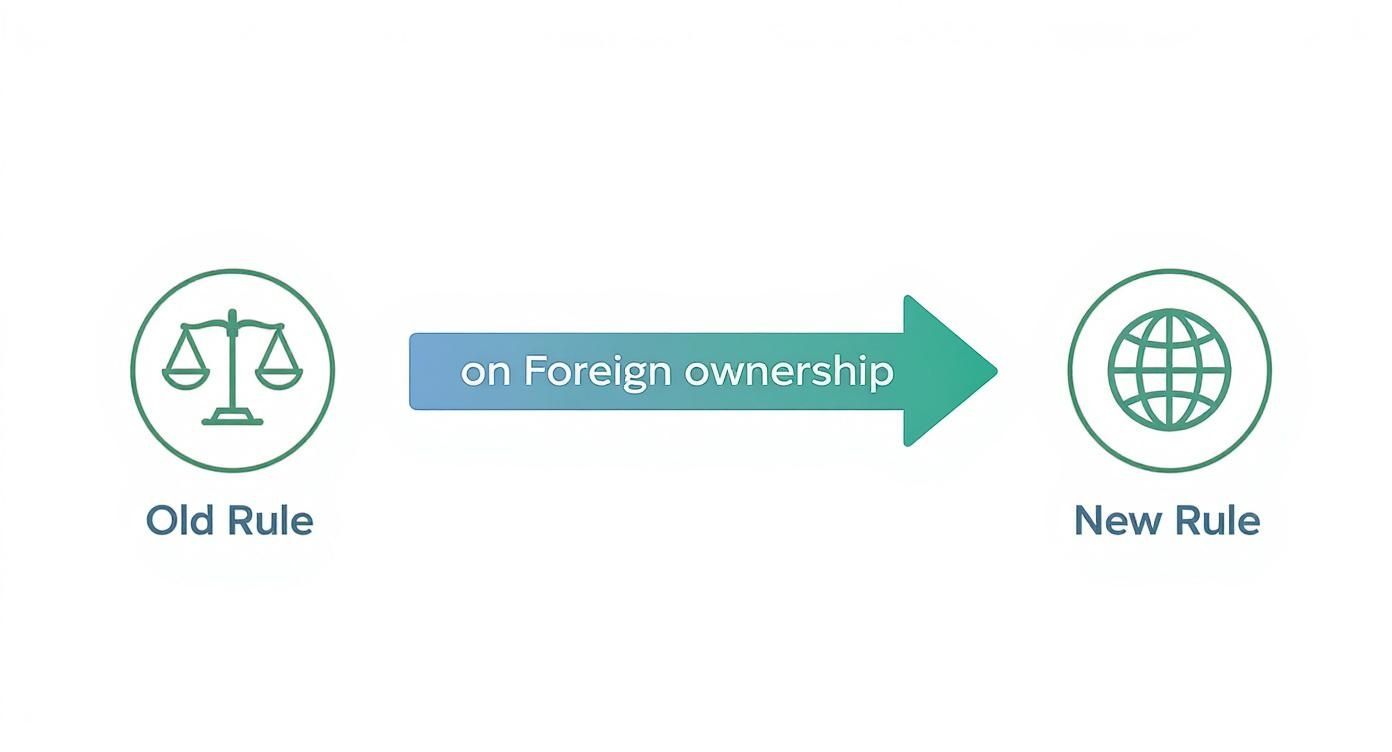
This shift is a game-changer, empowering foreign investors with full control over their businesses and removing a major barrier to entry.
The Final Submission and Licence Issuance
You've done the hard work: your trade name is reserved, Initial Approval is secured, the MoA is notarised, and your Ejari is in hand. Now it's time to bring it all together. The final stage involves submitting all these documents, along with passport copies for all partners and any other special approvals, to the DET.
The department will review your complete file. Once everything is verified, the DET issues a payment voucher for your trade licence fee. As soon as you pay it, your official trade licence is issued. From final submission to having the licence in hand, this part of the process usually takes just a few business days.
Congratulations! With your trade licence, your Dubai mainland company is officially registered and ready for business. You can now open a corporate bank account, process visas, and start your journey in one of the world's most dynamic business hubs.
Understanding the Costs of Your Dubai Mainland Setup
Budgeting for your mainland company setup in Dubai isn't about a single payment. It's a mix of one-time government fees and ongoing costs that you need to get a handle on from day one. Nailing down a realistic budget early on is one of the smartest things you can do to avoid surprises and keep your launch on track.
The total figure is a blend of government charges, third-party expenses, and the recurring costs of just keeping the lights on. While there's no magic number that fits everyone, we can break down the common components to give you a clear picture of what to expect.
One-Time Setup and Registration Fees
Your initial investment is all about getting that trade licence in your hands. These are the foundational, one-off payments that officially make your company a legal entity in Dubai.
Think of them as the building blocks for your business. They cover critical government approvals and administrative steps you'll only have to deal with at the very beginning.
Here’s a quick rundown of what those key one-time costs usually cover:
- Trade Name Reservation: A fee paid directly to the Department of Economy and Tourism (DET) to secure your unique business name.
- Initial Approval Certificate: This is the fee for the DET to green-light your business idea—a non-negotiable step before you can move forward.
- Memorandum of Association (MoA) Notarisation: If you’re setting up an LLC, your MoA needs to be legally notarised. This involves a fee paid to a public notary.
- Ejari Registration: The cost to register your office tenancy contract with the Real Estate Regulatory Agency (RERA).
Most of these fees are pretty standard, but the final total can shift a bit depending on how complex your MoA is or how many partners you have on board.
How Your Licence Type Affects the Cost
The kind of trade licence you choose—be it commercial, professional, or industrial—is a huge factor in your overall setup cost. Each licence category comes with its own fee structure, which is something you definitely want to consider during your planning.
A commercial licence, for instance, typically has a higher fee from the DET than a professional licence. This is often because commercial activities, such as general trading, may require more regulatory oversight.
Thankfully, the cost of setting up on the mainland has become much more competitive and transparent as the government works to attract global businesses. As a general rule, you can expect the average cost to establish a mainland company to fall somewhere between AED 15,000 and AED 30,000. This range usually covers government fees, licensing, a basic office rental, and the initial visa processing. A standard trading licence with a small office and three visas, for example, often lands around the AED 25,000 mark.
It's also important to remember that the UAE now has a 9% corporate tax on profits over AED 375,000, which applies to mainland companies. You can find more detailed breakdowns on the costs of a Dubai mainland company setup on kgrnaudit.com.
Knowing the cost difference between licence types isn’t just about the initial fee. It can also impact your annual renewal costs and even the kind of office space you’re required to rent.
To give you a clearer idea, here's a simple comparison of what to expect. Keep in mind these are just estimates; the final numbers can change based on your specific business activities and whether you need any external approvals.
Estimated Dubai Mainland Company Setup Costs
| Cost Component | Professional Licence (Estimate) | Commercial Licence (Estimate) | Notes |
|---|---|---|---|
| Trade Name & Initial Approval | AED 850 – AED 1,200 | AED 850 – AED 1,200 | Standard government fees. |
| MoA Notarisation | AED 1,500 – AED 2,500 | AED 2,000 – AED 3,500 | Varies with share capital and complexity. |
| Trade Licence Fee (DET) | AED 8,000 – AED 12,000 | AED 10,000 – AED 15,000 | The core fee, which differs by activity. |
| Office Rent & Ejari | AED 5,000+ (Flexi-desk) | AED 15,000+ (Physical Office) | Office requirements can vary significantly. |
| Total Estimated One-Time Cost | AED 15,350+ | AED 27,850+ | Excludes visas and other variable costs. |
This table provides a baseline, but always budget for a little extra to cover any unforeseen expenses that might pop up.
Looking Ahead to Annual and Ongoing Costs
Your financial planning doesn't end once you have the licence. To keep your company in good standing, you need to budget for annual recurring costs.
The biggest one is your trade licence renewal, paid to the DET every year. This renewal fee is often similar to what you paid for the initial licence. You'll also have to renew your office tenancy contract and any other related permits annually.
Other ongoing expenses to factor into your business plan include:
- Visa renewal fees for yourself and your employees.
- Salaries and general administrative overhead.
- Accounting, bookkeeping, and potential audit fees.
- Corporate tax payments if your profits cross the threshold.
By planning for both the one-time setup fees and the recurring annual costs, you set your Dubai mainland company up for long-term success without any nasty financial surprises down the line.
Life After Licensing Your Compliance Checklist
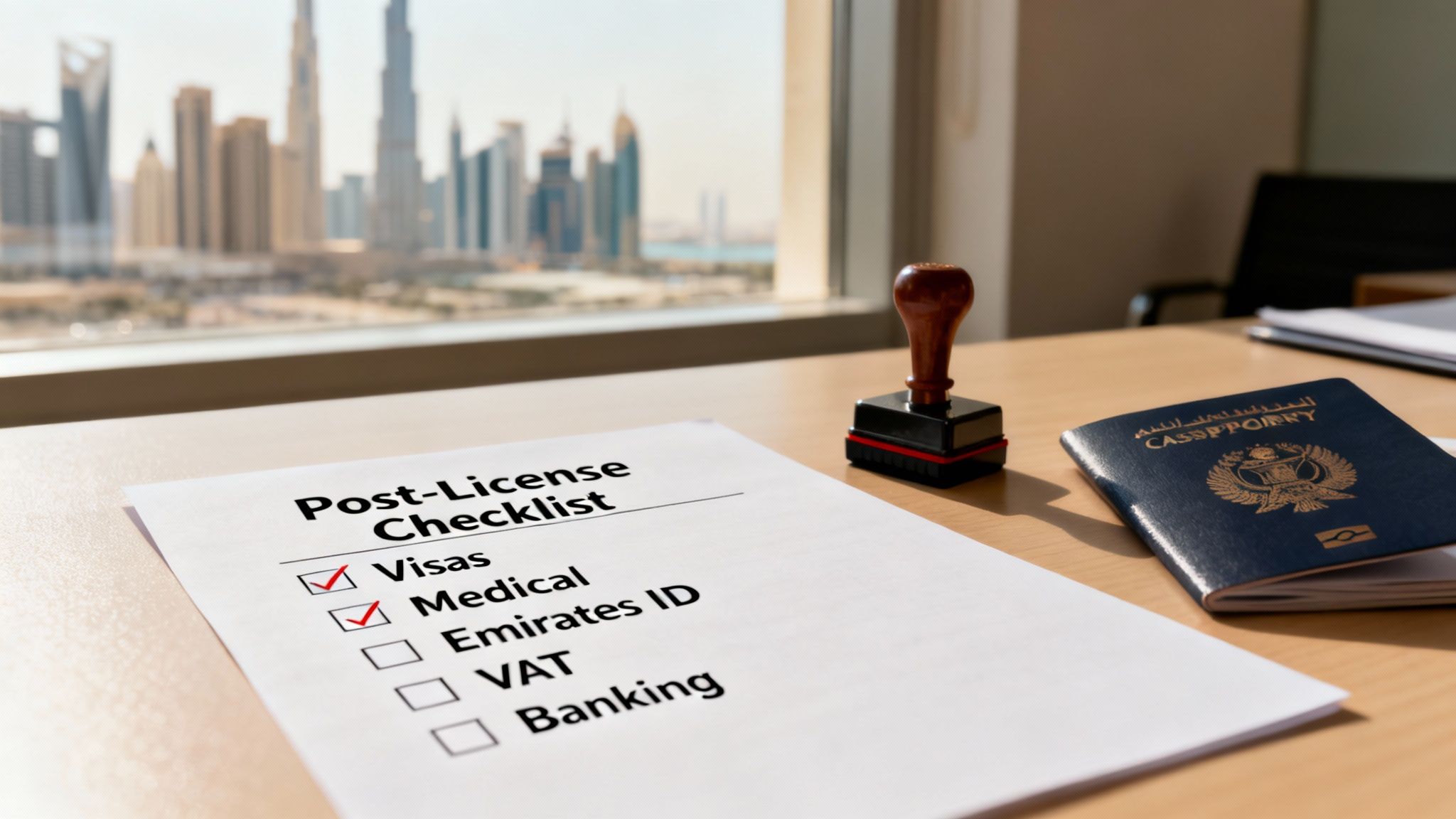
Getting your trade licence in hand is a huge milestone on your mainland company setup Dubai journey. It’s a moment to celebrate, for sure. But think of it as the starting pistol firing, not the finish line tape. What you do next is what truly builds the foundation for a successful business.
This is where you shift gears from paperwork to practical operations. The focus now turns to sorting out visas, opening your bank account, and getting your financial house in order. Essentially, you've just built the chassis of your car; now it's time to install the engine, get the driver behind the wheel, and make sure it's road-legal. This checklist will walk you through the non-negotiables every new mainland business owner needs to handle.
Navigating the Visa and Emirates ID Process
Your first order of business is usually getting your own residency sorted. As the company owner, your visa application paves the way for sponsoring your team. The entire process is managed by the General Directorate of Residency and Foreigners Affairs (GDRFA), and it demands careful attention to detail.
Here's how the journey to residency typically unfolds:
- Apply for an Establishment Card: Before you can sponsor anyone, your company needs its Establishment Card from the Ministry of Human Resources and Emiratisation (MOHRE). This is what officially registers your company as an employer.
- Get the Entry Permit (Employment Visa): With the card issued, you can apply for an entry permit for yourself and any staff. This is the document that allows someone to enter the UAE for work.
- Complete the Medical Fitness Test: After entering the country (or changing status if you're already here), every visa applicant must pass a mandatory medical exam at a government-approved health centre to screen for specific communicable diseases.
- Emirates ID Biometrics and Visa Stamping: Once you have the passed medical report, the final steps are visiting a centre for Emirates ID biometrics (fingerprints and photo) and then getting the actual visa sticker stamped into your passport.
This exact process is repeated for every employee you hire. One of the major perks of a mainland setup is the generous visa quota you get compared to most free zones, a critical advantage if you plan on growing your team.
Setting Up Your Corporate Bank Account
This is a step that trips up a lot of new entrepreneurs. Opening a corporate bank account in Dubai isn't as simple as walking in with your new trade licence. UAE banks are incredibly thorough with their due diligence to comply with strict anti-money laundering (AML) and know-your-customer (KYC) rules.
To give yourself the best shot at a quick approval, you need to show up over-prepared.
- The Basics: Have your trade licence, Memorandum of Association (MoA), and passport copies for all shareholders ready to go.
- The Extras: Banks will almost certainly ask for more. This often includes a detailed business plan, professional profiles of the shareholders, and sometimes even six-month bank statements from a personal or existing business account to show financial history.
- Physical Presence: Plan for this—most banks require the business owner(s) to be physically present in the UAE to sign the final account opening forms.
Don’t underestimate how long opening a bank account can take. It can easily stretch into several weeks, and any delay here puts your entire operation on hold. Get your file in order and be completely transparent about your business activities from day one.
Managing Your Financial and Tax Obligations
Running a mainland company in Dubai means you have clear financial responsibilities. Staying compliant isn't just a good idea; it's a legal requirement that protects the long-term health of your business. Right out of the gate, you need to get to grips with Value Added Tax (VAT) and Corporate Tax.
Value Added Tax (VAT): If you expect your company’s annual revenue to be over AED 375,000, you are legally required to register for VAT with the Federal Tax Authority (FTA). If your turnover is between AED 187,500 and AED 375,000, you can register voluntarily. Getting this right and filing on time is crucial for avoiding hefty penalties. For a detailed guide, see our article on how to register for VAT in the UAE.
Corporate Tax: As of 1 June 2023, the UAE has a federal Corporate Tax. If your business earns a net profit of more than AED 375,000, it will be subject to a 9% tax rate. This makes diligent, accurate bookkeeping an absolute necessity for calculating and reporting your taxable income correctly.
Keeping clean, organised accounts is no longer just good business sense—it’s the law. Put a solid accounting system in place from the very beginning. It will save you a world of stress and money down the line, ensuring you’re always ready for VAT filings and your annual corporate tax returns.
Got Questions About Your Dubai Mainland Setup? We've Got Answers
Even with the best roadmap, you’re bound to have questions when setting up a mainland company in Dubai. It's only natural. We've pulled together some of the most common queries we hear from entrepreneurs to give you straight, practical answers.
Think of this as your personal FAQ for navigating the finer points of the process—from office rules to visa numbers and realistic timelines. Getting these details right can make all the difference.
Do I Really Need a Physical Office?
Yes, this is a big one. For a Dubai mainland company, a physical office address is a legal must-have. You simply cannot get a trade licence without a registered tenancy contract, known as an Ejari. This is a major distinction from many free zone setups, which often dangle flexi-desks or virtual offices.
But don’t let the term "physical office" scare you. It doesn't have to mean a sprawling corporate suite. Depending on your business activity and how many visas you're after, a dedicated desk in a co-working space can do the trick, as long as it comes with a valid Ejari.
How Many Visas Can My Company Actually Get?
Here’s where a mainland setup truly shines. One of its biggest draws is the generous visa potential. Unlike free zones that often tie you to strict visa limits based on your package or small office size, mainland companies offer much more room to grow.
The number of visas you're eligible for is typically linked to the square footage of your office. The general rule of thumb is about 100 square feet per visa, though this can vary. The Department of Economy and Tourism (DET) uses this to ensure you have a proper workspace for your team. It’s a model built for scaling—as your team grows, so can your visa quota.
For ambitious companies planning serious growth, the ability to apply for a virtually unlimited number of employee visas is a game-changer. It removes a major headache that businesses in other jurisdictions constantly bump up against.
What’s a Realistic Timeline for the Whole Process?
It's tempting to look for the fastest possible route, but it’s better to have a realistic timeline. From reserving your company name to having that trade licence in your hands, a straightforward mainland company setup in Dubai usually takes about one to two weeks.
But a few things can shift that timeline:
- External Approvals: If your business is in a field like healthcare, education, or engineering, you'll need a thumbs-up from other government ministries, which can add extra time.
- Getting Your Documents in Order: This is where delays often creep in. If your Memorandum of Association (MoA) isn't drafted correctly or shareholder documents are missing, the clock stops.
- The Bank Account: Don't forget this crucial post-licence step! Opening your corporate bank account happens after you get your licence and can easily take another few weeks.
The single best way to stay on the shorter end of that timeline? Have all your paperwork perfectly prepared from day one.
Can I Put Multiple Business Activities on One Licence?
Absolutely. You can bundle multiple business activities under a single trade licence, as long as they fall into the same category (like all commercial, or all professional). It’s a smart, cost-effective way to run a diversified business without juggling multiple licences and their associated fees. For instance, a single commercial licence could let you trade in both electronics and apparel.
The key is to make sure all activities are compatible and approved by the DET. Trying to mix wildly different activities might force you into a separate licence, so it’s always best to check with a setup expert first.
Navigating these questions is much simpler with an expert partner. Smart Classic Business Hub handles every detail of your Dubai mainland setup, from initial approvals to visa processing and bank account support, ensuring a fast and compliant launch. Let us manage the complexities so you can focus on your business. Get a free consultation today!