There’s a popular myth that you need a mountain of cash to launch a business in Dubai. It’s an idea that stops a lot of good entrepreneurs in their tracks, but honestly, it’s just not true.
The reality is, a low-cost business setup in Dubai is entirely achievable. It all comes down to making smart, strategic decisions right from the start, especially when you know how to pick the right free zone or navigate the mainland process efficiently. This guide is your playbook for making those budget-conscious choices from day one.
Your Roadmap to an Affordable Dubai Launch
Kicking off a new venture in the UAE is an exciting prospect, but the initial costs can look pretty intimidating. The secret to an affordable launch isn't about cutting corners; it's about making informed choices that actually fit your business model and your wallet. Whether you're a freelancer, an SME, or an international investor, Dubai has several paths designed to get you started without demanding a massive upfront investment.
Think of this guide as your personal roadmap, here to cut through the noise of complex rules and hidden fees. My goal is to give you a crystal-clear picture of the main costs you’ll face and, more importantly, how to keep them under control.
We'll zero in on the big financial decisions you need to get right:
- Licensing Fees: We'll look at how your business activity and your choice of jurisdiction (free zone vs. mainland) are the biggest factors affecting this core expense.
- Visa Costs: I’ll break down exactly what you can expect to pay for investor and employee visas, so you can budget with confidence.
- Office Space Solutions: Forget expensive traditional leases. We’ll compare smart, budget-friendly options like flexi-desks and co-working spaces that give you a professional address without the overhead.
By focusing on value and efficiency, you can establish a fully compliant and professional business presence in Dubai for a fraction of what most people think it costs. It’s all about putting your money where it counts—fuelling your company's growth.
Ultimately, this guide is a practical tool to help you turn your vision into a real, affordable business. We’re moving beyond generic advice to give you actionable steps and insights from real-world experience. You'll learn how to sidestep common financial traps and spend smarter, building a solid foundation for success in one of the world's most dynamic business hubs. It’s about starting your journey with financial prudence, giving your dream the space to flourish without being weighed down by unnecessary costs.
Choosing Your Jurisdiction: Free Zone vs. Mainland
Getting this right is probably the single most important decision you'll make when setting up a business in Dubai, especially if you're keeping a close eye on costs. This isn't just about paperwork; it's a strategic call that will define your ownership structure, your operational freedom, and ultimately, your bottom line.
Forget the one-size-fits-all advice. Let's dig into what this choice actually means for your specific business.
This simple decision tree helps you see if a lean, low-capital start is the right path for your venture.
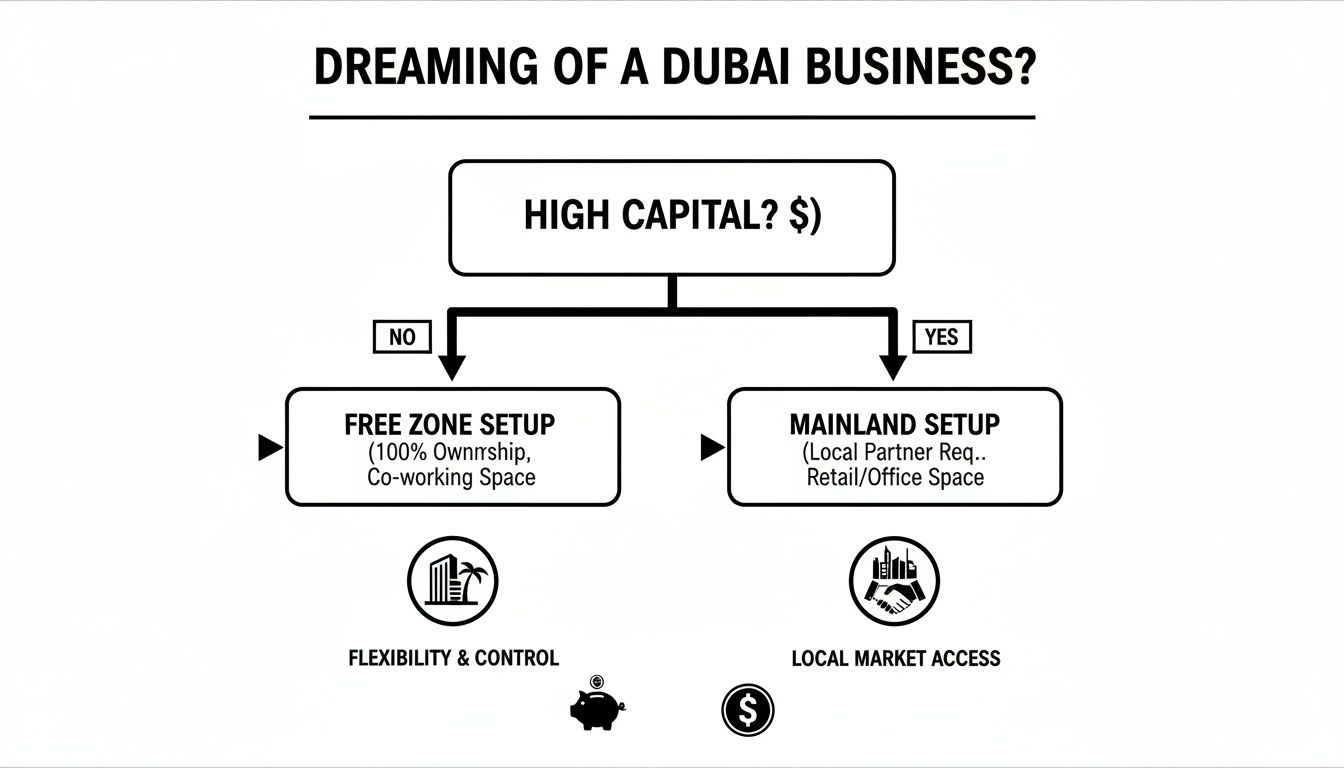
As you can see, a low-capital entry is a very popular and smart route for many entrepreneurs, often pointing them toward the cost-effective world of free zones.
Understanding the Free Zone Advantage
Dubai's free zones are a godsend for entrepreneurs wanting a fast, affordable entry into the UAE market. We're talking minimal investment for maximum benefits. The growth is explosive. Take the Dubai International Financial Centre (DIFC) as an example: in 2024, it was home to 6,920 active companies, a staggering 25% jump from 2023. This boom isn't just in numbers; their revenues hit AED 1.78 billion, a 37% year-on-year increase.
These figures prove the immense appeal of free zones, where a tech startup can get off the ground for as little as AED 15,000-25,000 using a flexi-desk or virtual office.
So, what is a free zone? Think of it as a designated economic area with its own set of rules designed to attract foreign investment. For a new business owner focused on the budget, this is a game-changer.
The benefits are hard to ignore:
- 100% Foreign Ownership: This is the big one. You own your company outright, no local partner needed.
- Tax Exemptions: Most free zones offer 0% corporate and personal income tax for a set period. This goes straight to your profit margin.
- Customs Perks: If you're in the import/re-export game, you can avoid customs duties, which is a massive cost saving.
- Painless Setup: The entire registration and licensing process is built for speed and simplicity, cutting down on admin headaches and costs.
If you want to get into the nitty-gritty, we've put together a detailed comparison of mainland vs freezone business setup in Dubai that breaks down even more details to help you decide.
Key Takeaway: A free zone is the default choice for most international businesses, consultants, and e-commerce ventures that don't need to trade directly within the local UAE market. The savings on ownership, taxes, and setup are just too good to pass up.
When Mainland Makes Sense
As attractive as free zones are, they're not for everyone. If your customers are right here in the UAE, a Mainland licence is almost certainly what you need. A Mainland company is registered with Dubai's Department of Economic Development (DED), giving you the freedom to trade anywhere in the country without restriction.
Here are a few scenarios where a Mainland licence is the only logical choice:
- Retail Businesses: Opening a café, a boutique, or an electronics shop? You need a physical presence on the mainland to serve local customers.
- Local Service Providers: Think construction companies, local marketing agencies, or maintenance services. Your clients are here, so you need to be here.
- Government Contracts: If you plan on bidding for lucrative government tenders, a mainland licence is a non-negotiable requirement.
The old fear of needing a local sponsor who owns 51% of your business is now largely a thing of the past. Recent legal reforms have opened the door for 100% foreign ownership across thousands of business activities on the mainland. This has made the mainland a far more appealing option for foreign investors who want to tap directly into the local economy.
Jurisdiction Showdown: Free Zone vs. Mainland at a Glance
To make the choice even clearer, let's break down the key differences side-by-side. This table cuts through the noise and gives you a direct comparison of what matters most when you're just starting out.
| Feature | Free Zone | Mainland |
|---|---|---|
| Ownership | 100% foreign ownership is standard. | 100% foreign ownership now available for most activities. |
| Market Access | Trade directly within the free zone and internationally. | Unrestricted trade anywhere in the UAE and internationally. |
| Office Space | Flexi-desks and virtual offices are common, lower-cost options. | Requires a physical office space with a registered tenancy contract (Ejari). |
| Taxation | 0% corporate and personal income tax for a guaranteed period. | Subject to UAE Corporate Tax (9% on profits over AED 375,000). |
| Government Tenders | Generally cannot bid for government contracts. | Eligible to participate in and win lucrative government projects. |
| Setup Cost | Typically lower, starting from AED 15,000. | Generally higher due to office and other requirements, starting from AED 30,000+. |
This table should give you a solid foundation, but the final decision always comes down to your specific business model and long-term goals.
Making the Final Call
Choosing your jurisdiction is all about balancing cost, control, and market access.
Let's use a real-world example. Say you're a freelance web developer. A cost-effective free zone like IFZA or Meydan is a perfect fit. You can get your licence, a flexi-desk for a professional address, and a visa, all on a tight budget. Since your clients are global, you don't need direct access to the local UAE market.
Now, imagine you're opening a specialty coffee shop in Jumeirah. Your customers are the residents and tourists walking by every day. In this case, you absolutely need a Mainland licence to secure a prime location and operate legally. The higher setup cost is a necessary investment to reach your target audience.
Ultimately, the best choice for a low-cost business setup in Dubai hinges entirely on your business model. Ask yourself: who are my customers, and where do I need to be to serve them? Answering that question honestly will set the foundation for your company's entire future.
A Realistic Breakdown of Your Core Setup Costs
Transparency is everything when you’re budgeting for a new venture. Vague estimates just won't cut it. So, let's get into the specifics of where your money will actually go during a low-cost business setup in Dubai. Knowing these core components inside and out is the key to dodging surprise fees and putting your funds where they matter most.
The main expenses fall into a few key buckets, each with its own variables. The good news? For every big-ticket item, there's usually a leaner, more budget-friendly alternative that keeps your initial investment in check.
Unpacking Your Trade Licence Fees
Your trade licence is your official permission slip to operate, and it’s not just one single fee. Think of it more like assembling a custom package for your business, where the total is a sum of several smaller, specific charges.
The biggest factor influencing your licence cost is your chosen business activity. A general trading licence, for example, will always be more expensive than a specific consultancy permit simply because it covers a much wider scope of operations.
Here’s a look at the typical parts that make up your total licence fee:
- Trade Name Reservation: A small but mandatory first step to secure your unique company name.
- Initial Approval: Before the final licence is issued, the authorities give a preliminary nod to confirm they're okay with your proposed business.
- Licence Issuance Fee: This is the main chunk of the cost, and it varies depending on your jurisdiction (free zone or mainland) and activity.
- Establishment Card: This is essential for processing visas and is a standard part of any company formation.
Understanding that your business activity is a major cost driver is crucial. Choosing a highly specific service activity over a broad one can often lead to significant savings on your initial licence fee.
Finding Affordable Office Space
For a low-cost business setup in Dubai, a traditional office lease is almost always off the table. It's a massive, unnecessary expense when so many flexible and affordable alternatives exist. Your office solution just needs to be compliant with your licence requirements—it doesn't have to be expensive.
Co-working spaces and flexi-desks are the go-to solutions for budget-conscious entrepreneurs. These options give you a legitimate business address and a professional place to work without the headache of a long-term lease or the extra costs of utilities and maintenance.
- Flexi-Desk: This is the most economical choice. You get access to a shared desk in a business centre, which is perfect for freelancers and solopreneurs who need a registered address and an occasional workspace.
- Co-working Membership: A step up from a flexi-desk, this usually gives you more flexible access and the chance to network with other professionals in the community.
- Virtual Office: This option provides a professional business address, mail handling, and sometimes a dedicated phone number, all without any physical office. It's ideal for businesses that operate remotely.
Demystifying Visa Costs
Visa processing is another core expense you need to nail down in your budget. The total cost for a single visa is made up of several stages, and you need to account for all of them. Whether you're getting your own investor visa or sponsoring an employee, the process and fees are quite similar.
The main components you'll be paying for are:
- Entry Permit: The initial permission for you or an employee to enter the UAE for work.
- Medical Fitness Test: A mandatory health screening for all residents.
- Emirates ID Application: The fee for issuing your national identity card.
- Visa Stamping: The final step where the residence visa is physically placed in your passport.
For a more detailed analysis, we have an in-depth guide covering the full cost of starting a business in Dubai, which breaks these figures down even further. As a rule of thumb, expect a single visa to cost somewhere between AED 3,500 and AED 5,000, depending on the jurisdiction and whether you opt for any fast-tracking services.
The Value of PRO Services
It might seem counterintuitive to spend money on a service when you're trying to save, but hiring a professional for Public Relations Officer (PRO) services is one of the smartest investments you can make. These are the experts who handle all the government paperwork, submissions, and follow-ups for your licence and visas.
Trying to navigate this complex administrative maze on your own can easily lead to costly mistakes, rejected applications, and frustrating delays. A small fee for a PRO service ensures everything is done correctly the first time. They know the exact requirements, preventing the kind of back-and-forth that can stall your launch for weeks, saving you time and, ultimately, money.
Staying Compliant with Taxes and Finances
Getting your trade license is a huge win, but let's be honest—it’s just the starting line. Your long-term success in Dubai really comes down to how well you manage your company’s finances from day one. The good news? The UAE’s tax system is designed to be friendly to new businesses, especially those working with a tight budget.
A lot of entrepreneurs hear "tax" and immediately brace for complicated rules and high costs. But once you understand Dubai’s straightforward approach, you’ll see it’s built to help you grow, not hold you back. Let's walk through the two main things you need to have on your radar.
Navigating Value Added Tax (VAT)
Value Added Tax, or VAT, was introduced back in 2018 at a standard rate of 5%. It's a simple consumption tax applied to most goods and services. For a new business, the most important detail here is the registration threshold.
You're only legally required to register for VAT once your taxable sales and imports top AED 375,000 over the last 12 months. This threshold is great for small businesses and freelancers just starting out, as it means you probably don't have to worry about VAT right away.
However, you can register voluntarily if your turnover is over AED 187,500. This can be a smart move if most of your clients are VAT-registered businesses, because it lets you claim back the VAT you pay on your own expenses. Staying compliant is as simple as filing quarterly returns and keeping your books in order. For a deeper dive, check out our guide on how to register for VAT in the UAE.
Understanding the Corporate Tax Framework
The arrival of Corporate Tax in 2023 was a big deal, but it was rolled out with small businesses and startups in mind. The standard rate is 9%, which is already one of the lowest you'll find anywhere in the world.
The real game-changer for anyone planning a low-cost business setup in Dubai is the profit threshold. Corporate Tax only kicks in on annual taxable profits that are more than AED 375,000. If your net profit is below that magic number, your corporate tax bill is 0%.
This "small business relief" is a massive advantage. It means startups and SMEs can pour every dirham of their early profits back into the company to fuel growth, without worrying about a tax hit. It’s a clear message that Dubai wants new ventures to get off the ground and scale up.
The UAE's tax-friendly policies make a low-cost business setup in Dubai exceptionally attractive, balancing incentives with compliance for sustainable growth. While many free zones boast zero corporate tax, mainland firms benefit from the 9% rate on profits over AED 375,000 and the 5% VAT—far below global averages. This framework helped fuel a 37% revenue spike in a major financial centre like DIFC in 2024. Expert guidance is key to navigating requirements like e-invoicing and corporate tax registration to avoid significant penalties. Discover more insights about business opportunities in Dubai on registerkaro.in.
Why Bookkeeping Is Not a Luxury
With such clear tax rules, it becomes obvious that professional bookkeeping isn’t just a "nice-to-have." It’s not something you can just put off—it's absolutely essential for staying compliant and keeping your business financially healthy.
From your very first sale, keeping clean, organised records is a must. Tidy books help you:
- Keep an eye on your VAT threshold. Without accurate numbers, you won't know when you’re about to cross the mandatory registration line, and that can lead to fines.
- Calculate Corporate Tax correctly. Your financial statements are what you'll use to figure out your taxable profit. You can't just guess.
- Steer clear of penalties. The Federal Tax Authority (FTA) is serious about compliance and has strict penalties for late registrations and incorrect filings.
- Make smarter decisions. Good financial data gives you a clear picture of your cash flow, helps you manage spending, and lets you plan for the future.
Honestly, investing in professional accounting or bookkeeping right from the start is one of the smartest things you can do. It saves you a world of headaches down the road, keeps you on the right side of the law, and gives you the financial clarity you need to run your business well.
Your Actionable Launch Checklist
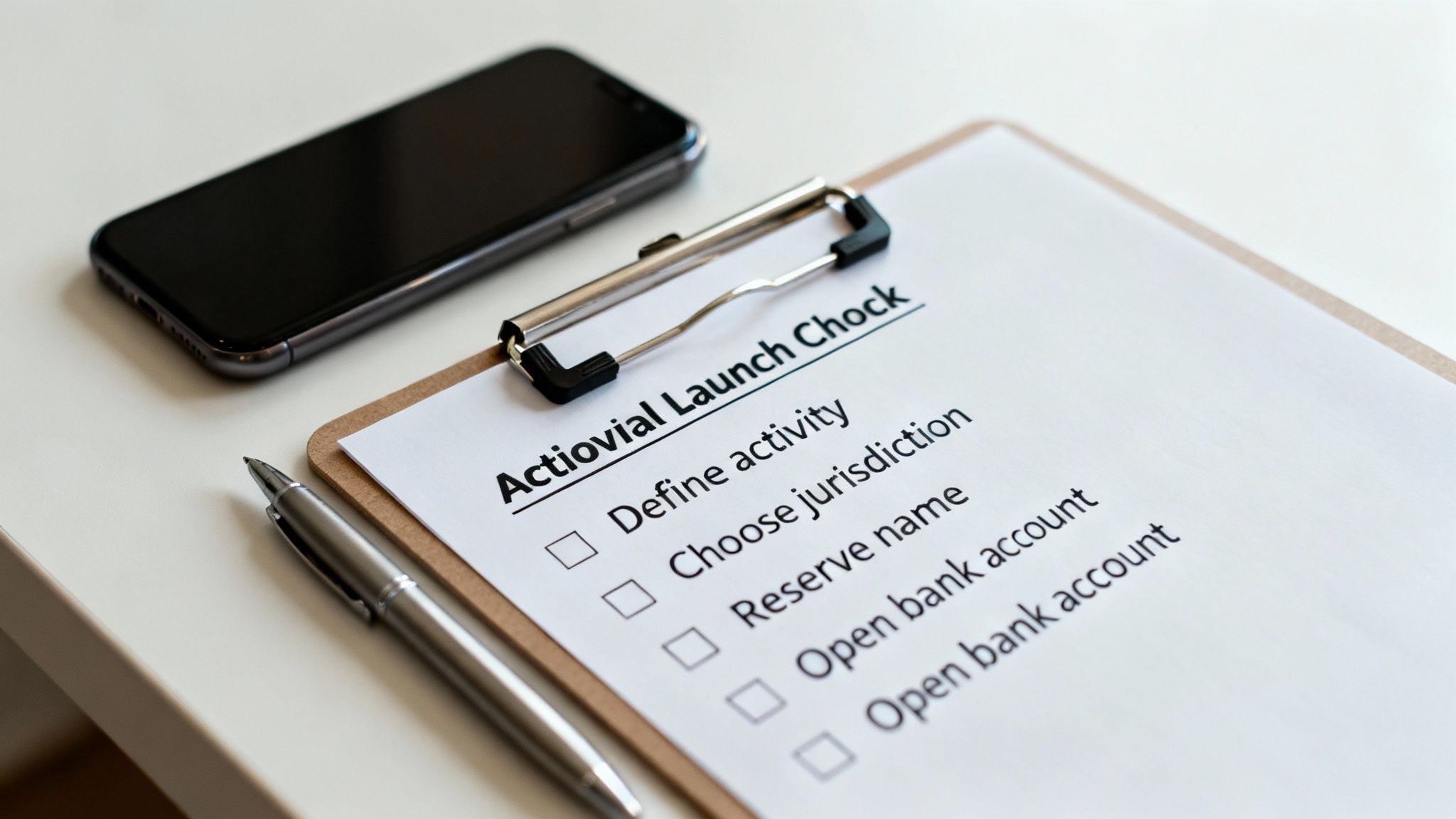
Putting all the pieces together can feel like a mammoth task, but a clear plan turns complexity into simple, manageable actions. I've designed this checklist as a practical roadmap to guide you through every critical phase of your low-cost business setup in Dubai.
Think of it as your personal project plan for a smooth launch. We'll start with the big-picture decisions and drill down to the final steps that get you fully operational, making sure nothing gets missed along the way.
Phase 1: Initial Planning and Decisions
The choices you make right at the start set the entire foundation for your business journey. Getting this phase right will save you a world of time, money, and stress later. It’s all about aligning your business model with the right legal and operational framework from day one.
- Define Your Business Activity: Be laser-focused here. A "Digital Marketing Consultancy" licence is almost always cheaper than a broad "General Trading" one. This single decision heavily impacts your final licence cost.
- Finalise Your Jurisdiction: Based on your activity and who you'll be selling to, make the final call between a free zone and the mainland. For service providers and those with international clients, free zones are typically the most affordable and direct route.
- Select and Reserve Your Trade Name: Come up with three to five potential company names that follow UAE naming conventions. Trust me, have backups ready. Your first choice might be taken, and this simple prep will speed up the reservation process.
Phase 2: Document Preparation and Application
With your core decisions locked in, it's time for the paperwork. Organisation is your best friend here. Having every document correctly prepared and ready to go prevents the small delays that can quickly snowball.
- Gather Shareholder Documents: You'll need clear, colour passport copies for all shareholders. Also, get passport-sized photos with a white background – they are surprisingly strict about the specifications.
- Prepare Your Business Plan: It doesn't need to be a novel. A concise, one-page business plan is incredibly useful, especially when you're ready to open your corporate bank account.
- Submit Your Application: This is where you formally submit everything to your chosen jurisdiction. Working with a business setup consultant at this stage can be a real lifesaver, helping you sidestep common and costly errors.
Dubai's vibrant economy and supportive infrastructure make a low-cost business setup a seriously high-return strategy for savvy entrepreneurs. The free zones, in particular, offer accessible entry points starting from around AED 15,000, complete with full ownership and tax advantages perfect for modern industries like AI and fintech. With over 5,600 startups launching in just the second quarter of 2024, the opportunities are massive. You can learn more about how to launch a profitable venture in Dubai on tdabeer.com.
Pro-Tip: I tell all my clients to do this: create a dedicated digital folder (on Google Drive, Dropbox, etc.) with clearly labelled subfolders: "Passports," "Visa Photos," "Application Forms." This simple step will save you from frantically searching for files later.
Phase 3: Becoming Operational
Once that trade licence is in your hands, you’re officially in business. But there are a few more hurdles to clear before you're fully up and running, especially when it comes to visas and banking. This final phase turns your licensed company into a functioning enterprise.
- Open Your Corporate Bank Account: This is a critical step that, frankly, can sometimes cause delays. Go to the bank prepared with all your company documents, shareholder information, and that clear business plan I mentioned. It makes the process much smoother.
- Process Your First Visa: Kick off the visa process for yourself or your primary employee. This involves applying for the entry permit, undergoing the medical fitness test, and finally, getting that all-important visa stamped in your passport.
- Register with Relevant Authorities: Depending on your business, you might need to register with customs. If you hire UAE nationals, you'll deal with the General Pension and Social Security Authority (GPSSA). And don't forget to keep an eye on your revenue for VAT registration once you approach the mandatory threshold.
Your Questions, Answered
When you're planning a business setup in Dubai, especially on a tight budget, a lot of practical questions pop up. Getting these sorted out early saves you time and headaches down the road. Let's tackle the most common ones I hear from entrepreneurs.
Here are some straight-to-the-point answers on everything from your initial budget and ownership rules to timelines and the infamous bank account hurdle. Think of this as your quick-reference guide to getting launched smoothly and affordably.
Can I really start a business in Dubai for under AED 20,000?
Yes, you absolutely can. This price point is most realistic for service-based businesses like consultancies or freelancers. The trick is to find a free zone package that bundles your trade licence, a flexi-desk, and one residence visa all together.
Going this route, your core setup costs will likely land somewhere between AED 15,000–18,000. Just remember to budget separately for the essentials that come after, like your visa processing, medical test, and Emirates ID, which usually add another AED 3,500–5,000 to the total. Factoring these in from day one prevents any nasty surprises.
- Licence & Visa Bundle: AED 15,000–18,000
- Visa & Emirates ID Fees: AED 3,500–5,000
- PRO Services: AED 1,500–2,500
Budget Considerations
Do I still need a local sponsor for a mainland company?
Good news—in most cases, you don’t. Thanks to recent reforms in the UAE, 100% foreign ownership is now the standard for thousands of business activities on the mainland. The old rule requiring a 51% Emirati partner has been scrapped for the majority of businesses.
However, a handful of strategic sectors still have specific ownership regulations. It's crucial to double-check where your specific business activity falls. A quick chat with a setup specialist can confirm you're choosing the right licence and won't face any unexpected sponsor requirements later.
Expert Insight: While the new laws have made mainland setups much more attractive for foreign investors, doing your homework on your specific business activity is still non-negotiable.
Ownership Rules
How long does the entire setup process take?
For a standard free zone company, you should plan for a timeline of 3–6 weeks from the day you apply to the moment you have your visa stamped in your passport. While the trade licence itself can be issued in just 2–5 days, the visa process is what takes up most of the time, as it depends on government approvals, your medical screening, and Emirates ID appointments.
If your documentation isn't perfect or your business activity is complex, expect delays. This is one area where hiring a good PRO (Public Relations Officer) service really pays off—they know how to navigate the system and can often cut down the timeline by avoiding common pitfalls.
| Setup Step | Typical Duration |
|---|---|
| Licence Issuance | 2–5 days |
| Document Approval | 1–3 weeks |
| Visa Processing | 1–2 weeks |
Timeline Overview
Is opening a corporate bank account difficult in the UAE?
Let's be honest: it can be a challenge. Banks here have very strict AML (Anti-Money Laundering) and due diligence checks. You'll need to have all your documents perfectly in order—your trade licence, Memorandum of Association, and passport copies are just the start. A solid, clear business plan is a must.
Startups often face the most scrutiny. This is where leaning on a consultancy with established banking relationships can make all the difference. They can introduce you to startup-friendly bankers and help you prepare a file that gets approved, not rejected. Also, make sure to ask about minimum deposit requirements and monthly balance rules upfront.
- Pro-Tip: Always get a clear breakdown of a bank's fee structure. Small monthly maintenance fees might not seem like a big deal, but they can eat into your cash flow over the year.
- Have a recent three-month personal bank statement ready to go.
- Prepare a sharp, one-page business plan that clearly shows your revenue projections.
- Ask your consultant which banks are actively looking for startup clients.
Ready to get started without the guesswork and costly mistakes? Partner with Smart Classic Business Hub for complete support, from finding the right licence and handling PRO work to getting your bank account opened. Contact our team for a free cost evaluation and a clear, personalised timeline. Don't leave your launch to chance—get expert guidance on your side today.