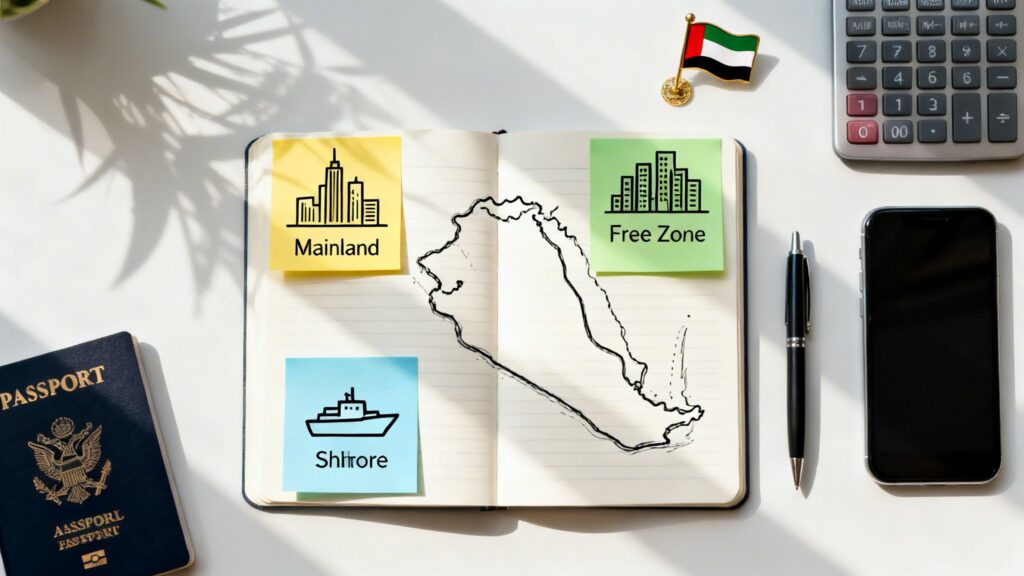
Getting an investor visa in the UAE might seem complex, but it really boils down to three main pathways. The specific investor visa UAE requirements you'll need to meet depend on your strategy: are you looking to buy property, start a new business, or make a significant financial investment to qualify for the prestigious Golden Visa?
Each route is designed with different financial thresholds and opens up different residency benefits.
Your Guide to the UAE Investor Visa Landscape
For entrepreneurs and investors around the world, securing long-term residency in the UAE is a major strategic move. The good news is that the country has deliberately moved away from old, bureaucratic hurdles, creating clear and genuinely attractive pathways to make this happen.
Think of the different visa options like tools in a toolbox, each built for a specific job. The right one for you really depends on your goals. Are you looking to plant roots by owning a home, build a bustling company, or simply make a stable, long-term investment?
This flowchart breaks down the main routes you can take.

As you can see, the Real Estate, Business, and Golden Visa routes each act as a unique entry point into the UAE, complete with their own rules and rewards.
Understanding the Key Visa Categories
Let's take a quick look at how these main categories cater to different types of investors.
- Real Estate Investor Visa: This is a straightforward path for anyone buying property in the UAE. The size of your investment directly impacts how long your visa will be valid.
- Business Investor Visa: Perfect for entrepreneurs. This is your ticket if you're setting up a company on the UAE mainland or within one of its dynamic free zones.
- The Golden Visa: The most coveted option. This visa grants a 10-year residency for those making larger investments in property, businesses, or approved local investment funds.
To give you an idea of how popular these programmes have become, consider this: in Dubai alone, the number of Golden Visas issued shot up to 158,000 in 2023. That's a massive vote of confidence from the global community in the UAE’s stable, tax-friendly environment. This incredible growth highlights just how successful the country has been in becoming a top destination for long-term residency in the UAE.
Demystifying The Golden Visa Requirements
The UAE Golden Visa is really the crown jewel of the country's residency options. It’s a remarkable 10-year, renewable visa that offers incredible stability and freedom.
What this visa does is decouple your residency from a specific employer. You can live, work, and study anywhere in the UAE without needing a national sponsor, giving you total control over your professional and personal life.

Unlike a standard residence visa, the Golden Visa has no minimum stay requirement. This gives you complete flexibility for global travel. It also comes with fantastic family sponsorship benefits, allowing you to sponsor your spouse, children (with no age limit for unmarried sons and daughters), and even your parents.
Investment Pathways To The Golden Visa
Getting your hands on this premier visa comes down to meeting certain investment criteria. While there are pathways for exceptional talents, doctors, and scientists, the most common routes for investors are through real estate or other financial contributions.
- Real Estate Investment: This is by far the most popular option. You need to own one or more properties with a total value of at least AED 2 million. The great thing is that these can be off-plan or completed properties, giving you more choice in your investment strategy.
- Investment Fund Deposit: A more straightforward path is to deposit AED 2 million into an accredited local investment fund. This is an excellent choice for those who prefer holding a financial asset over a physical one.
- Entrepreneur or Business Owner: You can also qualify by setting up a UAE-based company with a capital of AED 2 million or more. Alternatively, if you own a share in an existing company, your portion must be worth at least AED 2 million. Another route is if your company pays a minimum of AED 250,000 in federal tax each year.
A huge change in the investor visa UAE requirements has made the real estate option even more attractive. A February 2026 policy update removed the old rule that required a 50% down payment on mortgaged properties. Now, as long as the property's total value is at least AED 2 million, you can qualify even if it’s fully mortgaged.
This kind of forward-thinking regulation is exactly why the UAE continues to be a top global destination for residency by investment.
The Application Process And Key Documents
Applying for the Golden Visa is a pretty structured process. It all starts with making your qualifying investment and getting all the proof together. The application is typically handled online through the Federal Authority for Identity, Citizenship, Customs & Port Security (ICP) or the General Directorate of Residency and Foreigners Affairs (GDRFA) in the emirate you’re applying from.
Once you get the initial green light, you’ll need to complete a medical fitness test and provide your biometrics here in the UAE.
The checklist of documents will shift slightly depending on the investment path you choose, but the core requirements usually include:
- Passport copy
- Current visa copy (if you’re already in the UAE)
- Passport-sized photograph
- Proof of your investment (e.g., Title Deed from the Land Department, a letter from a UAE-accredited investment fund, or your company’s trade license and financial statements)
- Proof of medical insurance
To get a better sense of how the UAE's programme stacks up globally, looking into options like the EU Golden Visa for Property Investors can provide a useful comparison. It helps you really appreciate the unique advantages the UAE offers against other international programmes.
Securing Your Visa Through Property Investment

Using real estate to anchor your residency in the UAE is a popular and strategically sound move. Many see it as the most direct path to an investor visa, but it’s a route that demands careful planning to make sure your purchase lines up perfectly with the specific investor visa UAE requirements.
Think of it like this: your property is the key, but the visa application is the lock. For that key to turn smoothly, it has to be the right shape and size. This means hitting the minimum investment threshold, holding the correct ownership documents, and ensuring the property itself qualifies under government rules.
Ready vs Off-Plan Properties
One of the first, and most critical, decisions you'll make is whether to buy a ready property or go for an off-plan one.
A ready property is exactly what it sounds like—a completed unit you can move into or rent out straight away. This route usually offers a faster track to your visa because you can get the title deed in hand and kick off the application process almost immediately.
An off-plan property, on the other hand, is one you buy from a developer before construction is even finished. While you might get a more attractive price, you can't start the visa process until you've paid a certain amount of the property value or until the project is handed over and you receive the title deed. Your choice here has a major impact on your visa timeline.
To make sure your investment is solid, it's not enough just to meet the visa criteria; you need to know if you're getting a good deal. Learning how to calculate cap rate is a fundamental skill that helps you evaluate the financial return, ensuring your property is a strong asset, not just a visa tool.
Your Essential Document Checklist
Trying to apply for a property investor visa without all your documents in order is like trying to build flat-pack furniture without the instructions. It’s frustrating, time-consuming, and almost guaranteed to end badly. Getting your paperwork organised perfectly from the start is simply non-negotiable.
Here's a quick story to show you what I mean. An investor, let's call him Alex, bought a stunning apartment in Dubai Marina for AED 2.2 million. He was eager to get his Golden Visa but got hit with a three-week delay. The reason? His property valuation certificate wasn't from an evaluator approved by the Dubai Land Department (DLD). A tiny oversight, but it cost him precious time.
Let's make sure that doesn't happen to you. Organising your paperwork is the first step to a smooth application.
Property Investor Visa Document Checklist
Here’s a breakdown of the documents you’ll need to have ready. Think of this as your master list to avoid any last-minute surprises.
| Document | Description & Key Details | Where to Obtain |
|---|---|---|
| Title Deed or Oqood | Your ultimate proof of ownership. A Title Deed is issued for ready properties, while an Oqood certificate is for off-plan purchases. | Issued by the respective Emirate's Land Department (e.g., DLD in Dubai). |
| Passport & Current Visa | Clear, colour copies of your passport (valid for at least 6 months) and your current UAE visa (tourist or resident). | Your personal documents. Ensure copies are high-quality. |
| Passport-Sized Photo | A recent, high-quality photograph with a white background, conforming to UAE government standards. | Any professional photo studio. |
| Property Valuation Certificate | An official valuation confirming the property's market value meets the minimum threshold (e.g., AED 2 million for the Golden Visa). | From the Land Department or a DLD-approved real estate valuation firm. |
| Proof of Funds / Payment | Bank statements or an official letter from the developer/seller confirming that the minimum required amount has been paid. | Your bank, or the property developer/seller. |
| Police Clearance Certificate | A certificate from the UAE police confirming you have a clean criminal record within the country. | Can be requested online via the Dubai Police website or app. |
| Medical Fitness Test | A mandatory health screening to check for communicable diseases. | An approved government health centre in the UAE. |
Having these documents compiled and verified ahead of time will dramatically speed up your application and prevent the kind of frustrating delays that trip up so many applicants.
While these requirements are largely consistent across the UAE, you have to be aware of the small but crucial differences between Emirates. For example, Abu Dhabi has its own designated zones for foreign ownership that are different from Dubai’s. Always, always double-check the latest rules for the specific Emirate where you plan to put your money.
For any entrepreneur with their sights set on the UAE, an investor visa is more than just a residency permit. It’s the key that unlocks one of the most dynamic business hubs in the world. Starting a company here is one of the most straightforward paths to building a long-term future in the Emirates, but it all starts with understanding the ground rules.
The very foundation of your visa application is your company's structure. The first major fork in the road is choosing between a mainland and a free zone setup. This single decision will shape your ownership rights, your access to the market, and, crucially, your visa eligibility.
Mainland vs. Free Zone: The Critical Choice
Think of a mainland company as having an all-access pass to the entire UAE market. You can set up shop anywhere, trade directly with any customer, and bid on government contracts across the Emirates. While this freedom once required an Emirati partner, recent reforms now grant 100% foreign ownership for the vast majority of business activities.
A free zone company, in contrast, operates within a designated economic territory. These zones are often themed around specific industries like tech, media, or commodities. The big draw here is usually 100% ownership, tax benefits, and streamlined setup processes. The trade-off? Your direct business is typically confined to that free zone and international markets.
The choice between mainland and free zone isn't just a business decision; it's a visa decision. A mainland company ties your residency to the Department of Economic Development (DED) in that emirate. A free zone company links your visa to that specific zone's authority. Each has its own rulebook, costs, and procedures.
Capital Requirements and Your Trade Licence
Once you’ve picked your jurisdiction, your next mission is to get your trade licence. This is your official green light to operate and an absolute must-have for the investor visa process. Getting it involves several steps, from having your company name approved to drafting and submitting your Memorandum of Association (MOA).
A common question we get is about the capital needed. It really depends. Some free zones have no mandatory paid-up capital, while others might ask for anywhere from AED 50,000 to AED 250,000 or more. For a mainland company, while a strict minimum capital isn't always mandated by law anymore, you still need to show you have enough funds to get the business off the ground. For a more detailed look at this, you can check out our guide on how to start a business in the UAE.
Essential Documents for Your Business Investor Visa
With your company legally formed and your trade licence in hand, it's time to apply for the visa itself. Your residency is directly tied to your company's good standing, so getting your paperwork perfectly in order is non-negotiable.
Here’s a quick checklist of the core documents you’ll need to have ready:
- Company Trade Licence: The official proof that your business is legal and active.
- Memorandum of Association (MOA): This document outlines your company’s structure and who the shareholders are.
- Company Establishment Card: A vital document issued by the immigration authorities that links your company to their system.
- Company Bank Statements: You'll typically need to show the last three to six months to prove financial activity.
- Share Certificate: This confirms your ownership stake in the company.
- Passport Copies: Clear copies for yourself and any other partners in the business.
Having these documents organised and ready from the start doesn't just make the process smoother. It ensures you’re building a compliant foundation for both your business and your new life in the UAE.
Navigating Family Sponsorship and Visa Renewal
An investor visa is rarely just about you. For most people we work with, it's the first step toward building a new life in the UAE, and that almost always includes bringing family along for the journey.
Thankfully, the UAE’s family sponsorship rules are surprisingly straightforward, making it much easier to turn your residency into a genuine home for your loved ones.

Think of your investor visa as the master key. Once you have it, you can unlock residency for your immediate family, giving them the same security and lifestyle you came here for. This stability is a core part of the investor visa UAE requirements and a huge part of its appeal.
Who Can You Sponsor?
As the main visa holder, you can sponsor several family members. The process is designed to cover your core family unit, and in some cases, even extends to parents.
Generally, you can sponsor:
- Your Spouse (husband or wife).
- Your Children (sons and daughters). Golden Visa holders have a great advantage here, with no age limit for sponsoring unmarried children.
- Your Parents, though this usually requires a higher income threshold and proof that you are their sole financial provider.
The UAE's recent push for more flexible residency rules has been a massive draw for entrepreneurs. The government has expanded family sponsorship options without adding a lot of bureaucratic red tape. This, combined with the explosion in Golden Visas—with 158,000 issued in Dubai alone in 2023—has cemented the UAE's reputation as a top destination for families, not just businesses.
Maintaining Your Status Through Visa Renewal
Getting your investor visa is the first major milestone. The next, equally important step is keeping it active through regular renewal. As long as you’ve stuck to the original visa conditions, this is usually a smooth process.
Think of visa renewal as a regular health check for your residency. The authorities simply want to see that the reason your visa was granted—your investment in a property or an active company—is still valid.
To guarantee a hassle-free renewal, you just need to show that your investment is still in place. For a property investor, this means you still own the qualifying real estate. If you’re a business investor, your company must have a valid trade licence and be in good standing. This isn't just about paperwork; it's about demonstrating your ongoing commitment to the UAE economy.
The renewal itself involves submitting updated documents like a new medical test, valid health insurance, and either your renewed trade licence or property title deed. We always advise clients to start this process at least one month before their current visa expires to avoid any fines or last-minute headaches. To get a deeper look into the specifics, you can check out our detailed article on UAE residence visa renewal and its new rules.
Partnering with an Expert for a Smooth Application
Trying to navigate the different investor visa UAE requirements on your own can feel like trying to solve a puzzle with half the pieces missing. While the government lays out the rules, a single misplaced document or a poorly structured investment can bring everything to a grinding halt, leading to frustrating delays or even an outright rejection.
This is exactly where an expert guide changes the game. Working with a specialised consultancy like Smart Classic Business Hub takes the guesswork out of the equation and protects you from making costly mistakes. We manage the entire process for you, from the first eligibility check to handling all the paperwork and dealing directly with authorities like the GDRFA on your behalf.
From Business Setup to Visa in Hand
Our team is deeply experienced in both mainland and free zone company formation, which means we make sure your business is perfectly structured for visa eligibility right from the start. We don't just fill in forms—we build the proper legal and corporate foundation for your residency.
Think of us as your residency project manager. We take all the separate, complex parts—company registration, legal documents, PRO services, and the final visa submission—and manage them as one synchronised process. This ensures every single step is done right, on time, and in full compliance with the rules.
Partnering with a team that knows the system inside and out gives you a fast, smart, and dependable path to securing your UAE residency. It turns a bureaucratic headache into a clear and simple journey, so you can focus on what really matters: your investment and your new life in the Emirates.
Frequently Asked Questions About UAE Investor Visas
Even after covering the essentials, a few questions always pop up. Let's tackle some of the most common ones we hear from investors about the investor visa UAE requirements so you have all the answers you need.
Can I Apply for a UAE Investor Visa from My Home Country?
Yes, you can certainly get the ball rolling from abroad. This is a very common starting point for our clients.
If you’re investing in property, a Power of Attorney (POA) lets a trusted legal representative or consultant handle the property purchase and initial visa paperwork on your behalf. For those setting up a company, a consultant can manage the entire company formation and trade licence application process for you remotely.
Just remember, you will need to be in the UAE for the final, personal steps. This includes your medical fitness test and biometrics appointment, which must be done in person.
What Happens to My Visa if I Sell My Investment?
It's crucial to understand that your investor visa is directly linked to your qualifying asset. If you sell the property or close down the company that underpins your visa, the visa itself will be cancelled.
You won't be kicked out overnight, of course. The authorities will grant you a grace period to either leave the country or, more commonly, switch to a new visa under a different category. Before making a major decision like selling your investment, it's absolutely vital to speak with an expert to plan your next steps and ensure a seamless transition without any legal issues.
The Golden Visa stands out as a major exception to typical residency rules—it has no minimum stay requirement. This gives you incredible freedom to manage your global interests without ever worrying that your UAE residency will be voided. Standard investor visas, on the other hand, typically require you to be in the UAE at least once every 180 days to keep them active.
Navigating the investor visa process demands precision and deep local knowledge. Smart Classic Business Hub simplifies every step, from company formation to the final visa stamp in your passport, making sure your application is fast, smart, and dependable. Start your journey with confidence by contacting us at https://smartclassic.ae.