To legally work for yourself in Dubai, you first need a freelancer license. Think of it as your official permission slip to operate as an independent professional in one of the most exciting business hubs in the world. Whether you're a creative, a tech consultant, or a business strategist, this license is non-negotiable—it's your key to unlocking professional freedom and tapping into a massive market of potential clients.
Navigating the Dubai Freelance Landscape
Jumping into a freelance career in Dubai is a fantastic move. The city isn't just welcoming to independent professionals; it’s actively encouraging them. The numbers don't lie: the freelance market across the MENA region has seen registrations explode by an incredible 142 percent recently. Here in Dubai, the sector is growing at a solid 15 percent every single year. This isn't a fluke; it's a clear signal of the city's commitment to attracting top-tier global talent. You can learn more about the rise of freelancing in the UAE and its economic impact.
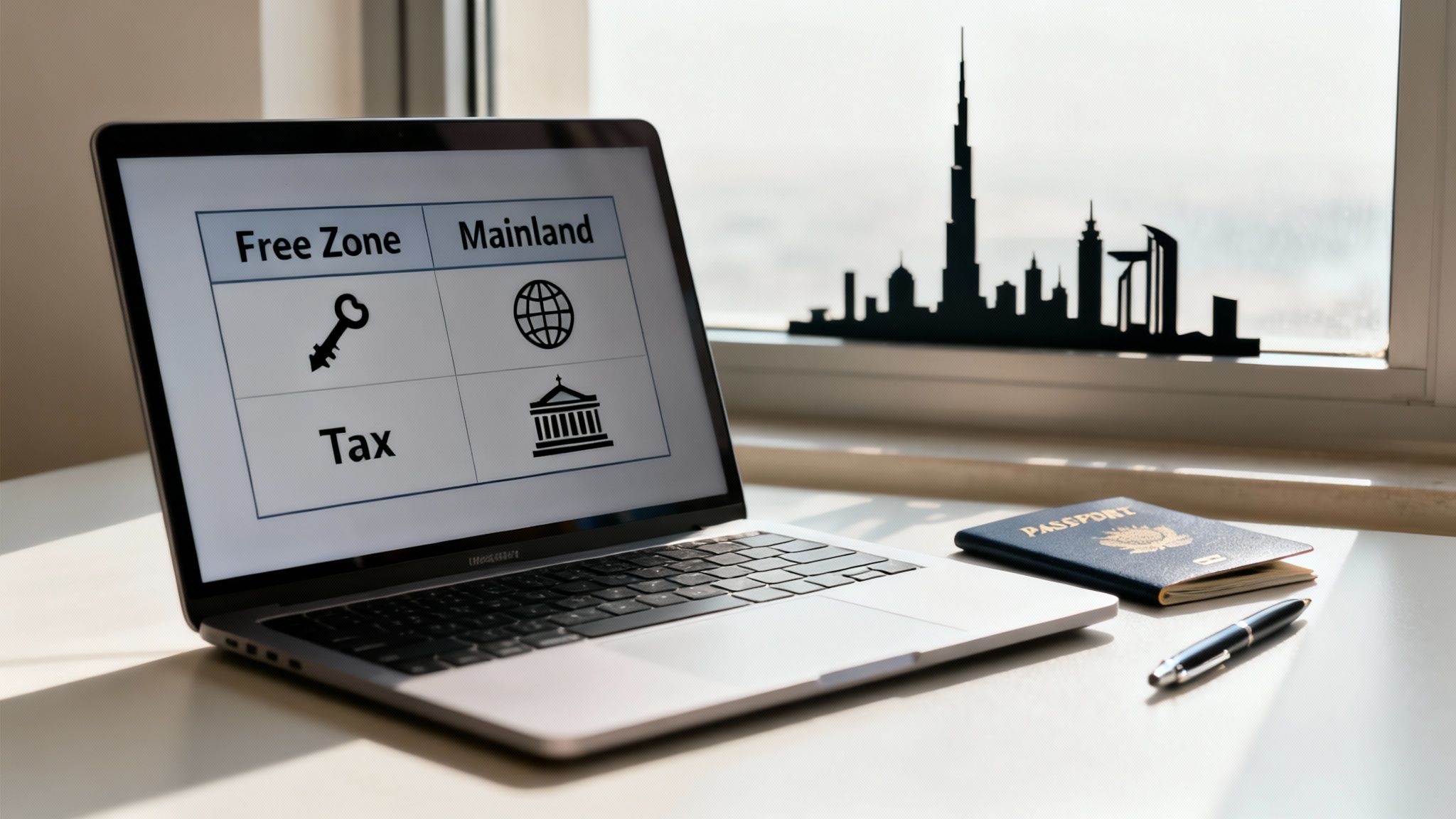
But before you start sending out invoices, you have a critical decision to make. It’s a choice that will fundamentally shape your business journey: will you get a permit in a free zone or a license on the mainland? This isn't just about paperwork. This decision determines who you can legally work with, where you can operate, and the entire legal structure of your freelance business.
Understanding Your Core Options
So, what’s the real difference? A free zone is best understood as a designated economic area, almost like a self-contained business community. Many of these zones are industry-specific—think Dubai Media City for creatives or Dubai Internet City for the tech crowd. Getting a freelance permit here usually comes with perks like 100% foreign ownership and some tax advantages. It’s a brilliant option if your client base is mostly international or concentrated within that specific free zone.
On the other side of the coin is a mainland license. Issued by the Department of Economy and Tourism (DET), this license gives you the freedom to work with anyone, anywhere in the UAE, without restrictions. Want to pitch your services to government bodies or major corporations headquartered in the heart of Dubai? A mainland license is your ticket. If your strategy involves casting a wide net across different sectors and bidding on public projects, this is almost certainly the way to go.
To help you get a clearer picture, I've put together a simple table that cuts through the noise and lays out the core differences.
Key Takeaway: The choice between a free zone and the mainland isn't about which one is "better." It's about which one is the right fit for your business model and future goals. Take a hard look at who your ideal clients are before you commit.
This comparison breaks down the main points so you can quickly see which path aligns with your ambitions as a freelancer in Dubai.
Quick Comparison Free Zone Permit vs Mainland License
| Feature | Free Zone Freelance Permit | Mainland Professional License |
|---|---|---|
| Client Access | Limited to clients within the same free zone or internationally. Cannot directly work with mainland companies. | Unrestricted access to clients across the entire UAE market, including government entities. |
| Ownership | 100% foreign ownership, no local partner needed. | 100% foreign ownership for most professional activities. A Local Service Agent (LSA) is sometimes required, but they hold no shares. |
| Office Space | Flexible options, often including co-working spaces or flexi-desks within the free zone. | Requires a registered physical office address, which can be a shared space or a dedicated office. |
| Jurisdiction | Governed by the specific free zone authority (e.g., DMCC, DDA). | Governed by the Department of Economy and Tourism (DET). |
| Best For | Consultants, creatives, and tech professionals serving international or specific industry clients. | Freelancers aiming to serve the broader local market, large corporations, and government contracts. |
Ultimately, weighing these factors against your business plan will lead you to the right decision. Whether you need the hyper-focused community of a free zone or the open-market access of the mainland, Dubai has a path designed to help you succeed.
Choosing Your Path: Free Zone or Mainland?
When you decide to get a freelancer license in Dubai, your first major fork in the road is choosing between a free zone or the mainland. This decision is far more than a simple matter of location; it dictates the very DNA of your freelance business. It will influence everything from your potential client base and operational rules to your long-term growth.
Essentially, you're aligning your professional goals with the right legal framework from day one.
The Allure of Free Zone Communities
Think of a free zone as a specialised business ecosystem. These are designated economic areas, often tailored to specific industries like tech, media, or design. A freelance permit from a zone like Dubai Media City or Dubai Internet City offers some killer advantages, including 100% foreign ownership and potential tax benefits.
This route is a perfect match for freelancers whose work is highly specialised and whose clients are often international or located within that same tight-knit business community.
Imagine you're a video editor or a graphic designer. Setting up in Dubai Media City places you right in the epicentre of the creative industry. You’re not just getting a license; you're gaining access to a built-in network of potential clients, collaborators, and industry peers. That proximity can be a powerful catalyst for growth.
The benefits are clear and compelling:
- Industry Synergy: You're surrounded by businesses in your field, which leads to organic networking opportunities and collaborations.
- Simplified Setup: Free zones are known for their straightforward registration processes, designed specifically to attract foreign talent and investment.
- Full Ownership: As a foreign national, you retain complete control over your freelance business without needing a local partner.
A key insight is to see a free zone permit not just as a license, but as an entry ticket to a curated professional community. For many, this environment is the ideal launchpad.
However, there's a catch: client access. A free zone permit generally restricts you from directly invoicing or working with companies based on the UAE mainland, including government entities. If your business plan relies heavily on serving the broader local market, this could be a significant hurdle.
Embracing the Mainland Advantage
On the other hand, a mainland professional license, issued by the Department of Economy and Tourism (DET), offers unparalleled freedom. This is the ultimate choice for freelancers who want unrestricted access to the entire UAE market. It lets you work with any company, anywhere in the Emirates—from small local businesses to large multinational corporations and lucrative government departments.
For instance, a management consultant aiming to secure contracts with major banks in Downtown Dubai would find a mainland license essential. The same goes for a project manager looking to work with construction firms across the UAE. It simply removes all jurisdictional boundaries on your business activities within the country.
Comparing Your Options Side-by-Side
To make this crucial decision easier, let's break down the core differences in a practical way. This isn't just about rules on paper; it's about how each choice impacts your day-to-day operations and future prospects. For an even deeper dive, you might want to explore a detailed guide comparing mainland vs free zone setups in Dubai to weigh the pros and cons for your specific needs.
Let's look at two distinct scenarios:
-
Scenario A: The Tech Consultant. An AI developer primarily works with international tech startups. A freelance permit from Dubai Internet City is ideal here. It provides access to a tech-focused community, simplifies international invoicing, and offers a straightforward visa process.
-
Scenario B: The Marketing Strategist. A marketing expert wants to serve a diverse portfolio of clients, including local retail chains, real estate developers, and government tourism projects. A mainland professional license is the only logical choice, offering the freedom to tender for any project across the UAE.
Ultimately, the best path for your freelancer license in Dubai depends entirely on your business model. Are you a specialist serving a niche, global audience, or a generalist aiming to capture a wide segment of the local market? Answering that question honestly will point you directly to the right choice, setting the stage for a successful and legally compliant freelance career in Dubai.
From Paperwork to Permit: Your Application Process
Getting your freelancer license in Dubai is less about just ticking boxes on a form and more about presenting a clear, professional story to the authorities. This isn't just an administrative task; it’s your first formal introduction to the business world in Dubai, whether you're applying through a free zone or the Department of Economy and Tourism (DET).
Think of it as your practical roadmap. Getting it right from the very beginning sets a positive tone for your entire freelance career here. Let's walk through the steps, starting with the most critical part: your documents.
Assembling Your Essential Documents
Before you even touch an application form, you need to get your paperwork in order. This is where small mistakes can cause big delays, so precision is key. Don't even think about using blurry phone pictures or expired documents. Everything needs to be crystal clear, current, and correctly formatted.
Your application packet is your professional portfolio. Make it count.
Here’s the core list of what you'll almost certainly need:
- A High-Quality Passport Copy: This must be a colour scan, and your passport needs at least six months of validity left on it. It’s the cornerstone of your identity verification.
- A Recent Passport-Sized Photograph: Make sure it has a plain white background and meets official UAE government standards. A casual selfie won't cut it.
- A Detailed Curriculum Vitae (CV): Your CV must be tailored to the freelance activity you're applying for. If you want a marketing consultancy permit, your CV needs to shout "marketing expert," showcasing relevant experience and skills.
- Educational Certificates or Professional Credentials: For many fields, especially specialised ones like education, engineering, or health, the authorities will want to see proof of your qualifications. Be prepared, as these documents often require official attestation.
We see this all the time: a freelancer's CV doesn't match their chosen activity. If your entire background is in software development, applying for a "business consultancy" permit without a clear, documented link between the two is a major red flag for reviewers. Your paperwork must tell a consistent and believable story.
The No Objection Certificate (NOC)
If you're already employed in the UAE on another company's visa, the No Objection Certificate (NOC) is absolutely non-negotiable. This is an official letter from your current sponsor confirming they have no issue with you obtaining a freelance license. The wording has to be precise and addressed to the correct authority (the specific free zone or the DET). A vague or poorly written NOC is one of the most common reasons for an application to be rejected outright.
To give you a clearer picture of how this all comes together, the infographic below compares the typical journey for a free zone permit versus a mainland license.

As you can see, both paths lead to the same goal, but the checkpoints and authorities involved are different, which directly impacts your timeline and the specific requirements you'll need to meet.
Submitting Your Application and Navigating the Review
With your documents complete, you're ready to submit. The process looks quite different depending on which route you take. Free zones generally use dedicated online portals that are quite user-friendly. A mainland license application, on the other hand, is handled through the DET and its approved service centres.
Review times can vary, too. Free zones are often known for their speed, sometimes granting initial approvals in just a few business days. The DET process can be more in-depth, especially if your freelance activity needs additional approvals from other government departments.
Patience is your best friend during the review stage. The authorities are verifying every detail you’ve submitted. It's not unusual to receive a request for more information or clarification. Responding quickly and clearly is crucial to keep your application moving.
From Payment to Permit in Hand
Once the review is successful, you'll get an official approval notice and a payment voucher. This is the last hurdle. The payment will cover your license fee and, if you're applying for a visa, an establishment card fee.
This is the point where most freelancers breathe a huge sigh of relief, but don't delay—complete this step swiftly.
You can usually pay online or at an approved service centre. As soon as the payment is confirmed, the authority will issue your freelance license, which is typically a digital document you can download instantly. This permit is your legal green light to start operating as a freelancer in Dubai, allowing you to invoice clients, open a corporate bank account, and apply for your residency visa.
A Realistic Look at Your Financial Commitment
When you're thinking about your freelancer license in Dubai, it’s easy to focus on the headline price of the permit itself. But to really get a handle on your budget, you need to look at the entire financial picture. Getting legally set up is a series of payments, not a single lump sum, and knowing this from the start will save you from any nasty surprises down the line.
The biggest factor influencing your total investment is your choice of jurisdiction: a free zone versus the mainland. A well-known free zone might come with a higher price tag but offer perks specific to your industry. On the other hand, newer or more niche zones can be a more affordable entry point. The mainland, which is overseen by the Department of Economy and Tourism (DET), has its own unique cost structure you'll need to consider.
Breaking Down the Initial Setup Costs
The first phase of your journey involves a few mandatory fees that make up your initial investment. These aren't optional add-ons; each one is a crucial step to getting both your license and visa sorted.
It's a bit like building a house – you have separate costs for the foundation, the frame, and getting the power turned on. Your business setup works in a similar way.
- License or Permit Fee: This is the main cost and the one that varies the most depending on where you set up—be it a specific free zone or the mainland.
- Establishment Card Fee: Think of this as the document that officially connects your freelance business to the immigration system. It’s absolutely essential for sponsoring yourself for a residency visa.
- Visa Application and Stamping: This bundle of costs covers all the government fees for processing your entry permit, getting your medical test done, registering for an Emirates ID, and the final step of stamping the residency visa into your passport.
A very common mistake I see is people only budgeting for the advertised license fee. The reality is, the establishment card and visa processing can easily add a significant amount to your initial outlay, sometimes even doubling what you thought you'd pay. Always, always ask for a fully itemised quote.
Estimated Costs for a Dubai Freelancer License
To give you a clearer picture, I've put together a realistic breakdown of what to expect. Keep in mind these are typical ranges; the final figures can change based on the specific authority, any active promotions, or extra services you might need. For an even deeper dive into these numbers, check out our guide on the trade license Dubai cost.
Here's a table outlining the key expenses to help you plan your budget.
| Expense Item | Typical Free Zone Cost Range (AED) | Typical Mainland Cost Range (AED) |
|---|---|---|
| Initial License/Permit Fee | 7,500 – 15,000 | 8,000 – 12,000 |
| Establishment Card | 2,000 – 3,000 | 2,000 – 2,500 |
| Residency Visa & Emirates ID | 3,500 – 5,500 | 4,000 – 6,000 |
| Medical Test | 300 – 800 | 300 – 800 |
| Total One-Time Estimate | 13,300 – 24,300 | 14,300 – 21,300 |
As you can see, the total one-time investment is a sum of several parts, not just a single fee. Planning for this full amount is key to a smooth start.
Planning for Ongoing Financial Obligations
Your financial planning doesn't stop once you have the license in hand. To stay compliant and keep your business running legally in Dubai, you absolutely have to budget for a couple of key recurring annual costs. These are just as vital as the initial setup fees for the long-term health of your freelance career here.
The biggest one is the annual license renewal. This fee keeps your permit active and ensures your visa remains valid. If you miss the renewal deadline, you could face hefty fines and even risk having your residency status cancelled.
Next up is mandatory health insurance. This is a legal requirement for every single resident in Dubai. As a freelancer, you’re responsible for arranging your own policy that meets the minimum standards set by the Dubai Health Authority (DHA). A basic plan can start from around AED 800 a year, but more comprehensive coverage can run into several thousand dirhams. Factoring these two recurring expenses into your annual budget isn’t just good advice—it’s crucial for sustainable success.
Securing Your UAE Residency Visa
Getting your freelancer license in Dubai is a huge milestone, but it's really the key that unlocks the next crucial step: your UAE residency visa. Think of the license as your eligibility ticket. The visa is what legally allows you to live and work here long-term. Once your license is issued, a separate, clear-cut process for your residency begins.
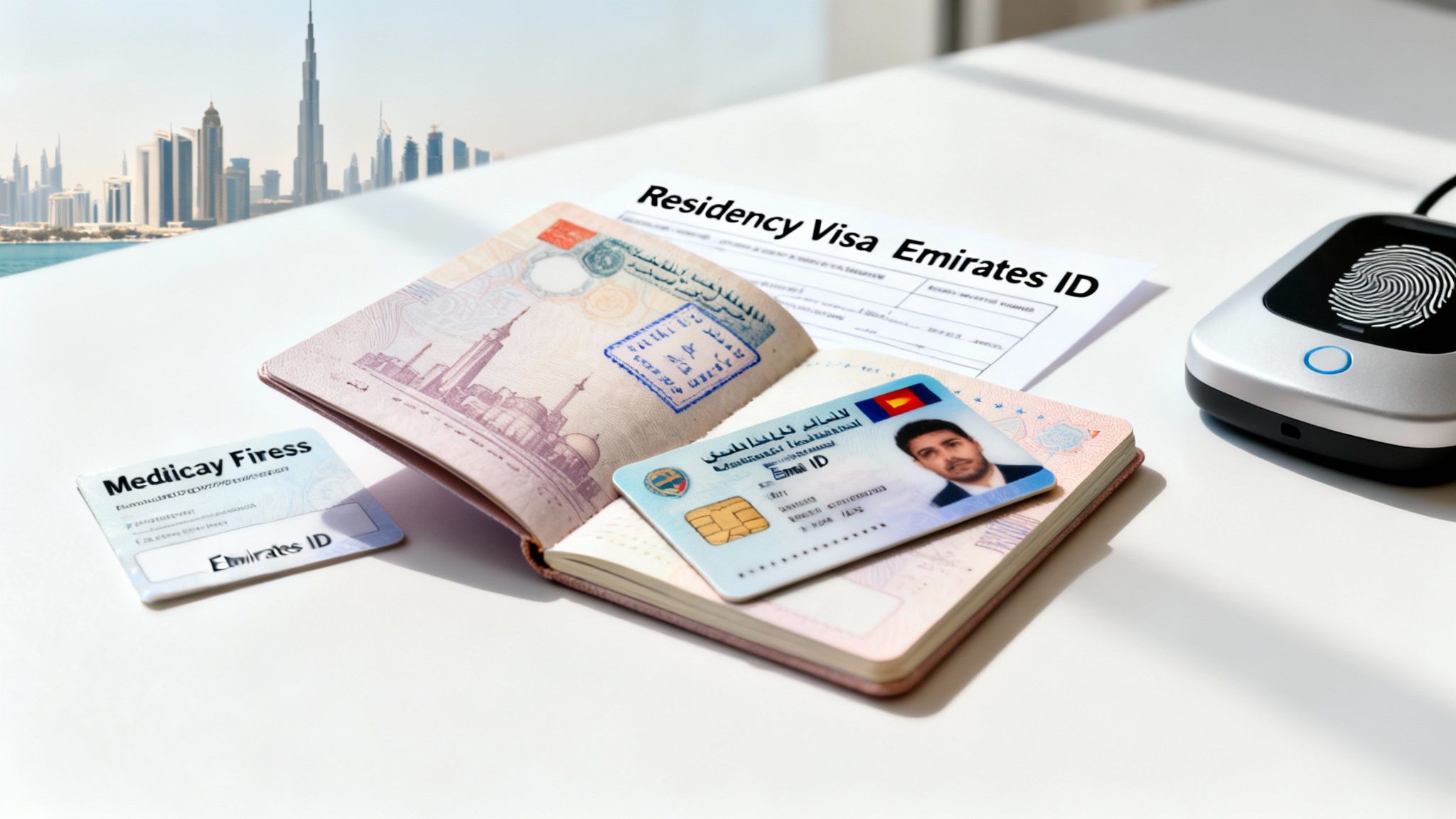
The first thing you’ll get is an entry permit. This is an electronic document that acts as a temporary pass. If you're outside the country, you'll use it to enter the UAE. If you're already here on a tourist visa, this permit allows you to start the residency application from within the country.
Navigating the Visa Process Steps
For those already in the UAE, the next move is a "status change." It's an essential administrative procedure that officially switches your visa status from tourist to resident. The best part? You don't have to leave the country to do it.
With your status adjusted, it's time for the mandatory medical fitness test. This is a standard procedure at a government-approved health centre, involving a blood test and a chest X-ray to screen for certain communicable diseases. It's a routine check to ensure public health and safety.
After you get the all-clear from your medical, you'll head to your Emirates ID biometrics appointment. They'll take your fingerprints and a photo. This is the last major step before the residency visa is physically stamped into your passport, making your move official.
Visa Duration and Sponsoring Your Family
A residency visa tied to a freelancer license in Dubai is usually valid for one to three years, though this can vary depending on the specific free zone or authority. As long as you keep your freelance permit active, you can renew your visa.
One of the biggest perks of having your own residency is the ability to sponsor your immediate family. Once your visa is stamped in your passport, you can begin the process to bring your spouse and children to live with you in Dubai, as long as you meet the minimum income requirements.
For freelancers looking for more stability, the UAE has also rolled out some fantastic longer-term options.
The Green Visa: A Five-Year Option for Freelancers
A great alternative for skilled professionals and established freelancers is the Green Visa. This visa is specifically designed to attract top talent by offering a five-year residency without needing a local sponsor or employer. It provides incredible stability and flexibility, making it a perfect long-term solution for independent professionals who have built a solid career.
To get a full picture of all the pathways available, from the standard freelance visa process to game-changers like the Green Visa, it helps to review a complete guide on the freelance visa in Dubai.
Taking Your Freelance Career to the Next Level in Dubai
Getting your freelancer license Dubai and residency visa is a huge milestone, but think of it as the starting line, not the finish line. Now the real work begins. To truly build a sustainable business, it's time to shift your mindset from setup to full-on operations.
Your first order of business should be to open a proper corporate bank account. I know it's tempting to just use your personal account, especially when you're just starting out, but this is a critical mistake. A dedicated business account not only makes your accounting a thousand times simpler, but it also signals to clients that you're a serious professional. In the Dubai market, credibility is everything.
Staying on Top of Your Responsibilities
With your finances in order, the next priority is staying compliant. Your legal duties don't just disappear once the license is in your hands; they simply evolve. You absolutely need to get familiar with your tax obligations. Depending on your annual revenue, you might need to register for Value Added Tax (VAT) and understand how the UAE's Corporate Tax laws could affect you. Don't leave this to chance.
Beyond taxes, you need to protect yourself and your work.
- Professional Indemnity Insurance: I can't recommend this enough, especially if you're a consultant, designer, or developer. It's your safety net against claims of negligence or errors in your work.
- License and Visa Renewals: This one is simple but so easy to forget. Put reminders in your calendar months in advance for your annual license renewal and your visa renewal. Missing these deadlines can result in hefty fines and can completely halt your business operations.
The moment you become a licensed freelancer, you're not just a creative or a consultant anymore. You're the CEO, CFO, and head of compliance for your own company. Owning these roles is what separates the freelancers who thrive from those who just get by.
Finally, get out there and become part of Dubai's incredible business community. Your license is your ticket to the game, but it won't bring clients to your door. Start attending industry meetups, get active in professional groups online, and network relentlessly. Your connections and your marketing are what will fill your pipeline and turn that license into a truly thriving freelance career.
Common Questions Answered
When you're exploring the idea of freelancing in Dubai, a few key questions always pop up. Let's tackle some of the most common ones we hear from aspiring independent professionals.
Can I Have a Full-Time Job and a Freelance License?
Absolutely. In fact, it's one of the most common ways people get started here. You can definitely hold a full-time job and operate under a freelancer license Dubai at the same time.
The crucial piece of the puzzle is getting a No Objection Certificate (NOC) from your current employer. This is simply a formal letter confirming that your sponsor is okay with you taking on freelance work on the side. It's a standard requirement, so don't be shy about asking.
Is a Physical Office Mandatory?
No, and honestly, this is one of the biggest perks of going the freelance route. The entire system is built for independent professionals, meaning you can skip the hassle and expense of a traditional office lease.
- Free Zone Permits: These are usually linked to the free zone's shared facilities, like co-working spaces or flexi-desks. This gives you a registered address without the high overheads.
- Mainland Licenses: For mainland setups, you can often register your business to a virtual address, which keeps your initial costs way down.
This flexibility is a massive advantage when you’re just launching your freelance career.
Expert Tip: While you don't need a physical office for the license, opening a corporate bank account is non-negotiable. It keeps your business and personal finances separate—essential for clean accounting—and shows clients you’re a serious, professional operation.
What Kind of Work Can I Do?
The work you can legally perform is tied directly to the specific activities listed on your license. Every issuing authority, whether it's a free zone or the Department of Economy and Tourism (DET), has a pre-approved list of professional categories you can choose from.
For instance, Dubai Media City is tailored for creatives, whereas a mainland license might offer more general consultancy categories. It's critical to make sure the services you plan to offer are officially covered by your chosen activity. Operating outside that scope is a big no-no. Getting this right from the very beginning is one of the most important steps in the whole process.
Ready to start your freelance journey in Dubai with confidence? The team at Smart Classic Business Hub provides expert guidance to ensure your license and visa application is seamless and successful. Contact us today for a free consultation to get started.