
Setting up a business in a Dubai free zone is, for most international entrepreneurs, the smartest play they can make. It's the go-to strategy for anyone looking for operational freedom and some serious financial perks. The big one? 100% foreign ownership. You get complete control of your company without needing a local Emirati sponsor, a hurdle that used to be a major barrier on the mainland. This model is your direct ticket to establishing a real presence in a global economic powerhouse.
Why a Dubai Free Zone Is Your Smartest Business Move

Choosing a free zone in Dubai goes way beyond just picking an office location; it’s the very foundation of your growth strategy. For decades, these specialised economic zones have been the main engine driving foreign investment into the UAE. They’re essentially self-contained ecosystems built from the ground up to eliminate the usual red tape and help businesses thrive.
The real appeal isn't just about easier paperwork. It's about gaining total control over your operations and maximising your profits in a stable, pro-business environment that genuinely wants you to succeed.
The Core Financial Advantages
Let’s be honest, the financial incentives are what get everyone's attention. When you set up shop in a free zone, you unlock a whole suite of benefits designed to keep capital in your business, fuelling your growth and innovation.
To give you a quick snapshot of the key benefits, here’s a table that breaks it down.
Key Advantages of a Dubai Free Zone Company at a Glance
| Benefit | Description | Impact on Your Business |
|---|---|---|
| 100% Foreign Ownership | You retain full control and ownership of your company without a local partner. | Complete autonomy in decision-making and strategy. |
| 0% Corporate Tax | Qualifying income from international trade is taxed at 0%. | Maximises your profits and boosts your competitive edge. |
| Profit Repatriation | You can transfer 100% of your capital and profits back to your home country. | No restrictions on accessing your earnings. |
| No Income Tax | Business owners and employees are not subject to personal income tax. | Attracts and retains top talent more easily. |
These aren't just minor perks; they are game-changers that can fundamentally alter your company's financial trajectory.
Operational Freedom and Strategic Positioning
Beyond the compelling tax benefits, free zones offer an unmatched level of operational flexibility. The registration processes are slick and often managed through slick digital portals, which slashes the time it takes to get up and running. That speed to market is a massive advantage, whether you're a lean startup or a major corporation.
The recent explosion in international interest is proof of this. Dubai's free zones have completely changed the game, with over 60% of new business registrations in 2025 coming from foreign founders. This boom is a direct result of policies allowing full foreign control—a massive shift since the UAE's economic reforms kicked in. Just look at the Dubai International Financial Centre (DIFC), which saw a staggering 32% jump in registrations in the first half of 2025 alone. You can dig deeper into company formation trends in Dubai to see the full story.
For many entrepreneurs I speak with, the ability to operate without a local sponsor is the single most important factor. It provides the legal and structural independence needed to execute a global business strategy without local interference or profit-sharing mandates.
Of course, figuring out this landscape can feel like a puzzle. That's where getting the right guidance becomes so important. A consultancy like Smart Classic Business Hub can turn a journey of bureaucratic headaches into a clear, straightforward process. We handle all the detailed paperwork, licensing, and compliance, so you can focus on what you do best: building your business.
Choosing the Right Free Zone and Business Licence
Picking a home for your business in Dubai is a massive decision. You're faced with over 40 free zones, and each one has its own rulebook, industry focus, and price tag. It's easy to feel overwhelmed. But this isn't just about finding a cheap office; it’s about plugging into the right ecosystem—one that's built for your specific business and supports where you want to go in the long run.
The right free zone can be a genuine launchpad, giving you access to tailored infrastructure and invaluable networking. For example, a fintech startup would feel instantly at home in the Dubai International Financial Centre (DIFC), rubbing shoulders with global financial giants. On the other hand, a media production company would naturally gravitate towards Dubai Media City to leverage its specialised studios and connect with a community of fellow creatives.
Matching Your Business to the Right Ecosystem
Your first move is to do a bit of strategic self-assessment. Don't just think about what you need today—think about where your industry is headed. Each free zone is basically a purpose-built city for a specific sector.
Here are a few real-world examples to get you thinking:
- For the Global Trader: The Jebel Ali Free Zone (JAFZA) is an absolute powerhouse. Its location right next to one of the world's busiest ports and airports makes it the undeniable hub for logistics, import-export, and any kind of large-scale trading.
- For the Tech Innovator: If you're running a software development firm or an AI research lab, you’ll thrive in places like Dubai Internet City (DIC) or Dubai Silicon Oasis (DSO). These zones are packed with robust tech infrastructure, access to venture capital, and a buzzing community of innovators.
- For the E-commerce Entrepreneur: An online retail startup has a couple of excellent, strategic choices. Dubai CommerCity is literally built for e-commerce, with integrated logistics and fulfilment centres. Alternatively, the Dubai Multi Commodities Centre (DMCC) offers incredible flexibility, a massive business network, and a prestigious address that can seriously boost your brand's credibility.
This choice affects everything from your daily operations to your ability to hire the right people. It's critical to look past the initial costs and see the strategic value each zone brings to the table. To get a clearer picture, it helps to understand the core differences between setting up in a free zone versus the mainland. You can check out a detailed mainland vs free zone Dubai guide to figure out which structure truly fits your business.
Decoding Your Business Licence
Once you’ve narrowed down your list of potential free zones, the next crucial step is nailing down the correct business licence. This document legally defines everything your business is allowed to do. Picking the wrong one can lead to hefty fines or frustrating operational roadblocks later on, so it's vital to get it right from day one.
In Dubai’s free zones, licences typically fall into three main buckets.
Main Types of Free Zone Licences
| Licence Type | Best For | Typical Activities |
|---|---|---|
| Commercial Licence | Businesses involved in buying and selling goods. | General trading, import-export, e-commerce, and logistics. |
| Professional Licence | Service-oriented businesses and skilled individuals. | Consultancy, marketing, IT services, design, and education. |
| Industrial Licence | Companies involved in manufacturing and production. | Assembling products, processing raw materials, and packaging. |
You need to be meticulous here and list every single activity you plan to offer. For instance, a digital marketing agency would need a professional licence that explicitly covers activities like "Social Media Marketing Services," "Web Design," and "Public Relations Consultancy." Free zone authorities are very specific—if an activity isn't on your licence, you aren't permitted to do it.
We often see entrepreneurs try to squeeze their unique business model into a generic licence just to save a bit of cash. This is a false economy. It's far better to invest the time upfront to define your activities precisely and get the right licence. This ensures your business is compliant and ready to scale from the get-go.
Some of the more modern free zones are also offering specialised licences. A freelance permit, for example, allows an individual to operate as a sole practitioner, while an e-commerce licence bundles all the activities specific to online retail. The key is to map your entire business plan to the licence categories available in your chosen free zone. This detailed approach makes sure your company is built on a solid, compliant foundation, ready for whatever comes next.
Getting Your Paperwork and Application in Order
You've pinpointed the right free zone and licence for your business—great stuff. Now comes the part that trips a lot of people up: the paperwork. Honestly, this is where most of the friction happens, but if you know what's needed and why, it's far less of a headache. Don't think of it as a bureaucratic nightmare; see it as your company's formal introduction to the UAE.
A clean, meticulously prepared application is your single best tool for avoiding delays. The free zone authorities aren't trying to catch you out, but they do need everything to be crystal clear and complete. A tiny mistake—a name spelled differently on a passport copy, for instance, or a half-baked business plan—can send your application right back to the beginning. That's a waste of precious time and momentum you just can't afford.
Assembling Your Core Documents
While every free zone has its own little quirks and specific requirements, there’s a standard set of documents that forms the backbone of almost every application. Get these sorted out first, and the whole process will feel a lot smoother.
Here's the essential checklist you'll almost certainly need:
- Passport Copies: Clear, colour copies for all shareholders, directors, and the manager are non-negotiable. Crucially, make sure every passport has at least six months of validity left.
- Passport-Sized Photographs: These need to follow specific UAE government standards—usually a crisp white background. You'll likely need digital versions to upload to the online portals.
- Proof of Address: A recent utility bill or a bank statement for each shareholder is usually all that's needed to verify where they live.
- Business Plan: This isn't always mandatory for the most straightforward licence types, but it's often required for anything more complex, like an industrial or specialised professional licence. It should cover your business goals, target market, and basic financial projections.
- Application Form: Each free zone has its own form. Fill this out with absolute precision, making sure every detail matches your other documents perfectly.
This simple flowchart breaks down the thinking that should happen before you even get to this paperwork stage.
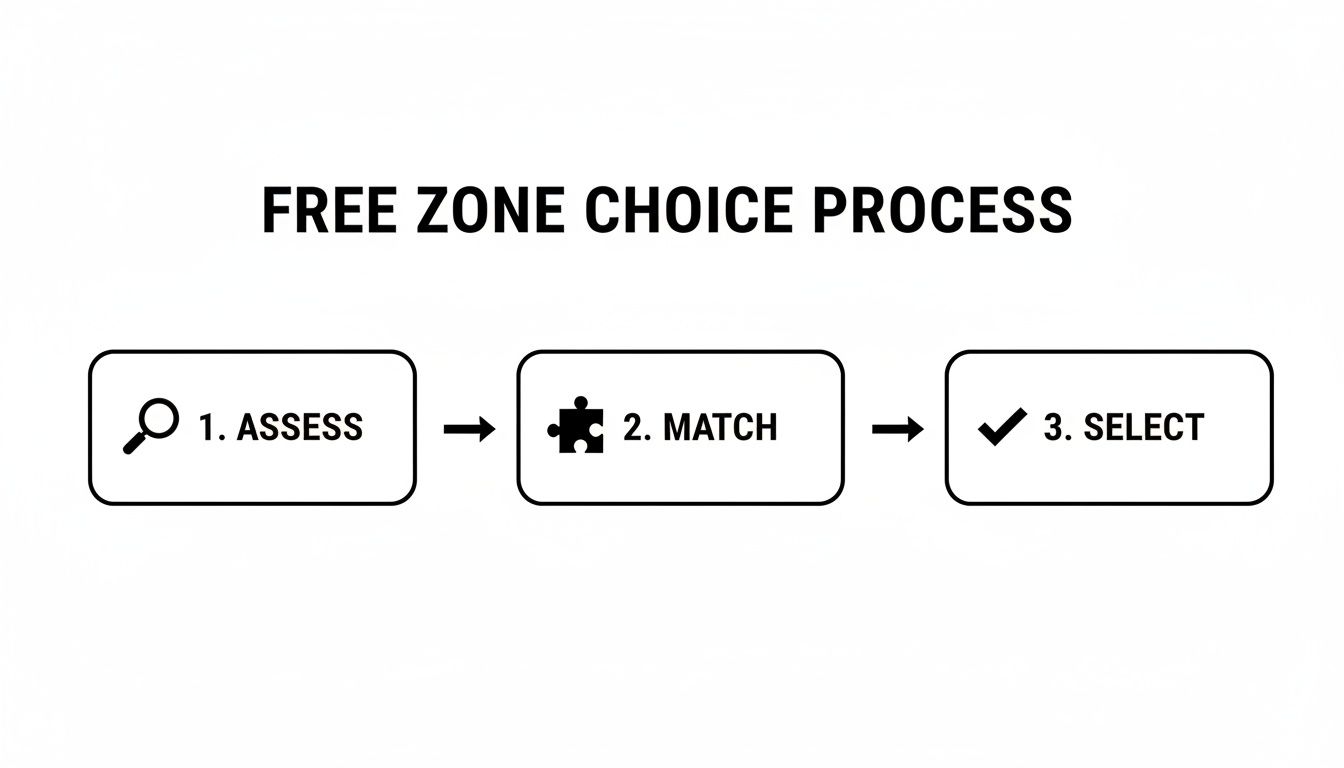
It's a simple but vital process: assess your needs, match them to a zone's specialisation, and then make your final selection. This strategic groundwork makes the documentation phase much more straightforward.
Choosing Your Legal Structure: FZE vs. FZ-LLC
During the application, you'll need to make a key decision about your company's legal structure. This choice affects everything from liability and ownership to how easily you can scale in the future. In Dubai's free zones, the two most common options you'll encounter are the Free Zone Establishment (FZE) and the Free Zone Limited Liability Company (FZ-LLC).
The difference is actually quite simple, but it's important.
- An FZE (Free Zone Establishment) is a legal entity set up with a single shareholder. It's the perfect structure for a solo entrepreneur or a large corporation establishing a wholly-owned subsidiary.
- An FZ-LLC (Free Zone Limited Liability Company), sometimes called an FZCO, is designed for businesses with two or more shareholders. These can be individuals, other companies, or a mix of both.
Both structures offer limited liability, which is a huge plus—it means your personal assets are shielded from business debts. The main factor guiding your choice is simply the number of owners your business will have when it's incorporated.
It's a common misconception that one structure is inherently "better" than the other. The right choice is entirely dependent on your ownership model. An FZE provides beautiful simplicity for a sole founder, while an FZ-LLC gives you the framework you need for a partnership.
Submitting the Application and Dodging Common Pitfalls
Once your documents are in order and you've chosen a legal structure, you're ready to submit. Most free zones have moved to slick online portals that make this part pretty efficient. You'll upload your documents, fill out the online forms, and pay the initial fees.
But this is where small errors can cause big delays. From our experience helping hundreds of businesses get set up, here are the most common mistakes that get applications flagged or outright rejected:
- Inconsistent Naming: The shareholder's name must be spelled identically across every single document—passport, application form, utility bill. Even a minor difference can trigger a query from the authorities.
- Vague Business Activities: Don't be generic. "Consultancy" isn't enough. You need to be specific, like "Human Resources Consultancy" or "IT Infrastructure Consultancy." The activity on your application has to match one of the official activities the free zone offers.
- Low-Quality Scans: This is an easy one to get right, yet so many get it wrong. Submit high-resolution, clear colour copies of everything. A blurry passport scan is one of the fastest ways to get your application put on hold.
- Incorrect Company Name: Your proposed trade name has to follow the UAE's naming rules. This means no restricted words, no religious references, and no names of famous existing companies. A good business setup consultant can pre-check name availability for you to avoid this headache.
Navigating the application for your Dubai free zone company formation is all about precision. By being methodical with your paperwork, understanding the legal structures, and knowing the common pitfalls to avoid, you can ensure a smooth and speedy approval. This gets you ready for the next exciting steps: securing your office, processing visas, and opening that all-important corporate bank account.
Costs, Visas, and What Comes After You Get Your Licence
Getting your trade licence is a huge milestone, no doubt about it. But in reality, it’s the starting pistol, not the finish line. I’ve seen so many entrepreneurs pour all their energy into the initial registration, only to be caught off guard by the crucial next steps—and the costs that come with them.
Having a clear financial and logistical map for what happens after approval is what separates a smooth launch from a stressful one. This isn't about hitting unexpected roadblocks; it's about being prepared for the complete Dubai free zone company formation process. The total investment goes way beyond just the licence fee. You’ve got to factor in visa processing, mandatory health insurance, and getting a workspace that actually fits your needs and visa allowance.
Budgeting for the Full Picture, Not Just the Licence
One of the most common slip-ups I see is underestimating the total setup cost. The licence fee is just one slice of the pie. To build a budget that won’t give you any nasty surprises, you need to account for several other mandatory expenses that pop up right after your company is incorporated.
Here’s a quick rundown of the key costs you should have on your radar:
- Establishment Card: Think of this as your company's official registration with the immigration authorities. It's a critical document that unlocks your ability to apply for visas. This is a one-time fee paid directly to the free zone.
- E-Channel Registration: Most free zones now use an online portal for handling visa applications and other immigration services. There's usually a registration fee to get access, plus an annual renewal to keep it active.
- Visa Application Fees: Every single residence visa you apply for—whether it’s for you as the owner or for your team members—has its own government fees. These can vary a little depending on the free zone and whether the person is applying from inside or outside the UAE.
And don't forget the recurring annual costs. Your trade licence, establishment card, and any office space you lease will all need to be renewed every year. For a really deep dive into the numbers, checking out a detailed guide on the cost of starting a business in Dubai can give you a much clearer sense of both the upfront and ongoing expenses.
Securing Your Office and Residence Visas
In Dubai's free zones, your office space and your visa eligibility are tied together. You can't just apply for ten visas on a whim; the number you're allocated is directly determined by the size and type of your registered office. It's a system designed to make sure every company has a genuine physical footprint.
The great thing is, the options are flexible enough for everyone from solo freelancers to growing teams.
- Flexi-Desk: This is the go-to for most startups and solo entrepreneurs. It's cost-effective and typically makes you eligible for one or two residence visas. It also gives you access to a shared workspace when you need it.
- Dedicated Office: If you need a bit more privacy or a larger visa quota, leasing a small, private office is the natural next step. A standard executive office can bump your visa allocation up to between three and five visas, depending on its square footage.
- Warehouse or Custom Space: For businesses in logistics, manufacturing, or heavy trading, larger spaces are available. Here, the visa quotas are much higher and are calculated based on the total area of your unit.
A key piece of advice we always give clients is to think about your hiring plan for the next 12 months. A flexi-desk is perfect for day one, but if you know you’ll be hiring three people in the next six months, you’ll be forced to upgrade your office package anyway. Planning ahead saves you a ton of time and administrative headaches down the line.
Once your office lease is signed and your Establishment Card is in hand, you can kick off the visa process. This involves a medical fitness test (a standard check for communicable diseases) and giving your biometrics for your Emirates ID card. From the medical test to finally getting that visa stamped in your passport, the whole sequence usually takes about 7-10 working days.
Nailing the Final Step: Your Corporate Bank Account
With your licence and visa sorted, the final, non-negotiable step is opening a UAE corporate bank account. You absolutely need one to run a legitimate business, take payments, and keep your finances clean. But be warned: this part of the process has become much more rigorous in recent years, thanks to tighter global compliance standards.
Banks will want to see a comprehensive set of documents to verify your business. Get ready to provide:
- Your company’s trade licence and all incorporation documents.
- Passport and visa copies for every shareholder.
- A solid business plan that clearly outlines your operations and financial projections.
- Proof of your business address (your office lease agreement).
The bank will then do its own due diligence, and the time it takes to get the account fully active can range from two to four weeks. The best way to speed this up is to have all your paperwork perfectly organised from the start. Once that’s done, you can finally start transacting as a fully operational UAE business.
Getting to Grips with Tax and Compliance in Your Free Zone
The tax situation for Dubai free zone companies is one of the biggest draws, but it's an area filled with myths and old information. You have to understand the real rules, especially with the UAE's newer corporate tax system, if you want to make the most of the financial perks and stay out of trouble.
The good news? The core advantages are still very much alive for most entrepreneurs setting up shop here.
At the centre of it all is the famous 0% corporate tax rate. This isn't a blanket rule; it applies to what's called "Qualifying Income." For most, this means income you earn from doing business with other companies in free zones or with clients based outside the UAE. So, if your startup is globally focused, the bulk of your profits will likely remain untaxed.
But, the new federal corporate tax did add a new layer to consider. It’s absolutely vital to know when this tax might apply to your free zone company.
Understanding Corporate Tax and VAT
The headline corporate tax rate in the UAE is now 9%, but it only kicks in for profits that go over AED 375,000. For a free zone company, you'd typically only face this tax on income you make from mainland UAE sources (though there are a few exceptions). This is why structuring your business activities correctly from day one is so important—it's the key to protecting your tax-exempt status.
When you do it right, your Dubai free zone company is a tax-efficient machine that's hard to beat. You can maintain that 0% rate on your zone-based activities by focusing on international trade and exports.
Now, let's talk about Value Added Tax (VAT), because it's a completely separate thing. VAT is a consumption tax set at a standard rate of 5%.
A common and dangerous mistake is assuming a free zone company is automatically exempt from VAT. That's not how it works. VAT registration is mandatory for any business—free zone or mainland—once its taxable supplies and imports cross AED 375,000 in a 12-month period.
This revenue threshold means VAT compliance isn't an "if" but a "when" as your business starts to grow.
Why Compliant Bookkeeping is Everything
Successfully navigating these tax rules boils down to one simple, non-negotiable practice: meticulous bookkeeping. You absolutely must be able to show a clear line between your qualifying and non-qualifying income to justify your tax position. The Federal Tax Authority (FTA) is clear on this—all businesses must keep accurate financial records for at least five years.
This isn't just about ticking a box to avoid fines; it's about having total clarity over your finances. Good accounting helps you make smarter business decisions, manage your cash flow, and face any potential audits without breaking a sweat.
This is where professional support, like our VAT filing in UAE services, can lift a huge weight off your shoulders. We handle the complexity, ensuring your records are perfect and your tax returns are filed on time. It’s a proactive approach that keeps you compliant and frees you up to focus on what you do best: growing your business.
Partnering for Success: How a Consultancy Streamlines Your Journey

Starting your Dubai free zone company is a massive step, but the path is often paved with complex regulations and administrative hoops to jump through. While you can go it alone, partnering with a seasoned consultancy turns a daunting process into a real strategic advantage. It's about saving yourself time, money, and a whole lot of headaches.
A good consultant does far more than just fill out paperwork; they're your strategic guide. They make sure your chosen free zone and licence are a perfect match for your long-term vision, helping you avoid the classic mistake of picking a setup that boxes you in later on.
Navigating Complexity with Expert Guidance
The true value of having an expert in your corner shines when it's time to deal with government bodies and figure out your obligations after you get the licence. A professional team manages all the fine print, from getting documents attested to liaising with the different authorities. This ensures every submission is spot-on, dramatically cutting down the risk of frustrating delays.
This support goes well beyond the initial setup. Expert guidance typically includes:
- Dedicated PRO Services: Handling all your visa applications, Emirates ID processing, and other government-facing tasks with practiced efficiency.
- Financial Compliance: Making sure your accounting is up to FTA standards right from the start, setting you up for success with VAT and corporate tax.
- Strategic Advice: Offering real-world insights on banking, company structuring, and ongoing compliance to build a rock-solid foundation.
Think of working with a consultancy not as a cost, but as an investment in getting it right the first time. It lets you skip the steep learning curve and focus all your energy on what you do best: launching and growing your business.
Ultimately, this partnership ensures your business gets off to a smooth start, backed by a team that's as invested in your UAE success as you are.
Your Questions, Answered
Setting up a business in Dubai naturally brings up a lot of questions. We get it. You want clear, straightforward answers to make the right decisions. Here are some of the most common queries we hear from entrepreneurs just like you.
Can My Free Zone Company Do Business on the Mainland?
This is a classic question. While a free zone licence is designed for operating within that specific zone and internationally, there are absolutely ways to tap into the lucrative mainland market. It’s not a closed door.
You'll need the right permits from the Department of Economy and Tourism (DET) to engage with mainland clients and suppliers. The most common route is to partner with a local distributor or agent. A good consultancy can help you structure this relationship properly, making sure you stay compliant while you grow your business across the UAE.
What's the Real Minimum Cost to Set Up in a Dubai Free Zone?
Costs can swing wildly depending on which free zone you choose, the kind of licence your business needs, and how many visas you're after. For a basic setup—think a flexi-desk and one visa—you're likely looking at a starting price somewhere between AED 12,000 to AED 20,000.
But that's just the headline number. It’s vital to see the full picture. You also need to budget for visa processing, medical tests, your Emirates ID, and mandatory health insurance. Always ask for a detailed, itemised quote so there are no surprises down the line.
How Long Does the Whole Setup Process Take?
Think of it in two stages. Getting the initial trade licence and your company's incorporation documents can be surprisingly fast—often just a few business days, as long as your application is spot-on.
The complete journey, from start to finish, including getting your residence visa stamped in your passport and opening your corporate bank account, usually takes between two to four weeks. The final timeline really depends on the specific free zone's processing speed and how quickly you can get things like your medical fitness test done.
Navigating the ins and outs of a Dubai free zone company formation is much easier when you have an expert in your corner. The team at Smart Classic Business Hub is here to guide you through everything, from picking the perfect free zone to handling visas and tax compliance, so you can get your business off the ground with total confidence. Start your UAE business journey today.