Let's get straight to the point. The initial cost of starting a business in Dubai can range anywhere from AED 15,000 to over AED 100,000. This isn't a simple, one-size-fits-all number because your final investment is shaped entirely by the choices you make—from your business activity to where you decide to set up shop.
Your Guide to Dubai Business Setup Costs
Think of budgeting for your new company like building a custom car. The basic engine and chassis—your trade license—have a base price. But the total cost changes dramatically depending on whether you’re building a practical sedan (like a simple free zone e-commerce setup) or a luxury SUV with every optional feature (like a mainland general trading company). Each choice adds another layer of expense.
This guide will break down every essential one-time cost you'll face. We'll walk you through the initial administrative hurdles all the way to the major financial decisions that will define your budget, making sure you have a clear financial roadmap from day one.
Initial Administrative Fees
Before you can even think about your license or office, there are a handful of foundational government and administrative fees. These are the non-negotiable first steps in making your business a legal reality in the UAE.
Think of these as the preliminary paperwork that officially gets your application file opened. While these one-time costs are relatively small compared to your total investment, they are absolutely essential to get the ball rolling.
Key upfront administrative costs include:
- Trade Name Reservation: This small fee secures your unique business name, ensuring no other company in the UAE can use it.
- Initial Approval Certificate: This is the green light from the economic department or free zone authority, confirming they have no objection to your proposed business.
- Memorandum of Association (MOA) Attestation: For mainland companies and certain free zones, your company's core legal document must be notarised and attested.
Understanding these initial costs is crucial. While they might seem like minor details, they form the bedrock of your setup budget. Overlooking them can lead to unexpected expenses right at the start of your journey.
Building Your Foundational Budget
These upfront costs are essentially the first invoice you'll pay on your entrepreneurial journey. While larger expenses like office rent and visa processing come a bit later, these initial fees are required to get the process started. They are fairly consistent whether you choose a mainland, free zone, or offshore setup.
To help you map out your initial budget, the table below outlines the typical ranges for these foundational one-time fees.
Estimated One-Time Business Setup Fees in Dubai
Here's a quick look at the typical one-time government and administrative fees you can expect to pay when registering a new company in Dubai.
| Fee Component | Estimated Cost Range (AED) | Description |
|---|---|---|
| Trade Name Reservation | AED 600 – AED 1,000 | Secures your company name with the relevant authority. |
| Initial Approval | AED 150 – AED 250 | A certificate confirming the government has no objection to your business. |
| MOA Attestation | AED 500 – AED 2,000 | Notarisation of your company's legal documents (mainly for mainland). |
| Government & Admin Fees | AED 2,000 – AED 4,000 | General processing, registration, and administrative charges. |
| Virtual Office (Ejari) | AED 1,000 – AED 5,000 | Required for mainland licenses to register a business address. |
Keep in mind that these are just the starting blocks. For a more personalised and detailed estimate based on your specific business needs, our dynamic business setup cost calculator can help turn these abstract figures into a concrete financial plan.
Mainland vs Free Zone: Your First Major Cost Decision
Right out of the gate, you’ll face a choice that will fundamentally shape your startup budget: setting up on the Dubai mainland or within a specialised free zone. This is the single most important decision you'll make, and it impacts everything from your licence fees to your long-term operational costs.
Think of it like choosing where to open a new restaurant. A mainland setup is like leasing a prime storefront on a busy high street. You have unrestricted access to the entire local market—anyone and everyone in the UAE can be your customer. But that prime real-estate comes with higher rent, more regulations, and a more complex setup process.
A free zone, on the other hand, is like opening a trendy eatery inside an exclusive, modern shopping mall. The setup is often a streamlined, all-in-one package. You get fantastic benefits like 100% foreign ownership and zero corporate tax, but your direct business is typically limited to other companies within that mall and international clients.
This single choice dictates nearly every cost that follows. The infographic below gives you a bird's-eye view of how these two paths diverge, from a lean, basic setup to a more premium, full-service launch.
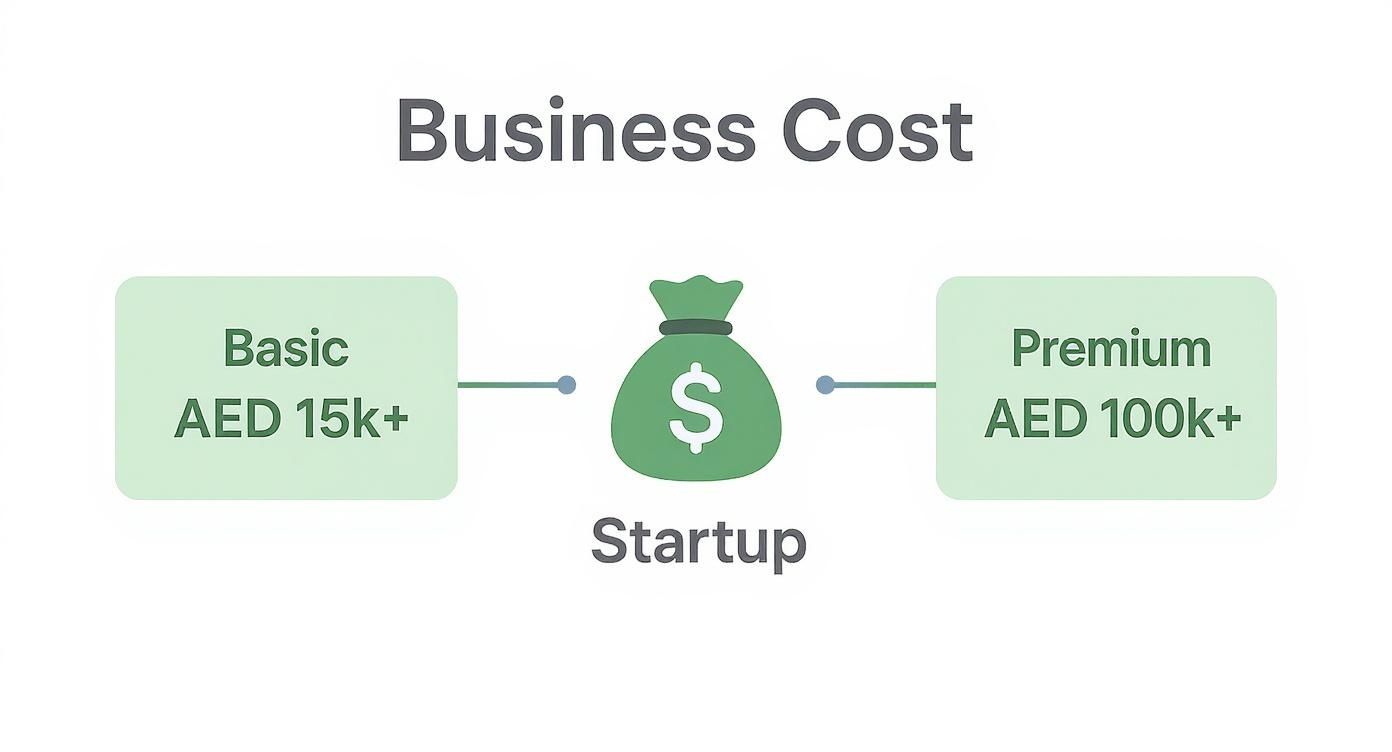
As you can see, the total investment can vary dramatically. A basic free zone package offers a much more accessible entry point, while a full-scale mainland operation requires a significantly higher capital commitment from day one.
Understanding Mainland Company Costs
A Dubai mainland company, often called an "onshore" company, is registered directly with the Department of Economy and Tourism (DET). This is the go-to option for businesses that want to trade freely and directly with any customer or company across the entire UAE market. But this freedom comes at a premium.
The cost of a mainland setup is typically higher because of a few non-negotiable requirements:
- Physical Office Space: Mainland companies must lease a physical office. This lease must be registered with Ejari, the official tenancy contract portal, which adds a significant and recurring expense to your books.
- Government Approvals: The setup process can involve getting approvals from multiple government departments (think Ministry of Human Resources, Dubai Municipality, etc.), and each one comes with its own fee.
- Local Service Agent (LSA): While 100% foreign ownership is now the norm for most activities, certain professional licences still require a UAE national to act as an LSA. This involves a fixed annual fee, not a share of the profits.
All in, a mainland business setup in Dubai will generally cost between AED 10,000 to AED 30,000 just for the initial formation. This figure is heavily influenced by your business activity, the size and location of your office, and how many visas you need. For setups that still require a local sponsor, their fees can add another AED 5,000 to AED 25,000 annually.
The Free Zone Cost Advantage
Dubai is home to over 40 free zones, each operating as a distinct economic hub with its own regulator and rules. They were specifically created to attract foreign investment with a suite of compelling incentives, making them an incredibly popular and often more affordable route for entrepreneurs.
The big draw? A bundled, predictable cost structure. For a single package fee, you often get your licence, registration, and a basic office solution like a flexi-desk all rolled into one. It takes a lot of the guesswork out of budgeting.
Key Takeaway: Free zones are purpose-built ecosystems. Choosing one that aligns with your industry—like Dubai Media City for creative agencies or DMCC for commodities trading—doesn't just save you money; it plugs you into a valuable network of peers, suppliers, and potential clients.
Another massive benefit is the speed of setup. Since you're dealing with just one governing authority, the paperwork is far more straightforward. You can often get your licence and be up and running in a few days, not weeks. That efficiency means lower initial costs and a much faster path to earning your first dirham.
To really dig into the details, have a look at our in-depth guide comparing the pros and cons of mainland vs free zone setups. It will help you understand the operational and financial differences so you can make a choice that perfectly fits your business goals.
Mainland vs Free Zone Cost Comparison
To put it all into perspective, here’s a quick side-by-side look at the major cost factors for each jurisdiction.
| Factor | Dubai Mainland | Dubai Free Zone |
|---|---|---|
| Ownership | 100% foreign ownership for most activities. Some professional licences may need a Local Service Agent (LSA). | 100% foreign ownership is standard across all free zones. |
| Scope of Business | Unrestricted trade across the entire UAE and internationally. Can take on government projects. | Direct trade is generally limited to within the free zone and internationally. Local UAE trade requires a distributor. |
| Office Requirement | A physical office with an Ejari-registered tenancy contract is mandatory. | Flexible options available, from virtual offices and flexi-desks to physical spaces. Requirements vary by free zone. |
| Initial Setup Cost | Typically higher, from AED 10,000 to AED 30,000+. | More affordable, with packages starting from AED 8,000 to AED 20,000+. |
| Approvals | May require multiple approvals from various government bodies (DET, Municipality, etc.). | A single-window approval process through the free zone authority. |
| Visa Eligibility | Visa eligibility is linked to the size of the physical office space. | Visa packages are often included with the licence, with the option to upgrade for more. |
This table makes it clear: the "better" option truly depends on your business model. If your focus is the local UAE market, the mainland is unavoidable. But if you’re an international service provider, a consultant, or an e-commerce business, a free zone offers an incredibly efficient and cost-effective launchpad.
Breaking Down Your Dubai Business License Costs
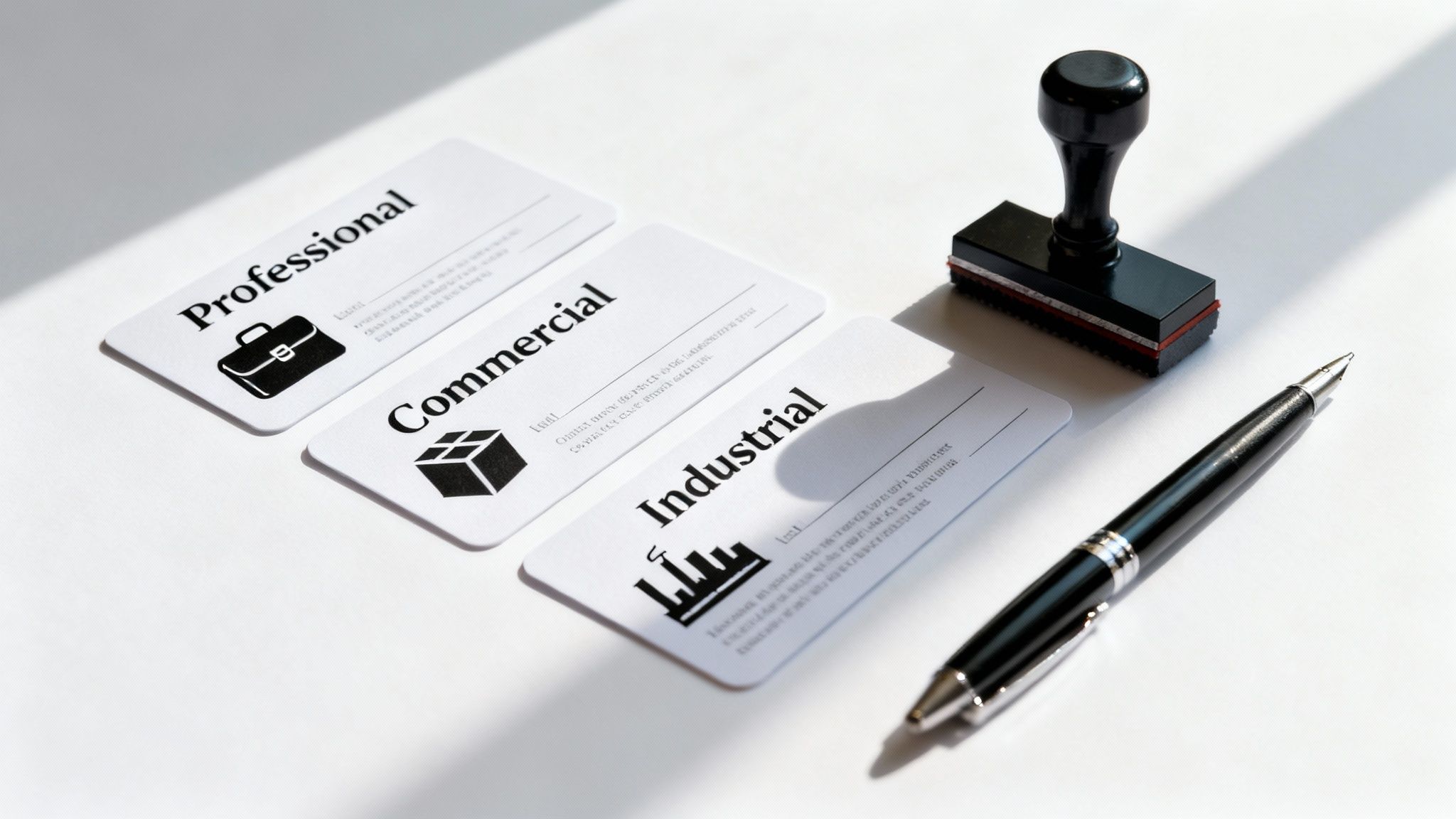
Your business license is the heart of your company. It dictates what you can do, where you can operate, and, crucially, forms the foundation of your initial setup costs. The price tag isn't a one-size-fits-all number; it’s a direct reflection of your business goals. The activities you choose will slot you into one of three main categories, each with its own cost structure and set of rules.
Figuring out which category you fall into is the first real step in forecasting the cost of starting a business in Dubai. Think of it like choosing the right tool for the job. You wouldn't bring a sledgehammer to hang a picture frame, and you wouldn't get a simple service license to run a massive import-export operation.
The Professional License: For Service-Based Experts
A Professional License is built for individuals or companies offering specialised, skill-based services instead of physical products. We're talking about consultants, designers, accountants, artisans, and IT specialists. It’s often the most affordable way to get started because the business is built on expertise and intellectual property, not tangible goods.
But there's a trade-off. For a mainland setup, a professional company is usually set up as a Sole Establishment or a Civil Company. This means the owners can have full personal liability for the business's debts. While it's cost-effective upfront, it’s a massive detail to factor into your long-term financial planning.
For example, a social media marketing agency setting up in a free zone with a professional license could land an all-in package for around AED 17,000. This often includes a flexi-desk and one visa, making it a very popular route for solo entrepreneurs and small service firms.
The Commercial License: For Traders and Retailers
If your business is all about buying and selling goods, you'll need a Commercial License. This is a broad category covering everything from general trading and e-commerce to retail shops and import-export firms. As you might expect, the costs are generally higher than for a professional license.
There are two main reasons for the price jump. First, commercial activities often come with more perceived risk and need a more solid legal structure, like a Limited Liability Company (LLC). Second, they usually require more government approvals related to customs, product registration, and trade regulations, each adding to the final bill.
Take a mainland logistics company. It would need a commercial license, and the initial investment would be higher due to the need for a physical warehouse or office with an Ejari (lease registration). Add in the fees for approvals from Dubai Customs and other authorities, and the total setup cost can easily top AED 35,000 in the first year.
The Industrial License: For Manufacturers and Producers
The most complex and capital-heavy option is the Industrial License. This is non-negotiable for any business that manufactures, produces, or processes goods. Think factories, assembly plants, and workshops turning raw materials into finished products.
Getting an industrial license involves a serious approval process. You'll need the green light from bodies like the Dubai Municipality, the Ministry of Economy, and various environmental and safety departments. Each approval adds another layer of cost and time to the setup.
A huge chunk of the cost for an industrial license comes from the need for a physical factory or workshop in a designated industrial zone. That’s before you even start talking about the significant investment in machinery and infrastructure.
Factoring in External Approvals
Beyond the basic license fee, some business activities require special external approvals from various ministries and government bodies. These aren't optional—they're a legal must-have to operate in certain regulated sectors.
Here are a few common ones:
- Healthcare: Clinics, pharmacies, and medical equipment traders must get approval from the Dubai Health Authority (DHA).
- Education: Schools, training centres, and nurseries need the nod from the Knowledge and Human Development Authority (KHDA).
- Food & Beverage: Restaurants and food trading companies require permits from the Food Safety Department of Dubai Municipality.
- Real Estate: Brokerages and property management firms need clearance from the Real Estate Regulatory Agency (RERA).
Each of these approvals has its own application fee, inspection charges, and annual renewal costs, which can add a significant amount to your startup budget. It really drives home why your choice of business activity is so critical to the final cost.
Budgeting for Visas and Office Space
Alright, once your licence is in hand, you'll face the next two big-ticket items on your budget: finding a home for your business and getting the right visas for you and your team. In Dubai, these aren't separate expenses; they're deeply connected, creating a critical cost puzzle that every new entrepreneur needs to solve.
Here’s a simple way to think about it: your business licence is like your car's registration. Your visa is your driver's licence, and the office is the mandatory parking spot. You can't legally hit the road without all three, and the size of your parking spot dictates how many drivers you can have.
Calculating Your Visa Costs
A residence visa is your golden ticket to legally live and work in the UAE. The whole process involves several stages, and each one comes with a fee. For a single investor or employee visa, you can expect the costs to add up, usually falling somewhere between AED 3,500 and AED 6,000 per person.
This isn't just one lump sum payment. It’s a series of smaller fees for each part of the application. For every person you sponsor, you'll need to budget for:
- Entry Permit: This is the initial green light for someone to enter the UAE for work.
- Medical Fitness Test: A compulsory health check-up that all residence visa applicants must pass.
- Emirates ID Application: The fee for issuing the mandatory national identity card.
- Visa Stamping: The final step, where the visa is officially stamped into the passport.
So, if you're a founder launching with a small team of three, the visa processing fees alone could easily hit AED 15,000 or more. That’s a significant upfront cost you absolutely must factor into your total setup budget. For a deeper dive into what this means for entrepreneurs, check out our guide on the Dubai investor visa package, which breaks down the entire process.
The Link Between Office Space and Visa Quotas
Now, this is where the budgeting gets a bit more strategic. In Dubai, your visa eligibility is almost always tied directly to your office space. The authorities use your office size as a straightforward way to decide how many employees your business can realistically handle.
It's a practical rule designed to stop companies from sponsoring dozens of employees without having a proper place for them to work. For instance, a mainland company is required to have a physical office registered with Ejari, and its visa quota is calculated based on its square footage.
Free zones offer more flexible options, but the core principle is the same. A basic flexi-desk package might only get you one or two visas. Need more? You'll have to upgrade your office package to a dedicated desk or a private office, which will, of course, bump up your annual costs.
Key Takeaway: Your hiring plan directly influences your real estate costs. Don't just budget for the office you need on day one. Think ahead and consider the space you'll require to accommodate the team you want to build over the next 12-18 months.
Comparing Office Space Costs and Solutions
Your choice of office is a major recurring expense that will sit on your books year after year. For solo entrepreneurs or small teams just starting out, a co-working space or flexi-desk is an incredibly smart and cost-effective way to begin.
- Flexi-Desk/Co-working Space: Perfect for freelancers and startups. These give you a professional address and essential facilities without locking you into a long-term lease. You can expect to pay between AED 15,000 and AED 25,000 annually in a free zone, often bundled with a licence and one visa.
- Serviced Office: These are fully furnished, move-in-ready private offices. They offer more privacy and come with a larger visa quota, making them ideal for small teams. Costs typically range from AED 25,000 to AED 60,000 per year.
- Traditional Physical Office (Mainland): This is the most expensive route but is mandatory for most mainland businesses. Rent varies dramatically depending on the location, but even a small office in a decent area will likely start from AED 40,000 annually, not including utilities and other overheads.
Getting a firm grasp on this interplay between visas and office space is crucial for accurate financial planning. It ensures your business has the physical and legal foundation it needs to operate smoothly and grow without hitting any surprise roadblocks.
Planning for Ongoing Costs and Annual Renewals
Getting your business licence is really just the entry ticket into Dubai's dynamic economy. To stay in the game and build a company that lasts, you have to shift your focus to its long-term financial health. This means getting real about the recurring costs that kick in the moment your business is officially registered.
Too many entrepreneurs get tunnel vision on the upfront cost of starting a business in Dubai and completely overlook what comes next. Thinking about these annual expenses from day one is the difference between a smooth launch and a cash-flow crisis in your second year.
These aren't just minor details; they are major financial commitments that will hit your balance sheet year after year. Let’s break down exactly what you need to budget for to keep your company in good standing.
Annual Licence and Visa Renewals
Your biggest recurring expense, without a doubt, will be your trade licence renewal. This isn't a one-time thing. It’s an annual charge, often just as much as your initial licence fee. If you miss this payment, your business can no longer operate legally, which opens the door to heavy fines and even getting blacklisted.
On top of that, residence visas for you and your team aren't permanent. They typically need renewing every two to three years. Each renewal is like a mini-setup process all over again—medical tests, Emirates ID applications, and all the associated fees for every single person you sponsor.
Here’s a quick rundown of the main recurring costs:
- Trade Licence Renewal: An annual fee paid to your jurisdiction (mainland or free zone) to keep your business legally active.
- Visa Renewals: A two- or three-year cost for every sponsored individual, including medical tests, Emirates ID, and visa stamping fees.
- Establishment Card Renewal: This card links your company to the immigration and labour departments and has to be renewed annually.
- Office/Flexi-Desk Rent: A significant recurring cost, whether it's a physical office on the mainland or a flexi-desk package in a free zone.
Think of your annual renewals like a subscription service for your business. You're not just buying a licence; you're maintaining your legal right to operate in one of the world's most competitive markets. Budgeting for it is non-negotiable.
Navigating Mandatory Tax and Compliance Costs
Beyond the predictable renewal fees, you absolutely must prepare for mandatory compliance costs. This is where hidden expenses often ambush new founders who aren't ready for them. The UAE has a sophisticated regulatory environment, and staying compliant takes professional help and dedicated resources.
The big ones are Value Added Tax (VAT) and the new Corporate Tax. These aren't optional—they're federal laws with strict registration thresholds and reporting deadlines. Getting this wrong can lead to severe financial penalties that could cripple a young company.
Understanding these obligations from the get-go is critical for accurate financial forecasting. The initial setup fee is one thing, but ongoing operational costs and regulatory compliance are what truly define the long-term cost of running a business in Dubai. Annual licence renewals alone can range from AED 10,000 to AED 25,000. Visa renewals will add another AED 3,500 to AED 5,000 per person. Plus, VAT registration becomes mandatory once your turnover hits AED 375,000, and the new federal corporate tax of 9% applies to profits over that same threshold. You can get more insights on the running costs of a UAE business over at ProPartnerGroup.com.
Budgeting for Professional Services
To manage all these complex rules, budgeting for professional services isn't a luxury—it's a necessity. These experts make sure your business stays on the right side of the law and avoids expensive blunders.
Here are the key professional services you should factor into your annual budget:
- Accounting and Bookkeeping: Keeping clean, accurate, and VAT-compliant financial records is mandatory. Good bookkeeping is the foundation for all your financial reporting.
- Auditing: Many free zones and all mainland companies require an annual audit of their books, which must be done by an accredited firm.
- Tax Filing: You'll need a registered tax agent to prepare and file your quarterly VAT returns and your annual Corporate Tax return with the Federal Tax Authority (FTA).
- PRO Services: A Public Relations Officer (PRO) handles all your government paperwork, from visa renewals to licence amendments. This saves you a massive amount of time and prevents costly mistakes.
Planning for these operational and compliance costs from the very beginning gives your business the financial runway it needs not just to survive, but to truly thrive in Dubai's competitive landscape.
Your Questions About Dubai Business Costs, Answered
When you're mapping out a new business venture, the financial side of things can feel like a maze. Let's clear up some of the most common questions we hear about the cost of starting a business in Dubai, so you can build your budget with confidence.
What Is the Absolute Cheapest Way to Start a Business in Dubai?
If you're looking for the most budget-friendly entry point, a freelance permit or a basic service licence in one of the more affordable free zones like IFZA or Meydan is usually your best bet. These packages are often designed for solo entrepreneurs, bundling one visa with flexi-desk access to keep those initial costs as low as possible.
Just keep in mind, this route is built for a specific purpose. It's perfect for consultants, digital nomads, and single-person operations that don't need a large physical office or a big team. The trade-off for the low cost is a narrower scope of business activities and growth potential.
Are There Any Hidden Costs I Should Be Aware Of?
Yes, and this is where a lot of new entrepreneurs get caught off guard. It's easy to focus on the big-ticket items like the licence and visa, but several smaller costs often get overlooked in the initial budget. For instance, mandatory fees for document translation and legal attestation for official paperwork can add up.
Beyond that, you absolutely must account for:
- Mandatory Health Insurance: In Dubai, this isn't optional—it's a legal requirement for every single visa holder.
- Bank Account Fees: Don't assume banking is free. Some banks require a minimum balance to avoid monthly charges, and others have setup fees.
- PRO Services: While it's a recurring cost, budgeting for a Public Relations Officer (PRO) to handle government paperwork is one of the smartest investments you can make. It saves an incredible amount of time and helps you avoid costly mistakes.
How Much Working Capital Do I Need After Setup?
This is the million-dollar question, and it really depends on your industry. But as a solid rule of thumb, we advise clients to have at least six to nine months of operating expenses tucked away after all the initial setup fees are paid.
Think of this financial cushion not just as a safety net, but as a strategic asset. It gives your business the runway it needs to cover salaries, rent, marketing, and all the other overheads before you start seeing consistent profit.
Can I Reduce My Business Setup Costs in Dubai?
Absolutely. There are several smart ways to trim your initial investment. The most effective strategy is choosing a free zone that offers competitive package deals, especially those tailored for startups and small to medium-sized enterprises (SMEs).
You can also find significant savings by:
- Choosing a flexi-desk or co-working space instead of a physical office, if your business activity allows for it. This alone can save a huge chunk of capital.
- Being selective with your business activities on your licence. Only pay for what you need to avoid fees for categories you won't use.
- Comparing quotes from several business setup consultants to find the best balance of value and expert service.
- Asking about multi-year licence packages. Some free zones offer pretty hefty discounts if you're willing to pay for two or three years upfront.
Navigating these costs and making the right strategic choices is what we do best. The team at Smart Classic Business Hub provides expert guidance to ensure your business is set up efficiently and affordably. To get a personalised cost breakdown and a clear path forward, explore our comprehensive business setup services.