To do business legally in the UAE’s capital, getting a business license in Abu Dhabi isn't just a box to tick—it’s the single most important step you'll take. Think of this license as the official green light, the permit that proves your company exists and can legally start trading. It's the foundation for everything that comes next in this energetic, pro-business city.
Your Key to the Abu Dhabi Market
Let's put it simply: a business license is like a passport for your company. It’s not just paperwork; it’s the key that unlocks one of the world's most exciting economies. Without it, you can't open a corporate bank account, you can't sponsor visas for your team, and you certainly can't engage in any formal trade. Essentially, your business doesn't legally exist.
This guide is here to cut through the complexity and give you a clear, actionable roadmap. Whether you're a solo entrepreneur with a fresh idea or an established company looking to expand, you need to understand this process inside and out. We’ll walk through the big decisions you'll face, like choosing between operating on the Mainland or in a specialised Free Zone like the Abu Dhabi Global Market (ADGM).
Why Abu Dhabi, and Why Now?
The emirate's economy isn't just growing; it's booming, making it a magnet for smart investors. The government has rolled out the red carpet with policies designed to help new ventures get off the ground and thrive. And it's working—entrepreneurs from all over are choosing the capital as their home base.
The numbers don't lie. Recent figures from the Abu Dhabi Registration and Licensing Authority (ADRA) show a 16% jump in new economic licences on the mainland. Renewals are up by 27%, and the total number of active licences has grown by 9% year-on-year. This isn't just a trend; it's a clear sign of massive investor confidence. You can dig deeper into these figures on the official ADDED portal.
Big Opportunities for Entrepreneurs
Getting started has never been easier, thanks to several government initiatives tailored to support different kinds of businesses.
- The 'Tajer Abu Dhabi' Programme: This is a game-changer for micro-businesses. It allows entrepreneurs to operate for three years without the cost of a physical office and now covers over 1,200 different activities. Unsurprisingly, licence issuance shot up by 20% in a single year.
- Freelancer Licences: Abu Dhabi is fully embracing the gig economy. The demand for flexible work is clear, with the number of freelancer licences issued skyrocketing by an incredible 104%.
For Emirati nationals, the growth is even more striking. There's been a 371% surge in freelancer licences, showing a powerful push to empower local talent and build a homegrown entrepreneurial community.
Our goal is to give you the strategic know-how and practical steps to secure your business license in Abu Dhabi smoothly, setting you up for success from day one.
Choosing Your Jurisdiction: Mainland vs. Free Zone
Right out of the gate, the first big decision you'll face when setting up in Abu Dhabi is choosing your jurisdiction. This choice is foundational—it sets the rules for who you can sell to, how your company is owned, and where you can operate.
Think of it like this: are you opening a shop on a bustling high street, accessible to everyone in town? Or are you setting up inside a massive, exclusive international trade show?
A Mainland licence is your high street shop. It’s the key that unlocks the entire UAE market, allowing you to trade directly with any customer or company, anywhere in the country. If your game plan involves selling to the local market, bidding on government projects, or opening a physical storefront, the mainland is where you need to be.
On the other hand, a Free Zone licence is like a VIP pass to a specialised global business hub. These zones, like the well-known Abu Dhabi Global Market (ADGM) or the sustainability-focused Masdar City, are designed to pull in foreign investment with some seriously attractive perks. They operate as self-contained economic areas with their own rules, often tailored to specific industries like finance, tech, or media.
This decision tree helps visualise the core differences and guides you on which path might be better for your business.
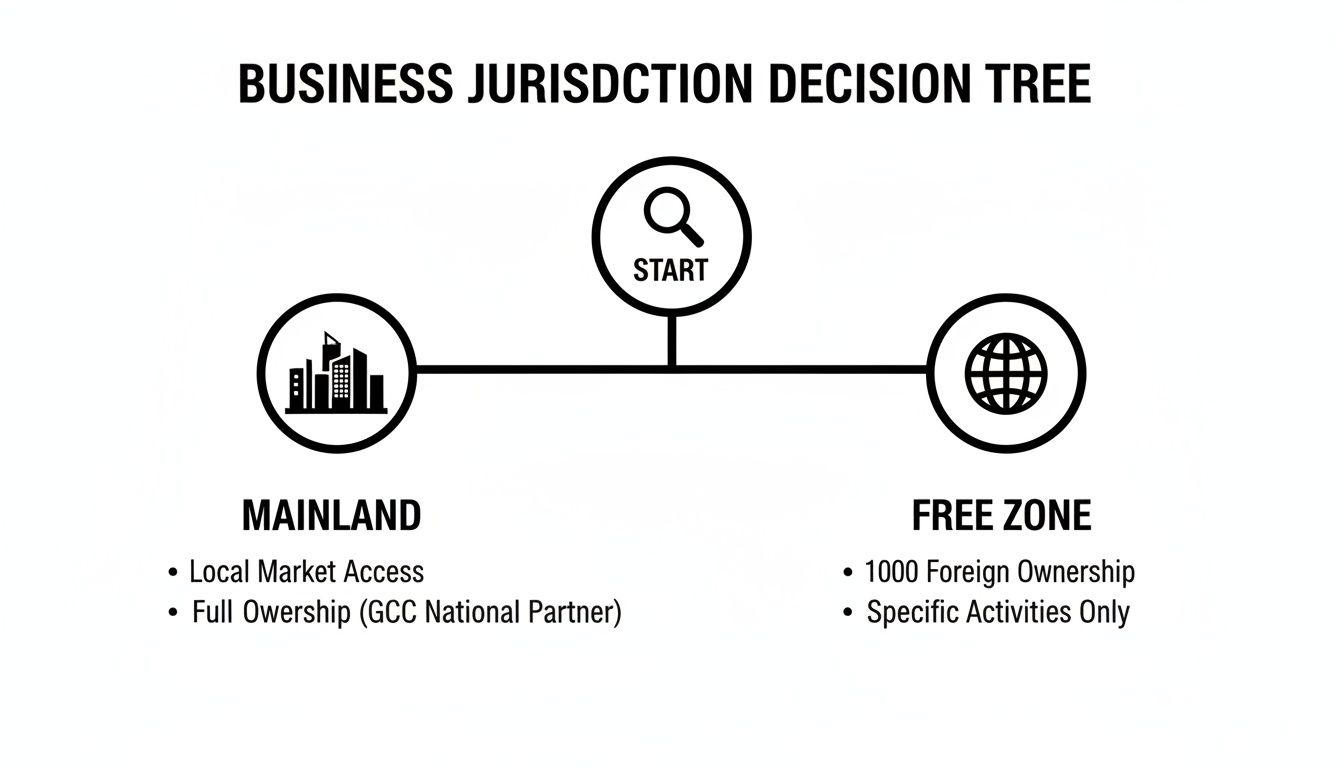
As you can see, it really boils down to your core business activity and, most importantly, who you plan to sell to.
Diving Deeper into a Mainland Setup
Setting up on the Abu Dhabi mainland means you're registering directly with the Department of Economic Development (ADDED). This is the traditional path for businesses that want to be fully embedded in the local economy.
The biggest win here is freedom. You can do business anywhere in the UAE without hitting any roadblocks. Open an office in Abu Dhabi, a warehouse in Al Ain, or a café on Saadiyat Island—it’s all possible. This makes it the go-to option for businesses like retail shops, construction firms, restaurants, and local service providers.
The old catch used to be ownership rules. But things have changed. Today, the UAE allows 100% foreign ownership for a huge list of mainland business activities. Only a few specific, strategic sectors might still need a UAE national partner. For a more detailed breakdown, check out our in-depth guide on the differences between Mainland and Free Zone setups.
The Power of Free Zones
Abu Dhabi is home to several world-class free zones, each creating a powerful ecosystem for certain industries. Their main draw? The financial and administrative ease they offer to foreign entrepreneurs.
Here's why a Free Zone licence is so compelling:
- Complete Foreign Ownership: You own 100% of your company. No exceptions, no matter your nationality or business activity.
- Tax Advantages: Most free zones offer 0% corporate and personal income tax, plus exemptions from import and export duties.
- Repatriation of Profits: You can send 100% of your capital and profits back to your home country without any hurdles.
- Modern Infrastructure: These zones are built for business, providing everything from sleek, high-tech offices to advanced logistics and warehousing.
A Free Zone is its own self-contained business universe. You can trade freely with other companies inside your zone or with clients internationally. However, if you want to sell directly to customers on the mainland, you'll typically need to work with a local distributor or agent.
The explosive growth of these zones speaks for itself. The UAE is fast approaching one million active commercial licences, and Abu Dhabi is a massive part of that story. Just look at ADGM, which saw its active licences rocket to a record 11,128 in the first half of the year—that’s a 47% jump from the year before. It's a clear sign of Abu Dhabi's rising status as a global business destination.
Mainland vs Free Zone Licence at a Glance
To help you decide, here’s a straightforward comparison of the key features for each jurisdiction. This table cuts through the noise and lays out what matters most when choosing where to set up your Abu Dhabi venture.
| Feature | Mainland Licence | Free Zone Licence (including ADGM) |
|---|---|---|
| Market Access | Unrestricted trade across the entire UAE | Trade within the free zone and internationally; requires a local agent for mainland trade |
| Business Ownership | 100% foreign ownership available for most activities | 100% foreign ownership guaranteed for all activities |
| Office Location | Can rent physical office space anywhere in Abu Dhabi | Must have a physical or virtual office within the specific free zone |
| Regulatory Body | Department of Economic Development (ADDED) | Respective Free Zone Authority (e.g., ADGM, Masdar City) |
| Government Tenders | Eligible to bid directly on government contracts | Generally not eligible to bid directly; must partner with a mainland company |
| Taxation | Subject to 9% UAE Corporate Tax (on profits > AED 375,000) | Often 0% corporate tax for qualifying income; tax holidays available |
Ultimately, the best choice depends entirely on your business model. Both jurisdictions offer incredible opportunities, but they serve different strategic goals.
Making the Right Choice for Your Business
Your decision should be a direct reflection of your business plan and where you see your company in five years. Ask yourself these simple but crucial questions:
- Who is my primary customer? If you're targeting the local UAE population or government bodies, a Mainland licence is your best bet.
- What am I actually doing? If you’re in international trade, finance, tech, or media, a specialised Free Zone offers an incredible ecosystem with tailored support.
- How important is 100% ownership to me? If it’s a non-negotiable, a Free Zone gives you that certainty from day one.
- What do I need to operate? Think about your real-world needs. Do you need a warehouse near a port, a retail shop in a mall, or just a flexible desk space?
Getting this foundational decision right is the first major step toward success. It ensures your Abu Dhabi business licence is perfectly aligned with your vision for growth.
Your Step-by-Step Guide to Getting Licensed in Abu Dhabi

Getting your business license in Abu Dhabi might feel like a huge task, but it’s best to think of it as a clear, logical sequence of steps. Like following a recipe, if you do things in the right order with the right ingredients, you end up with exactly what you wanted. This roadmap will break down the entire journey into a simple checklist, turning what looks like red tape into manageable actions.
The whole point of this process is to make sure your business is properly defined, legally protected, and compliant from the moment you open your doors. By knowing what’s coming at each stage, you can have the right documents ready and make smart decisions, avoiding the common delays that trip up so many new entrepreneurs.
Let's walk through the exact path to getting your company registered and ready to do business.
Step 1: Pinpoint Your Business Activities and Legal Structure
First things first: you need to be crystal clear on what your business actually does. This isn't just for your own planning—it's a critical legal step. The Abu Dhabi Department of Economic Development (ADDED) maintains a massive list of over 4,000 approved business activities. Your job is to pick the ones that perfectly match your operations.
This decision directly shapes your company's legal structure. For instance, if you're running a small tech consultancy, a Sole Proprietorship or a Limited Liability Company (LLC) might make sense. A large-scale manufacturing plant, however, will have completely different needs. Your legal form dictates everything from personal liability to ownership rules.
Getting this right from the very beginning is non-negotiable. Choosing the wrong activity can lead to hefty fines or force you to start the application all over again. The wrong legal form can create serious ownership and liability headaches down the road.
Step 2: Reserve Your Trade Name and Secure Initial Approval
Your company's name is its public face, and in Abu Dhabi, it has to follow the rules. It needs to be unique and can't violate public morals, include any religious or political references, or be the same as an existing company’s name. You’ll submit a few options for approval through the ADDED portal or your chosen free zone authority.
Once your name gets the green light, you’ll apply for Initial Approval. Think of this as the government giving you a preliminary nod to proceed. It’s an official confirmation that there are no immediate objections to your business idea, and it unlocks the next stages, like drafting legal paperwork and finding an office.
Step 3: Draft Legal Documents and Find a Business Premise
With initial approval in your back pocket, it’s time to build your company's legal foundation. For any business with more than one shareholder, this means drafting a Memorandum of Association (MOA).
This is a core legal document that spells out the essentials:
- Shareholder Details: Who owns the company and what percentage each person holds.
- Business Objectives: The specific activities your license will permit.
- Management Structure: How the business will be run and who has the authority to make key decisions.
This MOA has to be officially notarised to become legally valid. At the same time, you need to lock down a physical address for your business. This involves getting a registered tenancy contract, known locally as a Tawtheeq. Your workspace has to be suitable for your business activity. For many startups, cost-effective options like co-working spaces or serviced offices in free zones are a perfect fit.
Step 4: Submit the Final Application Package
You’re on the home stretch. This is where you pull together all the paperwork and preparation into one final submission, either to ADDED for a mainland company or to the specific free zone authority.
Your complete application will typically need to include:
- The approved trade name certificate.
- Your Initial Approval certificate.
- A copy of the notarised Memorandum of Association (MOA).
- The registered tenancy contract (Tawtheeq).
- Passport copies for all shareholders and managers.
After you've submitted everything and paid the final licensing fees, the authorities will perform one last review. Once they’ve checked and verified all your documents, they will issue your official business license in Abu Dhabi. This license is your key to operating legally, opening a corporate bank account, and officially starting your journey in the emirate.
Understanding the Main Types of Business Licenses
Picking the right business license in Abu Dhabi is a bit like choosing the right tool for a job. You wouldn’t use a hammer to saw a piece of wood, and you definitely shouldn't use a trading license to offer consultancy services. Each license is designed for a very specific set of business activities, and getting this right from day one is the foundation of a legally sound and successful company.
Your choice of license dictates everything: what your company is legally allowed to do, which government authorities you'll report to, and even the legal structures available to you. Nailing this ensures your business model fits perfectly within the emirate's legal framework. Let's break down the main categories to find the right fit for your venture.
Commercial Licenses for Trading and Sales
The Commercial License is, by a long shot, the most common type you'll see in Abu Dhabi. It's the essential permit for any business involved in the buying and selling of goods. Think of it as the all-access pass for trading, covering everything from retail shops and wholesale operations to import and export.
If your business involves a physical product changing hands, this is almost certainly the license you need. The category is incredibly broad and truly supports the backbone of the emirate's commerce.
A few real-world examples would be:
- An e-commerce store selling electronics.
- A fashion boutique in Yas Mall.
- A general trading company importing and exporting a variety of goods.
- A real estate brokerage firm facilitating property sales.
The numbers really tell the story of how central trade is here. During a recent economic boom, Abu Dhabi issued an incredible 25,593 new economic licences in just one year. The commercial sector was the undeniable star, making up 23,947 of these—a staggering 93.5% of all new licenses. You can read more about this impressive investor confidence on the IAAPUK website.
Professional Licenses for Services and Expertise
Where a commercial license is about goods, the Professional License is all about services. This permit is for individuals and companies offering their expertise, skills, or professional talents instead of physical products. It’s the go-to choice for consultants, creatives, artisans, and all kinds of service providers.
A huge advantage of the professional license on the mainland is that it often allows for 100% foreign ownership. Instead of needing a local partner to hold shares, you simply appoint a Local Service Agent (LSA). The LSA acts as your government liaison for a fixed annual fee, but they have no equity or say in your company.
This license is the perfect fit for:
- IT and management consulting firms.
- Marketing agencies and graphic design studios.
- Legal and accounting practices.
- Educational training centres.
Demand for professional expertise is surging. In that same record-breaking year, professional licences saw a massive growth of 161%, signalling a clear and powerful shift towards a knowledge-based economy in the capital.
Industrial Licenses for Manufacturing and Production
The Industrial License is for businesses that are actually making things. If you're involved in manufacturing, processing, or assembling goods on a larger scale, this is the permit you'll need. It's designed for companies that convert raw materials into finished products.
Because of the nature of the work, this is a more specialised license. It requires approvals from bodies like the Ministry of Economy and other specific authorities to make sure all safety, environmental, and quality standards are met.
Activities that fall under an industrial license include:
- Manufacturing furniture or textiles.
- Assembling electronic components.
- Food processing and packaging plants.
- Pharmaceutical production.
Specialised Licenses for Niche Sectors
Beyond these main three, Abu Dhabi also has specialised licenses for certain industries. For example, a Tourism License is mandatory for any business in the hospitality sector, including hotels, travel agencies, and tour operators.
Another key permit worth knowing is the Tajer Abu Dhabi license. This is an innovative option aimed squarely at startups and entrepreneurs. It allows you to legally operate for three years without needing a physical office space, which is a game-changer for new businesses. It’s a flexible, low-cost way to get started in over 1,200 different business activities, making it a hugely popular choice for ventures testing the waters in the Abu Dhabi market.
Getting a Handle on Costs, Timelines, and Paperwork
For anyone looking to start a business, it really boils down to two critical questions: "How much will this cost?" and "How long will this take?" Planning your business license in Abu Dhabi means getting a realistic grip on the financial and time commitments you're facing. While the final numbers will shift based on your unique setup, we can map out the main expenses and typical timelines to help you build a solid budget.
Don't think of the total cost as one giant fee. Instead, picture it as a series of smaller, manageable components. Knowing what these are puts you back in the driver's seat of your budget.
Breaking Down the Costs
The final price on your license hinges on a few key decisions: your jurisdiction (Mainland vs. Free Zone), how many visas you need, and what kind of office space you require.
Here's a look at the typical expenses you'll encounter:
- Initial Approval and Trade Name Fees: These are standard government charges for reserving your company name and getting the initial green light.
- License Registration Fee: This is the core cost for issuing the license itself. It can vary quite a bit depending on your specific business activities.
- Office Rental Costs: This could be anything from a premium physical office on the mainland to an affordable flexi-desk in a free zone. A registered tenancy contract, known as a Tawtheeq, is a must.
- Visa Processing Fees: Every residence visa for you, your partners, or your employees has its own set of costs covering the application, medical tests, and Emirates ID.
It’s always smarter to budget for a range, not a single fixed number. A straightforward professional license in a free zone might start from around AED 15,000. On the other hand, a complex mainland commercial license with several visas and a larger office could easily top AED 50,000. For a more granular look at these figures, our guide on the cost of starting a business offers a really helpful breakdown.
Understanding the Timelines
Time is money, and knowing how long the process takes is crucial for planning your launch. As a general rule, setting up in a free zone is usually a bit quicker because their processes are more self-contained and efficient.
- Free Zone Setup: If all your paperwork is in order, you can often have your license in hand within 1 to 2 weeks.
- Mainland Setup: This path is a bit more involved, as it requires coordination with multiple government bodies like ADDED. Expect it to take somewhere between 2 to 4 weeks.
Keep in mind, these timelines cover just the licensing part. You'll need to factor in additional time for processing employee visas and, importantly, opening your corporate bank account.
Your Must-Have Document Checklist
Nine times out of ten, delays are caused by missing or incorrect paperwork. Getting everything organised from the start is the single best thing you can do to keep the process moving smoothly.
Here’s a practical checklist of documents you'll almost certainly need to get started:
Personal Documents for All Shareholders:
- Passport Copies: Clear, colour copies for every single partner and the appointed manager.
- Visa and Emirates ID Copies: This is for anyone who is already a UAE resident.
- Passport-Sized Photographs: Make sure they have a white background and meet the standard photo specifications.
Application and Corporate Documents:
- A fully completed license application form.
- Your trade name reservation certificate.
- The Initial Approval certificate.
- An attested Memorandum of Association (MOA), which is needed if you have multiple partners.
- A registered tenancy contract (Tawtheeq) for your business address.
- Any extra approvals from third parties if your business activities are specialised (like healthcare or education).
Gathering this stack of documents early on puts you in a fantastic position for a quick and successful application.
How a Business Setup Partner Can Help You Succeed

While the steps to get a business licence in Abu Dhabi are logical, trying to handle it all yourself can feel like trying to build flat-pack furniture with the instructions missing. One wrong move—picking an unsuitable legal structure or misunderstanding a document requirement—can spiral into serious delays and surprise costs. This is where having a strategic partner on the ground becomes a game-changer.
Think of a business setup consultant as your expert local guide. They know every shortcut, every potential roadblock, and every tiny regulatory detail. They take a confusing bureaucratic maze and turn it into a clear, efficient path, making sure your company is built on a rock-solid legal foundation from day one.
Beyond Paperwork to Strategic Guidance
A top-tier consultancy does so much more than just fill in forms. Their real value is in providing complete, end-to-end support that covers every crucial part of your company's launch and long-term health.
Here’s what that typically looks like:
- End-to-End Company Formation: They’ll manage everything from reserving your trade name to getting the final licence in your hands.
- PRO and Government Liaison: All interactions with government bodies like ADDED are handled for you, saving you countless hours.
- Visa Processing: They manage applications for investors, employees, and their families, making the process smooth and efficient.
- Ongoing Compliance Support: They help with annual licence renewals and other regulatory must-dos to keep your business in good standing.
Working with an experienced firm isn't a cost; it's an investment in certainty and speed. By sidestepping common mistakes and using their local expertise, you don't just save money. You get back your most valuable asset: the time you need to actually grow your business.
It’s crucial to partner with a team that has a proven track record. Understanding the subtle differences in company formation requires deep local knowledge, which is why so many entrepreneurs look into working with the best business setup consultants they can find. This strategic decision helps ensure your entry into the Abu Dhabi market is successful, compliant, and perfectly aligned with your business goals.
Your Questions Answered
When you're diving into the process of getting a business license in Abu Dhabi, a few questions always pop up. It's completely normal. Here, I'll tackle some of the most common ones I hear from entrepreneurs to give you the clarity you need to move forward.
Can I Get a Business License Without a Physical Office?
Yes, you absolutely can, and frankly, this is one of the biggest reasons Abu Dhabi is such a great place for startups right now. The government has rolled out some incredibly flexible options to help new businesses launch without the massive overhead of a traditional office lease.
The best example is the ‘Tajer Abu Dhabi’ licence for mainland businesses. This was a game-changer, allowing entrepreneurs across more than 1,200 activities to operate legally for the first three years without needing a physical office. It's perfect for home-based businesses and lean startups. On top of that, almost every free zone offers cost-effective virtual office or flexi-desk packages. These give you a legitimate business address and satisfy the legal requirements, all for a fraction of the cost of a full-time office.
What Is the Role of a Local Sponsor for a Mainland License?
This is a big one, and the rules have changed for the better. While the UAE now allows 100% foreign ownership for the vast majority of mainland business activities, there are still a handful of strategic sectors that require an Emirati partner. Knowing where your business falls is critical.
- If you're setting up a Limited Liability Company (LLC) in one of these specific sectors, a UAE national sponsor is required to hold 51% of the company's shares.
- For a Professional License, it's a different story. You'll appoint a Local Service Agent (LSA). This person holds zero shares and has no say in how you run your business. They simply act as your official government liaison for an agreed annual fee.
The easiest way to know for sure is to chat with a business setup consultant. They can instantly tell you if your activity needs a local partner and help you find a trustworthy one if it does.
The key takeaway is this: for most businesses today, 100% foreign ownership on the mainland is the new normal. The need for a local partner has become the exception, not the rule.
How Do I Renew My Abu Dhabi Business License?
Think of your license renewal as an annual health check for your company. It's a mandatory process to keep your business legally compliant and running smoothly. If you miss the deadline, you're looking at hefty fines and, worse, a complete halt to your business activities—they can even freeze your corporate bank account.
The good news is that the renewal process is usually pretty straightforward. You can often handle it online through the Abu Dhabi Department of Economic Development (ADDED) portal or your free zone's platform.
Typically, it boils down to these steps:
- Check Your Tenancy Contract: Make sure your registered office lease (Tawtheeq) is valid for the upcoming year.
- Get Necessary Approvals: Depending on your business, you might need to get updated approvals from other government departments.
- Submit and Pay: The final step is submitting the renewal application and paying the fees.
Staying on top of your renewal date isn't just good practice; it's a non-negotiable part of doing business here.
Ready to get your business license in Abu Dhabi without the headaches and guesswork? The team at Smart Classic Business Hub lives and breathes this stuff. We provide end-to-end guidance to make your company setup fast, compliant, and completely seamless. Contact us today for a free consultation.