
A Dubai trade licence starts around AED 1,070 in government fees, but realistic first-year totals usually land between AED 12,000 and AED 55,000 once activity fees, visas, and office costs are added. The licence itself is only the entry ticket, not the full cost of operating legally.
You're probably looking at two or three setup quotations right now. One says “licence from AED 1,070”, another advertises a free-zone package below AED 5,000, and a third gives you a much larger figure without explaining what it includes. The difference usually comes from jurisdiction, activity classification, visa requirements, workspace, immigration registration, and professional service charges.
The right question isn't “What's the cheapest licence?” It's “What will I pay in year one, and what will renewal cost after that?” This guide treats trade license cost as a total first-year bill, then separates the parts so you can compare mainland, free-zone, and offshore proposals without being misled by a headline fee.
What Trade License Cost Really Means in the UAE
A founder accepts a low licence quote, then discovers that visas, office space, PRO work, and renewal sit outside the package. The advertised fee looked cheap because it covered only the permission to trade, not the cost of becoming operational.
Dubai's published government business setup service lists a trade licence issuance fee of AED 1,070, with standard additional charges including AED 620 for name reservation and AED 235 for initial approval. You can verify those components through the Government of Dubai trade licence issuance service. Treat that figure as one line on the bill, not as your full setup budget.
A company may also need an establishment card, immigration registration, residence visas, Emirates IDs, medical testing, document attestation, PRO assistance, office space, accounting, and activity-specific approvals. Independent UAE business-cost guidance places mainland trade licences in the AED 10,000 to AED 25,000 range, while broader first-year setup totals can reach AED 25,000 to AED 55,000, depending on the activity and jurisdiction, as outlined in this UAE business setup cost guide.
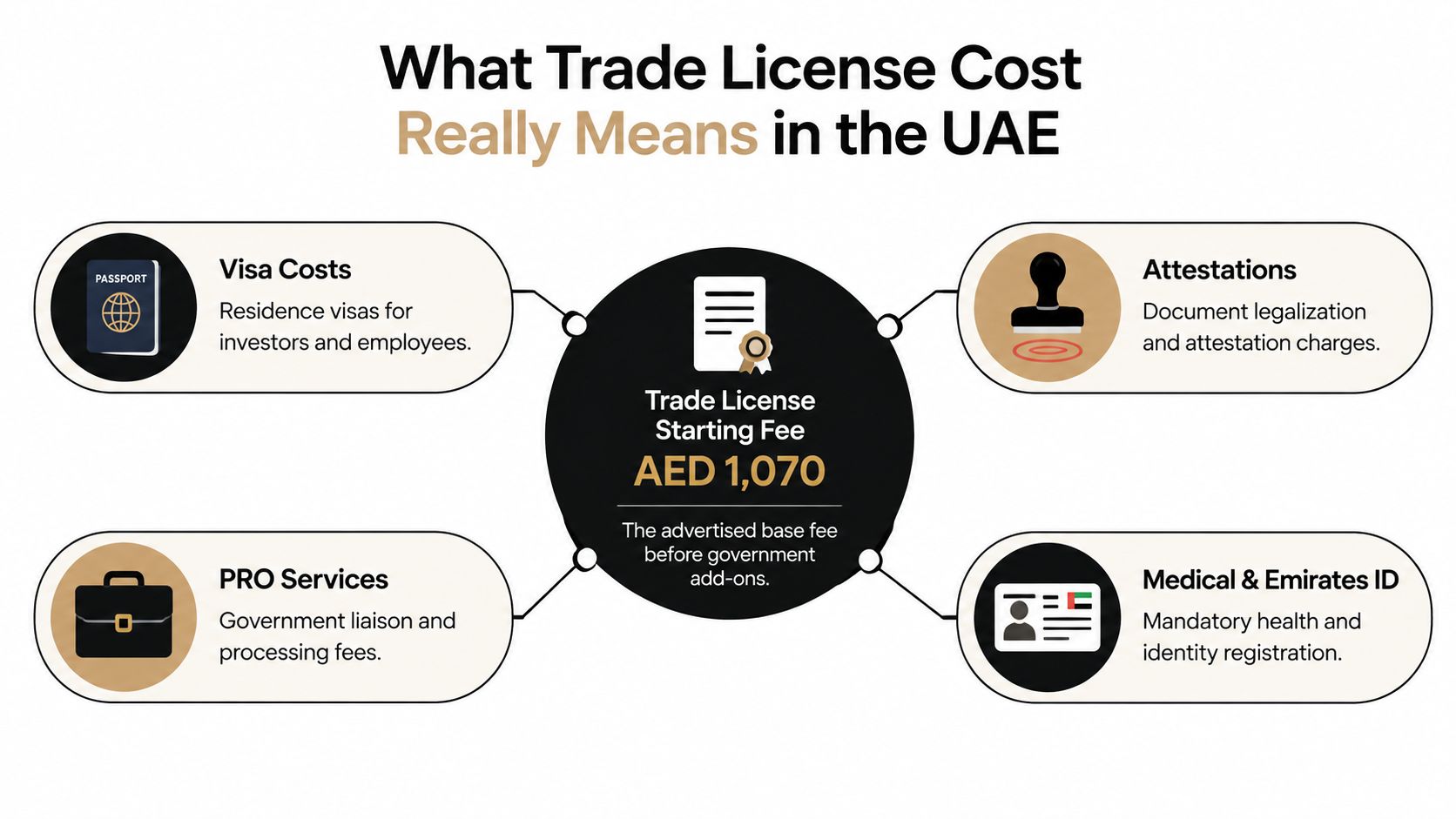
Government charges versus service charges
Government charges come from the relevant authority. They cover licence issuance, name reservation, initial approval, immigration registration, and official applications. A consultant may submit those applications, but the government fee is separate from the consultant's income.
Service fees cover PRO work, document clearing, application management, accounting, translation, and follow-up. Agents set these charges themselves, so two consultants can quote different amounts for the same application. Require both categories to appear separately.
Practical rule: Reject any quotation labelled “all-inclusive” unless it lists the licence, activities, visas, workspace, establishment card, PRO work, and renewal treatment individually.
Build your first-year budget across four layers:
- Licence and activity fees, which authorise the selected business activities.
- Corporate and immigration registration, which lets the company sponsor visas and use government systems.
- People and premises, including visas, medical checks, Emirates IDs, and workspace.
- Compliance and renewal, including accounting, VAT-related work where applicable, PRO support, and annual renewal.
The cheapest package is rarely the cheapest outcome if it excludes the items required to operate. Compare the complete first-year bill, then check what the same structure will cost to renew.
The Modular Fee Structure Behind Every Licence
A mainland licence invoice is modular. The authority doesn't charge one universal amount for every company because the application changes according to the business name, legal form, activity list, premises, and regulatory requirements.
For Dubai mainland, published market guidance identifies licence issuance at roughly AED 600 to AED 1,200, initial approval at AED 120 to AED 500, trade name registration at AED 620, and additional activity charges of about AED 1,000 beyond the first three activities. The same guidance places a standard mainland trade licence total at roughly AED 4,000 to AED 10,000 before workspace and immigration costs, as explained in this Dubai trade licence fee breakdown.
| Component | Approx. Fee (AED) | What Triggers It |
|---|---|---|
| Trade name reservation | 620 | Selecting and reserving the company name |
| Initial approval | 120–500 | Authority review of the proposed business |
| Licence issuance | 600–1,200 | Issuing the mainland licence |
| Additional activities | About 1,000 beyond the first three | Expanding the activity list |
| Establishment card | Varies | Registering the company for immigration and sponsorship |
The activity list usually matters more than the size of your team or the company's expected revenue. A solo founder with several regulated services can face a more complicated application than a larger company with one straightforward activity.
Choose the activity before you choose the package
A commercial licence generally supports trading goods. A professional licence is used for many service-based activities, while an industrial licence applies to manufacturing and industrial operations. The classification affects approvals, premises, documentation, and sometimes the authority that must review the application.
Adding activities without a clear reason is poor budgeting. A consultant, for example, shouldn't automatically add every possible advisory category. Each activity should correspond to a service the company will invoice for, and the wording should match the work described in contracts and marketing materials.
The modular model also lets authorities price regulatory complexity. Import, manufacturing, and regulated consulting activities can require more scrutiny than a low-touch professional service. The fee isn't a charge for printing a certificate. It reflects the scope of permission the company is requesting.
Mainland, Free Zone, and Offshore Compared on Cost
The three UAE jurisdiction choices solve different commercial problems. Mainland is usually the practical route for businesses that need direct access to UAE customers, local premises, or government contracts. Free zones can offer packaged formation, office options, and visa administration, but the package must match the founder's actual needs. Offshore structures are designed for holding, international invoicing, and asset or intellectual property arrangements, not ordinary UAE shopfront trading.
Published market guidance places mainstream Dubai mainland commercial setups in the AED 12,000 to AED 25,000 range for year-one licensing-related costs, while free-zone packages can start around AED 4,888. Regulated DIFC financial firms can exceed AED 900,000, showing why jurisdiction and regulatory intensity matter more than the phrase “UAE licence” alone, as set out in this UAE business licence cost comparison.
| Jurisdiction | Typical First-Year Cost (AED) | Can Trade in UAE? | Visas Allowed | Best For |
|---|---|---|---|---|
| Mainland | 12,000–25,000 for mainstream setups | Yes, subject to activity and approvals | Based on office and authority rules | Local trading, services, government contracts |
| Free zone | Starts around 4,888, then rises with visas and workspace | Depends on the zone, activity, and distribution model | Based on package and premises | Startups, international services, lean operations |
| Offshore | Formation pricing varies by structure | No ordinary physical UAE trading | Not a standard route for UAE residence visas | Holding, IP, international invoicing |
A mainland setup costs more when you add a compliant office, visas, and activity approvals, but it gives you broader operating flexibility inside the UAE. A free zone can be efficient when the company has limited local operating requirements and wants a defined package.
Offshore is the option founders most often misunderstand. A low formation fee doesn't create a UAE operating licence, local shop, warehouse, or residence visa. Choose it only when the business model directly involves holding or international activity.
Published Free Zone Licence Fees Across the UAE
A founder comparing free zones may see a licence advertised at AED 5,750, then receive a much higher first-year quotation. The gap usually comes from visas, immigration registration, workspace, activity approvals, and renewal items excluded from the headline price.
Published 2026 comparisons list annual starting fees of around AED 5,750 in SHAMS, AED 7,500 in RAKEZ, AED 10,020 in DWTC, AED 11,150 in KEZAD, AED 12,750 in IFZA, and AED 15,000 in DMCC. Premium regulated structures can exceed AED 50,000. Treat these figures as market benchmarks, not guaranteed invoices.
A service licence may be priced differently from a trading licence. A package without a visa or flexi-desk also cannot be compared fairly with one that includes workspace and immigration eligibility.
| Free Zone | Service Licence (From) | Trading Licence (From) | Includes Establishment Card | Notes |
|---|---|---|---|---|
| SHAMS | AED 5,750 | Varies by package | Confirm with the quotation | Budget-oriented packages may exclude visas and workspace |
| RAKEZ | AED 7,500 | Varies by activity | Confirm with the quotation | Activity and facility requirements affect the total |
| DWTC | AED 10,020 | Varies by activity | Confirm with the quotation | Premium Dubai location and package structure |
| KEZAD | AED 11,150 | Varies by activity | Confirm with the quotation | Industrial and commercial requirements can differ |
| IFZA | AED 12,750 | Varies by activity | Confirm with the quotation | Visa, office, and activity selections change the final bill |
| DMCC | AED 15,000 | Varies by activity | Confirm with the quotation | Higher-tier Dubai free-zone structure |
| JAFZA | Varies by activity and facility | Varies by activity and facility | Confirm with the quotation | Trading, logistics, and facility requirements are central |
| SPC FZ | Varies by package | Varies by package | Confirm with the quotation | Package inclusions need checking before payment |
| Ajman Free Zone | Varies by package | Varies by package | Confirm with the quotation | Often positioned as a lower-cost option |
| UAQ FTZ | Varies by package | Varies by package | Confirm with the quotation | Confirm activity permissions and visa inclusions |
Use the table to challenge a quotation, not to choose a zone by price alone. Ask the consultant to state whether the total includes the establishment card, immigration file, visa quota, flexi-desk, share capital requirement, and renewal charges.
The right comparison is the complete first-year bill. A low licence fee can produce an expensive setup once each required item is charged separately. Before paying, request an itemised quotation and confirm which costs recur at renewal.
Add-On Costs That Move the Bill Beyond the Licence
The licence gets the company registered. The add-ons get the founder and staff authorised to live, work, and operate through it.
Start with the immigration side. Investor, partner, employee, and domestic residence visas have different requirements, and each approved applicant may need medical testing, Emirates ID processing, health insurance, and related government applications. The establishment card registers the company with immigration authorities and is normally essential if the business intends to sponsor residence visas.
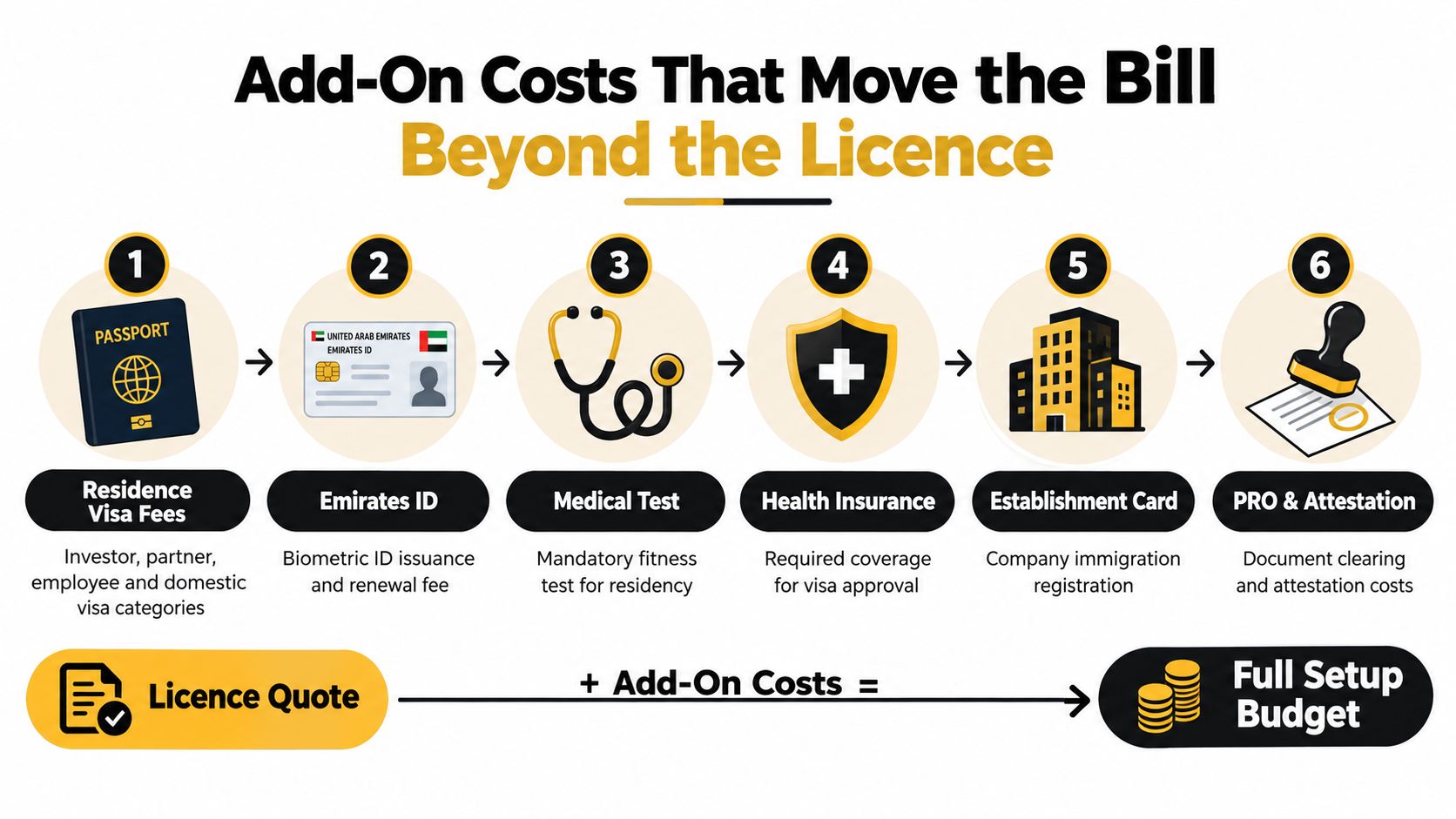
The costs founders forget first
Document preparation can include translation, notarisation, embassy or ministry attestation, and Memorandum of Association procedures. PRO providers may charge separately for name reservation, initial approval, application submission, immigration registration, visa processing, and document clearing.
Workspace is another major variable. A flexi-desk may suit a consultancy with one founder and no stock. A trading company may need a dedicated office, warehouse, or operational address that supports the declared activity. The authority's premises requirements should match the business model, not merely the cheapest available desk.
Recurring compliance also belongs in the first-year budget. Monthly bookkeeping, annual accounts, VAT registration and filing support where applicable, audit requirements in certain zones, and visa renewals can continue after incorporation. A cost guide published by Stratrich on UAE trade licence expenses notes that free-zone packages can start near AED 4,888 to AED 9,000, then rise to AED 20,000 to AED 45,000 once visas and workspace are included. The same source reports renewal costs ranging from AED 6,000 to AED 25,000, depending on the emirate and zone.
Two visas alone can add AED 7,000 to AED 9,000 to a setup budget, based on the supplied UAE cost planning data. That's why a founder should calculate the cost per visa and the cost of the premises separately rather than assuming the package covers both.
Two Founder Scenarios With Realistic First-Year Totals
A solo consultant and an import trader can receive the same “company formation” label while facing completely different bills. The consultant needs a service activity, light premises, and one visa. The trader needs commercial permissions, customs access, staff visas, storage or office capacity, and more active bookkeeping.
The following planning ranges use the supplied scenario assumptions. They're budgeting examples, not official authority invoices, and the final quotation will depend on the selected activity, package, and provider.
| Cost Item | Solo Consultant (DMCC) | Import Trader (AFZ) |
|---|---|---|
| Licence and activity package | AED 15,000 | AED 7,500 |
| Establishment card and immigration registration | AED 1,000 | AED 2,500 |
| Visas | AED 3,000 | AED 18,000 |
| Emirates ID and medical processing | AED 1,000 | AED 6,000 |
| PRO and document processing | AED 1,000 | AED 3,000 |
| Flexi-desk or office | AED 1,000 | AED 8,000 |
| Bookkeeping and accounting | AED 2,000 | AED 6,000 |
| Customs registration support | Not required | AED 2,000 |
| Estimated first-year total | AED 18,000–22,000 | AED 45,000–55,000 |
The consultant's calculation
The consultant chooses a DMCC service licence, one investor visa, a flexi-desk, and quarterly bookkeeping. The licence is the largest single line, but it isn't the only one. Immigration registration, the visa, medical and Emirates ID processing, PRO work, office access, and accounting bring the budget into the AED 18,000 to AED 22,000 range.
The important point is that this founder doesn't need a warehouse, multiple employee visas, or customs registration. Paying for those items would make the structure inefficient.
The trader's calculation
The import trader chooses an Ajman Free Zone commercial setup, three employee visas, a small office, customs registration support, and monthly accounting. The licence may be cheaper than the consultant's package, but the operating requirements are heavier.
Import-export businesses often need a Customs Client Code and a broader commercial licence, which pushes the first-year bill above the advertised package price, as discussed in this UAE guidance on the cheapest trade licence options. In this scenario, visas, premises, customs support, and recurring accounting drive the AED 45,000 to AED 55,000 total.
Why the Cheapest Package Often Costs More
A package below AED 5,000 can be perfectly suitable for a zero-visa founder who provides a narrow service and has no warehouse, local retail activity, or staff. It becomes poor value when the founder later discovers that the package doesn't support the intended trading model.
The common failure starts with the activity list. A founder buys a single-activity licence, then needs additional commercial permissions for another product line. The original saving disappears through added activity charges, new approvals, or a forced change of jurisdiction.
Three ways the cheap option breaks
- No-visa packages: The founder later needs residence status and must pay for an upgrade, immigration registration, and visa processing outside the advertised package.
- Restricted trading permissions: The licence permits a narrow service or product category, but the company begins invoicing for work outside that scope.
- Insufficient workspace: A shared desk suits a small consultancy but doesn't support a declared warehouse, trading, or client-facing operation.
A mainland package priced around AED 15,000 can be more practical for a founder who needs three activities, two visas, and a compliant Ejari office. The package may cost more at the start, but it can avoid a later restructure for a business that trades directly inside the UAE. That comparison is only valid when the quotation includes those items, so don't rely on the headline label.
| Package Type | Headline Price | Real First-Year Cost | Hidden Trap |
|---|---|---|---|
| Zero-visa free-zone package | Under AED 5,000 in some zones | Higher after residence and immigration needs | Visa and workspace exclusions |
| Single-activity commercial package | Low starting fee | Higher after added activities and approvals | Trading scope is too narrow |
| Flexi-desk package | Low premises cost | Higher if dedicated space is required | Workspace doesn't match activity |
| Mainland operating package | Around AED 15,000 in the supplied example | Can be efficient with included activities, visas, and office | Inclusions must be confirmed in writing |
Judge every quotation by cost per visa, cost per activity, office suitability, and renewal bill. The lowest sticker price is not a recommendation. It's only an opening number.
Practical Ways to Keep Trade License Cost Down
Cost control starts before the application is submitted. Write down what the company will sell, where it will sell, how many people need visas, and whether it will import, store, manufacture, or serve UAE customers directly. Then ask the consultant to build the activity list and jurisdiction around that operating model.
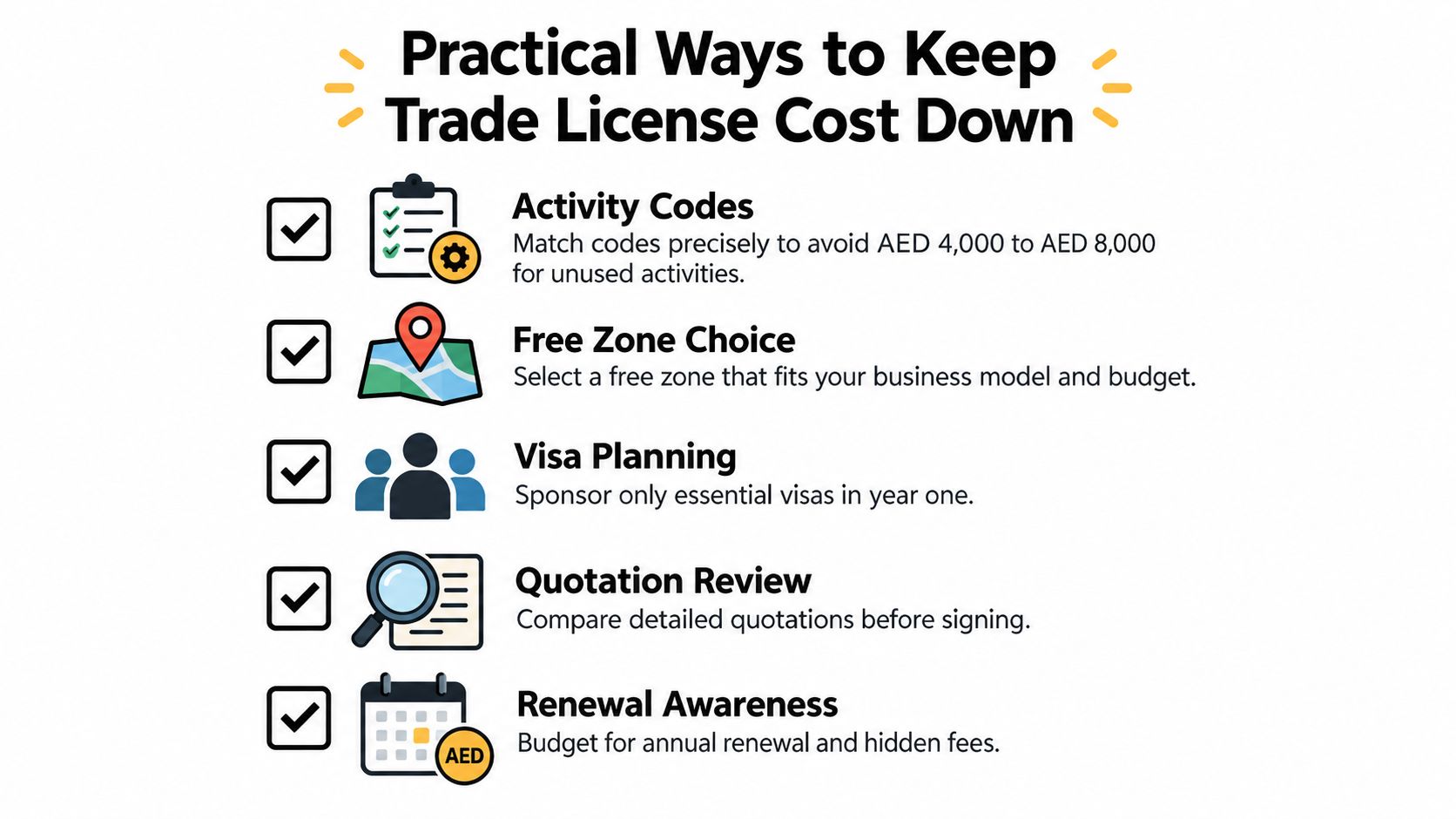
Use these controls before paying an incorporation deposit:
- Match activity codes: Remove activities you won't invoice for, but don't omit permissions the business needs. Extra activity charges can make an apparently cheap application expensive.
- Choose the right free zone: Select a zone that supports your customers, facilities, customs needs, and visa plan. A distant low-cost zone can create duplicate warehouse, logistics, or office costs.
- Plan visas early: Sponsor only the people who need residence status in year one. Include the investor, partners, and employees you expect to relocate.
- Review the quotation: Require separate rows for government fees, service fees, office, establishment card, visas, medical tests, Emirates IDs, accounting, and renewal.
- Track renewal dates: Put licence renewal, visa expiry, lease expiry, accounting filings, and insurance renewals on one calendar.
Bundling services can simplify administration, but don't accept a bundle without an itemised schedule. Ask whether the provider handles PRO work, VAT-compliant accounting, bookkeeping, audit coordination, tax residency certificates, or liquidation as separate services or as part of the agreed scope.
Before signing, ask five direct questions:
- How many activities are included, and what happens if I add another?
- How many visas does the office or package support?
- What office class is included, and does it satisfy the activity requirement?
- What exactly triggers renewal, and what will renewal cost?
- Which government and service fees are excluded?
Smart Classic Business Hub offers company formation across mainland, free-zone, and offshore structures, together with PRO services, visa support, VAT-compliant accounting, bookkeeping, and renewal guidance. Visit Smart Classic Business Hub with your activity list and visa plan to request a cost-focused setup assessment before you commit to a package.