
For UAE businesses, the right audit requirement depends on the entity's structure, free-zone status, tax-group membership, and revenue. From tax periods beginning on or after 1 January 2025, taxable persons outside a tax group with revenue above AED 50 million generally need audited financial statements, while Qualifying Free Zone Persons are included regardless of that threshold.
A Dubai founder often discovers the issue at the worst possible time. The Federal Tax Authority requests financial statements, a bank pauses a finance application until it receives an independent opinion, or an investor asks why the company's accounts have never been externally reviewed. The accounts may be accurate, but accuracy that nobody independent has tested doesn't carry the same weight with regulators, lenders, shareholders, or prospective investors.
Audit and assurance services provide independent verification of financial information and, where required, controls or non-financial reporting. In the UAE, the correct engagement isn't a simple checklist item. It depends on what the company does, where it is registered, how it joins a tax group, which party will rely on the statements, and which regulatory framework applies.
Why Audit & Assurance Matters for UAE Businesses
A problem usually shows up before anyone asks for an audit by name. A lender wants comfort on the numbers behind a facility request. A tax filing position needs financial statements that can stand up to scrutiny. A shareholder, buyer, or free-zone authority asks for accounts prepared under the right framework and supported by records that hold together under review. In the UAE, that is why audit and assurance services matter. They do more than satisfy a filing step. They help determine whether the financial statements in front of a third party are the right ones for the entity's legal and commercial position.
That distinction matters in practice. A mainland company, a free-zone entity, and a company inside a tax group can face different reporting expectations even if their operations look similar from the outside. The key decision is not only whether to get an audit. It is which financial statements are needed, who will rely on them, and whether the engagement will support licensing, tax, banking, investment, or governance objectives.
The profession has been regulated nationally since 1976, and the current framework has developed through Federal Law No. 12 of 2014 and Cabinet Resolution No. 48 of 2022. The 2014 law expanded regulatory and disciplinary powers and revised licensing requirements for auditors and audit firms. The 2022 resolution introduced a national fellowship as a qualifying credential, changed professional indemnity requirements, and revised licensing rules for certain applicants without an accounting degree under specified conditions.

More than a year-end formality
In the UAE, audit work is tied to international standards through Ministry of Economy requirements, so the output is meant for external reliance, not just internal housekeeping. For an SME, the benefit usually appears first in the evidence trail. A proper audit can bring out unsupported receivables, inconsistent revenue recognition, weak approval trails, or related-party balances that were posted without clear backing. It also gives management a clearer view of which controls need attention, while still stopping short of any promise that every error or fraud will be detected.
Practical rule: Decide who will rely on the financial statements before deciding which engagement to commission.
That point becomes sharper in listed environments. The UAE listed-company reporting study reviewed Abu Dhabi Securities Exchange and Dubai Financial Market companies and highlighted audit-report lag, the number of days between financial year-end and the audit-report date, as a governance issue with real operational consequences. Planning, evidence collection, management review, board approvals, and sign-off all affect that timeline.
The same research examined 298 company-year observations covering 2011 to 2013, and a separate governance study reviewed annual reports from 95 listed corporations. Those studies found that disclosures around external auditing and non-audit services were among the weaker areas in the companies reviewed. Private businesses should read that as a practical warning. Stakeholders do not only ask whether an audit exists. They also assess whether the surrounding records, approvals, and disclosures are complete enough to support confidence in the numbers.
Understanding the Three Main Types of Audits
UAE businesses use the word “audit” for engagements with very different purposes. A statutory audit gives external users an independent opinion on financial statements. An internal audit assesses how the business manages risk and controls. Controls-related assurance tests whether a defined control framework works as intended.
Statutory audits
A statutory audit is the formal external examination of financial statements required by law, regulation, a licence condition, a lender, or another reporting obligation. The auditor evaluates evidence and issues an opinion for users outside management, such as shareholders, banks, regulators, or investors.
For a company operating in a regulated sector, the scope can extend well beyond the general ledger. The UAE Central Bank's financial reporting and external audit regulation requires regulated companies to prepare statements under IFRS, maintain supporting records, publish annual statements with an independent auditor's opinion, and appoint a Central Bank-approved auditor each year. Audits must follow ISA and use a risk- and materiality-based approach.
Internal audits
An internal audit is designed primarily for management, the board, and the audit committee. It examines whether controls operate properly, whether risks are identified, and whether governance processes support reliable operations. It may review procurement approvals, segregation of duties, user access, inventory handling, payroll changes, or the reconciliation process.
Internal audit can be performed by employees or an external specialist, but the reviewer needs enough independence from the activity being tested. A finance manager shouldn't provide an objective review of controls that they personally designed and operate.
Controls-related assurance
Controls-related assurance evaluates a defined control framework against stated criteria. A bank may need evidence that its governance and quality-control procedures operate consistently. A technology provider may need assurance over controls relevant to a customer's financial reporting or information security requirements. The engagement is narrower than a full financial-statement audit, but it can be highly demanding within its agreed scope.

The distinction matters in banking and insurance. For insurers, the Central Bank's requirements cover investments, technical provisions, solvency margins, commissions, capital adequacy, reinsurance, corporate governance, risk management, internal controls, and, where applicable, Shariah compliance. Testing only account balances would miss the prudential risks that determine whether the entity can meet its obligations.
A controls review improves how the business operates. A statutory audit supports reliance on the financial statements. They complement each other, but one cannot automatically replace the other.
Statutory vs Tax-Purpose Audits and What Your Business Actually Needs
The most common UAE misunderstanding is treating a statutory audit and a tax-purpose audit as interchangeable. They can involve overlapping financial information, but the legal trigger, statement format, and intended user may differ.
Ministerial Decision No. 84 of 2025 applies to tax periods beginning on or after 1 January 2025. It requires audited financial statements for taxable persons outside a tax group when revenue exceeds AED 50 million. It also expressly includes Qualifying Free Zone Persons regardless of that threshold.
| Entity Type | Audit Requirement | Revenue Threshold |
|---|---|---|
| Taxable person outside a tax group | Audited financial statements for corporate-tax purposes where the applicable condition is met | Revenue exceeding AED 50 million |
| Qualifying Free Zone Person | Included in the audited-financial-statement requirement | Applies regardless of the AED 50 million threshold |
| Tax group | Audited special-purpose financial statements must be prepared and maintained | The requirement concerns the tax group's special-purpose statements |
| Non-resident with UAE presence | Assess UAE revenue attributable to a permanent establishment or nexus | Only attributable UAE revenue counts when assessing the threshold |
The decision matrix
Start with free-zone status, not turnover. A company that qualifies as a Qualifying Free Zone Person can fall within the audited-financial-statement requirement even when its revenue is below AED 50 million. Confirm the entity's tax status and keep the evidence supporting that status.
Next, establish whether the company is part of a tax group. A tax group has its own special-purpose financial-statement obligation, so the group's reporting work shouldn't be confused with the standalone accounts of each subsidiary. A standalone subsidiary may also have separate statutory, lender, licensing, or contractual requirements.
For a non-resident, assess only UAE revenue attributable to the relevant permanent establishment or nexus when applying the threshold. A foreign investor shouldn't assume that worldwide revenue automatically determines the UAE filing obligation.
Practical rule: Ask for a written matrix covering legal entity, free-zone classification, tax-group membership, accounting period, revenue basis, and intended financial-statement user before commissioning the work.
The Federal Tax Authority has also published guidance addressing financial statements and audit requirements for tax groups. That makes implementation detail important. The correct question isn't just, “Do I need an audit?” It's, “Which statements must this entity or group prepare, for which purpose, and with what evidence?”
The Typical Audit Process and Timeline
A weak audit timetable usually shows up long before fieldwork starts. The finance team closes late, operations cannot explain unusual balances, and management is still deciding which reporting framework applies. In the UAE, that last point matters more than many businesses expect. An entity's free-zone position, tax-group membership, and reporting purpose can change the statements the auditor is being asked to sign, which changes the evidence pack, review points, and timing.
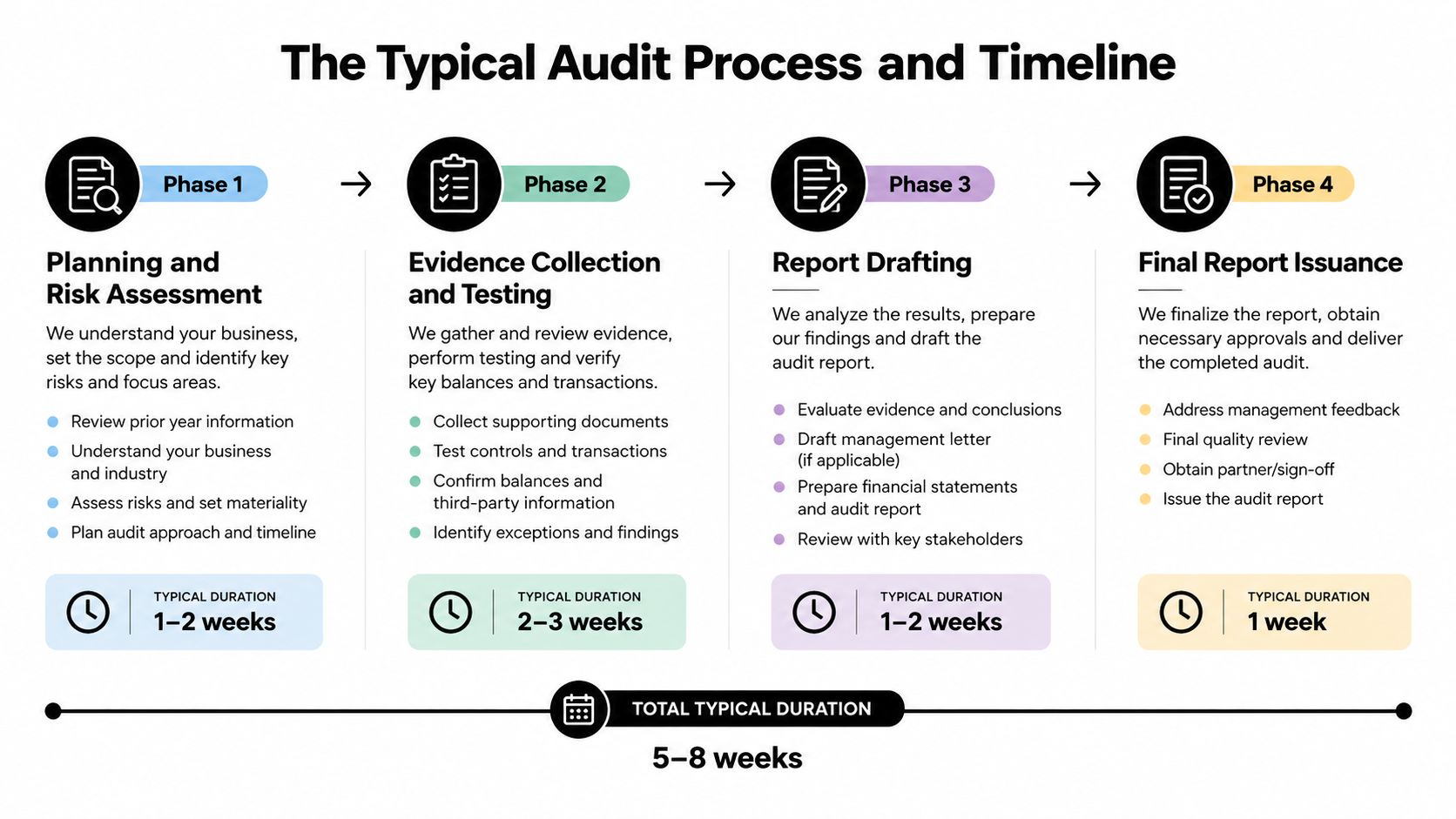
Four phases that keep the work moving
Planning and risk assessment
The auditor first needs a clear reporting brief: which financial statements are required, under which framework, for which user, and by what deadline. From there, the team examines how revenue is earned, how transactions are recorded, how cash is controlled, and where estimates or judgement could materially affect the accounts. If management has not settled these points early, the audit often slows down before testing begins.Evidence collection and testing
The auditor tests selected balances and transactions, reviews reconciliations, checks contracts, seeks confirmations where appropriate, and evaluates control evidence. Some entities need more than standard ledger support. Regulated businesses may also need valuation, solvency, actuarial, governance, or risk documentation.Management review and report drafting
This phase usually determines whether the timetable holds. Management answers queries, provides missing support, posts agreed adjustments, and reviews the draft financial statements and disclosures. Where responsibility is spread across finance, operations, and owners without a named decision-maker, review cycles drag.Final sign-off
The auditor closes review points, obtains management representations, completes partner review, and issues the report. The opinion issued will reflect both the quality of the evidence and whether the reporting framework used was the right one for the entity's actual obligation.
Deadlines are governance controls
For UAE listed entities, the capital-market reporting research cited earlier identifies a 90-day deadline for annual reports and a 30-day deadline for quarterly statements. Under some applicable regimes, audited reports may also be submitted within 120 days of financial year-end, but management should confirm the rule that applies to the specific entity before fixing the close calendar. These dates drive the board approval timetable, the ledger close, and the auditor's access to complete schedules.
Track audit-report lag, the period between year-end and the audit-report date. If that gap is widening, the cause is usually practical: unresolved estimates, late reconciliations, delayed confirmations, or slow internal approvals.
A disciplined close calendar helps. Assign each schedule to a named owner, clear bank and intercompany reconciliations early, document significant estimates, collect board minutes, and maintain a live query log from day one.
Key Documents and Evidence Required for Audit
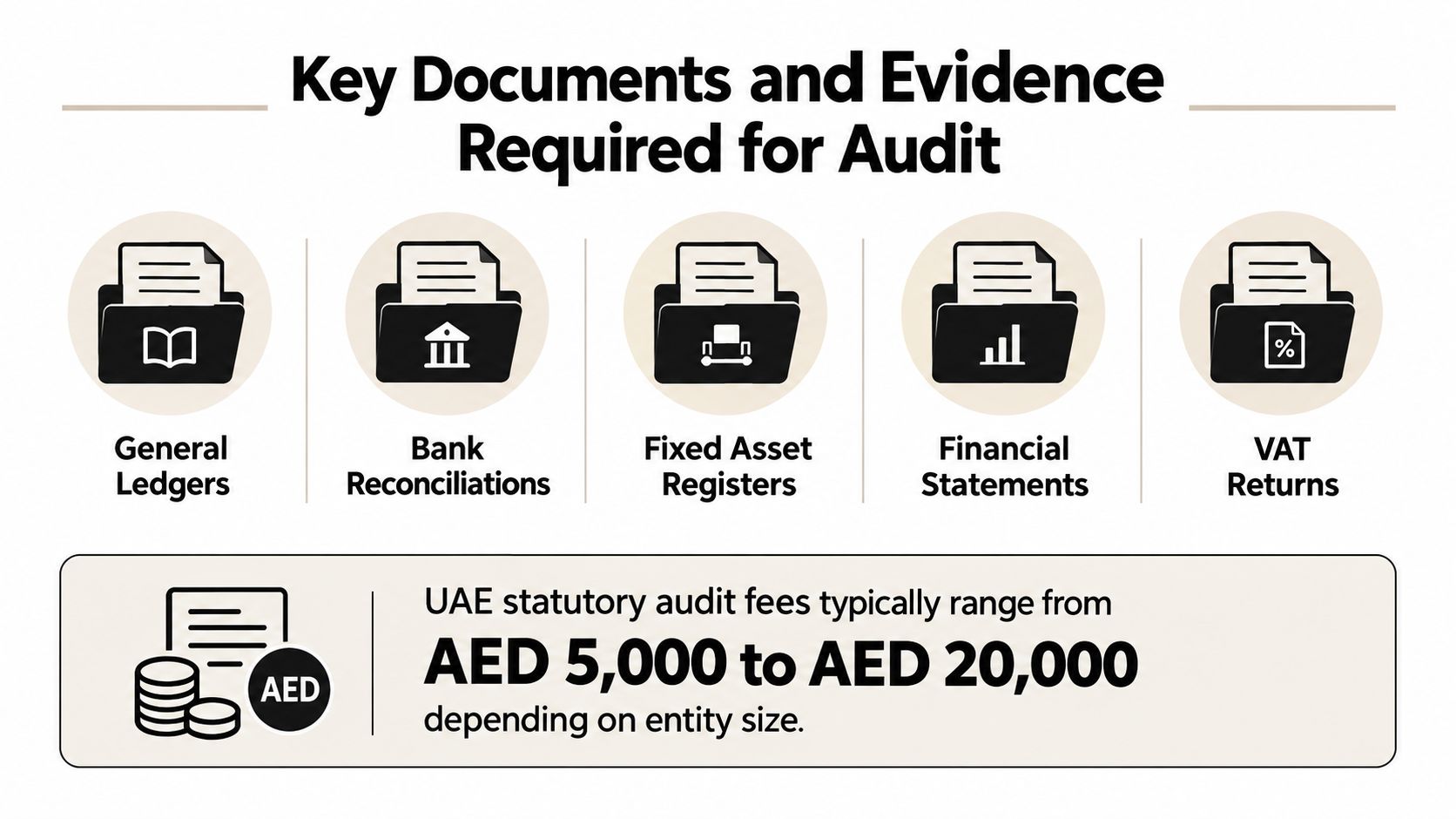
A file can look complete and still fail an audit within the first hour. The usual problem is not the absence of documents. It is the absence of a clear link between the numbers, the underlying transactions, management's judgement, and the approvals behind them. That distinction matters in the UAE, especially where the business first needs to decide which financial statements are required for its free-zone, tax-group, or corporate-tax position. Once that reporting basis is clear, the evidence pack has to support it.
Build the evidence pack around the statements
Start from the draft accounts and work backward to source records. Auditors usually ask for the same core set, but the depth changes by entity type, regulation, and reporting purpose.
- Financial statements: Provide the draft statement of financial position, income statement, cash-flow statement, changes in equity, and notes under the applicable framework.
- General ledgers and trial balance: Keep transaction-level records, the chart of accounts, journal listings, and closing entries that tie back to the draft accounts.
- Bank reconciliations: Include reconciliations for every bank account, explanations for outstanding items, and support for unusual movements.
- Fixed-asset register: Show additions, disposals, depreciation, ownership support, and invoices.
- Payroll and employee records: Retain payroll reports, approvals, end-of-service calculations, and reconciliations to the ledger.
- Tax records: Organise VAT returns, corporate-tax workings where relevant, supporting invoices, and correspondence with the authority.
- Contracts and governance records: Include leases, financing agreements, shareholder resolutions, board minutes, related-party agreements, and major customer or supplier contracts.
For regulated companies, the Central Bank's financial reporting and external audit regulation treats supporting record-keeping systems and independent auditor reporting as part of the reporting environment. For an insurer, that usually means the file also needs to support investments, technical provisions, solvency margins, reinsurance, capital adequacy, governance, and risk management.
Governance evidence protects independence
Governance documents matter as much as accounting schedules in regulated sectors. The Central Bank's external-audit standards require the audit committee to approve the external-audit tendering policy and assess competence, objectivity, independence, professional scepticism, and quality control.
The same standards set rotation and evaluation requirements for the audit firm and lead partner, and require annual oversight by the audit committee. In practice, an audit-ready file should include tender papers, committee approvals, independence assessments, auditor evaluations, support for management estimates, and records showing how significant issues were resolved.
This evidence shows more than administrative order. It shows that management can defend a balance, an estimate, or an approval under independent scrutiny, and that the audit process rests on repeatable governance rather than year-end improvisation.
How Smart Classic Supports Your Audit Journey
Audit preparation is easier when accounting, tax, governance, and corporate planning don't sit in separate files. A company that keeps VAT records in one system, board approvals in email, contracts in personal folders, and tax-group analysis in a separate spreadsheet creates unnecessary audit risk. The practical solution is to assign ownership and connect the evidence trail to the decisions the business makes.
Smart Classic Business Hub is one Dubai-based option for businesses that need support across that journey. Its services include VAT-compliant accounting, statutory audits, audit support, company formation, corporate finance advisory, feasibility studies, business planning, and liquidation. That combination can help a founder connect the entity's structure with its ongoing reporting obligations rather than treating the audit as an isolated year-end purchase.
Support from setup through reporting
The right starting point is often a structure review. Mainland, free-zone, and offshore entities can have different commercial and tax considerations, while tax-group membership changes the financial-statement question. A consultant can help organise the information needed to evaluate the entity, identify the reporting purpose, and coordinate with the appointed auditor.
For an operating SME, practical support may include:
- Accounting preparation: Maintain reconciliations, ledgers, VAT records, and financial schedules in an audit-ready format.
- Audit coordination: Prepare evidence packs, respond to auditor requests, and track open queries through completion.
- Corporate finance support: Align feasibility studies, financial management, and business plans with the information lenders or investors expect to review.
- Compliance continuity: Support company formation, PRO requirements, tax-residency documentation, and liquidation when the business changes direction.
Smart Classic Business Hub operates from Baniyas Square in Dubai and combines local consultancy support with a network for related business services. The value of that model isn't that one provider replaces the independent auditor. Independence still matters. The value is that management can improve the records, schedules, controls, and decisions presented to the auditor.
An effective engagement also starts with the requesting party. Confirm whether the bank, regulator, investor, tax adviser, or group finance team needs a statutory audit, tax-purpose audited statements, tax-group special-purpose statements, internal audit work, or controls-related assurance. Paying for the wrong scope creates cost and delay, while choosing too narrow a scope can leave the company unable to satisfy the original request.
Smart Classic's role is to help founders, SMEs, and international investors organise those moving parts while they focus on operations and growth. The final engagement should still be agreed with the qualified auditor and the relevant authority or counterparty.
Smart Classic Business Hub offers UAE businesses practical support with VAT-compliant accounting, statutory audit coordination, corporate finance advisory, and compliance planning. Visit Smart Classic Business Hub to discuss your entity structure, tax-group position, financial-statement requirements, and next audit steps with a Dubai-based consultant.