
The most popular advice about getting an e-commerce licence in the UAE is to compare packages and choose the cheapest. That's the wrong starting point. A low-cost licence is only useful if its activity wording, jurisdiction and approvals fit what you'll sell and how you'll deliver it.
Start with the transaction instead: what's the product, who's buying it, where's the stock, and which business takes payment? Those answers help you choose a licence that supports the store, rather than a package you'll need to change before you can launch.
What a UAE E-Commerce Licence Covers
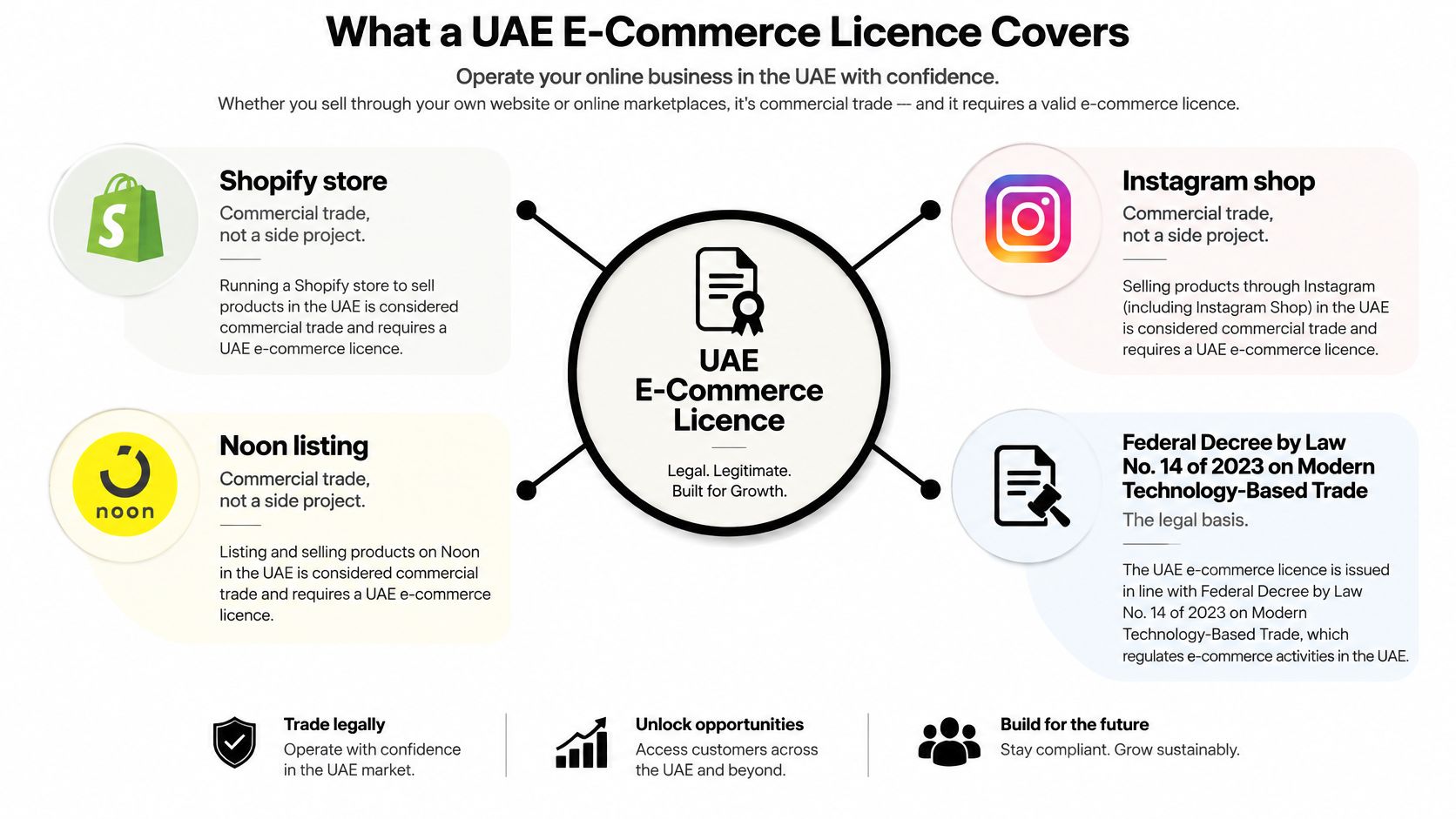
A Shopify store, Instagram shop or Noon listing is a sales channel, not permission to trade. Say you launch a skincare brand on Instagram, accept orders through direct messages and arrange deliveries from Dubai. You're operating a commercial business, even without a conventional shopfront.
The UAE Government's e-commerce guidance identifies Federal Decree by Law No. 14 of 2023 on Modern Technology-Based Trade as the legal framework for online buying and selling of goods, services and relevant data through websites, mobile applications, social platforms and digital marketplaces.
That scope includes physical products, subscriptions and online services. The important distinction isn't whether customers receive a parcel. It's whether you're conducting an authorised commercial activity through digital technology.
The authority behind the licence
For mainland operations, the licence generally comes from the emirate's economic department, with e-commerce included as an authorised activity. In Dubai, that authority is the Department of Economy and Tourism, commonly called DET. In Abu Dhabi, it's the Department of Economic Development.
Some emirates also offer standalone individual e-commerce licences. Free-zone authorities offer specialised licensing routes for digital businesses, startups and international e-commerce operations. These aren't interchangeable documents, so don't assume a licence offered in one jurisdiction has the same conditions as another.
The government guidance also identifies approval from the Telecommunications and Digital Government Regulatory Authority, or TDRA, as part of e-commerce licensing. Confirm how that approval is handled within your chosen authority's application process rather than treating it as something your website provider arranges.
What permission doesn't replace
Businesses must have legal capacity to trade, obtain the necessary licence and approvals, meet technical and regulatory requirements, and maintain secure technology infrastructure. Your storefront software can help you operate the business, but it can't establish your legal entitlement to sell.
Keep these distinctions clear:
- Sales channel: Where the customer finds and orders the product.
- Licensed activity: What the business is authorised to do.
- Operating jurisdiction: Which authority issues and administers the licence.
- Additional approvals: Permissions attached to the product or business model.
Practical rule: Describe the business without mentioning Shopify, Instagram or Noon. If you can't explain what you sell and how you fulfil it, you're not ready to select the activity.
Whether you're planning an own-site store, social selling, dropshipping or cross-border fulfilment, use the jurisdiction comparison below to narrow the route. The issuing authority determines the application documents and the conditions attached to your setup.
Mainland or Free Zone for Your Store
Which e-commerce route fits the store
| Route | Who issues it | Selling reach | Premises | Best fit |
|---|---|---|---|---|
| Mainland commercial licence with e-commerce activity | Emirate economic department, such as Dubai DET or Abu Dhabi DED | UAE customers and local contracts, within approved activities | Office, warehouse or flexi-desk accepted by the authority | Local retail, marketplaces and stock in the UAE |
| Free-zone digital or e-commerce licence | The free-zone authority | Approved online and export activity; confirm local-retail permissions | Flexi-desk where the chosen package and activity permit it | Startups and international stores |
| Individual e-commerce licence | Participating emirate's licensing authority | The individual's approved online activities | Follow the issuing emirate's premises conditions | Solo seller with a short activity list |
| Offshore company | Offshore registry | Don't treat incorporation as a local trading licence | Not a substitute for authorised retail premises | Holding or non-UAE structures, rather than UAE consumer retail |
Choose from customer location and stock location, not the lowest advertised package. A business selling locally from a UAE warehouse has different operating needs from a digital-services company invoicing overseas customers.
A mainland commercial licence is a sensible starting point to assess for UAE-focused retail, local contracts and marketplace selling. A free-zone route deserves consideration when the business is international and the zone's permitted activities support its actual operations. Neither label, by itself, answers every question about local selling or fulfilment.
Test the route against the transaction
Consider a founder selling cosmetics from a Dubai warehouse to UAE buyers. An export-focused free-zone package might appear attractive, but the founder needs confirmation that the proposed structure accommodates local sales, storage, product approvals and the intended delivery arrangements.
The useful question isn't, “Can I get an e-commerce licence?” It's, “Can this entity sell these cosmetics to these customers from this warehouse?” Get the answer before committing to premises or inventory.
Use these decision checks:
- Customer location: Are buyers mainly in the UAE, overseas, or both?
- Stock location: Will goods remain abroad, sit in your warehouse, or be held by a fulfilment partner?
- Product category: Does the range include goods that need approval beyond company licensing?
- Residence plans: Does a founder or employee need a UAE residence visa?
A free-zone authority should confirm its local-market conditions for your model. Where a mainland presence, distributor or additional permission is needed, put that arrangement into the operating plan rather than assuming online sales bypass it.
Compare legal form as well as jurisdiction
An individual licence may suit a person selling within a restricted activity list, but it shouldn't be selected without checking eligibility and permitted goods. Likewise, an offshore company shouldn't be confused with a local trading operation because both involve company registration.
Our mainland versus free-zone comparison can help you organise the structural questions before filing. Keep a written record of the authority's answers, particularly where the business combines UAE customers with overseas fulfilment.
We guide clients through jurisdiction and company legal-structure decisions through to obtaining an investment licence. That assessment can begin while a founder is still outside the UAE, provided the proposed products, customers and operating arrangements are clearly described.
How to Apply for the Licence
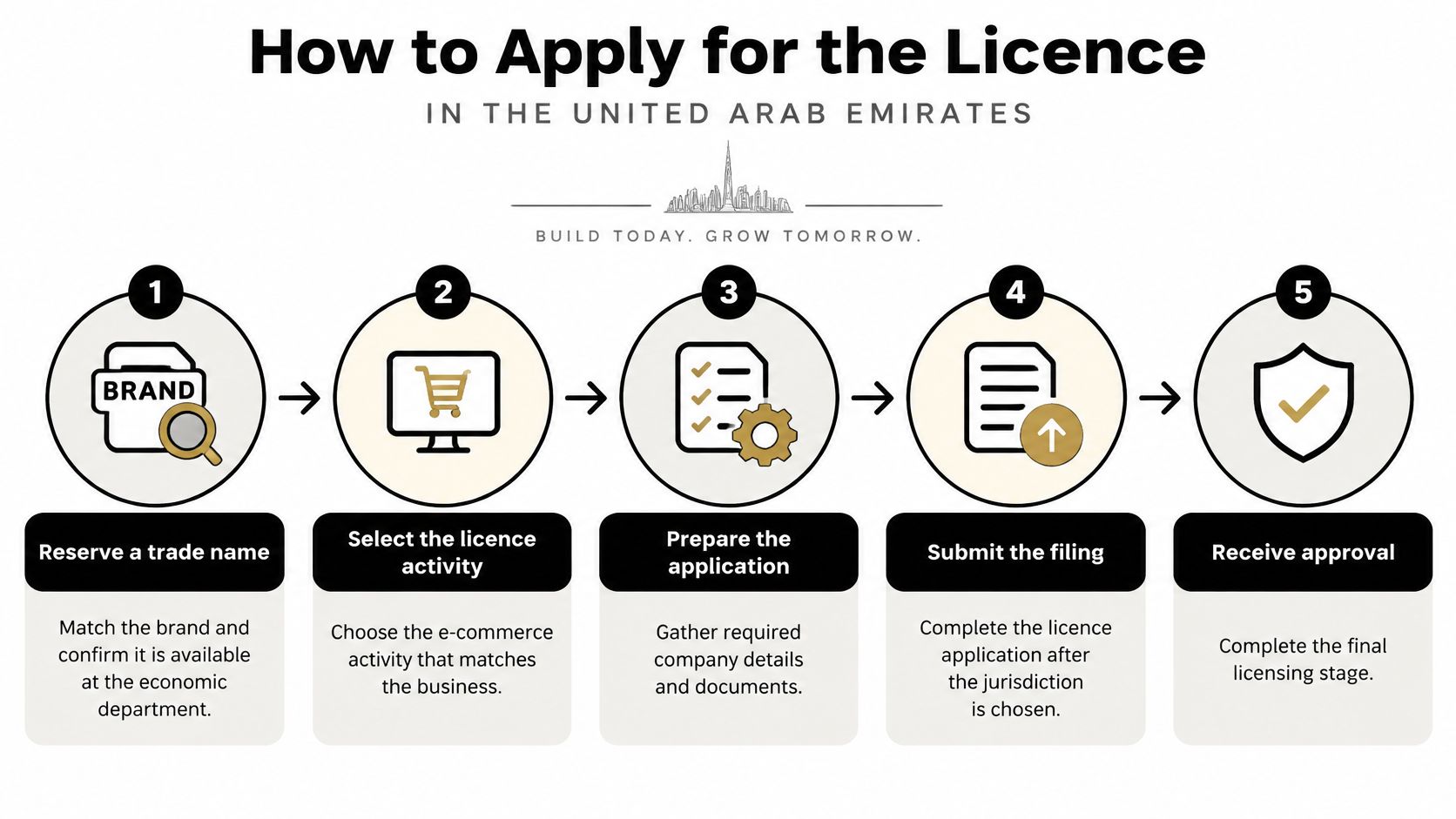
Once you've chosen the jurisdiction, treat the application as a sequence of connected decisions. Don't collect documents for a package until the authority has confirmed that its activity and premises conditions suit your business.
Prepare the application in order
Reserve the trade name.
Submit the proposed name to Dubai DET, the relevant emirate's economic department or the chosen free-zone authority. Check availability before paying for packaging or committing to a permanent brand identity. Keep alternatives ready so a rejected name doesn't hold up the rest of the application.Confirm the exact activity wording.
This is the decision to scrutinise most closely. Give the authority a concrete product list rather than a description such as “selling things online”. Ask whether each category fits the proposed activity and whether additional trading activities or product approvals are required.Choose the legal form.
Confirm which structures the jurisdiction permits for your ownership arrangement, such as a sole establishment or limited liability company where available. Ask how the legal form affects shareholder documents and signing authority. Don't copy another founder's structure without checking whether your circumstances match.Arrange accepted premises.
Obtain the lease, flexi-desk agreement or other premises evidence the authority accepts. If you'll store goods, explain the storage arrangement explicitly. An address used for company administration shouldn't be assumed to authorise warehousing.
Submit, approve and collect
Prepare the document pack.
Request the authority's checklist for your applicant type. Prepare passport copies, photographs, visa or entry-status documents where requested, and the relevant company constitutional documents. For an existing business, additional documents may include financial statements and a letter of intent.File for initial approval and related permissions.
Submit through Dubai DET, the relevant economic department or the free-zone authority. Confirm how e-commerce and TDRA-related approvals are incorporated into the filing. Keep product-specific applications visible as separate tasks where they aren't included.Pay the assessed fees and collect the licence.
Check the company name, ownership details and activity wording against the approved application before using the document. Where residence is planned, confirm the establishment-card and immigration-file requirements with the relevant authority.Follow through until outstanding approvals are issued.
Track the licence application, residence applications and other permits separately. Ask for the current processing expectations at filing, and base your launch date on the slowest approval that's necessary for trading.
A document marked approved is only useful when you know which application it belongs to and what remains outstanding.
We handle business-licence paperwork so clients can complete the paperwork process from home. After submission, we follow up with the relevant authorities for approvals and licences, which can include trade licences, residence visas and other permits.
The output you need is more than a certificate bearing the company name. It's a licence with an activity line that accurately reflects the products and sales model you submitted.
Costs Fees and VAT After Setup
What an e-commerce setup costs
| Cost item | When it applies | What changes the amount |
|---|---|---|
| Trade name reservation | Before filing | Name selection and any further reservation applications |
| Trade licence fee | On licensing and renewal | Jurisdiction, legal form and approved activities |
| Premises or flexi-desk | Where required by the chosen authority | Location, space, package conditions and visa eligibility |
| Establishment card and visa file | Where needed for immigration arrangements | Authority requirements and the proposed staffing structure |
| Investor or partner visa | If a founder applies for residence | Application route and applicant circumstances |
| Product permits | Where the goods require category-specific clearance | Product category, testing and approving authority |
| VAT registration | When the business meets applicable registration conditions | Taxable supplies and the relevant tax rules, not the licence label |
The advertised licence fee isn't a complete launch budget. Build your comparison around the same operating assumptions, including premises, residence requirements, product clearance and renewal obligations.
For example, compare packages using the same product list and the same founder-residence plan. Otherwise, you may be comparing a licence-only offer with a setup that includes premises or immigration administration.
Separate setup costs from selling costs
Request an itemised quotation with included, excluded and recurring charges clearly identified. Ask what happens financially if the authority requires an additional activity or rejects the proposed premises arrangement.
Product permits should have their own budget line. A store selling cosmetics, food, supplements or health-related goods shouldn't assume that payment for company licensing also covers product assessment or clearance.
Marketplace costs belong in a separate operating budget. If AmaJova is among your proposed channels, understanding AmaJova's selling costs helps you examine its fee information alongside fulfilment, returns and customer-acquisition expenses, rather than confusing platform charges with government setup fees.
- Setup budget: Company formation, licensing, premises and applicable immigration work.
- Product-readiness budget: Required approvals, compliant product information and operational preparation.
- Trading budget: Platform charges, payment processing, fulfilment, returns and accounting.
- Renewal budget: Recurring licences, permits and other continuing commitments.
Keep VAT separate from licensing
VAT registration and company licensing are different decisions. Don't assume that receiving a trade licence automatically registers the business for VAT, or that a free-zone label settles its tax treatment.
Assess the current registration rules against the business's taxable supplies and circumstances. Our guide to registering for VAT in the UAE provides a starting point for organising that assessment.
Corporate tax also needs a separate review rather than being folded into a licence-package comparison. Keep accounting records from the beginning so the business can assess its obligations using actual transactions.
Before accepting a cheap package, add the premises arrangement, any founder visa requirement and the applicable product-clearance work. Compare the cost of becoming operational, not just the cost of receiving the licence.
Readiness Checks Before the First Sale
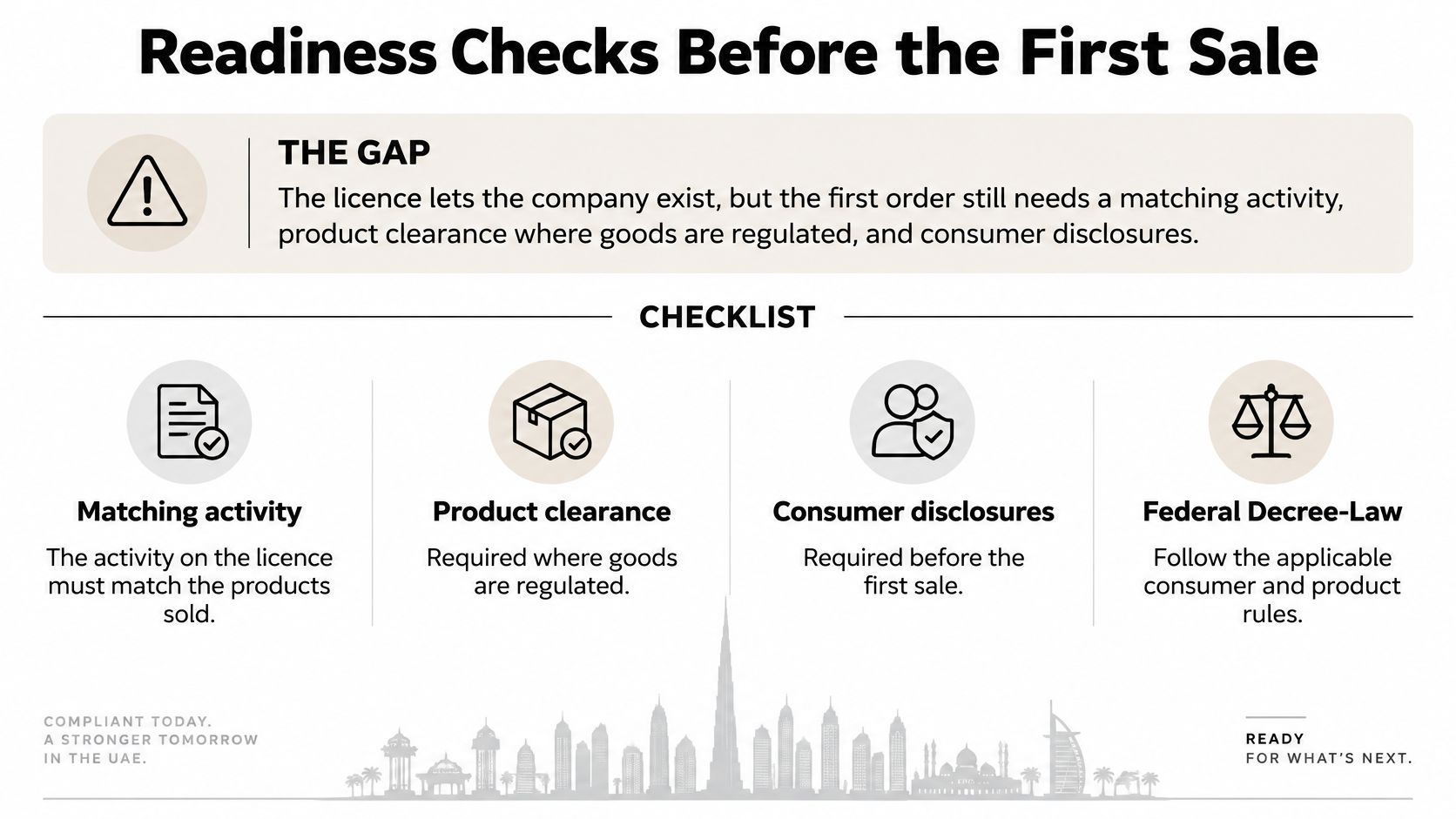
The cheapest licence becomes risky when the founder mistakes issuance for launch approval. An official UAE e-commerce checklist identifies obligations beyond licensing, including applicable approvals, secure technology, compliant marketing, data-protection controls and a digital invoice for every transaction.
That means your launch review must follow the customer journey. Check what the buyer sees, what they agree to, who receives the payment and what happens when the product needs to be returned.
Make the seller and terms clear
The UAE Government's consumer-protection guidance explains that Federal Decree Law No. 5 of 2023 amended Federal Law No. 15 of 2020, with protections covering goods and services across the mainland and free zones, expressly including goods sold through UAE-registered e-commerce platforms.
Licensed online businesses must provide licensing-entity details, Arabic product or service information, specifications, contract terms, payment conditions, warranty information and other relevant data. These are customer-facing responsibilities, not documents to leave in the formation folder.
The cited provisions don't apply to transactions between UAE customers and e-commerce businesses registered abroad. Don't interpret that distinction as a general exemption from every applicable obligation; cross-border sellers still need to establish which rules govern their transaction.
Readiness checks by how you sell
| Sales model | Licence must cover | Extra before the first order |
|---|---|---|
| Own website | Online sale of the actual goods or services | Arabic product information, contract and payment terms, warranty information and digital invoicing |
| Social selling | The activity behind the promoted products | Visible licensing-entity details and accessible Arabic disclosures, including when orders arrive through private messages |
| Marketplace | The activity relevant to the platform category | Confirm licence-upload requirements, category acceptance and returns arrangements |
| Dropshipping | The actual selling and fulfilment model | Allocate supplier responsibilities, issue transaction invoices and establish a workable returns path |
| Cross-border fulfilment | Authorised activities supporting the stock movement | Confirm the customs path, seller of record and warranty arrangements |
Private messages aren't a substitute for accessible terms. If customers order through Instagram, give them the information they need before payment rather than relying on a conversation that omits warranties or payment conditions.
Clear the product, not just the company
For cosmetics, food, supplements, health products, financial services and other regulated categories, establish which approvals apply to the exact offering. A broad trading description shouldn't be treated as confirmation that a particular product can be sold.
Keep the supporting approval against the relevant product record. If you change the formulation, supplier, claims or category, reassess whether the existing clearance remains appropriate before updating the storefront.
Before investing heavily in packaging or inventory, use Readymerce's guidance to assess your product idea before building. Commercial validation helps you decide whether the opportunity is worth pursuing, but it doesn't replace regulatory clearance.
Run a test order before launch
Place a test order through each intended channel and check the complete record:
- Product page: Keep approved Arabic product text alongside the English master, with consistent specifications and claims.
- Checkout: Show the responsible seller, payment conditions and relevant terms before the customer commits.
- Invoice: Confirm that the transaction produces a digital invoice containing the appropriate business and order details.
- Returns: Assign a contact, return destination and process that your supplier or fulfilment partner can support.
- Information security: Review account access, customer-data handling and payment-provider arrangements.
Treat brand protection separately from trade-name approval. Our Dubai trademark registration guide can help you frame that review before committing to branded stock.
Don't announce a delivery date until you can explain how the product will legally reach the buyer and who will resolve a complaint.
Finally, create a renewal calendar when the documents arrive, not when they're close to expiry. We track expiration dates and handle regular renewals of trade licences, visas and other permits on clients' behalf, helping keep those administrative obligations visible after launch.
Confirm the Jurisdiction Then File
If your customers and stock are in the UAE, assess a mainland commercial licence with the appropriate e-commerce activity first. If the store is mainly international, assess a free-zone digital licence against the chosen zone's permitted model and obtain written clarification of local-market conditions before taking UAE orders.
For regulated goods, establish the product-approval route before committing to advertising or a launch date. Then decide whether anyone needs residence, because that decision affects the immigration work and premises arrangements you'll need to consider.
Bring an operating plan to the assessment
Prepare a short brief that contains:
- Sales channels: Your own website, social accounts, named marketplaces or a combination.
- Stock location: The supplier, warehouse or fulfilment partner holding the goods.
- Residence requirements: Who intends to relocate and their proposed role.
- Product list: Clear descriptions, proposed categories and activity wording for review.
This gives the adviser something concrete to assess. It also helps prevent an attractive package from becoming the default choice before anyone has checked the transaction.
Our initial consultation examines the client's business requirements and objectives, then assesses the PRO work needed, such as company registration, visa processing and government approvals. Use that assessment to settle the jurisdiction and legal form before authorising the filing.
The decision should leave you with a clear application scope and a separate list of launch conditions. That's a stronger basis for starting an online business than a fee advert with an appealing headline.
Smart Classic Business Hub offers UAE trade-licence services, government approvals, investor visa applications and licence renewals for founders establishing their businesses. Visit Smart Classic Business Hub with your product list, sales channels, stock location and residence requirements to arrange an assessment before filing your e-commerce licence application.