
A founder comparing a UAE free zone with the mainland may already know where the customers are. The harder question is whether the company can serve them under the right licence, with premises and approvals that match the work, and a budget that covers compliance after setup. A licence can be issued while important operational tasks remain unfinished.
UAE mainland business setup is most useful when your business needs to serve customers across the UAE or contract directly with government bodies. But market access is only part of the decision. The activity, legal form, ownership route, office requirements and post-licence obligations must fit together. The practical test isn't how quickly you can get a licence. It's whether the structure lets you invoice your intended customers, then operate compliantly.
What UAE Mainland Business Setup Really Gives You
A mainland company is established within an emirate, outside its recognised free zones. That gives it a different operating scope from a business established within a designated free-zone jurisdiction. Official UAE investor guidance says mainland companies can conduct business across the UAE and contract with federal and local government bodies without involving a local commercial or national agent. Those features can make mainland licensing a better fit for companies whose customers, contracts or delivery work span multiple emirates. (UAE investor guidance on mainland business)
Consider a founder choosing between a free-zone company with a setup that fits a defined operating model and a mainland company intended to serve clients onshore. If the founder expects to tender for government work or invoice customers throughout the UAE, the mainland's reach may be more relevant than a lower initial quote. If the business can operate within the free zone's permitted framework, the mainland's additional premises and compliance needs may not be justified. The right comparison depends on the actual customers, activities and delivery model, not just the licence headline.
The ownership reforms also changed the decision. Federal Decree-Law No. 26 of 2020 took effect in early 2021 and was consolidated through Federal Decree-Law No. 32 of 2021. The amended framework allows foreign investors to own up to 100% of eligible mainland companies, removing the former majority-local-shareholding requirement for most commercial activities. It also removed the requirement for branches of foreign companies to appoint a UAE national service agent. (UAE Government guidance on full foreign ownership)
That change doesn't make every activity unrestricted. Strategic-impact or regulated activities can still require special ownership arrangements, licences or approvals. The most useful way to compare mainland and free-zone options is to write down the activity, customer locations, government-contracting needs, premises requirements and staffing plan, then check each route against that brief. A practical mainland versus free-zone comparison for Dubai can help frame the choice, but the selected activity and authority rules still need to be confirmed.
Choosing the Right Activity Legal Form and Ownership Route
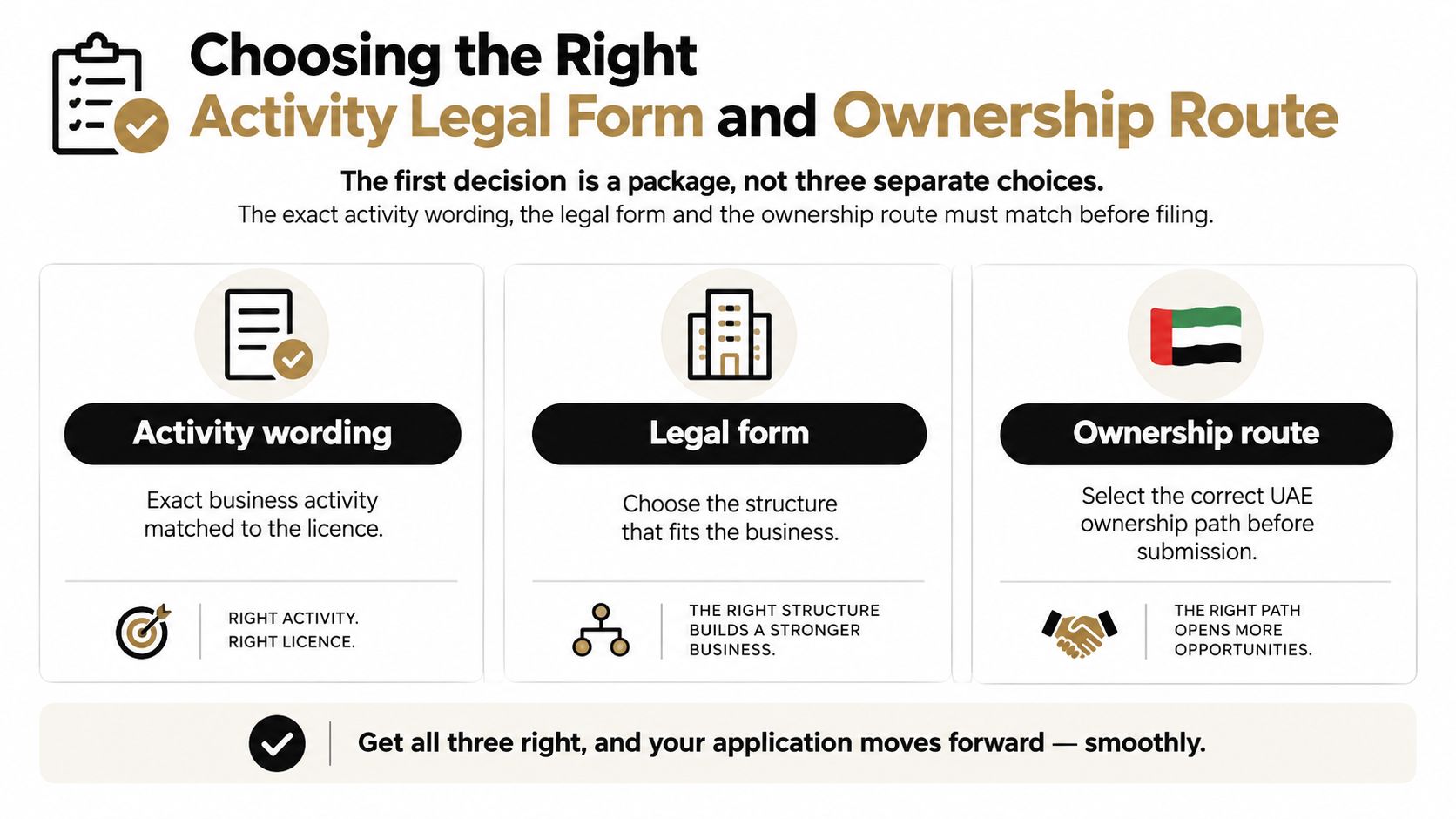
Treat activity wording, legal form and ownership as one decision. Filing with an activity that doesn't reflect the company's actual work can create problems later: an authority may request clarification, a bank may question the company's business model, or invoices may not align with the licence. Choosing a legal form first and squeezing an activity into it afterwards can cause similar friction.
| Decision | What to settle before filing | Where the mismatch causes trouble |
|---|---|---|
| Activity wording | Specify the work the company will actually perform and how it will earn revenue. | The licence, invoices, contracts and operations may tell different stories. |
| Legal form | Select a structure that fits the activity, ownership and operating model. | A form chosen without regard to the activity may not suit the intended business. |
| Ownership route | Check whether the activity permits full foreign ownership or needs special conditions or approvals. | Eligibility can't be assumed from the general mainland rule. |
An LLC is a common option for commercial trading, while qualifying services may suit professional or civil-company-style structures. A branch can give a foreign parent an onshore presence, but it brings its own documentation and approval requirements. These are starting points, not automatic recommendations. The activity classification and the relevant emirate authority determine what structures are available for the specific application.
Full foreign ownership is permitted for many eligible mainland activities, but it's not a universal answer. The UAE Government identifies areas such as security and defence, telecommunications, banking, exchange, financing and insurance as restricted or regulated, alongside other activities that may have special conditions. Even when ownership is permitted, the authority may still require an activity-specific licence, external approval or professional qualification.
Before filing: Confirm whether the exact activity permits the intended ownership, which authority must approve it, whether qualifications are required, and whether the premises and planned invoices will match the licensed scope.
For a practical comparison of sole-proprietor and LLC considerations, use this guide to sole proprietor versus LLC structures. Then ask the relevant authority to confirm the proposed activity and structure before you commit to documents or premises.
Licensing Routes Sponsors Agents and Office Requirements
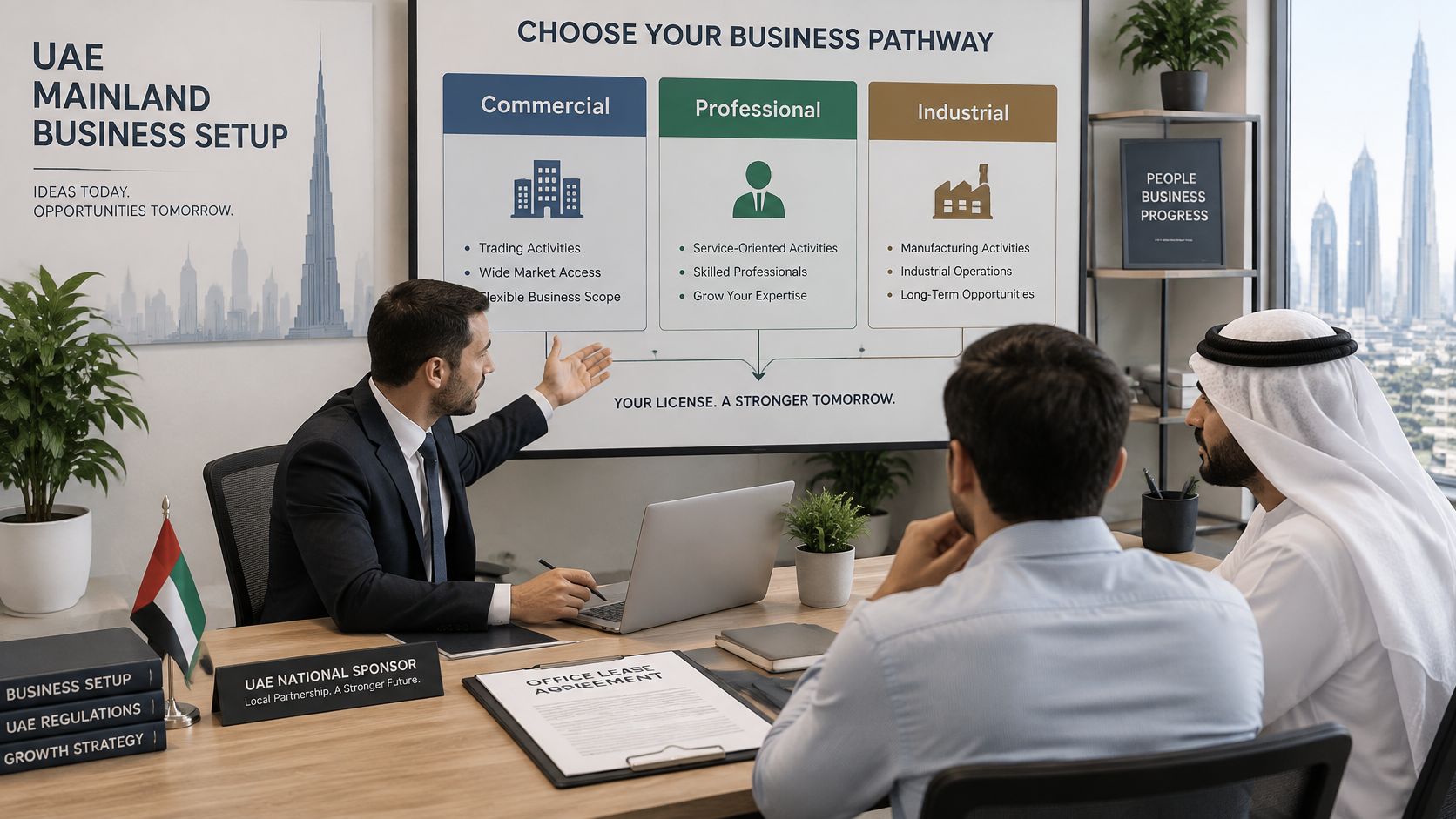
A commercial, professional or industrial-style licence describes a different kind of activity, but the label alone doesn't settle what your company needs. A trading business, a consultancy and a business producing or processing goods can face different activity classifications, document requirements and premises expectations. Confirm the precise activity with the relevant emirate authority before choosing a package or signing a lease.
The former default assumption that a UAE national shareholder or service agent is always required no longer applies to many eligible activities. However, a national may still be involved where an activity is restricted, where special ownership conditions apply, or where the selected structure requires a local service agent. These are distinct arrangements. Don't accept a sponsor or agent proposal until you understand why it applies to your specific activity and what it means for ownership and control.
Premises are a substantive part of the application, not a box to tick at the end. The authority may require a tenancy contract or equivalent premises evidence, and the site must be suitable for the licensed activity. Where applicable, confirm whether the contract needs Ejari-style registration. A desk or co-working arrangement can appear economical but may not meet the authority's requirements, support the company's intended visa needs, or satisfy an inspection.
Compare the licence and premises together
- Commercial activity: Check that the selected trading scope covers the products and transactions the company will handle.
- Professional activity: Confirm whether the service requires qualifications, external approvals or a particular legal form.
- Industrial-style activity: Verify that the proposed premises can support the activity and any relevant technical or inspection requirements.
- Branch or restricted case: Confirm whether a service agent or other local arrangement is required, rather than assuming it is.
A formation adviser can save rework by checking activity classification against the proposed premises, ownership and operating model before the application is filed. Smart Classic Business Hub offers mainland formation support, PRO coordination, premises options through partners and planning support for accounting readiness and setup costs. Compare those services against the relevant authority's requirements and the provider's written scope before committing.
From Initial Approval to Trade Licence Issuance
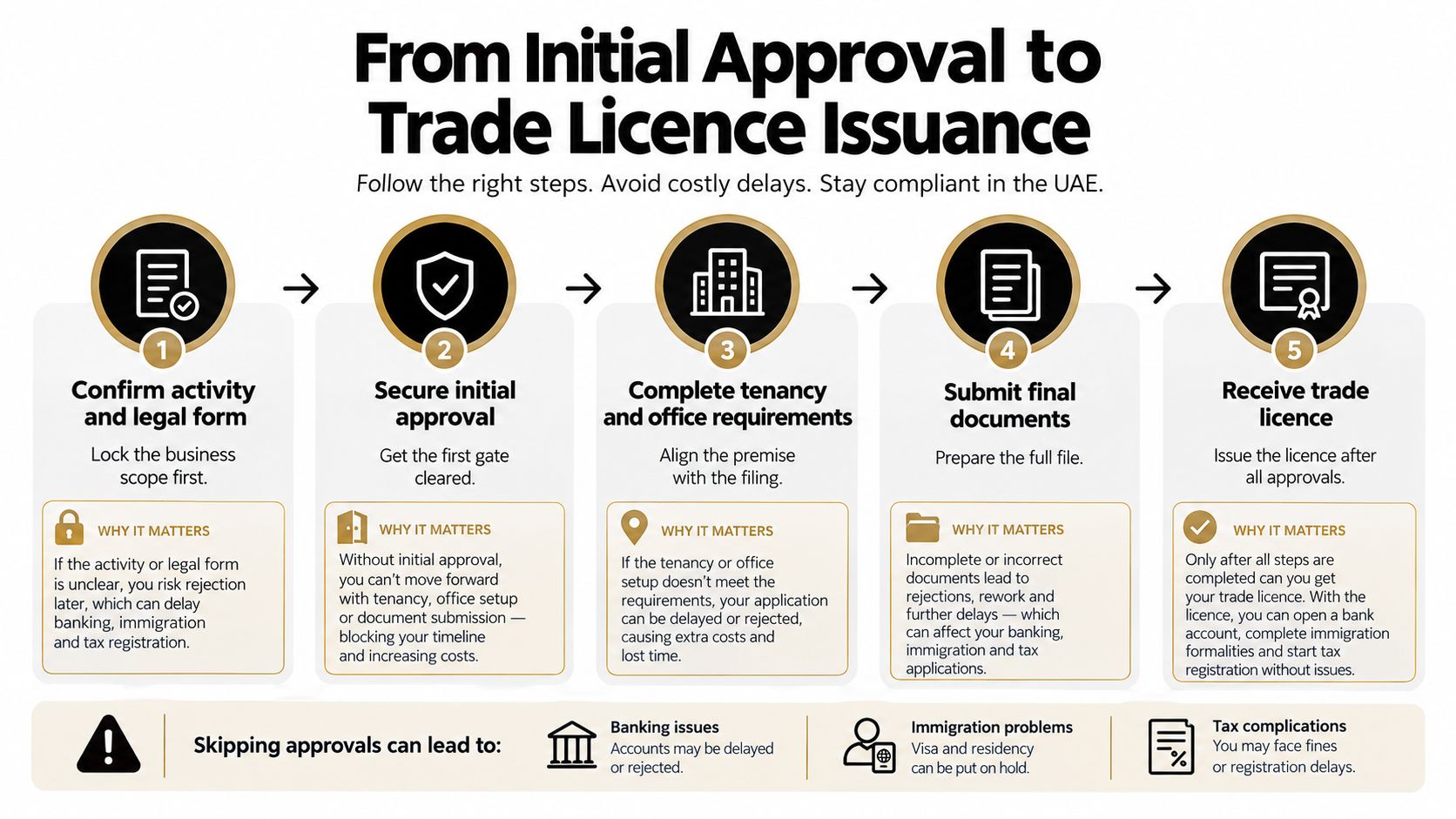
Treat the application as a gated sequence. An approval at one stage doesn't remove the need to satisfy the next gate, and a mismatch introduced early can affect later licensing, banking or immigration steps. The authority, activity and emirate determine the precise documents, so confirm the current checklist before submitting.
Clear each gate in order
Confirm the activity and legal form. Write a plain-language description of the work, then match it to the available licence activity. Decide the proposed legal form and ownership route at the same time. For a consultancy, clarify what services the company will invoice for; for general trading, specify the intended trading scope rather than relying on a broad label.
Obtain initial approval. Submit the proposed activity, ownership and company details to the relevant licensing authority. Initial approval is an early checkpoint, not a trade licence and not confirmation that every external requirement has been met.
Secure activity-specific external approvals. Check whether another authority must approve the work. Food-related activities, for example, may have additional requirements. Regulated professional services can also require qualifications or other supporting evidence. Resolve these requirements before assuming the company can move directly to final issuance.
Prepare the constitutional and company documents. Provide shareholder and manager details, proposed names, identification documents, forms and any parent-company papers needed for a branch. Prepare and notarise the Memorandum of Association where applicable. Regulated activities may require qualifications or other evidence, so confirm these before filing.
Provide compliant premises evidence. Secure the tenancy contract or other accepted premises documentation and check that the site suits the activity. A lease that doesn't meet the authority's requirements can delay the file even if the rest of the documents are ready.
Submit the final file and obtain the licence. Check that names, ownership, activity wording, signed forms and premises details agree across the application. The relevant emirate authority issues the trade licence after the required approvals and documents are complete.
The useful completion test isn't simply whether the licence has been issued. It's whether the company can support its licensed activity with the right premises evidence, authority approvals and company documents.
As soon as the licence is issued, move into operational readiness. Arrange immigration establishment registration, set up the labour file if you plan to hire, maintain beneficial-owner information, put bookkeeping controls in place and check applicable tax-registration obligations. A dated document checklist helps prevent the common mistake of treating licence issuance as the finish line.
Visas Labour Banking and Tax Registrations After Licensing
The licence arrives on a Tuesday, the founder assumes hiring starts that week, and then the first visa application stalls because the office only supports a limited quota. The bank asks for contracts the company has not signed yet. Nobody has checked whether the entity crossed the VAT registration threshold two months earlier. Treat the licence as the midpoint of the setup. What the company can actually do depends on the registrations that follow it.
Register the establishment with the immigration authority before recruiting anyone. The labour file and visa quota depend on the licensed activity and the premises on record, so a small serviced office may support fewer allocations than the hiring plan assumes. Confirm the quota before signing employment offers, and run the owner's residence process alongside employee onboarding rather than after it. Partners and dependents each need their own file, and the document sets differ.
Banks test coherence. The licensed activity, contracts, invoices, website and ownership records should all describe the same business, because an application that says consultancy while the invoices describe goods trading invites questions that can hold the account for weeks. Keep signed agreements, source-of-funds evidence and constitutional documents in one folder you can produce within a day.
Put tax triggers on the calendar
The Federal Tax Authority sets VAT registration thresholds by reference to taxable supplies and imports, not bank receipts. The FTA VAT registration guidance covers both the mandatory and voluntary tests. Track the rolling twelve-month position plus expected near-term activity, and record return dates as soon as the tax period is confirmed. Completing VAT registration does not satisfy Corporate Tax registration; the two carry separate deadlines.
| Obligation | Trigger | Deadline or filing rule | Penalty risk |
|---|---|---|---|
| Mandatory VAT registration | Taxable supplies and imports exceed AED 375,000 over the preceding twelve months, or are expected to exceed that amount in the next thirty days. | Register when the mandatory test applies. After registration, file the return and pay the amount due within 28 days of the end of the tax period. | Check the current FTA rules for the applicable case. |
| Voluntary VAT registration | Taxable supplies and imports exceed AED 187,500 under the voluntary test described in the FTA guidance linked above. | Apply when eligible and maintain the required records. | Check the current FTA rules for the applicable case. |
| Corporate Tax registration | UAE-resident juridical persons generally must register, including where they are already VAT-registered or below the VAT threshold. | Register by the deadline that applies to the entity. | Late registration can attract an AED 10,000 administrative penalty. (FTA Corporate Tax FAQs) |
Build a monthly tracker with taxable sales, imports, taxable expenses, exempt and zero-rated items, customer location and invoice treatment. Bank receipts alone hide a threshold breach until it is already late. Each registration above also creates a renewal or filing date that repeats over the next twelve to thirty-six months, so capture those dates in one calendar now rather than at renewal time. For a plain-language refresher on the records and controls involved, this compliance guidance for small business owners is a practical starting point, and the walkthrough on registering for VAT in the UAE covers the application steps. Confirm the final position with the FTA before relying on any date.
Budgeting Real Costs Timelines and Compliance for Three Years
The trade licence sits in the middle of the setup job. Cash pressure usually comes from what happens before issuance, when activity wording or premises evidence slows approval, and after issuance, when renewals, visas, bookkeeping and tax work begin to repeat.
| One-off or setup items | Recurring or conditional items |
|---|---|
| Application and approval fees, trade-name and document work, constitutional documents, and premises arrangements. | Annual renewal, tenancy or premises charges, bookkeeping, accounting, tax returns and payroll where applicable. |
| Establishment registration and initial visa-related steps, including medical and Emirates ID processes where required. | Visa renewals and employee administration, audit exposure where applicable, and ongoing beneficial-owner record maintenance. |
Build the budget around your approval path. A consultancy can still face questions over professional activity wording and premises suitability. A trading company may need broader licence scope, storage or customer contracts that match invoicing. An employer carries labour file, payroll and visa administration from the first hire.
Ask each provider for an itemised quote tied to your exact activity list, legal form, premises type and staffing plan. Separate confirmed government charges from estimates still subject to authority review. Then model cash across the first 12, 24 and 36 months, with formation costs shown apart from renewals, premises, visas, accounting and tax support. A resource to help you plan your 2026 startup budget can support the exercise, but UAE fees should come from current written quotations.
Don't choose on the licence price alone. A low initial quote can become the expensive option if the premises don't work, visas aren't supported or recurring compliance was left out of the budget.
Treat timelines as conditional. External approvals, document legalisation, activity classification, tenancy evidence and bank review can each pause the file. Ask what is included, which approvals remain outstanding, and what evidence you must supply at each stage.
Keep relief claims conditional too. Small Business Relief depends on revenue eligibility and prior-period conditions, so track turnover from day one and confirm the current FTA position before pricing the next three years around it.
Your 90 Day Readiness Checklist and Next Step
A trade licence solves the permission problem. It does not solve the operating problem. Most applications that stall do so because someone planned backwards from licence issuance instead of forwards from day-to-day operation, and the 12 to 36 months after issuance are where unfunded renewals and missed registrations turn a cheap setup into an expensive one.
Spend the first 15 days on the decisions that shape everything downstream. Write the activity wording and test it against the authority's classification list, because the single biggest delay risk is wording that triggers an external approval nobody scoped. Confirm the ownership route and legal form, compare licensing jurisdictions against where your customers are, and build a cost model that extends three years out and includes premises, visas and recurring compliance.
From days 16 to 45, clear the early application gates. Obtain initial approval, confirm which external approvals apply to your activity, prepare the Memorandum of Association or parent-company documents where applicable, and secure premises evidence that meets the authority's requirements. Don't sign a desk or tenancy agreement until you've confirmed its suitability for the licensed activity and intended headcount.
During days 46 to 75, focus on being able to operate. Complete licensing, arrange establishment registration, open the labour file if you'll employ staff, prepare visa applications and check that your bank file aligns with the licence, contracts and invoices.
Use days 76 to 90 to set up the controls that protect you after the licence is framed:
- Accounting and records: Set up bookkeeping and retain company and transaction documents.
- Ownership information: Maintain beneficial-owner records and assign responsibility for updates.
- Tax calendar: Check VAT and Corporate Tax registration separately, then record applicable deadlines.
- Renewals: Track premises, licence and other renewal dates through the full first cycle.
- Individual registration deadlines: If you're a natural person conducting business, check whether your revenue crosses the FTA's Corporate Tax registration threshold. As covered in the budgeting section, a fixed penalty applies for missing the deadline, so diarise the date rather than relying on memory.
Before filing, check that you haven't chosen a licence solely because it was cheap, treated VAT registration as Corporate Tax registration, or planned invoices that don't match the licensed activity. Book a consultation with Smart Classic Business Hub and use its cost calculator to test your setup assumptions before you commit to an application or premises.
Smart Classic Business Hub supports UAE mainland formation, PRO coordination, premises arrangements and ongoing accounting and compliance planning. Visit Smart Classic Business Hub to discuss your activity, check the setup route and cost your operating plan before filing.